ZL-101: Biosystematics and Taxonomy
Unit I
o Definition and basic concepts of biosystematics taxonomy and classification.
o History and theories of biological Classification.
o Trends in biosystematics: Chemotaxonomy, cytotaxonomy and molecular taxonomy
o Dimensions of speciation. Species concepts: Typological, Nominalistic and Biological
species concepts. Subspecies and other infra-specific categories.
Unit II
o Taxonomic Characters and different kinds.
o Origin of reproductive isolation, biological mechanism of genetic incompatibility.
o Taxonomic procedures: Taxonomic collections, preservation, curetting, process of
identification.
Unit III
o Taxonomic keys, different types of keys, their merits and demerits.
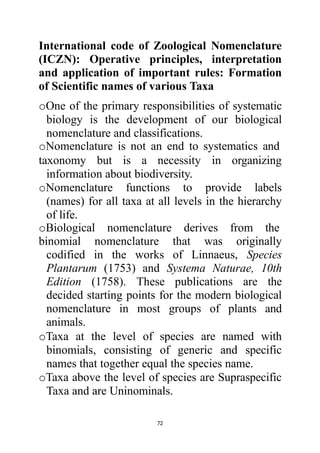
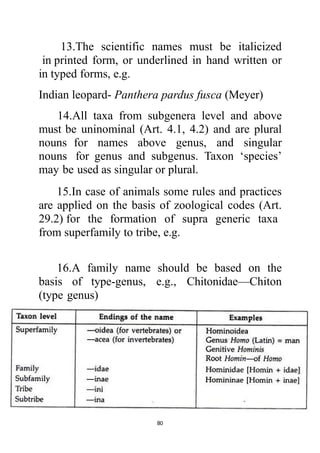
o International code of Zoological Nomenclature (ICZN): Operative principles,
interpretation and application of important rules: Formation of Scientific names of various
Taxa.
o Synonyms, homonyms and tautonomy.
Unit IV
o Evaluation of biodiversity indices.
o Evaluation of Shannon Weiner Index.
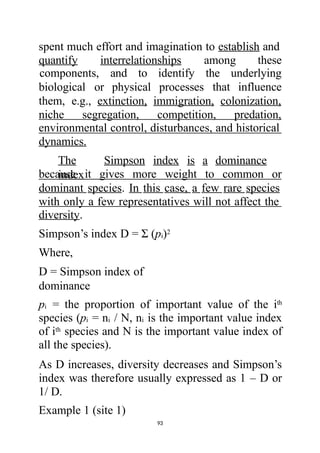
o Evaluation of Dominance Index.
o Similarity and Dissimilarity Index.
Suggested Reading Material (All latest editions)
1. M. Kato. The Biology of Biodiversity, Springer.
2. J.C. Avise. Molecular Markers, Natural History and Evolution, Chapman & Hall, New York.
3. E.O. Wilson. Biodiversity, Academic Press, Washington.
4. G.G. Simpson. Principle of animal taxonomy, Oxford IBH Publishing Company.
5. E. Mayer. Elements of Taxonomy.
6. E.O. Wilson. The Diversity of Life (The College Edition), W.W. Northem& Co.
7. B.K. Tikadar. Threatened Animals of India, ZSI Publication, Calcutta.
Practical Module – I
 Composition assessment of the taxonomic diversity / biodiversity in a habitat (e.g.
grassland, arid land, wet land, etc.).
 Influence of climatic conditions on taxonomic diversity in a given habitat.
 Preparation of models showing the status of certain taxa or species in a particular habitat.
1
Unit I
 Definition and basic
concepts taxonomy and
classification.
2
of biosystematics,
 History of Classification
Chemotaxonomy,
 Trends in biosystematics:
cytotaxonomy and molecular taxonomy
 Dimensions of speciation.
 Species concepts: species category, different
species concepts, subspecies and other infra-specific
categories.
 Theories of biological classification:
hierarchy of categories.
Definition and basic concepts of biosystematics,
taxonomy and classification
Biosystematics:
o Systematics: In biology, systematics is the
study and classification of living things; in
other words, grouping organisms based on a
set of rules (or system).
o The science of classifying organisms.
o Thus, biosystematics may be defined
as 'taxonomy of living populations'.
o The word systematics is derived from
the
Latinized Greek word ‘systema’ applied to the
system of classification developed by Carolus
Linnaeus in the 4th edition of his historical
book Systema Naturae in 1735.
Kinds of Systematics
o Systematics can be divided into two
closely
classification: taxonomic (known as
related and overlapping levels of
the
Linnaean System) and phylogenetic.
o Taxonomic classifications group living things
together based on shared traits - usually what
they look like or what their bodies do.
o For example, animals that lay eggs and have
scales we call reptiles, and animals that give
births and have fur or hair we call mammals.
o More specifically, all humans share the same
characteristics and so belong to a group, or
taxon, of the genus Homo, and species sapien.
o Phylogenetic classifications use the taxonomic
names, but further group organisms by how
evolutionarily related they are to one another.
o By looking at each organism's genes, we know
that gorillas (taxonomic term) are more closely
related to humans than they are to
cockroaches.
is the theory and practice of
Taxonomy:
o Taxonomy
identifying plants and animals. In fact,
taxonomy deals with the principle involved in
the study of classification of organisms.
3
o It is the functional science which deals with
identification, nomenclature and classification
of different kinds of organisms all over the
world.
o The word ‘taxonomy’ is derived from the
Greek words taxis (= arrangement) and nomos
(= law) and the term ‘taxonomy’ was coined
by A. P. de Candolle in 1813.
There are several stages of taxonomy such as:
o Alpha taxonomy: In this stage species are
identified and characterized on the basis of
gross morphological features.
o Beta taxonomy: In this stage species are
arranged from lower to higher categories, i.e.,
hierarchic system of classification.
o Gamma taxonomy: In this stage intraspecific
differences and evolutionary history are
studied.
o The nomenclatural and taxonomic system for
botany introduced by Linnaeus and improved
by many generations of later botanists as its
first goal to make possible information storage
and retrieval concerning plants and plant
products.
o While Linnaeus originally believed the
systematic pattern he recognized in nature to
4
divine creation, post-Darwinian botanists have
mostly interpreted it as resulting from
evolution.
o Many botanical taxonomists of today therefore
regard systematics as the art of tracing
similarities between taxa, combining them into
larger groups, and hypothesizing about their
evolution.
o While the number of taxonomic features
available to Linnaeus was very limited, the
gradual refinement of technical equipment has
both widened the scope of
morphological studies
and facilitatedthe
introduction
of ancillary sciences
like anatomy,
embryology,
serology, cytotaxonomy, genetics, palynology,
and chemotaxonomy.
o Those have provided a number of new
character sets, the incorporation of which has
been facilitated by methodologies such as
numerical taxonomy, cladistics and DNA
hybridization.
5
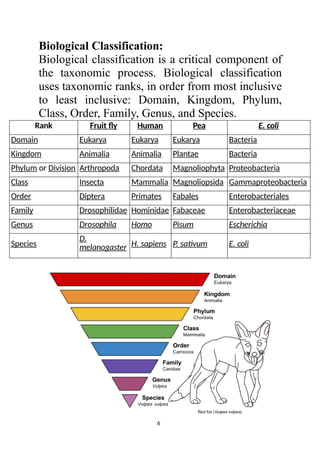
Biological Classification:
Biological classification is a critical component of
the taxonomic process. Biological classification
uses taxonomic ranks, in order from most inclusive
to least inclusive: Domain, Kingdom, Phylum,
Class, Order, Family, Genus, and Species.
Rank Fruit fly Human Pea E. coli
Domain Eukarya Eukarya Eukarya Bacteria
Kingdom Animalia Animalia Plantae Bacteria
Phylum or Division Arthropoda Chordata Magnoliophyta Proteobacteria
Class Insecta Mammalia Magnoliopsida Gammaproteobacteria
Order Diptera Primates Fabales Enterobacteriales
Family Drosophilidae Hominidae Fabaceae Enterobacteriaceae
Genus Drosophila Homo Pisum Escherichia
Species
D.
melanogaster H. sapiens P. sativum E. coli
6
7
History of Classification:
The Greeks and Romans
Aristotle (384–322 BC):
In Western scientific taxonomy, the Greek
philosopher Aristotle was the first to classify all
living things, and some of his groups are still used
today, like the vertebrates and invertebrates, which
he called animals with blood and without blood.
He further divided the animals with blood into
egg-bearing and live-bearing, and formed groups
within the animals without blood that we
recognize today, such as insects, crustacea and
testacea (molluscs).
Theophrastus (370–285 BC):
Theophrastus was a student of Aristotle and Plato.
He wrote a classification of all known plants, De
Historia Plantarum, which contained 480 species.
His classification was based on growth form.
Carolus Linnaeus accepted many of his generic
names.
There are two surviving botanical works by
Theophrastus – The Enquiry into Plants and On
the Causes of Plant Phenomena. In his Causes
Theophrastus looks at plant physiology and
considers different methods of cultivation. In the
Enquiry Theophrastus turns his attention in a more
taxonomical direction. In this work he was one of
the first authors to attempt to classify plants into
different types, dividing them into ‘trees’,
‘shrubs’, ‘undershrubs’ and ‘plants’. These two
books give Theophrastus a good claim to the title
of ‘the grandfather of botany’.
Dioscorides (40–90 AD):
Dioscorides was a Greek physician and a medic in
Roman Army, who travelled widely in the Roman
and Greek world to gather knowledge about
8
medicinal plants and wrote De Materia Medica,
which contained around 600 species. De Materia
16th
copied several times. One
Medica
century,
famous
was used in medicine
until the and
was
copy from
6th
the century is kept in
Vienna. The classification in his work is based on
the medicinal properties of the species.
Plinius (23–79 AD):
Plinius was involved in the Roman army and wrote
many books, but the only one that has survived is
his ‘Naturalis Historia’, a work of 160 volumes, in
which he described several plants and gave them
Latin names. Many of these names we still
recognize, like Populus alba and Populus nigra,
and since Latin was later kept for botanical
science, we may call him the Father of Botanical
Latin.
9
Early taxonomists
Until the end of the 16th
taxonomic works of ancient Greeks were
century, the
not
replaced. One of the reasons for this was the
development of optic lenses, which made it
possible to study details in the different species.
Collection of specimens became part of the
growing sciences, and the emphasis turned from
medical aspects to taxonomic aspects.
Caesalpino (1519–1603):
Caesalpino in Italy, who is sometimes called "the
first taxonomist". In 1583 he wrote De Plantis, a
work that contained 1500 species. His
classification was based on growth habit together
with fruit and seed form, as was that of
Theophrastus.
Bauhin (1541–1631) and Bauhin (1560–1624)
Two Swiss brothers (Bauhin) wrote the
work ‘Pinax Theatri Botanici’ in 1623. The
work is a listing of 6000 species. The
Bauhin brothers included synonymes, which
was a great necessity of the time. The
Bauhin brothers recognized genera and
species as major taxonomic levels. Linnaeus
honored the Bauhin brothers Gaspard and Jean
in the genus name Bauhinia.
John Ray (1627–1705):
10
John Ray, the English naturalist wrote several
important works through his life. His most
important contribution was the establishment of
species as the ultimate unit of taxonomy. In 1682
he published ‘Methodus Plantarum Nova’, which
contained around 18000 plant species, a result of a
relatively narrow species concept.
He published important works on botany, zoology,
and natural theology. His classification of plants in
his Historia Plantarum, was an important step
towards modern taxonomy.
Ray rejected the system of dichotomous division
by which species were classified according to a
pre-conceived, either/or type system, and instead
classified plants according to similarities and
differences that emerged from observation. He was
the first to give a biological definition of the term
species.
In his 1686 History of Plants:
"No surer criterion for determining species has
occurred to me than the distinguishing features
that perpetuate themselves in propagation from
seed. Thus, no matter what variations occur in the
individuals or the species, if they spring from the
seed of one and the same plant, they are accidental
variations and not such as to distinguish a species.
Animals likewise that differ specifically preserve
their distinct species permanently; one species
never springs from the seed of another nor vice
versa".
Joseph Pitton de Tournefort (1656–1708):
Joseph Pitton de Tournefort from France
constructed a botanical classification that came to
rule in botanical taxonomy until the time of
Carolus Linnaeus. In 1700, he published
Institutiones Rei Herbariae, in which around 9000
species were listed in 698 genera. He put primary
emphasis on the classification of genera, and many
genera were accepted by Linnaeus and still in use
today. Tournefort's plant classification was
exclusively based on floral characters.
Linnaean era
Starting point of modern taxonomy
For nomenclatural reasons two works of
Carolus Linnaeus (1707–1778) are regarded as the
starting points of modern botanical and zoological
taxonomy: the global flora ‘Species Plantarum’,
published in 1753 and the tenth edition of
‘Systema Naturae’ in 1758 including global fauna.
Linnaeus introduced a binary form of species
names called "trivial names" for both plants and
animals in these books. The trivial names were
11
12
intended for fieldwork and education, and not to
replace the earlier phrase names.
Linnaeus counted 8,530 species of flowering
plants in 1753. The simplicity of Linnaeus' trivial
names revolutionized nomenclature, and soon
binary nomenclature.
Linnaeus published several books that would
transform botany and zoology into sciences of
their own. Until then, these two disciplines had
merely been a fringe of practical medicine. With
the works of Linnaeus, botany and zoology
transformed into a Scientia, a science surrounded
by philosophy, order and systems.
Post-Linnaean taxonomy
Natural system emerging in France
One of the few countries in which the
Linnaean systematics did not make success was
France. Four French scientists emerged that made
an impact on future biological sciences.
Georges-Luise Leclerc de Buffon (1707–
1788) was a strong critic to Linnaeus work,
and he found it wrong to impose an artificial order
on the disorderly natural world. His approach was
for an evolutionary theory.
Michel Adanson (1727–1806) wrote Familles
des Plantes already in 1763. He launched the idea
13
that in classification one should not put greater
emphasis on some characters than on others. He
critized Linnaeus' works, and considered
Tournefort's classification far superior.
Antoine Laurent de Jussieu (1748–1836)
changed the system of plants with his Genera
Plantarum in 1789, in which he launched a natural
system based on many characters that came to be a
foundation of modern classification. He divided
the plants into acotyledons and monocotyledons.
Jean-Baptiste de Lamarck (1744–1829)
launched an evolutionary theory including
inheritance of acquired characters, named the
"Lamarckism".
The French scientific work, the development
of anatomy and physiology and improved optical
instruments made way for a new era of taxonomy,
which was trying to cope with an increasing
number of species in a rapidly expanding flora and
fauna of the world.
Theories of biological classification:
hierarchy of categories.
process of giving hierarchy
scientific procedure based
of
categories on
features
Biological classification is defined as a
by
of
organisms and arranging them into different
14
relationship among different organisms and
groups. The very purpose is to establish the
to
know about their evolution. Further, to study and
include each organism along with its identification
and habitat.
Artificial Classification
Artificial Classification uses form, shape as
prominent features for grouping organisms.
Animals were also classified on basis of red blood
cells, habitat such as land, water or air. They were
also classified on their basis to fly or not to fly.
This system is relatively easy to follow.
Artificial System of Classification has many
disadvantages. It relies just on form and shape of
organisms and does not take into account other
features. So it is difficult to
understand the evolution of organism.
It leads to
misunderstanding of any relationship among
organisms. The different types of organisms are
arranged in same groups like birds, insects, bats
they fly and they are grouped in same criteria. The
form and shape of organism is not permanent and
it changes with time.
Natural System of Classification
It takes into account multiple features such as
anatomy, physiology, pathology, biochemistry,
reproduction and cytology to compare the
15
organisms and establish a relationship between
them. It overshadows all the disadvantages of
artificial system of classification. It helps to
understand the evolution of organism by knowing
the relationship between them.
The features undertaken in this classification
are constant. In this bird, reptiles and mammals are
placed in the different groups based on
the multiple features. For example humans
have 4 hearts, warm blooded nature and
erythrocytes. Fishes have 2
chambered
denucleated
chambered hearts, cold blooded and respire
through gills.
Phylogenetic System of Classification
It is defined as a relationship based on the
evolutionary aspect of organisms. It is based on
Darwin’s Concept of Natural Selection. It tells us
about the original relationship among organisms.
The foremost phylogenetic system of classification
was given by Engler and Prantl. They divide the
plants into primitive and modern types.
Hierarchy Categories
Taxonomic Hierarchy Categories were also
introduced by Linnaeus. They are also known as
Linnaean hierarchy. It is defined as sequence of
categories in a decreasing or increasing order from
kingdom to species and vice versa. Kingdom is the
16
highest rank followed by phylum, class, order,
family, genus and species. Species is the lowest
rank in the Hierarchy.
The hierarchy has two categories which are
obligate and intermediate. Obligate means they are
followed strictly and range from kingdom to
species as said above. Intermediate are not
followed strictly and they are added in obligate list
such as subdivision, super family, super class,
suborder, subspecies etc.
Species:
Group of population which is similar in form,
shape and reproductive features so that fertile
sibling can be produced. Some siblings can be
sterile when a hybrid is produced. A hybrid can be
product of female horse & male donkey (Mule).
Or male tiger & female lion known as Tigon.
Sexual reproduction is present in eukaryotes.
Species is followed by subspecies, varieties and
races. These categories are inferior as compared to
species.
Genus:
It is defined as group of similar species. But it
is not mandatory to have many species. Some
genera have only one species known as
Monotypic. If there are more than one species it is
known as polytypic. For example lion, tiger are
17
quite similar species placed under the genus
Panthera.
Family:
It is defined as collection of similar genera.
For example, cats and leopard are included in the
family Felidae.
Order:
One or more than one similar families
constitute order. Family felidae are included in the
order Carnivora.
Class:
One or more than one order makes a class.
Class Mammalia includes all mammals which are
bats, rodents, kangaroos, whales, apes and man.
Phylum:
It is a term used for animals while its synonym
‘Division’ is used for plants. It is a collection of
similar classes. Phylum Chordata of animals has
class Mammalia along with birds, reptiles and
amphibians.
Kingdom:
The top most taxonomic category. Example all
animals are included in Kingdom animalia.
18
Trends in biosystematics: Chemotaxonomy,
Cytotaxonomy and Molecular taxonomy.
Chemotaxonomy
The chemotaxonomy or chemical taxonomy is
used for the classification of plants on the basis of
their chemical constituents. Plants produce
thousand types of chemicals. Some of the organic
compounds like carbohydrates, fats, proteins,
nucleic acids, chlorophylls are required for their
basic metabolic processes and found throughout
the plant kingdom. These organic compounds are
called ‘primary metabolites’ or ‘biomolecules’.
These are produced in large quantities and can
easily be extracted from the plants.
Many plants, fungi and microbes of certain
genera and families synthesize a number of
organic compounds which are not involved in
primary metabolism (photosynthesis, respiration,
and protein and lipid metabolism) and seem to
have no direct function in growth and development
of plants. Such compounds are called ‘secondary
metabolites’ (secondary plant products or natural
products).
These compounds are accessary rather than
central to the functioning of the plants in which
they are found. These compounds are produced in
small quantities only in specific parts of plants and
their extraction from the plant is difficult and
expensive.
These are derivatives of primary metabolites.
Secondary metabolites are not directly involved in
the normal growth, development, or reproduction
of an organism. They are used for protection and
defence against predators and pathogens. Usually,
secondary metabolites are specific to an individual
species.
The phenolics, alkaloids, terpenoids and non-
protein amino acids are the four important and
widely exploited groups of compounds utilized for
chemotaxonomic classification. These groups of
compounds exhibit a wide variation in chemical
diversity, distribution and function. The system of
chemotaxonomic classification relies on the
chemical similarity of taxon.
Examples: Pigments – carotenoid,
anthocyanin
19
etc; Alkaloids – morphine, codeine
etc; Terpenoides– monoterpene, diterpene,
etc;
Essential oils – Lemongrass oil; Toxins – abrin,
ricin, etc; Lectins – concanavalin A; Drugs –
vinblastine, curcumin etc; Polymeric – rubber,
gum, cellulose etc.
Cyanogenic glycoside in chemotaxonomy
The cyanogenic glycosides are the compounds
responsible for providing defensive mechanism to
plants. Plant species have ability to produce
hydrogen cyanide (HCN) by enzymatic hydrolysis
of cyanogenic glycosides by the process called
cyanogenesis. Different amino acid like phenyl
alanine, tyrosine, valine, leucine, and isoleucine
are precursor for the biosynthesis of cyanogenic
glycosides, but they are restricted to families: a
cyanogenic glycoside synthesized from leucine
commonly occurs in the subfamily Amygdaloideae
(almond) and Maloideae (apple) of family
Rosaceae.
Cytotaxonomy
It is the branch of biology dealing with the
relationship and classification of organism using
comparative studies of chromosomes. The
structure, number and behaviour of chromosomes
is of great value in taxonomy, with chromosome
number being the most widely used and quoted
character. Chromosome numbers are usually
determined at mitosis and quoted as the diploid
number (2n). Another useful taxonomic character
is the position of the centromere.
The cytotaxonomy is more significant over
physiological taxonomy because cytotaxonomy is
dealing with the comparative study of
chromosome and with this method minute
20
21
variation among the individuals can be detected.
DNA are present in the chromosome and the
variation in DNA are responsible for the variation
among the individuals, species, genus and so on.
The difference in physiological variation are too
less among the individuals of same species and
other higher taxa.
Molecular Taxonomy
Molecular Taxonomy is the classification of
organisms on the basis of the distribution and
composition of chemical substances in them.
Molecular techniques in the field of biology have
helped to establish genetic relationship between
the members of different taxonomic categories.
DNA and protein sequencing, immunological
methods, DNA-DNA or DNA-RNA hybridization
methods are more informative in the study of
different species. The data obtained from such
studies are used to construct phylogenetic trees.
Dimensions of speciation
Speciation is the evolutionary process by
which biological populations evolve to become
distinct species. Charles Darwin was the first to
describe the role of natural selection in speciation
in his book ‘The Origin of Species’ (1859).
There are four geographic modes of
speciation
in nature, based on the extent to which
speciating populations are isolated from one
another:
22
allopatric, peripatric, parapatric, and sympatric.
All forms of natural speciation have taken place
over the course of evolution.
Allopatric
During allopatric speciation, a population
splits into two geographically isolated populations
(e.g., habitat fragmentation due to geographical
change such as mountain formation). The isolated
populations then undergo genotypic or phenotypic
divergence as: (a) they become subjected to
dissimilar selective pressures; (b) they
independently undergo genetic drift (variation in
the relative frequency of different genotypes in a
small population, owing to the chance
disappearance of particular genes as individuals
die or do not reproduce); (c) different mutations
arise in the two populations. When the populations
come back into contact, they have evolved such
that they are reproductively isolated and are no
longer capable of exchanging genes.
Peripatric
In peripatric speciation, a subform of allopatric
speciation, new species are formed in isolated,
smaller peripheral populations that are prevented
from exchanging genes with the main population.
It is related to the concept of a founder effect,
since small populations often undergo bottlenecks.
23
Genetic drift is often proposed to play a significant
role in peripatric speciation.
Parapatric
In parapatric speciation, there is only partial
separation of the zones of two diverging
populations afforded by geography; individuals of
each species may come in contact or cross habitats
from time to time (but behaviours or mechanisms
prevent their interbreeding).
Parapatric speciation may be associated with
differential landscape-dependent selection. Even if
there is a gene flow between two populations,
strong differential selection may impede
assimilation and different species may eventually
develop. Habitat
important in the
differences may be
more development
of
reproductive
isolation than the isolation time.
Sympatric
Sympatric speciation refers to the formation of
two or more descendant species from a single
ancestral species all occupying the same
sympatric speciation are found in
24
geographic location. Often-cited examples of
insects that
become dependent on different host plants in the
same area. However, the existence of sympatric
speciation as a mechanism of speciation remains
highly debated.
25
Species concepts: species category, different
species concepts, subspecies and other infra-
specific categories
The species concept
oUnder the currently accepted Biological Species
Concept (BSC), species exist only in sexually
reproducing organisms as a consequence of the
of genetic shuffling and
during meiosis and in
zygote
mechanisms
recombination
formation.
oSpecies do not exist in asexually reproducing
organisms except as an artificial classificatory
convenience.
oThe BSC is usually defined as: groups of actually
or potentially interbreeding populations in nature
which are reproductively isolated from other
such groups (Mayr, 1942, 1963).
oBy reproductive isolation, evolutionists mean
that no gene flow exists between different
species, not necessarily that members of different
species cannot interbreed and produce hybrids.
oEvolutionists actually use the criterion of lack of
gene flow between different species, rather than
lack of reproduction.
oThus, Bock (1986) modified definition of the
BSC, namely: a species is a group of actually or
potentially interbreeding populations of
26
organisms which are genetically isolated
in nature from other such groups.
oThe distinction between these two definitions is
clarified in the classification of intrinsic isolating
mechanisms (Mayr, 1963), as follows:
o1. Mechanisms that prevent interspecific crosses
(premating mechanisms)
(a)Potential mates do not meet (seasonal
and habitat isolation)
(b)Potential mates meet but do not
mate (ethological isolation)
(c)Copulation attempted but no transfer
of sperm takes place (mechanical
isolation)
2. Mechanisms that reduce full success
of
interspecific crosses (postmating mechanisms)
(a)Sperm transfer takes place but egg is
not fertilized (gametic mortality)
(b)Egg is fertilized but zygote dies
(zygote mortality)
(c)Zygote produces an F1 hybrid of
reduced viability (hybrid inviability)
(d)F1 hybrid zygote is fully viable but
partially or completely sterile, or produces
deficient F2 (hybrid sterility)
oAll of these intrinsic isolating mechanisms serve
to prevent exchange of genetic materials between
27
members of different species taxa and achieve
genetic isolation.
Species possess three individual sets of properties
that separate them from one another:
1.Genetic coherence: the members of a
species form a genetic community which is
genetically isolated from other species. Genetic
material from reproduction thus will flow between
members of a single species, but not from one
species to another under natural conditions.
Genetic isolation is maintained by the
possession of intrinsic genetic isolating
mechanisms.
2.Reproductive coherence: the members of
a species form a breeding community which
is reproductively isolated from other
species. Members of one species do not
interbreed or attempt to interbreed with
members of another species under natural
conditions, regardless of the barriers to gene flow
between them. Interbreeding between members of
different species would be prevented by
particular intrinsic reproductive isolating
mechanisms.
3.Ecological coherence: the members of a
species have similar ecological requirements
that differ from those of other species.
Competition between sympatric members of
different species is thus greatly reduced and
separated.
oIn fully evolved species, all three sets of
properties are developed such that the species are
completely genetically isolated, completely
reproductively isolated and largely ecologically
separated from other sympatric species.
Types of species concepts:
Typological species concept
Typological species
concept defines as
species
that “a group of individuals that differ from other
groups by possessing constant diagnostic
characters”. Nearly all of the older definitions of
the species, including those of Buffon, Lamark and
Cuvier refer to the morphological similarities of
individuals of the same species.
Typological species concept is also called as
Essentialist, Morphological, Phenetic species
concept. Typology is based on
morphology/phenotype. Still applied in museum
research where a single specimen (type specimen)
is the basis for defining the species. In
paleontology all you have is morphology: typology
is practiced and species are defined as
morphospecies (e.g. snail shells in fossil beds).
Problems: what about sexual dimorphism:
males and females might be assigned to different
species. Geographic variants: different forms
28
viewed as different species? What about life
stages: caterpillars and butterflies? If typology is
let run it can lead to over splitting taxa: each
variant is called a new species.
Nominalistic species concept
Occan, the proponent of this concept and his
followers (Buffon, Bessey, Lamarck, etc.) believed
that only individuals exist but did not believe in
the existence of species.
Species are man’s own creations and have no
actual existence in nature. They are mental concept
and nothing more. Therefore, such mental concept
(i.e. species) of man has no value.
Biological species concept
An entirely new species concept has begun to
emerge in the seventeenth century. John Ray
believed in the morphological definition of species
and his species characterization also contained the
germ of biological species concept, which
considers the reproductive relationship to be a
principle species criterion.
The biological species concept was
clearly
Mayr a species is a group of
formulated
According
potentially
by Jordan, Dobzhansky and
Mayr. to
or actually interbreeding natural
population which are reproductively isolated from
other such groups.
29
30
Dobzhansky added the term gene pool, and
defined species as “a reproductive community of
sexually reproducing individuals which share in a
common gene pool”. The biological species
concept is the most widely accepted.
In the biological species concept,
interbreeding among the individuals of the same
species and reproductive isolation from
other species are the principal criteria.
Evolutionary species concept
Simpson proposed the evolutionary species
concept and defined the species as a lineage (an
ancestral–descendent sequence of populations)
evolving separately from others and with its own
unitary evolutionary role and tendencies.
Mayr has criticized the evolutionary species
definition saying that it is the definition of a
phyletic lineage, but not of the species. The
evolutionary species concept ignores the core of
the species problem and thus, Mayr did not accept
the evolutionary species concept and he strongly
advocated for the biological species concept in
spite of certain difficulties in its application.
31
Subspecies and other infra-specific categories
Subspecies:
Subspecies is actually a
category below species. Linnaeus
used the term “subspecies”
recognised four subgroups such as (i)
when he classified subgroups of man. He
the
American-Indians (Homo sapiens americanus), (ii)
the Europeans (Homo sapiens europaeus), (iii) the
Orientals (Homo sapiens asiaticus) and the
African Negroes (Homo sapiens afers).
Early taxonomists applied the
term ‘variety’ indiscriminately for any variation
in the population 19th
of a species. In the century the
term subspecies replaced ‘variety’
and the term
‘variety’ is obsolete today.
When a population of a species splits up by
natural barriers such as mountains, islands,
climate, etc., each isolated group may evolve
different characteristic features, so as to become
recognizable as a separate geographical race or
subspecies.
The scientific name of the race (subspecies) of
Indian lion is Panthera leo persica, and the name
of the African lion (race) is Panthera leo leo. The
distinguishing features of Indian race are - (i)
scantier mane than that of the African race (ii) a
longer tassel of hair at the tip of the tail than that
32
of the African race (iii) a well-pronounced tuft of
hairs on the elbow joints and (iv) the abdomen
bears a fuller fringe of hairs.
Two subspecies (races) of the same species
can interbreed if they meet and professional
taxonomists can only recognise the differentiating
features of the subspecies of a species.
If species which contain two or more than two
subspecies, are called polytypic species and the
species which is without subspecies is
called monotypic species. With the
establishment of polytypic concept (Beckner,
1959), it is well
accepted that some species are
distributed in different geographical areas and
form different
local populations.
It is widely accepted that genotypic variation
within allopatric species occurs. It is widely
accepted that these populations become different
from each other in morphology, biochemical or
genotypic variations that help to mark a taxonomic
level sufficient to designate them as subspecies.
Types of Species:
(i) Allopatric species:
The two or more related species that have
separate geographical ranges are called allopatric
species. Examples of such species are Indian lion
33
(Panthera leo persica) and African lion (Panthera
leo leo).
(ii) Sympatric species:
Two or more species are said to be sympatric
when their geographical distributions
though they may segregate into
overlap,
different
ecological niche. Examples of this type are the fig-
frog (Rana grylio) and the gopher frog (R.
areolata). The former is extremely aquatic, while
the latter species is restricted to the margins of
swampy areas.
(iii) Parapatric species:
These are the species which have the
geographical ranges with a very narrow region of
overlap. Example of this type is the flightless
Australian grass-hoppers, Moraba scurra and M.
viatica. (Parapatric species are formed in nature
mostly through chromosomal rearrangements)
(iv) Sibling species:
Two or more than two closely related species
which are morphologically alike but behaviourally
or reproductively isolated from each other.
Examples are Drosophila persimilis and D.
pseudoobscura. The sibling species can interbreed
and are incapable of producing fertile hybrids.
(v) Cryptic species:
34
The species which are alike on the basis of
observed features but are genetically and sexually
they are different are cryptic species. There is a
confusion between the terms sibling species and
cryptic species. The cryptic species are incapable
of interbreeding.
(vi) Monotypic species:
When a genus includes a single species but
does not include any subspecies, e.g.,
Vampyroteuthis, a vampire squid which is a single
monotypic genus and also contains a single
species, V. infernalis (monotypic species).
(vii) Polytypic species:
When a species contains two or more
subspecies, it is called polytypic species. Examples
are tiger, Panthera tigris which has several
subspecies; such as - (i) Indian tiger, Panthera
tigris tigris, (ii) the Chinese tiger, P. t. amoyensis,
(iii) the Siberian tiger, P. t. altaica, (iv) the
Javan tiger, P. t. sondaica, etc.
(viii) Endemic species:
The species which are found in a particular
region, called endemic species. Usually the species
of oceanic islands which are found in a limited
geographic area are called endemic species. The
Darwinian finches are the endemic species of
Galapagos Islands.
35
(ix) Agamo species:
Species are those which consist of uniparental
organisms. They may produce gametes but
fertilization does not take place. They reproduce
by obligatory parthenogenesis. In case of bees,
wasps, rotifers the haploid eggs develop into
haploid individuals and the haploid eggs are not
fertilized by sperms.
36
The species category
oDuring the process of sexual reproduction,
recombination of genetic materials takes place
between parental individuals which leads to new
combinations of genes in the progeny.
oHowever, there are many examples which do not
come under the biological species category such
as hermaphroditism,
parthenogenesis, gynogenesis and vegetative
reproduction which
show uniparental reproduction. There
are
numerous examples of such
reproduction in invertebrates and
uniparental
vertebrates.
Mayr has given a new terminology to such
uniparental lineages, i.e. paraspecies.
oMost workers have assumed that the species
category is the same as the species concept, and
hence that the biological species concept (BSC)
is the species category. This assumption is
invalid because the species category must apply
to all organisms, including asexual ones, and the
biological species concept applies only to
sexually reproducing organisms.
oA broader definition of the species category is
needed, concordant with the BSC.
oDefining the species category for all organisms is
awkward, but can be summarized as: the
fundamental level in the Linnaean hierarchy for
describing the diversity of
biological organisms that
is based on the biological
concept for
reproducing
species
sexually
organisms or on the
equivalent of the ecological unit of biological
species for groups of asexual organisms.
oSurvey of taxonomic literature shows that there
are a large number of species categories which
have been suggested by naturalists, taxonomists
and evolutionary biologists from time to time.
Agamo species: Agamo species are those which
consist of uniparental organisms. They may
produce gametes but fertilization does not take
place. They reproduce by obligatory
parthenogenesis. In case of bees, wasps,
rotifers the haploid eggs develop into
haploid individuals.
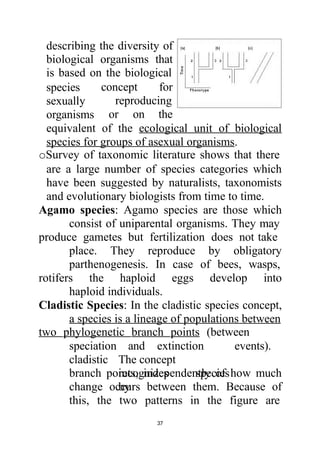
Cladistic Species: In the cladistic species concept,
a species is a lineage of populations between
two phylogenetic branch points (between
speciation
cladistic
and extinction events).
The concept
recognizes species
by
branch points, independently of how much
change occurs between them. Because of
this, the two patterns in the figure are
37
38
cladistically identical: in both there are three
species and species 1 gives birth to two new
species at the branch point. On the non-
temporal species concepts, such as the
biological, recognition and ecological
species concepts, there are two species in
Figure (a) and three in (b).
(a) The ancestral species does not change
phenetically
ecologically)
(or
reproductively or after a
daughter
species
evolves. Species 1 and 2 are phenetically
identical but cladistically different. (b) The
ancestral species changes after the evolution
of the new species; species 1 and 2 are both
phenetically and cladistically different. (c)
Phenetic change in one lineage with no
speciation.
Cohesion Species: According to the cohesion
species concept (Templeton 1989) a species
is the largest delimited population that has
internal mechanism, and maintains mutual
phenotype cohesion among its members.
Phenotype cohesion of a population occurs
when mutual similarity observed among the
members of the population even when the
average appearance of individuals in the
population changes in time.
39
Composite Species: All organisms belonging to
an internodon and their descendants until a
subsequent internodon (internodon is a set
of organisms whose parent-child relations
are not split).
E.g. the composite species concept defines a
species is a lineage between two temporal
occurrence of new characters.
Ecological Species: A lineage which occupies an
adaptive zone, minimally different from that
of any other lineage in its range and which
evolves separately from all lineages outside
its range.
Evolutionary Species: A lineage (ancestral-
descendent sequence of
populations)
evolving separately from others and with its
own unitary evolutionary role and
tendencies.
Geological concordance (similarity): Population
subdivisions concordantly identified by
multiple independent genetic units
constitute the population units worthy of
recognition as phylogenetic taxa.
Genetic Species: Group of organisms that may
inherit characters from each other, common
gene pool, reproductive community that
forms a genetic unit.
40
Genotypic cluster definition: Clusters of
monotypic or polytypic biological entities,
identified using morphology or genetics that
have few or no intermediates when in
contact.
Hennigian species: A tokogenetic community that
arises when a stem species is dissolved into
two new species and ends when it goes
extinct or speciates.
Morphological species: Similar to typological
species concept of Linnaeus; species are the
smallest groups that are consistently and
persistently distinct and distinguishable by
ordinary means.
Nominalistic species: Only individuals exist and
nothing more. Species have no actual
existence in nature.
Nothospecies: Species formed from the
hybridization of two distinct parental
species.
Phenetic species: A class of organisms that share
most of a set of characters. A family
resemblance concept is possession of most
characters which required for inclusion in a
species but not all.
Phylogenetic species: A species is the smallest
diagnosable cluster of individual organisms
41
within which there is a parental pattern of
ancestry and descent.
The concept of a species as an irreducible
group whose members are descended from a
common ancestor and who all possess a
combination of certain defining, or derived,
traits.
Recognition species: The recognition species
concept is a concept of species, according to
which a species is a set of organisms that
recognize one another as potential mates:
they have a shared mate recognition system
(behavioural, physiological
or
morphological).
Biological Species: Population of
sexually reproducing organisms,
interbreeding
natural populations isolated from other such
groups, depending upon reproductive
isolating mechanisms.
42
Unit II
Taxonomic Characters and different kinds.
Origin of reproductive isolation, biological
mechanism of genetic incompatibility.
Taxonomic procedures: Taxonomic
collections, preservation, curetting, process of
identification.
Taxonomic Characters and different kinds
oTaxonomic character is a distinguishing feature
of taxa – a characteristic of one kind of organism
which will distinguish it from another kind.
Example, serrated leaves may distinguish one
species of plant from another and hence called a
character. Similarly, punctate elytra may
differentiate between two species of beetles.
oMayr et al (1953) define a taxonomic character,
as “any attribute of an organism or of a group of
organisms by which it differs from an organism
belonging to a different taxonomic category (or
resembles an organism belonging to the same
category)”.
oThe taxonomic characters can be roughly
grouped into:
a) Morphological characters.
b)Physiological characters.
c) Behavioural characters.
d) Ecological and distributional characters.
Morphological Characters
oStructural attributes of organisms at the cellular
level or above.
oExternal, internal,microscopic,
including cytological and developmental
characters.
Characteristics:
1. Not subject to wide variation among specimens.
2. Not readily modified by the environment.
3. Consistently expressed.
4. Available in specimens you are using.
5. Effectively recorded.
oCharacters that do not vary
or vary randomly between groups are of
no use.
External Morphology:
oMost characters are useful. May be single or
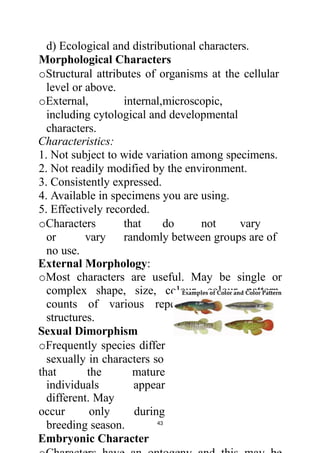
complex shape, size, colour, colour pattern,
counts of various repeated or comparable
structures.
Sexual Dimorphism
oFrequently species differ
sexually in characters so
that the mature
individuals appear
different. May
occur only during
breeding season.
Embryonic Character
43
discrete body forms which undergo
metamorphosis. Because of these changes we
must use equivalent forms.
oOntogenetic characters are useful in establishing
relationships.
Chromosomes
oChromosomal changes may accompany
or
fecundity,
and
provide speciation, reduced
sterile.
oThree levels are analyzed commonly for
and size of
chromosomes:
oAlpha Karyology -
Number chromosomes.
centromere to allow for comparison
oBeta Karyology - Number and location of
of
chromosomes between species.
oGamma Karyology - Number, centromere &
stains for various regions of chromosomes to
identify homologous parts of chromosome.
oChromosome number expressed as
haploid or diploid.
oCompare number of metacentrics,
acrocentrics and telocentrics.
Physiological characters
Body secretions:
oMorphology, numbers, size
and structures of secretory
44
45
glands. E.g. waxy secretion of scale insects and
mealy bugs.
Molecular characters
oImmunological information
oElectrophoretic differences
oAmino acid sequences of proteins
oDNA hybridization
oDNA and RNA sequences
Behavioral characters
oCourtship and other ethological
isolating mechanisms:
oMatting and reproducing behaviour of species.
oHelp in taxonomic classification.
oResult in reproductive isolation and consequent
speciation.
oLiving, eating and nesting behaviour.
Ecological characters and distributional
characters
oHabit and habitats
oFood and Seasonal variations
oParasites and hosts
oGeographic characters, General
biogeographic distribution patterns
oSympatric-allopatric relationship of populations
Origin of reproductive isolation: biological
mechanism of genetic incompatibility
The origin of reproductive isolating
mechanisms
o In the origin and maintenance of race and
species, isolation is an indispensable factor and
its role and importance have been recognized for
a long time.
o Even Lamarck and Darwin pointed out that
interbreeding of different populations may result
in swamping of the differences acquired during
the process of evolutionary divergence.
o During the process of speciation the diverging
populations must acquire some means of isolation
so that the genes from one gene pool are
prevented from dispersing freely into foreign
gene pool.
o Reproductive isolating mechanisms prevent
exchange of genes between populations by
genetically conditioned mechanisms which are
intrinsic to the organisms themselves.
o The mechanism of reproductive isolation is a
collection of evolutionary, behavioural and
physiological processes critical for speciation.
o Thus, the origin of reproductive isolating
mechanisms is an important event in the process
of cladogenesis (speciation).
46
Isolating mechanisms:
o Thespecies specific reproductive
characteristics prevent different species from
fusing. The isolating barriers
maintain the
reproductive
integrity of a species
by
reducing gene flow between related species.
o Different types of reproductive isolating
mechanisms have been studied in Drosophila
such as gametic isolation, ethological (sexual or
behavioural) isolation, hybrid inviability and
hybrid sterility.
oTwo broad kinds of isolating
mechanisms between species are typically
distinguished, together with a number of sub-types
(Mayr 1970): Pre-mating isolating mechanisms:
Pre-zygotic isolation mechanisms are the most
economical in terms of the natural selection of a
population, as resources are not wasted on the
production of a descendant that is weak, non-
viable or sterile. These mechanisms include
physiological or systemic barriers to fertilization.
a)Temporal isolation. Individuals of different
species do not mate because they are active at
different times of day or in different seasons or
difference in the time of sexual maturity or
flowering.
47
48
b) Ecological isolation: Individuals mate in their
preferred habitat, and therefore do not meet
individuals of other species with different
ecological preferences.
c)Behavioural isolation: Potential mates meet, but
choose members of their own species. The
potential mates exhibit species specific courtship
display.
d) Mechanical isolation: Copulation is
attempted, but transfer of sperm does not take
place. Mating pairs may not be able to couple
successfully if their genitals are not compatible.
Post-mating isolating mechanisms:
e)Gametic incompatibility: Sperm transfer takes
place, but egg is not fertilized. The synchronous
spawning of many species of coral in marine
reefs means that inter-species hybridization can
take place as the gametes of hundreds of
individuals of tens of species are liberated into
the same water at the same time. Approximately
a third of all the possible crosses between
species are compatible, in the sense that the
gametes will fuse and lead to individual hybrids.
This hybridization apparently plays a
fundamental role in the evolution of coral
species. However, the other two-thirds of
possible crosses are incompatible.
49
b) Zygotic mortality. A type of incompatibility
that is found as often in plants as in animals
occurs when the egg or ovule is fertilized but the
zygote does not develop, or it develops and the
resulting individual has a reduced viability. This
is the case for crosses between species of the
frog genus, where widely differing results are
observed depending of the species involved.
c)Hybrid inviability: Hybrid embryo forms, but of
reduced viability.
d) Hybrid sterility: Hybrid is viable, but resulting
adult is sterile. A hybrid has normal viability but
is deficient in terms of reproduction. This is
demonstrated by the mule. In all of these cases
sterility is due to the interaction between the
genes of the two species involved; to
chromosomal imbalances due to the different
number of chromosomes in the parent species.
Hinnies (male horse x female donkey) and mules
(female horse x male donkey) are hybrids. These
animals are nearly always sterile due to the
difference in the number of chromosomes
between the two parent species. Both horses and
donkeys belong to the genus Equus, but Equus
caballus has 64 chromosomes, while Equus
asinus only has 62. A cross will produce
offspring (mule or hinny) with 63 chromosomes
50
that will not form pairs, which means that they
do not divide in a balanced manner during
meiosis.
e)Hybrid breakdown. First generation (F1)
hybrids are viable and fertile, but further hybrid
generations (F2) may be inviable or sterile.
51
Taxonomic procedures: Taxonomic collections,
preservation, curetting, process of identification
Taxonomic collections:
Biological collections are typically preserved
plant or animal specimens along with specimen
documentation such as labels and notations.
Types of collection
Most biological collections are either dry
collections or wet collections. They also may
include collections preserved at low temperatures
or microscopy collections.
Dry collections
Dry collections consist of those specimens that
are preserved in a dry state. Two factors influence
decisions about preserving specimens this way:
Rigidity - Some specimens
can be preserved
naturally (starfish) or
artificially with
sufficient rigidity to accommodate
normal handling. Such specimens often are
suitable for dry preservation.
Specific characteristics - Drying may provide
the
best available means to preserve natural
colours (for example, butterflies) or distinguishing
features (such as skeletal parts or surface
details). Such specimens in a dry state may have
great potential for interpretation and research.
52
Wet collections are specimens kept in a liquid
preservative to prevent their deterioration. Certain
biological specimens are preserved in a wet form
due to: Convenience - an intent to preserve body
form and soft parts for a variety of uses. When
colour preservation is not critical and dry
preservation sacrifices qualities needed for other
intended uses, fluid preservation is beneficial.
Biological low-temperature collections
Specimens are maintained at low temperatures to
preserve:
soft parts for various biochemical analyses
Some algae, Protozoa (especially parasitic
strains), Viruses, Bacteria, Bacteriophages,
Plasmids
Animal tissues (dissected
organs, muscles),Cell lines
Blood and blood components (serum, plasma
etc)
Semen, Venom
Other samples (isolated proteins and
nucleic acids, cell suspensions)
Biological microscopy collections:
Scientists preserve certain specimens as
microscope preparations to preserve whole or
partial organisms for:
various kinds of microscopic examination
Biochemical analyses, extraction of DNA.
Histology
Karyology
Scales
hair
Value of biological collections
Most biological collections are highly valuable
for the following reasons. Museums are only place
where extinct species are preserved.
specimens of special historical value.
specimens rarely found in any collections.
Many areas in world are geographically
inaccessible.
such area
invaluable
Material from
are
&
are preserved at
all costs.
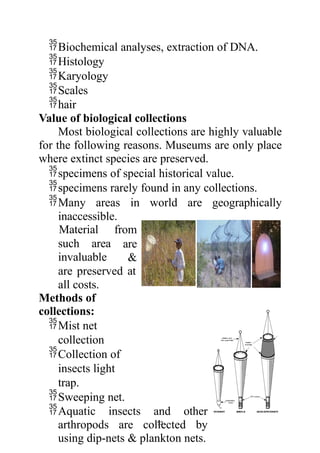
Methods of
collections:
Mist net
collection
Collection of
insects light
trap.
Sweeping net.
Aquatic insects and other
arthropods are collected by
using dip-nets & plankton nets.
53
dredging
Trawling
and
for
collecting deep
sea animals
Killing Jar:
Spreading
tray:
Carcasses or
remnants
Carcasses or remnants
of dead animals, scat and
other biological material
found in the wild may be
very useful for obtaining data about
wild populations. It can no longer be regarded as
ethical to kill threatened wild animals for
obtaining skins for collections; carcasses of
animals found or confiscated from poachers
may serve as a better source of material for
reference collections. Skeletal material, skulls,
owl pellets may be an interesting source of
bones, hair samples; reference hair collection
of sympatric species,
Fur and hair
After removing the skin from the animal, as
much flesh as possible should be removed, but
without damaging the skin with hair roots. Then
54
55
the skin can be dried in the sun, or if necessary,
high over a fire, either hung on a line or stretched
between pegs. Salting the skin will speed the
drying process and temporarily preserve the skin.
Areas that still have flesh or fat should be salted
thoroughly. Powdered borax can be put on the skin
to further preserve it. When the skin is nearly dry,
it should be folded with the hairy sides together.
Preservatives and Fixatives
Formalin: Its use will not harm the specimen, is a
better preservative than alcohol. It penetrates more
rapidly and internal organs remain in better
condition. Commercial formalin (40%) should be
diluted with ten volumes of water to a 4% solution.
2% formalin with seawater is an excellent quick
preservative for small marine specimens.
Alcohol: It is used in zoology, generally 95% ethyl
alcohol (white spirits) which may be diluted with
distilled water to strengths of 70% and 80%. At
least 70% is required for safe storage of material.
Alcohol is a valuable preservative for crustacea,
polychaeta and echinoderms with bristles or hard-
parts.
A teaspoonful of glycerine mixed with alcohol
helps to preserve natural colours and to keep
integuments flexible.
56
Alcohol in jars containing preserved
specimens should be changed at intervals once or
twice a year and evaporation should be guarded
against.
One of the most important fixatives for the
general collector of invertebrates is Bouin’s fluid,
which is excellent for general structural and
histological work, and for preservation of animals
for dissection. Fixation time is at least 12 hours for
a specimen of l cc. bulk, correspondingly longer
for larger material. There is not much danger of
over-fixing. Afterwards specimens should be
washed in 70% alcohol, to remove excess picric
acid, and stored in 70-80% alcohol.
Formula for Bouin's: 75 parts saturated
aqueous picric acid; 25 parts 40% formalin; 5 parts
glacial acetic acid.
Preservation by cooling or freezing:
Removal of the skin with insulating fur
before cooling or freezing may help to cool the
carcass down more quickly. Freezing is not
recommended if histological examination is
planned.
Storage of the Collection
As the collection grows, the greatest need will
be for an orderly storage system, with facilities for
57
quick reference to any container, to field notes and
any other information.
It may be desired to have the collection visible
for permanent display, and with dried material a
set of flat cabinet drawers is best for storage.
Most invertebrates, will be kept in bottles, and
sets of tubes or jars can be kept together in a small
space by placing them in deep cardboard
boxes, conspicuously labelled with serial box
numbers.
Containers
Uniform sizes of tubes and jars will be
preferred.
Jars should be wide-mouthed, and of clear
glass, thick enough to withstand knocks. Non-
corrodible tops are preferable to metal
caps. Alternatively, wide-mouthed bottles
may be stoppered with firm, good quality corks.
Preserving jars with rubber washer lids are
ideal for larger specimens.
Specimens as a rule may be put straight into
the container.
Labelling
The bulk of the information about a specimen
should be entered on the record sheet. Labels
attached to the container should include
the habitat, locality and date, and the collector's
initial.
58
Alternatively specimen labels can be placed in
the preservative within the container. They should
then be written on stiff, non-absorbent white card,
either in pencil or in indian ink.
Ink labels should be allowed to dry, then
steeped for a few minutes in a 3% solution of
acetic acid, which effectively sets the ink and
prevents “running” when placed in preservative.
Recording of data
Geographic locality
Date
Stage (adult male, female or immature form)
Altitude or depth.
Host
Name of collector and other
relevant information
Identification:
Identification of collections may be carried out
based on published references and museum
specimens.
Curating of Collections
Every taxonomist has to take the responsibility of
curating collections. This requires a great deal of
expertise, knowledge and clear understanding of
the function of different collections.
59
Preparation of Material
o There are certain materials which are ready for
study as soon as collected from the field e.g.,
bird and mammal skins.
o There are certain insects which should never
be placed in alcohol or any other liquid
preservative, whereas others are useless when
dried.
o Most insects are pinned, and the wings are
spread if they are taxonomically important as
in butterflies, moths and some grasshoppers.
o Certain invertebrates are to be preserved in
alcohol or formalin before their study.
Housing
o Research collections should be housed in
fireproof and dustproof buildings.
o Most museums keep their collections in air-
conditioned buildings.
o Rapid changes in temperature and humidity
are harmful to museum cases and specimens.
o Storage cases should be built to be insect-
proof. Photographs and films should be stored
in air-conditioned rooms.
o Improperly preserved or inadequately labelled
specimens should be eliminated by the curator.
The most efficient method for the elimination
60
of useless material is to ask specialists to pull
out such specimens while scrutinizing the
material during a revision.
Exchange of Material
o The selecting of material for exchanges and
keeping its record is time consuming, so the
exchanges are not as popular as they used to
be.
o A specialist doing a monograph on a certain
genus or family can always borrow material
completing his work. Exchanges
from other institutions and return it after
are
sometimes necessary to build up complete
identification collections.
Unit III
o Taxonomic keys, different types of keys, their merits and
demerits.
o International code of Zoological Nomenclature (ICZN):
Operative principles, interpretation and application of
important rules: Formation of Scientific names of various
Taxa.
o Synonyms, homonyms and tautonomy.
Taxonomic keys, different types of keys, their
merits and demerits
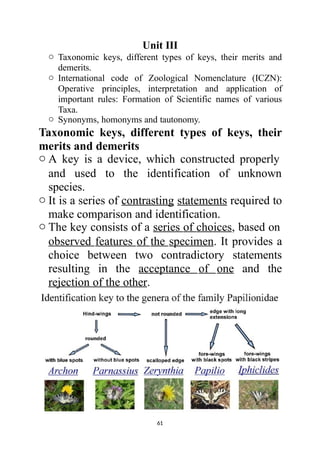
o A key is a device, which constructed properly
and used to the identification of unknown
species.
o It is a series of contrasting statements required to
make comparison and identification.
o The key consists of a series of choices, based on
observed features of the specimen. It provides a
choice between two contradictory statements
resulting in the acceptance of one and the
rejection of the other.
61
62
o At each point in the decision process, multiple
alternatives are offered, each leading to a result
or a further choice.
o The alternatives are commonly called “leads”,
the set of leads at a given point a “couplet”. If
the entire key consists of exactly two choices at
each branching point, the key is
called dichotomous, otherwise it is described
as polytomous or poly clave.
Constructive features of taxonomic keys:
1) Constant characteristics rather than
variable ones should be used.
2) Proper measurements rather than terms
like
“large” and “small” should be used.
3) Characteristics that are generally available to
the user of the key rather than
seasonal characteristics or those seen
only in the field should be used.
4) A positive choice should be made. The
term “is” instead of “is not” should be used.
5) If possible one should start both choices of a
pair with the same word.
6) If possible, different pairs of choices should be
started with different words.
7) The descriptive terms should be preceded with
the name of the part to which they apply.
63
Types of Taxonomic Keys
There are basically two types of keys:
A) Dichotomous and
B) Poly clave (Multiple Access or Synoptic).
C) Dichotomous Keys:
o This is one of the most frequent keys, which are
the most common, probably first published by
Jean Baptiste-Lamarck in 1778.
o Keys in which the choices allow only two
alternative couplets are known as dichotomous
keys.
o In constructing a key, contrasting characters are
chosen that divide the full set of possible species
into smaller and smaller groups i.e. the statements
typically begin with broad characteristics and
become narrower as more choices are required.
o Each time a choice is made, a number of species
are eliminated from consideration and the range of
possible species to which the unknown specimen
may belong is narrowed.
o Eventually, after sufficient choices have been
made, their range reduces to a single species and
the identity of the unknown species is revealed.
o Couplets can be organized in several forms. The
couplets can be presented using numbers (numeric)
or using letters (alphabetical). The couplets can be
presented together or grouped by relationships.
64
Types of Dichotomous Keys:
There are two types of dichotomous keys. They
differ in the method by which the couplets are
organized and how the user is directed to
successive choices.
i) Indented Keys (also called yoked):
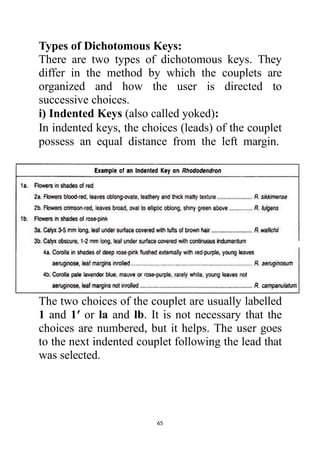
In indented keys, the choices (leads) of the couplet
possess an equal distance from the left margin.
The two choices of the couplet are usually labelled
1 and 1′ or la and lb. It is not necessary that the
choices are numbered, but it helps. The user goes
to the next indented couplet following the lead that
was selected.
65
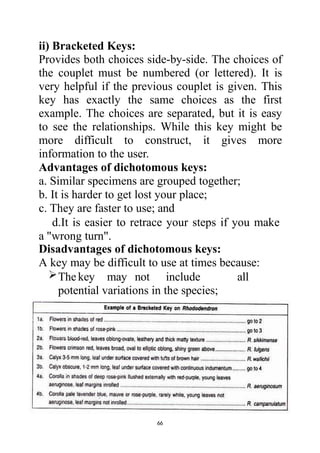
ii) Bracketed Keys:
Provides both choices side-by-side. The choices of
the couplet must be numbered (or lettered). It is
very helpful if the previous couplet is given. This
key has exactly the same choices as the first
example. The choices are separated, but it is easy
to see the relationships. While this key might be
more difficult to construct, it gives more
information to the user.
Advantages of dichotomous keys:
a. Similar specimens are grouped together;
b. It is harder to get lost your place;
c. They are faster to use; and
d.It is easier to retrace your steps if you make
a "wrong turn".
Disadvantages of dichotomous keys:
A key may be difficult to use at times because:
Thekey may not include all
potential variations in the species;
66
67
The key may rely on features not present
in that season;
Thekey may not include “all”
species of
interest;
Onemay misinterpret a feature or
make a mistake.
B. Poly clave keys:
o Poly clave keys are tools used to help identify
unknown objects or species. The keys are
generated using interactive computer programs.
Polyclave keys use a process of elimination.
o The user is presented with a series of choices
that describe features of the species they wish to
identify. The user then checks off a list of
character states present in the organism they
wish to study.
o The program looks to match those character
states with all the species they can possibly
match. If a species does not have that character
state it is eliminated from the list. The more
character states listed the more species that are
eliminated.
o This allows the rapid elimination of large
numbers of species that the specimen cannot be.
The process continues until only one species
remains.
Advantages of Poly clave keys:
68
1) They are easy to use.
2) They allow multi-entry i.e. the user can
start anywhere. This is a significant advantage
because the user can rely on characters that are
most easy to observe, rather than having to
deal with characters that may not be present in
the specimen or are poorly developed.
3) They are order-free i.e. the user can work
in any direction with any character.
4) They are faster.
5) They are easily computerized. In fact,
these keys are most commonly used in this
form. Paper versions are typically large and
unwieldy because each character needs to list
all possible taxa.
Disadvantages: It is based on specimen and their
availability. They have generally been written only
for a limited number of taxonomic groups.
Polyclave Key: Example - Pollination Type
Pollination is the process of transferring pollen
from one flower to another. Since plant can't
move, they utilize vectors such as wind, water and
animals to accomplish this process for them.
Flowers are specialized by shape, color, odor,
nectar reward in order to maximize the chance that
a certain vector will accomplish pollination. These
69
flower adaptations are collectively known as
pollination syndromes.
Plants differ in the degree of their specialization
for a particular pollination system. For example,
many orchids are pollinated by only a single type
of bee. Other flowers are not as specialized and
may be pollinated by a variety of bees or perhaps
beetles. In other cases, insects may visit flowers
without actually transferring pollen. These factors
make it difficult to determine with absolute
certainty the pollination system by the polyclave
key.
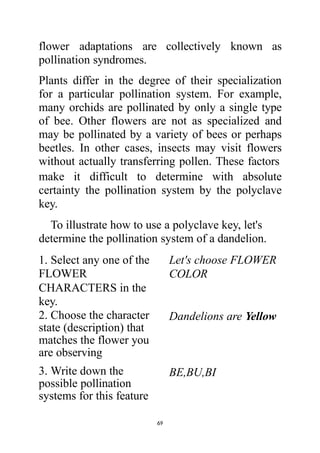
To illustrate how to use a polyclave key, let's
determine the pollination system of a dandelion.
1. Select any one of the
FLOWER
CHARACTERS in the
key.
Let's choose FLOWER
COLOR
2. Choose the character
state (description) that
matches the flower you
are observing
Dandelions are Yellow
3. Write down the
possible pollination
systems for this feature
BE,BU,BI
70
(BE-Bee pollination, BU-
Butterfly pollination, BI-
Bird pollination)
4. Select another feature NECTAR
5. Choose the character
state description that
matches your flower (WI-
wind pollination, FM-fly
pollination, BE-bee
pollination, BA-bat
pollination)
b.
present...WI,FM,BE,BA
6. Eliminate from the first
character state selected
the pollination systems
not found on both lists.
Continue this process
until the pollination
system is identified.
BE,BU,BI
Thus, dandelions are
bee pollinated
Abbreviation Code:
pollination (anemophily); BT Beetle
WI Wind
pollination
(cantharophily); FM Fly pollination (syrphid and
bee flies; myophily); FS Fly pollination (carrion
and dung flies; sapromyophily); BE Bee
pollination (mellittophily); BU Butterfly
pollination ; (psychophily); MO Moth pollination
71
(phalaenophily & sphingophily); BI Bird
pollination (ornithophily); BA Bat pollination
(chiropterophily)
72
International code of Zoological Nomenclature
(ICZN): Operative principles, interpretation
and application of important rules: Formation
of Scientific names of various Taxa
oOne of the primary responsibilities of systematic
biology is the development of our biological
nomenclature and classifications.
oNomenclature is not an end to systematics and
taxonomy but is a necessity in organizing
information about biodiversity.
oNomenclature functions to provide labels
(names) for all taxa at all levels in the hierarchy
of life.
oBiological nomenclature derives from the
binomial nomenclature that was originally
codified in the works of Linnaeus, Species
Plantarum (1753) and Systema Naturae, 10th
Edition (1758). These publications are the
decided starting points for the modern biological
nomenclature in most groups of plants and
animals.
oTaxa at the level of species are named with
binomials, consisting of generic and specific
names that together equal the species name.
oTaxa above the level of species are Supraspecific
Taxa and are Uninominals.
73
oTaxa below the level of species are Subspecies or
Trinominals.
History of Nomenclature Codes:
1758 Linnaeus' 10th Edition of Systema Naturae
1840 Strickland Code of British Association for
the Advancement of Science
1867 Set of "laws" at Paris International Botanical
Congress
1881 French Code developed
1887 U. S. Code developed
1889 International Zoological Congress adopted
Blanchard Code
1894 German Code developed
1901 Regles International Nomenclature of
Zoology adopted by 5th Congress, published
under the 6th Congress in 1905
1904 International Commission on Zoological
Nomenclature (ICZN) formed
1913 Plenary powers granted to ICZN
1952 International Code of Botanical
Nomenclature
1953 Publication of Copenhagen Decisions and the
Follett Summary (1955)
1958 Rewritten as international code and updated
since that time
74
1976 International Code of Nomenclature of
Bacteria
1985 Publication of International
Code of Zoological Nomenclature
1994 Most recent Code of Botanical Nomenclature
1999 Most recent Code of Zoological
Nomenclature
Parts of International Code of Zoological
Nomenclature:
The International Code of Zoological
Nomenclature contains three main parts:
(i) The Code proper, (ii) The Appendices and (iii)
The Official Glossary
oThe code proper includes a preamble followed by
90 articles (grouped in 18 Chapters) which cover
mandatory rules without any explanation.
oThere are three Appendices, of which the first
two cover the status of recommendations and the
third part of the Appendices is the constitution of
the commission.
oThe glossary contains the terms used in the codes
with detailed definition.
oThe English and French texts of the Code are
published on behalf of the Commission by the
International Trust for Zoological Nomenclature.
75
Rules of Zoological Nomenclature:
At present the naming of the animal is governed
by the International Code of Zoological
Nomenclature. There are many rules (Articles)
concerning the Zoological Nomenclature.
Some important ones are cited below:
1.Zoological nomenclature is independent of
other system of nomenclature. The scientific
name of animals and plants must be different,
and the generic name of a plant and an animal
may be same, but this system is to be avoided.
e.g., the generic name of banyan or fig tree is
Ficus and the fig shell (a gastropod shell) is Ficus.
The scientific name of fig tree is Ficus carica or
F. indica, F. religiosa, F. bengalensis etc., but
the scientific name of the fig shell is Ficus
ficus or Ficus gracilis, etc.
2.The scientific name of a species is to
be binomial (Art. 5.1) and a subspecies to
be trinomial (Art. 5.2).
e.g., the scientific name of Indian bull frog is Rana
tigerina. It is binomial. The scientific name of
Indian lion is Panthera leo persica. It is trinomial.
Such a system of naming by
Latinized words is known
three Latin
or as
trinomial
nomenclature.
3.The first part of a scientific name is generic
(L. Genus = race) and is a single word and the
first alphabet or letter must be written in Capital
letter. The genus must be a noun in the
nominative singular. The generic part assigns a
Latin noun, a Latinized Greek or a Latinized
vernacular word.
4. The second part of a name is species (L. species
= particular kind) name and may be a single word
or a group of words. The first alphabet or letter of
the species name must be written in small letter.
The species name must be adjective form in
nominative singular agreeing in gender with genus
name which is in noun form; e.g.:
The specific name indicates distinctness while
generic part shows relationship.
5.If the species names are framed after
any person’s name, the endings of the species are
i, ii and ae, or if the species name are framed
after
76
geographical place, the endings of the species are
‘ensis’, ‘iensis’, e.g.:
6. First part of a compound species-group name is
a Latin letter and denotes a character of the taxon,
connected to the remaining part of the name by a
hyphen (-) e.g., Sole (a kind of flat fish)—
Aseraggodes sinus-arabici L. Sinus = recess
China-rose (a kind of coloured rose) — Hibiscus
rosa-sinensis L. rosa = rose
7. If a subgenus taxon is used, it is included within
parenthesis in between genus and species part and
is not included in binomial and trinominal
nomenclature, e.g.:
77
8.The person who first publishes the
scientific name of an animal, is the original
author of a name, may be written after the species
name along with the year of publication. The
author’s name may be in its abbreviated form.
Lion- Felis leo Linnaeus, 1758; Lion- Felis leo
Linn., 1758; Felis leo L., 1758
9.Comma is only used between author’s name
and the year of publication (Art. 22. A. 2.1), e.g.,
the scientific name of Common octopus is
Octopus vulgaris Cuvier, 1797. No punctuation
marks are considered one to other ends of the
name, e.g., “Octopus vulgaris Cuvier, 1797” (Not
considered). No diacritic mark, apostrophe (i’)
and hypen (-) are used in names. In German
word the umlaut sign is removed from a vowel
and the letter ‘e’ is inserted after the vowel,
e.g., Mülleri becomes Muelleri.
10.If the original generic name given by the
first author who also reported the species
name, transfers the species part from one genus
to the 78
79
other, the name of the original author is put within
parenthesis, e.g.,
Tiger:
Felis tigris Linnaeus, 1758. At first almost all the
members of the cat family were placed under the
genus-Felis.
Later the genus Felis was divided into two genera,
the genus of the larger cats (tiger, lion, leopard,
etc.) is Panthera and smaller cats such as jungle
cat, fishing cat, golden cat, etc. are placed under
the genus Felis, e.g.:
Lion- Felis leo Linnaeus, 1758 – Lion - Panthera
leo (Linnaeus, 1758)
Jungle cat- Felis chaus
11. The names are not acceptable before the
publication of Linnaean treatise, Systema Naturae
(10th edition) which was published on 1st January,
1758 except the Nomenclature of spiders which
starts in 1757. The book Aranei suecici was
published by C. Clerck in 1757.
12. The scientific names must be either in Latin or
Latinized or so constructed that they can be treated
as a Latin word.
13.The scientific names must be italicized
in printed form, or underlined in hand written or
in typed forms, e.g.
Indian leopard- Panthera pardus fusca (Meyer)
14.All taxa from subgenera level and above
must be uninominal (Art. 4.1, 4.2) and are plural
nouns for names above genus, and singular
nouns for genus and subgenus. Taxon ‘species’
may be used as singular or plural.
15.In case of animals some rules and practices
are applied on the basis of zoological codes (Art.
29.2) for the formation of supra generic taxa
from superfamily to tribe, e.g.
16.A family name should be based on the
basis of type-genus, e.g., Chitonidae—Chiton
(type genus)
80
81
+ idae = Chitonidae.
17.Two species under a same genus should
not have the same name.
18.Nomenclature of a hybrid/hybrids cannot
be considered because the hybrids are
normally individuals but not population. Thus
such names
have no status in nomenclature.
Hybridsare typically sterile and
become synaptic failure
during meiosis. They are prevented from back
crossing with either parental species.
19.A name published without satisfying
the conditions of availability (nomen nudum =
naked name) has no standing in zoological
nomenclature and is best never recorded, even in
synonymy.
20.A scientific valid name which is not used
about 50 years in literature, then as per zoological
code’s provision the unused senior valid
scientific name is treated as obliterated name
and junior name which is used continuously in
literature (at least by 10 authors in 25
publications) becomes the accepted official
name.
82
Remark:
The disadvantage of the binominal system is its
instability and the name of a species changes every
time and is transferred to a different genus.
21.As per the zoological code’s provision,
the species and subspecies parts of a name may
be same spelling and even the second or the
third component of the name repeats the generic
name (tautonomy), e.g.: Scandinavian red fox-
Vulpes vulpes vulpes
22.Synonyms are the different names for a
same animal or a taxon (species or genus). If the
several scientific names are given to a single
animal by different scientists, the senior-most
name is selected by law of priority. The
senior-most or earliest name is called senior
synonym (Art. 10.6) and is considered as valid
species and the rest of the names are called
junior synonyms and are treated as invalid
species.
The leopard cat was named Felis bengalensis by
Kerr and the same animal was named by Gray,
Felis chinensis. Again this animal was named as
Prionailurus bengalensis by Kerr. So the first
name is senior synonym and valid and the rest
names are junior synonyms and are invalid.
83
The whale shark was named Rhiniodon typus by
Smith in 1828 and the same was named Rhinodon
typicus by Muller and Henle in 1839, Micristodus
punctatus by Gill in 1865 and Rhinodon
pentalineatus by Kishinouye in 1891. Here the
first name is considered as senior synonym
(Rhiniodon typus) and valid, the rest are junior
synonyms and are invalid.
23. Homonyms mean when identical names are
given to two or more different taxa. According to
the zoological code (Art. 52.2) when two or more
homonyms are found, the senior most (oldest)
homonym (Art. 52.2) is used and the junior-most
homonyms are replaced with new names, e.g.,
Cuvier proposed the genus Echidna in 1797 for the
spiny anteater.
Forster already proposed the genu Echidna in 1777
for morey eels. According to Law of Priority,
Forsters genus claimed senior homonym and
Cuvier’s genus considered as junior homonym.
Illiger replaced the Cuvier’s name as Tachyglossus
for spiny anteater in 1811.
Taxonomic Categories?
Taxonomic Hierarchy Categories were also
introduced by Linnaeus. They are also known as
84
Linnaean hierarchy. It is defined as sequence of
categories in a decreasing or increasing order from
kingdom to species and vice versa. Kingdom is the
highest rank followed by division, class, order,
family, genus and species. Species is the lowest
rank in the Hierarchy. The hierarchy has two
categories which are obligate and intermediate.
Obligate means they are followed strictly and
range from kingdom to species as said above.
Intermediate are not followed strictly and they are
added in obligate list such as subdivision, super
family, super class, suborder, subspecies etc.
1. Kingdom: The top most taxonomic category.
Example all animals are included in Kingdom
Animalia. The unit in classification that denotes
grouping of organism based on features which are
observable is known as Taxon.
The different methods used to identify and classify
organisms are referred to Taxonomic aids.
Identification of organisms is a tedious process.
Keys are used for
identification referred as key.
It includes a
long table of
with alternative features to identify
Taxonomic
statements
organisms. The features which are related to
organism are chosen.
2. Phylum: It is a term used for animals while its
synonym division is used for plants. It is a
85
collection of similar classes. Phylum chordata of
animals has class mammalia along with birds,
reptiles and amphibians.
3.Class: One or more than one order makes
a class. Class mammalia includes all
mammals which are bats, rodents, kangaroos,
whales, great apes and man.
4.Order: One or more than one similar
families constitute order. Family felidae are
included in the
order Carnivora. Order puts them in a general
group of what they are, like the group turtle, which
including all turtles.
5.Family: In biological classification,
family (Latin: familia, plural familiae) is one
of the
eight major taxonomic ranks; it is classified
between order and genus. A family may be divided
into subfamilies, which are intermediate ranks
above the rank of genus. In vernacular usage, a
family may be named after one of its common
members. It can be separated from genera by
reproductive and vegetative features.
6.Genus: The classification of kingdom is
very general and includes the animal kingdom or
plant
kingdom. In contrast, the division of genus is more
specific as the grouping before species and after
family. It is defined as group of similar species.
But it is not mandatory to have many species.
86
Some genera have only one species known as
Monotypic. If there are more than one species it is
known as Polytypic. For example lion, tiger are
quite similar species placed under the genus
Panthera.
7. Species: The biological species concept defines
a species as members of populations that actually
or potentially interbreed in nature, not according to
similarity of appearance. Although appearance is
helpful in identifying species, it does not define
species.
Unit IV
Evaluation of biodiversity indices. Evaluation of
Shannon Weiner Index. Evaluation of
Dominance Index. Similarity and Dissimilarity
Index.
The variety of life on Earth is commonly
referred as biological diversity or biodiversity.
Biodiversity is one of the primary
interests of ecologists, but quantifying the species
diversity of
ecological communities is complicated.
The biodiversity indices aim to describe
general properties of communities that allow us to
compare different regions, taxa, and trophic levels.
They are of fundamental importance for
environmental monitoring and conservation,
although there is no consensus about which indices
are more appropriate and informative.
87
88
The spatial component of biodiversity can be
termed as alpha, beta, and gamma diversity.
Imagine that you have a landscape containing of a
number of separate sites and habitats. Alpha
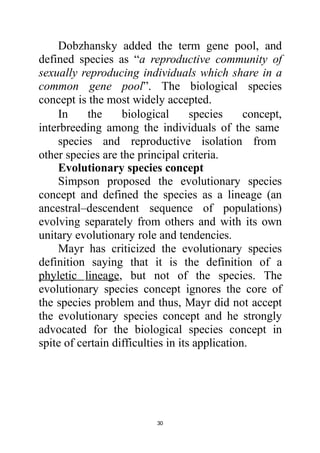
diversity is just the diversity of each site/habitat
(local species pool). Beta diversity represents the
differences in species composition among
sites/habitats. Gamma diversity is the diversity of
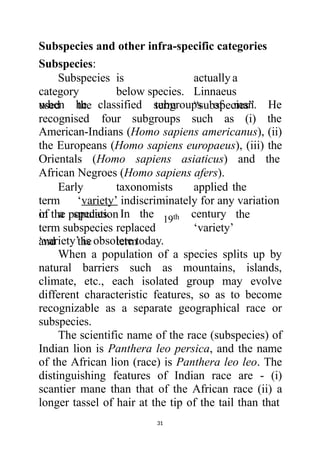
the entire landscape (regional species pool).
Diversity mainly includes two different
aspects: species richness and evenness. Species
richness, or the number of species, is the simplest
measure of diversity and does not consider
differences in species relative abundance. That is,
each species is not likely to have the same number
of individuals. One species may be represented by
1000 birds, another by 200 and a third only a
single bird species.
Species evenness is the similarity in species
relative abundance in a community. The majority
of studies on biodiversity have used species
richness to represent diversity on account of its
apparent simplicity compared to species evenness.
Diversity indices are mathematical functions
that combine richness and evenness in a single
measure. The most commonly used diversity
89
indices are: Shannon’s diversity and Simpson’s
diversity indices.
Shannon Diversity Index
The Shannon index increases as both the
richness and the evenness of the community
increase. The fact that the index incorporates both
components of biodiversity can be seen as both a
strength and a weakness. It is a strength because it
provides a simple, synthetic summary, but it is a
weakness because it makes it difficult to compare
communities that differ greatly in richness.
Typical values are generally between 1.5 and 3.5
in most ecological studies, and the index is rarely
greater than 4.
H’ = – Σ pi In pi
Where,
H’ = Shannon index of diversity
pi = the proportion of important value of
the ith species (pi = ni / N, ni is the important value
index of ith species and N is the important value
index of all the species).
To calculate the index:
90
1.Divide the number of individuals of species #1
you found in your sample by the total number
of individuals of all species. This is pi
2.Multiply the fraction by its natural log (pi * ln
pi)
3.Repeat this for all of the different species that
you have.
4.Sum all the - (pi * ln pi) products to get the
value of H’
Example 1:
S.
No.
Name of
species
N pi lnpi pi lnpi
1
Pigeon 10 0.05
-
2.912
-
0.158279927
2
Robin 4 0.02
-
3.829
-
0.083231335
3
Myna 9 0.05
-
3.018
-
0.147605438
4
Crow 7 0.04
-
3.269
-
0.124365105
5 House
sparrow 11 0.06
-
2.817
-
0.168410029
6
Grasshopper 15 0.08
-
2.507 -0.20436567
7
Butterfly 11 0.06
-
2.817
-
0.168410029
91
8
Snake 1 0.01
-
5.215
-
0.028342042
9
Frog 12 0.07
-
2.730
-
0.178045377
10
Monkey 10 0.05
-
2.912
-
0.158279927
11
Owl 4 0.02
-
3.829
-
0.083231335
12
Chital 18 0.10
-
2.325 -0.227403
13
Drango 21 0.11
-
2.170
-
0.247710216
14
Blue Jay 15 0.08
-
2.507 -0.20436567
15
Egret 17 0.09
-
2.382 -0.22005044
16
Heron 19 0.10
-
2.270
-
0.234453472
Total
184 1 -47.5 -
2.636549012
H = 2.636
Example 2:
Birds Ni Pi ln Pi - (Pi * ln Pi)
Pigeon 96 .96 -.041 .039
Robin 1 .01 -4.61 .046
Starling 1 .01 -4.61 .046
92
Crow 1 .01 -4.61 .046
House sparrow 1 .01 -4.61 .046
H = 0.223
High values of H’ would be representative of more
diverse communities. A community with only one
species would have an H’ value of 0 because pi
would equal 1 and be multiplied by ln pi which
would equal zero. If the species are evenly
distributed then the H’ value would be high. So the
H’ value allows us to know not only the number of
species but how the abundance of the species is
distributed among all the species in the
community.
Evaluation of Dominance Index (Simpson’s
index):
Dominance is one of the most important
concepts in the study of animal social behaviour.
Dominance hierarchies in groups arise from dyadic
relationships between dominant and subordinate
individuals present in a social group. In concrete
way, dominance is an important indicator of
species composition in a habitat. The dominance
of a species refers to its relative importance in its
habitat, which determines the degree of influence
of the species on the ecosystem. Ecologists have
spent much effort and imagination to establish and
quantify interrelationships among these
biological or physical processes
components, and to identify the underlying
that influence
them, e.g., extinction, immigration, colonization,
niche segregation, competition, predation,
environmental control, disturbances, and historical
dynamics.
The Simpson index is a dominance
index
because it gives more weight to common or
dominant species. In this case, a few rare species
with only a few representatives will not affect the
diversity.
Simpson’s index D = Σ (pi)2
Where,
D = Simpson index of
dominance
pi = the proportion of important value of the ith
species (pi = ni / N, ni is the important value index
of ith species and N is the important value index of
all the species).
As D increases, diversity decreases and Simpson’s
index was therefore usually expressed as 1 – D or
1/ D.
Example 1 (site 1)
93
94
Order n Pi pi2
ln pi pi ln pi
Orthoptera
(grasshopper) 6 0.222222 0.049383
-
1.50408
-
0.33424
Orthoptera
(grasshopper) 5 0.185185 0.034294 -1.6864 -0.3123
Lepidoptera
(butterfly) 1 0.037037 0.001372 3.29584 0.12207
Lepidoptera
(butterfly) 3 0.111111 0.012346
-
2.19722
-
0.24414
Coleoptera
(beetle) 12 0.444444 0.197531
-
0.81093
-
0.36041
27 1
0.294925 =
Σ(pi)2
= D
-
9.49447
-
1.37315
1/ Σ(pi)2
= D 3.390698
Number of species = 5
Total number of individuals = 27
Σ (pi)2 = 0.294
Σ pi ln pi = -1.373
H’ = -(-0.334 + -0.312 + -0.122
+ -0.244
+ -0.360) = 1.373
D = 1/(0.049 + 0.034 + 0.001 +
0.012 + 0.197)
= 1/0.294 = 3.390
Example 2 (site 2)
Order (n) Pi pi2
ln pi pi ln pi
Orthoptera
(grasshopper) 99 0.99 0.9801
-
0.01005
-
0.00995
95
Orthoptera
(grasshopper) 1 0.01 0.0001
-
4.60517
-
0.04605
100 1
0.9802 =
Σ(pi)2 =
D
-
4.61522 -0.056
1-
Σ(pi)2
= D 0.020
96
Similarity and Dissimilarity Index
In comparing species composition and biodiversity
of two or more assemblages in taxonomic and
ecological research, similarity (or overlap) or
dissimilarity (or distance) indices provide
quantitative bases of assessment. A large number
of similarity indices based on presence / absence
data have been proposed in the literature. The two
classic and the most widely used indices are the
Jaccard and Sorensen indices.
The Jaccard index and Sorensen index are the
two oldest and most widely used similarity indices
for assessing compositional similarity of
assemblages (sometimes called species overlap)
and hence, its complement, dissimilarity. Both
measures are based on the presence/absence of
species in paired assemblages and are simple to
compute. Many other similarity indices exist that
are based on the same information: the number of
species shared by two samples and the number of
species unique to each of them, and new indices
continue to appear.
Jaccard Index:
Uses presence/absence data (i.e., ignores info
about abundance)
SJ =
Where,
a
a+b+
c
SJ = Jaccard similarity coefficient,
a = number of species common to (shared by)
quadrats,
b = number of species unique to the
first quadrat, and
c = number of species unique to the second
quadrat
Quadrat sp 1 sp 2 sp 3 sp 4 sp 5 sp 6
I 3 4 2 1 0 0
J 3 3 0 5 2 1
kyki = 3 + 4 + 2 + 1 + 0 + 0 = 10
kykj = 3 + 3 + 0 + 5 + 2 + 1 = 14
2 2 2 2 2 2 2
kyki = 3 + 4 + 2 + 1 + 0 + 0 = 30
2 2 2 2 2 2 2
kykj = 3 + 3 + 0 + 5 + 2 + 1 = 48
kykiykj = 3(3) + 4(3) + 2(0) + 1(5) + 0(2) +
0(1) = 26
Quadrat
sp
1 sp 2
sp
3 sp 4
sp
5
sp
6 Total
I 3 4 2 1 0 0 10
J 3 3 0 5 2 1 14 26 = a
I2
9 16 4 1 0 0 30 = b 104 = a+b+c
J2
9 9 0 25 4 1 48 = c 0.25 (a/a+b+c) Similarity
IxJ 9 12 0 5 0 0 26 = a
0.75 = DJ = 1.0-
SJ Dissimilarity
This index can be modified to a coefficient of
dissimilarity by taking its inverse: Jaccard's
dissimilarity coefficient  1Sj (i.e., DJ = 1.0 - SJ)
97
Sorensen’s Index:
o This measure is very similar to the Jaccard
measure, and was first used by Czekanowski in
1913 and discovered anew by Sorensen (1948).
o Give greater "weight" to species common to the
quadrats than to those found in only one quadrat.
o Indices of similarity and dissimilarity were
calculated by using formulae as per Misra (1989)
and Sorensen (1948) as follows:
Index of similarity (S) = 2C/A+B
Where,
A = Number of species in
the community A
B = Number of species in the
community B
C = Number of common species in both the
communities.
Index of dissimilarity = 1-S
Example 1:
There are 20 species found in community 1
and 25 in community 2. Between them, they
have 5 species in common. The calculation would
be:
2∗
5
Sorenson’s Coefficient (CC) =
0.222
20+2
5
= 10/45 =
98
According to Sorenson’s coefficient,
these much
overlap or
communities do not have
similarity.
Example 2:
There are 15 species found in community 1 and 25
in community 2. Between them, they have 12
species in common. The calculation would be:
Sorenson’s Coefficient (CC) =
2∗1
2
15+2
5
= 24/40 = 0.6
99
According
communities
similarity.
coefficient, these
to Sorenson’s
have quite a
bit
of overlap or

Biosystematics and Taxonomy , classification notes.pptx

  • 1.
    ZL-101: Biosystematics andTaxonomy Unit I o Definition and basic concepts of biosystematics taxonomy and classification. o History and theories of biological Classification. o Trends in biosystematics: Chemotaxonomy, cytotaxonomy and molecular taxonomy o Dimensions of speciation. Species concepts: Typological, Nominalistic and Biological species concepts. Subspecies and other infra-specific categories. Unit II o Taxonomic Characters and different kinds. o Origin of reproductive isolation, biological mechanism of genetic incompatibility. o Taxonomic procedures: Taxonomic collections, preservation, curetting, process of identification. Unit III o Taxonomic keys, different types of keys, their merits and demerits. o International code of Zoological Nomenclature (ICZN): Operative principles, interpretation and application of important rules: Formation of Scientific names of various Taxa. o Synonyms, homonyms and tautonomy. Unit IV o Evaluation of biodiversity indices. o Evaluation of Shannon Weiner Index. o Evaluation of Dominance Index. o Similarity and Dissimilarity Index. Suggested Reading Material (All latest editions) 1. M. Kato. The Biology of Biodiversity, Springer. 2. J.C. Avise. Molecular Markers, Natural History and Evolution, Chapman & Hall, New York. 3. E.O. Wilson. Biodiversity, Academic Press, Washington. 4. G.G. Simpson. Principle of animal taxonomy, Oxford IBH Publishing Company. 5. E. Mayer. Elements of Taxonomy. 6. E.O. Wilson. The Diversity of Life (The College Edition), W.W. Northem& Co. 7. B.K. Tikadar. Threatened Animals of India, ZSI Publication, Calcutta. Practical Module – I  Composition assessment of the taxonomic diversity / biodiversity in a habitat (e.g. grassland, arid land, wet land, etc.).  Influence of climatic conditions on taxonomic diversity in a given habitat.  Preparation of models showing the status of certain taxa or species in a particular habitat. 1
  • 2.
    Unit I  Definitionand basic concepts taxonomy and classification. 2 of biosystematics,  History of Classification Chemotaxonomy,  Trends in biosystematics: cytotaxonomy and molecular taxonomy  Dimensions of speciation.  Species concepts: species category, different species concepts, subspecies and other infra-specific categories.  Theories of biological classification: hierarchy of categories. Definition and basic concepts of biosystematics, taxonomy and classification Biosystematics: o Systematics: In biology, systematics is the study and classification of living things; in other words, grouping organisms based on a set of rules (or system). o The science of classifying organisms. o Thus, biosystematics may be defined as 'taxonomy of living populations'. o The word systematics is derived from the Latinized Greek word ‘systema’ applied to the system of classification developed by Carolus Linnaeus in the 4th edition of his historical book Systema Naturae in 1735.
  • 3.
    Kinds of Systematics oSystematics can be divided into two closely classification: taxonomic (known as related and overlapping levels of the Linnaean System) and phylogenetic. o Taxonomic classifications group living things together based on shared traits - usually what they look like or what their bodies do. o For example, animals that lay eggs and have scales we call reptiles, and animals that give births and have fur or hair we call mammals. o More specifically, all humans share the same characteristics and so belong to a group, or taxon, of the genus Homo, and species sapien. o Phylogenetic classifications use the taxonomic names, but further group organisms by how evolutionarily related they are to one another. o By looking at each organism's genes, we know that gorillas (taxonomic term) are more closely related to humans than they are to cockroaches. is the theory and practice of Taxonomy: o Taxonomy identifying plants and animals. In fact, taxonomy deals with the principle involved in the study of classification of organisms. 3
  • 4.
    o It isthe functional science which deals with identification, nomenclature and classification of different kinds of organisms all over the world. o The word ‘taxonomy’ is derived from the Greek words taxis (= arrangement) and nomos (= law) and the term ‘taxonomy’ was coined by A. P. de Candolle in 1813. There are several stages of taxonomy such as: o Alpha taxonomy: In this stage species are identified and characterized on the basis of gross morphological features. o Beta taxonomy: In this stage species are arranged from lower to higher categories, i.e., hierarchic system of classification. o Gamma taxonomy: In this stage intraspecific differences and evolutionary history are studied. o The nomenclatural and taxonomic system for botany introduced by Linnaeus and improved by many generations of later botanists as its first goal to make possible information storage and retrieval concerning plants and plant products. o While Linnaeus originally believed the systematic pattern he recognized in nature to 4
  • 5.
    divine creation, post-Darwinianbotanists have mostly interpreted it as resulting from evolution. o Many botanical taxonomists of today therefore regard systematics as the art of tracing similarities between taxa, combining them into larger groups, and hypothesizing about their evolution. o While the number of taxonomic features available to Linnaeus was very limited, the gradual refinement of technical equipment has both widened the scope of morphological studies and facilitatedthe introduction of ancillary sciences like anatomy, embryology, serology, cytotaxonomy, genetics, palynology, and chemotaxonomy. o Those have provided a number of new character sets, the incorporation of which has been facilitated by methodologies such as numerical taxonomy, cladistics and DNA hybridization. 5
  • 6.
    Biological Classification: Biological classificationis a critical component of the taxonomic process. Biological classification uses taxonomic ranks, in order from most inclusive to least inclusive: Domain, Kingdom, Phylum, Class, Order, Family, Genus, and Species. Rank Fruit fly Human Pea E. coli Domain Eukarya Eukarya Eukarya Bacteria Kingdom Animalia Animalia Plantae Bacteria Phylum or Division Arthropoda Chordata Magnoliophyta Proteobacteria Class Insecta Mammalia Magnoliopsida Gammaproteobacteria Order Diptera Primates Fabales Enterobacteriales Family Drosophilidae Hominidae Fabaceae Enterobacteriaceae Genus Drosophila Homo Pisum Escherichia Species D. melanogaster H. sapiens P. sativum E. coli 6
  • 7.
    7 History of Classification: TheGreeks and Romans Aristotle (384–322 BC): In Western scientific taxonomy, the Greek philosopher Aristotle was the first to classify all living things, and some of his groups are still used today, like the vertebrates and invertebrates, which he called animals with blood and without blood. He further divided the animals with blood into egg-bearing and live-bearing, and formed groups within the animals without blood that we recognize today, such as insects, crustacea and testacea (molluscs). Theophrastus (370–285 BC): Theophrastus was a student of Aristotle and Plato. He wrote a classification of all known plants, De Historia Plantarum, which contained 480 species. His classification was based on growth form. Carolus Linnaeus accepted many of his generic names. There are two surviving botanical works by Theophrastus – The Enquiry into Plants and On the Causes of Plant Phenomena. In his Causes Theophrastus looks at plant physiology and considers different methods of cultivation. In the Enquiry Theophrastus turns his attention in a more taxonomical direction. In this work he was one of
  • 8.
    the first authorsto attempt to classify plants into different types, dividing them into ‘trees’, ‘shrubs’, ‘undershrubs’ and ‘plants’. These two books give Theophrastus a good claim to the title of ‘the grandfather of botany’. Dioscorides (40–90 AD): Dioscorides was a Greek physician and a medic in Roman Army, who travelled widely in the Roman and Greek world to gather knowledge about 8 medicinal plants and wrote De Materia Medica, which contained around 600 species. De Materia 16th copied several times. One Medica century, famous was used in medicine until the and was copy from 6th the century is kept in Vienna. The classification in his work is based on the medicinal properties of the species. Plinius (23–79 AD): Plinius was involved in the Roman army and wrote many books, but the only one that has survived is his ‘Naturalis Historia’, a work of 160 volumes, in which he described several plants and gave them Latin names. Many of these names we still recognize, like Populus alba and Populus nigra, and since Latin was later kept for botanical science, we may call him the Father of Botanical Latin.
  • 9.
    9 Early taxonomists Until theend of the 16th taxonomic works of ancient Greeks were century, the not replaced. One of the reasons for this was the development of optic lenses, which made it possible to study details in the different species. Collection of specimens became part of the growing sciences, and the emphasis turned from medical aspects to taxonomic aspects. Caesalpino (1519–1603): Caesalpino in Italy, who is sometimes called "the first taxonomist". In 1583 he wrote De Plantis, a work that contained 1500 species. His classification was based on growth habit together with fruit and seed form, as was that of Theophrastus. Bauhin (1541–1631) and Bauhin (1560–1624) Two Swiss brothers (Bauhin) wrote the work ‘Pinax Theatri Botanici’ in 1623. The work is a listing of 6000 species. The Bauhin brothers included synonymes, which was a great necessity of the time. The Bauhin brothers recognized genera and species as major taxonomic levels. Linnaeus honored the Bauhin brothers Gaspard and Jean in the genus name Bauhinia. John Ray (1627–1705):
  • 10.
    10 John Ray, theEnglish naturalist wrote several important works through his life. His most important contribution was the establishment of species as the ultimate unit of taxonomy. In 1682 he published ‘Methodus Plantarum Nova’, which contained around 18000 plant species, a result of a relatively narrow species concept. He published important works on botany, zoology, and natural theology. His classification of plants in his Historia Plantarum, was an important step towards modern taxonomy. Ray rejected the system of dichotomous division by which species were classified according to a pre-conceived, either/or type system, and instead classified plants according to similarities and differences that emerged from observation. He was the first to give a biological definition of the term species. In his 1686 History of Plants: "No surer criterion for determining species has occurred to me than the distinguishing features that perpetuate themselves in propagation from seed. Thus, no matter what variations occur in the individuals or the species, if they spring from the seed of one and the same plant, they are accidental variations and not such as to distinguish a species. Animals likewise that differ specifically preserve
  • 11.
    their distinct speciespermanently; one species never springs from the seed of another nor vice versa". Joseph Pitton de Tournefort (1656–1708): Joseph Pitton de Tournefort from France constructed a botanical classification that came to rule in botanical taxonomy until the time of Carolus Linnaeus. In 1700, he published Institutiones Rei Herbariae, in which around 9000 species were listed in 698 genera. He put primary emphasis on the classification of genera, and many genera were accepted by Linnaeus and still in use today. Tournefort's plant classification was exclusively based on floral characters. Linnaean era Starting point of modern taxonomy For nomenclatural reasons two works of Carolus Linnaeus (1707–1778) are regarded as the starting points of modern botanical and zoological taxonomy: the global flora ‘Species Plantarum’, published in 1753 and the tenth edition of ‘Systema Naturae’ in 1758 including global fauna. Linnaeus introduced a binary form of species names called "trivial names" for both plants and animals in these books. The trivial names were 11
  • 12.
    12 intended for fieldworkand education, and not to replace the earlier phrase names. Linnaeus counted 8,530 species of flowering plants in 1753. The simplicity of Linnaeus' trivial names revolutionized nomenclature, and soon binary nomenclature. Linnaeus published several books that would transform botany and zoology into sciences of their own. Until then, these two disciplines had merely been a fringe of practical medicine. With the works of Linnaeus, botany and zoology transformed into a Scientia, a science surrounded by philosophy, order and systems. Post-Linnaean taxonomy Natural system emerging in France One of the few countries in which the Linnaean systematics did not make success was France. Four French scientists emerged that made an impact on future biological sciences. Georges-Luise Leclerc de Buffon (1707– 1788) was a strong critic to Linnaeus work, and he found it wrong to impose an artificial order on the disorderly natural world. His approach was for an evolutionary theory. Michel Adanson (1727–1806) wrote Familles des Plantes already in 1763. He launched the idea
  • 13.
    13 that in classificationone should not put greater emphasis on some characters than on others. He critized Linnaeus' works, and considered Tournefort's classification far superior. Antoine Laurent de Jussieu (1748–1836) changed the system of plants with his Genera Plantarum in 1789, in which he launched a natural system based on many characters that came to be a foundation of modern classification. He divided the plants into acotyledons and monocotyledons. Jean-Baptiste de Lamarck (1744–1829) launched an evolutionary theory including inheritance of acquired characters, named the "Lamarckism". The French scientific work, the development of anatomy and physiology and improved optical instruments made way for a new era of taxonomy, which was trying to cope with an increasing number of species in a rapidly expanding flora and fauna of the world. Theories of biological classification: hierarchy of categories. process of giving hierarchy scientific procedure based of categories on features Biological classification is defined as a by of organisms and arranging them into different
  • 14.
    14 relationship among differentorganisms and groups. The very purpose is to establish the to know about their evolution. Further, to study and include each organism along with its identification and habitat. Artificial Classification Artificial Classification uses form, shape as prominent features for grouping organisms. Animals were also classified on basis of red blood cells, habitat such as land, water or air. They were also classified on their basis to fly or not to fly. This system is relatively easy to follow. Artificial System of Classification has many disadvantages. It relies just on form and shape of organisms and does not take into account other features. So it is difficult to understand the evolution of organism. It leads to misunderstanding of any relationship among organisms. The different types of organisms are arranged in same groups like birds, insects, bats they fly and they are grouped in same criteria. The form and shape of organism is not permanent and it changes with time. Natural System of Classification It takes into account multiple features such as anatomy, physiology, pathology, biochemistry, reproduction and cytology to compare the
  • 15.
    15 organisms and establisha relationship between them. It overshadows all the disadvantages of artificial system of classification. It helps to understand the evolution of organism by knowing the relationship between them. The features undertaken in this classification are constant. In this bird, reptiles and mammals are placed in the different groups based on the multiple features. For example humans have 4 hearts, warm blooded nature and erythrocytes. Fishes have 2 chambered denucleated chambered hearts, cold blooded and respire through gills. Phylogenetic System of Classification It is defined as a relationship based on the evolutionary aspect of organisms. It is based on Darwin’s Concept of Natural Selection. It tells us about the original relationship among organisms. The foremost phylogenetic system of classification was given by Engler and Prantl. They divide the plants into primitive and modern types. Hierarchy Categories Taxonomic Hierarchy Categories were also introduced by Linnaeus. They are also known as Linnaean hierarchy. It is defined as sequence of categories in a decreasing or increasing order from kingdom to species and vice versa. Kingdom is the
  • 16.
    16 highest rank followedby phylum, class, order, family, genus and species. Species is the lowest rank in the Hierarchy. The hierarchy has two categories which are obligate and intermediate. Obligate means they are followed strictly and range from kingdom to species as said above. Intermediate are not followed strictly and they are added in obligate list such as subdivision, super family, super class, suborder, subspecies etc. Species: Group of population which is similar in form, shape and reproductive features so that fertile sibling can be produced. Some siblings can be sterile when a hybrid is produced. A hybrid can be product of female horse & male donkey (Mule). Or male tiger & female lion known as Tigon. Sexual reproduction is present in eukaryotes. Species is followed by subspecies, varieties and races. These categories are inferior as compared to species. Genus: It is defined as group of similar species. But it is not mandatory to have many species. Some genera have only one species known as Monotypic. If there are more than one species it is known as polytypic. For example lion, tiger are
  • 17.
    17 quite similar speciesplaced under the genus Panthera. Family: It is defined as collection of similar genera. For example, cats and leopard are included in the family Felidae. Order: One or more than one similar families constitute order. Family felidae are included in the order Carnivora. Class: One or more than one order makes a class. Class Mammalia includes all mammals which are bats, rodents, kangaroos, whales, apes and man. Phylum: It is a term used for animals while its synonym ‘Division’ is used for plants. It is a collection of similar classes. Phylum Chordata of animals has class Mammalia along with birds, reptiles and amphibians. Kingdom: The top most taxonomic category. Example all animals are included in Kingdom animalia.
  • 18.
    18 Trends in biosystematics:Chemotaxonomy, Cytotaxonomy and Molecular taxonomy. Chemotaxonomy The chemotaxonomy or chemical taxonomy is used for the classification of plants on the basis of their chemical constituents. Plants produce thousand types of chemicals. Some of the organic compounds like carbohydrates, fats, proteins, nucleic acids, chlorophylls are required for their basic metabolic processes and found throughout the plant kingdom. These organic compounds are called ‘primary metabolites’ or ‘biomolecules’. These are produced in large quantities and can easily be extracted from the plants. Many plants, fungi and microbes of certain genera and families synthesize a number of organic compounds which are not involved in primary metabolism (photosynthesis, respiration, and protein and lipid metabolism) and seem to have no direct function in growth and development of plants. Such compounds are called ‘secondary metabolites’ (secondary plant products or natural products). These compounds are accessary rather than central to the functioning of the plants in which they are found. These compounds are produced in small quantities only in specific parts of plants and
  • 19.
    their extraction fromthe plant is difficult and expensive. These are derivatives of primary metabolites. Secondary metabolites are not directly involved in the normal growth, development, or reproduction of an organism. They are used for protection and defence against predators and pathogens. Usually, secondary metabolites are specific to an individual species. The phenolics, alkaloids, terpenoids and non- protein amino acids are the four important and widely exploited groups of compounds utilized for chemotaxonomic classification. These groups of compounds exhibit a wide variation in chemical diversity, distribution and function. The system of chemotaxonomic classification relies on the chemical similarity of taxon. Examples: Pigments – carotenoid, anthocyanin 19 etc; Alkaloids – morphine, codeine etc; Terpenoides– monoterpene, diterpene, etc; Essential oils – Lemongrass oil; Toxins – abrin, ricin, etc; Lectins – concanavalin A; Drugs – vinblastine, curcumin etc; Polymeric – rubber, gum, cellulose etc. Cyanogenic glycoside in chemotaxonomy The cyanogenic glycosides are the compounds responsible for providing defensive mechanism to
  • 20.
    plants. Plant specieshave ability to produce hydrogen cyanide (HCN) by enzymatic hydrolysis of cyanogenic glycosides by the process called cyanogenesis. Different amino acid like phenyl alanine, tyrosine, valine, leucine, and isoleucine are precursor for the biosynthesis of cyanogenic glycosides, but they are restricted to families: a cyanogenic glycoside synthesized from leucine commonly occurs in the subfamily Amygdaloideae (almond) and Maloideae (apple) of family Rosaceae. Cytotaxonomy It is the branch of biology dealing with the relationship and classification of organism using comparative studies of chromosomes. The structure, number and behaviour of chromosomes is of great value in taxonomy, with chromosome number being the most widely used and quoted character. Chromosome numbers are usually determined at mitosis and quoted as the diploid number (2n). Another useful taxonomic character is the position of the centromere. The cytotaxonomy is more significant over physiological taxonomy because cytotaxonomy is dealing with the comparative study of chromosome and with this method minute 20
  • 21.
    21 variation among theindividuals can be detected. DNA are present in the chromosome and the variation in DNA are responsible for the variation among the individuals, species, genus and so on. The difference in physiological variation are too less among the individuals of same species and other higher taxa. Molecular Taxonomy Molecular Taxonomy is the classification of organisms on the basis of the distribution and composition of chemical substances in them. Molecular techniques in the field of biology have helped to establish genetic relationship between the members of different taxonomic categories. DNA and protein sequencing, immunological methods, DNA-DNA or DNA-RNA hybridization methods are more informative in the study of different species. The data obtained from such studies are used to construct phylogenetic trees.
  • 22.
    Dimensions of speciation Speciationis the evolutionary process by which biological populations evolve to become distinct species. Charles Darwin was the first to describe the role of natural selection in speciation in his book ‘The Origin of Species’ (1859). There are four geographic modes of speciation in nature, based on the extent to which speciating populations are isolated from one another: 22
  • 23.
    allopatric, peripatric, parapatric,and sympatric. All forms of natural speciation have taken place over the course of evolution. Allopatric During allopatric speciation, a population splits into two geographically isolated populations (e.g., habitat fragmentation due to geographical change such as mountain formation). The isolated populations then undergo genotypic or phenotypic divergence as: (a) they become subjected to dissimilar selective pressures; (b) they independently undergo genetic drift (variation in the relative frequency of different genotypes in a small population, owing to the chance disappearance of particular genes as individuals die or do not reproduce); (c) different mutations arise in the two populations. When the populations come back into contact, they have evolved such that they are reproductively isolated and are no longer capable of exchanging genes. Peripatric In peripatric speciation, a subform of allopatric speciation, new species are formed in isolated, smaller peripheral populations that are prevented from exchanging genes with the main population. It is related to the concept of a founder effect, since small populations often undergo bottlenecks. 23
  • 24.
    Genetic drift isoften proposed to play a significant role in peripatric speciation. Parapatric In parapatric speciation, there is only partial separation of the zones of two diverging populations afforded by geography; individuals of each species may come in contact or cross habitats from time to time (but behaviours or mechanisms prevent their interbreeding). Parapatric speciation may be associated with differential landscape-dependent selection. Even if there is a gene flow between two populations, strong differential selection may impede assimilation and different species may eventually develop. Habitat important in the differences may be more development of reproductive isolation than the isolation time. Sympatric Sympatric speciation refers to the formation of two or more descendant species from a single ancestral species all occupying the same sympatric speciation are found in 24 geographic location. Often-cited examples of insects that become dependent on different host plants in the same area. However, the existence of sympatric speciation as a mechanism of speciation remains highly debated.
  • 25.
    25 Species concepts: speciescategory, different species concepts, subspecies and other infra- specific categories The species concept oUnder the currently accepted Biological Species Concept (BSC), species exist only in sexually reproducing organisms as a consequence of the of genetic shuffling and during meiosis and in zygote mechanisms recombination formation. oSpecies do not exist in asexually reproducing organisms except as an artificial classificatory convenience. oThe BSC is usually defined as: groups of actually or potentially interbreeding populations in nature which are reproductively isolated from other such groups (Mayr, 1942, 1963). oBy reproductive isolation, evolutionists mean that no gene flow exists between different species, not necessarily that members of different species cannot interbreed and produce hybrids. oEvolutionists actually use the criterion of lack of gene flow between different species, rather than lack of reproduction. oThus, Bock (1986) modified definition of the BSC, namely: a species is a group of actually or potentially interbreeding populations of
  • 26.
    26 organisms which aregenetically isolated in nature from other such groups. oThe distinction between these two definitions is clarified in the classification of intrinsic isolating mechanisms (Mayr, 1963), as follows: o1. Mechanisms that prevent interspecific crosses (premating mechanisms) (a)Potential mates do not meet (seasonal and habitat isolation) (b)Potential mates meet but do not mate (ethological isolation) (c)Copulation attempted but no transfer of sperm takes place (mechanical isolation) 2. Mechanisms that reduce full success of interspecific crosses (postmating mechanisms) (a)Sperm transfer takes place but egg is not fertilized (gametic mortality) (b)Egg is fertilized but zygote dies (zygote mortality) (c)Zygote produces an F1 hybrid of reduced viability (hybrid inviability) (d)F1 hybrid zygote is fully viable but partially or completely sterile, or produces deficient F2 (hybrid sterility) oAll of these intrinsic isolating mechanisms serve to prevent exchange of genetic materials between
  • 27.
    27 members of differentspecies taxa and achieve genetic isolation. Species possess three individual sets of properties that separate them from one another: 1.Genetic coherence: the members of a species form a genetic community which is genetically isolated from other species. Genetic material from reproduction thus will flow between members of a single species, but not from one species to another under natural conditions. Genetic isolation is maintained by the possession of intrinsic genetic isolating mechanisms. 2.Reproductive coherence: the members of a species form a breeding community which is reproductively isolated from other species. Members of one species do not interbreed or attempt to interbreed with members of another species under natural conditions, regardless of the barriers to gene flow between them. Interbreeding between members of different species would be prevented by particular intrinsic reproductive isolating mechanisms. 3.Ecological coherence: the members of a species have similar ecological requirements that differ from those of other species. Competition between sympatric members of different species is thus greatly reduced and separated.
  • 28.
    oIn fully evolvedspecies, all three sets of properties are developed such that the species are completely genetically isolated, completely reproductively isolated and largely ecologically separated from other sympatric species. Types of species concepts: Typological species concept Typological species concept defines as species that “a group of individuals that differ from other groups by possessing constant diagnostic characters”. Nearly all of the older definitions of the species, including those of Buffon, Lamark and Cuvier refer to the morphological similarities of individuals of the same species. Typological species concept is also called as Essentialist, Morphological, Phenetic species concept. Typology is based on morphology/phenotype. Still applied in museum research where a single specimen (type specimen) is the basis for defining the species. In paleontology all you have is morphology: typology is practiced and species are defined as morphospecies (e.g. snail shells in fossil beds). Problems: what about sexual dimorphism: males and females might be assigned to different species. Geographic variants: different forms 28
  • 29.
    viewed as differentspecies? What about life stages: caterpillars and butterflies? If typology is let run it can lead to over splitting taxa: each variant is called a new species. Nominalistic species concept Occan, the proponent of this concept and his followers (Buffon, Bessey, Lamarck, etc.) believed that only individuals exist but did not believe in the existence of species. Species are man’s own creations and have no actual existence in nature. They are mental concept and nothing more. Therefore, such mental concept (i.e. species) of man has no value. Biological species concept An entirely new species concept has begun to emerge in the seventeenth century. John Ray believed in the morphological definition of species and his species characterization also contained the germ of biological species concept, which considers the reproductive relationship to be a principle species criterion. The biological species concept was clearly Mayr a species is a group of formulated According potentially by Jordan, Dobzhansky and Mayr. to or actually interbreeding natural population which are reproductively isolated from other such groups. 29
  • 30.
    30 Dobzhansky added theterm gene pool, and defined species as “a reproductive community of sexually reproducing individuals which share in a common gene pool”. The biological species concept is the most widely accepted. In the biological species concept, interbreeding among the individuals of the same species and reproductive isolation from other species are the principal criteria. Evolutionary species concept Simpson proposed the evolutionary species concept and defined the species as a lineage (an ancestral–descendent sequence of populations) evolving separately from others and with its own unitary evolutionary role and tendencies. Mayr has criticized the evolutionary species definition saying that it is the definition of a phyletic lineage, but not of the species. The evolutionary species concept ignores the core of the species problem and thus, Mayr did not accept the evolutionary species concept and he strongly advocated for the biological species concept in spite of certain difficulties in its application.
  • 31.
    31 Subspecies and otherinfra-specific categories Subspecies: Subspecies is actually a category below species. Linnaeus used the term “subspecies” recognised four subgroups such as (i) when he classified subgroups of man. He the American-Indians (Homo sapiens americanus), (ii) the Europeans (Homo sapiens europaeus), (iii) the Orientals (Homo sapiens asiaticus) and the African Negroes (Homo sapiens afers). Early taxonomists applied the term ‘variety’ indiscriminately for any variation in the population 19th of a species. In the century the term subspecies replaced ‘variety’ and the term ‘variety’ is obsolete today. When a population of a species splits up by natural barriers such as mountains, islands, climate, etc., each isolated group may evolve different characteristic features, so as to become recognizable as a separate geographical race or subspecies. The scientific name of the race (subspecies) of Indian lion is Panthera leo persica, and the name of the African lion (race) is Panthera leo leo. The distinguishing features of Indian race are - (i) scantier mane than that of the African race (ii) a longer tassel of hair at the tip of the tail than that
  • 32.
    32 of the Africanrace (iii) a well-pronounced tuft of hairs on the elbow joints and (iv) the abdomen bears a fuller fringe of hairs. Two subspecies (races) of the same species can interbreed if they meet and professional taxonomists can only recognise the differentiating features of the subspecies of a species. If species which contain two or more than two subspecies, are called polytypic species and the species which is without subspecies is called monotypic species. With the establishment of polytypic concept (Beckner, 1959), it is well accepted that some species are distributed in different geographical areas and form different local populations. It is widely accepted that genotypic variation within allopatric species occurs. It is widely accepted that these populations become different from each other in morphology, biochemical or genotypic variations that help to mark a taxonomic level sufficient to designate them as subspecies. Types of Species: (i) Allopatric species: The two or more related species that have separate geographical ranges are called allopatric species. Examples of such species are Indian lion
  • 33.
    33 (Panthera leo persica)and African lion (Panthera leo leo). (ii) Sympatric species: Two or more species are said to be sympatric when their geographical distributions though they may segregate into overlap, different ecological niche. Examples of this type are the fig- frog (Rana grylio) and the gopher frog (R. areolata). The former is extremely aquatic, while the latter species is restricted to the margins of swampy areas. (iii) Parapatric species: These are the species which have the geographical ranges with a very narrow region of overlap. Example of this type is the flightless Australian grass-hoppers, Moraba scurra and M. viatica. (Parapatric species are formed in nature mostly through chromosomal rearrangements) (iv) Sibling species: Two or more than two closely related species which are morphologically alike but behaviourally or reproductively isolated from each other. Examples are Drosophila persimilis and D. pseudoobscura. The sibling species can interbreed and are incapable of producing fertile hybrids. (v) Cryptic species:
  • 34.
    34 The species whichare alike on the basis of observed features but are genetically and sexually they are different are cryptic species. There is a confusion between the terms sibling species and cryptic species. The cryptic species are incapable of interbreeding. (vi) Monotypic species: When a genus includes a single species but does not include any subspecies, e.g., Vampyroteuthis, a vampire squid which is a single monotypic genus and also contains a single species, V. infernalis (monotypic species). (vii) Polytypic species: When a species contains two or more subspecies, it is called polytypic species. Examples are tiger, Panthera tigris which has several subspecies; such as - (i) Indian tiger, Panthera tigris tigris, (ii) the Chinese tiger, P. t. amoyensis, (iii) the Siberian tiger, P. t. altaica, (iv) the Javan tiger, P. t. sondaica, etc. (viii) Endemic species: The species which are found in a particular region, called endemic species. Usually the species of oceanic islands which are found in a limited geographic area are called endemic species. The Darwinian finches are the endemic species of Galapagos Islands.
  • 35.
    35 (ix) Agamo species: Speciesare those which consist of uniparental organisms. They may produce gametes but fertilization does not take place. They reproduce by obligatory parthenogenesis. In case of bees, wasps, rotifers the haploid eggs develop into haploid individuals and the haploid eggs are not fertilized by sperms.
  • 36.
    36 The species category oDuringthe process of sexual reproduction, recombination of genetic materials takes place between parental individuals which leads to new combinations of genes in the progeny. oHowever, there are many examples which do not come under the biological species category such as hermaphroditism, parthenogenesis, gynogenesis and vegetative reproduction which show uniparental reproduction. There are numerous examples of such reproduction in invertebrates and uniparental vertebrates. Mayr has given a new terminology to such uniparental lineages, i.e. paraspecies. oMost workers have assumed that the species category is the same as the species concept, and hence that the biological species concept (BSC) is the species category. This assumption is invalid because the species category must apply to all organisms, including asexual ones, and the biological species concept applies only to sexually reproducing organisms. oA broader definition of the species category is needed, concordant with the BSC. oDefining the species category for all organisms is awkward, but can be summarized as: the fundamental level in the Linnaean hierarchy for
  • 37.
    describing the diversityof biological organisms that is based on the biological concept for reproducing species sexually organisms or on the equivalent of the ecological unit of biological species for groups of asexual organisms. oSurvey of taxonomic literature shows that there are a large number of species categories which have been suggested by naturalists, taxonomists and evolutionary biologists from time to time. Agamo species: Agamo species are those which consist of uniparental organisms. They may produce gametes but fertilization does not take place. They reproduce by obligatory parthenogenesis. In case of bees, wasps, rotifers the haploid eggs develop into haploid individuals. Cladistic Species: In the cladistic species concept, a species is a lineage of populations between two phylogenetic branch points (between speciation cladistic and extinction events). The concept recognizes species by branch points, independently of how much change occurs between them. Because of this, the two patterns in the figure are 37
  • 38.
    38 cladistically identical: inboth there are three species and species 1 gives birth to two new species at the branch point. On the non- temporal species concepts, such as the biological, recognition and ecological species concepts, there are two species in Figure (a) and three in (b). (a) The ancestral species does not change phenetically ecologically) (or reproductively or after a daughter species evolves. Species 1 and 2 are phenetically identical but cladistically different. (b) The ancestral species changes after the evolution of the new species; species 1 and 2 are both phenetically and cladistically different. (c) Phenetic change in one lineage with no speciation. Cohesion Species: According to the cohesion species concept (Templeton 1989) a species is the largest delimited population that has internal mechanism, and maintains mutual phenotype cohesion among its members. Phenotype cohesion of a population occurs when mutual similarity observed among the members of the population even when the average appearance of individuals in the population changes in time.
  • 39.
    39 Composite Species: Allorganisms belonging to an internodon and their descendants until a subsequent internodon (internodon is a set of organisms whose parent-child relations are not split). E.g. the composite species concept defines a species is a lineage between two temporal occurrence of new characters. Ecological Species: A lineage which occupies an adaptive zone, minimally different from that of any other lineage in its range and which evolves separately from all lineages outside its range. Evolutionary Species: A lineage (ancestral- descendent sequence of populations) evolving separately from others and with its own unitary evolutionary role and tendencies. Geological concordance (similarity): Population subdivisions concordantly identified by multiple independent genetic units constitute the population units worthy of recognition as phylogenetic taxa. Genetic Species: Group of organisms that may inherit characters from each other, common gene pool, reproductive community that forms a genetic unit.
  • 40.
    40 Genotypic cluster definition:Clusters of monotypic or polytypic biological entities, identified using morphology or genetics that have few or no intermediates when in contact. Hennigian species: A tokogenetic community that arises when a stem species is dissolved into two new species and ends when it goes extinct or speciates. Morphological species: Similar to typological species concept of Linnaeus; species are the smallest groups that are consistently and persistently distinct and distinguishable by ordinary means. Nominalistic species: Only individuals exist and nothing more. Species have no actual existence in nature. Nothospecies: Species formed from the hybridization of two distinct parental species. Phenetic species: A class of organisms that share most of a set of characters. A family resemblance concept is possession of most characters which required for inclusion in a species but not all. Phylogenetic species: A species is the smallest diagnosable cluster of individual organisms
  • 41.
    41 within which thereis a parental pattern of ancestry and descent. The concept of a species as an irreducible group whose members are descended from a common ancestor and who all possess a combination of certain defining, or derived, traits. Recognition species: The recognition species concept is a concept of species, according to which a species is a set of organisms that recognize one another as potential mates: they have a shared mate recognition system (behavioural, physiological or morphological). Biological Species: Population of sexually reproducing organisms, interbreeding natural populations isolated from other such groups, depending upon reproductive isolating mechanisms.
  • 42.
    42 Unit II Taxonomic Charactersand different kinds. Origin of reproductive isolation, biological mechanism of genetic incompatibility. Taxonomic procedures: Taxonomic collections, preservation, curetting, process of identification. Taxonomic Characters and different kinds oTaxonomic character is a distinguishing feature of taxa – a characteristic of one kind of organism which will distinguish it from another kind. Example, serrated leaves may distinguish one species of plant from another and hence called a character. Similarly, punctate elytra may differentiate between two species of beetles. oMayr et al (1953) define a taxonomic character, as “any attribute of an organism or of a group of organisms by which it differs from an organism belonging to a different taxonomic category (or resembles an organism belonging to the same category)”. oThe taxonomic characters can be roughly grouped into: a) Morphological characters. b)Physiological characters. c) Behavioural characters.
  • 43.
    d) Ecological anddistributional characters. Morphological Characters oStructural attributes of organisms at the cellular level or above. oExternal, internal,microscopic, including cytological and developmental characters. Characteristics: 1. Not subject to wide variation among specimens. 2. Not readily modified by the environment. 3. Consistently expressed. 4. Available in specimens you are using. 5. Effectively recorded. oCharacters that do not vary or vary randomly between groups are of no use. External Morphology: oMost characters are useful. May be single or complex shape, size, colour, colour pattern, counts of various repeated or comparable structures. Sexual Dimorphism oFrequently species differ sexually in characters so that the mature individuals appear different. May occur only during breeding season. Embryonic Character 43
  • 44.
    discrete body formswhich undergo metamorphosis. Because of these changes we must use equivalent forms. oOntogenetic characters are useful in establishing relationships. Chromosomes oChromosomal changes may accompany or fecundity, and provide speciation, reduced sterile. oThree levels are analyzed commonly for and size of chromosomes: oAlpha Karyology - Number chromosomes. centromere to allow for comparison oBeta Karyology - Number and location of of chromosomes between species. oGamma Karyology - Number, centromere & stains for various regions of chromosomes to identify homologous parts of chromosome. oChromosome number expressed as haploid or diploid. oCompare number of metacentrics, acrocentrics and telocentrics. Physiological characters Body secretions: oMorphology, numbers, size and structures of secretory 44
  • 45.
    45 glands. E.g. waxysecretion of scale insects and mealy bugs. Molecular characters oImmunological information oElectrophoretic differences oAmino acid sequences of proteins oDNA hybridization oDNA and RNA sequences Behavioral characters oCourtship and other ethological isolating mechanisms: oMatting and reproducing behaviour of species. oHelp in taxonomic classification. oResult in reproductive isolation and consequent speciation. oLiving, eating and nesting behaviour. Ecological characters and distributional characters oHabit and habitats oFood and Seasonal variations oParasites and hosts oGeographic characters, General biogeographic distribution patterns oSympatric-allopatric relationship of populations
  • 46.
    Origin of reproductiveisolation: biological mechanism of genetic incompatibility The origin of reproductive isolating mechanisms o In the origin and maintenance of race and species, isolation is an indispensable factor and its role and importance have been recognized for a long time. o Even Lamarck and Darwin pointed out that interbreeding of different populations may result in swamping of the differences acquired during the process of evolutionary divergence. o During the process of speciation the diverging populations must acquire some means of isolation so that the genes from one gene pool are prevented from dispersing freely into foreign gene pool. o Reproductive isolating mechanisms prevent exchange of genes between populations by genetically conditioned mechanisms which are intrinsic to the organisms themselves. o The mechanism of reproductive isolation is a collection of evolutionary, behavioural and physiological processes critical for speciation. o Thus, the origin of reproductive isolating mechanisms is an important event in the process of cladogenesis (speciation). 46
  • 47.
    Isolating mechanisms: o Thespeciesspecific reproductive characteristics prevent different species from fusing. The isolating barriers maintain the reproductive integrity of a species by reducing gene flow between related species. o Different types of reproductive isolating mechanisms have been studied in Drosophila such as gametic isolation, ethological (sexual or behavioural) isolation, hybrid inviability and hybrid sterility. oTwo broad kinds of isolating mechanisms between species are typically distinguished, together with a number of sub-types (Mayr 1970): Pre-mating isolating mechanisms: Pre-zygotic isolation mechanisms are the most economical in terms of the natural selection of a population, as resources are not wasted on the production of a descendant that is weak, non- viable or sterile. These mechanisms include physiological or systemic barriers to fertilization. a)Temporal isolation. Individuals of different species do not mate because they are active at different times of day or in different seasons or difference in the time of sexual maturity or flowering. 47
  • 48.
    48 b) Ecological isolation:Individuals mate in their preferred habitat, and therefore do not meet individuals of other species with different ecological preferences. c)Behavioural isolation: Potential mates meet, but choose members of their own species. The potential mates exhibit species specific courtship display. d) Mechanical isolation: Copulation is attempted, but transfer of sperm does not take place. Mating pairs may not be able to couple successfully if their genitals are not compatible. Post-mating isolating mechanisms: e)Gametic incompatibility: Sperm transfer takes place, but egg is not fertilized. The synchronous spawning of many species of coral in marine reefs means that inter-species hybridization can take place as the gametes of hundreds of individuals of tens of species are liberated into the same water at the same time. Approximately a third of all the possible crosses between species are compatible, in the sense that the gametes will fuse and lead to individual hybrids. This hybridization apparently plays a fundamental role in the evolution of coral species. However, the other two-thirds of possible crosses are incompatible.
  • 49.
    49 b) Zygotic mortality.A type of incompatibility that is found as often in plants as in animals occurs when the egg or ovule is fertilized but the zygote does not develop, or it develops and the resulting individual has a reduced viability. This is the case for crosses between species of the frog genus, where widely differing results are observed depending of the species involved. c)Hybrid inviability: Hybrid embryo forms, but of reduced viability. d) Hybrid sterility: Hybrid is viable, but resulting adult is sterile. A hybrid has normal viability but is deficient in terms of reproduction. This is demonstrated by the mule. In all of these cases sterility is due to the interaction between the genes of the two species involved; to chromosomal imbalances due to the different number of chromosomes in the parent species. Hinnies (male horse x female donkey) and mules (female horse x male donkey) are hybrids. These animals are nearly always sterile due to the difference in the number of chromosomes between the two parent species. Both horses and donkeys belong to the genus Equus, but Equus caballus has 64 chromosomes, while Equus asinus only has 62. A cross will produce offspring (mule or hinny) with 63 chromosomes
  • 50.
    50 that will notform pairs, which means that they do not divide in a balanced manner during meiosis. e)Hybrid breakdown. First generation (F1) hybrids are viable and fertile, but further hybrid generations (F2) may be inviable or sterile.
  • 51.
    51 Taxonomic procedures: Taxonomiccollections, preservation, curetting, process of identification Taxonomic collections: Biological collections are typically preserved plant or animal specimens along with specimen documentation such as labels and notations. Types of collection Most biological collections are either dry collections or wet collections. They also may include collections preserved at low temperatures or microscopy collections. Dry collections Dry collections consist of those specimens that are preserved in a dry state. Two factors influence decisions about preserving specimens this way: Rigidity - Some specimens can be preserved naturally (starfish) or artificially with sufficient rigidity to accommodate normal handling. Such specimens often are suitable for dry preservation. Specific characteristics - Drying may provide the best available means to preserve natural colours (for example, butterflies) or distinguishing features (such as skeletal parts or surface details). Such specimens in a dry state may have great potential for interpretation and research.
  • 52.
    52 Wet collections arespecimens kept in a liquid preservative to prevent their deterioration. Certain biological specimens are preserved in a wet form due to: Convenience - an intent to preserve body form and soft parts for a variety of uses. When colour preservation is not critical and dry preservation sacrifices qualities needed for other intended uses, fluid preservation is beneficial. Biological low-temperature collections Specimens are maintained at low temperatures to preserve: soft parts for various biochemical analyses Some algae, Protozoa (especially parasitic strains), Viruses, Bacteria, Bacteriophages, Plasmids Animal tissues (dissected organs, muscles),Cell lines Blood and blood components (serum, plasma etc) Semen, Venom Other samples (isolated proteins and nucleic acids, cell suspensions) Biological microscopy collections: Scientists preserve certain specimens as microscope preparations to preserve whole or partial organisms for: various kinds of microscopic examination
  • 53.
    Biochemical analyses, extractionof DNA. Histology Karyology Scales hair Value of biological collections Most biological collections are highly valuable for the following reasons. Museums are only place where extinct species are preserved. specimens of special historical value. specimens rarely found in any collections. Many areas in world are geographically inaccessible. such area invaluable Material from are & are preserved at all costs. Methods of collections: Mist net collection Collection of insects light trap. Sweeping net. Aquatic insects and other arthropods are collected by using dip-nets & plankton nets. 53
  • 54.
    dredging Trawling and for collecting deep sea animals KillingJar: Spreading tray: Carcasses or remnants Carcasses or remnants of dead animals, scat and other biological material found in the wild may be very useful for obtaining data about wild populations. It can no longer be regarded as ethical to kill threatened wild animals for obtaining skins for collections; carcasses of animals found or confiscated from poachers may serve as a better source of material for reference collections. Skeletal material, skulls, owl pellets may be an interesting source of bones, hair samples; reference hair collection of sympatric species, Fur and hair After removing the skin from the animal, as much flesh as possible should be removed, but without damaging the skin with hair roots. Then 54
  • 55.
    55 the skin canbe dried in the sun, or if necessary, high over a fire, either hung on a line or stretched between pegs. Salting the skin will speed the drying process and temporarily preserve the skin. Areas that still have flesh or fat should be salted thoroughly. Powdered borax can be put on the skin to further preserve it. When the skin is nearly dry, it should be folded with the hairy sides together. Preservatives and Fixatives Formalin: Its use will not harm the specimen, is a better preservative than alcohol. It penetrates more rapidly and internal organs remain in better condition. Commercial formalin (40%) should be diluted with ten volumes of water to a 4% solution. 2% formalin with seawater is an excellent quick preservative for small marine specimens. Alcohol: It is used in zoology, generally 95% ethyl alcohol (white spirits) which may be diluted with distilled water to strengths of 70% and 80%. At least 70% is required for safe storage of material. Alcohol is a valuable preservative for crustacea, polychaeta and echinoderms with bristles or hard- parts. A teaspoonful of glycerine mixed with alcohol helps to preserve natural colours and to keep integuments flexible.
  • 56.
    56 Alcohol in jarscontaining preserved specimens should be changed at intervals once or twice a year and evaporation should be guarded against. One of the most important fixatives for the general collector of invertebrates is Bouin’s fluid, which is excellent for general structural and histological work, and for preservation of animals for dissection. Fixation time is at least 12 hours for a specimen of l cc. bulk, correspondingly longer for larger material. There is not much danger of over-fixing. Afterwards specimens should be washed in 70% alcohol, to remove excess picric acid, and stored in 70-80% alcohol. Formula for Bouin's: 75 parts saturated aqueous picric acid; 25 parts 40% formalin; 5 parts glacial acetic acid. Preservation by cooling or freezing: Removal of the skin with insulating fur before cooling or freezing may help to cool the carcass down more quickly. Freezing is not recommended if histological examination is planned. Storage of the Collection As the collection grows, the greatest need will be for an orderly storage system, with facilities for
  • 57.
    57 quick reference toany container, to field notes and any other information. It may be desired to have the collection visible for permanent display, and with dried material a set of flat cabinet drawers is best for storage. Most invertebrates, will be kept in bottles, and sets of tubes or jars can be kept together in a small space by placing them in deep cardboard boxes, conspicuously labelled with serial box numbers. Containers Uniform sizes of tubes and jars will be preferred. Jars should be wide-mouthed, and of clear glass, thick enough to withstand knocks. Non- corrodible tops are preferable to metal caps. Alternatively, wide-mouthed bottles may be stoppered with firm, good quality corks. Preserving jars with rubber washer lids are ideal for larger specimens. Specimens as a rule may be put straight into the container. Labelling The bulk of the information about a specimen should be entered on the record sheet. Labels attached to the container should include the habitat, locality and date, and the collector's initial.
  • 58.
    58 Alternatively specimen labelscan be placed in the preservative within the container. They should then be written on stiff, non-absorbent white card, either in pencil or in indian ink. Ink labels should be allowed to dry, then steeped for a few minutes in a 3% solution of acetic acid, which effectively sets the ink and prevents “running” when placed in preservative. Recording of data Geographic locality Date Stage (adult male, female or immature form) Altitude or depth. Host Name of collector and other relevant information Identification: Identification of collections may be carried out based on published references and museum specimens. Curating of Collections Every taxonomist has to take the responsibility of curating collections. This requires a great deal of expertise, knowledge and clear understanding of the function of different collections.
  • 59.
    59 Preparation of Material oThere are certain materials which are ready for study as soon as collected from the field e.g., bird and mammal skins. o There are certain insects which should never be placed in alcohol or any other liquid preservative, whereas others are useless when dried. o Most insects are pinned, and the wings are spread if they are taxonomically important as in butterflies, moths and some grasshoppers. o Certain invertebrates are to be preserved in alcohol or formalin before their study. Housing o Research collections should be housed in fireproof and dustproof buildings. o Most museums keep their collections in air- conditioned buildings. o Rapid changes in temperature and humidity are harmful to museum cases and specimens. o Storage cases should be built to be insect- proof. Photographs and films should be stored in air-conditioned rooms. o Improperly preserved or inadequately labelled specimens should be eliminated by the curator. The most efficient method for the elimination
  • 60.
    60 of useless materialis to ask specialists to pull out such specimens while scrutinizing the material during a revision. Exchange of Material o The selecting of material for exchanges and keeping its record is time consuming, so the exchanges are not as popular as they used to be. o A specialist doing a monograph on a certain genus or family can always borrow material completing his work. Exchanges from other institutions and return it after are sometimes necessary to build up complete identification collections.
  • 61.
    Unit III o Taxonomickeys, different types of keys, their merits and demerits. o International code of Zoological Nomenclature (ICZN): Operative principles, interpretation and application of important rules: Formation of Scientific names of various Taxa. o Synonyms, homonyms and tautonomy. Taxonomic keys, different types of keys, their merits and demerits o A key is a device, which constructed properly and used to the identification of unknown species. o It is a series of contrasting statements required to make comparison and identification. o The key consists of a series of choices, based on observed features of the specimen. It provides a choice between two contradictory statements resulting in the acceptance of one and the rejection of the other. 61
  • 62.
    62 o At eachpoint in the decision process, multiple alternatives are offered, each leading to a result or a further choice. o The alternatives are commonly called “leads”, the set of leads at a given point a “couplet”. If the entire key consists of exactly two choices at each branching point, the key is called dichotomous, otherwise it is described as polytomous or poly clave. Constructive features of taxonomic keys: 1) Constant characteristics rather than variable ones should be used. 2) Proper measurements rather than terms like “large” and “small” should be used. 3) Characteristics that are generally available to the user of the key rather than seasonal characteristics or those seen only in the field should be used. 4) A positive choice should be made. The term “is” instead of “is not” should be used. 5) If possible one should start both choices of a pair with the same word. 6) If possible, different pairs of choices should be started with different words. 7) The descriptive terms should be preceded with the name of the part to which they apply.
  • 63.
    63 Types of TaxonomicKeys There are basically two types of keys: A) Dichotomous and B) Poly clave (Multiple Access or Synoptic). C) Dichotomous Keys: o This is one of the most frequent keys, which are the most common, probably first published by Jean Baptiste-Lamarck in 1778. o Keys in which the choices allow only two alternative couplets are known as dichotomous keys. o In constructing a key, contrasting characters are chosen that divide the full set of possible species into smaller and smaller groups i.e. the statements typically begin with broad characteristics and become narrower as more choices are required. o Each time a choice is made, a number of species are eliminated from consideration and the range of possible species to which the unknown specimen may belong is narrowed. o Eventually, after sufficient choices have been made, their range reduces to a single species and the identity of the unknown species is revealed. o Couplets can be organized in several forms. The couplets can be presented using numbers (numeric) or using letters (alphabetical). The couplets can be presented together or grouped by relationships.
  • 64.
  • 65.
    Types of DichotomousKeys: There are two types of dichotomous keys. They differ in the method by which the couplets are organized and how the user is directed to successive choices. i) Indented Keys (also called yoked): In indented keys, the choices (leads) of the couplet possess an equal distance from the left margin. The two choices of the couplet are usually labelled 1 and 1′ or la and lb. It is not necessary that the choices are numbered, but it helps. The user goes to the next indented couplet following the lead that was selected. 65
  • 66.
    ii) Bracketed Keys: Providesboth choices side-by-side. The choices of the couplet must be numbered (or lettered). It is very helpful if the previous couplet is given. This key has exactly the same choices as the first example. The choices are separated, but it is easy to see the relationships. While this key might be more difficult to construct, it gives more information to the user. Advantages of dichotomous keys: a. Similar specimens are grouped together; b. It is harder to get lost your place; c. They are faster to use; and d.It is easier to retrace your steps if you make a "wrong turn". Disadvantages of dichotomous keys: A key may be difficult to use at times because: Thekey may not include all potential variations in the species; 66
  • 67.
    67 The key mayrely on features not present in that season; Thekey may not include “all” species of interest; Onemay misinterpret a feature or make a mistake. B. Poly clave keys: o Poly clave keys are tools used to help identify unknown objects or species. The keys are generated using interactive computer programs. Polyclave keys use a process of elimination. o The user is presented with a series of choices that describe features of the species they wish to identify. The user then checks off a list of character states present in the organism they wish to study. o The program looks to match those character states with all the species they can possibly match. If a species does not have that character state it is eliminated from the list. The more character states listed the more species that are eliminated. o This allows the rapid elimination of large numbers of species that the specimen cannot be. The process continues until only one species remains. Advantages of Poly clave keys:
  • 68.
    68 1) They areeasy to use. 2) They allow multi-entry i.e. the user can start anywhere. This is a significant advantage because the user can rely on characters that are most easy to observe, rather than having to deal with characters that may not be present in the specimen or are poorly developed. 3) They are order-free i.e. the user can work in any direction with any character. 4) They are faster. 5) They are easily computerized. In fact, these keys are most commonly used in this form. Paper versions are typically large and unwieldy because each character needs to list all possible taxa. Disadvantages: It is based on specimen and their availability. They have generally been written only for a limited number of taxonomic groups. Polyclave Key: Example - Pollination Type Pollination is the process of transferring pollen from one flower to another. Since plant can't move, they utilize vectors such as wind, water and animals to accomplish this process for them. Flowers are specialized by shape, color, odor, nectar reward in order to maximize the chance that a certain vector will accomplish pollination. These
  • 69.
    69 flower adaptations arecollectively known as pollination syndromes. Plants differ in the degree of their specialization for a particular pollination system. For example, many orchids are pollinated by only a single type of bee. Other flowers are not as specialized and may be pollinated by a variety of bees or perhaps beetles. In other cases, insects may visit flowers without actually transferring pollen. These factors make it difficult to determine with absolute certainty the pollination system by the polyclave key. To illustrate how to use a polyclave key, let's determine the pollination system of a dandelion. 1. Select any one of the FLOWER CHARACTERS in the key. Let's choose FLOWER COLOR 2. Choose the character state (description) that matches the flower you are observing Dandelions are Yellow 3. Write down the possible pollination systems for this feature BE,BU,BI
  • 70.
    70 (BE-Bee pollination, BU- Butterflypollination, BI- Bird pollination) 4. Select another feature NECTAR 5. Choose the character state description that matches your flower (WI- wind pollination, FM-fly pollination, BE-bee pollination, BA-bat pollination) b. present...WI,FM,BE,BA 6. Eliminate from the first character state selected the pollination systems not found on both lists. Continue this process until the pollination system is identified. BE,BU,BI Thus, dandelions are bee pollinated Abbreviation Code: pollination (anemophily); BT Beetle WI Wind pollination (cantharophily); FM Fly pollination (syrphid and bee flies; myophily); FS Fly pollination (carrion and dung flies; sapromyophily); BE Bee pollination (mellittophily); BU Butterfly pollination ; (psychophily); MO Moth pollination
  • 71.
    71 (phalaenophily & sphingophily);BI Bird pollination (ornithophily); BA Bat pollination (chiropterophily)
  • 72.
    72 International code ofZoological Nomenclature (ICZN): Operative principles, interpretation and application of important rules: Formation of Scientific names of various Taxa oOne of the primary responsibilities of systematic biology is the development of our biological nomenclature and classifications. oNomenclature is not an end to systematics and taxonomy but is a necessity in organizing information about biodiversity. oNomenclature functions to provide labels (names) for all taxa at all levels in the hierarchy of life. oBiological nomenclature derives from the binomial nomenclature that was originally codified in the works of Linnaeus, Species Plantarum (1753) and Systema Naturae, 10th Edition (1758). These publications are the decided starting points for the modern biological nomenclature in most groups of plants and animals. oTaxa at the level of species are named with binomials, consisting of generic and specific names that together equal the species name. oTaxa above the level of species are Supraspecific Taxa and are Uninominals.
  • 73.
    73 oTaxa below thelevel of species are Subspecies or Trinominals. History of Nomenclature Codes: 1758 Linnaeus' 10th Edition of Systema Naturae 1840 Strickland Code of British Association for the Advancement of Science 1867 Set of "laws" at Paris International Botanical Congress 1881 French Code developed 1887 U. S. Code developed 1889 International Zoological Congress adopted Blanchard Code 1894 German Code developed 1901 Regles International Nomenclature of Zoology adopted by 5th Congress, published under the 6th Congress in 1905 1904 International Commission on Zoological Nomenclature (ICZN) formed 1913 Plenary powers granted to ICZN 1952 International Code of Botanical Nomenclature 1953 Publication of Copenhagen Decisions and the Follett Summary (1955) 1958 Rewritten as international code and updated since that time
  • 74.
    74 1976 International Codeof Nomenclature of Bacteria 1985 Publication of International Code of Zoological Nomenclature 1994 Most recent Code of Botanical Nomenclature 1999 Most recent Code of Zoological Nomenclature Parts of International Code of Zoological Nomenclature: The International Code of Zoological Nomenclature contains three main parts: (i) The Code proper, (ii) The Appendices and (iii) The Official Glossary oThe code proper includes a preamble followed by 90 articles (grouped in 18 Chapters) which cover mandatory rules without any explanation. oThere are three Appendices, of which the first two cover the status of recommendations and the third part of the Appendices is the constitution of the commission. oThe glossary contains the terms used in the codes with detailed definition. oThe English and French texts of the Code are published on behalf of the Commission by the International Trust for Zoological Nomenclature.
  • 75.
    75 Rules of ZoologicalNomenclature: At present the naming of the animal is governed by the International Code of Zoological Nomenclature. There are many rules (Articles) concerning the Zoological Nomenclature. Some important ones are cited below: 1.Zoological nomenclature is independent of other system of nomenclature. The scientific name of animals and plants must be different, and the generic name of a plant and an animal may be same, but this system is to be avoided. e.g., the generic name of banyan or fig tree is Ficus and the fig shell (a gastropod shell) is Ficus. The scientific name of fig tree is Ficus carica or F. indica, F. religiosa, F. bengalensis etc., but the scientific name of the fig shell is Ficus ficus or Ficus gracilis, etc. 2.The scientific name of a species is to be binomial (Art. 5.1) and a subspecies to be trinomial (Art. 5.2). e.g., the scientific name of Indian bull frog is Rana tigerina. It is binomial. The scientific name of Indian lion is Panthera leo persica. It is trinomial. Such a system of naming by Latinized words is known three Latin or as trinomial nomenclature.
  • 76.
    3.The first partof a scientific name is generic (L. Genus = race) and is a single word and the first alphabet or letter must be written in Capital letter. The genus must be a noun in the nominative singular. The generic part assigns a Latin noun, a Latinized Greek or a Latinized vernacular word. 4. The second part of a name is species (L. species = particular kind) name and may be a single word or a group of words. The first alphabet or letter of the species name must be written in small letter. The species name must be adjective form in nominative singular agreeing in gender with genus name which is in noun form; e.g.: The specific name indicates distinctness while generic part shows relationship. 5.If the species names are framed after any person’s name, the endings of the species are i, ii and ae, or if the species name are framed after 76
  • 77.
    geographical place, theendings of the species are ‘ensis’, ‘iensis’, e.g.: 6. First part of a compound species-group name is a Latin letter and denotes a character of the taxon, connected to the remaining part of the name by a hyphen (-) e.g., Sole (a kind of flat fish)— Aseraggodes sinus-arabici L. Sinus = recess China-rose (a kind of coloured rose) — Hibiscus rosa-sinensis L. rosa = rose 7. If a subgenus taxon is used, it is included within parenthesis in between genus and species part and is not included in binomial and trinominal nomenclature, e.g.: 77
  • 78.
    8.The person whofirst publishes the scientific name of an animal, is the original author of a name, may be written after the species name along with the year of publication. The author’s name may be in its abbreviated form. Lion- Felis leo Linnaeus, 1758; Lion- Felis leo Linn., 1758; Felis leo L., 1758 9.Comma is only used between author’s name and the year of publication (Art. 22. A. 2.1), e.g., the scientific name of Common octopus is Octopus vulgaris Cuvier, 1797. No punctuation marks are considered one to other ends of the name, e.g., “Octopus vulgaris Cuvier, 1797” (Not considered). No diacritic mark, apostrophe (i’) and hypen (-) are used in names. In German word the umlaut sign is removed from a vowel and the letter ‘e’ is inserted after the vowel, e.g., Mülleri becomes Muelleri. 10.If the original generic name given by the first author who also reported the species name, transfers the species part from one genus to the 78
  • 79.
    79 other, the nameof the original author is put within parenthesis, e.g., Tiger: Felis tigris Linnaeus, 1758. At first almost all the members of the cat family were placed under the genus-Felis. Later the genus Felis was divided into two genera, the genus of the larger cats (tiger, lion, leopard, etc.) is Panthera and smaller cats such as jungle cat, fishing cat, golden cat, etc. are placed under the genus Felis, e.g.: Lion- Felis leo Linnaeus, 1758 – Lion - Panthera leo (Linnaeus, 1758) Jungle cat- Felis chaus 11. The names are not acceptable before the publication of Linnaean treatise, Systema Naturae (10th edition) which was published on 1st January, 1758 except the Nomenclature of spiders which starts in 1757. The book Aranei suecici was published by C. Clerck in 1757. 12. The scientific names must be either in Latin or Latinized or so constructed that they can be treated as a Latin word.
  • 80.
    13.The scientific namesmust be italicized in printed form, or underlined in hand written or in typed forms, e.g. Indian leopard- Panthera pardus fusca (Meyer) 14.All taxa from subgenera level and above must be uninominal (Art. 4.1, 4.2) and are plural nouns for names above genus, and singular nouns for genus and subgenus. Taxon ‘species’ may be used as singular or plural. 15.In case of animals some rules and practices are applied on the basis of zoological codes (Art. 29.2) for the formation of supra generic taxa from superfamily to tribe, e.g. 16.A family name should be based on the basis of type-genus, e.g., Chitonidae—Chiton (type genus) 80
  • 81.
    81 + idae =Chitonidae. 17.Two species under a same genus should not have the same name. 18.Nomenclature of a hybrid/hybrids cannot be considered because the hybrids are normally individuals but not population. Thus such names have no status in nomenclature. Hybridsare typically sterile and become synaptic failure during meiosis. They are prevented from back crossing with either parental species. 19.A name published without satisfying the conditions of availability (nomen nudum = naked name) has no standing in zoological nomenclature and is best never recorded, even in synonymy. 20.A scientific valid name which is not used about 50 years in literature, then as per zoological code’s provision the unused senior valid scientific name is treated as obliterated name and junior name which is used continuously in literature (at least by 10 authors in 25 publications) becomes the accepted official name.
  • 82.
    82 Remark: The disadvantage ofthe binominal system is its instability and the name of a species changes every time and is transferred to a different genus. 21.As per the zoological code’s provision, the species and subspecies parts of a name may be same spelling and even the second or the third component of the name repeats the generic name (tautonomy), e.g.: Scandinavian red fox- Vulpes vulpes vulpes 22.Synonyms are the different names for a same animal or a taxon (species or genus). If the several scientific names are given to a single animal by different scientists, the senior-most name is selected by law of priority. The senior-most or earliest name is called senior synonym (Art. 10.6) and is considered as valid species and the rest of the names are called junior synonyms and are treated as invalid species. The leopard cat was named Felis bengalensis by Kerr and the same animal was named by Gray, Felis chinensis. Again this animal was named as Prionailurus bengalensis by Kerr. So the first name is senior synonym and valid and the rest names are junior synonyms and are invalid.
  • 83.
    83 The whale sharkwas named Rhiniodon typus by Smith in 1828 and the same was named Rhinodon typicus by Muller and Henle in 1839, Micristodus punctatus by Gill in 1865 and Rhinodon pentalineatus by Kishinouye in 1891. Here the first name is considered as senior synonym (Rhiniodon typus) and valid, the rest are junior synonyms and are invalid. 23. Homonyms mean when identical names are given to two or more different taxa. According to the zoological code (Art. 52.2) when two or more homonyms are found, the senior most (oldest) homonym (Art. 52.2) is used and the junior-most homonyms are replaced with new names, e.g., Cuvier proposed the genus Echidna in 1797 for the spiny anteater. Forster already proposed the genu Echidna in 1777 for morey eels. According to Law of Priority, Forsters genus claimed senior homonym and Cuvier’s genus considered as junior homonym. Illiger replaced the Cuvier’s name as Tachyglossus for spiny anteater in 1811. Taxonomic Categories? Taxonomic Hierarchy Categories were also introduced by Linnaeus. They are also known as
  • 84.
    84 Linnaean hierarchy. Itis defined as sequence of categories in a decreasing or increasing order from kingdom to species and vice versa. Kingdom is the highest rank followed by division, class, order, family, genus and species. Species is the lowest rank in the Hierarchy. The hierarchy has two categories which are obligate and intermediate. Obligate means they are followed strictly and range from kingdom to species as said above. Intermediate are not followed strictly and they are added in obligate list such as subdivision, super family, super class, suborder, subspecies etc. 1. Kingdom: The top most taxonomic category. Example all animals are included in Kingdom Animalia. The unit in classification that denotes grouping of organism based on features which are observable is known as Taxon. The different methods used to identify and classify organisms are referred to Taxonomic aids. Identification of organisms is a tedious process. Keys are used for identification referred as key. It includes a long table of with alternative features to identify Taxonomic statements organisms. The features which are related to organism are chosen. 2. Phylum: It is a term used for animals while its synonym division is used for plants. It is a
  • 85.
    85 collection of similarclasses. Phylum chordata of animals has class mammalia along with birds, reptiles and amphibians. 3.Class: One or more than one order makes a class. Class mammalia includes all mammals which are bats, rodents, kangaroos, whales, great apes and man. 4.Order: One or more than one similar families constitute order. Family felidae are included in the order Carnivora. Order puts them in a general group of what they are, like the group turtle, which including all turtles. 5.Family: In biological classification, family (Latin: familia, plural familiae) is one of the eight major taxonomic ranks; it is classified between order and genus. A family may be divided into subfamilies, which are intermediate ranks above the rank of genus. In vernacular usage, a family may be named after one of its common members. It can be separated from genera by reproductive and vegetative features. 6.Genus: The classification of kingdom is very general and includes the animal kingdom or plant kingdom. In contrast, the division of genus is more specific as the grouping before species and after family. It is defined as group of similar species. But it is not mandatory to have many species.
  • 86.
    86 Some genera haveonly one species known as Monotypic. If there are more than one species it is known as Polytypic. For example lion, tiger are quite similar species placed under the genus Panthera. 7. Species: The biological species concept defines a species as members of populations that actually or potentially interbreed in nature, not according to similarity of appearance. Although appearance is helpful in identifying species, it does not define species.
  • 87.
    Unit IV Evaluation ofbiodiversity indices. Evaluation of Shannon Weiner Index. Evaluation of Dominance Index. Similarity and Dissimilarity Index. The variety of life on Earth is commonly referred as biological diversity or biodiversity. Biodiversity is one of the primary interests of ecologists, but quantifying the species diversity of ecological communities is complicated. The biodiversity indices aim to describe general properties of communities that allow us to compare different regions, taxa, and trophic levels. They are of fundamental importance for environmental monitoring and conservation, although there is no consensus about which indices are more appropriate and informative. 87
  • 88.
    88 The spatial componentof biodiversity can be termed as alpha, beta, and gamma diversity. Imagine that you have a landscape containing of a number of separate sites and habitats. Alpha diversity is just the diversity of each site/habitat (local species pool). Beta diversity represents the differences in species composition among sites/habitats. Gamma diversity is the diversity of the entire landscape (regional species pool). Diversity mainly includes two different aspects: species richness and evenness. Species richness, or the number of species, is the simplest measure of diversity and does not consider differences in species relative abundance. That is, each species is not likely to have the same number of individuals. One species may be represented by 1000 birds, another by 200 and a third only a single bird species. Species evenness is the similarity in species relative abundance in a community. The majority of studies on biodiversity have used species richness to represent diversity on account of its apparent simplicity compared to species evenness. Diversity indices are mathematical functions that combine richness and evenness in a single measure. The most commonly used diversity
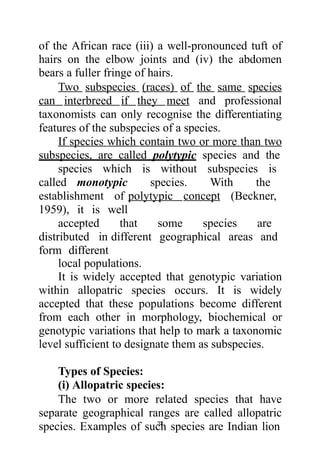
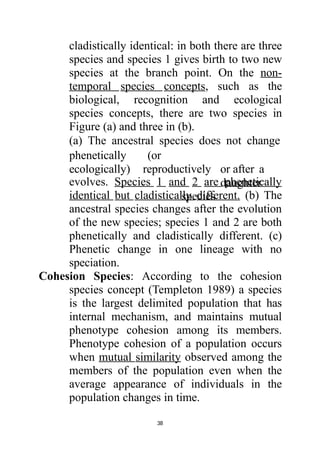
  • 89.
    89 indices are: Shannon’sdiversity and Simpson’s diversity indices. Shannon Diversity Index The Shannon index increases as both the richness and the evenness of the community increase. The fact that the index incorporates both components of biodiversity can be seen as both a strength and a weakness. It is a strength because it provides a simple, synthetic summary, but it is a weakness because it makes it difficult to compare communities that differ greatly in richness. Typical values are generally between 1.5 and 3.5 in most ecological studies, and the index is rarely greater than 4. H’ = – Σ pi In pi Where, H’ = Shannon index of diversity pi = the proportion of important value of the ith species (pi = ni / N, ni is the important value index of ith species and N is the important value index of all the species). To calculate the index:
  • 90.
    90 1.Divide the numberof individuals of species #1 you found in your sample by the total number of individuals of all species. This is pi 2.Multiply the fraction by its natural log (pi * ln pi) 3.Repeat this for all of the different species that you have. 4.Sum all the - (pi * ln pi) products to get the value of H’ Example 1: S. No. Name of species N pi lnpi pi lnpi 1 Pigeon 10 0.05 - 2.912 - 0.158279927 2 Robin 4 0.02 - 3.829 - 0.083231335 3 Myna 9 0.05 - 3.018 - 0.147605438 4 Crow 7 0.04 - 3.269 - 0.124365105 5 House sparrow 11 0.06 - 2.817 - 0.168410029 6 Grasshopper 15 0.08 - 2.507 -0.20436567 7 Butterfly 11 0.06 - 2.817 - 0.168410029
  • 91.
    91 8 Snake 1 0.01 - 5.215 - 0.028342042 9 Frog12 0.07 - 2.730 - 0.178045377 10 Monkey 10 0.05 - 2.912 - 0.158279927 11 Owl 4 0.02 - 3.829 - 0.083231335 12 Chital 18 0.10 - 2.325 -0.227403 13 Drango 21 0.11 - 2.170 - 0.247710216 14 Blue Jay 15 0.08 - 2.507 -0.20436567 15 Egret 17 0.09 - 2.382 -0.22005044 16 Heron 19 0.10 - 2.270 - 0.234453472 Total 184 1 -47.5 - 2.636549012 H = 2.636 Example 2: Birds Ni Pi ln Pi - (Pi * ln Pi) Pigeon 96 .96 -.041 .039 Robin 1 .01 -4.61 .046 Starling 1 .01 -4.61 .046
  • 92.
    92 Crow 1 .01-4.61 .046 House sparrow 1 .01 -4.61 .046 H = 0.223 High values of H’ would be representative of more diverse communities. A community with only one species would have an H’ value of 0 because pi would equal 1 and be multiplied by ln pi which would equal zero. If the species are evenly distributed then the H’ value would be high. So the H’ value allows us to know not only the number of species but how the abundance of the species is distributed among all the species in the community. Evaluation of Dominance Index (Simpson’s index): Dominance is one of the most important concepts in the study of animal social behaviour. Dominance hierarchies in groups arise from dyadic relationships between dominant and subordinate individuals present in a social group. In concrete way, dominance is an important indicator of species composition in a habitat. The dominance of a species refers to its relative importance in its habitat, which determines the degree of influence of the species on the ecosystem. Ecologists have
  • 93.
    spent much effortand imagination to establish and quantify interrelationships among these biological or physical processes components, and to identify the underlying that influence them, e.g., extinction, immigration, colonization, niche segregation, competition, predation, environmental control, disturbances, and historical dynamics. The Simpson index is a dominance index because it gives more weight to common or dominant species. In this case, a few rare species with only a few representatives will not affect the diversity. Simpson’s index D = Σ (pi)2 Where, D = Simpson index of dominance pi = the proportion of important value of the ith species (pi = ni / N, ni is the important value index of ith species and N is the important value index of all the species). As D increases, diversity decreases and Simpson’s index was therefore usually expressed as 1 – D or 1/ D. Example 1 (site 1) 93
  • 94.
    94 Order n Pipi2 ln pi pi ln pi Orthoptera (grasshopper) 6 0.222222 0.049383 - 1.50408 - 0.33424 Orthoptera (grasshopper) 5 0.185185 0.034294 -1.6864 -0.3123 Lepidoptera (butterfly) 1 0.037037 0.001372 3.29584 0.12207 Lepidoptera (butterfly) 3 0.111111 0.012346 - 2.19722 - 0.24414 Coleoptera (beetle) 12 0.444444 0.197531 - 0.81093 - 0.36041 27 1 0.294925 = Σ(pi)2 = D - 9.49447 - 1.37315 1/ Σ(pi)2 = D 3.390698 Number of species = 5 Total number of individuals = 27 Σ (pi)2 = 0.294 Σ pi ln pi = -1.373 H’ = -(-0.334 + -0.312 + -0.122 + -0.244 + -0.360) = 1.373 D = 1/(0.049 + 0.034 + 0.001 + 0.012 + 0.197) = 1/0.294 = 3.390 Example 2 (site 2) Order (n) Pi pi2 ln pi pi ln pi Orthoptera (grasshopper) 99 0.99 0.9801 - 0.01005 - 0.00995
  • 95.
    95 Orthoptera (grasshopper) 1 0.010.0001 - 4.60517 - 0.04605 100 1 0.9802 = Σ(pi)2 = D - 4.61522 -0.056 1- Σ(pi)2 = D 0.020
  • 96.
    96 Similarity and DissimilarityIndex In comparing species composition and biodiversity of two or more assemblages in taxonomic and ecological research, similarity (or overlap) or dissimilarity (or distance) indices provide quantitative bases of assessment. A large number of similarity indices based on presence / absence data have been proposed in the literature. The two classic and the most widely used indices are the Jaccard and Sorensen indices. The Jaccard index and Sorensen index are the two oldest and most widely used similarity indices for assessing compositional similarity of assemblages (sometimes called species overlap) and hence, its complement, dissimilarity. Both measures are based on the presence/absence of species in paired assemblages and are simple to compute. Many other similarity indices exist that are based on the same information: the number of species shared by two samples and the number of species unique to each of them, and new indices continue to appear. Jaccard Index: Uses presence/absence data (i.e., ignores info about abundance)
  • 97.
    SJ = Where, a a+b+ c SJ =Jaccard similarity coefficient, a = number of species common to (shared by) quadrats, b = number of species unique to the first quadrat, and c = number of species unique to the second quadrat Quadrat sp 1 sp 2 sp 3 sp 4 sp 5 sp 6 I 3 4 2 1 0 0 J 3 3 0 5 2 1 kyki = 3 + 4 + 2 + 1 + 0 + 0 = 10 kykj = 3 + 3 + 0 + 5 + 2 + 1 = 14 2 2 2 2 2 2 2 kyki = 3 + 4 + 2 + 1 + 0 + 0 = 30 2 2 2 2 2 2 2 kykj = 3 + 3 + 0 + 5 + 2 + 1 = 48 kykiykj = 3(3) + 4(3) + 2(0) + 1(5) + 0(2) + 0(1) = 26 Quadrat sp 1 sp 2 sp 3 sp 4 sp 5 sp 6 Total I 3 4 2 1 0 0 10 J 3 3 0 5 2 1 14 26 = a I2 9 16 4 1 0 0 30 = b 104 = a+b+c J2 9 9 0 25 4 1 48 = c 0.25 (a/a+b+c) Similarity IxJ 9 12 0 5 0 0 26 = a 0.75 = DJ = 1.0- SJ Dissimilarity This index can be modified to a coefficient of dissimilarity by taking its inverse: Jaccard's dissimilarity coefficient  1Sj (i.e., DJ = 1.0 - SJ) 97
  • 98.
    Sorensen’s Index: o Thismeasure is very similar to the Jaccard measure, and was first used by Czekanowski in 1913 and discovered anew by Sorensen (1948). o Give greater "weight" to species common to the quadrats than to those found in only one quadrat. o Indices of similarity and dissimilarity were calculated by using formulae as per Misra (1989) and Sorensen (1948) as follows: Index of similarity (S) = 2C/A+B Where, A = Number of species in the community A B = Number of species in the community B C = Number of common species in both the communities. Index of dissimilarity = 1-S Example 1: There are 20 species found in community 1 and 25 in community 2. Between them, they have 5 species in common. The calculation would be: 2∗ 5 Sorenson’s Coefficient (CC) = 0.222 20+2 5 = 10/45 = 98 According to Sorenson’s coefficient, these much overlap or communities do not have similarity.
  • 99.
    Example 2: There are15 species found in community 1 and 25 in community 2. Between them, they have 12 species in common. The calculation would be: Sorenson’s Coefficient (CC) = 2∗1 2 15+2 5 = 24/40 = 0.6 99 According communities similarity. coefficient, these to Sorenson’s have quite a bit of overlap or