M.Sc.II Sem - III
Paper X- Taxonomy of Angiosperms
Unit III
Dr. Swati Pundkar
Assistant Professor
Department of Botany
Shri Shivaji Science College, Amravati.
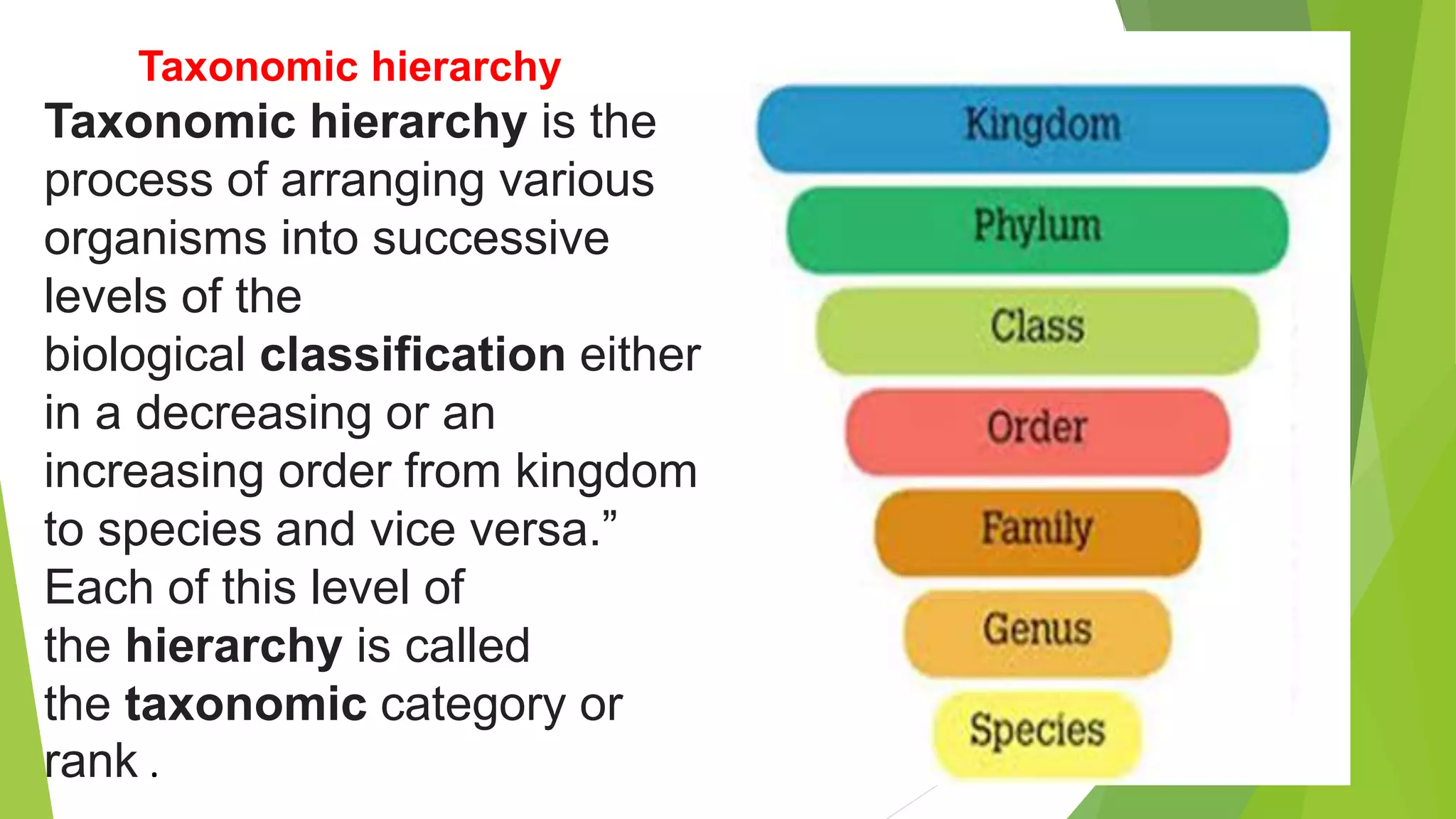
Taxonomic hierarchy
Taxonomic hierarchy is the
process of arranging various
organisms into successive
levels of the
biological classification either
in a decreasing or an
increasing order from kingdom
to species and vice versa.”
Each of this level of
the hierarchy is called
the taxonomic category or
rank .
Kingdom is the highest level or rank of the classification.
Example: Plantae
Division is the next level of classification that consists of
number of classes.
Example: Magnoliophyta.
Class consists of group of orders which share few
similarities.
Order includes group of families which show less
similarities among them.
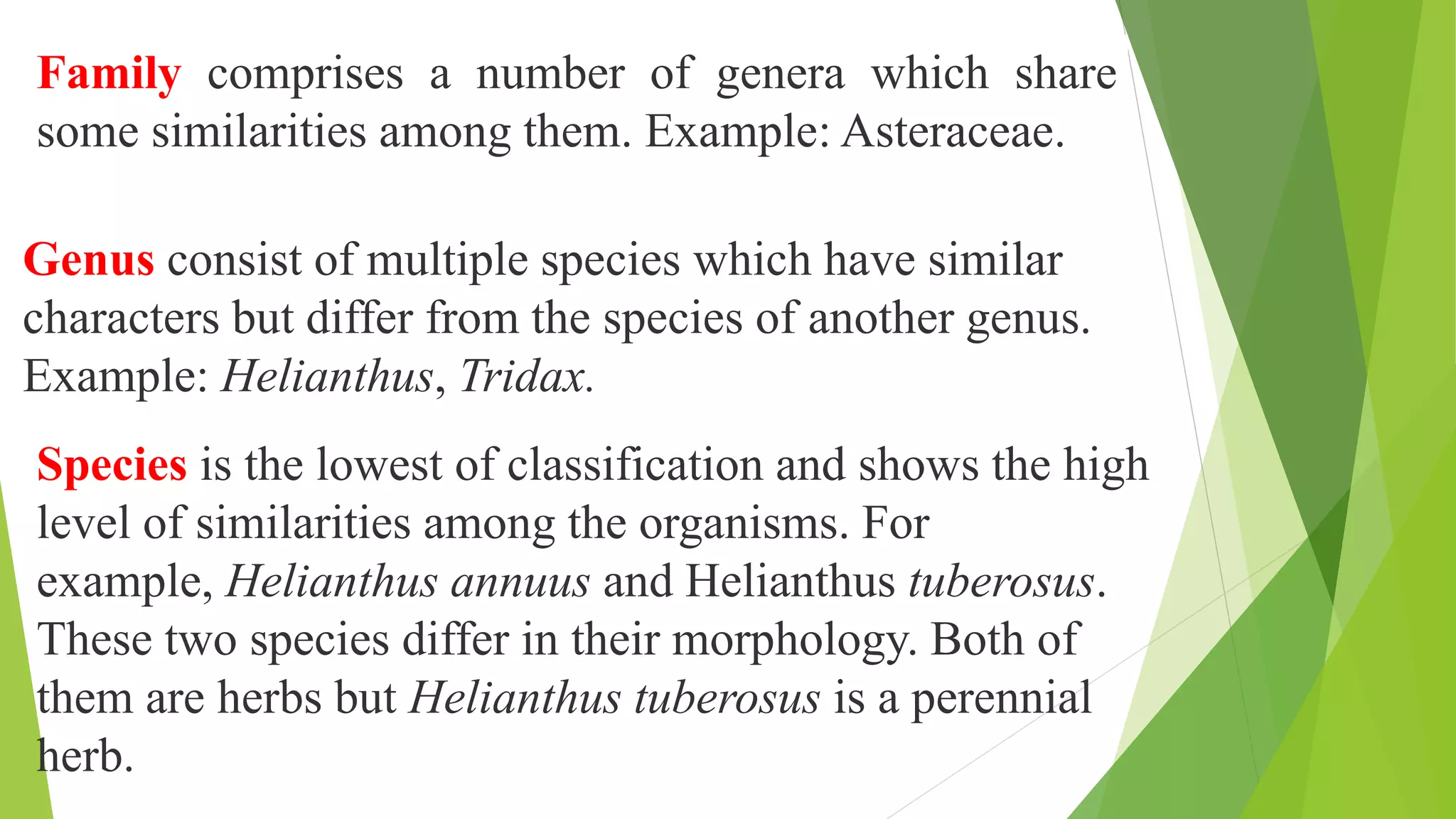
Family comprises a number of genera which share
some similarities among them. Example: Asteraceae.
Genus consist of multiple species which have similar
characters but differ from the species of another genus.
Example: Helianthus, Tridax.
Species is the lowest of classification and shows the high
level of similarities among the organisms. For
example, Helianthus annuus and Helianthus tuberosus.
These two species differ in their morphology. Both of
them are herbs but Helianthus tuberosus is a perennial
herb.
Advantages of Taxonomic hierarchy
1)Grouping of living organisms into different categories
on the basis of degrees of diversity exhibited by them
is possible.
2)Such classification helps one to refer a particular group
of plants into appropriate classes.
There are two main categories
1)Major Categories-
Subdivision, Class, Order are together called Major
categories
2) Minor Categories-
Genus, Species, Variety are called Minor categories
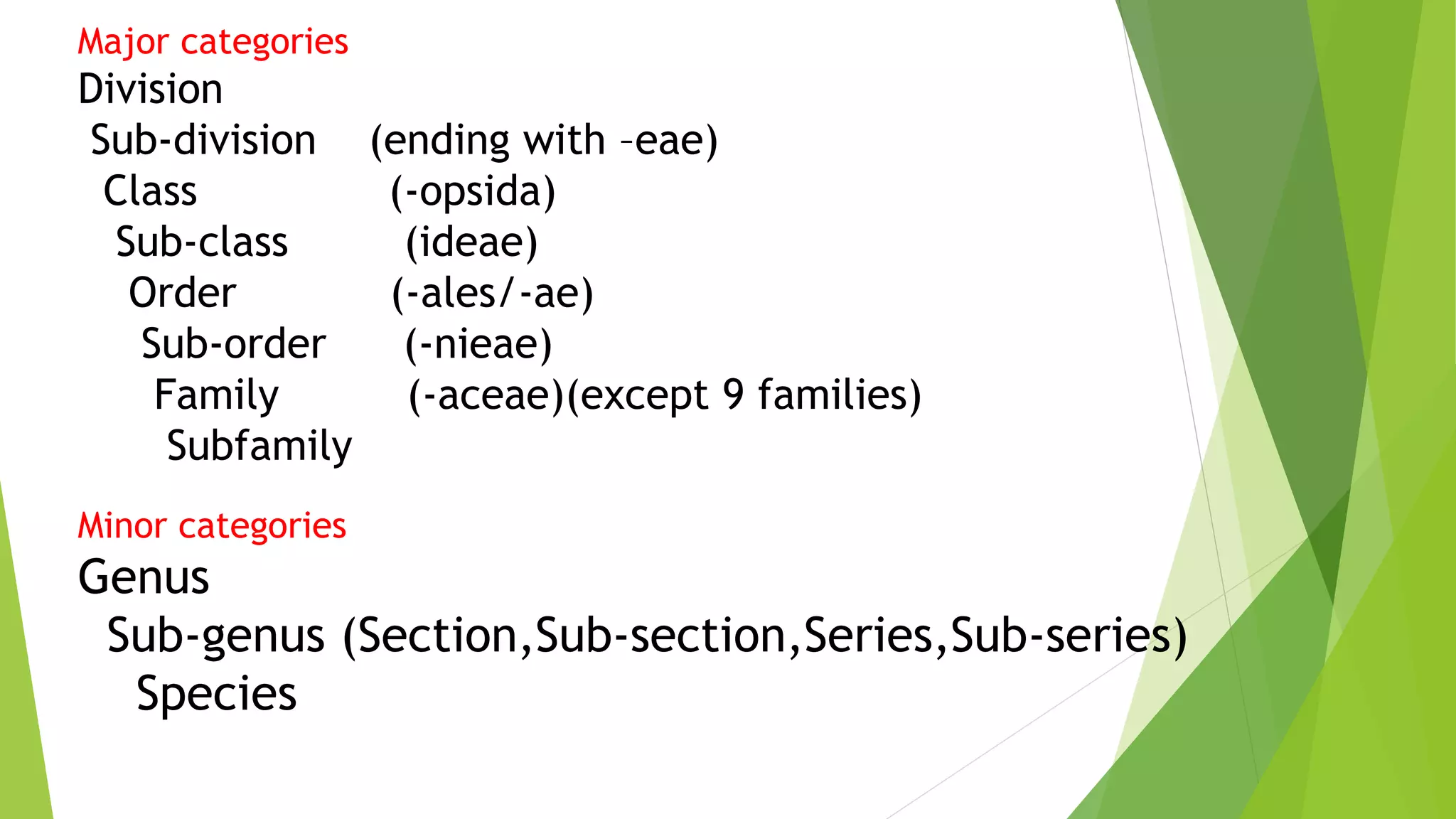
Major categories
Division
Sub-division (ending with –eae)
Class (-opsida)
Sub-class (ideae)
Order (-ales/-ae)
Sub-order (-nieae)
Family (-aceae)(except 9 families)
Subfamily
Minor categories
Genus
Sub-genus (Section,Sub-section,Series,Sub-series)
Species
Infraspecific Categories-
Any category below the rank of spices is Infraspecific
category.
Most commonly used categories of this group are sub-
species, Variety and Forma.

Taxonomic hierarchy

  • 1.
    M.Sc.II Sem -III Paper X- Taxonomy of Angiosperms Unit III Dr. Swati Pundkar Assistant Professor Department of Botany Shri Shivaji Science College, Amravati.
  • 9.
    Taxonomic hierarchy Taxonomic hierarchyis the process of arranging various organisms into successive levels of the biological classification either in a decreasing or an increasing order from kingdom to species and vice versa.” Each of this level of the hierarchy is called the taxonomic category or rank .
  • 12.
    Kingdom is thehighest level or rank of the classification. Example: Plantae Division is the next level of classification that consists of number of classes. Example: Magnoliophyta. Class consists of group of orders which share few similarities. Order includes group of families which show less similarities among them.
  • 13.
    Family comprises anumber of genera which share some similarities among them. Example: Asteraceae. Genus consist of multiple species which have similar characters but differ from the species of another genus. Example: Helianthus, Tridax. Species is the lowest of classification and shows the high level of similarities among the organisms. For example, Helianthus annuus and Helianthus tuberosus. These two species differ in their morphology. Both of them are herbs but Helianthus tuberosus is a perennial herb.
  • 14.
    Advantages of Taxonomichierarchy 1)Grouping of living organisms into different categories on the basis of degrees of diversity exhibited by them is possible. 2)Such classification helps one to refer a particular group of plants into appropriate classes. There are two main categories 1)Major Categories- Subdivision, Class, Order are together called Major categories 2) Minor Categories- Genus, Species, Variety are called Minor categories
  • 15.
    Major categories Division Sub-division (endingwith –eae) Class (-opsida) Sub-class (ideae) Order (-ales/-ae) Sub-order (-nieae) Family (-aceae)(except 9 families) Subfamily Minor categories Genus Sub-genus (Section,Sub-section,Series,Sub-series) Species
  • 16.
    Infraspecific Categories- Any categorybelow the rank of spices is Infraspecific category. Most commonly used categories of this group are sub- species, Variety and Forma.