BSc Part II ( Sem
Chapter I
Angiosperm Systematic And Biodiversity
Sem – III)
Chapter I
Angiosperm Systematic And Biodiversity
Presented by
Dr. Reshma P . Sonwalkar
Assistant Professor
Jijamata mahavidyalaya Buldana
•Topic
I- Origin and Evolution of Angiosperm
. Introduction
II- Botanical Nomenclature
. Plant nomenclature
. Binomial Nomenclature
III- Principles of International code of Botanical Nomenclature(
ICBN)
Topic
Origin and Evolution of Angiosperm
Principles of International code of Botanical Nomenclature(
Origin and evolution of angiosperm
Introduction:
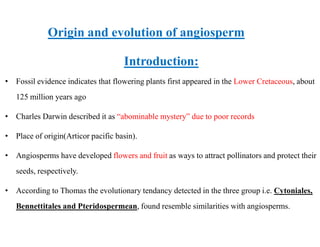
• Fossil evidence indicates that flowering plants first appeared in the
125 million years ago
• Charles Darwin described it as “abominable mystery” due to poor records
• Place of origin(Articor pacific basin).
• Angiosperms have developed flowers and fruit
seeds, respectively.
• According to Thomas the evolutionary tendancy
Bennettitales and Pteridospermean, found resemble similarities with angiosperms.
Origin and evolution of angiosperm
Introduction:
evidence indicates that flowering plants first appeared in the Lower Cretaceous, about
“abominable mystery” due to poor records
flowers and fruit as ways to attract pollinators and protect their
tendancy detected in the three group i.e. Cytoniales,
, found resemble similarities with angiosperms.
Pteridospermean
Accordinf to different workesrs various orders of
Equsetales are ancester of the angiosperm
According to some workers Seed ferns that is pteridopserms
Steller structure and available fossils record favour
absence of vessels in the secondary wood of same primitive angiosperm and in seed ferns
In both , the sporangiale development is eusporangiate and
Pteridopserm ancestry of angiosperm is insupportable because of some objection .
1.The scalariform xylem elements never occur in
2. No satisfacrory explanarion is given for cupule in comparison with
Pteridospermean Theory
various orders of Pteridophytes such as Psilophytales , Lycopodial
pteridopserms where the ancestor of angiosperm
favour this theory.
in the secondary wood of same primitive angiosperm and in seed ferns
eusporangiate and amphiphloicstele is common.
ancestry of angiosperm is insupportable because of some objection .
xylem elements never occur in pteriodopsperm while they are common in angio
is given for cupule in comparison with multiovulate cupules.
Bennettitalean
• This theory was first proposed by Saporta and Marion
• According to this theory the nature and organization
the Bennettitales are similar with the flower of
• Benettitales as possible ancestor of angiosperms
and Magnoliaand Magnolia
• Strobili and flower both are bisexual.
• Elongated central axis having bracts, micro and
• Carpel bear single ovule
• Contradiction with stem anatomy disappoints
Bennettitalean Theory
Marion (1885) followed by Arber and Parkin (1907
organization of the reproductive structure of the mem
of angiosperm
angiosperms for similarities between the strobili of Cycade
and megasporophylls.
this theory.
Botanical Nomenclature
• Defination –
Botanical nomenclature is the formal, scientific naming of plants
• That means the name assigned to a particular plant species is based on the
botanical nomenclature system, particularly the International Code of Nomenclature
fungi, and plants (ICN).fungi, and plants (ICN).
• Plant Nomenclature: Correct naming of the group according to the accepted rules.
• Binomial nomenclature: A system of nomenclature of plants and animals in which the
name consist of two words or Parts of epithets
• It was introduced by Linnaeus in his book “
Botanical Nomenclature
formal, scientific naming of plants.
That means the name assigned to a particular plant species is based on the rules within the
botanical nomenclature system, particularly the International Code of Nomenclature for algae
: Correct naming of the group according to the accepted rules.
A system of nomenclature of plants and animals in which the scien
name consist of two words or Parts of epithets( Generic epithets and species epithet )
It was introduced by Linnaeus in his book “ species plantarum”published in 1753
Binomial Nomenclature
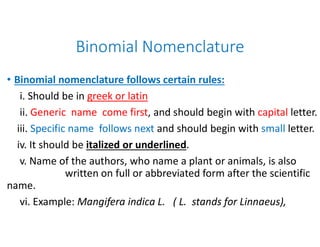
• Binomial nomenclature follows certain rules:
i. Should be in greek or latin
ii. Generic name come first, and should begin with
iii. Specific name follows next and should begin withiii. Specific name follows next and should begin with
iv. It should be italized or underlined
v. Name of the authors, who name a plant or animals, is also
written on full or abbreviated form after the scientific
name.
vi. Example: Mangifera indica L. ( L. stands for Linnaeus),
Binomial Nomenclature
Binomial nomenclature follows certain rules:
, and should begin with capital letter.
and should begin with small letter.and should begin with small letter.
or underlined.
v. Name of the authors, who name a plant or animals, is also
written on full or abbreviated form after the scientific
L. ( L. stands for Linnaeus),
Principles of International Code of Botanical Nomenclature, (ICBN):
• Linnaeus called his principle as aphorisms
• International Code of Botanical Nomenclature
with formal botanical names that are given to plants.
• Its main aim is that each taxon has only one correct name and that is accepted
it is also known as legitimate name.
• Principle:
• Botanical nomenclature is independent of zoological nomenclature.
• The code applies equally to names of taxonomic groups treated as plants whether or not these
groups were originally so treated (Plants do not include Bacteria).
Principles of International Code of Botanical Nomenclature, (ICBN):
International Code of Botanical Nomenclature is the set of rules and recommendations dea
with formal botanical names that are given to plants.
Its main aim is that each taxon has only one correct name and that is accepted throughtout the
Botanical nomenclature is independent of zoological nomenclature.
The code applies equally to names of taxonomic groups treated as plants whether or not these
groups were originally so treated (Plants do not include Bacteria).
• Application of names of taxonomic groups is determined by means of
nomenclature types.
• The nomenclature of a taxonomic group is based upon
• Each taxonomic group with a particular circumscription, position, and route
can bear only one correct name, the earliest that is in accordance with thecan bear only one correct name, the earliest that is in accordance with the
rules, except in specific cases.
• Scientific names of taxonomic groups are treated as Latin regardless of their
derivation.
• The rules of nomenclature are retroactive unless expressly limited.
Application of names of taxonomic groups is determined by means of
The nomenclature of a taxonomic group is based upon priority of publication
Each taxonomic group with a particular circumscription, position, and route
can bear only one correct name, the earliest that is in accordance with thecan bear only one correct name, the earliest that is in accordance with the
Scientific names of taxonomic groups are treated as Latin regardless of their
The rules of nomenclature are retroactive unless expressly limited.
Taxonomic Rank
• Taxonomy : Taxonomy is the branch of biology that deals with the
nomenclature & classification of organisms
• Taxonomic hierarchy is the process of arranging various organisms into
successive levels of the biological classification either in a decreasing or an
increasing order from kingdom to species and vice versa.”
• Each of this level of the hierarchy is called the
• kingdom is always ranked the highest
genus, and species.
Taxonomic Rank
: Taxonomy is the branch of biology that deals with the identificat
nomenclature & classification of organisms
is the process of arranging various organisms into
successive levels of the biological classification either in a decreasing or an
increasing order from kingdom to species and vice versa.”
Each of this level of the hierarchy is called the taxonomic category or rank.
highest followed by division, class, order, famil
• Division : The number of groups in this taxon is not fixed, it depends on the
classification system.
• Based on similar characteristics observed on a few elements or organs
of a sporophyte to a gametophyte, presence of an ovule, seed formation and several
other morphological and anatomical characteristics
• Order : Separation is based on a more convincing genetic relationship which earlier had
been detected at the class and division level.been detected at the class and division level.
• Familiy : Based on more characteristics compared to order, class and division e.g. the
morphological characteristics of reproductive organs (inflorescence, ovary position,
placentation, number of pistils and carpels, types of ovule and androecium)
• Genus : Genus involves more similar characteristics including a closer family
relationship but they do not cross. If a hybrid cross does occur the
normally infertile or will not survive.
: The number of groups in this taxon is not fixed, it depends on the
similar characteristics observed on a few elements or organs e.g. : dominance
of a sporophyte to a gametophyte, presence of an ovule, seed formation and several
other morphological and anatomical characteristics
: Separation is based on a more convincing genetic relationship which earlier had
been detected at the class and division level.been detected at the class and division level.
: Based on more characteristics compared to order, class and division e.g. the
morphological characteristics of reproductive organs (inflorescence, ovary position,
placentation, number of pistils and carpels, types of ovule and androecium)
: Genus involves more similar characteristics including a closer family
relationship but they do not cross. If a hybrid cross does occur the offsprings are
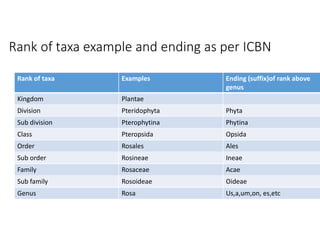
Rank of taxa example and ending as per ICBN
Rank of taxa Examples
Kingdom Plantae
Division Pteridophyta
Sub division PterophytinaSub division Pterophytina
Class Pteropsida
Order Rosales
Sub order Rosineae
Family Rosaceae
Sub family Rosoideae
Genus Rosa
Rank of taxa example and ending as per ICBN
Ending (suffix)of rank above
genus
Phyta
PhytinaPhytina
Opsida
Ales
Ineae
Acae
Oideae
Us,a,um,on, es,etc
• Nomenclatural Type:
The nomenclatural type is that constituent element (a spec-imen, or a description or a figure) of
taxon to which the name is permanently at­tached
representative element but is the original material on which the description of the taxon is based
• Holotype: Specimen or other element designated by the author or used by him as the nomenclat
type.
• Isotype:
• This is a duplicate of the holotype.
• Syntype:• Syntype:
• When more than one specimen are cited by the author without mentioning which is the holotype
each specimen is designated as a Syntype.
• Paratype:
• Specimens cited along with the holotype are designated as Para
• Neotype:
• When all original materials are missing a Neotype
• Topotype: Specimen of a species collected at the same locality as the holo-type.
The nomenclatural type is that constituent element (a spec-imen, or a description or a figure) of
name is permanently at­tached. This need not be the most typical or
representative element but is the original material on which the description of the taxon is based
Specimen or other element designated by the author or used by him as the nomenclat
When more than one specimen are cited by the author without mentioning which is the holotype
Specimens cited along with the holotype are designated as Para- types.
Neotype is selected from other materials.
Specimen of a species collected at the same locality as the holo-type.
Valid Publication
• Any printed matter when widely circulated is re-garded as effectively published.
• Valid publication of a name of new taxon is necessary to have it effectively published, to have a
correct form and to be accompanied by a description or diagnosis or a reference to a previously
published description. For the name of a new taxon to be valid it is necessary that
the diagnosis should be in Latin.the diagnosis should be in Latin.
• Those published earlier to 1st Jan. 1935 are considered valid even if the description or diagnosi
not in Latin. In the case of Algae the date has been fixed as 1st Jan. 1958 instead of 1st Jan.
1935Publication of a new name of the rank of family or below on or after 1st January, 1958 is n
considered valid if the type is not indicated.
Valid Publication:
Any printed matter when widely circulated is re-garded as effectively published.
Valid publication of a name of new taxon is necessary to have it effectively published, to have a
correct form and to be accompanied by a description or diagnosis or a reference to a previously
For the name of a new taxon to be valid it is necessary that the descriptio
Those published earlier to 1st Jan. 1935 are considered valid even if the description or diagnosi
not in Latin. In the case of Algae the date has been fixed as 1st Jan. 1958 instead of 1st Jan.
1935Publication of a new name of the rank of family or below on or after 1st January, 1958 is n
• The name of a taxon below the rank of a genus is not validly
published unless the name of the genus or species to which it is
assigned is validly published.
• He who first validly published the name of a taxon is the author
of that name. It is necessary to cite the name of the author after
the name of the taxon.
The name of a taxon below the rank of a genus is not validly
published unless the name of the genus or species to which it is
assigned is validly published.
He who first validly published the name of a taxon is the author
of that name. It is necessary to cite the name of the author after
Thanking youThanking youThanking youThanking you

Angiosperm systematics and biodiversity

  • 1.
    BSc Part II( Sem Chapter I Angiosperm Systematic And Biodiversity Sem – III) Chapter I Angiosperm Systematic And Biodiversity Presented by Dr. Reshma P . Sonwalkar Assistant Professor Jijamata mahavidyalaya Buldana
  • 2.
    •Topic I- Origin andEvolution of Angiosperm . Introduction II- Botanical Nomenclature . Plant nomenclature . Binomial Nomenclature III- Principles of International code of Botanical Nomenclature( ICBN) Topic Origin and Evolution of Angiosperm Principles of International code of Botanical Nomenclature(
  • 3.
    Origin and evolutionof angiosperm Introduction: • Fossil evidence indicates that flowering plants first appeared in the 125 million years ago • Charles Darwin described it as “abominable mystery” due to poor records • Place of origin(Articor pacific basin). • Angiosperms have developed flowers and fruit seeds, respectively. • According to Thomas the evolutionary tendancy Bennettitales and Pteridospermean, found resemble similarities with angiosperms. Origin and evolution of angiosperm Introduction: evidence indicates that flowering plants first appeared in the Lower Cretaceous, about “abominable mystery” due to poor records flowers and fruit as ways to attract pollinators and protect their tendancy detected in the three group i.e. Cytoniales, , found resemble similarities with angiosperms.
  • 4.
    Pteridospermean Accordinf to differentworkesrs various orders of Equsetales are ancester of the angiosperm According to some workers Seed ferns that is pteridopserms Steller structure and available fossils record favour absence of vessels in the secondary wood of same primitive angiosperm and in seed ferns In both , the sporangiale development is eusporangiate and Pteridopserm ancestry of angiosperm is insupportable because of some objection . 1.The scalariform xylem elements never occur in 2. No satisfacrory explanarion is given for cupule in comparison with Pteridospermean Theory various orders of Pteridophytes such as Psilophytales , Lycopodial pteridopserms where the ancestor of angiosperm favour this theory. in the secondary wood of same primitive angiosperm and in seed ferns eusporangiate and amphiphloicstele is common. ancestry of angiosperm is insupportable because of some objection . xylem elements never occur in pteriodopsperm while they are common in angio is given for cupule in comparison with multiovulate cupules.
  • 5.
    Bennettitalean • This theorywas first proposed by Saporta and Marion • According to this theory the nature and organization the Bennettitales are similar with the flower of • Benettitales as possible ancestor of angiosperms and Magnoliaand Magnolia • Strobili and flower both are bisexual. • Elongated central axis having bracts, micro and • Carpel bear single ovule • Contradiction with stem anatomy disappoints Bennettitalean Theory Marion (1885) followed by Arber and Parkin (1907 organization of the reproductive structure of the mem of angiosperm angiosperms for similarities between the strobili of Cycade and megasporophylls. this theory.
  • 6.
    Botanical Nomenclature • Defination– Botanical nomenclature is the formal, scientific naming of plants • That means the name assigned to a particular plant species is based on the botanical nomenclature system, particularly the International Code of Nomenclature fungi, and plants (ICN).fungi, and plants (ICN). • Plant Nomenclature: Correct naming of the group according to the accepted rules. • Binomial nomenclature: A system of nomenclature of plants and animals in which the name consist of two words or Parts of epithets • It was introduced by Linnaeus in his book “ Botanical Nomenclature formal, scientific naming of plants. That means the name assigned to a particular plant species is based on the rules within the botanical nomenclature system, particularly the International Code of Nomenclature for algae : Correct naming of the group according to the accepted rules. A system of nomenclature of plants and animals in which the scien name consist of two words or Parts of epithets( Generic epithets and species epithet ) It was introduced by Linnaeus in his book “ species plantarum”published in 1753
  • 7.
    Binomial Nomenclature • Binomialnomenclature follows certain rules: i. Should be in greek or latin ii. Generic name come first, and should begin with iii. Specific name follows next and should begin withiii. Specific name follows next and should begin with iv. It should be italized or underlined v. Name of the authors, who name a plant or animals, is also written on full or abbreviated form after the scientific name. vi. Example: Mangifera indica L. ( L. stands for Linnaeus), Binomial Nomenclature Binomial nomenclature follows certain rules: , and should begin with capital letter. and should begin with small letter.and should begin with small letter. or underlined. v. Name of the authors, who name a plant or animals, is also written on full or abbreviated form after the scientific L. ( L. stands for Linnaeus),
  • 8.
    Principles of InternationalCode of Botanical Nomenclature, (ICBN): • Linnaeus called his principle as aphorisms • International Code of Botanical Nomenclature with formal botanical names that are given to plants. • Its main aim is that each taxon has only one correct name and that is accepted it is also known as legitimate name. • Principle: • Botanical nomenclature is independent of zoological nomenclature. • The code applies equally to names of taxonomic groups treated as plants whether or not these groups were originally so treated (Plants do not include Bacteria). Principles of International Code of Botanical Nomenclature, (ICBN): International Code of Botanical Nomenclature is the set of rules and recommendations dea with formal botanical names that are given to plants. Its main aim is that each taxon has only one correct name and that is accepted throughtout the Botanical nomenclature is independent of zoological nomenclature. The code applies equally to names of taxonomic groups treated as plants whether or not these groups were originally so treated (Plants do not include Bacteria).
  • 9.
    • Application ofnames of taxonomic groups is determined by means of nomenclature types. • The nomenclature of a taxonomic group is based upon • Each taxonomic group with a particular circumscription, position, and route can bear only one correct name, the earliest that is in accordance with thecan bear only one correct name, the earliest that is in accordance with the rules, except in specific cases. • Scientific names of taxonomic groups are treated as Latin regardless of their derivation. • The rules of nomenclature are retroactive unless expressly limited. Application of names of taxonomic groups is determined by means of The nomenclature of a taxonomic group is based upon priority of publication Each taxonomic group with a particular circumscription, position, and route can bear only one correct name, the earliest that is in accordance with thecan bear only one correct name, the earliest that is in accordance with the Scientific names of taxonomic groups are treated as Latin regardless of their The rules of nomenclature are retroactive unless expressly limited.
  • 10.
    Taxonomic Rank • Taxonomy: Taxonomy is the branch of biology that deals with the nomenclature & classification of organisms • Taxonomic hierarchy is the process of arranging various organisms into successive levels of the biological classification either in a decreasing or an increasing order from kingdom to species and vice versa.” • Each of this level of the hierarchy is called the • kingdom is always ranked the highest genus, and species. Taxonomic Rank : Taxonomy is the branch of biology that deals with the identificat nomenclature & classification of organisms is the process of arranging various organisms into successive levels of the biological classification either in a decreasing or an increasing order from kingdom to species and vice versa.” Each of this level of the hierarchy is called the taxonomic category or rank. highest followed by division, class, order, famil
  • 11.
    • Division :The number of groups in this taxon is not fixed, it depends on the classification system. • Based on similar characteristics observed on a few elements or organs of a sporophyte to a gametophyte, presence of an ovule, seed formation and several other morphological and anatomical characteristics • Order : Separation is based on a more convincing genetic relationship which earlier had been detected at the class and division level.been detected at the class and division level. • Familiy : Based on more characteristics compared to order, class and division e.g. the morphological characteristics of reproductive organs (inflorescence, ovary position, placentation, number of pistils and carpels, types of ovule and androecium) • Genus : Genus involves more similar characteristics including a closer family relationship but they do not cross. If a hybrid cross does occur the normally infertile or will not survive. : The number of groups in this taxon is not fixed, it depends on the similar characteristics observed on a few elements or organs e.g. : dominance of a sporophyte to a gametophyte, presence of an ovule, seed formation and several other morphological and anatomical characteristics : Separation is based on a more convincing genetic relationship which earlier had been detected at the class and division level.been detected at the class and division level. : Based on more characteristics compared to order, class and division e.g. the morphological characteristics of reproductive organs (inflorescence, ovary position, placentation, number of pistils and carpels, types of ovule and androecium) : Genus involves more similar characteristics including a closer family relationship but they do not cross. If a hybrid cross does occur the offsprings are
  • 12.
    Rank of taxaexample and ending as per ICBN Rank of taxa Examples Kingdom Plantae Division Pteridophyta Sub division PterophytinaSub division Pterophytina Class Pteropsida Order Rosales Sub order Rosineae Family Rosaceae Sub family Rosoideae Genus Rosa Rank of taxa example and ending as per ICBN Ending (suffix)of rank above genus Phyta PhytinaPhytina Opsida Ales Ineae Acae Oideae Us,a,um,on, es,etc
  • 13.
    • Nomenclatural Type: Thenomenclatural type is that constituent element (a spec-imen, or a description or a figure) of taxon to which the name is permanently at­tached representative element but is the original material on which the description of the taxon is based • Holotype: Specimen or other element designated by the author or used by him as the nomenclat type. • Isotype: • This is a duplicate of the holotype. • Syntype:• Syntype: • When more than one specimen are cited by the author without mentioning which is the holotype each specimen is designated as a Syntype. • Paratype: • Specimens cited along with the holotype are designated as Para • Neotype: • When all original materials are missing a Neotype • Topotype: Specimen of a species collected at the same locality as the holo-type. The nomenclatural type is that constituent element (a spec-imen, or a description or a figure) of name is permanently at­tached. This need not be the most typical or representative element but is the original material on which the description of the taxon is based Specimen or other element designated by the author or used by him as the nomenclat When more than one specimen are cited by the author without mentioning which is the holotype Specimens cited along with the holotype are designated as Para- types. Neotype is selected from other materials. Specimen of a species collected at the same locality as the holo-type.
  • 14.
    Valid Publication • Anyprinted matter when widely circulated is re-garded as effectively published. • Valid publication of a name of new taxon is necessary to have it effectively published, to have a correct form and to be accompanied by a description or diagnosis or a reference to a previously published description. For the name of a new taxon to be valid it is necessary that the diagnosis should be in Latin.the diagnosis should be in Latin. • Those published earlier to 1st Jan. 1935 are considered valid even if the description or diagnosi not in Latin. In the case of Algae the date has been fixed as 1st Jan. 1958 instead of 1st Jan. 1935Publication of a new name of the rank of family or below on or after 1st January, 1958 is n considered valid if the type is not indicated. Valid Publication: Any printed matter when widely circulated is re-garded as effectively published. Valid publication of a name of new taxon is necessary to have it effectively published, to have a correct form and to be accompanied by a description or diagnosis or a reference to a previously For the name of a new taxon to be valid it is necessary that the descriptio Those published earlier to 1st Jan. 1935 are considered valid even if the description or diagnosi not in Latin. In the case of Algae the date has been fixed as 1st Jan. 1958 instead of 1st Jan. 1935Publication of a new name of the rank of family or below on or after 1st January, 1958 is n
  • 15.
    • The nameof a taxon below the rank of a genus is not validly published unless the name of the genus or species to which it is assigned is validly published. • He who first validly published the name of a taxon is the author of that name. It is necessary to cite the name of the author after the name of the taxon. The name of a taxon below the rank of a genus is not validly published unless the name of the genus or species to which it is assigned is validly published. He who first validly published the name of a taxon is the author of that name. It is necessary to cite the name of the author after
  • 16.