TAXONOMY
A d va n c e P l a n t
I n t r o d u c t i o n t o
A d v a n c e T a x o n o m i c
T e r m i n o l o g y
2.
Introduction
Taxonomy is rathergeneral term,
encompassing classification, nomenclature,
and identification of natural objects.
I n t r o d u c t i o n t o
A d v a n c e T a x o n o m i c
T e r m i n o l o g y
3.
Classification
Plant classification involvesgrouping plants based on their characteristics.
Theophrastus (372-287 B.C.) was one of the earliest to classify about 480 plants
into woody and herbaceous types. Carolus Linnaeus (1707-1778), known as the
father of modern plant taxonomy, introduced binomial nomenclature in his
works Genera Plantarum and Species Plantarum, using a sexual system based on
stamens and pistils. In 1859, Charles Darwin's Origin of Species introduced
phylogenetic classification, revolutionizing scientific thought. Today, modern
plant taxonomists favor a natural system of classification.
I n t r o d u c t i o n t o
A d v a n c e T a x o n o m i c
T e r m i n o l o g y
4.
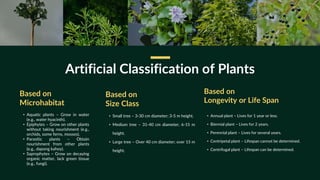
Artificial Classification ofPlants
Based on
Microhabitat
Based on
Size Class
Based on
Longevity or Life Span
• Aquatic plants – Grow in water
(e.g., water hyacinth).
• Epiphytes – Grow on other plants
without taking nourishment (e.g.,
orchids, some ferns, mosses).
• Parasitic plants – Obtain
nourishment from other plants
(e.g., dapong kahoy).
• Saprophytes – Grow on decaying
organic matter, lack green tissue
(e.g., fungi).
• Small tree – 3-30 cm diameter; 3-5 m height.
• Medium tree – 31-40 cm diameter; 6-15 m
height.
• Large tree – Over 40 cm diameter; over 15 m
height.
• Annual plant – Lives for 1 year or less.
• Biennial plant – Lives for 2 years.
• Perennial plant – Lives for several years.
• Centripetal plant – Lifespan cannot be determined.
• Centrifugal plant – Lifespan can be determined.
5.
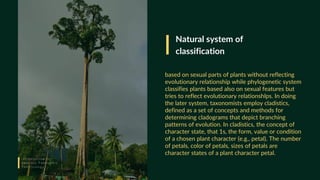
Natural system of
classification
basedon sexual parts of plants without reflecting
evolutionary relationship while phylogenetic system
classifies plants based also on sexual features but
tries to reflect evolutionary relationshlps. In doing
the later system, taxonomists employ cladistics,
defined as a set of concepts and methods for
determining cladograms that depict branching
patterns of evolution. In cladistics, the concept of
character state, that 1s, the form, value or condition
of a chosen plant character (e.g., petal). The number
of petals, color of petals, sizes of petals are
character states of a plant character petal.
I n t r o d u c t i o n t o
A d v a n c e T a x o n o m i c
T e r m i n o l o g y
6.
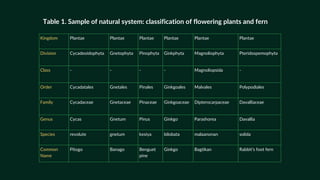
Kingdom Plantae PlantaePlantae Plantae Plantae Plantae
Division Cycadeoidophyta Gnetophyta Pinophyta Ginkphyta Magnoliophyta Pteridospemophyta
Class - - - - Magnoliopsida -
Order Cycadatales Gnetales Pinales Ginkgoales Malvales Polypodiales
Family Cycadaceae Gnetaceae Pinaceae Ginkgoaceae Dipterocarpaceae Davalliaceae
Genus Cycas Gnetum Pinus Ginkgo Parashorea Davallia
Species revolute gnetum kesiya bilobata malaanonan solida
Common
Name
Pitogo Banago Benguet
pine
Ginkgo Bagtikan Rabbit’s foot fern
Table 1. Sample of natural system: classification of flowering plants and fern
7.
DEFINITIONS OF
TAXONOMIC UNITS
•Taxon/taxa is abbreviation for taxonomic group
• Species is a collection of individuals so similar that they suggest common parentage and produce
like offspring (Harlow, Harrar and White 1979). Species is also defined as a group of individuals of
a taxon which are believed to interbreed with a high level of freedom under a specified set of
conditions (Brigs and Walters 1969).
• lntraspecific taxon is any category below the species rank:
- Subspecies is primarily used to indicate a rank between species and variety, and is geographically
segregated type.
Variety is minor difference between sub-populations of a species. Differences in color and/or size
of leaves between sub-populations. Hence, a species is the sum of its varieties.
- Forma is a taxon that is designated on the basis of similar form or morphological character which
is conspicuous in any other individuals.
8.
DEFINITIONS OF
TAXONOMIC UNITS
•Other taxonomic ranks below species level
- Hybrid is one that is produced by crossing two species or geographical races within a
species. A hybrid plant is distinguished on by symbol“x" place before the species, such as
Quercus x jackiana which is produced out of Q. alba and Q bicolor.
- Clone is population developed vegetatively from a single tree or ortet.
- Ramets are plant parts used for vegetative propagation: cuttings, roots sprouts, scions.
- Cultivar denotes an assemblage of cultivated individuals which are distinguished by a
characters (morphological, physiological, cytological chemical or other) significant for the
purposes of forestry, agriculture, and horticulture, and which , when reproduced (sexually or
asexually) retain their distinguishing feature.
• Higher taxonomic groups above species level:
- Genus is a collection of closely related species. Similar definitions apply to higher
taxonomic ranks such as family, order, class and division. A term that terminates ”ceas* is
referred to family, while order ends “ales"; class ends “opsida” and division ends ”phyta".
9.
Old Family NameRecent Family Name
Palmae Arecaceae
Gramineae Poaceae
Cruciferae Brassicaceae
Guttiferae Cluciaceae
Umbelliferae Ammiaceae
Labiatae Lamiaceae
Compositae Asteraceae
Leguminosae Fabaceae
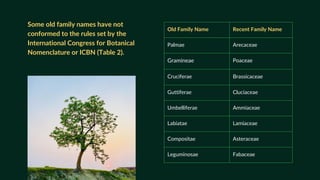
Some old family names have not
conformed to the rules set by the
International Congress for Botanical
Nomenclature or ICBN (Table 2).
10.
Old Family NameNew Independent Family Names
Musaseaea Musaceae, Heliconiaceae,
Strelitziaceae
Rubiaceae Rubiaceae, Naucaceae
Anacardiaceae Anacardiaceae, Pistaciaceae
Guttiferae Clusiaceae, Hypericaceae
Taxonomic ranks are but definite, either
lowered or elevated, and splitted or lumped by
competent splitter or lumper taxonomlsts.
Plants bearing legumes (Leguminosae) are
reclassified into Fabaceae with 3 sub classes:
Papolionoideae (Pisum type), Caesalpinoideae
(Gled‘itsia type), and Mimosoideae (Mimosa
type). Other families are separated by
taxonomistsinto two or more independent
families (see Table 3).
Table 3. Some plant families that are splitted into independent families
Any taxonomic group above species rank that
contains but only one of the next smaller unit
is considered a monotyplc or a monotype and
those represented by more than one next
smaller unit are polytypic. Thus, a monotyplc
genus is represented by only one species.
Local names areused within
a specific locality or region
and do not follow a
standardized naming system.
For example, the jackfruit is
called:
• Badak by the Maranaos
• Nangka by the Cebuanos
• Langka by the Tagalogs
Local Names Common Names
A common name is a name given and
widely accepted by a tribe, region, or
nation that speaks a common
language. These names are often
passed down through generations.
The official common name of a plant
is typically used within a single
language or country. In the
Philippines, the lexicon of Philippine
trees by Salvosa (1968) and its
revision by Rojo (1999) are generally
accepted as official sources for
naming native and introduced trees
(including tree-like plants).
13.
Basis for AssigningCommon Names
A plant’s common name may be based on various factors, including:
• Habitat: Talisai gubat, river fern, pitogong dagat
• Distinctive Features: Tagisang bayauak, balanti bilog, red palm, nitong pula, kaliskis ahas
• Locality or Region: Mindanao cinnamon, Mindoro pine, Banahaw igem
• Use: Sugar cane, paper mulberry
• Commemoration: McArthur’s palm, Micholitz’s alocasia
• Foreign Language Influence: Arborvitae (Spanish), maple (Spanish)
• Similarity to Known Species:
⚬ Malaalmaciga (Nageia wallichianus)
⚬ Malaadelfa (Podocarpus neriifolius)
• Use of Genetic Names:
⚬ Dieffenbachia (Dieffenbachia maculata)
⚬ Amhersia (Amhersia nobilis)
• Use of Specific Name or Epithet:
⚬ Dao (Dracontomelon dao)
⚬ Kalantas (Toona kalantas)
14.
Factors influencing theselection of Common Names
1. Habitat or the particular location where the plants normally grow e. g. Dungon late
2. Some distinctive features of the plant e.g. Prickly narra
3. Locality or region where the species is usually found e.g. Benguet pine
4. Uses of the species e.g. Paper mulberry
5. In commemoration to a person in authority e.g. Vidal's Lanutan
6. Adaptation from other languages e.g. Agoho (Spanish)
7. Similarity to other species e.g. Malaalmaciga
8. The genetic name as common name e.g. Acacia from Acacia auriculiformis
9. The specific epithet as common name e.g. Mangium from Acacia mangium
15.
Advantages of
Common Names
Disadvantagesof
Common Names
1. It is easy to memorize and
understand.
2. They are on the language known
by the people.
3. They are used by people in general
and also in commerce.
1. They change in different
countries, places and languages
2. The same common name Is used
for different species in different
places countries and languages.
3. Many species do not have thelr
own district common names.
4. There are no codes or rules
governing common names
5. Many common names are not
exact.
A scientific nameis a binomial name assigned to a plant or
organism. It consists of:
• Genus name
• Species epithet
• Name of the author(s)
Scientific names are universally used to avoid the
limitations and confusion associated with common names.
Rules for Writing Scientific Names
1.In handwritten reports, the scientific name should be
underlined (e.g., Mangifera indica).
2.In printed or published manuscripts, the scientific name
should always be italicized (e.g., Mangifera indica), and
the author’s name may be omitted after its first
mention.
3.Most scientific names originate from Greek or older
names that have been Latinized.
18.
Scientific names arepreferred over common names
because common names present several challenges:
1.Lack of Universality – Common names vary across
different countries and languages, making
communication difficult.
2.No Taxonomic Information – They do not indicate
family or generic relationships.
3.Multiple Names for One Species – Some widely known
or distributed species have multiple common names.
4.Same Name for Different Species – Two or more
species may share the same common name, causing
confusion.
5.Absence of Common Names – Many species do not
have a common name at all.
By using scientific names, plants and organisms can be
accurately and universally identified. 🌿
Need for Scientific Names
• A speciesname has two parts:
⚬ Genus (capitalized)
⚬ Specific epithet (lowercase, unless from a name)
• If the epithet has two words, use a hyphen.
• Formatting:
⚬ Italicized when printed
⚬ Underlined when handwritten
• The author's name (full or abbreviated) follows the species
name.
Example: Cocos nucifera L. (Coconut)
• Cocos = Genus
• nucifera = Specific epithet
• L. = Linnaeus, who named it
This binomial system was introduced by Carolus Linnaeus in
1753.
Species Naming Rules
21.
The
Genus
1. Name ofa person such as Linnaea for Linnaeus, Bauhinia for Bauhin, Victoria for
Queen Victoria of England, etc.
2. Name of a place such as Araucaria after Arauco, which is a province in Chile, Arabis
for Arabia and Siberaea for Siberia.
3. Important character of the plant such as yellow wood in Zanthoxylum, liver-like
leaves In Hepatica, marshy habit of Hygrophila and spiny fruit of Acanthus.
4. Aboriginal names taken directly from a language other than Latin without alteration
of ending. Naf iSSUS is the Greek name for daffodils, G/nkgo a Chinese, Vanda a
Sanskrit and Sasa a Japanese aboriginal name.
5. Words of poetic or mythological origin, e.g. Theobroma for "god's food".
The generic name is always a noun and is always singular In
number. It may be derived from any of the following sources:
22.
• First lettercapitalized.
• Always singular.
• Ends in different suffixes based on gender:
⚬ Masculine: -us
⚬ Feminine: -a
⚬ Neutral: -um, -er, -o, -n, -i, -s, -x
• When named after a person:
⚬ Ends in vowel → add “a” (Lee → Leea, Otto → Ottoa)
⚬ Ends in a → add “ea” (Angela → Angelaea)
⚬ Ends in consonant → add “ia” (Michel → Michelia)
⚬ Ends in -er → add “a” (Kerner → Kernera)
Rules for Writing the Genus
23.
The Specific
Epithet
1. Nameof a person — e.g. elmerii for Elmer, warburgii for Warburg
2. Name of a place — e.g. indicus for India, australis for Australia, philippinensis fOF
Philippines
3. Plant character - e.g. alba for white, bicoiâr for two-colored, repens for creeping
4. Noun in apposition — e.g. in Pyrus malus, malus is the Greek name for common
apple; in Allium cepa, the name cepa is Latin for onion
The specific epithet is usually an adjective and may be derived from any source
or may be composed arbitrarily. The following sources are commonly used:
24.
• Always lowercase(unless based on a name).
• Matches the gender of the genus.
• If derived from a person’s name:
• Ends in vowel → add “i” (Blanco → blancoi*)
• Ends in a → add “e” (Minahassa → minahassae)
• Ends in consonant → add “ii” (Merrill → merrillii)
• Ends in -er or -y → add “i” (Baker → bakeri, Foxworthy → foxworthyi)
Rules for Writing the Species Name
25.
• The numberof species is either singular or plural form.
The genus and species always conform to each other in gander: Arlocarpus hete nphyllus, Dipterocarpus
grandiftorus, Pinanga modesfa
• Those species that do not conform their gender, they are governed by certain rule in Species Plantarum
(1753).
Specific epithet may be named in the same manner as genus: derived after a person (blanfioi, minahassae,
merrillii), place Iphilippinensi8, luzonica, orientalis, virginianus, sumatrane) or character of certain plant (6ico/or,
alba, grandiflora, fragrans).
• Rules employed In the Information of a specific name taken from the name of a person include:
» Name ends with a vowel, letter "i" is added: Blanco becomes blanfioi
» Name ends with a vowel, letter “e" is added: Minahassa becomes Minahassae
» Name ends with a consonant, letters "ii" are added: Merill becomes /Ueril/ii Name ends with er or y, letter
a “i" is added: Baker becomes bakeri and Foxworthy become foxworthyi
Species (specific epithet Specific name) is written after the
generic name in small letters.
26.
1.Subspecies (subsp.)
⚬ Denotedby subsp. and written in lowercase after the species name.
⚬ Example: Cassia javanica subsp. nodosa
2.Variety (var.)
⚬ Denoted by var. and written in lowercase after the species name.
⚬ Example: Caryota rumphiana var. philippinensis
3.Forma (forma)
⚬ Denoted by forma and written in lowercase after the species name.
⚬ Example: Pterocarpus indicus forma echinatus
4.Hybrids and Cultivated Taxa
⚬ Hybrids: Indicated with an "×" placed after the genus.
■ Example: Quercus × jackiana (a hybrid of Q. alba and Q. bicolor)
⚬ Cultivars: Written in non-Latinized form and enclosed in single quotation
marks.
■ Example: Gleditsia triacanthos ‘Calhoun’
Intraspecific Taxa (Categories Below Species Rank)
27.
In botanical nomenclature,the name of the author(s) follows the specific epithet of a scientific name.
It recognizes their contributions to the correct identification and classification of species.
Guidelines for Writing Author Names in Manuscripts or Reports:
1.Abbreviation of Author Names:
⚬ Example abbreviations:
■ Vidal → Vid.
■ Merrill → Merr.
■ Foxworthy → Foxw.
■ Linnaeus → L.
■ However, names like Brown, Rolfe, King, and White are written in full.
2.Joint Authors:
⚬ When two authors jointly describe a species, both names are listed:
■ Example: Genus species X & Y
3.Reclassification by a Different Author:
⚬ When Author X reclassifies a species originally described by Author Y, the format is:
■ Example: Genus species (Y) X
4.Publication by a Different Author:
⚬ When Author X publishes the work of Author Y, the format is:
■ Example: Genus species X ex Y
Naming of Authors in Botanical Literature
28.
Advantages of
Scientific Names
Disadvantagesof
Scientific Names
• Universally Recognized: Scientific
names are accepted worldwide,
avoiding language barriers.
• Clarity and Precision: They are
distinct, making them easier to spell
and pronounce compared to some
common names.
• Standard Reference: Used in
scientific literature, including books,
manuals, floras, and journal
publications.
• Complexity: Scientific names can be
difficult to spell and pronounce.
• Limited Usage: Primarily used by
botanists and technical experts,
making them less accessible to the
general public.
• Memorization Challenge: Being in
Latin and composed of two words,
they can be hard to remember.
• Multiple Valid Names: Some species
may have both a prior name and a
synonym, leading to confusion.
29.
Thank You
F OR Y O U R A T T E N T I O N
I n t r o d u c t i o n t o
A d v a n c e T a x o n o m i c
T e r m i n o l o g y