Introduction to
BOTANY
Maedel Joy Ventura – Escote, Ph.D
Objectives
1. Define Botany
2. Discuss plant taxonomy
3. Determine the unifying features of botany
4. Understand the importance of the study of
plants
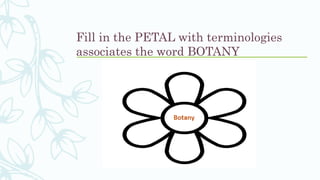
Fill in the PETAL with terminologies
associates the word BOTANY
What is a Plant?
– Plants are not animals but the same with animals
they are living organisms composed of the basic
characteristics of a living thing. Just like the animals,
plants breath and has functional systems.
– Plants can be divided into two groups: plants1
and plants2
Unifying features of plants
– They are photosynthetic and obtain all their nutrients from inorganic sources, i.e. they
are autotrophic and the start of a food chain. Many protists, particularly among the
plankton, are also photosynthetic. A few plants derive all or part of their nutrients from
other organisms, but these are closely related to other, photosynthetic, flowering
plants.
– The photosynthetic pigment is chlorophyll, and in all plants except some algae, there
are two forms, a and b, contained within chloroplasts.
– The cells have a cell wall made predominantly of the polysaccharide cellulose and a
vacuole in addition to the cytoplasm.
– There is an alternation of diploid and haploid generations. Often one of these is much
reduced and may not live independently.
TAXONOMY
– Taxonomy or systematic is the study or description on
variations among organisms to come out with a
classification system. Organisms that are arranged into
groups enable a large population to be categorized and
understood.
– Taxonomy began about 300 years before Christ by
Theophrastus (370-285 BC) Carolus Linnaeus (1707-
1778) is regarded as the founder of taxonomy (father of
taxonomy) till today.
Importance of Plant Taxonomy
1. To arrange elements or taxa of plants into a more systematic
manner so that they can be better understood and could be
used easily and more effectively.
2. To arrange data or information and knowledge about plants.
3.To indicate the source and genetic relationship
(phylogenetic), ancestry and origin of plants.
4. To indicate the distribution and habitat of plants on earth and
their benefits.
Taxonomic Components
1. Classification
– Plants are arranged into groups of similar characteristics. The groups are
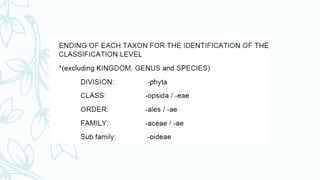
considered as categories or taxa and form the taxonomic system.
2. Identification
– To identify and derive the name of an organism by referring to an existing
classification.
3. Nomenclature
– To provide a scientific name to an organism.
4. Description
– To describe the characteristics of a taxon e.g. a family.
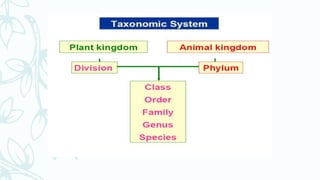
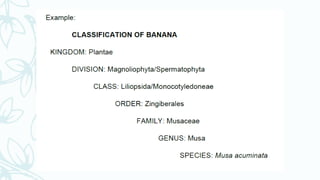
Kingdom:
– The highest level in a classification e.g. animal and plant kingdom
Division:
– The number of groups in this taxon is not fixed, it depends on the classification
system.
– Based on similar characteristics observed on a few elements or organs e.g.:
dominance of a sporophyte to a gametophyte, presence of an ovule, seed
formation and several other morphological and anatomical characteristics.
– Those are hereditary characteristics and will continue to exist from generation to
generation.
– Class:
– The number of groups in this taxon is also not fixed, depending on the
classification system.
– Separation is based on important basic differences that exist between the groups.
– Order:
– Separation is based on a more convincing genetic relationship which earlier had
been detected at the class and division level.
– Familiy
– Based on more characteristics compared to order, class and division e.g. the
morphological characteristics of reproductive organs (inflorescence, ovary
position, placentation, number of pistils and carpels, types of ovule and
androecium)
– Genus
– Genus involves more similar characteristics including a closer family relationship,
but they do not cross. If a hybrid cross does occur the offspring are normally
infertile or will not survive.
– Phylogenetically, new genus arises and separates from the same parental origin.
– SUB AND SUPER CATEGORIES
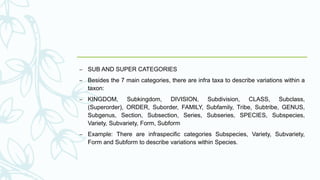
– Besides the 7 main categories, there are infra taxa to describe variations within a
taxon:
– KINGDOM, Subkingdom, DIVISION, Subdivision, CLASS, Subclass,
(Superorder), ORDER, Suborder, FAMILY, Subfamily, Tribe, Subtribe, GENUS,
Subgenus, Section, Subsection, Series, Subseries, SPECIES, Subspecies,
Variety, Subvariety, Form, Subform
– Example: There are infraspecific categories Subspecies, Variety, Subvariety,
Form and Subform to describe variations within Species.
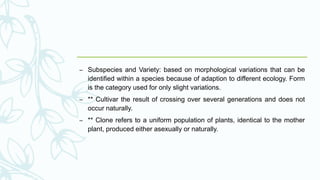
– Subspecies and Variety: based on morphological variations that can be
identified within a species because of adaption to different ecology. Form
is the category used for only slight variations.
– ** Cultivar the result of crossing over several generations and does not
occur naturally.
– ** Clone refers to a uniform population of plants, identical to the mother
plant, produced either asexually or naturally.
NOMENCLATURE
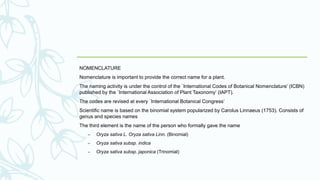
Nomenclature is important to provide the correct name for a plant.
The naming activity is under the control of the `International Codes of Botanical Nomenclature’ (ICBN)
published by the `International Association of Plant Taxonomy’ (IAPT).
The codes are revised at every `International Botanical Congress’
Scientific name is based on the binomial system popularized by Carolus Linnaeus (1753). Consists of
genus and species names
The third element is the name of the person who formally gave the name
– Oryza sativa L. Oryza sativa Linn. (Binomial)
– Oryza sativa subsp. indica
– Oryza sativa subsp. japonica (Trinomial)
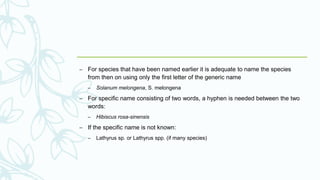
– For species that have been named earlier it is adequate to name the species
from then on using only the first letter of the generic name
– Solanum melongena, S. melongena
– For specific name consisting of two words, a hyphen is needed between the two
words:
– Hibiscus rosa-sinensis
– If the specific name is not known:
– Lathyrus sp. or Lathyrus spp. (if many species)
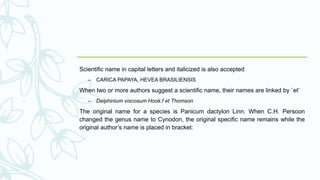
Scientific name in capital letters and italicized is also accepted
– CARICA PAPAYA, HEVEA BRASILIENSIS
When two or more authors suggest a scientific name, their names are linked by `et’
– Delphinium viscosum Hook.f et Thomson
The original name for a species is Panicum dactylon Linn. When C.H. Persoon
changed the genus name to Cynodon, the original specific name remains while the
original author’s name is placed in bracket:
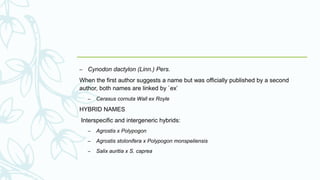
– Cynodon dactylon (Linn.) Pers.
When the first author suggests a name but was officially published by a second
author, both names are linked by `ex’
– Cerasus cornuta Wall ex Royle
HYBRID NAMES
Interspecific and intergeneric hybrids:
– Agrostis x Polypogon
– Agrostis stolonifera x Polypogon monspeliensis
– Salix auritia x S. caprea
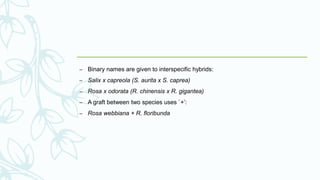
– Binary names are given to interspecific hybrids:
– Salix x capreola (S. aurita x S. caprea)
– Rosa x odorata (R. chinensis x R. gigantea)
– A graft between two species uses `+’:
– Rosa webbiana + R. floribunda
Introduction to Botany Lesson 1.pptx