iii
Plant Systematics LabManual
Table of Contents
Syllabus Plant Systematics: Biology 530 iv–vii
Laboratory 1 Plant Systematics: An Overview 1
Laboratory 2 Phylogenetic Systematics 7
Laboratory 3 Evolution and Diversity of Green and Land Plants 19
Laboratory 4 Evolution and Diversity of Vascular Plants 21
Laboratory 5 Evolution and Diversity of Woody and Seed Plants 25
Laboratory 6 Evolution of Flowering Plants 29
Laboratory 7 Diversity and Classification of Flowering Plants: Amborellales-Monocots 31
Laboratory 8 Diversity and Classification of Flowering Plants: Eudicots 62
Laboratory 9 Plant Morphology 91
Laboratory 10 Plant Anatomy and Physiology 119
Laboratory 11 Plant Embryology 125
Laboratory 12 Palynology 127
Laboratory 13 Plant Reproductive Biology 129
Laboratory 14 Plant Molecular Systematics 133
Laboratory 15 Plant Identification 135
Laboratory 16 Plant Nomenclature 139
Laboratory 17 Plant Collecting and Documentation 143
Laboratory 18 Herbaria and Database Systems 157
Appendix 1 Plant Description 163
Appendix 2 Plant Morphology Review 167
Appendix 3 SDSU Plants 179
4.
5.
Laboratory 1 PlantSystematics: An Overview 1
Plant Systematics Laboratory #1
PLANT SYSTEMATICS: AN OVERVIEW
OBJECTIVES FOR THIS LABORATORY:
1. Review the major groups of plants.
2. Review the major concepts and terms of phylogenetic systematics.
3. Understand the basics of taxonomy by performing exercises in its components.
plant SYSTEMATICS
What is a plant?
Observe and label the examples of each of the major plant groups on display: liverworts, hornworts, mosses,
lycophytes, psilophytes, equisetophytes, ferns, conifers, cycads, Ginkgo, Gnetales, and angiosperms (monocots
and eudicots). Have your instructor check your labels.
Begin to think about the differences between these plant groups, such as the characters are used to separate
them, and how they are related to one another. Why are all of these organisms called plants? Are any left out that
have traditionally been called “plants?”
What is systematics?
Review the primary objective of systematics. As a class the following terms: cladogram, lineage/clade,
common ancestor, divergence, speciation, apomorphy, monophyletic, paraphyletic/polyphyletics.
For the above plant groups, draw what you think is a phylogenetic tree (cladogram). Can you name some of
the apomorphies that link these major groups together?
Plant Taxonomy
Taxonomy can be defined as the science dealing with the description, identification, nomenclature, and
classification of life. The following are exercises to practice using these interrelated components.
Description
Description is assigning features or attributes to an entity. An important concept in taxonomic description
is that of the character (a feature) and character states (two or more forms of a character).
Obtain a shoot (stem + leaves) from each of several species. Study these specimens. Then, working in a
small group, come up with characters and corresponding character states, using Table 1.1. You may refer to the
book for technical terms, but work quickly. The object here is to master the concept of character and character
state; the actual technical terminology will be mastered later.
After you work on this for about 15 minutes, a member of each group should stand up and i) state and define
one character; and ii) explain the character states for the taxa examined. Then, another group can explain a
second character and character states. The object here is for the whole class to discuss and perhaps agree on the
characters and character states.
OPTIONAL: Obtain a flower from a given plant species. Look at it with the naked eye or under a dissecting
microscope. Next, describe the flower in writing to the best of your ability (using Table 1.2), spending no more
than about 10 minutes. Discuss the types of words you used in this description? At a later time, your descriptions
will be compared with those written after you have had training in descriptive morphological terminology. Hand
in the flower description to your instructor.
6.
2 Plant SystematicsLaboratory Manual
Plant Systematics Laboratory Manual 1.2
Table 1.1 Description Exercise
Character #1: Character #2: Character #3: Character #4: Character #5:
No. Scientific name
1.
2.
3.
4.
5.
6.
Table 1.2 Flower Description Exercise
Plant species:
7.
Laboratory 1 PlantSystematics: An Overview 3
Plant Systematics Laboratory Manual 1.3
Identification
Identification is associating an unknown entity with a known entity. There are several ways to identify a
plant: specimen comparison, image comparison, taxonomic keys, and expert determination. The following will
give you an introduction to these methods.
a. One tool used in identification is a taxonomic key. Working in a group, construct an indented and
numbered dichotomous taxonomic key to the species that you studied above (from shoots), using the characters
from Table 1.1. Begin by sorting the specimens into two groups and devising a character that distinguishes the
two groups, with each group having a different character state of the character. This character and its states
become the basis for the first couplet (composed of two leads) of the key. Next, divide each of these groups two
subgroups, continuing this until you are left with one sample. In writing the key, be sure to list the organ or part
first, then the character state. Do not list characters. For example, say "Leaves opposite, pinnately compound,"
not "Leaf arrangement opposite, leaf type pinnately compound." As you write the key, try to list more than one
character state in some of the leads. Write onto Table 1.3.
After the key is written, select someone from your group to write one couplet on the board. The next group
puts in a second couplet, etc., until the key is written. The whole class should agree on the best, final key.
b. Working together as a class, construct an indented and numbered dichotomous key to all of the students in
the class. In writing the key, be sure to list the character first, then the character state. Divide the class into two,
logical groups, and then each of these into two, etc. Think of characters and character states that describe the
physical features of these people. To make it more interesting, only use characteristics visible only from the
"neck up". What are some potential problems with some of the characters, e.g., in terms of variation? In what
ways can class members be classified?
c. Review and examine taxonomic keys on-line, both dichotomous and polythetic. How does a polythetic
(multi-entry) key differ from a dichotomous one? What are the advantages of the former?
Table 1.3 Identification Exercise: Key to Plant Species
8.
4 Plant SystematicsLaboratory Manual
Plant Systematics Laboratory Manual 1.4
Nomenclature
a. Syllabize and accent each of the names from the earlier exercise. Record onto Table 1.4. Practice
pronouncing the names.
a. Use references to record the etymology (derivation and meaning) of these scientific names onto Table 1.4.
c. Working with a few other people, memorize the scientific names of the plant species identified. Ask your
instructor about the correct or preferred pronunciation of each name. Use one or more of three methods to
remember names: i) learn the etymology of the genus and specific epithet names and mentally connect that
meaning with the plant; ii) use a mnemonic device, involving a vivid image, to associate the plant itself with a
word that sounds like the scientific name of the species; and iii) practice, use repetition until the name becomes
familiar. Recite each of the names when shown a sample of the plant.
Classification
a. Working together as a class, use available references to look up the common name, family, and native
distribution of each of the plant species identified above. Place this information on the chalkboard or computer
projector until all are completed. Then copy the information onto Table 1.4.
Note: Check out some Web pages, e.g., International Plant Names Index <http://www.ipni.org>,
Angiosperm Phylogeny Website <http://www.mobot.org/MOBOT/research/APweb/>, or (for California plants)
The Jepson Online Interchange <http://ucjeps.berkeley.edu/interchange.html>.
Table 1.4 Identification of Selected Taxa
No. Scientific name Etymology Family Distribution
Syllabize/Accent (genus and spec. eptithet)
1.
2.
3.
4.
5.
6.
9.
Laboratory 1 PlantSystematics: An Overview 5
SCRIPPS
TERRACE
AVENUE OF ARTS
Hepner Hall
Life Sciences-South
1
2
7
6
9
4
3
5
8
Med.
Gard.
4
4
4
KEY TO TEN SELECTED TREES AT SAN DIEGO STATE UNIVERSITY
1. Trunk unbranched (at least above base); leaves more than two feet long, acrocaulis (arising near apex of trunks)
2. Trunk single; leaves pinnately compound, leaflets in more than one plane Syagrus romanzoffiana
2’ Trunks multiple from rhizomatous base; leaves simple with large blade, blade often torn Strelitzia nicolai
1’ Trunk with numerous lateral branches; leaves simple or compound, <3 feet long
3. Leaves simple
4. Leaves opposite, gen. < 10 cm long, narrowly oblanceolate, silvery-white below Olea europaea
4’ Leaves alternate, > 10 cm long, elliptic, green or brown-red hairy below Magnolia grandiflora
3’ Leaves compound (with two or more discrete leaflets)
5. Leaves ternately compound, with 3 leaflets Erythrina caffra
5’ Leaves pinnately or bipinnately compound, with more than 3 leaflets
6. Leaves pinnately compound (leaflets along one main axis, the rachis)
7. Leaves usually whorled (usu. three per node), leaflets scabrous (rough, like sandpaper) Kigelia africana
7’ Leaves alternate (one per node), leaflets smooth, not scabrous
8’ Leaves paripinnate (without a terminal leaflet); leaflets widely elliptic, entire (without teeth) Ceratonia siliqua
8’ Leaves imparipinnate (with a terminal leaflet); leaflets elliptic, often with small teeth Schinus terebinthifolius
6’ Leaves bipinnately compound (leaflets along secondary axes, rachillae) Jacaranda mimosifolia
Laboratory 2 PhylogeneticSystematics 7
Plant Systematics Laboratory #2
PHYLOGENETIC SYSTEMATICS
OBJECTIVES
1. To understand and review the concepts and methodology of phylogenetic reconstruction.
2. To learn how to use a computer algorithm (MacClade) for visualizing cladograms and character evolution.
3. To explore interactive Web sites for investigating plant interrelationships.
PHYLOGENY RECONSTRUCTION EXERCISE
Study Figure 2.1, which illustrates eight species (A-H) of a hypothetical group of plants. This figure
also shows a presumed extinct ancestor (“Anc”), which contains all ancestral characteristics. Your job is to infer
relationships of the eight species of this taxon.
a) Working with a partner, name and record as many characters with associated character states as possible.
Arrange these in a “Character x Taxon” data matrix, with “Taxa” in a column (at left) and “Characters” in a row at
the top (Table 2.1). Name and record the character states of each character for each taxon.
b) For each character, circle those character states that are derived. Those shared by two or more taxa are
synapomorphies, apomorphies that can be used to link together all taxa that possess them.
c) Draw the cladogram for the hypothetical organisms in the space at Table 2.2. Circle all monophyletic
groups.
e) Use the data of Figure 2.2 to add to the data matrix. Do these new data confirm your original hypothesis
of relationship? Refine the cladogram and redraw it in Table 2.3
d) From the refined cladogram devise an indented classification scheme at Table 2.4, both dichotomous
and annotated. Make up new names for monophyletic groups as needed. Experiment with placing these new
monophyletic groups into ranks, assuming that the ingroup (species A-H) represent a subfamily of plants.. What
are the advantages and disadvantages of having ranks?
12.
8 Plant SystematicsLaboratory Manual
Figure 2.1 Hypothetical plants.
A C
B
D F
E
G Anc
H
13.
Laboratory 2 PhylogeneticSystematics 9
2.3
Table 2.1 Character X taxon matrix for hypothetical plant exercise (Figure 2.1) and most parsimonious
cladogram (draw below).
CHARACTERS
TAXA
A
B
C
D
E
F
G
H
Anc
14.
10 Plant SystematicsLaboratory Manual
Table 2.2 Most parsimonious cladogram (below), from data matrix of Table 2.1. Indicate all character
state changes.
15.
Laboratory 2 PhylogeneticSystematics 11
Figure 2.2 Added characters for hypothetical plants: pollen morphology (above) and ovule mrophology (below).
A C
B
D F
E
G Anc
H
16.
12 Plant SystematicsLaboratory Manual
Table 2.3 Refined most parsimonious cladogram (below), from data matrix of Table 2.1, with pollen and
ovule characters (Figure 2.2) added to original set. Indicate all character state changes.
Table 2.4 Classification scheme for taxa of Figure 2.1. A. Annotated. B. Dichotomous.
A. B.
17.
Laboratory 2 PhylogeneticSystematics 13
USE OF COMPUTER ALGORITHM FOR VISUALIZING CLADOGRAMS & CHARACTERS
1. Computer phylogeny applications. If a computers are available, you may wish to explore one of the commonly
used phylogeny software applications. The program we will be using for visualizing cladograms is: MacClade
(Maddison and Maddison, 2000), written for computers using the Macintosh operating system. Other programs are
available for Windows OS (e.g., Winclada; Nixon, 1999). These programs allow the user to input data, including
taxa names and their characters and character states. They allow visualization of both the phylogenetic relationships
of taxa and character state changes.
With the help of your instructor, enter a data file using MacClade, or some other phylogeny application for
a given taxonomic group. You may use the data matrix in Table 2.4, illustrating relationships of the families of the
Zingiberales.
See Appendix 2.1 for information on the use of MacClade. Engage the function that displays characters;
visualize several of these, noting the distribution of their states. You may also “swap branches” on the cladogram,
exploring alternative evolutionary hypotheses and noting the change in tree length. Try to find the most “optimal”
(most parsimonious) tree by swapping branches and getting the shortest tree.
If time allows, choose a volunteer to re-draw the cladogram from MacClade onto the chalkboard. List each
apomorphy illustrated on MacClade by placing the derived character state (apomorphy) beside a hatch-mark on the
cladogram. Circle and tentatively name all monophyletic groups.
Review as a class the following terms: cladogram, lineage/clade, common ancestor, speciation, apomorphy,
synapomorphy, autapomorphy, monophyletic, paraphyletic.
Table 2.5. Example data set of the families of the Zingiberales (from Plant Systematics, 2010, p. 51)
Lf. Seed Polyarc Inner Med. Silica
Arr. Aril Root Stamen Raphides crystals
Cannaceae distichous + + + - +
Costaceae monistichous + + + - +
Heliconiaceae distichous + + + + -
Lowiaceae distichous + - - + -
Marantaceae distichous + + + - +
Musaceae spiral - - - + -
Strelitziaceae distichous + + - + -
Zingiberaceae distichous + + + - +
Stamen Staminode Out. Tepals Anther
number petaloid Perisperm fused type
Cannaceae 1 + + - monothecal
Costaceae 1 + + + bithecal
Heliconiaceae 5 - - - bithecal
Lowiaceae 5 - - - bithecal
Marantaceae 1 + + - monothecal
Musaceae 5 - - - bithecal
Strelitziaceae 5 - - - bithecal
Zingiberaceae 1 + + + bithecal
WEB SITES ON PLANT PHYLOGENY AND CLASSIFICATION
Log onto the Angiosperm Phylogeny Website <http://www.mobot.org/MOBOT/Research/APweb>, Tree of Life
<http://tolweb.org/tree>, or TreeBase <http://www.treebase.org/treebase/index.html>. These web pages contains
up to date information on the relationships of various organismal groups. Note that cladograms, characters, images,
and apomorphies may be illustrated in an interactive format. Also note that some phylogenetic relationships and
classification schemes may differ, indicating that workers in the field may disagree and that systematic studies have
not yet unambiguously resolved all the details of phylogenetic relationships.
18.
14 Plant SystematicsLaboratory Manual
Appendix 2.1 Use of MacClade, version 4.05 (D. R. Maddison and W. P. Maddison, 2002)
A computer program for phylogeny and character visualization
Commands Commonly Used:
NOTE: You must hold down the command key while typing the next letter
Command Command Name Menu Function
D Trace Character Trace View optimized tracing of character evolution
E Data Editor Windows View and edit data matrix
I Character List Characters View character coding information
K Trace All Changes Trace View apomorphic changes at each lineage
N New File File Creates a new data file
O Open File File Open a file to display data matrix or tree(s)
R Show MPRs Mode Trace Visualization of alternative char state changes
S Save File File Save a file to memory; including all changes
T Tree Window Windows View tree
W Close File File Close a file, necessary before opening a file
Y Tree List Trees Select alternative trees
Getting Started:
Open MacClade by double clicking on the MacClade “cladogram” icon.
Open a data file; e.g., select the MacClade Examples folder, then select Vertebrates by double
clicking or by highlighting and then clicking Open. To open future data files, type Command O or
select Open File from the File menu. To close, type Command W or select Close File from the File
menu.
Data matrix:
A spreadsheet with the character/taxon matrix will appear. If a tree appears instead, type Command
E (or select Data Editor from the Windows menu). Briefly study this matrix. You may “scroll”
through characters and taxa by clicking and holding on the arrows at the bottom or to the right. Note
that taxa appear in the left column, character numbers and names in the top row, and character state
names within the matrix. Selecting Transposed Matrix from the Display menu inverts the taxa/
characters rows and columns. Moving the “ruler” in the upper left corner changes column width. You
may change the character state names to symbols (the character codes) by selecting Data Matrix Styles
® Plain from the Display menu. Try making these changes.
Tree Visualization:
Type Command T (or select Tree Window from the Windows menu) and a tree will appear. If the
tree appears too small or too large for your computer, select Expand Window or Reduce Window from
the Display menu. (You may select from a list of trees by clicking Command Y or selecting Tree List
from the Tree menu.) If you wish the tree represented as 90o (instead of 45o) intersecting lines, select
Tree Shape & Size from the Display menu and click into the second icon. With the latter type of tree
visualization, you may also specify that the branches be centered from the same menu.
Note the treelength, which for the “Bad Guess” cladogram of the Vertebrate data set is 35 character
state changes. Also note the listing of number of taxa (10) and characters (13). If CI is not already
visible on the data box in the lower right, select Consistency Index from the ∑ menu.
Character/Character State Visualization:
Perhaps the most valuable feature of MacClade is the character tracing function, allowing for the
19.
Laboratory 2 PhylogeneticSystematics 15
clear visualization of character state distributions for each character. Type Command D (or select Trace
Character from the Trace menu). Try typing Command D a few times; it operates as a toggle switch.
Note the character box that appears in the lower right corner and the optimized character state are
displayed on the cladogram. Click the right arrow on the character box, noting how you may proceed
through the character list in sequence.
Practice rearranging branches by placing the arrow anywhere on a clade, holding down the
mouse button, “dragging” to another clade, and then releasing the mouse button. Note that you may
rearrange branches with the character tracing function (Command D) turned on. The new character
state distribution will appear for this new topology. Try moving clades around to fit the relationships
you think correct. Do this by going through the characters one at a time and grouping taxa based
on apomorphies. For example, choose character #1, “amnion”. The character state distributions for
absence/presence of an amnion are superimposed on individual clades. Drag the clades that possess
an amnion into one group. Continue this for all other characters in the data set. Note that equivocal
state optimizations appear as horizontal lines on given clades. Attempt to minimize the treelength (i.e.,
attain the most parsimonious tree) by noting the change in treelength in the tree data box. Note that CI
changes inversely with treelength; thus, to find the most parsimonious tree, minimize treelength and
maximize CI. (Hint: The most parsimonious tree is 19 steps long.)
After creating the most parsimonious “Vertebrate” cladogram, go through the character list once
again. Choose the character #1 again, “amnion.” The presence of an amnion appears as an apomorphy
for a monophyletic group, the “Amniotes,” containing turtles, mammals, snakes, lizards, crocodiles,
and birds. Select character #2, “appendages.” Note three different clade shadings (or colors) for the
three character states. These are coded as “ordered.” The presence of “legs only” is a synapomorphy
for a monophyletic group, the “Tetrapods,” containing salamanders, frogs, turtles, mammals, snakes,
lizards, crocodiles, and birds; “legs only” became modified to “legs+wings” in the bird lineage. Note
also the “uncertain” shading for the box above the “mammal” clade, indicating that the character state
for mammals was coded as polymorphic (because only some mammals, i.e., bats, have wings). Select
character #3, “body covering,” and note the tracings for five states, plus one for “equivocal,” the latter
indicating that there is no single most parsimonious state assignment for the clade immediately below
the “Tetrapods.” In other words, the occurrence of neither “smooth” nor “epidermal scales” body
covering can be supported for the internode just above the “lungfish” clade. Note, in the next character,
#4, “thermoregulation,” the convergent evolution of homeothermy in mammals and birds. Continue
through the data set to get a feel for this feature of MacClade. Its value is in allowing easy visualization
of character state changes and of alternative, equally parsimonious optimizations.
Type Command K (or select Trace All Changes from the Trace menu). This allows you to show
the total number of changes on each branch, where unambiguous (unequivocal) changes occur on the
cladogram. By clicking on one of these clades, a listing of the specific changes occurring can be seen.
To turn off this function, type Command K again. By selecting Trace Labeling from the Display menu
you have several options for display of state changes on the cladogram. Experiment with these.
As you trace character evolution using Command D (Trace Character from the Trace menu), you
may discover “equivocal” areas (shaded with horizontal bars) on the cladogram. These represent nodes
(HTUs, ancestors) that have alternative, equally parsimonious character states. To find out exactly how
many equally parsimonious optimizations there are for a given equivocal lineages and exactly which
character states are possible, type Command R (or select Show MPRs Mode from the Trace menu).
Using this function, you will see the shading/character states change at the equivocal node(s). Continue
toggling (Command R) and you will go through all possible reconstructions. A count of the number of
equally parsimonious reconstructions can be obtained by choosing Number of MPRs from the Trace
menu. Character 3, for example, has three equally parsimonious optimizations. (By choosing Expand
20.
16 Plant SystematicsLaboratory Manual
Clade from the Tools menu, you can click on the node of interest and obtain precisely the number of
reconstructions under the assumption that the outgroup node is ancestral.)
For certain characters, a given cladogram topology may show an “equivocal” condition (shaded
as horizontal bars) at a given internode that can be explained as either of two equally parsimonious
character optimizations: DELTRAN (DELay TRANsformations) or ACCTRAN (ACCelerate
TRANsformations). DELTRAN delays changes away from the root node, which in effect promotes
convergent character evolution; ACCTRAN accelerates changes toward the root node, which maximized
reversals. DELTRAN and ACCTRAN options may be visualized with MacClade as follows. First,
select the character of interest on the tree with the Trace Character (Command D) option on. Then
select Resolving Options from the Trace menu. Click either Deltran or Acctran and then click
OK (or type the Return key). Note the change in character optimization on the tree. Not all equivocal
optimizations are resolved using DELTRAN or ACCTRAN.
Character Status:
Type Command I (or select Character List from the Characters menu). Note the display of
characters, listing: a) character number; b) character name; c) whether included (box with a check)
or excluded from the analysis (box with an “X”); d) character type (unordered, ordered, irreversible,
stratigraphic, Dollo, or user-defined); e) character weight; f) number of character states; g) optimized
number of character steps (for the current tree); and h) character CI. You may alter the first four
variables by clicking on and highlighting a given row and then clicking the small arrow beside the
column headings. To remove the Character Status box, click the upper left red spot (or Command
W). Note that the default character type is unordered; thus, if you wish any to be ordered, irreversible,
statigraphic, Dollo, or user defined, you must specify it.
Tools:
From the Windows menu select Tool Palette and note the Tool box that appears, with several
functions, different in Edit mode (Command E) versus Tree mode (Command T). In Tree & Display
(Command D) mode, these are (from left to right, top to bottom):
1) Search Above Performs a search upward pass and selects that cladogram topology which is
most parsimonious based on that upward pass.
2) Reroot Tree Allows tree to be rerooted at any point.
3) Make Ancestral Allows you to make a terminal OTU a direct ancestor at the immediate node
below.
4) Exclude Clade Allows exclusion of any particular clade; may be reversed by selecting
Include-Exclude Taxa from the Tree menu.
5) Move Branch This is the default setting, allowing you to move clades into different
topologies.
6) Polytomy Exchange Allows branch rearrangements within a polytomy.
7) Rotate Branches Rotates branches at the node immediately above the clade selected.
8) Rotate to Lean Right Rearranges branches such that they are “ladderized”
9) Collapse Clade Arranges every clade above a given branch into a polytomy.
10) Collapse Branch Collapses a given clade, such that the immediate branches above form a
polytomy with that/those below.
11) Test Correlation [Click in and read.]
12) (Unused)
13) List States Will list the character state at a given clade.
14) (Unused)
21.
Laboratory 2 PhylogeneticSystematics 17
15) Fix States Allows fixing the state of a given character at a given clade. Works by
clicking into the desired state at the character state box and then clicking
into the desired clade.
16) (Unused)
17) Select in List Window Allows clicking on a given clade and viewing the matrix for taxa
characteristics.
18) Set Evolve Segments
19) Expand Clade Allows visualization and expansion of only part of the cladogram, that
immediately above the lineage selected; reversed by clicking the most
basal clade.
20) Move Tree Moves tree on the screen.
Practice using the Rotate Branches command, a useful exercise for beginning students. Note that
by flipping branches, the general appearance of the cladogram may change drastically, but the topology
(and cladistic relationships) are unchanged. You may “ladderize” the cladogram (or a portion thereof)
by selecting Rotate to Lean Right from the Tools menu.
Try the Expand Clade command. This may also be implemented by simply double-clicking with
the Move Branch arrow on a clade internode. To reverse, double click on the basal-most internode.
Another useful exercise is to use the Reroot Tree command. This will not alter the topology of the
unrooted tree, but it will definitely alter relationships in the rooted tree. The Make Ancestral command
will collapse a terminal taxon to a hypothetical direct ancestor on the clade.
Polytomies (in which three or more clades arise from the same point) may be represented in the tree
as follows. First, rearrange the branches such that those clades that will form a polytomy at a given node
are placed into a monophyletic group of dichotomizing branches. Next, select Collapse Clade from the
Tools menu and click into the root clade of this monophyletic group. Finally, select Collapse Branch
from the Tools menu and click into the same root clade to remove it and create the polytomy.
MacClade is very limited with regard to finding most parsimonious trees. Thus, a powerful
computer algorithm, such as PAUP, is needed to find all most parsimonious trees for even a modest data
set. However, for relatively small data sets the Search Above command may be attempted.
Taking the Vertebrate data set as an example, begin by selecting the Bad Guess cladogram (trees
seen using Command Y). Note that “rayfinned fish” is at the most basal or outgroup position. Select
the Search Above command from the Tools menu and click at the internode just above the common
ancestor of “rayfinned fish” and the other taxa. Note the decrease in Tree Length and increase in CI. Is
this tree equivalent to the tree that you obtained by manually swapping branches?
Another useful feature is that of arbitrarily changing the state of a given clade; i.e., the cladogram
topology will remain unchanged but the most parsimonious character distribution will be altered. Select
Fix States from the Tools menu. A paintbrush-like icon will appear. Move this icon (using the mouse)
to the character box at the lower right. Click into the desired character state (shaded box) for a given
character, then click into that clade for which you wish to change to the given state. The shading for
that clade will change to that selected. To remove your character tracing alteration, select the Unfix all
command from the Trace menu.
Formating New Data Files:
Enter a data set into MacClade. First, close any opened file by typing Command W or selecting
Close File from the File menu. Next, type Command N, or select New file from the File menu.
MacClade utilizes a very handy user-friendly spreadsheet format, allowing you to easily enter and
manipulate your data.
Type in the following: 1) Taxa (in left-hand column by default, which you may expand or contract
22.
18 Plant SystematicsLaboratory Manual
as needed by moving the mouse below until arrows appear, holding down the mouse button, and
then moving up or down); 2) Characters, top row, which you may expand by selecting (from the
Display menu) Data Matrix Styles, then Wide with State Names; 3) Character states (internal data
matrix; should be entered initially as whole, non-negative numbers, from 0 onward). Polymorphic
character states (in which more than one state apply) may be listed by typing all character states with
either a space or a “/” between them. Taxa or characters may be moved to different rows or columns,
respectively, by clicking at the far left or top and dragging the row or column to a new location.
After entering the raw data, name your characters and character states by selecting State Names &
Symbols from the Characters menu.
After entering all the data, you may visualize the state names (instead of numbers) by selecting Data
Matrix Styles, then Wide with State Names from the Display menu.
MacClade allows you to assign “user defined characters,” which allow for custom designing with
regard to the number of state changes between character states of a multistate character. To define a user
defined character, enter the data matrix (Command E), then click into the top region of the character
you wish assigned. (The entire column will become highlighted.) Next, from the Characters menu,
select Edit Type. A listing of character codings will appear at the top (unordered, ordered, irreversible,
etc.). If not already visualized, select “unordered” (the default). To define a new user defined character
click New, name the user defined character; and then click Create. The new name will then appear
in the character listing. Finally, alter the original “unordered matrix” as you desire by clicking into
a cell, typing the desired number of state changes, and clicking Enter. When finished, click OK (or
type the Return key). This user defined character may be used for other characters of the data matrix
(Command E) by typing Command I, clicking into a character (highlighting the entire row), then
clicking the character Type and selecting a particular character coding. Type Command I or select
Character Status from the Display menu to visualize the status of your characters.
When you are finished, select “Close file” from the File menu. You will be asked whether or not to
save the tree or to save the (revised) data file. If you wish, save your newly entered file. (Alternatively,
you may type Command S or select Save File from the File menu.) If using a shared computer, create
and name your own folder or save the file on a memory stick.
Interfacing with PAUP:
It is suggested that you create all your data files using MacClade because of the ease of using the
data editor. The data matrix can then be opened directly using the program PAUP* (Swofford, 2003),
which you will use to find the most parsimonious trees. Use the Save File As option in PAUP to save
the trees under a given file name. You may then go back to MacClade to examine the tree(s) that were
generated with PAUP, noting character transformations. This iterative approach, using MacClade to
enter data, PAUP to generate trees, and then MacClade to examine trees and perhaps to re-code the data,
maximizes the value of the two programs.
23.
Laboratory 3 Evolutionand Diversity of Green and Land Plants 19
Plant Systematics Laboratory #3
Evolution AND DIVERSITY of GREEN AND Land Plants
OBJECTIVES FOR THIS LABORATORY
1. Be able to recognize and name apomorphies for monophyletic taxa.
2. Understand the function and adaptive significance of these apomorphies.
3. Be able to identify and name the major plant groups and their features.
Green Plants (Chlorobionta)
Chloroplasts & cell wall
Pull off a young leaf of the aquatic plant flowering Elodea (Hydrocharitaceae) and prepare a “wet mount” by placing in
a drop of water on a microscope slide and covering with a cover glass. Observe under a compound microscope. Observe the
cells, each having a 1o cell wall that is composed largely of cellulose. The cellulosic wall in Elodea is thin and appears as a
thin whitish line viewed with the light microscope.) Note also the green chloroplasts, which are pushed to the periphery of the
cell by a large central vacuole (the membrane of which is usually invisible). The green color is caused by selective absorbance/
reflectance of the major photosynthetic pigments, chlorophyll a + b. The chloroplasts may be moving in a circular motion, a
phenomenon called cytoplasmic streaming or cyclosis. Observe the electron micrographs of chloroplasts, noting the thylakoids
(chlorophyll-containing membranes) that are stacked into units called grana. (Acellulosic cell wall and chloroplasts containing
chlorophyll b, grana, and starch are major apomorphies for all green plants.) Draw and label a cell, showing the cell wall and
chloroplasts.
Oogamy and Antheridia
Observe the available material of the genus Chara or Nitella of the Charales, among the closest relatives of the land
plants. Note the plant habit from preserved material. These are small (up to 30 cm tall), erect, fresh water aquatics. Observe
the Chara whole mount prepared slides of sexual organs. Observe the spherical, sperm-producing antheridia, which are
surrounded by a sterile “jacket” layer of cells. Also note the egg cell, which in Chara is enclosed within a structure called an
oogonium (surrounded by noticeable helically-oriented cells). This type of sexual reproduction, in which one gamete (the
egg) has become larger and non-motile is called oogamy. The antheridium, oogamy, and retention of the egg cell (e. g., in
an oogonium) on the plant body represent major apomorphies for some Chlorobionta, among them the Charales and the land
plants. Draw an oogonium (showing the egg and outer helical cells) and an antheridium, showing the sterile jacket layer and
internal sperm cells.
Observe the demonstration of the fossil oogonia of Charales, some dating from as far back as the Devonian (345-395
million years ago).
Some GeneralAdaptations of the Land Plants
The non-vascular land plants, including mosses, liverworts, and hornworts, share a number of derived features
(apomorphies) with the vascular land plants. All of these represent major adaptations to life on land.
Cuticle. Observe the available prepared microscope slides of leaf cross-sections (e. g., Cycas revoluta, a seed plant,
which has a particularly thick cuticle). The cuticle appears as a translucent, homogeneous layer covering the outer epidermal
cells. What is it composed of? What is its function? Draw, labeling the cell, cell wall, and cuticle.
Antheridium. Observe the microscope slide of the available moss (e.g. Mnium) or liverwort (e.g. Marchantia)
antheridium. Draw and label an antheridium, with enclosed sperm cells.
Archegonia. Observe the microscope slide of the available moss or liverwort archegonium. Note the egg cell and
nucleus, ventral canal cell, neck, and neck canal cells. Draw and label an archegonium, including neck, neck canal cells,
ventral canal cell and egg.
Non-Vascular Land Plants (“Bryophytes”)
Liverworts (Hepaticae)
Observe the live or preserved material of a thalloid liverwort, such as Marchantia. Virtually all of the material you
see here is haploid (n) gametophyte, which in the non-vascular land plants is the dominant, long-lived life cycle phase. In
Marchantia the gametophyte is a flat mass of tissue or thallus. On the upper surface look for “gemmae cups,” which contain
“gemmae.” These structures function in vegetative (asexual) reproduction; when a droplet of water falls into the gemmae
cup, the gemmae spores may be dispersed some distance away, growing into a genetic clone of the parent. Pores in the upper
surface allow for gas exchange. These pores are not true stomata, as they have no regulating guard cells. Also look for
antheridiophores and archegoniophores, if present. What do these structures produce? Draw a thalloid liverwort gametophyte,
including (if available) gemmae cups and antheridiophores or archegoniophores.
24.
20 Plant SystematicsLaboratory Manual
Observe the material of a leafy liverwort. Note the very different appearance of the gametophyte, which consists of
a terete axis bearing three rows of leaves (generally two above or dorsal and one below or ventral); these leaves evolved
independently from, and are thus not homologous with, those of vascular plants. Draw a leafy liverwort gametophyte in upper
(dorsal) and lower (ventral) views, showing the three ranks of leaves.
Observe the prepared slide of a liverwort sporophyte, e. g., Marchantia. Note that the sporophyte is attached to (and
nutritionally dependent on) the gametophyte. Also note the numerous spores (each a haploid product of meiosis) and surrounding
elaters, specialized structures that hygroscopically aid in spore release. Prepare an outline drawing of the sporophyte and a
close-up drawing of some of the spores and elaters.
Stomates
Stomates are derived features for all land plants, with the exception of the Liverworts. It is as yet unclear if stomates
evolved once or independently two or more times. Make a wet mount in a drop of water of an epidermal peel of the lower
epidermis of available material (e. g., Coleus, Commelina, Graptopetalum, or Zebrina). Observe the stomates (= stomata),
containing two guard cells which control the size of the pore (stoma). Stomata are the only epidermal cells with chloroplasts.
Draw and label a stomate, noting the two guard cells and stoma.
Mosses (Musci)
The true Mosses are a group of non-vascular land plants that have evolved a diversity of morphological forms. Observe
various moss gametophytes, the haploid, green, leafy part of the life cycle. Draw and label a moss gametophyte.
Moss Sporophyte. All land plants have a specialized life cycle phase: the diploid (2n) sporophyte. A young sporophyte
attached to the gametophyte is called an embryo, hence the alternate name Embryophyta for the land plants. In the non-
vascular land plants (“Bryophytes”), the sporophyte is relatively small, short-lived, and generally non-photosynthetic, being
nutritionally dependent on the gametophyte. Observe sporophytes of mosses. These appear as brownish, short to elongate
structures that are attached to the leafy, green gametophyte. Sporophytes grow from the fertilized egg (zygote) within the
archegonium. The sporophyte terminates in an expanded sporangium (also called a “capsule” in “Bryophytes”), a specialized
organ where meiosis occurs, producing spores. Most moss sporangia have teeth-like structures, called peristome teeth, that
are hygroscopic, opening and closing depending on atmospheric moisture, effecting spore dispersal in the process. Draw
and label a moss sporophyte, showing the seta (stalk), capsule (sporangium), operculum (cap), peristome teeth, and spores.
[Optional: observe the capsule longitudinal-section.]
Sphagnum PEAT MOSS. Observe this moss, which grows in wet bogs and chemically modifies its environment by
making the surrounding water acidic. If available, make a wet mount of live Sphagnum leaves and observe with the compound
microscope. The leaves of Sphagnum are unusual in having two cell types: chlorophyllous cells that form a network around
large, clear hyaline cells, the latter having characteristic pores and helical thickenings. The pores of the hyaline cells give
Sphagnum remarkable properties of water absorption and retention, making it quite valuable horticulturally in potting mixtures.
Observe the sample of peat. Peat is fossilized and partially decomposed Sphagnum, and is mined for use in potting mixtures
and as an important fuel source in parts of the world.
Draw and label a portion of a Sphagnum leaf, showing the chlorophyllous cells and hyaline cells, the latter with pores
and helical thickenings:
Observe the prepared slide of germinating moss spores, which develop into a filamentous protonema. The protonema
represents a ancestral vestige, resembling a filamentous green “alga.” It soon grows into a parenchymatous gametophyte. The
spores of mosses and basal vascular plants have a thick outer layer called a perine layer, which may constitute an apomorphy
for mosses and vascular plants. Also, note the 3-lined structure on the spore wall, called a trilete mark, that is the scar from
the junction of the 4 spores after meiosis. Draw and label a spore, showing the trilete mark, a filamentous protonema, and a
young gametophyte, if present.
Hornworts (Anthocerotae)
Observe the live, preserved, or whole mounts of a hornwort, e.g., Anthoceros. Note that the gametophytes of hornworts
are thalloid, very similar to those of the thalloid liverworts. Draw a hornwort, showing the thalloid gametophyte and the
cylindrical sporophyte with a stout foot embedded in the gametophyte and surrounding gametophytic collar.
If available, study the longitudinal-section of a hornwort sporophyte. Draw and label the spores, central columella, and
pseudoelaters, the latter functioning in spore dispersal.
25.
Laboratory 4 Evolutionand Diversity of Vascular Plants 21
Plant Systematics Laboratory #4
Evolution AND DIVERSITY of VASCULAR Plants
OBJECTIVES
1. To be able to recognize and name (on sight) all taxa listed below in bold type.
2. To be able to recognize and name (on sight) major organs or structural components of these taxa, including knowing
all terms listed in bold type.
3. To be able to recognize and know the function of the major apomorphies described.
Vascular Plant Apomorphies
Vascular Tissue
1. Observe the demonstration slides of xylem tracheary elements (tracheids or vessels). Note that each cell is a miniature
tube. Draw and label.
2. Observe the demonstration slide of phloem sieve elements (sieve cells or sieve tube elements). Note, in sieve tube
elements, the sieve plates with aggregates of callose-lined pores. Draw and label.
3. Observe the demonstration slide of fibers. Note that each of the long, tapering cells has a thick, lignified cell wall. Draw
and label.
4. If available, observe the demonstration slide of sclereids. Note the pits in the lignified, secondary cell wall. Draw and
label.
Shoot and Stem Structure
1. Shoot: Study the prepared slide of a shoot longitudinal section, e.g. Coleus stem tip. Note apical meristem, leaf
primordia, and bud primordia. Also note the young vasculature. Check off each of these terms from your textbook.
2. Stem anatomy: Observe the stem cross-section of Lycopodium, (clubmoss), Helianthus (sunflower), or some other
vascular plant. Note the epidermis, cortex, pith, and vasculature tissue, consisting of xylem and phloem. Also note
fibers, typically outer to the phloem tissue. Check off each of these terms from your textbook.
Sporophytic Leaf Structure
1. Leaf Structural Anatomy: Observe the prepared slide leaf cross-section of Ligustrum. Note upper epidermis, palisade
mesophyll, spongy mesophyll, lower epidermis (with stomata), and vascular bundle (vein), with xylem and phloem.
The vascular bundle contains phloem below and xylem above (when the slide is correctly oriented). Check off each of
these terms from your textbook.
Root Structure and Function
1. Root morphology: Observe the roots growing from the available material, e. g., Eichhornia crassipes, water-hyacinth, or
Raphanus sativus, radish. Note root hairs and rootcap.
2. Root development: Look at the prepared slide of a root longitudinal section (e. g., Ranunculus or Elodea root tip). Note
the root cap and apical meristem, where a high rate of mitosis occurs. Observe that cells elongate as they mature, until
at a later stage cells completely differentiate (mature). Check off each of these terms from your textbook.
3. Root anatomy: Observe a representative root cross-section of a dicot (e. g., Ranunculus older root mature metaxylem).
Note the epidermis, cortex (filled with starch grains), endodermis, xylem, and phloem. What is the function of each?
Check off each of these terms from your textbook.
Diversity Of NON-SEED Vascular Plants
The vascular plants differ from “Bryophytes” in having a dominant, photosynthetic, long-lived sporophyte
generation. The gametophyte is relatively small and short-lived. Thus, the obvious component of each of the vascular plants
below is a diploid sporophyte.
RHYNIOPHYTES
Rhynia. If available, observe the fossilized remains of this plant, one of the earlier vascular plants. These fossil
stems are embedded in a rock type called chert, “Rhynie Chert,” collected in Aberdeenshire, Scotland. Peruse the references
showing photographs and drawings of other representative Rhyniophytes.
26.
22 Plant SystematicsLaboratory Manual
LYCOPODIOPHYTA - LYCOPOPHYTES
Lycopodium Club-Moss. Note the general morphology of Lycopodium, commonly known as CLUB-MOSS. It
is not, of course, a true moss; how does it differ? Vegetatively, there are numerous spirally arranged leaves, microphylls,
covering the photosynthetic stem. Lycopodium has true roots, present in all vascular plants except the Psilophytes. Note
the yellowish sporangia on top of the small leaves. These produce numerous spores (which develop into what?). In some
species the sporangia are aggregated into a terminal strobilus (cone), consisting of an axis of sporophylls bearing sporangia.
Lycopodium spores were once used as flash powder in photography.
Draw and label a Lycopodium shoot, showing the strobilus. Optional: Make an outline drawing of a strobilus
longitudinal section, showing the sporophylls and sporangia.
Selaginella Spike-Moss, Moss-Fern. Selaginella bigelovii BIGELOW’S MOSSFERN. Note the moss-like
appearance of this plant, which is actually a vascular plant, native to our region. Stems are rhizomatous to decumbent. The
leaves, which are microphylls, are very tiny, spirally arranged, and isomorphic, of one size and shape.
Selaginella apoda. This species differs in being prostrate and in having dimorphic leaves in four rows: two with
small, dorsal leaves and two with larger, ventral leaves. Observe the leaf morphology. Draw and label a close-up, showing
the four rows of dimorphic microphylls.
Selaginella sporangia. Observe the longitudinal-section of Selaginella, showing microsporangia, with microspores,
and megasporangia, with megaspores. Note the vast difference in spore size. What is the evolution of two spore types
termed?
Isoetes Quillwort, Merlin’s Grass. This genus of lycopods occur in wet areas, e. g., vernal pools in our region. In
most species the stem is short and erect, bearing numerous long, thin leaves, which are microphylls. Sporangia are located
at the leaf base (upper surface) of some leaves. Draw and label the whole plant.
Fossil Lycopods. Note the fossil specimens of Lepidodendron [=Stigmaria]. These plants were large trees (some
taller than 100 feet tall), living approximately 200-300 million years ago. Lepidodendron stems are recognizable in having
the remains of diamond-shaped leaf scars covering the surface. Other representative fossil lycopods may include casts,
compressions, or coal-ball peels of Sigillaria (stems), Lepidostrobus (cones), and Lepidophlois. Fossil lycopods are of
economic importance in being a major contributor to present day coal and oil deposits. Learn to recognize Lepidodendron:
EUPHYLLOPHYTA - EUPHYLLOPHYTES
MONILOPHYTA - MONILOPHYTES
EQUISETOPSIDA - HORSETAILS
Equisetum - Equisetaceae. Observe the herbarium sheets and live material of Equisetum, the only extant genus
of this group. The Equisetophytes are recognized by 1) the longitudinal ridges on the outer photosynthetic stem; 2) the
articulate (jointed), septate nodes; and 3) the whorls of leaves (microphylls) present at these nodes.
Species of Equisetum lacking many lateral branches are called “scouring rushes,” after their use in colonial times as
a souring brush to, e. g., clean pots and pans. This use is possible because of the presence of considerable silica in the cell
walls of the stems. Species of Equisetum with numerous lateral branches (arising from the nodes) are called “Horsetails.”
Equisetum hyemale Scouring Rush. Note the rhizomatous underground stem, which often develops into an
extensive clonal colony (sometimes encompassing several acres). Also note the whorled leaves (microphylls), forming an
encircling sheath by virtue of being laterally fused. Terminal strobili (cones) may be visible on stems.
Equisetum arvense Horsetail. Note that this species differs from the above in having dimorphic stems. The sterile,
photosynthetic stems have numerous lateral branches arising at the nodes. The branches actually pierce the base of the
sheath-like leaves and give the plant its characteristic “horsetail” appearance. Strobili (cones) are borne at the tips of non-
photosynthetic stems which lack the lateral branches. Draw and label a close-up of the ridged stem, whorled leaves, and (if
present) lateral branches.
Equisetum strobilus. Observe the strobilus (cone) of Equisetum. This unique structure consists of a central
axis bearing units called sporganiophores. Each sporangiophore is a peltate (umbrella-shaped) structure with a stalk,
outer shield (somewhat hexagonal in shape), and several inwardly-curved, longitudinally-dehiscent sporangia. Observe a
sporganiophore with sporangia. Open up a sporangium under the dissecting microscope to expose the spores. As they dry,
note their amazing movement, caused by hygroscopic elaters attached to the spores that effect spore dispersal. Make a wet-
mount of the spores and view with the compound microscope. Draw and label the strobilus, sporangiophore, and spore.
Fossil Equisetophytes. During the Carboniferous period and beyond, Equisetophytes were much more common
than today and contributed significantly to the biomass of plants. Calamites was a tree Equisetophyte common during this
27.
Laboratory 4 Evolutionand Diversity of Vascular Plants 23
time. It is a major component of coal deposits. Observe the fossil Calamites, which is recognizable from the longitudinal
striations present on this impression of the stem. Other fossil Equisetophytes may include casts, compressions, or coal-ball
peels of Calamodendron and Arthropitys. Learn to recognize Calamites.
PSILOTOPSIDA
Ophioglossales - Ophioglossoid Ferns
Observe the specimens of Ophioglossum and Botrychium spp. in the family Ophioglossaceae. What is distinctive
about their leaf anatomy? What type of gametophyte and sporangium to they have?
Psilotales - Whisk Ferns
Psilotum nudum Whisk Broom (Psilotaceae). Observe and draw a stem and microphyll of Psilotum. What is the
underground portion of the plant? The vascular plants differ from liverworts, hornworts, and mosses in having a dominant,
photosynthetic, long-lived sporophyte generation. The gametophyte is relatively small and short-lived. Thus, the material
you see is diploid sporophyte.
Draw and label a plant of Psilotum, showing the rhizomes (underground stem), dichotomously branched aerial
stem, and microphylls. Also, draw and label a Psilotum synangium, a fusion product of 3 sporangia, and its forked
appendage. Optional: Make a wet-mount preparation of the spores and observe with a microscope.
MARATTIOPSIDA - MARATTIOID FERNS
Observe the examples of marattioid ferns, e.g., Angiopteris, Danaea, Marattia. Note that these look like typical
“ferns,” some being quite large. However, carefully observe the sporangia, located on the abaxial surface of some leaves.
These are eusporangia, which develop from several cells and have a sporangial wall which is many cells thick. This is in
contrast to the leptosporangia of the Polypodiopsia (below).
POLYPODIOPSIDA - LEPTOSPORANGIATE FERNS
Note the fern sporophyte, the most visible phase of the life cycle. Fern leaves (fronds) bear on their underside
sporangia, often grouped together into sori (singlular, sorus). Observe the fiddleheads or croziers (young coiled fern
leaves or fronds), exhibiting circinate vernation. These are collected and used as a vegetable (tastes similar to asparagus),
particularly popular in parts of China.
Salviniales-Aquatic/Heterosporous Ferns
These are true leptosporangiate ferns but are unusual both in being aquatic and heterosporous (producing both male
and female spores, which develop into separate male and female gametophytes). Learn to recognize:
Marsilea sp. water clover Marsileaceae
Pilularia sp., pillwort Marsileaceae
Salvinia sp. water spangles Salviniaceae
Azolla sp. mosquito fern Salviniaceae [Azollaceae]
If available, observe the endosporic female gametophytes of Marsilea, with gelatinous acrolamellae, in which you
may find embedded sperm cells.
Cyatheales
Cyatheaceae Scaly Tree Fern family
Cyathea cooperi Australian Tree Fern Cyatheaceae
Note the very large, bi- to tripinnately compound fronds arising from an erect trunk.
Polypodiales
Aspleniaceae Spleenwort family
Asplenium nidus Bird’s Nest Fern Polypodiaceae
Note simple fronds and linear sori and indusia, the latter diagnostic for this family.
Polypodiaceae Polypody family
Polypodium aureum Hare’s Foot Fern Polypodiaceae
This illustrates a pinnatifid (=pinnately divided) frond division. Note the round sori, which are exindusiate,
characteristic of this family.
Platycerium bifurcatum Staghorn Fern Polypodiaceae Australia, New Guinea
This is an epiphytic fern with dimorphic fronds. Sterile fronds overlap the base and function to trap decaying vegetation.
28.
24 Plant SystematicsLaboratory Manual
Fertile fronds are erect and pinnately lobed, with acrostichoid (not aggregated in sori).
Pteridaceae Pteroid Fern family
Adiantum sp. Maidenhair Fern
Note the generally tripinnately compound fronds. The venation of each pinnule is dichotomous. Adiantum has what is
called a false indusium, a flap of tissue covering the sori originating from the leaf blade margin.
Pteris sp.
Note the marginal sporangia, with a false indusium.
29.
Laboratory 5 Evolutionand Diversity of Woody and Seed Plants 25
Plant Systematics Laboratory #5
Evolution AND DIVERSITY of Woody and Seed Plants
OBJECTIVES
1. To be able to recognize and name (on sight) the major apomorphies of the groups described and evaluate their
adaptive significance.
2. To be able to recognize and name (on sight) all taxa listed below in bold type.
3. To be able to recognize and name (on sight) the major organs or structural components of these taxa, including
knowing all terms listed in bold type.
Lignophyta (Woody Plant) APOMORPHIES
Eustele
Observe the cross-section of a young stem (before wood formation) of a seed plant. Note the eustele, a single ring of
vascular bundles, each bundle consisting of an inner group of xylem tracherary elements and an outer group of phloem sieve
elements.
Observe a eustele, identifying and labeling vascular bundles, xylem, phloem, cortex, pith, and epidermis. Note, at
higher magnification, one of the vascular bundles, illustrating a few tracheary elements of the xylem, sieve elements of the
phloem, and fibers (if present). Check off these terms from the illustrations in your book.
Wood
Study the slide of a young woody stem cross-section. Note the incipient vascular cambium, consisting of specialized
cells that divide and form secondary tissue. Check off the terms from the illustrations in your book: primary xylem,
primary phloem, vascular bundle, vascular cambium, cortex, and pith.
Study the slide of an older woody stem cross-section. Observe the vascular cambium, which has deposited layers
of secondary phloem to the outside and secondary xylem (wood) to the inside. Note the annual rings of wood, each
layer corresponding to one year’s growth, and the rays which traverse the secondary tissue. Also note the formation of a
periderm, from the cork cambium at the stem periphery. Check off the terms from the illustrations in your book: secondary
xylem, secondary phloem, vascular cambium, cortex, pith, and periderm.
Observe the demonstration slide of a close-up of the junction between one annual ring and the next. The rings are
caused by the fact that the tracheary elements at the beginning of a growth season are larger and thinner walled, constituting
the spring wood; those at the end of the season are smaller and thicker walled, constituting the summer wood. Draw a few
cells of each annual ring (at their junction) and label which is the spring wood and which summer wood.
Observe the wood samples on demonstration. Note the rays, tracheary elements (tracheids or vessels), and annual
rings. What is the adaptive significance of wood? Note also the difference in thickness of the annual rings. What might
these differences reflect? How can scientists use this data? What is this science called?
DIVERSITY OF Non-seed woody plants
Observe the available material or illustrations of the fossil plant Archeopteris (not to be confused with the very famous,
ancient reptilian bird, Archeopteryx), a non-seed Lignophyte. Archeopteris was a large tree, with wood like a conifer but
leaves like a fern. Sporangia born on fertile branch systems produced spores.
Spermatophyta (Seed Plant) APOMORPHIES
The Seed
Observe an ovule (immature seed, prior to fertilization and embryo development) from the available material. Prepare
a longitudinal section of an ovule or observe the demonstration material. Note the outer seed coat and the inner tissue of the
female gametophyte.
Observe the prepared slides of ovules with a dissecting and compound microscope. Note the outer seed coat, if present.
Observe the megasporangium (nucellus), having a distal pollination chamber. Look closely here for male gametophytes:
pollen grains with pollen tubes. Note the massive tissue of the female gametophyte. Look for the archegonia at the distal
end of the female gametophyte. Draw and label the prepared slide of a seed, noting the above components.
Observe the parts of a seed, from a Cycad, Ginkgo, or Conifer. What different functions does the seed have in all these
taxa?
If available, dissect a “pine nut” (Pignolia), which is the edible seed of a species of pine (Pinus pinea) minus the outer
seed coat. Carefully split open (with fingernails or razor blade) the outer, whitish female gametophyte tissue to reveal the
30.
26 Plant SystematicsLaboratory Manual
central, longitudinally-oriented embryo. With care, you can remove or expose the embryo intact. Observe the radical
(attached to long, stringy suspensor cells), cotyledons (3-18 in Pine), and epicotyl (observed by removing some cotyledons).
Draw and label the dissected Pine seed, noting the above components.
Observe the prepared slide of a seed longitudinal section, noting the female gametophyte and embryo parts described
above. Draw.
Diversity of Seed Plants
Fossil “Seed ferns”
Observe the available material of the fossil seed ferns. “Seed ferns” are a paraphyletic (non-natural) group of fossil
plants that had fern-like foliage, yet bore seeds. Medullosa is one example of a seed fern; note the fossil stems. As in
many fossil plants, different organs of Medullosa are placed in separate “form genera.” For example, the fern-like leaves of
Medullosa are in the form genera Alethopteris and Neuropteris. Dolerotheca (having huge pollen grains) refers to the pollen-
bearing organs of Medullosa. Also note the fossil seed Pachytesta; both longitudinal and cross-sections are on display.
Cycads (Cycadales)
Cycads are a relatively ancient group of plants, now fairly restricted in distribution. None are native to our area,
although many, especially Cycas circinalis, are planted horticulturally. Observe the potted specimens of cycads on display.
Note the generally short, erect stem, lacking axillary branching (a possible apomorphy for the group). Stems bear spirally
arranged, coriaceous (leathery), pinnately compound leaves (bipinnately compound in the tropical Australian Bowenia). Note
that immature leaves have circinate vernation.
Note the available reproductive material. All cycads are dioecious, either male or female. Each male cone (strobilus)
has a central axis bearing microsporophylls, which bear microsporangia on the abaxial surface. The microsporangia form
microspores, which develop into pollen grains. Draw and label a male cycad cone plus a close-up of a microsporophyll
with microsporangia.
Note female cones (strobili) with megasporophylls, each bearing two seeds. The genus Cycas itself is the only cycad
that lacks cones, having large megasporophylls bearing several seeds. Draw and label a female cycad cone and/or Cycas
megasporophyll plus a close-up of a megasporophyll with attached ovules or seeds. (If suitable material is available, try to
observe motile (flagellate) sperm within cycad seeds.)
Cycas (e. Africa to Japan & Australia) C. revoluta Sago-Palm commonly planted as outdoor ornamental; this species
and others are a source of sago from pith (probably carcinogenic), used for flour & bread in India; C. media, seeds boiled,
eaten by Australian Aborigines
Dioon (Mexico & Central America) D. spinulosa; D. edule (Mexico) has edible seeds
Encephalartos (trop. to s. Africa) Cultivated ornamental; stems a source of sago (starchy food)
Macrozamia (Australia) Cultivated ornamental; seeds edible (e. g., Queensland Nut)
Zamia (trop. & warm Americas) Cultivated ornamental; starch sources (toxic until boiled)
Microcycas (Cuba) Monotypic (M. calocoma), endemic to Cuba, almost extinct; mis-named, as it tallest cycad,
approaching palms in height (see photograph).
Ginkgo (Ginkgoales)
Observe the live and/or herbarium material of Gingko biloba. Ginkgo is native only to certain remote regions of China
but has now been planted worldwide as a popular street tree. Note the short shoots (in addition to long shoots) and the
distinctive obtriangular, apically 2-lobed leaves with dichotomous venation. Ginkgo, like the Cycads, is dioecious and has
motile (flagellate) sperm that arise from the pollen grain after pollination.
Draw, label, and learn to recognize a Ginkgo leaf and short shoot.
Conifers (Coniferales)
Pinaceae PINE FAMILY. Observe a pine branch. Note that the leaves of the main branch, the long shoot, are small,
brownish, and often non-photosynthetic scale leaves. In the axil of each scale leaf occurs a modified lateral branch, known
as a short shoot or fascicle. Each short-shoot or fascicle consists of stem tissue, one or more needle-shaped leaves, and
persistent bud scales. Remember that the fascicle is a shoot system and will arise from an bud in the axil of a scale leaf.
Draw and label a pine fascicle.
Note the male cones of a pine, consisting of microsporophylls bearing microsporangia (little yellow sacs where
pollen grains are produced). Draw and label a male cone and a close-up of a microsporophyll with microsporangia. If
available, observe the male cone longitudinal-section and draw the same structures.
Make a wet-mount of some pollen grains of pine and observe with a compound microscope. Draw and label a single
pollen grains, noting the saccate morphology (appearing as a “mickey mouse” shape). What is the possible function of the
saccate pollen grain morphology?
31.
Laboratory 5 Evolutionand Diversity of Woody and Seed Plants 27
Female cones are determinate shoots consisting of a stem axis which bears ovuliferous scales, each ovuliferous scale
subtended by a bract. The bracts are generally small but can get large, e.g., in Pseudotsuga (DOUGLAS-FIR). Each
ovuliferous scale bears two ovules (which, of course, develop into two seeds) on its adaxial surface. Ovuliferous scales
evolved from much more elaborate lateral branch systems, which became fused and flattened; this fertile shoot system
constitutes a synapomorphy with the Ginkgoales. Pine seeds are often winged. When the female cones are closed, the outer
exposed surface of the ovuliferous scale is called an apophysis; a raised portion of the apophysis is known as an umbo.
The umbo often ends in a prickle. Note first year cones, second year cones, and mature cones that have released the seeds
already.
Observe the prepared slide of a pine female cone, noting ovule, ovuliferous scale, and bract. Draw and label.
Pinaceae. Pine family. Draw and label parts of one female cone of a representative members:
Pinus spp. Pines. Note the representative species of pines, including P. canariensis, P. coulteri, P. jeffreyi, P.
monophylla, and P. torreyana. Note the species differences in the number, shape, and size of the leaves of the
fascicle and differences in female cone morphology.
Abies sp. Fir. Note the petiolate to subsessile, linear leaves of the Fir tree. The cones of Fir are erect.
Picea sp. Spruce. Note the petiolate, linear leaves, which leave behind a characteristic peg-like leaf-scar.
Pseudotsuga sp. Douglas-Fir. Note the petiolate, linear leaves. The female cones are pendant (hang down) and
have elongate, trifid bracts.
Cupressaceae Cypress family (including Taxodiaceae). Members of this family have characteristic small, triangular
(awl-shaped) leaves, which are often (though not always) decussate and closely appressed to the stem.
Calocedrus decurrens [Libocedrus decurrens] Incense-Cedar. A large tree of high altitude, coniferous forests (e.g.,
Cuyamaca, Laguna Mts. of S.D. Co.). Note that the minute, decussate leaves are decurrent along the highly
branched and flattened stems.
Chamaecyparis thyoides White Cedar, eastern U.S.
Cupressus forbesii Tecate-Cypress Note the minute leaves and highly branched shoots of this somewhat rare
species. The female cones are spherical with tightly closed ovuliferous scales bearing a raised umbo.
Cupressus sempervirens var. stricta Italian-Cypress This commonly cultivated tree is tall and very narrow.
Juniperus californica California Juniper. The junipers differ from the cypresses in having succulent, “berry-like”
female cones, caused by a thickening and fusion of the ovuliferous scales.
Metasequoia glyptostroboides Dawn Redwood
Sequoia sempervirens Redwood
Sequoiadendron giganteum Giant Sequoia
Taxodium distichum Bald-Cypress
Taxodium mucronatum Montezuma-Cypress
Thuja occidentalis Eastern White Cedar, T. plicata Western Cedar. This genus can be recognized in part by the
flattened branch systems.
Araucariaceae. Members of this family are found in parts of South America, Australia, Oceania, and s.e. Asia.
Araucaria bidwillii Bunya-Bunya, n. e. Australia
Araucaria heterophylla Norfolk Island-Pine, Norfolk I., Australia
Podocarpaceae. Members of this family have very reduced female cones, appearing as a single seed.
Agathis sp.
Podocarpus gracilior East African Fern Pine (tropical Africa)
Podocarpus macrophyllus Japanese Yew Pine (Japan)
Gnetales
Ephedra sp. MORMON-TEA. Ephedra can be recognized by the photosynthetic, striate (longitudinally ridged) stems
and the very reduced scale-like leaves, only 2 or 3 per node. (NOTE: Don’t confuse with Equisetum; study the differences.)
Male or female cones may be found in the axils of the leaves. Draw and learn to recognize.
Welwitschia mirabilis WELWITSCHIA. Observe the live or preserved material (if available) and photographs of
this weird plant native to deserts of Namibia (southwestern Africa). An underground caudex bears only two leaves, these
becoming quite long and lacerated in old individuals. Male and female cones are born on axes arising from the apex of the
caudex. Draw and learn to recognize.
Gnetum. This plant is a tropical vine with opposite, simple leaves, looking all the world like an angiosperm but, of
course, lacking true flowers. Observe photographs.
Laboratory 6 Evolutionof Flowering Plants 29
Plant Systematics Laboratory #6
evolution of Flowering Plants
OBJECTIVES
1. To be able to recognize and name (on sight) the major apomorphies of the angiosperms and evaluate their adaptive
significance.
2. To be able to recognize and name (on sight) the major organs or structural components of these taxa, including
knowing all terms listed in bold type.
FLOWERING PLANT APOMORPHIES
Flower
Dissect a flower from the material available. Note the basic floral parts: a perianth, composed of a calyx of one or
more sepals and a corolla or one or more petals; an androecium, composed of one or more stamens, each with an anther
and filament, the latter of which may be absent; and a gynoecium composed of one or more pistils, each with an ovary, one
or more styles (which may be absent) and one or more stigmas. Draw the whole flower and label the parts.
Observe the demonstration slide of early flower development in longitudinal-section. Note the resemblance between the
determinate flower shoot and a vegetative shoot.
Observe the demonstration slide of a flower in cross-section. Draw, noting the perianth, stamens (with pollen inside),
ovary, carpels, and ovules.
Anther
Remove a single anther from flowers of different stages (before and after pollen release) and observe under high
magnification. Note the two anther halves, each half called a theca (plural, thecae). Section a very young anther or observe
the microscope slides and note the two microsporangia per theca. Draw and label. At dehiscence these microsporangia fuse
into a single anther locule.
Reduced Male Gametophyte
Observe an Angiosperm pollen grain from either a prepared slide or a wet mount (stained with acetocarmine or toluidine
blue). Note the tube cell nucleus and generative cell (which later divides into two sperm cells). Draw and label.
Observe the prepared slides of Angiosperm pollen germination. Note the pollen tube, generative cell, and tube
nucleus. In some, the generative cell may have divided to form the two sperm cells? Draw and label.
Carpel
If material is available, observe the gynoecium of a species that is apocarpous (carpels unfused) and of a species that is
syncarpous (carpels fused).
Draw and label the pistils of the apocarpous species (if available), showing ovary, style, and stigma.
Observe the prepared slide of a flower longitudinal-section. Note the basic parts of the flower. In the ovary, observe
locule(s), ovules, and placentae. Draw and label the latter.
If available, observe stages of fruit development. Note how an ovary can drastically change shape and increase in size
as it matures into a fruit. Draw. What is the adaptive significance of a fruit?
Reduced Female Gametophyte
Observe under the dissecting scope the ovary cross sections of Lilium or Fritillaria. Make an outline drawing,
showing ovary wall, locules, and ovules. Note the two linear rows of ovules per carpel.
Observe Lilium or Fritillariaovules with a “compound” microscope. Observe a single ovule in mid-sagittal view,
showing the funiculus, inner integument, outer integument, micropyle, and megasporangium (nucellus). Observe a
mature female gametophyte of Lilium or Fritillaria, noting the three antipodal cells, two polar nuclei, and 3 cells of the
“egg apparatus” (egg and 2 synergids). Draw and label.
If time permits, observe earlier developmental stages of Lilium or Fritillariaovule development.
Endosperm
Observe the demonstration of a prepared slide of an angiosperm seed (e. g., Capsella bursa-pastoris Shephard’s Purse,
Brassicaceae). Observe the endosperm encasing the embryo, both surrounded by a seed coat. Note the parts of the embryo:
radical, hypocotyl, epicotyl, cotyledons. How many cotyledons are there? Draw and label.
Laboratory 7 Diversityand Classification of Flowering Plants: Amborellales – Monocots 31
Plant Systematics Laboratory #7
DIVERSITY AND CLASSIFICATION OF FLOWERING PLANTS:
AMBORELLALES, NYMPHAEALES, AUSTROBAILEYALES,
MAGNOLIIDS, CERATOPHYLLALES, AND MONOCOTS
The main objective is to learn to identify a given plant to plant family. Recognizing the family of an unknown
angiosperm can be quite helpful in ultimately identifying it using a taxonomic key or specimen comparison.
Another objective is to learn to use descriptive morphological terminology. A final objective is to learn the names
of one or more exemplars of a given plant family.
The following include character sheets to be used for observing the characteristics of specific families of
flowering plants. For each family, determine the character states of the characters listed and fill out the floral
formula. Make a drawing of at least one plant family exemplar.
Learn to recognize and know scientific name of EXEMPLARS in bold. For EXEMPALRS marked “*”, be
able to recognize scientific name, and know common name, family, and plant use/part used.
NYMPHAEALES
Nymphaeaceae—Water-Lily family (Nymphe, a water nymph). 6 genera / 60 species.
If possible, study the rootstock (underground/underwater stem) of a water-lily. Take a single flower and pull
off a single part, working from the outer perianth parts to the innermost stamens. Lay these out and observe the
transition between perianth and stamens. Draw or photograph outer, middle, and inner perianth parts and outer,
middle, and inner stamens.
Make a flower longitudinal section. Draw and observe the ovary position.
Make an ovary cross section. Draw the placentation.
Fill out a family sheet. (Note: Answer characters in bold first, then answer others as time permits.)
EXEMPLARS:
Nymphaea sp. Water-Lily Nymphaeaceae cult. orn.
magnoliIDS
laurales
Lauraceae—Laurel family (L. laurus, laurel or bay). 45 genera / 2200 species.
Crush a leaf and smell the aromatic oils. If feasible, make a leaf cross-section and note the oil glands.
Observe the perianth cycly. Pull off 1-2 stamens from the base and draw carefully. Note any basal nectaries.
Note and draw the anther dehiscence. Are any staminodes present?
Draw the pistil. Try to make a longitudinal section of the ovary and note the placentation. Draw.
If fruits are available, carefully make section to note the fruit type. Is there an enlarged receptacular region?
Draw.
Fill out a family sheet. (Note: Answer characters in bold first, then answer others as time permits.)
EXEMPLARS:
Laurus nobilis* Laurel, Bay Lauraceae Mediterranean region herb flavoring
Umbellularia californica Calif. Laurel, Bay Lauraceae nw U.S., California herb flavoring
magnoliales
Annonaceae—Custard-Apple family (Anona, a Haitian name). 112 genera / 2150 species.
Carefully note and draw the leaf arrangement.
From a flower sample, note the perianth cycly and merosity.
Make a flower longitudinal section. Remove one or more stamens (draw) and note the carpels and
placentation (draw).
If available, section a seed and note the ruminate endosperm (draw).
Fill out a family sheet. (Note: Answer characters in bold first, then answer others as time permits.)
36.
32 Plant SystematicsLaboratory Manual
EXEMPLARS:
Annona cherimola* Cherimoya, Custard-Apple Annonaceae Andes, Peru & Ecuador fruit tree
Magnoliaceae—Magnolia family (after Pierre Magnol of Monpelier, 1638–1715). 7 genera/200 species.
Note the stipulate leaves; the stipules encircle the stem, leaving an encircling stipule scar (draw).
Pull off one perianth part, from outside to inside, and compare. Draw. What is the perianth arrangement?
Note the distinctive elongate receptacular axis. Note the spiral arrangement of stamens and pistils. Pull
off a stamen and draw. Pull off a carpel, section sagittally (dividing it into two mirror image halves). Note the
placentation; draw.
If fruits are available, note the fruit type and the seeds, with sarcotesta.
Fill out a family sheet. (Note: Answer characters in bold first, then answer others as time permits.)
EXEMPLARS:
Magnolia grandiflora Flowering Magnolia Magnoliacae s.e. United States cult. orn.
Michelia doltsopa Magnoliacae cult. orn.
PIPERALES
Aristolochiaceae - Birthwort family (Gr. aristos, best + lochia, childbirth, from resemblance of a species of
Aristolochia to the correct fetal position). 7 genera / 410 species.
Note the plant habit. Draw a leaf, showing its attachment and arrangement.
Draw one of the weird flowers. Note that the great bulk of the perianth is interpreted as a calyx.
Make a longitudinal section of a flower and draw, showing the androecium and gynoecium.
Draw a close-up of the gynostemium, a fusion product of androecium and gynoecium.
Make a longitudinal and cross section of an ovary (appearing like a pedicel. What is the ovary position?
placentation type?
Fill out a family sheet. (Note: Answer characters in bold first, then answer others as time permits.)
EXEMPLARS:
Aristolochia gigantea Birthwort, Dutchman’s Pipe Cultivated ornamental
Aristolochia grandiflorum Birthwort, Dutchman’s Pipe Cultivated ornamental
Piperaceae—Pepper family ( piper, Indian name for pepper). 14 genera/1940 species.
Note the stem habit. Make a stem cross-section and note the “stelar” type.
Make a cross section of the inflorescence and note the fleshy axis. What is the inflorescence type?
From several cross sections or side views of the inflorescence, note the flower structure. Can you identify
what a flower is? Remove and draw each flower part. Are the flowers bisexual or unisexual? The If
available, section a fruit and note the fruit type. Draw.
Fill out a family sheet. (Note: Answer characters in bold first, then answer others as time permits.)
EXEMPLARS:
Peperomia Peperomia Culivated ornamental
*Piper methysticum Kava Source of kava kava, tea/mild euphoric
*Piper nigrum Black Pepper India Source of black and white pepper
37.
Laboratory 7 Diversityand Classification of Flowering Plants: Amborellales – Monocots 33
MONOCOTS
MONOCOT APOMORPHIES
Atactostele
Observe the prepared slide of a monocot stem (e. g., Zea mays, Corn, Poaceae). Note the atactostele,
consisting of scattered vascular bundles, lacking a vascular cambium. Make an outline drawing of the
atactostele. Draw and label (below) a close-up of a single vascular bundle, illustrating cells of the xylem
tracheary elements (vessels), phloem sieve elements (sieve tube members), and fibers (phloem bundle fibers).
Parallel or penni-parallel leaf venation
Observe the examples of monocot leaves, having parallel or penni-parallel venation. Draw and label (below)
a close-up of the smallest veins, showing the transverse veins connecting two or more major parallel veins.
Compare the monocot with a typical non-Monocot Angiospermous leaf, which has reticulate venation.
One Cotyledon
Observe the prepared slide of a typical monocot seed in section. Note the single cotyledon. Draw and label
(below).
38.
34 Plant SystematicsLaboratory Manual
MONOCOTS
ALISMATALES
Alismataceae—Water-Plantain family (Alisma, a name used by Dioscorides for a plantain-leaved aquatic plant).
11 genera/ca. 80 species.
Draw a leaf, noting the leaf attachment.
Draw a whole flower in face view. What is the perianth cycly?
Note the gynoecium. What is the gynoecial fusion? Remove a stamen and carpel and draw close-up.
Fill out a family sheet. (Note: Answer characters in bold first, then answer others as time permits.)
EXEMPLARS:
Sagittaria sp. Arrowleaf Cultivated ornamental
Araceae — Arum family (Arum, a name used by Theophrastus). 104 genera/ca. 3300 species.
Note the habit and leaf morphology of various examples of the Araceae. What is the inflorescence type?
Draw. Determine the flower sex and dissect and draw one or more flowers, noting all the parts.
Fill out a family sheet. (Note: Answer characters in bold first, then answer others as time permits.)
EXEMPLARS:
Caladium sp. Caladium cultivated ornamental
Colocasia esculenta* Cocoyam, Taro trop. Asia Ornamental, food source in tropics
Dieffenbachia sp. Dumb-cane trop. America Ornamental houseplant; poisonous
Monstera deliciosa Monstera trop. America Ornamental (spathe white)
Philodendron selloum Philodendron trop. America Cultivated ornamental
Xanthosoma sagittifolium Yautia, Malanga W. Indies, S. Am. cult. orn.; rhizome food source
Zantedeschia aethiopica Calla Lily S. Africa cultivated ornamental
Lemna sp. Duckmeal Ecologically important
Wolffia sp. Watermeal Ecologically important
ASPARAGALES
Apomorphy: Note exemplar seeds with black phytomelan in seed coats
Agavaceae—Agave family (after Agave, meaning “admired one”). Ca. 8 (-12+) genera/300+ species.
Note the plant habit and leaf morphology of typical members of the Agavaceae. Scrap a leaf lengthwise on
both sides with a stout blade and note the fibrovascular bundles that remain. Study a flower and note the perianth
cycly and ovary position, the latter variable in the family. Draw a flower and an ovary cross section, noting the
placentation.
Fill out a family sheet. (Note: Answer characters in bold first, then answer others as time permits.)
EXEMPLARS:
Agave sp. Century Plant cultivated ornamental
Yucca gloriosa Spanish Dagger U.S.: N. Car. - FL. cultivated ornamental
Alliaceae—Onion family (Latin name for garlic). 13 genera/ca. 600 species.
Dig up the rootstock of members of this family and make a longitudinal section, noting the stem type. Note
the characteristic “alliaceous” odor. Draw the inflorescence, which is characteristic of the family. Note the flower
perianth cycly and ovary position. Draw a flower, stamen, and ovary, whole and in cross section.
Fill out a family sheet. (Note: Answer characters in bold first, then answer others as time permits.)
EXEMPLARS:
Allium cepa* Onion Mediterranean region bulb edible
Allium sativum* Garlic Mediterranean region bulb edible
Tulbaghia violacea Society-Garlic cultivated ornamental
39.
Laboratory 7 Diversityand Classification of Flowering Plants: Amborellales – Monocots 35
MONOCOTS
ASPARAGALES (continued)
Amaryllidaceae—Amaryllis family (Latin name for a country girl). 59 genera / 850 species.
Compare members of this family with the Alliaceae, with which it is closely related. How are they similar in
underground stem type, inflorescence type, and perianth cycly? How do they differ in odor and ovary position?
Draw a flower, including an ovary cross section, noting the placentation.
Fill out a family sheet. (Note: Answer characters in bold first, then answer others as time permits.)
EXEMPLARS:
Amaryllis sp. Amaryllis cultivated ornamental
Clivia miniata S. African Lily South Africa cultivated ornamental
Hymenocallis sp. Spider Lily cultivated ornamental
Asphodelaceae—Asphodel or Aloe family. 15 genera / 780 species.
This family is characterized by the leaf texture. Cut a leaf and note the succulent storage tissue. If feasible,
section and note the anatomical features. Observe the inflorescence type and flower morphology. Draw a flower,
showing the perianth cycly, stamens, and ovary. Make a cross section to note the placentation. If available, study
the fruits and seeds, the latter having characteristic arils. Draw.
Fill out a family sheet. (Note: Answer characters in bold first, then answer others as time permits.)
EXEMPLARS:
Alöe spp. Aloe South Africa cultivated ornamental
Bulbine spp. Bulbine South Africa cultivated ornamental
Gasteria spp. Gasteria South Africa cultivated ornamental
Haworthia spp. Haworthia South Africa cultivated ornamental
ASPARAGALES
Iridaceae—Iris family (after Iris, mythical goddess of the rainbow). 70 genera/1750 species.
Note the underground stem type. Remove a leaf from the point of attachment to the stem. Note the sheathing
base. Make a cross section of the leaf at this basal, sheathing region and two other sections 1/3 and 2/3 the
distance from the base. Draw these sectional outlines. What is this leaf structural type called?
Note the inflorescence type of exemplars. How does it vary within the family?
Draw a single flower. How many stamens are there? What is the characteristic stamen position? If you are
studying Iris or close relatives, what is distinctive about the styles/stigmas? Finally, what is the ovary position?
Make an ovary cross section to note the placentation type. Draw.
Fill out a family sheet. (Note: Answer characters in bold first, then answer others as time permits.)
EXEMPLARS:
Chasmanthe aethiopica South Africa cultivated ornamental
Dietes spp. African Iris South Africa cultivated ornamental
Iris spp. Iris cultivated ornamental
Sisyrhinchium spp. Iris California native
ASPARAGALES
Orchidaceae—Orchid family (orchis, testicle, from the shape of the root tubers). 700–800 genera / ca. 20,000
species.
If available, note epiphytic members of the orchid family. What is the specialized root type? The flowers
require special and detailed study. Note first that, with few exceptions, the flowers are resupinate, twisted 180˚.
Draw a flower in face view. Note the perianth symmetry and cycly. What is the inner, anterior tepal called? Note
the central column (gynostegium, gynostemium), a fusion product of androecium and gynoecium. Locate the
specialized anther. Draw a pollinarium, pollinium, and viscidium. Can you locate an operculum? rostellum?
Where is the stigma? Finally, observe the inferior ovary, often appearing as a pedicel. Make an ovary cross
section and note the distinctive placentation. Draw.
Fill out a family sheet. (Note: Answer characters in bold first, then answer others as time permits.)
EXEMPLARS:
Calodendrum sp. cultivated ornamental
Dendrobium sp. cultivated ornamental
Encyclia / Epidendrum sp. cultivated ornamental
Vanilla planifolia* Vanilla C., S. Am. capsules used as flavoring
40.
36 Plant SystematicsLaboratory Manual
MONOCOTS: COMMELINIDS
ARECALES
Arecaceae (Palmae)—Palm family (from areca, Portuguese for the betel palm). ca. 190 genera / 2000 spp.
Observe several palm plants, noting the (typically) single trunk and acrocaulis leaves. Note the inflorescence
position, whether infrafoliar, interfoliar, or suprafoliar. Also note leaf type and posture.
Note the inflorescence type and observe and draw a whole flower. Note perianth cycly, stamen number, and
ovary position. From an ovary cross or longitudinal section, note and draw the placentation.
Section a fruit and note the fruit type. Draw.
Fill out a family sheet. (Note: Answer characters in bold first, then answer others as time permits.)
EXEMPLARS:
Archontophoenix cunninghamiana King Palm Queensl., N.S.W., Austr. cultivated ornamental
Areca catechu* Betel-Nut Palm Trop. Asia (cultigen) Stimulatory/med. seeds
Calamus sp.* Rattan Palm Old World tropics Stems-furniture, baskets
Caryota sp. (e.g., C. mitis) Fishtail Palm S. E. Asia cultivated ornamental
Chamaedorea costaricana Palm Costa Rica cultivated ornamental
Chamaerops humilis Mediterr. Palm Mediterranean region cultivated ornamental
Cocos nucifera* Coconut Palm Pan-tropical Edible seed; husk (coir)
Copernicia cerifera* Carnauba Palm n.e. Brazil Leaves - wax
Elaeis guineensis* Oil Palm W. Africa Pericarp/seeds - oil
Phoenix canariensis Canary Is. Palm Canary Islands cultivated ornamental
Phoenix dactylifera* Date Palm w. Asia & n. Africa Edible pericarp
Syagrus romanzoffiana Queen Palm c. Brazil to Argentina cultivated ornamental
Washingtonia robusta Mex. Fan Palm Mexico in Son. & B.C. cultivated ornamental
COMMELINALES
Haemodoraceae—Bloodwort family (Gr. haimo, blood, in reference to red pigmentation in roots and rootstocks
of some members). 13 genera / 100 species.
Note the plant habit, underground stem type and leaf structural type. Draw the dendritic trichomes.
Fill out a family sheet. (Note: Answer characters in bold first, then answer others as time permits.)
EXEMPLAR:
Anigozanthos sp. Kangaroo Paw s.w. Australia cultivated ornamental
Pontederiaceae– Pickerel-Weed family (for Buillo Pontedera, 1688-1757). 7 genera / 31 species.
Note the plant babit and plant habitat. All members of this family are aquatics. In Eichhornia crassipes
(water-hyacinth), note the swollen, spongy petiole bases, functioning in floatation. Also note the adventitious
roots with prominent root caps. If flowers are available, fill out a family sheet.
EXEMPLARS:
Eichhornia crassipes Water-Hyacinth S. Am. cultivated ornamental; weed
Pontederia sp. Pickerel-Weed cultivated ornamental
ZINGIBERALES
Note the general characteristics (some of which are apomorphic) of this order: 1) leaves penni-parallel; 2)
supervolute ptyxis, in which each half of the blade is rolled, one within the other; 3) diaphragmed air chambers
in petioles; 4) ovary inferior. The general floral formula is: P 3 + 3 A 1-6 G (3), inferior
Key to the eight families of the Zingiberales
Fertile stamens 5-6
Lvs. spiral, flowers unisexual (plants monoecious) Musaceae
Lvs. distichous, flowers perfect
Lower median tepal of inner whorl a large labellum; style widened into three stigmatic lobes Lowiaceae
Lower median tepal of inner whorl not larger than others; style not widened into three stigmatic lobes
Fruit a schizocarp; seeds 1 per carpel, exarillate Heliconiaceae
Fruit a loculicidal capsule; seeds several per carpel, arillate Strelitziaceae
Fertile stamen 1, staminodes 4, petaloid
Anterior staminodes connate; fertile stamen not petaloid, fertile anther bithecal
Leaves distichous; labellum derived from connation of two inner staminodes Zingiberaceae
Leaves spiral; labellum derived from connation of five petaloid staminodes Costaceae
41.
Laboratory 7 Diversityand Classification of Flowering Plants: Amborellales – Monocots 37
Anterior staminodes distinct; fertile stamen petaloid, fertile anther monothecal
Ovules several per carpel; seeds without aril Cannaceae
Ovules one per carpel; seeds arillate Marantaceae
ZINGIBERALES (continued)
Musaceae– Banana family (after Antonia Musa, physician to Emporer Augustus 63-14 BC). 3 genera (Ensete,
Musa, and Musella) / ca. 40 species.
Note the plant habit, an herb with overlapping leaf sheaths that form a “pseudotrunk”. What is the leaf
arrangement? Note the penni-parallel venation and the diaphragmed air chambers in the petioles (Draw). If
possible, dissect the leaves from an erect shoot and observe, at ground level, the apical meristem with leaf
primordia.
Observe and dissect the female and male flowers. Draw each. What is the plant sex? What is the fruit type?
Draw a floral diagram and fill out a family sheet. (Note: Answer characters in bold first, then answer others as
time permits.)
EXEMPLARS:
Ensete ventricosum Abyssinian banana Ethiopia cultivated ornamental
Musa textilis* Manila-Hemp, Abacá Phillipines fiber source
Musa acuminata Banana food source
Musa xparadisiaca Banana India food source
Strelitziaceae - Bird-of-paradise family (after Charlotte of Mecklenburg-Strelitz, wife of King George III). 3
genera (Phenakospermum, Ravenala, Strelitzia) / 7 species.
Note the leaf morphology and its penni-parallel venation. How does the leaf arrangement differ from the
Musaceae? With one inflorescence, make a cross-section of the flowers and note their zig-zag arrangement,
forming a monochasial cyme. Draw. Pull off a complete flower of another inflorescence and draw it. Note
the three outer tepals and three inner tepals, in the latter of which the two anterior tepals are connate. Note the
protruding stigma; gently pull this up to separate it from the androecium. What is the stamen number, fusion, and
dehiscence? Make an ovary cross-section and draw.
Fill out a family sheet. (Note: Answer characters in bold first, then answer others as time permits.)
EXEMPLARS:
Ravenala madagascariensis Traveler’s-Palm Madagascar cultivated ornamental
Strelitzia nicolai Giant Bird-of-Paradise South Africa cultivated ornamental
Strelitzia reginae Bird-of-Paradise South Africa cultivated ornamental
Cannaceae— Canna-Lily family (Gr. canna, a reed). 1 genus (Canna) / 10-25 species.
Note the leaf arrangment. Find and carefully remove the outer tepals and inner tepals. Lay these in a row on
the table, noting the difference in their morphology. Pull off the showy, petaloid staminodes and stamen, from
outside to inside, and also lay out in the row of tepals. Carefully observe the single, fertile stamen. Draw a close-
up of the anther. Note that it is monothecal. Draw the unusually shaped style. Finally, note the ovary position.
Make an ovary cross-section and draw. If fruits are available, draw these.
Fill out a family sheet. (Note: Answer characters in bold first, then answer others as time permits.)
EXEMPLARS:
Canna edulis Queensland Arrowroot Australia rhizome-easily digestible starch
Canna Xgeneralis Canna, Arrowroot S. Am. cultivated ornamental
Zingiberaceae– Ginger family (from a pre-Gr. name, possibly from India). 50 genera / ca. 1,300 species.
Note the leaf venation and arrangment of an exemplar species. Pull off a complete flower and draw it in
oblique view. Carefully note the outer tepals and inner tepals. What are the showy portions of the flower? Note
the single stamen and its position. Note that the style traverses between the anther thecae. What is the ovary
position? Draw a floral diagram.
Fill out a family sheet. (Note: Answer characters in bold first, then answer others as time permits.)
EXEMPLARS:
Alpinia speciosa Shell-Ginger e. Asia cultivated ornamental
Curcuma longa* Turmeric India? rhizome-spice, in curry powder
Elettaria cardamomum* Cardamom India seeds used as spice
Hedychium flavescens Yellow-Ginger India cultivated ornamental
Hedychium flavum India cultivated ornamental
Hedychium gardnerianum Kahili-Ginger India cultivated ornamental
Zingiber officinale* Common Ginger trop. S.E. Asia rhizome used as spice
42.
38 Plant SystematicsLaboratory Manual
POALES
Bromeliaceae - Bromeliad family (after Swedish medical doctor and botanist, O. Bromell, 1639-1705). 59
genera / 2,400 species.
Note the trichome cover of various bromeliad species. The trichomes function to absorb water from the
atmosphere and water and mineral nutrients from runoff and also function in photoreflectance, perhaps in
protecting the plant from UV radiation. Scrape off some trichomes from the surface of a leaf into a drop of water
or 50% glycerol on a microscope slide and cover with a cover slip. Observe under a high powered compound
microscope. Draw, noting the details of the wall structure.
Note the general morphology of different types of bromeliads. Many bromeliads are epiphytic, some are
“tank” species, in which the sheathing leaf bases form a catchment for rain water and detritus (and sometimes a
home for animals). If available, examine closely the sympodial growth form of Tillandsia usneoides, Spanish-
moss. Carefully draw a shoot, noting the sympodial units.
Dissect a flower and fill out a family sheet. Note the ovary position, which varies from superior to inferior.
Notice if scales are present at the base of the perianth, and note the characteristic twisted style/stigma. Also note
the fruit type (if available), usually a berry (sorosis in Ananas comosus) or a capsule, the latter with winged or
plumose-crowned (comose) seeds.
EXEMPLARS: (Classification of subfamilies after Givnish et al. 2005)
Subfamily Bromelioideae [Some epiphytic, lvs. usu. spinose-serrate, G inferior, fr. berry, seeds w/o append.]
Aechmea (tank bromeliad)
Ananas comosus* Pineapple seedless cultigen, derived from native S. Am. sp.; fruit sorosis
Billbergia lvs. flat; inflor. often pendant; fls. lax
Brocchinia tank bromeliad that is possibly carnivorous
Bromelia
Canistrum infl. head-like; bracts spiral, colorful
Cryptanthus lvs. undulate
Neoregelia lvs. forming “tank;” infl. head-like, from center of rosette
Nidularium lvs. forming “tank;” infl. head-like, from center of rosette
Subfamily Hechtioideae [Usu. terrestrial, G superior, fr. capsule, seeds winged]
Hechtia lf. margin spinose-serrate
Subfamily Pitcairnioideae [Usu. terrestrial, G superior, fr. capsule, seeds winged]
Dyckia lf. margin spinose-serrate
Pitcairnia
Subfamily Puyoideae [Usu. terrestrial, G superior, fr. capsule, seeds winged]
Puya (e. g. P. alpestris) large, coarse lf. rosettes
Subfamily Tillandsioideae [Epiphytic, lvs. usu. entire, G superior, fr. capsule, seeds comose]
Guzmania lvs. flat; inflor. pedunculate; fl. bracts colorful, spiral
Tillandsia lvs. var.; inflor. unit spicate; fls. distichous; bracts colorful
Tillandsia usneoides Spanish Moss s.e. U.S.; epiphytic
Vriesia lvs. flat; inflor. unit spicate; fls. distichous; bracts colorful
Cyperaceae - Sedge family (Gr. for several species of the genus Cyperus). 104 genera / ca. 5,000 species.
If cauline leaves are present, note the closed, sheathing leaf bases and the tristichous leaf arrangement.
Remove, observe, dissect, and draw a sedge spikelet, either in flower or fruit. Study the flower morphology,
noting that the perianth, if present at all, consists of bristle-like tepals. Note the bracts (scales) arranged along
an axis (rachilla), either in a spiral or distichous arrangement. Study and draw the fruit type for this family, an
achene.
EXEMPLARS:
Cyperus involucratus Umbrella Plant W. Indies, S. Am. cultivated ornamental
Cyperus papyrus* Papyrus C. Africa, Nile Valley cult. orn.; early “paper”
Juncaceae - Rush family (L. for binder, in reference to use in weaving and basketry). 7 genera/ca. 350 spp.
If material is available, study the flowers of a member of this family, noting the biseriate-homochlamydeous,
scarious perianth, typically 6 stamens, and 3-carpellate, superior ovary. Draw. Also study and draw the fruit, a
capsule, and contrast this fruit type with that of the Cyperaceae.
EXEMPLAR:
Juncus sp. Rush ecologically important
43.
Laboratory 7 Diversityand Classification of Flowering Plants: Amborellales – Monocots 39
Poaceae (Gramineae) - Grass family (from Poa, Greek name for a grass). 668 genera / 9,500 species.
Note the leaves, which are distichous, with an open, sheathing leaf base and a ligule at the junction of sheath
and blade. Remove, observe, dissect, and draw a grass spikelet, either in flower or fruit. Note its structure:
typically 2 glumes at the base of an axis (rachilla), and one or more florets on a very short lateral branch. Draw a
complete spikelet, then dissect open a floret, illustrating the lemma, palea, and reduced flower (lodicules, stamens,
and pistil) or fruit within. Study and draw the fruit type for this family, a grain.
Arundo donax Giant Reed Europe weed
Avena sativa* Oats Mediterranean region cereal grain
Cortaderia sp. Pampas Grass Argentina cultivated ornamental
Hordeum vulgare* Barley Mediterranean region cereal grain
Muhlenbergia rigida Deer Grass California ecologically important
Oryza sativa* Rice s. e. Asia cereal grain
Phyllostachys aurea Golden Bamboo China, Japan cultivated ornamental
Saccharum officinarum* Sugar Cane Asia or E. Indies(?) sugar source
Secale cereale* Rye Mediterranean region cereal grain
Triticum aestivum* Wheat Mediterranean region cereal grain
Zea mays* Corn Central, S. America cereal grain
44.
40 Plant SystematicsLaboratory Manual
7.10
FAMILY CHARACTERISTICS: Example Sheet
FAMILY: Haemodoraceae
SPECIES SCIENTIFIC/COMMON NAME: Anigozanthos flavidus
Plant Habit e.g., herb, shrub, tree, vine
Stem Type - Underground e.g., rhizome, bulb, corm
Leaf Type e.g., simple, pinnate, palmate, geminate-pinnate, ternate
Leaf Arrangement e.g., spiral, opposite-decussate, distichous
Leaf Attachment e.g., sessile, petiolate, amplexicaul, sheathing
Leaf/Leaflet Blade Shape e.g., ovate, elliptic, lanceolate
Leaf/Leaflet Blade Base/Margin/Apex e.g., cuneate / serrate / acuminate
Leaf/Leaflet Surface e.g., glabrous, tomentose, pubescent
Stipule (+/-) e.g., exstipulate, stipulate
Inflorescence Type e.g., raceme, thryse, spike, panicle
Inflorescence Bract/Bractlet (+/-) e.g., bracteate, involucrate
Flower Sex e.g., unisexual, bisexual/perfect
Flower Bract/Bractlet (+/-) e.g., fls. bracteate, ebracteate
Flower Symmetry e.g., actinomorphic (radial), zygomorphic (bilateral)
Perianth Cycly e.g., dichlamydeous, homochlamydeous
Perianth/Corolla Type e.g., bilabiate, campanulate, urceolate
Calyx Fusion/Aestivation e.g., synsepalous / valvate
Corolla Fusion/Aestivation e.g., sympetalous / convolute
Hypanthium (+/-) / Shape e.g., hypanthium tubular
Stamen Position e.g., antisepalous, diplostemonous
Stamen Arrangement e.g., didynamous, tetradynamous, whorled, spiral
Androecium Fusion e.g., epipetalous, monadelphous
Staminode (+/-)/Shape e.g., present / oblanceoloid, filiform
Anther Attachment e.g., basifixed, dorsifixed-versatile
Anther Dehiscence/Direction e.g., longitudinal, poricidal / introrse, extrorse
Gynoecial Fusion e.g., syncarpous, apocarpous
Ovary Position e.g., inferior, superior
Perianth/Androecial Position e.g., hypogynous, perigynous, epigynous, epiperigynous
Carpel Number e.g., 1, 2, 3, 4, 5, 10
Locule Number e.g., 1, 2, 3, 4, 5, 10
Placentation e.g., axile, parietal, basal
Ovule Number (per carpel) e.g, 1, 2, ∞
Style Position / Stigma Shape e.g., terminal, gynobasic / linear
Fruit Type e.g., drupe, loculicidal capsule, achene, follicetum
FLORAL FORMULA: K C A G or P A G
45.
Laboratory 7 Diversityand Classification of Flowering Plants: Amborellales – Monocots 41
7.11
FAMILY CHARACTERISTICS
Fill out the states for the following characters.
FAMILY:
SPECIES SCIENTIFIC/COMMON NAME:
Plant Habit
Stem Type - Underground
Leaf Type
Leaf Arrangement
Leaf Attachment
Leaf/Leaflet Blade Shape
Leaf/Leaflet Blade Base/Margin/Apex
Leaf/Leaflet Surface
Stipule (+/-)
Inflorescence Type
Inflorescence Bract/Bractlet (+/-)
Flower Sex
Flower Bract/Bractlet (+/-)
Flower Symmetry
Perianth Cycly
Perianth/Corolla Type
Calyx Fusion/Aestivation
Corolla Fusion/Aestivation
Hypanthium (+/-) / Shape
Stamen Position
Stamen Arrangement
Androecium Fusion
Staminode (+/-)/Shape
Anther Attachment
Anther Dehiscence/Direction
Gynoecial Fusion
Ovary Position
Perianth/Androecial Position
Carpel Number
Locule Number
Placentation
Ovule Number (per carpel)
Style Position / Stigma Shape
Fruit Type
FLORAL FORMULA: K C A G or P A G
46.
42 Plant SystematicsLaboratory Manual
7.11
FAMILY CHARACTERISTICS
Fill out the states for the following characters.
FAMILY:
SPECIES SCIENTIFIC/COMMON NAME:
Plant Habit
Stem Type - Underground
Leaf Type
Leaf Arrangement
Leaf Attachment
Leaf/Leaflet Blade Shape
Leaf/Leaflet Blade Base/Margin/Apex
Leaf/Leaflet Surface
Stipule (+/-)
Inflorescence Type
Inflorescence Bract/Bractlet (+/-)
Flower Sex
Flower Bract/Bractlet (+/-)
Flower Symmetry
Perianth Cycly
Perianth/Corolla Type
Calyx Fusion/Aestivation
Corolla Fusion/Aestivation
Hypanthium (+/-) / Shape
Stamen Position
Stamen Arrangement
Androecium Fusion
Staminode (+/-)/Shape
Anther Attachment
Anther Dehiscence/Direction
Gynoecial Fusion
Ovary Position
Perianth/Androecial Position
Carpel Number
Locule Number
Placentation
Ovule Number (per carpel)
Style Position / Stigma Shape
Fruit Type
FLORAL FORMULA: K C A G or P A G
47.
Laboratory 7 Diversityand Classification of Flowering Plants: Amborellales – Monocots 43
7.11
FAMILY CHARACTERISTICS
Fill out the states for the following characters.
FAMILY:
SPECIES SCIENTIFIC/COMMON NAME:
Plant Habit
Stem Type - Underground
Leaf Type
Leaf Arrangement
Leaf Attachment
Leaf/Leaflet Blade Shape
Leaf/Leaflet Blade Base/Margin/Apex
Leaf/Leaflet Surface
Stipule (+/-)
Inflorescence Type
Inflorescence Bract/Bractlet (+/-)
Flower Sex
Flower Bract/Bractlet (+/-)
Flower Symmetry
Perianth Cycly
Perianth/Corolla Type
Calyx Fusion/Aestivation
Corolla Fusion/Aestivation
Hypanthium (+/-) / Shape
Stamen Position
Stamen Arrangement
Androecium Fusion
Staminode (+/-)/Shape
Anther Attachment
Anther Dehiscence/Direction
Gynoecial Fusion
Ovary Position
Perianth/Androecial Position
Carpel Number
Locule Number
Placentation
Ovule Number (per carpel)
Style Position / Stigma Shape
Fruit Type
FLORAL FORMULA: K C A G or P A G
48.
44 Plant SystematicsLaboratory Manual
7.11
FAMILY CHARACTERISTICS
Fill out the states for the following characters.
FAMILY:
SPECIES SCIENTIFIC/COMMON NAME:
Plant Habit
Stem Type - Underground
Leaf Type
Leaf Arrangement
Leaf Attachment
Leaf/Leaflet Blade Shape
Leaf/Leaflet Blade Base/Margin/Apex
Leaf/Leaflet Surface
Stipule (+/-)
Inflorescence Type
Inflorescence Bract/Bractlet (+/-)
Flower Sex
Flower Bract/Bractlet (+/-)
Flower Symmetry
Perianth Cycly
Perianth/Corolla Type
Calyx Fusion/Aestivation
Corolla Fusion/Aestivation
Hypanthium (+/-) / Shape
Stamen Position
Stamen Arrangement
Androecium Fusion
Staminode (+/-)/Shape
Anther Attachment
Anther Dehiscence/Direction
Gynoecial Fusion
Ovary Position
Perianth/Androecial Position
Carpel Number
Locule Number
Placentation
Ovule Number (per carpel)
Style Position / Stigma Shape
Fruit Type
FLORAL FORMULA: K C A G or P A G
49.
Laboratory 7 Diversityand Classification of Flowering Plants: Amborellales – Monocots 45
7.11
FAMILY CHARACTERISTICS
Fill out the states for the following characters.
FAMILY:
SPECIES SCIENTIFIC/COMMON NAME:
Plant Habit
Stem Type - Underground
Leaf Type
Leaf Arrangement
Leaf Attachment
Leaf/Leaflet Blade Shape
Leaf/Leaflet Blade Base/Margin/Apex
Leaf/Leaflet Surface
Stipule (+/-)
Inflorescence Type
Inflorescence Bract/Bractlet (+/-)
Flower Sex
Flower Bract/Bractlet (+/-)
Flower Symmetry
Perianth Cycly
Perianth/Corolla Type
Calyx Fusion/Aestivation
Corolla Fusion/Aestivation
Hypanthium (+/-) / Shape
Stamen Position
Stamen Arrangement
Androecium Fusion
Staminode (+/-)/Shape
Anther Attachment
Anther Dehiscence/Direction
Gynoecial Fusion
Ovary Position
Perianth/Androecial Position
Carpel Number
Locule Number
Placentation
Ovule Number (per carpel)
Style Position / Stigma Shape
Fruit Type
FLORAL FORMULA: K C A G or P A G
50.
46 Plant SystematicsLaboratory Manual
7.11
FAMILY CHARACTERISTICS
Fill out the states for the following characters.
FAMILY:
SPECIES SCIENTIFIC/COMMON NAME:
Plant Habit
Stem Type - Underground
Leaf Type
Leaf Arrangement
Leaf Attachment
Leaf/Leaflet Blade Shape
Leaf/Leaflet Blade Base/Margin/Apex
Leaf/Leaflet Surface
Stipule (+/-)
Inflorescence Type
Inflorescence Bract/Bractlet (+/-)
Flower Sex
Flower Bract/Bractlet (+/-)
Flower Symmetry
Perianth Cycly
Perianth/Corolla Type
Calyx Fusion/Aestivation
Corolla Fusion/Aestivation
Hypanthium (+/-) / Shape
Stamen Position
Stamen Arrangement
Androecium Fusion
Staminode (+/-)/Shape
Anther Attachment
Anther Dehiscence/Direction
Gynoecial Fusion
Ovary Position
Perianth/Androecial Position
Carpel Number
Locule Number
Placentation
Ovule Number (per carpel)
Style Position / Stigma Shape
Fruit Type
FLORAL FORMULA: K C A G or P A G
51.
Laboratory 7 Diversityand Classification of Flowering Plants: Amborellales – Monocots 47
7.11
FAMILY CHARACTERISTICS
Fill out the states for the following characters.
FAMILY:
SPECIES SCIENTIFIC/COMMON NAME:
Plant Habit
Stem Type - Underground
Leaf Type
Leaf Arrangement
Leaf Attachment
Leaf/Leaflet Blade Shape
Leaf/Leaflet Blade Base/Margin/Apex
Leaf/Leaflet Surface
Stipule (+/-)
Inflorescence Type
Inflorescence Bract/Bractlet (+/-)
Flower Sex
Flower Bract/Bractlet (+/-)
Flower Symmetry
Perianth Cycly
Perianth/Corolla Type
Calyx Fusion/Aestivation
Corolla Fusion/Aestivation
Hypanthium (+/-) / Shape
Stamen Position
Stamen Arrangement
Androecium Fusion
Staminode (+/-)/Shape
Anther Attachment
Anther Dehiscence/Direction
Gynoecial Fusion
Ovary Position
Perianth/Androecial Position
Carpel Number
Locule Number
Placentation
Ovule Number (per carpel)
Style Position / Stigma Shape
Fruit Type
FLORAL FORMULA: K C A G or P A G
52.
48 Plant SystematicsLaboratory Manual
7.11
FAMILY CHARACTERISTICS
Fill out the states for the following characters.
FAMILY:
SPECIES SCIENTIFIC/COMMON NAME:
Plant Habit
Stem Type - Underground
Leaf Type
Leaf Arrangement
Leaf Attachment
Leaf/Leaflet Blade Shape
Leaf/Leaflet Blade Base/Margin/Apex
Leaf/Leaflet Surface
Stipule (+/-)
Inflorescence Type
Inflorescence Bract/Bractlet (+/-)
Flower Sex
Flower Bract/Bractlet (+/-)
Flower Symmetry
Perianth Cycly
Perianth/Corolla Type
Calyx Fusion/Aestivation
Corolla Fusion/Aestivation
Hypanthium (+/-) / Shape
Stamen Position
Stamen Arrangement
Androecium Fusion
Staminode (+/-)/Shape
Anther Attachment
Anther Dehiscence/Direction
Gynoecial Fusion
Ovary Position
Perianth/Androecial Position
Carpel Number
Locule Number
Placentation
Ovule Number (per carpel)
Style Position / Stigma Shape
Fruit Type
FLORAL FORMULA: K C A G or P A G
53.
Laboratory 7 Diversityand Classification of Flowering Plants: Amborellales – Monocots 49
7.11
FAMILY CHARACTERISTICS
Fill out the states for the following characters.
FAMILY:
SPECIES SCIENTIFIC/COMMON NAME:
Plant Habit
Stem Type - Underground
Leaf Type
Leaf Arrangement
Leaf Attachment
Leaf/Leaflet Blade Shape
Leaf/Leaflet Blade Base/Margin/Apex
Leaf/Leaflet Surface
Stipule (+/-)
Inflorescence Type
Inflorescence Bract/Bractlet (+/-)
Flower Sex
Flower Bract/Bractlet (+/-)
Flower Symmetry
Perianth Cycly
Perianth/Corolla Type
Calyx Fusion/Aestivation
Corolla Fusion/Aestivation
Hypanthium (+/-) / Shape
Stamen Position
Stamen Arrangement
Androecium Fusion
Staminode (+/-)/Shape
Anther Attachment
Anther Dehiscence/Direction
Gynoecial Fusion
Ovary Position
Perianth/Androecial Position
Carpel Number
Locule Number
Placentation
Ovule Number (per carpel)
Style Position / Stigma Shape
Fruit Type
FLORAL FORMULA: K C A G or P A G
54.
50 Plant SystematicsLaboratory Manual
7.11
FAMILY CHARACTERISTICS
Fill out the states for the following characters.
FAMILY:
SPECIES SCIENTIFIC/COMMON NAME:
Plant Habit
Stem Type - Underground
Leaf Type
Leaf Arrangement
Leaf Attachment
Leaf/Leaflet Blade Shape
Leaf/Leaflet Blade Base/Margin/Apex
Leaf/Leaflet Surface
Stipule (+/-)
Inflorescence Type
Inflorescence Bract/Bractlet (+/-)
Flower Sex
Flower Bract/Bractlet (+/-)
Flower Symmetry
Perianth Cycly
Perianth/Corolla Type
Calyx Fusion/Aestivation
Corolla Fusion/Aestivation
Hypanthium (+/-) / Shape
Stamen Position
Stamen Arrangement
Androecium Fusion
Staminode (+/-)/Shape
Anther Attachment
Anther Dehiscence/Direction
Gynoecial Fusion
Ovary Position
Perianth/Androecial Position
Carpel Number
Locule Number
Placentation
Ovule Number (per carpel)
Style Position / Stigma Shape
Fruit Type
FLORAL FORMULA: K C A G or P A G
55.
Laboratory 7 Diversityand Classification of Flowering Plants: Amborellales – Monocots 51
7.11
FAMILY CHARACTERISTICS
Fill out the states for the following characters.
FAMILY:
SPECIES SCIENTIFIC/COMMON NAME:
Plant Habit
Stem Type - Underground
Leaf Type
Leaf Arrangement
Leaf Attachment
Leaf/Leaflet Blade Shape
Leaf/Leaflet Blade Base/Margin/Apex
Leaf/Leaflet Surface
Stipule (+/-)
Inflorescence Type
Inflorescence Bract/Bractlet (+/-)
Flower Sex
Flower Bract/Bractlet (+/-)
Flower Symmetry
Perianth Cycly
Perianth/Corolla Type
Calyx Fusion/Aestivation
Corolla Fusion/Aestivation
Hypanthium (+/-) / Shape
Stamen Position
Stamen Arrangement
Androecium Fusion
Staminode (+/-)/Shape
Anther Attachment
Anther Dehiscence/Direction
Gynoecial Fusion
Ovary Position
Perianth/Androecial Position
Carpel Number
Locule Number
Placentation
Ovule Number (per carpel)
Style Position / Stigma Shape
Fruit Type
FLORAL FORMULA: K C A G or P A G
56.
52 Plant SystematicsLaboratory Manual
7.11
FAMILY CHARACTERISTICS
Fill out the states for the following characters.
FAMILY:
SPECIES SCIENTIFIC/COMMON NAME:
Plant Habit
Stem Type - Underground
Leaf Type
Leaf Arrangement
Leaf Attachment
Leaf/Leaflet Blade Shape
Leaf/Leaflet Blade Base/Margin/Apex
Leaf/Leaflet Surface
Stipule (+/-)
Inflorescence Type
Inflorescence Bract/Bractlet (+/-)
Flower Sex
Flower Bract/Bractlet (+/-)
Flower Symmetry
Perianth Cycly
Perianth/Corolla Type
Calyx Fusion/Aestivation
Corolla Fusion/Aestivation
Hypanthium (+/-) / Shape
Stamen Position
Stamen Arrangement
Androecium Fusion
Staminode (+/-)/Shape
Anther Attachment
Anther Dehiscence/Direction
Gynoecial Fusion
Ovary Position
Perianth/Androecial Position
Carpel Number
Locule Number
Placentation
Ovule Number (per carpel)
Style Position / Stigma Shape
Fruit Type
FLORAL FORMULA: K C A G or P A G
57.
Laboratory 7 Diversityand Classification of Flowering Plants: Amborellales – Monocots 53
7.11
FAMILY CHARACTERISTICS
Fill out the states for the following characters.
FAMILY:
SPECIES SCIENTIFIC/COMMON NAME:
Plant Habit
Stem Type - Underground
Leaf Type
Leaf Arrangement
Leaf Attachment
Leaf/Leaflet Blade Shape
Leaf/Leaflet Blade Base/Margin/Apex
Leaf/Leaflet Surface
Stipule (+/-)
Inflorescence Type
Inflorescence Bract/Bractlet (+/-)
Flower Sex
Flower Bract/Bractlet (+/-)
Flower Symmetry
Perianth Cycly
Perianth/Corolla Type
Calyx Fusion/Aestivation
Corolla Fusion/Aestivation
Hypanthium (+/-) / Shape
Stamen Position
Stamen Arrangement
Androecium Fusion
Staminode (+/-)/Shape
Anther Attachment
Anther Dehiscence/Direction
Gynoecial Fusion
Ovary Position
Perianth/Androecial Position
Carpel Number
Locule Number
Placentation
Ovule Number (per carpel)
Style Position / Stigma Shape
Fruit Type
FLORAL FORMULA: K C A G or P A G
58.
54 Plant SystematicsLaboratory Manual
7.11
FAMILY CHARACTERISTICS
Fill out the states for the following characters.
FAMILY:
SPECIES SCIENTIFIC/COMMON NAME:
Plant Habit
Stem Type - Underground
Leaf Type
Leaf Arrangement
Leaf Attachment
Leaf/Leaflet Blade Shape
Leaf/Leaflet Blade Base/Margin/Apex
Leaf/Leaflet Surface
Stipule (+/-)
Inflorescence Type
Inflorescence Bract/Bractlet (+/-)
Flower Sex
Flower Bract/Bractlet (+/-)
Flower Symmetry
Perianth Cycly
Perianth/Corolla Type
Calyx Fusion/Aestivation
Corolla Fusion/Aestivation
Hypanthium (+/-) / Shape
Stamen Position
Stamen Arrangement
Androecium Fusion
Staminode (+/-)/Shape
Anther Attachment
Anther Dehiscence/Direction
Gynoecial Fusion
Ovary Position
Perianth/Androecial Position
Carpel Number
Locule Number
Placentation
Ovule Number (per carpel)
Style Position / Stigma Shape
Fruit Type
FLORAL FORMULA: K C A G or P A G
59.
Laboratory 7 Diversityand Classification of Flowering Plants: Amborellales – Monocots 55
7.11
FAMILY CHARACTERISTICS
Fill out the states for the following characters.
FAMILY:
SPECIES SCIENTIFIC/COMMON NAME:
Plant Habit
Stem Type - Underground
Leaf Type
Leaf Arrangement
Leaf Attachment
Leaf/Leaflet Blade Shape
Leaf/Leaflet Blade Base/Margin/Apex
Leaf/Leaflet Surface
Stipule (+/-)
Inflorescence Type
Inflorescence Bract/Bractlet (+/-)
Flower Sex
Flower Bract/Bractlet (+/-)
Flower Symmetry
Perianth Cycly
Perianth/Corolla Type
Calyx Fusion/Aestivation
Corolla Fusion/Aestivation
Hypanthium (+/-) / Shape
Stamen Position
Stamen Arrangement
Androecium Fusion
Staminode (+/-)/Shape
Anther Attachment
Anther Dehiscence/Direction
Gynoecial Fusion
Ovary Position
Perianth/Androecial Position
Carpel Number
Locule Number
Placentation
Ovule Number (per carpel)
Style Position / Stigma Shape
Fruit Type
FLORAL FORMULA: K C A G or P A G
60.
56 Plant SystematicsLaboratory Manual
7.11
FAMILY CHARACTERISTICS
Fill out the states for the following characters.
FAMILY:
SPECIES SCIENTIFIC/COMMON NAME:
Plant Habit
Stem Type - Underground
Leaf Type
Leaf Arrangement
Leaf Attachment
Leaf/Leaflet Blade Shape
Leaf/Leaflet Blade Base/Margin/Apex
Leaf/Leaflet Surface
Stipule (+/-)
Inflorescence Type
Inflorescence Bract/Bractlet (+/-)
Flower Sex
Flower Bract/Bractlet (+/-)
Flower Symmetry
Perianth Cycly
Perianth/Corolla Type
Calyx Fusion/Aestivation
Corolla Fusion/Aestivation
Hypanthium (+/-) / Shape
Stamen Position
Stamen Arrangement
Androecium Fusion
Staminode (+/-)/Shape
Anther Attachment
Anther Dehiscence/Direction
Gynoecial Fusion
Ovary Position
Perianth/Androecial Position
Carpel Number
Locule Number
Placentation
Ovule Number (per carpel)
Style Position / Stigma Shape
Fruit Type
FLORAL FORMULA: K C A G or P A G
61.
Laboratory 7 Diversityand Classification of Flowering Plants: Amborellales – Monocots 57
7.11
FAMILY CHARACTERISTICS
Fill out the states for the following characters.
FAMILY:
SPECIES SCIENTIFIC/COMMON NAME:
Plant Habit
Stem Type - Underground
Leaf Type
Leaf Arrangement
Leaf Attachment
Leaf/Leaflet Blade Shape
Leaf/Leaflet Blade Base/Margin/Apex
Leaf/Leaflet Surface
Stipule (+/-)
Inflorescence Type
Inflorescence Bract/Bractlet (+/-)
Flower Sex
Flower Bract/Bractlet (+/-)
Flower Symmetry
Perianth Cycly
Perianth/Corolla Type
Calyx Fusion/Aestivation
Corolla Fusion/Aestivation
Hypanthium (+/-) / Shape
Stamen Position
Stamen Arrangement
Androecium Fusion
Staminode (+/-)/Shape
Anther Attachment
Anther Dehiscence/Direction
Gynoecial Fusion
Ovary Position
Perianth/Androecial Position
Carpel Number
Locule Number
Placentation
Ovule Number (per carpel)
Style Position / Stigma Shape
Fruit Type
FLORAL FORMULA: K C A G or P A G
62.
58 Plant SystematicsLaboratory Manual
7.11
FAMILY CHARACTERISTICS
Fill out the states for the following characters.
FAMILY:
SPECIES SCIENTIFIC/COMMON NAME:
Plant Habit
Stem Type - Underground
Leaf Type
Leaf Arrangement
Leaf Attachment
Leaf/Leaflet Blade Shape
Leaf/Leaflet Blade Base/Margin/Apex
Leaf/Leaflet Surface
Stipule (+/-)
Inflorescence Type
Inflorescence Bract/Bractlet (+/-)
Flower Sex
Flower Bract/Bractlet (+/-)
Flower Symmetry
Perianth Cycly
Perianth/Corolla Type
Calyx Fusion/Aestivation
Corolla Fusion/Aestivation
Hypanthium (+/-) / Shape
Stamen Position
Stamen Arrangement
Androecium Fusion
Staminode (+/-)/Shape
Anther Attachment
Anther Dehiscence/Direction
Gynoecial Fusion
Ovary Position
Perianth/Androecial Position
Carpel Number
Locule Number
Placentation
Ovule Number (per carpel)
Style Position / Stigma Shape
Fruit Type
FLORAL FORMULA: K C A G or P A G
63.
Laboratory 7 Diversityand Classification of Flowering Plants: Amborellales – Monocots 59
7.11
FAMILY CHARACTERISTICS
Fill out the states for the following characters.
FAMILY:
SPECIES SCIENTIFIC/COMMON NAME:
Plant Habit
Stem Type - Underground
Leaf Type
Leaf Arrangement
Leaf Attachment
Leaf/Leaflet Blade Shape
Leaf/Leaflet Blade Base/Margin/Apex
Leaf/Leaflet Surface
Stipule (+/-)
Inflorescence Type
Inflorescence Bract/Bractlet (+/-)
Flower Sex
Flower Bract/Bractlet (+/-)
Flower Symmetry
Perianth Cycly
Perianth/Corolla Type
Calyx Fusion/Aestivation
Corolla Fusion/Aestivation
Hypanthium (+/-) / Shape
Stamen Position
Stamen Arrangement
Androecium Fusion
Staminode (+/-)/Shape
Anther Attachment
Anther Dehiscence/Direction
Gynoecial Fusion
Ovary Position
Perianth/Androecial Position
Carpel Number
Locule Number
Placentation
Ovule Number (per carpel)
Style Position / Stigma Shape
Fruit Type
FLORAL FORMULA: K C A G or P A G
64.
60 Plant SystematicsLaboratory Manual
7.11
FAMILY CHARACTERISTICS
Fill out the states for the following characters.
FAMILY:
SPECIES SCIENTIFIC/COMMON NAME:
Plant Habit
Stem Type - Underground
Leaf Type
Leaf Arrangement
Leaf Attachment
Leaf/Leaflet Blade Shape
Leaf/Leaflet Blade Base/Margin/Apex
Leaf/Leaflet Surface
Stipule (+/-)
Inflorescence Type
Inflorescence Bract/Bractlet (+/-)
Flower Sex
Flower Bract/Bractlet (+/-)
Flower Symmetry
Perianth Cycly
Perianth/Corolla Type
Calyx Fusion/Aestivation
Corolla Fusion/Aestivation
Hypanthium (+/-) / Shape
Stamen Position
Stamen Arrangement
Androecium Fusion
Staminode (+/-)/Shape
Anther Attachment
Anther Dehiscence/Direction
Gynoecial Fusion
Ovary Position
Perianth/Androecial Position
Carpel Number
Locule Number
Placentation
Ovule Number (per carpel)
Style Position / Stigma Shape
Fruit Type
FLORAL FORMULA: K C A G or P A G
65.
Laboratory 8 Diversityand Classification of Flowering Plants: Eudicots 61
Plant Systematics Laboratory #8
DIVERSITY AND CLASSIFICATION OF FLOWERING PLANTS:
EUDICOTS
The main objective is to learn to identify a given plant to plant family. Recognizing the family of an unknown
angiosperm can be quite helpful in ultimately identifying it using a taxonomic key or specimen comparison.
Another objective is to learn to use descriptive morphological terminology. A final objective is to learn the names
of one or more exemplars of a given plant family.
The following include character sheets to be used for observing the characteristics of specific families of
flowering plants. For each family, determine the character states of the characters listed and fill out the floral
formula. Make a drawing of at least one plant family exemplar.
Learn to recognize and know scientific name of EXEMPLARS in bold. For EXEMPALRS marked “*”, be
able to recognize scientific name, and know common name, family, and plant use/part used.
EUDICOT APOMORPHIES
Observe the demonstration slides of a typical non-Eudicot pollen grain. Note the single, furrow-shaped
aperture, an aperture type termed monosulcate. Draw and label.
Observe the demonstration slides of a typical Eudicot pollen grain. Note the three, furrow-shaped apertures,
an aperture type termed tricolpate. Draw and label.
PROTEALES
Platanaceae—Sycamore / Plane Tree family (Greek Platanus, broad leaf). 1 genus (Platanus) / 7 species.
Observe a vegetative and reproductive branch of Platanus. Note the distinctive encircling stipules (leaving
an encircling stipule scar on the twigs), infrapetiolar buds, and palmately divided leaves. Note the inflorescence,
consisting of globose head units, which bear either male or female flowers. What is the plant sex of family
members? Also note the fruits, a multiple of achenes, with a bristly perianth.
EXEMPLAR:
Platanus racemosa Western Sycamore Platanaceae W USA cult. orn.
Proteaceae — Protea family (after Proteus, the sea god, for his versatility in changing form). 75 genera / 1350
species.
Observe members of this family. Note the typically coriaceous leaves and the flowers of great diversity
of forms. The inflorescence is quite variable, sometimes with hundreds of flowers clustered in a head (e.g.,
Protea, Leucospermum) or raceme (e.g., Banksia). Carefully pull off a single flower and draw. Note its structure:
a perianth of 4 sepals, 4 antisepalous stamens (in some taxa at the tips of the sepals with sessile anthers), and a
single pistil. Draw a stamen close-up. Make a longitudinal section of the ovary and note the placentation; draw.
Fill out a family sheet for an exemplar of this group.
EXEMPLARS:
Banksia sp. Banksia Proteaceae Australia cult. orn.
Protea sp. Protea Proteaceae S. Africa cult. orn.
Macadamia ternifolia* Macadamia Proteaceae Australia edible seed
CARYOPHYLLAES
CORE CARYOPHYLLALES APOMORPHIES
If available, prepare or observe a demonstration slides of a typical campylotropous ovule, e.g., from a cactus.
Note its structure and venation (see Chapter 12). Draw and label. What are two other apomorphies of the Core
Caryophyllales?
HIGHER CARYOPHYLLALES APOMORPHY
Note the reddish coloration of various members of the so-called “Higher Caryophyllales”, which include
about 10 families. What causes this pigmentation and how is it different from other angiosperms?
66.
62 Plant SystematicsLaboratory Manual
Aizoaceae — Mesembryanthemum or Vygie family (meaning always alive”). 128 genera / 1850 species.
Note the leaf texture and arrangement of exemplars of the Aizoaceae. Section a leaf. Dissect a flower
and note the uniseriate perianth and, in many taxa, staminodes that strongly resemble petals. What is the stamen
merosity? the perianth/androecial position? the ovary position? the placentation? Fill out a family sheet for this
group.
EXEMPLARS:
Aptenia cordifolia Baby Sun-Rose Aizoaceae S. Africa
Carpobrotus edulis Iceplant, Hottentot-Fig Aizoaceae S. Africa
Faucaria tigrina Tiger’s Jaw Aizoaceae S. Africa
Lithops sp. Stone Plant Aizoaceae S. Africa
Trichodiadema sp. Aizoaceae S. Africa
Cactaceae — Cactus family (Greek for a spiny plant). 97 genera / 1400 species.
Note the distinctive vegetative form of various cacti, most of which lose their photosynthetic leaves early
in development. Note the succulent stems, functioning to store water. Observe prickly pears, if available and note
their stem type. What is the name for the distinctive, modified bud which bears leaf spines? Which group of cacti
have glochidia? If available, observe glochidia under a dissecting microscope and note the distinctive retrorse
barbs.
If flowers are available, dissect one and note the perianth, consisting of numerous parts grading from
sepal-like to petal-like structures. What is the stamen merosity? perianth/androecial position? ovary position?
placentation?
EXEMPLARS:
Opuntia spp. Prickly-Pear, Cholla Cactaceae N., S. Am.
Pereskia grandifolia Pereskia Cactaceae Brazil
Caryophyllaceae — Carnation family (meaning “clove-leaved”). 87 genera / 2300 species.
Polygonaceae — Buckwheat family (meaning “many knees,” from swollen nodes found in some species). 46
genera / 1100 species.
Other CARYOPHYLLAES of economic importance:
Beta vulgaris* Beet Amaranthaceae Mediterranean
Spinacia oleracea* Spinach Amaranthaceae s.w. Asia
Bougainvillea sp. Bougainvillea Nyctaginaceae S. Am.
Plumbago capensis Plumbago Plumbaginaceae S. Africa
SAXIFRAGALES
Crassulaceae — Stonecrop family (meaning “thick or succulent little plant”). 33 genera / ca. 1500 species.
Note the vegetative form of family exemplars. Section a leaf and note the distinctive texture. What is the
photosynthetic pathway of members of this family?
If flowers are available, dissect one and note the perianth cycly, androecium cycly and position, and
distinctive gynoecial fusion. Note the fruits, if available. Fill out a family sheet for this group.
EXEMPLARS:
Crassula argentea Jade Plant Crassulaceae cult. orn.
Kalenchoë beharensis Felt Plant Crassulaceae cult. orn.
67.
Laboratory 8 Diversityand Classification of Flowering Plants: Eudicots 63
ROSIDS
MYRTALES
Myrtaceae — Myrtle family (myrtus, Gr. name for myrtle). 120 genera / 3850 species.
What is the plant habit of family members? Observe the leaves under a dissecting microscope or hand
lens and note the pellucid-glandular or punctate-glandular leaves. What is the function of these?
Dissect and study a flower, noting in particular the ovary position, perianth/androecial position, and
stamen number. If Eucalyptus is available, note the distinctive perianth, a calyptra.
EXEMPLARS:
Callistemon citrinus Bottlebrush Myrtaceae cult. orn.
Eucalyptus sideroxylon Red Ironbark Myrtaceae cult. orn.
Pimenta dioica* Allspice Myrtaceae spice (from drupe)
Psidium guajava* Guava Myrtaceae fruit tree
Syzygium aromaticum* Cloves Myrtaceae spice (from fl. buds)
ROSIDS: Eurosids I
CUCURBITALES
Cucurbitaceae – Cucumber / Gourd family (L. for gourd). 120 genera / 775 species.
Note the plant habit, plant sex, and fruit type of a member of the Cucurbitaceae.
EXEMPLARS:
Citrullus lanatus* Watermelon Cucurbitaceae food crop
Cucumis melo* Melons Cucurbitaceae food crop
Cucumis sativa* Cucumber Cucurbitaceae food crop
Cucurbita pepo* Squash, Pumpkin Cucurbitaceae food crop
Luffa sp.* Luffa Cucurbitaceae sponge
FABALES
Fabaceae – Bean/Pea family (after faba, Latin name for broad bean). 643 genera / 18,000 species.
Observe a legume, the fruit type of all Fabaceae. What are the features of a legume? From what type of
pistil is a legume derived?
For one or more of the following subfamilies, fill out a family sheet:
Caesalpinioideae. Note the flower symmetry, stamen fusion, and corolla aestivation.
Faboideae. Note the flower symmetry, stamen fusion, and corolla aestivation. What is the specialized type
of perianth type of this subfamily?
Mimosoideae. Note the flower symmetry, stamen fusion, and stamen number. What is the showy part of the
flower?
EXEMPLARS:
Acacia longifolia Wattle Fabaceae pan-tropical cult. orn.
Acacia redolens Wattle Fabaceae cult. orn.
Arachis hypogaea* Peanut Fabaceae edible seeds
Bauhinia variegata Orchid Tree Fabaceae India, China cult. orn.
Ceratonia siliqua Carob, St. John’s Bread Fabaceae e. Mediter. cult., ed. fr.
Erythrina caffra Coral Tree Fabaceae e. S. Africa cult. orn.
Erythrina coralloides Naked Coral Tree Fabaceae warm temp.,trop. cult. orn.
Glycine max* Soybean Fabaceae n.e. China edible seed
Medicago sativa Alfalfa, Lucerne Fabaceae forage crop
Phaseolus vulgaris* Bean (incl. Pinto) Fabaceae C., S. Am. edible seed
Pisum sativum* Pea Fabaceae edible seed
FAGALES
Fagaceae – Oak family (Latin for the beech tree). 8 genera / 700 species.
Observe the plant habit and leaf morphology of an oak in the genus Quercus. What is the plant sex? The
inflorescence type?
EXEMPLARS:
Quercus suber Cork Oak Fagaceae Mediterranean source of cork
68.
64 Plant SystematicsLaboratory Manual
ROSIDS: Eurosids I (continued)
MALPIGHIALES
Euphorbiaceae – Spurge family (after Euphorbus, physician to the king of Mauritania, 1st century). ca. 300
genera / ca. 8,000 species.
Observe the vegetative form of some of the stem-succulent Euphorbia’s (subfamily Euphorbioideae) from
S. Africa. Note the often prominent stipular spines. Pierce the stem to see the distinctive latex. Obtain material
of Euphorbia or Chamaecyse inflorescences, the cyathium. Draw this in face or oblique view and label the parts:
bracts, glands (if present), male flowers, and female flowers. Make a longitudinal section of a cyathium and
dissect out a single male flower, consisting of a single stamen. Draw, noting the typical junction between pedicel
and filament. Pull out a female flower and note the components. What is the carpel number? Draw.
EXEMPLARS:
Aleurites fordii Tung Oil Tree central Asia oil (drying)
Euphorbia grandicornis Cow’s-horn S. Afr. cult. orn.
Euphorbia milii Crown-of-Thorns Madagascar cult. orn.
Hevea brasiliensis* Rubber Tree S. Am. source of natural rubber
Manihot esculenta* Bitter Cassava trop. Brazil food (from roots/cyanide!), tapioca
Ricinus communis* Castor Bean e/ne Afr., ME oil, poison (ricin, toxalbumin)
ROSALES
Rosaceae – Rose family (Latin for various roses). 95 genera / 2800 species.
Observe a member of the rose family and note the stipules at the base of the leaf, found in almost all
members of the family. Make a longitudinal section of a flower and note the hypanthium. What is the perianth/
androecial position, ovary position, and gynoecial fusion of family members vary? What are some fruit types of
family members?
EXEMPLARS:
Eriobotrya japonica Loquat China, Japan fruit edible
Fragaria Xananassa* Strawberry fruit achenecetum
Malus domestica* Apple Asia fruit pome
Prunus Xdomestica* Plum Asia fruit drupe
Prunus persica* Peach China fruit drupe
Pyrus communis* Pear Eur., w. Asia fruit pome
Pyrus kawakami Evergreen Pear Taiwan cult. orn.
Raphiolepis indica Indian Hawthorn S. China cult. orn.
Rosa sp. Rose cult. orn.
Rubus spp.* Blackberry, Raspberry fruit drupecetum
Moraceae – Mulberry family (Latin name for mulberry). ca. 40 genera / 1100 species
Make a sagittal longitudinal section of a fig (Ficus sp.) and note the inflorescence and/or fruit type. What is
their structure? What are they called? What is the plant sex? The pollination mechanism?
EXEMPLARS:
Ficus carica* Fig (edible) Moraceae fruit crop
Ficus nitida Indian Laurel Fig Moraceae cult. orn.
Ficus rubiginosa Rusty Fig Moraceae cult. orn.
Morus sp.* Mulberry Moraceae fruit crop
69.
Laboratory 8 Diversityand Classification of Flowering Plants: Eudicots 65
ROSIDS: Eurosids II
BRASSICALES
Brassicaceae (Cruciferae) – Mustard family (name used by Pliny for cabbagelike plants). 365 genera / 3250
species.
If available, note some economically important members of the Brassicaceae, e.g., some common
vegetable plants such as brocolli, cauliflower, or mustard. What class of compounds causes the distinctive odor of
these plants (an apomorphy for the order)?
Observe flowers of this distinctive family and note the calyx / corolla fusion and merosity. What is the
perianth type? Count the size and number of stamens. What is the stamen arrangement? Draw. Note the ovary
and try making an ovary cross-section. Finally, note the fruit. How is it specialized? What are the names of the
two fruit types of this family?
EXEMPLARS:
Brassica campestris* Turnip Brassicaceae Storage Root
Brassica oleracea v. botrytis* Brocolli Brassicaceae Immature flowers
Brassica oleracea v. capitata* Cabbage Brassicaceae Veg. shoot
Brassica oleracea v. cauliflora* Cauliflower Brassicaceae Immature flowers
Lobularia maritima Sweet Alyssum Brassicaceae Europe
Raphanus sativus* Radish Brassicaceae Storage Root
MALVALES
Malvaceae – Mallow family (name used by Pliny, meaning “soft”). ca. 250 genera / 4230 species.
A good exemplar of this family is Hibiscus. Observe a flower and note the bracts subtending the calyx
(what are they called?), the calyx aestivation, and the corolla aestivation. What is the stamen fusion? Make a
flower longitudinal section to clearly see the ovary position, nectaries, and fusion of androecium and corolla.
Draw. What is the specialized anther type? Draw. Note the style (through what does it traverse?), style
branches, and stigmas. Finally, make an ovary cross-section to observe the ovule number and placentation.
Draw.
EXEMPLARS:
Chorchorus sp.* Jute fiber, from fibrovascular bundles
Chorisia speciosa Floss-Silk Tree cult. orn.
Cola nitida* Cola flavoring plant
Gossypium sp.* Cotton fiber, from seed trichomes
Hibisus sp. Hibiscus cult. orn.
Theobroma cacao* Chocolate flavoring plant, fr. roasted seeds
SAPINDALES
Anacardiaceae – Cashew family (Gr. for heart-shaped, after swollen, red pedicel in cashew fruit). 70 genera / 875
species.
EXEMPLARS:
Anacardium occidentale* Cashew Anacardiaceae trop. Am.
Mangifera indica* Mango Anacardiaceae Indomal.
Pistacia vera* Pistachio Anacardiaceae Iran-c. Asia
Schinus terebinthifolius Brazilian Pepper Tree Anacardiaceae Brazil
Rutaceae – Rue / Citrus family (Latin for rue). 153 genera / 1800 species.
EXEMPLARS:
Citrus spp.* Citrus (orange, lemon, grapefruit, etc.) Rutaceae Fruit crops
Ruta graveolens Rue Rutaceae Herb
70.
66 Plant SystematicsLaboratory Manual
ASTERIDS
Dissect an ovule from a member of this group and note the unitegmic condition (see Lab 11,
Embryology), an apomorphy for all or most of the Asterids. What other, chemical apomorphy is present? What is
the typical corolla fusion of the Asterids.
Ericales
Ericaceae – [including Empetraceae, Epacridaceae, Monotropaceae, Pyrolaceae] — Heath family (from Erica, a
name used by Pliny, adapted from Theophrastus). 106 genera / ca. 3355 species.
Make a flower longitudinal section and draw, noting the corolla fusion, stamen fusion, nectaries, and
ovary position. Fill out a family sheet.
Obtain fresh (or liquid preserved) material of a member of the Ericaceae exhibiting stages from young
buds to mature flowers. Open the flower buds and draw a stamen from each of 2-4 stages, up to open flowers
at anthesis. Note the 180˚ inversion of the anthers, an apomorphy for most of the group. Note the anther
dehiscence type and direction and any anther appendages that might be present.
Dissect pollen grains from the anther of a member of the Ericaceae. Stain the grains with toludine blue
or acetocarmine. If available, clear the grains in Hoyer’s solution (see Lab 12, Palynology) and view with Phase
contast or Nomarski (DIC) optics. Note that the four pollen grains resulting from meiosis remain attached (at the
time or release) as a tetragonal tetrad, an apomorphy for all but basal members of the Ericaceae. Carefully draw
a pollen tetrad, noting the boundaries of the pollen grains and the intersecting apertures.
EXEMPLARS:
Arbutus unedo Strawberry Tree Ericaceae Mediterranean cult. orn.
Rhododendron spp.* Rhododendron, Azalea Ericaceae cult. orn.
Vaccinium spp.* Blueberry Ericaceae food-berry
Xylococcus bicolor Mission Manzanita Ericaeae California’s native
GENTIANALES
Apocynaceae [incl. Asclepiadaceae] — Dogbane/Milkweed family (Greek for “away from dog,” in reference to
some taxa used as dog poison). 411 genera / 4650 species.
Obtain flowers of an “Asclepiadoid”, a milkweed, formerly classified in the Asclepiadaceae. Study the
unusual flower morphology. Open a flower from the side to expose the gynoecium. Note and draw the two,
distinct ovaries and styles, the latter leading to a common, enlarged stigma. From the side of the flower, note
and draw the unusual anthers, which develop into pollinia. Take a dissecting needle and gently pull up on the
“corpusculum”, to which two arm-like “retinacula” and masses of connate pollen grains are attached. What is the
name of the structure consisting of adnate androecium and gynoecium?
Obtain a flower of a more basal (non-milkweed) member of the Apocynaceae. Make a flower longitudinal
section and note the ovary, style, and stigma, and any appendages that might be present. Do you see resemblances
to the milkweed above?
EXEMPLARS:
Asclepias sp. Milkweed Apocynaceae
Carissa grandiflora Natal Plum Apocynaceae Natal, S. Africa cult. orn.
Nerium oleander Oleander Apocynaceae Mediterranean-Japan cult. orn.
Catharanthus roseus* Madagascar Periwinkle Apocynaceae Madagascar Source of
alkaloids vincristine (leucocristine) & vinblastine (leucoblastine), used to treat childhood leukemia
Rauvolfia serpentina* Snakeroot India Source or reserpine, an important
alkaloid used to treat hypertension (high blood pressure) and psychotic disorders
LAMIALES
Bignoniaceae – Bignoniaceae — Bignonia family (after Abbé Jean-Paul Bignon, 1662–1743, court librarian at
Paris, friend of Tournefort). 109 genera / 750 species.
Draw a flower of this family, especially noting the corolla fusion, corolla symmetry, and stamen
arrangement. Observe and draw the seeds of a typical fruit and note their morphology.
Jacaranda mimosifolia Jacaranda Bignoniaceae N. W. Argentina cult. orn.
71.
Laboratory 8 Diversityand Classification of Flowering Plants: Eudicots 67
Kigelia pinnata Sausage Tree Bignoniaceae Africa cult. orn.
Spathodea campanulata African Fountain Tree Bignoniaceae Tropical Africa cult. orn.
Tecomaria capensis Cape-Honeysuckle Bignoniaceae South Africa cult. orn.
Lamiaceae – Lamiaceae (Labiatae) — Mint family (lamium, gullet, after the shape of the corolla tube or old
Latin name used by Pliny). 251 genera / 6700 species.
Fill out a family sheet for an exemplar of the mint family. Note particularly the leaf arrangement, stem
shape (often 4-sided), inflorescence type, and ovary shape/style position. Make a flower longitudinal section and
draw. Carefully remove the calyx and corolla of another flower and draw the 4-lobed ovary.
Mentha piperita* Peppermint Lamiaceae Europe herb (leaf, oil)
Mentha spicata* Spearmint Lamiaceae Europe herb (leaf, oil)
Ocimum basilicum* Basil Lamiaceae Trop. Asia, Afr. herb (leaf)
Origanum vulgare* Oregano Lamiaceae Mediter. region herb (leaf)
Rosamarinus officinalis* Rosemary Lamiaceae Mediterranean herb(leaf)
Salvia officinalis* Sage Lamiaceae Mediter. region herb (leaf)
Thymus vulgaris* Thyme Lamiaceae Mediter. region herb (leaf)
SOLANALES
Solanaceae — Nightshade family (Latin for sleeping or comforter). 94 genera /2950 species.
Fill out a family sheet of a family member. Note the flower symmetry and corolla aestivation.
EXEMPLARS:
Atropa belladona Belladona Solanaceae Alkaloid atropine (eye dilator)
Brugmansia sp. Angel’s Trumpet Solanaceae Cult. orn.
Capsicum* Pepper Solanaceae Food (berry), flavoring
Datura sp. Jimson weed Solanaceae Hallucinogen, poisonous
Lycopersicon esculentum* Tomato Solanaceae Food (berry), flavoring
Nicotiana tabacum* Tobacco Solanaceae Fumatory (carcingenic)
Physalis philadelphica Tomatillo Solanaceae Flavoring plant
Solanum tuberosum* Potato Solanaceae Food
APIALES
Apiaceae (Umbelliferae) — Carrot family (apium, used by Pliny for celerylike pl). 446 genera / 3540 spp.
Note the leaf attachment and inflorescence type of this family. Draw a single flower, noting the inferior
ovary and stylopodium. Draw a fruit, a schizocarp of mericarps, noting the carpophore.
EXEMPLARS:
Apium graveolens* Celery Apiaceae Medit. region Food (leaves), herb (fruits)
Conium maculatum Poison Hemlock Apiaceae Medit. region Poisonous plant
Coriandrum sativum* Coriander, Cilantro Apiaceae Medit. region Herb (fruits), flav (leaves)
Daucus carota* Carrot Apiaceae Medit. region Food (root), herb (fruits)
Foeniculum vulgare* Wild Fennel Apiaceae Medit. region Herb (fruits)
Petroselinum crispum* Parsely Apiaceae Medit. region Garnish (leaves)
Araliaceae — Ginseng family (possibly from French Canadian Aralie). 47 genera / 1325 species.
Note the leaf attachment and inflorescence type of this family. Draw a single flower, noting the inferior
ovary. Make and ovary longitudinal section and note the placentation. Draw. Make an ovary cross section and
draw, noting the carpel number. What is the fruit type? EXEMPLARS:
Fatsia japonica Fatsia Araliaceae Cult. orn.
Hedera sp. Ivy Araliaceae Cult. orn.
Panax sp. Ginseng Araliaceae Medicinal uses/
Schefflera actinophylla Schefflera Araliaceae Cult. orn.
Tetrapanax papyrifer Chinese rice paper Araliaceae Paper
72.
68 Plant SystematicsLaboratory Manual
ASTERALES
Asteraceae (Compositae)—Sunflower family (after Aster, meaning star). 1528 genera / 22,750 species.
Note the typical inflorescence type of this family. Make a longitudinal section of a head and draw, noting
the compound receptacle, involucral bracts (phyllaries) and flowers. Carefully remove and draw a ray flower and
disk flower. Note the ovary, calyx (modified as a pappus, which may be absent), and corolla. Carefully dissect
the corolla from the side and draw the distinctive stamen fusion. Note and draw a fruit.
Cynara scolymus* Artichoke Asteraceae Medit. Food (heads)
Helianthus annuus* Sunflower Asteraceae N. Am. Seeds, oil
Lactuca sativa* Lettuce Asteraceae food (shoot)
73.
Laboratory 8 Diversityand Classification of Flowering Plants: Eudicots 69
7.10
FAMILY CHARACTERISTICS: Example Sheet
FAMILY: Haemodoraceae
SPECIES SCIENTIFIC/COMMON NAME: Anigozanthos flavidus
Plant Habit e.g., herb, shrub, tree, vine
Stem Type - Underground e.g., rhizome, bulb, corm
Leaf Type e.g., simple, pinnate, palmate, geminate-pinnate, ternate
Leaf Arrangement e.g., spiral, opposite-decussate, distichous
Leaf Attachment e.g., sessile, petiolate, amplexicaul, sheathing
Leaf/Leaflet Blade Shape e.g., ovate, elliptic, lanceolate
Leaf/Leaflet Blade Base/Margin/Apex e.g., cuneate / serrate / acuminate
Leaf/Leaflet Surface e.g., glabrous, tomentose, pubescent
Stipule (+/-) e.g., exstipulate, stipulate
Inflorescence Type e.g., raceme, thryse, spike, panicle
Inflorescence Bract/Bractlet (+/-) e.g., bracteate, involucrate
Flower Sex e.g., unisexual, bisexual/perfect
Flower Bract/Bractlet (+/-) e.g., fls. bracteate, ebracteate
Flower Symmetry e.g., actinomorphic (radial), zygomorphic (bilateral)
Perianth Cycly e.g., dichlamydeous, homochlamydeous
Perianth/Corolla Type e.g., bilabiate, campanulate, urceolate
Calyx Fusion/Aestivation e.g., synsepalous / valvate
Corolla Fusion/Aestivation e.g., sympetalous / convolute
Hypanthium (+/-) / Shape e.g., hypanthium tubular
Stamen Position e.g., antisepalous, diplostemonous
Stamen Arrangement e.g., didynamous, tetradynamous, whorled, spiral
Androecium Fusion e.g., epipetalous, monadelphous
Staminode (+/-)/Shape e.g., present / oblanceoloid, filiform
Anther Attachment e.g., basifixed, dorsifixed-versatile
Anther Dehiscence/Direction e.g., longitudinal, poricidal / introrse, extrorse
Gynoecial Fusion e.g., syncarpous, apocarpous
Ovary Position e.g., inferior, superior
Perianth/Androecial Position e.g., hypogynous, perigynous, epigynous, epiperigynous
Carpel Number e.g., 1, 2, 3, 4, 5, 10
Locule Number e.g., 1, 2, 3, 4, 5, 10
Placentation e.g., axile, parietal, basal
Ovule Number (per carpel) e.g, 1, 2, ∞
Style Position / Stigma Shape e.g., terminal, gynobasic / linear
Fruit Type e.g., drupe, loculicidal capsule, achene, follicetum
FLORAL FORMULA: K C A G or P A G
74.
70 Plant SystematicsLaboratory Manual
7.11
FAMILY CHARACTERISTICS
Fill out the states for the following characters.
FAMILY:
SPECIES SCIENTIFIC/COMMON NAME:
Plant Habit
Stem Type - Underground
Leaf Type
Leaf Arrangement
Leaf Attachment
Leaf/Leaflet Blade Shape
Leaf/Leaflet Blade Base/Margin/Apex
Leaf/Leaflet Surface
Stipule (+/-)
Inflorescence Type
Inflorescence Bract/Bractlet (+/-)
Flower Sex
Flower Bract/Bractlet (+/-)
Flower Symmetry
Perianth Cycly
Perianth/Corolla Type
Calyx Fusion/Aestivation
Corolla Fusion/Aestivation
Hypanthium (+/-) / Shape
Stamen Position
Stamen Arrangement
Androecium Fusion
Staminode (+/-)/Shape
Anther Attachment
Anther Dehiscence/Direction
Gynoecial Fusion
Ovary Position
Perianth/Androecial Position
Carpel Number
Locule Number
Placentation
Ovule Number (per carpel)
Style Position / Stigma Shape
Fruit Type
FLORAL FORMULA: K C A G or P A G
75.
Laboratory 8 Diversityand Classification of Flowering Plants: Eudicots 71
7.11
FAMILY CHARACTERISTICS
Fill out the states for the following characters.
FAMILY:
SPECIES SCIENTIFIC/COMMON NAME:
Plant Habit
Stem Type - Underground
Leaf Type
Leaf Arrangement
Leaf Attachment
Leaf/Leaflet Blade Shape
Leaf/Leaflet Blade Base/Margin/Apex
Leaf/Leaflet Surface
Stipule (+/-)
Inflorescence Type
Inflorescence Bract/Bractlet (+/-)
Flower Sex
Flower Bract/Bractlet (+/-)
Flower Symmetry
Perianth Cycly
Perianth/Corolla Type
Calyx Fusion/Aestivation
Corolla Fusion/Aestivation
Hypanthium (+/-) / Shape
Stamen Position
Stamen Arrangement
Androecium Fusion
Staminode (+/-)/Shape
Anther Attachment
Anther Dehiscence/Direction
Gynoecial Fusion
Ovary Position
Perianth/Androecial Position
Carpel Number
Locule Number
Placentation
Ovule Number (per carpel)
Style Position / Stigma Shape
Fruit Type
FLORAL FORMULA: K C A G or P A G
76.
72 Plant SystematicsLaboratory Manual
7.11
FAMILY CHARACTERISTICS
Fill out the states for the following characters.
FAMILY:
SPECIES SCIENTIFIC/COMMON NAME:
Plant Habit
Stem Type - Underground
Leaf Type
Leaf Arrangement
Leaf Attachment
Leaf/Leaflet Blade Shape
Leaf/Leaflet Blade Base/Margin/Apex
Leaf/Leaflet Surface
Stipule (+/-)
Inflorescence Type
Inflorescence Bract/Bractlet (+/-)
Flower Sex
Flower Bract/Bractlet (+/-)
Flower Symmetry
Perianth Cycly
Perianth/Corolla Type
Calyx Fusion/Aestivation
Corolla Fusion/Aestivation
Hypanthium (+/-) / Shape
Stamen Position
Stamen Arrangement
Androecium Fusion
Staminode (+/-)/Shape
Anther Attachment
Anther Dehiscence/Direction
Gynoecial Fusion
Ovary Position
Perianth/Androecial Position
Carpel Number
Locule Number
Placentation
Ovule Number (per carpel)
Style Position / Stigma Shape
Fruit Type
FLORAL FORMULA: K C A G or P A G
77.
Laboratory 8 Diversityand Classification of Flowering Plants: Eudicots 73
7.11
FAMILY CHARACTERISTICS
Fill out the states for the following characters.
FAMILY:
SPECIES SCIENTIFIC/COMMON NAME:
Plant Habit
Stem Type - Underground
Leaf Type
Leaf Arrangement
Leaf Attachment
Leaf/Leaflet Blade Shape
Leaf/Leaflet Blade Base/Margin/Apex
Leaf/Leaflet Surface
Stipule (+/-)
Inflorescence Type
Inflorescence Bract/Bractlet (+/-)
Flower Sex
Flower Bract/Bractlet (+/-)
Flower Symmetry
Perianth Cycly
Perianth/Corolla Type
Calyx Fusion/Aestivation
Corolla Fusion/Aestivation
Hypanthium (+/-) / Shape
Stamen Position
Stamen Arrangement
Androecium Fusion
Staminode (+/-)/Shape
Anther Attachment
Anther Dehiscence/Direction
Gynoecial Fusion
Ovary Position
Perianth/Androecial Position
Carpel Number
Locule Number
Placentation
Ovule Number (per carpel)
Style Position / Stigma Shape
Fruit Type
FLORAL FORMULA: K C A G or P A G
78.
74 Plant SystematicsLaboratory Manual
7.11
FAMILY CHARACTERISTICS
Fill out the states for the following characters.
FAMILY:
SPECIES SCIENTIFIC/COMMON NAME:
Plant Habit
Stem Type - Underground
Leaf Type
Leaf Arrangement
Leaf Attachment
Leaf/Leaflet Blade Shape
Leaf/Leaflet Blade Base/Margin/Apex
Leaf/Leaflet Surface
Stipule (+/-)
Inflorescence Type
Inflorescence Bract/Bractlet (+/-)
Flower Sex
Flower Bract/Bractlet (+/-)
Flower Symmetry
Perianth Cycly
Perianth/Corolla Type
Calyx Fusion/Aestivation
Corolla Fusion/Aestivation
Hypanthium (+/-) / Shape
Stamen Position
Stamen Arrangement
Androecium Fusion
Staminode (+/-)/Shape
Anther Attachment
Anther Dehiscence/Direction
Gynoecial Fusion
Ovary Position
Perianth/Androecial Position
Carpel Number
Locule Number
Placentation
Ovule Number (per carpel)
Style Position / Stigma Shape
Fruit Type
FLORAL FORMULA: K C A G or P A G
79.
Laboratory 8 Diversityand Classification of Flowering Plants: Eudicots 75
7.11
FAMILY CHARACTERISTICS
Fill out the states for the following characters.
FAMILY:
SPECIES SCIENTIFIC/COMMON NAME:
Plant Habit
Stem Type - Underground
Leaf Type
Leaf Arrangement
Leaf Attachment
Leaf/Leaflet Blade Shape
Leaf/Leaflet Blade Base/Margin/Apex
Leaf/Leaflet Surface
Stipule (+/-)
Inflorescence Type
Inflorescence Bract/Bractlet (+/-)
Flower Sex
Flower Bract/Bractlet (+/-)
Flower Symmetry
Perianth Cycly
Perianth/Corolla Type
Calyx Fusion/Aestivation
Corolla Fusion/Aestivation
Hypanthium (+/-) / Shape
Stamen Position
Stamen Arrangement
Androecium Fusion
Staminode (+/-)/Shape
Anther Attachment
Anther Dehiscence/Direction
Gynoecial Fusion
Ovary Position
Perianth/Androecial Position
Carpel Number
Locule Number
Placentation
Ovule Number (per carpel)
Style Position / Stigma Shape
Fruit Type
FLORAL FORMULA: K C A G or P A G
80.
76 Plant SystematicsLaboratory Manual
7.11
FAMILY CHARACTERISTICS
Fill out the states for the following characters.
FAMILY:
SPECIES SCIENTIFIC/COMMON NAME:
Plant Habit
Stem Type - Underground
Leaf Type
Leaf Arrangement
Leaf Attachment
Leaf/Leaflet Blade Shape
Leaf/Leaflet Blade Base/Margin/Apex
Leaf/Leaflet Surface
Stipule (+/-)
Inflorescence Type
Inflorescence Bract/Bractlet (+/-)
Flower Sex
Flower Bract/Bractlet (+/-)
Flower Symmetry
Perianth Cycly
Perianth/Corolla Type
Calyx Fusion/Aestivation
Corolla Fusion/Aestivation
Hypanthium (+/-) / Shape
Stamen Position
Stamen Arrangement
Androecium Fusion
Staminode (+/-)/Shape
Anther Attachment
Anther Dehiscence/Direction
Gynoecial Fusion
Ovary Position
Perianth/Androecial Position
Carpel Number
Locule Number
Placentation
Ovule Number (per carpel)
Style Position / Stigma Shape
Fruit Type
FLORAL FORMULA: K C A G or P A G
81.
Laboratory 8 Diversityand Classification of Flowering Plants: Eudicots 77
7.11
FAMILY CHARACTERISTICS
Fill out the states for the following characters.
FAMILY:
SPECIES SCIENTIFIC/COMMON NAME:
Plant Habit
Stem Type - Underground
Leaf Type
Leaf Arrangement
Leaf Attachment
Leaf/Leaflet Blade Shape
Leaf/Leaflet Blade Base/Margin/Apex
Leaf/Leaflet Surface
Stipule (+/-)
Inflorescence Type
Inflorescence Bract/Bractlet (+/-)
Flower Sex
Flower Bract/Bractlet (+/-)
Flower Symmetry
Perianth Cycly
Perianth/Corolla Type
Calyx Fusion/Aestivation
Corolla Fusion/Aestivation
Hypanthium (+/-) / Shape
Stamen Position
Stamen Arrangement
Androecium Fusion
Staminode (+/-)/Shape
Anther Attachment
Anther Dehiscence/Direction
Gynoecial Fusion
Ovary Position
Perianth/Androecial Position
Carpel Number
Locule Number
Placentation
Ovule Number (per carpel)
Style Position / Stigma Shape
Fruit Type
FLORAL FORMULA: K C A G or P A G
82.
78 Plant SystematicsLaboratory Manual
7.11
FAMILY CHARACTERISTICS
Fill out the states for the following characters.
FAMILY:
SPECIES SCIENTIFIC/COMMON NAME:
Plant Habit
Stem Type - Underground
Leaf Type
Leaf Arrangement
Leaf Attachment
Leaf/Leaflet Blade Shape
Leaf/Leaflet Blade Base/Margin/Apex
Leaf/Leaflet Surface
Stipule (+/-)
Inflorescence Type
Inflorescence Bract/Bractlet (+/-)
Flower Sex
Flower Bract/Bractlet (+/-)
Flower Symmetry
Perianth Cycly
Perianth/Corolla Type
Calyx Fusion/Aestivation
Corolla Fusion/Aestivation
Hypanthium (+/-) / Shape
Stamen Position
Stamen Arrangement
Androecium Fusion
Staminode (+/-)/Shape
Anther Attachment
Anther Dehiscence/Direction
Gynoecial Fusion
Ovary Position
Perianth/Androecial Position
Carpel Number
Locule Number
Placentation
Ovule Number (per carpel)
Style Position / Stigma Shape
Fruit Type
FLORAL FORMULA: K C A G or P A G
83.
Laboratory 8 Diversityand Classification of Flowering Plants: Eudicots 79
7.11
FAMILY CHARACTERISTICS
Fill out the states for the following characters.
FAMILY:
SPECIES SCIENTIFIC/COMMON NAME:
Plant Habit
Stem Type - Underground
Leaf Type
Leaf Arrangement
Leaf Attachment
Leaf/Leaflet Blade Shape
Leaf/Leaflet Blade Base/Margin/Apex
Leaf/Leaflet Surface
Stipule (+/-)
Inflorescence Type
Inflorescence Bract/Bractlet (+/-)
Flower Sex
Flower Bract/Bractlet (+/-)
Flower Symmetry
Perianth Cycly
Perianth/Corolla Type
Calyx Fusion/Aestivation
Corolla Fusion/Aestivation
Hypanthium (+/-) / Shape
Stamen Position
Stamen Arrangement
Androecium Fusion
Staminode (+/-)/Shape
Anther Attachment
Anther Dehiscence/Direction
Gynoecial Fusion
Ovary Position
Perianth/Androecial Position
Carpel Number
Locule Number
Placentation
Ovule Number (per carpel)
Style Position / Stigma Shape
Fruit Type
FLORAL FORMULA: K C A G or P A G
84.
80 Plant SystematicsLaboratory Manual
7.11
FAMILY CHARACTERISTICS
Fill out the states for the following characters.
FAMILY:
SPECIES SCIENTIFIC/COMMON NAME:
Plant Habit
Stem Type - Underground
Leaf Type
Leaf Arrangement
Leaf Attachment
Leaf/Leaflet Blade Shape
Leaf/Leaflet Blade Base/Margin/Apex
Leaf/Leaflet Surface
Stipule (+/-)
Inflorescence Type
Inflorescence Bract/Bractlet (+/-)
Flower Sex
Flower Bract/Bractlet (+/-)
Flower Symmetry
Perianth Cycly
Perianth/Corolla Type
Calyx Fusion/Aestivation
Corolla Fusion/Aestivation
Hypanthium (+/-) / Shape
Stamen Position
Stamen Arrangement
Androecium Fusion
Staminode (+/-)/Shape
Anther Attachment
Anther Dehiscence/Direction
Gynoecial Fusion
Ovary Position
Perianth/Androecial Position
Carpel Number
Locule Number
Placentation
Ovule Number (per carpel)
Style Position / Stigma Shape
Fruit Type
FLORAL FORMULA: K C A G or P A G
85.
Laboratory 8 Diversityand Classification of Flowering Plants: Eudicots 81
7.11
FAMILY CHARACTERISTICS
Fill out the states for the following characters.
FAMILY:
SPECIES SCIENTIFIC/COMMON NAME:
Plant Habit
Stem Type - Underground
Leaf Type
Leaf Arrangement
Leaf Attachment
Leaf/Leaflet Blade Shape
Leaf/Leaflet Blade Base/Margin/Apex
Leaf/Leaflet Surface
Stipule (+/-)
Inflorescence Type
Inflorescence Bract/Bractlet (+/-)
Flower Sex
Flower Bract/Bractlet (+/-)
Flower Symmetry
Perianth Cycly
Perianth/Corolla Type
Calyx Fusion/Aestivation
Corolla Fusion/Aestivation
Hypanthium (+/-) / Shape
Stamen Position
Stamen Arrangement
Androecium Fusion
Staminode (+/-)/Shape
Anther Attachment
Anther Dehiscence/Direction
Gynoecial Fusion
Ovary Position
Perianth/Androecial Position
Carpel Number
Locule Number
Placentation
Ovule Number (per carpel)
Style Position / Stigma Shape
Fruit Type
FLORAL FORMULA: K C A G or P A G
86.
82 Plant SystematicsLaboratory Manual
7.11
FAMILY CHARACTERISTICS
Fill out the states for the following characters.
FAMILY:
SPECIES SCIENTIFIC/COMMON NAME:
Plant Habit
Stem Type - Underground
Leaf Type
Leaf Arrangement
Leaf Attachment
Leaf/Leaflet Blade Shape
Leaf/Leaflet Blade Base/Margin/Apex
Leaf/Leaflet Surface
Stipule (+/-)
Inflorescence Type
Inflorescence Bract/Bractlet (+/-)
Flower Sex
Flower Bract/Bractlet (+/-)
Flower Symmetry
Perianth Cycly
Perianth/Corolla Type
Calyx Fusion/Aestivation
Corolla Fusion/Aestivation
Hypanthium (+/-) / Shape
Stamen Position
Stamen Arrangement
Androecium Fusion
Staminode (+/-)/Shape
Anther Attachment
Anther Dehiscence/Direction
Gynoecial Fusion
Ovary Position
Perianth/Androecial Position
Carpel Number
Locule Number
Placentation
Ovule Number (per carpel)
Style Position / Stigma Shape
Fruit Type
FLORAL FORMULA: K C A G or P A G
87.
Laboratory 8 Diversityand Classification of Flowering Plants: Eudicots 83
7.11
FAMILY CHARACTERISTICS
Fill out the states for the following characters.
FAMILY:
SPECIES SCIENTIFIC/COMMON NAME:
Plant Habit
Stem Type - Underground
Leaf Type
Leaf Arrangement
Leaf Attachment
Leaf/Leaflet Blade Shape
Leaf/Leaflet Blade Base/Margin/Apex
Leaf/Leaflet Surface
Stipule (+/-)
Inflorescence Type
Inflorescence Bract/Bractlet (+/-)
Flower Sex
Flower Bract/Bractlet (+/-)
Flower Symmetry
Perianth Cycly
Perianth/Corolla Type
Calyx Fusion/Aestivation
Corolla Fusion/Aestivation
Hypanthium (+/-) / Shape
Stamen Position
Stamen Arrangement
Androecium Fusion
Staminode (+/-)/Shape
Anther Attachment
Anther Dehiscence/Direction
Gynoecial Fusion
Ovary Position
Perianth/Androecial Position
Carpel Number
Locule Number
Placentation
Ovule Number (per carpel)
Style Position / Stigma Shape
Fruit Type
FLORAL FORMULA: K C A G or P A G
88.
84 Plant SystematicsLaboratory Manual
7.11
FAMILY CHARACTERISTICS
Fill out the states for the following characters.
FAMILY:
SPECIES SCIENTIFIC/COMMON NAME:
Plant Habit
Stem Type - Underground
Leaf Type
Leaf Arrangement
Leaf Attachment
Leaf/Leaflet Blade Shape
Leaf/Leaflet Blade Base/Margin/Apex
Leaf/Leaflet Surface
Stipule (+/-)
Inflorescence Type
Inflorescence Bract/Bractlet (+/-)
Flower Sex
Flower Bract/Bractlet (+/-)
Flower Symmetry
Perianth Cycly
Perianth/Corolla Type
Calyx Fusion/Aestivation
Corolla Fusion/Aestivation
Hypanthium (+/-) / Shape
Stamen Position
Stamen Arrangement
Androecium Fusion
Staminode (+/-)/Shape
Anther Attachment
Anther Dehiscence/Direction
Gynoecial Fusion
Ovary Position
Perianth/Androecial Position
Carpel Number
Locule Number
Placentation
Ovule Number (per carpel)
Style Position / Stigma Shape
Fruit Type
FLORAL FORMULA: K C A G or P A G
89.
Laboratory 8 Diversityand Classification of Flowering Plants: Eudicots 85
7.11
FAMILY CHARACTERISTICS
Fill out the states for the following characters.
FAMILY:
SPECIES SCIENTIFIC/COMMON NAME:
Plant Habit
Stem Type - Underground
Leaf Type
Leaf Arrangement
Leaf Attachment
Leaf/Leaflet Blade Shape
Leaf/Leaflet Blade Base/Margin/Apex
Leaf/Leaflet Surface
Stipule (+/-)
Inflorescence Type
Inflorescence Bract/Bractlet (+/-)
Flower Sex
Flower Bract/Bractlet (+/-)
Flower Symmetry
Perianth Cycly
Perianth/Corolla Type
Calyx Fusion/Aestivation
Corolla Fusion/Aestivation
Hypanthium (+/-) / Shape
Stamen Position
Stamen Arrangement
Androecium Fusion
Staminode (+/-)/Shape
Anther Attachment
Anther Dehiscence/Direction
Gynoecial Fusion
Ovary Position
Perianth/Androecial Position
Carpel Number
Locule Number
Placentation
Ovule Number (per carpel)
Style Position / Stigma Shape
Fruit Type
FLORAL FORMULA: K C A G or P A G
90.
86 Plant SystematicsLaboratory Manual
7.11
FAMILY CHARACTERISTICS
Fill out the states for the following characters.
FAMILY:
SPECIES SCIENTIFIC/COMMON NAME:
Plant Habit
Stem Type - Underground
Leaf Type
Leaf Arrangement
Leaf Attachment
Leaf/Leaflet Blade Shape
Leaf/Leaflet Blade Base/Margin/Apex
Leaf/Leaflet Surface
Stipule (+/-)
Inflorescence Type
Inflorescence Bract/Bractlet (+/-)
Flower Sex
Flower Bract/Bractlet (+/-)
Flower Symmetry
Perianth Cycly
Perianth/Corolla Type
Calyx Fusion/Aestivation
Corolla Fusion/Aestivation
Hypanthium (+/-) / Shape
Stamen Position
Stamen Arrangement
Androecium Fusion
Staminode (+/-)/Shape
Anther Attachment
Anther Dehiscence/Direction
Gynoecial Fusion
Ovary Position
Perianth/Androecial Position
Carpel Number
Locule Number
Placentation
Ovule Number (per carpel)
Style Position / Stigma Shape
Fruit Type
FLORAL FORMULA: K C A G or P A G
91.
Laboratory 8 Diversityand Classification of Flowering Plants: Eudicots 87
7.11
FAMILY CHARACTERISTICS
Fill out the states for the following characters.
FAMILY:
SPECIES SCIENTIFIC/COMMON NAME:
Plant Habit
Stem Type - Underground
Leaf Type
Leaf Arrangement
Leaf Attachment
Leaf/Leaflet Blade Shape
Leaf/Leaflet Blade Base/Margin/Apex
Leaf/Leaflet Surface
Stipule (+/-)
Inflorescence Type
Inflorescence Bract/Bractlet (+/-)
Flower Sex
Flower Bract/Bractlet (+/-)
Flower Symmetry
Perianth Cycly
Perianth/Corolla Type
Calyx Fusion/Aestivation
Corolla Fusion/Aestivation
Hypanthium (+/-) / Shape
Stamen Position
Stamen Arrangement
Androecium Fusion
Staminode (+/-)/Shape
Anther Attachment
Anther Dehiscence/Direction
Gynoecial Fusion
Ovary Position
Perianth/Androecial Position
Carpel Number
Locule Number
Placentation
Ovule Number (per carpel)
Style Position / Stigma Shape
Fruit Type
FLORAL FORMULA: K C A G or P A G
92.
88 Plant SystematicsLaboratory Manual
7.11
FAMILY CHARACTERISTICS
Fill out the states for the following characters.
FAMILY:
SPECIES SCIENTIFIC/COMMON NAME:
Plant Habit
Stem Type - Underground
Leaf Type
Leaf Arrangement
Leaf Attachment
Leaf/Leaflet Blade Shape
Leaf/Leaflet Blade Base/Margin/Apex
Leaf/Leaflet Surface
Stipule (+/-)
Inflorescence Type
Inflorescence Bract/Bractlet (+/-)
Flower Sex
Flower Bract/Bractlet (+/-)
Flower Symmetry
Perianth Cycly
Perianth/Corolla Type
Calyx Fusion/Aestivation
Corolla Fusion/Aestivation
Hypanthium (+/-) / Shape
Stamen Position
Stamen Arrangement
Androecium Fusion
Staminode (+/-)/Shape
Anther Attachment
Anther Dehiscence/Direction
Gynoecial Fusion
Ovary Position
Perianth/Androecial Position
Carpel Number
Locule Number
Placentation
Ovule Number (per carpel)
Style Position / Stigma Shape
Fruit Type
FLORAL FORMULA: K C A G or P A G
93.
Laboratory 8 Diversityand Classification of Flowering Plants: Eudicots 89
7.11
FAMILY CHARACTERISTICS
Fill out the states for the following characters.
FAMILY:
SPECIES SCIENTIFIC/COMMON NAME:
Plant Habit
Stem Type - Underground
Leaf Type
Leaf Arrangement
Leaf Attachment
Leaf/Leaflet Blade Shape
Leaf/Leaflet Blade Base/Margin/Apex
Leaf/Leaflet Surface
Stipule (+/-)
Inflorescence Type
Inflorescence Bract/Bractlet (+/-)
Flower Sex
Flower Bract/Bractlet (+/-)
Flower Symmetry
Perianth Cycly
Perianth/Corolla Type
Calyx Fusion/Aestivation
Corolla Fusion/Aestivation
Hypanthium (+/-) / Shape
Stamen Position
Stamen Arrangement
Androecium Fusion
Staminode (+/-)/Shape
Anther Attachment
Anther Dehiscence/Direction
Gynoecial Fusion
Ovary Position
Perianth/Androecial Position
Carpel Number
Locule Number
Placentation
Ovule Number (per carpel)
Style Position / Stigma Shape
Fruit Type
FLORAL FORMULA: K C A G or P A G
94.
90 Plant SystematicsLaboratory Manual
7.11
FAMILY CHARACTERISTICS
Fill out the states for the following characters.
FAMILY:
SPECIES SCIENTIFIC/COMMON NAME:
Plant Habit
Stem Type - Underground
Leaf Type
Leaf Arrangement
Leaf Attachment
Leaf/Leaflet Blade Shape
Leaf/Leaflet Blade Base/Margin/Apex
Leaf/Leaflet Surface
Stipule (+/-)
Inflorescence Type
Inflorescence Bract/Bractlet (+/-)
Flower Sex
Flower Bract/Bractlet (+/-)
Flower Symmetry
Perianth Cycly
Perianth/Corolla Type
Calyx Fusion/Aestivation
Corolla Fusion/Aestivation
Hypanthium (+/-) / Shape
Stamen Position
Stamen Arrangement
Androecium Fusion
Staminode (+/-)/Shape
Anther Attachment
Anther Dehiscence/Direction
Gynoecial Fusion
Ovary Position
Perianth/Androecial Position
Carpel Number
Locule Number
Placentation
Ovule Number (per carpel)
Style Position / Stigma Shape
Fruit Type
FLORAL FORMULA: K C A G or P A G
95.
Plant Systematics LaboratoryManual 91
Plant Taxonomy Laboratory #9
PLANT MORPHOLOGY
A. PLANT HABIT, PLANT HABITAT, ROOTS, STEMS, TWIGS
Objective: To be able to recognize and define the plant characters and character states exemplified
below. Working in pairs, first determine the meaning/concept of a given character state. Then, learn
the specific character state. Review at end. [You need not memorize specific examples on display.]
PLANT HABIT
What does plant habit refer to?
List the character state and define (example optional). Draw or photograph as needed.
Character State Definition Example (optional)
1)
2)
3)
4)
PLANT HABITAT
What does plant habitat refer to?
List the character state and define (example optional). Draw or photograph as needed.
Character State Definition Example (optional)
5)
6)
7)
ROOT TYPE
What is the function of a root?
Observe and list the parts of a root.
List the character state and define (example optional). Draw or photograph as needed.
Character State Definition Example (optional)
8)
9)
10)
11)
12)
96.
92 Plant SystematicsLaboratory Manual
STEM/SHOOT TYPE
What is the function of a stem? What is a shoot?
Define and list the parts of a shoot.
List the character state and define (example optional). Draw or photograph as needed.
Character State Definition Example (optional)
13)
14)
15)
16)
17)
18)
19)
20)
21)
22)
23)
24)
25)
STEM HABIT
What does stem habit refer to?
List the character state and define (example optional). Draw or photograph as needed.
Character State Definition Example (optional)
26)
27)
28)
29)
97.
Plant Systematics LaboratoryManual 93
TWIG MORPHOLOGY
Draw a representative twig and label the following: leaf scar, leaf vascular bundle scars, stipule scars
(if present), terminal bud, lateral (axillary) bud, node, internode, lenticels.
For a single bud, carefully make a longitudinal section with a razor blade. Observe (under dissecting
scope) the bud scales and young leaf primordia. Draw and label.
BUD TYPE
List the character state and define (example optional). Draw or photograph as needed.
Character State Definition Example (optional)
30)
31)
32)
33)
34)
STEM BRANCHING PATTERN
List one example and define each of the following character states. Draw or photograph as needed.
Character State Definition Example (optional)
35)
36)
37)
98.
94 Plant SystematicsLaboratory Manual
B. LEAF STRUCTURAL TYPE, LEAF ATTACHMENT, LEAF VENATION, LEAF TYPE
LEAF STRUCTURAL TYPE
List the character state and define (example optional). Draw or photograph as needed.
Character State Definition Example (optional)
1)
2)
3)
4)
5)
6)
7)
8)
9)
10
11
12
LEAF ATTACHMENT
List the character state and define (example optional). Draw or photograph as needed.
Character State Definition Example (optional)
13)
14)
15)
16)
17)
18)
99.
Plant Systematics LaboratoryManual 95
LEAF VENATION
List the character state and define (example optional). Draw or photograph as needed.
Character State Definition Example (optional)
19)
20)
21)
22)
23)
24)
LEAF TYPE
List the character state and define (example optional). Draw or photograph as needed.
Character State Definition Example (optional)
25)
26)
27)
28)
29)
30)
31)
32)
33)
34)
35)
NOTE: Be able to identify/define:
stipule
petiole
blade
rachis
rachilla
leaflet
petiolule
pulvinus.
100.
96 Plant SystematicsLaboratory Manual
C. SURFACE FEATURES
For each of the following surface types, define each character state and observe and list one example.
Draw or photograph as needed.
VESTITURE
Character State Definition Example (optional)
arachnoid
glabrous
hirsute
hispid
scabrous
sericeous
sericeous
villous
TRICHOME TYPE
Character State Definition Example (optional)
Malpighian
pilate-glandular
stellate
CONFIGURATION
Character State Definition Example (optional)
aculeate/prickly
punctate
rugose
EXCRESCENCE
Character State Definition Example (optional)
glandular
glaucous
viscid
101.
Plant Systematics LaboratoryManual 97
B. VEGETATIVE MORPHOLOGY AND GENERAL TERMINOLOGY
VEGETATIVE MORPHOLOGY EXAMPLES: Answer the following.
Acacia longifolia/A. redolens Wattle Fabaceae
A) Leaf structural type:
B) Leaf shape:
C) Leaf base:
D) Leaf apex:
E) Leaf apical process:
Acmispon glaber Deer Weed Fabaceae
A) Leaf type:
B) Leaflet shape:
Adenóstoma fasciculàtum Chamise Rosaceae
A) Stem/shoot type:
B) Leaf arrangement:
C) Leaf shape:
D) Leaf apex:
Artemísia califórnica Coastal Sagebrush Asteraceae
A) Leaf division:
Arundo donax / Avena fatua Wild Oat Poaceae
A) Leaf arrangement:
B) Leaf venation:
C) Leaf attachment:
D) Lf str. type (inflor.):
Bauhinia variegata Orchid Tree Fabaceae
A) Leaf shape:
B) Leaf base:
C) Leaf division:
D) Leaf venation:
Calliandra hematocephala Powderpuff Fabaceae
A) Leaf type (specific):
B) Leaf arrangement:
C) Leaflet arrangement:
D) Leaflet venation:
E) Leaf parts at petiole base:
Encèlia californica California Encelia Asteraceae
A) Leaf base:
B) Leaf venation:
Eriogonum fasiculatum Ca. Buckwheat Polygonac.
A) Stem type (at leaves):
B) Leaf arrangement:
C) Leaf margin:
D) Leaf apical process:
Erythrina caffra Coral-Bean Fabaceae
A) Leaf type:
B) Leaf part (arrow):
C) Leaf part (arrow):
D) Leaf part (arrow):
Eucalyptus sideroxylon Eucalyptus Myrtaceae
A) Leaf type:
B) Leaf shape:
Foeniculum vulgare Fennel Apiaceae
A) Leaf division:
B) Leaf attachment:
Heterómeles arbutifòlia Toyon, Christmas Berry Rosac.
A) Leaf margin:
B) Leaf texture:
102.
98 Plant SystematicsLaboratory Manual
Juniperus sp. Juniper Cupressaceae
A) Leaf arrangement:
B) Leaf orientation:
A) Leaf shape:
Lupinus hirsutissimus Stinging Lupine Fabaceae
A) Leaf type:
B) Vestiture:
Malosma laurina Laurel-Sumac Anacardiaceae
A) Leaf texture:
B) Leaf posture (longitudinal):
Màrah macrocárpus Wild-Cucumber Cucurbitaceae
A) Plant habit:
B) Leaf type:
C) Leaf division:
D) Stem/Leaf structure (coiled):
Plátanus racemòsa California Sycamore Platanaceae
A) Leaf division:
B) Bud type:
C) Stipule scar type:
Pópulus fremóntii Western Cottonwood Salicaceae
A) Leaf shape:
B) Leaf base:
Prunus ilicifolia Holly-leaf Cherry Rosaceae
A) Leaf margin:
B) Leaf posture:
Rhus integrifòlia Lemonadeberry Anacardiaceae
A) Leaf texture:
B) Leaf margin:
Sagittaria latifolia Arrow Leaf Alismataceae
A) Leaf shape:
B) Leaf base:
Salix lasiolepis Arroyo Willow Salicaceae
A) Leaf epidermal excrescence (abax.):
Salvia mellifera Black Sage Lamiaceae
A) Leaf arrangement:
B) Leaf surface (configuration):
Schefflera sp. Araliaceae
A) Leaf type:
B) Leaf surface:
Schinus terebinthifolius Pepper Tree Anacardiaceae
A) Leaf type:
B) Leaf surface:
Stelitzia reginae Bird of Paradise Strelitziaceae
A) Leaf venation:
B) Leaf attachment:
C) Leaf blade shape:
Tropaeolum majus Nasturtium Tropaeolaceae
A) Leaf base:
B) Leaf blade shape:
Washingtonia robusta Fan Palm Arecaceae
A) Leaf posture:
B) Leaf division:
Leaf Texture:
A) Carpobrotus/Aloe leaf:
B) Protea: C) Allium (bulb scales):
Leaf Surface:
A) Nicotiana glauca leaf:
B) Banksia sp. leaf (abaxial): C) Kigelia
africana leaf: D) Phacelia sp. stem/leaf:
103.
Plant Systematics LaboratoryManual 99
VEGETATIVE MORPHOLOGY EXERCISE
Fill in the following for each species. For at least one, write a formal description, listing the organ or
part (in Bold, below) followed by character state(s), the states separated by commas.
SPECIES #1: SPECIES #2: SPECIES #3:
Plant Duration1
Plant Habit / Height
Stem Type2
(Aerial) Stem Habit2
Leaf (Leaves) Number / Length3
Leaf Type
Leaf Attachment
Leaf stipule/stipel presence/absence
Leaf Duration
Leaf Position
Leaf Arrangement
Leaf Orientation4
Leaf Posture
Rachilla Number (if bi-compound)
Leaflets Number (if compound)
Leaf Blade / Leaf outline Shape5
Leaflet Blade Shape (if compound)
Leaflet Blade Attachment (if compd.)
Leaf/Leaflet Blade Color / Length/Wid
Leaf/Leaflet Blade Base
Leaf/Leaflet Blade Margin
Leaf/Leaflet Blade Apex /Apical Proc.
Leaf/Leaflet Blade Division
Leaf/Leaflet Blade Venation
Leaf/Leaflet Blade Surface6
Leaf/Leaflet Blade Texture
Petiole/Petiolule Morph/Color/Size
Stipule/Stipel Shape/Morph/Size
1Omit if plant habit = shrub or tree; 2Omit if not specialized; 3Leaf Number (per plant) normally not listed unless
unusual; may omit Length if listed for petiole & blade separately. 4You may omit Orientation if variable or mostly
horizontal. 5Use Leaf Blade if leaf simple; Leaf outline if leaf compound. 6Includes configuration, epidermal
excrescence, and vestiture; distinguish adaxial and abaxial surfaces.
104.
100 Plant SystematicsLaboratory Manual
100
VEGETATIVE MORPHOLOGY EXERCISE
Fill in the following for each species. For at least one, write a formal description, listing the organ or
part (in Bold, below) followed by character state(s), the states separated by commas.
SPECIES #4: SPECIES #5: SPECIES #6:
Plant Duration1
Plant Habit / Height
Stem Type2
(Aerial) Stem Habit2
Leaf (Leaves) Number / Length3
Leaf Type
Leaf Attachment
Leaf stipule/stipel presence/absence
Leaf Duration
Leaf Position
Leaf Arrangement
Leaf Orientation4
Leaf Posture
Rachilla Number (if bi-compound)
Leaflets Number (if compound)
Leaf Blade / Leaf outline Shape5
Leaflet Blade Shape (if compound)
Leaflet Blade Attachment (if compd.)
Leaf/Leaflet Blade Color / Length/Wid
Leaf/Leaflet Blade Base
Leaf/Leaflet Blade Margin
Leaf/Leaflet Blade Apex /Apical Proc.
Leaf/Leaflet Blade Division
Leaf/Leaflet Blade Venation
Leaf/Leaflet Blade Surface6
Leaf/Leaflet Blade Texture
Petiole/Petiolule Morph/Color/Size
Stipule/Stipel Shape/Morph/Size
1Omit if plant habit = shrub or tree; 2Omit if not specialized; 3Leaf Number (per plant) normally not listed unless
unusual; may omit Length if listed for petiole & blade separately. 4You may omit Orientation if variable or mostly
horizontal. 5Use Leaf Blade if leaf simple; Leaf outline if leaf compound. 6Includes configuration, epidermal
excrescence, and vestiture; distinguish adaxial and abaxial surfaces.
105.
Plant Systematics LaboratoryManual 101
D. FLOWER & INFLORESCENCE MORPHOLOGY
1) Basic Floral Parts and Dissection
Observe a flower from the outside and identify: bract (if present), pedicel (if present), and
perianth. Note if the perianth consists of tepals or tepal lobes or is clearly delimited into calyx and
corolla. If the latter (dichlamydeous), note the sepals or calyx lobes and the petals or corolla lobes.
Draw.
Now open up the flower by making a longitudinal section of the entire flower with a razor blade.
Note the stamens, and whether laminar or filamentous (consisting of a filament and anther). Draw.
Note the gynoecium, consisting of one or more pistils. Note the ovary position, whether
superior, or inferior. Note if there is a hypanthium, a tube-like or cup-like structure (arising from the
base to the top of the ovary), to which are attached the perianth and androecium. Determine the
perianth/androecial position. Draw.
Now, make an ovary cross-section. If the ovary is large enough, you can do this by holding the
ovary vertically in one hand and slicing it with a razor blade held in the other hand. [You may instead
hold the entire flower upside-down in one hand, such that you will be slicing through the perianth when
making an ovary cross-section.] When slicing the ovary, gently cut across the ovary while sliding the
blade toward you. (Be careful not to slice into a finger!) Make several, sequential slices with the razor
blade. You may leave these on the blade or transfer to a microscope slide using a needle. Observe the
sections with a dissecting microscope and note the placentation. Draw.
106.
102 Plant SystematicsLaboratory Manual
102
2A) Floral Description
Dissect a flower and fill in the following character states for selected species. Write a
description by listing each organ or part (in Bold, below) followed by character state(s) separated by
commas. List the floral formula, draw appropriate floral parts, and illustrate with a floral diagram.
SP. #1: SP. #2:
Characters
Inflorescence Position/Type
Flower Sex
Flower Symmetry
Flower Attachment
Bract(s)/Bractlet(s) (No.)/Size/Shape/Surface
Receptacle Size/Shape
Hypanthium (if present) Shape/Size
Perianth Cycly / Aestivation
Perianth (& Hypanthium) Type
Calyx/Outer Tepal(s) Fusion
Sepal(s)/Calyx Lobes/Outer Tepal(s) Merosity
Corolla/Inner Tepal(s) Fusion
Corolla/Inner Tepal(s) Color
Petal(s)/Corolla Lobe(s)/Inner Tepal(s) Merosity
Stamen(s) (Androecium) Cycly/Merosity
Stamen Arrangement
Stamen Position
Stamen Insertion
Stamen Fusion
Staminode(s) (if present) No./Pos./Size/Shape
Anther(s) Attachment
Anther Dehiscence Type / Direction
Gynoecium Fusion
Ovary Position / Attachment (if not sessile)
Perianth/Androecial Position
Carpel(s) Number
Locule(s) Number
Placentation
Ovule(s) Number (Per carpel)
Style(s) Number (Per pistil)
Style Position/Shape
Stigma(s) Shape
Nectary(s) Type/Position
FLORAL FORMULAS: K C A G K C A G
or P A G P A G
107.
Plant Systematics LaboratoryManual 103
2B) Floral Description
Dissect a flower and fill in the following character states for selected species. Write a
description by listing each organ or part (in Bold, below) followed by character state(s) separated by
commas. List the floral formula, draw appropriate floral parts, and illustrate with a floral diagram.
SP. #3: SP. #4:
Characters
Inflorescence Position/Type
Flower Sex
Flower Symmetry
Flower Attachment
Bract(s)/Bractlet(s) (No.)/Size/Shape/Surface
Receptacle Size/Shape
Hypanthium (if present) Shape/Size
Perianth Cycly / Aestivation
Perianth (& Hypanthium) Type
Calyx/Outer Tepal(s) Fusion
Sepal(s)/Calyx Lobes/Outer Tepal(s) Merosity
Corolla/Inner Tepal(s) Fusion
Corolla/Inner Tepal(s) Color
Petal(s)/Corolla Lobe(s)/Inner Tepal(s) Merosity
Stamen(s) (Androecium) Cycly/Merosity
Stamen Arrangement
Stamen Position
Stamen Insertion
Stamen Fusion
Staminode(s) (if present) No./Pos./Size/Shape
Anther(s) Attachment
Anther Dehiscence Type / Direction
Gynoecium Fusion
Ovary Position / Attachment (if not sessile)
Perianth/Androecial Position
Carpel(s) Number
Locule(s) Number
Placentation
Ovule(s) Number (Per carpel)
Style(s) Number (Per pistil)
Style Position/Shape
Stigma(s) Shape
Nectary(s) Type/Position
FLORAL FORMULAS: K C A G K C A G
or P A G P A G
108.
104 Plant SystematicsLaboratory Manual
104
2C) Floral Description
Dissect a flower and fill in the following character states for selected species. Write a
description by listing each organ or part (in Bold, below) followed by character state(s) separated by
commas. List the floral formula, draw appropriate floral parts, and illustrate with a floral diagram.
SP. #5: SP. #6:
Characters
Inflorescence Position/Type
Flower Sex
Flower Symmetry
Flower Attachment
Bract(s)/Bractlet(s) (No.)/Size/Shape/Surface
Receptacle Size/Shape
Hypanthium (if present) Shape/Size
Perianth Cycly / Aestivation
Perianth (& Hypanthium) Type
Calyx/Outer Tepal(s) Fusion
Sepal(s)/Calyx Lobes/Outer Tepal(s) Merosity
Corolla/Inner Tepal(s) Fusion
Corolla/Inner Tepal(s) Color
Petal(s)/Corolla Lobe(s)/Inner Tepal(s) Merosity
Stamen(s) (Androecium) Cycly/Merosity
Stamen Arrangement
Stamen Position
Stamen Insertion
Stamen Fusion
Staminode(s) (if present) No./Pos./Size/Shape
Anther(s) Attachment
Anther Dehiscence Type / Direction
Gynoecium Fusion
Ovary Position / Attachment (if not sessile)
Perianth/Androecial Position
Carpel(s) Number
Locule(s) Number
Placentation
Ovule(s) Number (Per carpel)
Style(s) Number (Per pistil)
Style Position/Shape
Stigma(s) Shape
Nectary(s) Type/Position
FLORAL FORMULAS: K C A G K C A G
or P A G P A G
109.
Plant Systematics LaboratoryManual 105
2D) Detailed Floral Description Exercise
Dissect a flower and fill in the following character states for a given species. Write a description
by listing each organ or part (in Bold, below) followed by character state(s) separated by commas. List
the floral formula, draw appropriate floral parts, and illustrate with a floral diagram.
Species:
Characters
Inflorescence Position
Inflorescence Development 1/Type2
Flower Sex
Flower Size3
Flower Arrangement4/Orientation
Flower Symmetry5
Flower Attachment
Pedicel (if present) Size/Shape
Bract(s)/Bractlet(s) (No.)/Size/Shape/Surface
Receptacle Size/Shape6
Hypanthium (if present) Shape/Size
Perianth Cycly / Aestivation
Perianth (& Hypanthium) Type7
Calyx/Outer Tepal(s) Fusion
Calyx/Outer Tepal(s) Size
Calyx/Outer Tepal(s) Surface
Sepal(s)/Calyx Lobes/Outer Tepal(s) Merosity
Sepal(s)/Calyx Lobes/Outer Tepal(s) Shape
Sepal(s)/Calyx Lobes/Outer Tepal(s) Size
Corolla/Inner Tepal(s) Fusion
Corolla/Inner Tepal(s) Cycly8
Corolla/Inner Tepal(s) Color
Corolla/Inner Tepal(s) Size
Corolla/Inner Tepal(s) Surface
Petal(s)/Corolla Lobe(s)/Inner Tepal(s) Merosity
Petal(s)/Corolla Lobe(s)/Inner Tepal(s) Shape
Petal(s)/Corolla Lobe(s)/Inner Tepal(s) Size
Petal(s)/Corolla Lobe(s)/Inner Tepal(s) Orientation
Stamen(s) (Androecium) Cycly/Merosity
Stamen Type / Attachment
Stamen Arrangement
Stamen Position
Stamen Insertion
Stamen Fusion
Staminode(s) (if present) No./Pos./Size/Shape
Anther(s) Attachment
Anther Dehiscence Type / Direction
Gynoecium Fusion
Ovary Position / Attachment (if not sessile)
Perianth/Androecial Position
Carpel(s) Number
Locule(s) Number
Placentation
Ovule(s) Number (Per carpel)
Style(s) Number (Per pistil)
Style Position/Shape
Stigma(s) Shape
Nectary(s) Type/Position
1Unecessary if development implied by inflorescence type; 2List both secondary and primary (unit) inflorescence; e. g.,
"panicle of heads;" 3Unecessary if sizes of individual flower parts given; 4Often omitted unless unusual; 5Describe
symmetry of individual floral components; 6Describe only if receptacle enlarged or unusual; 7List here only if for whole
perianth, not, e. g., for corolla alone; 8List only if not uniseriate.
FLORAL FORMULA: K C A G or P A G
110.
106 Plant SystematicsLaboratory Manual
106
FLOWER & INFLORESCENCE MORPHOLOGY: EXAMPLES
Inflorescence Position terminal; axillary
Inflorescence Development 1/Type2 raceme of indeterminate umbels; head; panicle; thyrse
Flower Sex bisexual/perfect; unisexual/imperfect (describe male/female)
Flower Size3 2.5 cm long; 9 mm broad
Flower Arrangement4/Orientation opposite on rachis/divergent; inclined
Flower Symmetry5 actinomorphic (radial); zygomorphic (bilateral)
Flower Attachment pedicellate; sessile; bracteate; ebracteate
Pedicel (if present) Size/Shape 2 cm long; terete
Bract(s)/Bractlet(s) (No.)/Size/Shape/Surface bracts 3 mm long, ovate, hirsute; bractlets 2, 1mm, ovate
Receptacle Size/Shape6 3 mm long; hemispheric; discoid
Hypanthium (if present) Shape/Size cup-shaped; flat; 4 mm long, 8 mm wide from edge to edge;
Perianth Cycly / Aestivation biseriate; homochlamydeous / valvate; convolute
Perianth (& Hypanthium) Type7 campanulate; bilabiate; salverform; rotate; urceolate;
cruciate
Calyx/Outer Tepal(s) Fusion aposepalous; synsepalous basally; distinct; connate
Calyx/Outer Tepal(s) Size 1.4 cm long; 3 mm wide
Calyx/Outer Tepal(s) Surface adaxially glabrous; abaxially pubescent; hirsute along veins
Sepal(s)/Calyx Lobes/Outer Tepal(s) Merosity 3, (or 3-merous, trimerous)
Sepal(s)/Calyx Lobes/Outer Tepal(s) Shape lanceolate, attenuate (clawed), acute
Sepal(s)/Calyx Lobes/Outer Tepal(s) Size 4 mm long; 1.5 mm wide
Corolla/Inner Tepal(s) Fusion apopetalous; sympetalous
Corolla/Inner Tepal(s) Cycly8 uniseriate; biseriate
Corolla/Inner Tepal(s) Color yellowish; anterior lobe purple with red basal spots
Corolla/Inner Tepal(s) Size 35-55 mm long, 20 mm wide
Corolla/Inner Tepal(s) Surface pubescent; hirsute; bearded at adaxial base
Petal(s)/Corolla Lobe(s)/Inner Tepal(s) Merosity 3; 4; 5 (or 5-merous, pentamerous)
Petal(s)/Corolla Lobe(s)/Inner Tepal(s) Shape oblanceolate, acuminate
Petal(s)/Corolla Lobe(s)/Inner Tepal(s) Size 1.5 cm long; 3 mm wide
Petal(s)/Corolla Lobe(s)/Inner Tepal(s) Orientation 3 posterior petals/lobes divergent; 2 anterior recurved
Stamen(s) (Androecium) Cycly/Merosity uniseriate, 8; biseriate and pentamerous (or 5 + 5)
Stamen Type / Attachment filamentous; laminar / sessile
Stamen Arrangement whorled; tetradynamous; didymous; didynamous
Stamen Position antipetalous; antisepalous; diplostemous
Stamen Insertion exserted; inserted
Stamen Fusion epipetalous; monadelphous; syngenesious; diadelphous
Staminode(s) (if present) No./Pos./Size/Shape One, posterior; 12 mm long; lanceoloid
Anther(s) Attachment basifixed; subbasifixed; dorsifixed; versatile
Anther Dehiscence Type / Direction longitudinal; poricidal / introrse; extrorse
Gynoecium Fusion apocarpous; syncarpous; semicarpous; unicarpellous
Ovary Position / Attachment (if not sessile) superior; inferior; half-inferior / stipitate (stylocarpepodic)
Perianth/Androecial Position hypogynous; epigynous; perigynous; epiperigynous
Carpel(s) Number 1; 2; 3; 5; 10
Locule(s) Number 1; 2; 3; 4
Placentation axile; parietal; marginal; free-central; basal; apical
Ovule(s) Number (Per carpel) 1; 2; 4; numerous (specify approx. number)
Style(s) Number (Per pistil) 1; 2; 3; 5
Style Position/Shape terminal; subapical; gynobasic; lateral / terete, flattened
Stigma(s) Shape capitate; clavate; decurrent; 3-lobed; plumose; terete
Nectary(s) Type/Position septal; base of ovary; at base of spur
FLORAL FORMULAS: K=Calyx C=Corolla P=Perianth A=Androecium G=Gynoecium, superior or inferior ( )=fusion
111.
Plant Systematics LaboratoryManual 107
INFLORESCENCE MORPHOLOGY (CALIFORNIA PLANTS)
Amorpha fruticosa Fabaceae:
A. Inflorescence type:
B. Inflorescence position:
Amsinkia menziesii var. intermedia Boraginac.:
A. Inflorescence type:
Avena fatua Poaceae:
A. Inflorescence type:
Bahiopsis laciniata S. D. Sunflower Asteraceae:
A. Inflorescence type:
B. Infl. parts:
Brodiaea kinkiensis Themidaceae:
A. Inflorescence type:
B. Structure (at "1"):
C. Structure:
Foeniculum vulgare Fennel Apiaceae:
A. Inflorescence type:
B. Structure:
C. Structure:
Lathyrus sulphureus Fabaceae:
A. Inflorescence type:
B. Inflorescence position:
C. Inflorescence structure:
D. Inflorescence structure:
E. Structure (flower part):
Marah macrocarpa Cucurbitaceae:
A. Plant sex:
B. Inflor. type (staminate):
C. Inflor. type (pistillate):
Mimulus aurantiacus Phrymaceae:
A. Inflorescence type:
B. Inflorescence position:
Mirabilis multiflora Nyctaginaceae:
A. Inflorescence type:
B. Infl. structure (subtending fls.):
Penstemon spectabilis Plantaginaceae:
A. Infl. type:
Quercus kelloggii Fagaceae:
A. Inflorescence type:
B. Inflorescence sex:
Salvia mellifera Black Sage Lamiaceae:
A. Inflorescence type:
B. Flower symmetry:
C. Perianth structural type:
Sambucus nigra subsp. caerulea Adoxaceae:
A. Inflorescence type:
Saxifraga bryophora Saxifragaceae:
A. Inflorescence type:
112.
108 Plant SystematicsLaboratory Manual
FLOWER MORPHOLOGY (CULTIVATED PLANTS-Spring):
Alliaceae/Themidac. Allium, Dichel. Tulbaghia
A) Perianth cycly:
B) Perianth parts:
C) Perianth fusion:
D) Ovary position:
Apocynaceae Carissa grandiflora
A) Perianth cycly:
B) Perianth type:
C) Leaf arrangement:
D) Stem type (sharp):
Araceae
A) Inflorescence type:
B) Inflorescence bract:
C) Flower sex:
D) Plant sex:
Asteraceae
A) Inflorescence type:
B) Inflorescence bracts:
C) Perianth types:
Balsaminaceae Impatiens
A) Perianth type:
Begoniaceae Begonia
A) Flower sex:
B) Plant sex:
C) No. perianth parts (male):
D) No. perianth parts (female):
E) Ovary position:
Boraginaceae Echium
A) Inflorescence:
B) Style position:
C) Perianth type:
Brassicaceae Brassica, Hirschfeldia, Lobularia
A) Perianth type:
B) Stamen arrangement:
Convolvulaceae Calystegia, Ipomoea
A) Perianth type:
B) Perianth fusion:
Crassulaceae Aeonium, Crassula, Dudleya
A) Stamen cycly:
B) Stamen pos.:
C) Gynoecial fusion type:
Cucurbitaceae Marah
A. Inflorescence type (male):
B. Flower sex:
C. Plant sex:
Ericaceae Arbutus, Xylococcus
A) Perianth type:
B) Anther dehiscence:
Iridaceae Chasmanthe, Iris
A) Inflorescence type:
B) Ovary position:
C) Perianth symmetry:
Lamiaceae Salvia, Leonotis, Rosmarinus
A) Flower symmetry:
B) Perianth type:
C) Style position:
Lauraceae Laurus, Umbellularia
A) Anther cycly:
B) Anther dehiscence type:
Malvaceae Hibiscus, Lavatera
A) Androecial fusion:
B) Carpel number:
C) Stigma shape:
Plumbaginaceae Limonium, Plumbago
A) Perianth type:
Rhamnaceae Ceanothus
A) Sepal posture:
B) Petal posture:
C) Stamen position:
Rosaceae Prunus, Pyrus
A) Ovary position:
B) Perianth/androecial pos.:
C) Flower part:
Solanaceae Nicotiana glauca
A) Perianth symmetry:
B) Perianth type:
C) Ovary position:
Solanaceae Datura
A) Perianth symmetry:
B) Perianth type:
C) Stamen fusion:
D) Ovary position:
113.
Plant Systematics LaboratoryManual 109
9.109
FLOWER MORPHOLOGY (CULTIVATED PLANTS-Fall):
Agapanthaceae Agapanthus
A) Inflorescence type:
B) Perianth cycly:
C) Ovary position:
D) Perianth/androecial position:
E) Flower symmetry:
Alliaceae Tulbaghia
A) Perianth cycly:
B) Perianth parts:
C) Perianth fusion:
D) Stamen fusion:
E) Stamen insertion:
Apocynaceae Carissa grandiflora
A) Perianth cycly:
B) Perianth type:
C) Leaf arrangement:
D) Stem type (sharp):
Asteraceae
A) Inflorescence type:
B) Inflorescence bracts:
C) Perianth types:
Balsaminaceae Impatiens
A) Perianth type:
Begoniaceae Begonia
A) Flower sex:
B) Plant sex:
C) No. perianth parts (male):
D) No. perianth parts (female):
E) Ovary position:
Brassicaceae Lobularia maritima
A) Perianth type:
B) Stamen arrangement:
Crassulaceae Aeonium, Crassula
A) Stamen cycly:
B) Stamen pos.:
C) Gynoecial fusion type:
Ericaceae Arbutus, Xylococcus
A) Perianth type:
B) Anther dehiscence:
Haemodoraceae Anigozanthos
A) Inflorescence type:
B) Flower symmetry:
C) Ovary position:
D) Perianth trichome type:
Lamiaceae Leonotis leonurus
A) Inflorescence type:
B) Flower symmetry:
C) Perianth type:
D) Style position:
E) Perianth (outer) vestiture:
Lauraceae Laurus, Umbellularia
A) Anther cycly:
B) Anther dehiscence type:
Lythraceae Lagerstroemia indica Crape Myrtle
A) Perianth type:
B) Perianth/androecial pos.:
C) Corolla merosity:
Malvaceae Hibiscus or Lavatera
A) Calyx aestivation:
B) Corolla aestivation:
C) Androecial fusion:
D) Style no.:
Myrtaceae Eucalyptus sp.
A) Perianth type:
B) Ovary position:
C) Perianth/androecial position:
Plantaginaceae Linaria or Penstemon
A) Perianth symmetry:
B) Perianth type:
C) Stamen arrangement:
Plumbaginaceae Limonium or Plumbago
A) Perianth type:
B) Calyx trichomes:
Rosaceae Raphiolepis
A) Ovary position:
B) Perianth/androecial pos.:
C) Flower part:
Solanaceae Nicotiana or Brugmansia
A) Perianth symmetry:
B) Perianth type:
C) Ovary position:
114.
110 Plant SystematicsLaboratory Manual
E. FRUIT AND SEED MORPHOLOGY
Working with another person, complete the answers in this key to specific fruit types.
Fruit derived from a single flower
Fruit derived from a single ovary (pistil) of 1 flower = SIMPLE FRUIT
Pericarp dry at maturity (i. e., at time of seed maturation and dispersal)
Fruit winged 1) ________
[Note: Many fruit types below may be winged; these may be called a samara or, e.g., a "winged achene."]
Fruit not winged
Fruit dehiscent (splitting or opening in a regular manner)
Carpel 1
Fruit dehiscing along a single (ventral) line 2) ________
Fruit dehiscing along two lines 3) ________
Carpel 2 or more
Carpels 2; fruits dehiscent along 2 lines, w/ persistent central septum (replum) bearing seeds
Fruit about as long as broad 4) ________
Fruit 2X or more longer than broad 5) ________
Carpels 2 or more; fruits lacking a persistent central septum
Fruit splitting into 2 or more mericarps enclosing seed(s) at time of splitting 6) ________
[Note: The mericarp may be identified as a specific unit fruit type; e. g., a "schizocarp of follicles."]
Fruit not splitting into mericarps
Fruit dehiscing by pores 7) _________ ________
Fruit dehiscing by lines
Lines of dehiscence transversely oriented 8) _________ ________
Lines of dehiscence vertically oriented
Lines of dehiscence opposite locules 9) _________ ________
Lines of dehiscence along septa 10) _________ ________
Fruit indehiscent
Seed coat fused completely to pericarp 11) ________
Seed coat not fused to pericarp
Pericarp moderately hard; seed attached to pericarp at one point
Pericarp inflated, bladder-like (i.e., pericarp large in relation to seed) 12) ________
Pericarp not inflated or bladder-like (i.e., pericarp ca. same size as seed) 13) ________
Pericarp very hard; seed attached to pericarp at one or more points 14) ________
Pericarp fleshy at maturity (i. e., at time of seed maturation and dispersal)
Endocarp hard and stoney 15) ________
Endocarp not hard and stoney
Ovary superior; endocarp with juice sacs (swollen liquid-filled trichomes) 16) ________
Ovary superior or inferior; juice sacs absent
Ovary inferior; exocarp leathery & placentation parietal or endocarp cartilaginous & plac. axile
Exocarp leathery and placentation parietal 17) ________
Endocarp cartilaginous and placentation axile 18) ________
Ovary superior or inferior; pericarp fleshy, but not a pepo nor a pome 19) ________
Fruit derived from several ovaries (pistils) of 1 flower = AGGREGATE FRUIT. Some types:
Unit fruit fleshy at maturity, with a hard endocarp and fleshy mesocarp 20) ___________
Unit fruit dry at maturity
Unit fruit indehiscent, 1-seeded 21) ___________
Unit fruit dehiscent, with one line of dehiscence 22) ___________
Fruit derived from more than 1 (usu. several) flowers = MULTIPLE FRUIT. Some types:
Unit fruits fleshy, laterally fused, arising along a common central axis 23) ___________
Unit fruits not fused, born inside a fleshy compound receptacle with an apical pore 24) ___________
115.
Plant Systematics LaboratoryManual 111
FRUIT AND SEED EXAMPLES
Aceraceae Acer macrophyllum Big-Leaf Maple
A) Fruit type:
B) Dispersal mechanism:
Actinidiaceae Actinidium chinensis Kiwi
A) Fruit type:
B) Ovary position:
C) Carpel number:
Agavaceae Hesperoyucca whipplei Chaparral Yucca
A) Fruit type:
B) Fruit dehiscence:
C) Ovary position:
D) Carpel number:
E) Seed shape:
Anacardiaceae Mangifera indica Mango
A) Fruit type:
Apiaceae Foeniculum vulgare Fennel
A) Fruit type:
B) Fruit unit:
C) Structure between fruits:
Apocynaceae Asclepias cordifolia Milkweed
A) Fruit type:
B) Seed surface (vestiture):
C) Dispersal mechanism:
Arecaceae Cocos nucifera Coconut
A) Fruit type:
B) Pericarp layers:
C) Name white flesh, milky fluid:
D) Dispersal mechanism:
Asteraceae Helianthus annuus Sunflower
A) Fruit type:
B) Fruit development:
Asteraceae Xanthium sp. Cocklebur
A) Fruit type:
B) Accessory part:
C) Dispersal mechanism:
Brassicaceae Arabis perennans
A) Fruit type:
B) Name of central septum (partition):
C) Carpel number:
Brassicaceae Capsella bursa-pastoris Shep's Pur.
A) Fruit type:
Bromeliaceae Ananas comosus Pineapple
A) Fruit type:
B) Fruit development:
C) Ovary position:
Caricaceae Carica papaya Papaya
A) Fruit type:
B) Placentation:
Cucurbitaceae Cucumis/Cucurbita Cucumber/squash
A) Fruit type:
B) Placentation:
C) Ovary position:
Fabaceae Acacia, Erythrina. Pisum, Senegalia, etc..
A) Fruit type:
B) Number of lines of dehiscence:
C) Carpel number:
D Placentation:
Fabaceae Arachis hypogaea Peanut
A) Fruit type:
Fagaceae Quercus sp. Oak
A) Fruit type:
B) Accessory structure, base of fruit:
Juglandaceae Juglans regia Walnut
A) Fruit type:
B) Accessory tissue:
116.
112 Plant SystematicsLaboratory Manual
Lamiaceae Leonotis leonurus Lion's Mane
A) Fruit type:
B) Style position:
Magnoliaceae Magnolia grandiflora Fl. Magnol.
A) Fruit development:
B) Fruit type:
C) Red, fleshy covering of seeds:
Moraceae Ficus sp. Fig
A) Fruit type:
B) Fruit part:
Musaceae Musa paradisiaca Banana
A) Fruit type:
B) Ovary position:
C) Carpel number:
D) Pericarp layers:
Myrtaceae Eucalyptus sp. Eucalyptus
Fruit type:
Papaveraceae Papaver sp. Poppy
A) Fruit type:
Platanaceae Platanus racemosa Calif. Sycamore
Fruit development:
Fruit type:
Poaceae Zea mays Corn
A) Fruit development:
B) Fruit type:
Rosaceae Fragaria X ananassa Strawberry
Fruit development:
Fruit type:
Accessory tissue:
Rosaceae Malus pumila Apple / Pyrus sp. Pear
A) Fruit type:
B) Placentation:
C) Ovary position:
D) Accessory tissue:
E) Dispersal mechanism:
Rosaceae Prunus persica Peach
A) Fruit texture:
B) Fruit type:
C) Pericarp layers:
Rosaceae Rubus sp. Blackberry/Raspberry
A) Fruit type:
Rutaceae Citrus sp. Orange, Grapefruit
A) Fruit type:
B) Locule number:
C) Placentation:
D) Pericarp layers:
Solanaceae Nicotiana glauca Tree Tobacco
A) Fruit type:
B) Carpel number:
C) Seed surface:
Solanaceae Physalis Tomatillo
A) Fruit type:
B) Accessory tissue:
Solanaceae Solanum esculentum Tomato
A) Fruit type:
B) Ovary position:
C) Placentation:
Vitaceae Vitis sp. Grape
A) Fruit type:
B) Ovary position:
117.
Plant Systematics LaboratoryManual 113
SEED AND SEEDLING MORPHOLOGY
Bean (Phaseolus vulgaris): Observe seed coat and embryo (noting that endosperm is absent). The
embryo consists of two large cotyledons, the radicle (embryonic root), the hypocotyl (between the
cotyledons and radicle), and the epicotyl (embryonic shoot). Note the transformation of these structures
from seed to seedling stage. The cotyledons are lifted above the ground on the hypocotyl (called
"epigeal" germination) and eventually wither away. Is bean a dicot or monocot? Draw and label the
seed.
Corn (Zea mays): Observe outermost pericarp (fruit wall), seed coat, endosperm, and embryo.
The embryo consists of one cotyledon, a radicle (contained within the coleorhiza), and the epicotyl
(contained within the coleoptile). Note the transformation of these structures from seed to seedling
stage. The cotyledon and seed coat remain in the ground (called "hypogeal" germination). Is corn a
dicot or monocot? Draw and label the seed.
If available, observe various seeds with different types of seed coats, including seeds that have: 1)
wings; and 2) a sarcotesta (fleshy layer). Also, observe seeds that are arillate, i. e., with arils, which is
an outer, fleshy layer additional to the seed coat proper.
118.
114 Plant SystematicsLaboratory Manual
FRUIT MORPHOLOGY
Foeniculum vulgare Fennel Apiaceae. Take a single unit fruit and examine under a dissecting
scope. Note that these fruits split open at maturity. 1) Draw and label. 2) What is the fruit type? 3)
What is the name of each of the fruit halves? 4) What is the name of the stalk that attaches to each of
these halves?
Fragaria sp. Strawberry Rosaceae. Take a single strawberry and observe the parts. Note the
calyx below and, if you look carefully, persistent, withered stamens between the calyx and the fruit.
Section the strawberry longitudinally to see the greatly expanded receptacle tissue. Observe the surface
of the strawberry under a dissecting scope. 1) Draw and label a single pistil and note the style and
stigma. Remove a few pistils and dissect, noting the single seed within. 2) What is the fruit type? 3)
What is the name of the swollen, fleshy tissue (99% of the fruit volume)?
Lobularia maritima Sweet Alyssum Brassicaceae (or other member of the Brassicaceae).
Remove the fruits and observe under a dissecting scope. Carefully make a cross-section with a razor
blade to note the central replum (mature septum in fruit) and two locules. For mature fruits, note that
the replum persists after the two valves detach. 1) Draw and label a fruit. 2) What is the fruit type? 3)
What is the name of the persistent septum?
Plantago sp. Plantain Plantaginaceae. Look at the fruit under a dissecting scope and note the
transverse line of dehiscence, characteristic of a circumscissile capsule. 1) Draw and label. 2) What is
the fruit type?
Platanus sp. Sycamore Platanaceae. Observe the multiple fruits of this taxon. Pull off a single
unit fruit and dissect, noting that it is one-seeded, dry and indehiscent. What is this unit fruit called?
What is the multiple fruit called? 1) Draw and label. 2) What is the fruit type?
Rubus sp. Raspberry, Blackberry Rosaceae. Observe one of the unit fruits (derived from one
pistil) under the dissecting scope. 1) Draw and label a unit fruit, noting the style and stigma. 2) What is
the fruit type?
Salvia sp. or Leonotus leonuris Lamiaceae. Note the inflorescence type, a verticillaster. Pull off
several calyces from the base and place under a dissecting scope. Carefully dissect these zygomorphic
calyces to find 4 schizocarpic nutlets inside. The nutlets have probably fallen off; thus, an individual
calyx may bear only a single nutlet. 1) Draw and label. 2) What is the fruit type? 3) What is the term
of the unit of each fruit?
119.
Plant Systematics LaboratoryManual 115
FRUIT & SEED MORPHOLOGY
SPECIES #1: SPECIES #2:
Fruit Origin/Development
Fruit Texture
Fruit Dehiscence (+/-;#;Pos.)
Fruit Structural Type
Fruit Color/Size
Fruit Shape
Fruit Surface
Funiculus Size/Shape
Seed Color/Size
Seed Shape
Seed Surface
Seed Type (Nutritive Tissue)
Aril (+/-), Size/Shape/Pos.
Embryo Type (Size/Shape/Pos.)
Cotyledon Position
Radicle Position
Seedling Type
Draw and label the fruit, seed, and seed parts.
FRUIT AND SEED MORPHOLOGY: EXAMPLES
Fruit Origin/Development simple; aggregate; multiple; accessory
Fruit Texture dry; fleshy
Fruit Dehiscence (+/-;#;Pos.) indehiscent; dehiscent: 2 longitudinal lines of deh.
Fruit Structural Type septicidal capsule; drupe; follicetum; sorosis; hip
Fruit Color/Size green; yellow / 2-3 cm long; 8-9 mm long, 2 mm wide
Fruit Shape ovoid; ellipsoid; spherical; pyriform
Fruit Surface farinaceous; glabrous; pubescent; tomentose; viscid
Funiculus Size/Shape funiculus 1-2 mm long, narrow, curved
Seed Color/Size dark brown; yellow / 1.1-1.7 mm long; 2.5 cm long
Seed Shape discoid; ellipsoid; fusiform; lenticular
Seed Surface comose; glabrous; scabrous; verrucose
Seed Type (Nutritive Tissue) cotylespermous; endospermous
Aril (+/-), Size/Shape/Pos. seeds arillate, aril small, basal
Embryo Type (Size/Shape/Pos.) lateral; linear; rudimentary
Cotyledon Position lateral
Radicle Position basal
Seedling Type epigeous; hypogeous
120.
116 Plant SystematicsLaboratory Manual
F. PLANT MORPHOLOGY TERMINOLOGY EXERCISE
Obtain a plant flora from a local region or of cultivated plants. For each character below, list one
character state from a description in that flora, indicating the taxon name and page number.
GENERAL CHARACTERS
Character state Taxon Page no.
COLOR / Color
Color Pattern
SIZE / Size
NUMBER / Number
Cycly
Merosity
TEXTURE / Texture
FUSION
General Fusion
SHAPE
Shape: Solid
Shape: Plane
Base
Margin
Apex: Shape
Apex: Apical Process
Division
DISPOSITION
Position
Arrangement
Orientation
Transverse Posture
Longitudinal Posture
Twisting / Bending Posture
VENATION / Venation
SURFACE
Configuration
Epidermal Excrescence
Vestiture
Trichome Types
Bristle Types
SYMMETRY / Symmetry
121.
Plant Systematics LaboratoryManual 117
Character state Taxon Page no.
TEMPORAL PHENOMENA
Duration
Maturation
Periodicity
PLANT STRUCTURE CHARACTERS: VEGETATIVE
Character state Taxon Page no.
ROOTS
Plant Parts
Plant Habit
Root Parts
Root Type
STEMS/SHOOTS
Twig Structures
Bud Types
Stem parts: Bark
Stem Branching Pattern
Stem Habit
Stem / Shoot Type
LEAVES
Leaf Parts
Leaf Type
Leaf Attachment
Leaf Structural Type
PLANT STRUCTURE CHARACTERS: REPRODUCTIVE
Character state Taxon Page no.
INFLORESCENCES
Inflorescence Parts
Inflorescence Position
Inflorescence Development
Inflorescence Types
FLOWERS
Flower Parts
Flower Sex
Plant Sex
Flower Attachment
Floral Cycly
Perianth Cycly
Perianth Merosity
Perianth Symmetry
Aestivation
122.
118 Plant SystematicsLaboratory Manual
Character state Taxon Page no.
FLOWERS (continued)
Perianth Fusion
Perianth Parts
Perianth (&Hypanthium) Type
Stamen / Androecium Parts
Stamen / Androecium Types
Stamen Arrangement
Stamen Position
Stamen Cycly
Stamen Attachment
Stamen Insertion
Stamen / Androecial Fusion
Anther Parts
Anther Attachment
Anther Dehiscence Type
Anther Dehiscence Direction
Gynoecium/Carpel Parts
Gynoecial Fusion
Placentation
Style Position
Ovary Position
Perianth/Androecial Position
Ovule Parts
Ovule Types
Ovule Position
FRUITS
Fruit Parts
Fruit Types
SEEDS
Seed Parts
Seed (Endosperm) Types
123.
Laboratory 10 PlantAnatomy and Physiology 119
Plant Systematics Laboratory #10
PLANT ANATOMY AND PHYSIOLOGY
Cells and Organelles:
Cells and Organelles:
Chloroplasts: Place a small leaf of the aquatic plant Elodea in a drop of water on a slide and cover with
a cover glass (known as a “wet mount”). Note an individual cell with 1o cell wall, a large central
vacuole (the membrane of which is usually invisible), and peripheral chloroplasts
chloroplasts. Note the cytoplasmic
streaming (cyclosis). Draw.
Chromoplasts: Make a wet mount (unstained) of a small piece of a yellow flower petal. Observe under
high (40x) magnification and draw the chromoplasts
chromoplasts, containing variably shaped carotenoid deposits that
impart color to the petal. Draw.
Amyloplasts (starch grains): Tease a small piece of potato (Solanum tuberosum) both in a drop of water and
in a drop of IKI and mount with a cover slip (or observe ground meristem of Piper stem xs). Observe the
Piper stem xs). Observe the
Piper
lamellate starch grains, often having a distinctive morphology for each species. The IKI solution stains
starch blue to black in color. Draw.
Crystals:
Observe calcium oxalate crystals in the form of druses (pith & cortex of Aristolochia 1-yr. stem) and
needle-like raphides (ground meristem of Cordyline yg. stem l.s.). What is their function? Draw.
Vacuoles:
Observe tissue from a purple-colored plant part. Note that the cells are completely filled with a vacuole,
which contains either anthocyanins or betalains. Draw.
CELL TYPES
Make a hand cross-section of celery (Apium graveolens
Make a hand cross-section of celery (Apium graveolens
Make a hand cross-section of celery ( ) petiole. Stain with 0.05% toluidine blue. Note:
Parenchyma: From the celery cross-section observe the mostly transparent, live cells comprising most of the
tissue of the petiole. Look for nuclei and (in outer tissues) chloroplasts
chloroplasts. Draw.
Collenchyma: From the celery cross-section observe the cells grouped near the periphery of the petiole having
the white-glistening, unevenly-thickened cell wall. What compounds infuse the cell walls? What is the
function of these cells? Draw.
Sclerenchyma:
Fibers: From the celery cross-section observe note the fiber bundles occurring to the outer side of the
vascular bundles. Note the thick, secondary cell walls of these fibers. What is their function? Draw.
Observe the prepared slide of macerated fiber cells (Yucca smalliana peduncle-macerated). Note that they are
thin, very elongate cells with tapering end walls and thick, secondary cell walls. Draw.
124.
120 Plant SystematicsLaboratory Manual
Sclereids: Observe a preparation of cells from the flesh of pear (Pyrus communis
Observe a preparation of cells from the flesh of pear (Pyrus communis
Observe a preparation of cells from the flesh of pear ( fruit). Note the sclereids,
which have a thick, secondary cell wall with numerous simple pits. Sclereids give the gritty taste to pears. Draw.
Vessel elements: Look at the prepared slide of vessel elements (Quercus alba macerated wood). Note that
they look like little hollow tubes, with perforation plates
perforation plates at each end. Observe the small pits
pits (what is a pit?)
on the side walls. Try to find vessel elements that are still attached end to end (to form a vessel). What is the
function of these cells? Draw.
Sieve tube members: Look at the prepared slides of sieve tube members (Salix stem XRT, phloem/xylem).
Note that side walls contain groups of callose-lined pores (sieve areas) and end walls have bands of larger pores
(sieve plates
sieve plates). Try to find sieve tube members that are attached end to end (forming a sieve tube). What is the
function of these cells? Draw.
Epidermis: Observe the cross-section of a Cycas leaf and note the epidermis, with a thick, outer cuticle
region. With what is a cuticle impregnated? What is its function? Draw.
Stomates: Make a wet mount of an epidermal peel of the lower epidermis of availabe material (e. g., Coleus,
Commelina, or Zebrina. Observe the stomates (= stomata), containing two guard cells which control the opening
(stoma). These are the only epidermal cells with chloroplasts. Draw.
Laticifers: Observe the live material and the stem longitudinal sections of Euphorbia sp., a plant with a milky
latex. Observe in the slide the laticifers, cells that function in secreting latex. What is the function of latex?
Draw.
Resin ducts: Observe the stem cross section only
only (appearing round on the slide) of Pinus stem X,R,T sect.
Note the resin ducts interspersed in the wood. These ducts are lined with epithelial cells that secrete resin into the
cavity of the duct. Draw.
Laticifers: Observe Euphorbia stem ls (green box). Note, in this stem longitudinal section, the tube-shaped
laticifers interspersed in the cortex. These are the specialized cells that secrete latex, economically important as
the source of, e. g., rubber. Draw.
Tannin cells: Observe the Sambucus stem c. s. Note the dark tannin cells interspersed in pith region.
Oil cells: Observe the Citrus fruit c.s. &/or a cross-section of a schizocarp of fennel. Oil cavities are
prevalent at the periphery of the pericarp in both. Draw.
125.
Laboratory 10 PlantAnatomy and Physiology 121
PLANT ORGANS AND TISSUES
Root:
Root types: (observe)
Pistia stratiotes WATER LETTUCE or Hydrocharis morsus-ranae FROG BIT: Note rootcap
rootcap, root hairs,
root hairs, and
1o & 2o roots
Orchid: Note aerial roots
Zea mays
mays CORN: Note prop roots
prop roots . What is their function?
Root growth: Look at the prepared slide of a root longitudinal section (e. g., Ranunculus or Elodea root tip).
Note the root cap
root cap and apical meristem
apical meristem (region of cell division
region of cell division). Observe that cells elongate as they mature (region
region
of cell elongation
of cell elongation). Check off terms of ROOT handout.
Root mature structure: Look at the root cross-section of a eudicot (e. g., Ranunculus older root mat.
metaxylem) [optionally, of a monocot, e.g., Smilax mature root]. Note epidermis
epidermis, cortex (with starch grains),
endodermis, pericycle
pericycle, xylem
xylem, and phloem
phloem. In particular, note the suberized Casparian strips
Casparian strips of the non-lignified
endodermis. What is their function? In eudicots the xylem is structured as fluted ridges (appearing as “arms”);
in monocots there are numerous xylem “arms” and a central, lignified pith
pith region. Phloem strands alternate with
xylem “arms” in both dicots and monocots. Check off terms of ROOT handout.
Shoot:
Look at the prepared slide of a shoot longitudinal section (Coleus stem tip). Note apical meristem
apical meristem, leaf
primordia
primordia, bud primordia
bud primordia, and young vasculature. Check off terms of SHOOT handout.
Stem:
Make a hand-section or observe a prepared slide of a dicot stem, e. g., Coleus and stain with 0.05% toluidine
blue (or use prepared slides of Helianthus mat. stem). First, note the tissue regions: epidermis
epidermis, cortex, single ring
of vascular bundles, and pith
pith. The epidermis contains a thick, suberized cuticle. Just beneath the epidermis are
3-4 layers of collenchyma
collenchyma, characterized by having pectic-rich (appearing glistening white), unequally thickened
cell walls. Note, from the l.s. that these are elongate cells, functioning in structural support. The bulk of the
cortex is parenchyma
parenchyma cells, including the peripheral chloroplast-containing chlorenchyma
chlorenchyma. The vascular bundles
contain xylem to the inside and phloem to the outside. The xylem is comprised of lignified tracheary
tracheary elements
(vessels and/or tracheids); phloem is made up of non-lignified sieve tube members and companion cells. Fibers
are located in groups touching and to the outside of the phloem, in “bundle caps.” Check off terms of STEM
handout.
Make a hand cross-section or observe a prepared slide of a monocot stem, e. g., Commelina or Zea. Stain
with IKI and note the starch grains present in the parenchyma cells. Note the numerous, scattered vascular
bundles. Each bundle maintains the orientation of xylem and phloem. The vascular bundles tend to have a large
lacuna (hole) where the xylem first differentiates (“protoxylem”). Check off terms of STEM handout.
Leaf:
Observe the prepared slide leaf cross-section of Ligustrum. Note upper epidermis
upper epidermis, palisade mesophyll
palisade mesophyll,
spongy mesophyll
spongy mesophyll, lower epidermis
lower epidermis (with stomata), and vascular bundle (vein). The vascular bundle contains
phloem below and xylem above (when the slide is correctly oriented). Check off terms of LEAF handout.
Wood anatomy:
Wood is technically 2
o
xylem, derived from the vascular cambium.
126.
122 Plant SystematicsLaboratory Manual
Observe the demonstration of different cuts of wood:
Transverse (Cross) -- Identify annual rings
rings, pores
pores (vessels), rays
rays.
Radial -- Note that annual rings
rings are still visible and that rays
rays appear as horizontal lines or bands.
Tangential -- Note that annual rings
rings (because cuts are not perfectly even) appear as dark wavy loops and
that rays
rays appear as short vertical lines.Note the ring-porous wood of OAK
PINE (Pinus
PINE (Pinus
PINE ( sp.) stem cross-section
Note 2
o
sp.) stem cross-section
o
sp.) stem cross-section
xylem
xylem, 2
o
sp.) stem cross-section
o
sp.) stem cross-section
phloem
phloem, annual rings
rings, rays
rays, tracheids, and resin canals. How old is this stem? Draw.
PINE (Pinus
PINE (Pinus
PINE ( sp.) wood XRT
Be able to distinguish between and identify the type of cut of the three types of sections. Identify 2
o
xylem
xylem,
annual rings
rings, tracheids with circular bordered pits
pits, rays
rays, and resin canals in all three sections. (The resin canals
are lined with epithelial cells that secrete resin into the cavity of the canal.) Draw.
BASSWOOD (Tilia sp.) stem cross-section
Note 2
o
BASSWOOD (
o
BASSWOOD (
xylem
xylem, 2
o
phloem
phloem, annual rings
rings, rays
rays, vessels, fibers. How old is this stem? Draw.
BASSWOOD (Tilia sp.) wood XRT
Be able to distinguish between and identify the type of cut of the three types of sections. Identify 2
o
xylem
xylem, 2
o
phloem
phloem, annual rings
rings, rays
rays, vessels, and fibers in all three sections. Draw.
Dendrochronology:
Count the number of annual rings of the sectioned log on demonstration. Note that the wood to the
outside is lighter sapwood
sapwood, that toward the center is darker heartwood (because of deposition of tannins, resins,
heartwood (because of deposition of tannins, resins,
heartwood
lignin, and/or gums). Note also that the width of annual rings varies. The wider the ring, the greater amount of
growth during that year. Annual rings to the center of the stem tend to be wider, as growth is generally greater in
the sapling stage. Annual rings will also be wider during favorable conditions (e.g., plentiful rainfall, sunlight,
etc.). Thus, a history of climate can be deduced from the wood. From samples of wood of the southwestern U.
S., this has been used in confirming sunspot cycles.
Paper:
Note specimens of PAPYRUS (Cyperus papyrus), an ancient source of paper. Flax (Linum
), an ancient source of paper. Flax (Linum
), an ancient source of paper. Flax (
usitatissimum) is also used to make paper, esp. cigarette papers and bank notes.
Today, 90% of all paper is derived from wood (2
o
) is also used to make paper, esp. cigarette papers and bank notes.
o
) is also used to make paper, esp. cigarette papers and bank notes.
xylem) pulp. Take a very small piece of newspaper
and make a wet-mount microscope slide, teasing the paper apart in a drop of water. Draw. Note that paper is
composed of a mat of “fibers,” which can be true fiber cells, tracheids, or vessels (usually tracheids). If these are
tracheids, can you see the circular bordered pits?
Cork:
Cork is derived from the outer bark of Quercus suber, the CORK OAK tree. Make a thin cross-section of a cork
and prepare a wet-mount. Note the cubical cells, devoid of any living contents. (Robert Hooke first coined the
term “cell” from observing cork tissue.) All that remains is the cell wall, which is heavily impregnated with
suberin, a very water resistant compound. Draw.
127.
Laboratory 10 PlantAnatomy and Physiology 123
WOOD FORENSICS
The Case
A crime has been committed ... the vicious murder of Jack McCaw.
You are a famous, Nobel prize-winning botanist, an expert in wood and plant fibers. The police bring you
samples to identify that may help to nab the criminal.
The First Sample
The first sample is a tiny fragment of wood, found in the skull of the murder victim. Determining the
identity of this wood could be vital to identifying the murder weapon ... and the murderer!
From the sample of wood given to you (already XRT sectioned by your lab technician), determine the
plant genus, using the key below. Then, verify your answer with named samples of the wood.
1. Wood porous, = with vessel elements (having perforation plates), lacking circular bordered pits
2. Wood ring porous (having large vessels in spring wood, small ones in summer wood)
3. Wood rays both multiseriate (with ∞ vertical columns of cells) and uniseriate
(with 1 column of cells) Quercus (oak)
3’ Wood rays mostly biseriate, = having 2 vertical columns of cells Fraxinus (ash)
2’ Wood not ring porous; vessels in spring and summer wood of similar size Salix (willow)
1’ Wood non-porous, = lacking vessels, having only tracheids, with circular bordered pits
[Note: resin canals can falsely appear to be vessels but are not conductive.]
4. Wood with numerous resin canals; rays mostly uniseriate, some multiseriate and associated with
resin cells Pinus (pine)
4’ Wood without resin canals; rays mostly 1-2-seriate Sequoia (redwood)
From this information, infer the murderer, given this information:
A. Professor Plum possesses a cane, inherited from his father, made of solid oak.
B. Mister Green has a collection of baseball bats, made of ash.
C. Colonel Mustard has in his possession a club made of pine wood.
D. Misses Peacock has a hand-carved Indian relict, made of willow wood.
E. Miss Scarlet has a fine vase, made of beautiful redwood.
You testify in court, presenting the evidence. Who is implicated as the murderer?
ADDENDUM:
Material dissection and preparation:
Material dissection and preparation:
A wealth of information can be gained by careful dissection and observation of plants. Look first at the outer
form of the plant, noting the basic plant organs (root, stem, leaves, buds, flowers, fruits) and specific aspects of
these organs. Gently pull apart the plant organs to better see their morphology. For flowers and fruits, use both
your hands and naked eye and dissecting needles under a dissecting scope to examine the components.
Careful anatomical studies usually involves time consuming embedding and microtome sectioning. However,
a simple technique of hand sectioning with a razor blade will allow you to see considerable detail of cell and
128.
124 Plant SystematicsLaboratory Manual
tissue anatomy. Stout material, such as an herbaceous stem, can be held upright
upright in the left hand between thumb
upright in the left hand between thumb
upright
and index finger (assuming you are right-handed). More flimsy material, such as a leaf, can be sandwiched
between two small pieces (cut only slightly larger than the material) of styrofoam; the end is moistened and both
styrofoam and plant material are sectioned together. In either case, rest the side of the razor blade on your index
finger and position your thumb a bit lower (so that if you do slip, you won’t cut yourself). There are tricks of the
trade to successful sections:
1) As you cut, move the razor blade toward you, as well as across the material; thus, the cut is somewhat
diagonal.
2) Make an initial cut to level off (discarding this piece) and then make several thin slices, keeping the
sections on the razor blade until they get too crowded; then, transfer the sections to water in a Syracuse
dish or petri plate. Clean your razor blade and make a few more sections.
3) Select the thinnest sections, pull out with a brush, and place in a few drops of stain in another dish. After
staining, rinse your sections very briefly in water and place in a drop of water or (for a semi-permanent
mount) 50% glycerol. Cover with a cover slip, avoiding air bubbles and adding more fluid to the side if
necessary.
Most important is to make those sections THIN!! Although you will want at least one complete section, other
sections may be partial, as long as they are thin. Clean your razor blade afterward and you may reuse it.
For tough, fibrous or woody tissue place lie the material down on a plastic petri plate and make downward
slices with your razor blade. This same technique can be used with softer, small plant material if it is sandwiched
between two layers of Parafilm and the material sectioned in a “dicing” motion.
The following are some “vital” stains (i.e., used with live material):
Compound for which
Stain stain is specific Color
Stain stain is specific Color
Alcian blue Pectins Blue
Aniline blue Callose Blue
(UV-fluoresces Yellow)
IKI Starch Blue to black
Phloroglucinol/HCl Lignin Red (NOTE: Takes
sev. mins. to react)
Sudan III or Sudan IV Oil droplets Reddish
Toluidine blue Metachromatic (will stain a
variety of cell walls different
shades of blue/green):
Lignified tracheary elements Dark blue
Sclerenchyma Blue to blue-green
Parenchyma Light blue
Collenchyma Reddish-purple
Sieve tubes and companion cells Greenish
Callose/Starch Unstained
Drawings:
Drawings: Making careful drawings not only gives you a record of what you observe, it also helps you become a
careful observer. When “forced” to draw it, you often see more than you otherwise would.
Make drawings with a #2 or #3 hard lead pencil. Draw the outlines of organs or tissues (e. g., of a root cross-
section) at low magnification to record the overall structure. Then draw a portion of the whole (e. g., a “pie slice
of the root section, showing some of the individual cells of a vascular bundle) to show details.
129.
Laboratory 11 PlantEmbryology 125
Plant Systematics Laboratory #11
PLANT EMBRYOLOGY
Equipment & supplies needed:
Equipment & supplies needed:
Compound microscope (preferably phase contrast or D.I.C.)
Syracuse dish
Dissecting needles
Fine forceps
Scalpel, w/ #11 blade
Microscope slides
Cover slips (squares or circles)
Kimwipes
Felt-tip pen, rapidograph, or diamond scribe (for marking slides)
Paper and pencil (2H)
Dropper bottles:
Herr’s Clearing Solution
Stock bottles:
F.A.A. [5% formalin (commercial strength), 5% acetic acid
(glacial), 63% ethanol]
Ethanol - 70%
Ethanol - 95%
Ovule Clearings:
Ovule Clearings:
Ovules must be individually removed from the ovary or a flower in order to observe histological and
positional details. Flowering material may be dissected live or fixed beforehand in F.A.A. for 24-48
hours. (Replace F.A.A. with 70% ethanol after fixation.) Dissect in Syracuse dish while viewing under
a dissecting scope, using needles, forceps, and scalpel. Place flower in a dish filled with 95% ethanol
and detach the ovary. Carefully tear open the side of the ovary (from top or bottom) with forceps to
expose the ovule(s); avoid damaging the ovule(s). Observe placentation, ovule type (if apparent), and
ovule position; record information. Place the opened ovary on a small drop of ethanol on a microscope
slide (Don’t let dry out!). Detach the ovule(s) from the base of the funiculus with forceps or needle.
(With patience and skill in dissecting, even the tiniest ovules can be successfully removed.)
Place two cover slips on either side of the ovule(s). Drain most of the ethanol (or allow to
evaporate). Immediately, place 1-2 drops of Herr’s Clearing fluid (Herr, 1971, 1982) directly on
the ovule(s). Cover ovule with a third cover slip, which rests on the edges of the other two. This
arrangement prevents the ovule from being squashed. Add more Herr’s solution from the edge, as
needed.
After ca. 5 minutes, place slide under brightfield, phase contrast, or D.I.C. microscope and observe.
Note:
1) Placentation (axile, parietal, basal, apical, free-central, apical-axile, parietal-septate, laminar)
2) Ovule position (hypotropous, epitropous, pleurotropous; dorsal or ventral)
3) Ovule type (anatropous, orthotropous, or campylotropous & subtypes).
4) Number of integuments (unitegmic or bitegmic).
5) Number of cell layers per integument (1, 2, or more).
6) Micropyle type (amphistomal, exostomal, endostomal, or unistomal).
7) Vasculature traversing funiculus into nucellus.
8) Details of embryo sac (this usually requires careful and considerable observation).
Possible taxa to investigate:
Possible taxa to investigate:
Armeria maritima [Caryophyllales, Plumbaginaceae]:
Aptenia cordifolia [Caryophyllales, Aizoaceae]:
Centranthus ruber [Dipsacales, Valerianaceae]:
Centranthus ruber [Dipsacales, Valerianaceae]:
Centranthus ruber
Eriogonum fasciculatum [Caryophyllales, Polygonaceae]:
Erythrina sp. [Fabales, Fabaceae]:
Euryops pectinata [Asterales, Asteraceae]:
Hedera helix [Apiales, Araliaceae]:
Hedera helix [Apiales, Araliaceae]:
Hedera helix
130.
126 Plant SystematicsLaboratory Manual
Malacothamnus fasciculatus [Malvales, Malvaceae]:
Pereskia grandiflora [Caryophyllales, Cactaceae]:
Phormium tenax [Asparagales, Phormiaceae]:
Phormium tenax [Asparagales, Phormiaceae]:
Phormium tenax
Salvia mellifera [Lamiales, Lamiaceae]:
Pollen Tube Growth
Carefully remove the style of a pollinated flower (e. g., a composite). Place the style in a
couple of drops of aniline blue stain. Cover with a cover slip and slightly squash. Observe under the
fluorescent microscope. Aniline blue is preferential for callose, which is deposited in the pollen tubes.
Pollen tubes appear bright yellow under fluorescence microscopy. Observe.
Female Gametophyte (Embryo Sac) Development
Female Gametophyte (Embryo Sac) Development
Observe the mature female gametophyte of Phormium tenax and of the prepared slides of Lilium,
noting the 3 antipodal cells, 2 polar nuclei, and 3 cells of the egg apparatus. If time permits, observe
earlier developmental stages. Draw.
Embryo morphology:
Embryo morphology:
Dissect out embryos or clear small seeds of a given species and observe under brightfield, phase
contrast, or D.I.C. microscopy. Draw.
Taxa: Capsella bursa-pastoris
Capsella bursa-pastoris Shephard’s Purse or Lepidium
Lepidium sp. Peppergrass (both Brassicaceae)
Seed morphology:
Seed morphology:
Dicot:
Bean (Phaseolus vulgaris
vulgaris): Observe seed coat and
seed coat and
seed coat embryo
embryo (noting that endosperm is absent). The
embryo consists of two large cotyledons
cotyledons, the radicle (embryonic root), the hypocotyl
hypocotyl (between the
cotyledons and radicle, and the epicotyl
epicotyl (embryonic shoot). If available, note the transformation of these
structures from seed to seedling stage. The cotyledons are lifted above the ground on the hypocotyl
(called “epigeal” germination) and eventually wither away. Draw the seed:
Monocots:
Corn (Zea mays
mays) grain: Observe outermost pericarp
pericarp (fruit wall), seed coat, endosperm
endosperm, and embryo
embryo.
The embryo consists of one cotyledon
cotyledon, a radicle (contained within the coleorhiza), and the epicotyl
epicotyl
(contained within the coleoptile). If available, note the transformation of these structures from seed
to seedling stage. The cotyledon and seed coat remain in the ground (called “hypogeal” germination).
Draw the seed:
131.
Laboratory 12 Palynology127
Plant Systematics Laboratory #12
PALYNOLOGY
Equipment & supplies needed:
Equipment & supplies needed:
Compound microscope (brightfield, phase contrast, or D.I.C.)
Dissecting needles
Fine forceps (optional)
Microscope slides
Cover slips (22 X 22 squares & 18 circles)
Kimwipes
Paper and pencil (2H)
Felt-tip pen, rapidograph, or diamond scribe (for marking slides)
Dropper bottles:
F.A.A. [5% formalin (commercial strength), 5% acetic acid (glacial), 63% ethanol]
Ethanol - 70%
Basic Fuchsin (in 50% glycerol)
Glycerol - 50%
Herr’s Clearing Solution
Acetocarmine
IKI
Sudan IV (or Sudan III)
Pollen grain observation:
Pollen grain observation: Pollen grains may be observed under brightfield microscopy by teasing apart
anthers in a drop of Basic Fuchsin (in 50% glycerol) on a microscope slide. (Live or fixed material may
be used.) After teasing out pollen grains, remove any large anther fragments, place a cover slip on the
slide, and observe under the microscope. Basic fuchsin stains the outermost exine layer of the pollen
grain, allowing for better visualization of structural detail. (IMPORTANT: Be sure to decrease the
condenser aperture
aperture opening in order to obtain the best contrast.) Optional: You may also wish to mount
pollen grains in 50% glycerol (without the basic fuchsin stain) or in Herr’s clearing solution (preferably
fixed briefly in F.A.A. or alcohol beforehand) and observe with a phase contrast or D.I.C. microscope.
Note the following in your pollen grain samples:
1) Pollen unit (monad is most common; look for tetrads, polyads, or pollinia).
2) Pollen grain shape and size (need an ocular micrometer for the latter).
3) Wall sculpturing (e.g., verrucate, reticulate, echinate, psilate, rugulate).
4) Number, type, and arrangement of aperuture(s) (e.g., tricolpate, tricolporate, monoporate,
monosulcate).
5) Pollen kit (yellowish or orange carotenoid-like material adhering to exine; functions in pollen
dispersal).
Pollen grain nuclear number and storage product:
Pollen grain nuclear number and storage product: The number of nuclei present in a pollen grain at
the time of pollen release may be a valuable taxonomic character. Pollen grains are usually binucleate,
containing one tube cell (consisting of a spherical nucleus with the bulk of the pollen grain acting as
the cell) and one generative cell
generative cell (usually crescent-shaped). In some taxa the mature pollen grains are
trinucleate, vis-à-vis the precocious division of the generative cell into two sperm cells
sperm cells.
Dissect pollen grains of available material in a drop of acetocarmine solution, which stains DNA
132.
128 Plant SystematicsLaboratory Manual
(and therefore nuclei) a red color. Observe whether the grains are binucleate or trinucleate.
Pollen grains store either starch or oil as the energy reserve, a feature that may be taxonomic
significant.
To detect starch, dissect pollen grains in a drop of IKI, add a cover slip, and observe. IKI stains
starch grains a black to dark blue color. To detect oils, dissect pollen grains in a drop of either Sudan IV
or Sudan III, which stains oil a deep red.
Pollen grain germination:
Pollen grain germination: Dissect pollen from available live material in a drop or two of growth
medium. Do not allow to dry out! Cover with a cover slip. After 30 minutes to 3 hours, check under the
microscope for pollen tube germination. Attempt to identify the tube nucleus and generative nucleus
generative nucleus.
Place the stigma(s) and apical part of the style(s) in a drop of 1% Aniline blue. (Live or fixed
material may be used.) Cover with a cover slip and observe under fluorescence microscope. Aniline is
specific for callose, which fluoresces brightly. (Other components, such as the exine wall and stigma
papilla may fluoresce as well, but not as brightly.) You may observe the course of the pollen tube
through the style with this technique.
How is this technique valuable in studies of reproductive biology?
Pollen grain viability:
Pollen grain viability: Stain pollen with cotton blue in lactophenol. Live pollen stains dark blue; dead
pollen stains light blue or clear. How is this technique valuable in studies of reproductive biology?
Possible taxa to investigate:
Possible taxa to investigate: (
(Draw)
Amaryllidaceae or Liliaceae: monosulcate
Asteraceae: echinate or spinulose, tricolporate
Cactaceae: pantoporate
Ericaceae: permanent tetrads
Malvaceae: echinate
Mimosoideae (Fabaceae): polyads (usu. in groups of 8)
Rosaceae: tricolpate or tricolporate
133.
Laboratory 13 ReproductiveBiology 129
Plant Systematics Laboratory #13
PLANT REPRODUCTIVE BIOLOGY
1) Working in pairs, go outside or to the greenhouse and collect 5 flowers of different types to bring
back. Speculate upon and be prepared to discuss the following:
a) Mode of attraction for pollination
b) Mode of reward for pollination
c) Specific type of pollination mechanism
2) Observe visitation of a flower by an insect or bird. If possible, use a video camera to document this
visitation. Can you note specific methods by which the animal obtains the reward and, in the process,
pollinates the flower? Bring in an example of the flower and draw it (e.g., in longitudinal-section), in
order to highlight this.
3) Examine specimens of two species of plants plus any putative hybrids between them.
a) Study both vegetative and floral characters, from original observations or using a Manual of the
area, and note which diagnostic features distinguish the two species.
b) Decide upon which characters to measure in the specimens available.
c) Record 10-25 measurements of each of the parameters chosen. Compare these by preparing graphs
in order to recognize discontinuities (or lack thereof) of the three taxa.
4) Locate a population of a Composite (Asteraceae) species that has both disk and ray flowers.
Observe insect visitors (potential pollinators) in each of two subsets of plants (or inflorescences): one
undisturbed and another with all ray flowers removed. Count the number and type of visitors over a
time period (e. g. 10-30 minutes) and record.
5) In the material available, observe ultraviolet light sensitive regions in the perianth by placing a flower
into a jar saturated with ammonium vapors. Note that these regions of UV reflectance can be detected
by bees.
6) If equipment and materials are available, observe UV fluorescence of pollen tube growth. This is a
method of assessing whether or not pollen tubes are growing down a style, and can be used to determine
self-compatibility.
7) As a longer-term project, do a caging/emasculating experiment, as explained in your textbook. What
can you deduce about reproductive biology from this experiment?
8) Take notes on the movie “Sexual Encounters of the Floral Kind” and record plant names, pollinators,
Sexual Encounters of the Floral Kind” and record plant names, pollinators,
Sexual Encounters of the Floral Kind
and pollination mechanisms.
Laboratory 14 PlantMolecular Systematics 133
Plant Systematics Laboratory #14
PLANT MOLECULAR SYSTEMATICS
1) GENBANK
Log onto GenBank <http://www.ncbi.nih.gov/Genbank> and perform a search on a species or genus for
registered molecular data. For example, under “Entrez”, search for the family name Haemodoraceae. Click the
Nucleotide: sequence database (GenBank) link. (You should see about 50 entries; if not, repeat the search.)
Scroll down all pages and list all types of genes for which sequences are cited. Is each of these a nuclear or
chloroplast gene?
2) MACCLADE
Download an example molecular data set from the course web page <http://www.sci.sdsu.edu/plants/
plsys530> and download the “MacClade Molecular Data Set” by holding down the Option key then clicking the
link. Open MacClade (from the “dock” in Mac OSX) then open this file.
Observe the data matrix [from Windows menu, select Data Editor (or type Command E)] and view cells in
color [from Display menu, select Data Matrix Styles, then Plain Molecular]. Scroll through the data matrix and
note the characters and character states. What do these correspond to? Also note the missing data, indicated by a
hash mark. Are there any large blocks of missing data? What might these correspond to?
Go to tree mode [from Windows menu, select Tree Window (or type Command T)]. Make sure the tool
box shows an arrow tool, then drag the lineage terminating in Kalenchoe to the base of the tree to serve as the
outgroup. From the toolbox select the Search Above tool (the first one) and click this icon at the base of the tree.
After a time, the shortest tree will be calculated. Ladderize the tree by selecting the Rotate to Lean Right tool
(row 2, column 3 of the toolbox) and click this icon at the base of the tree.
Note the monophyletic groups shown. Is your tree similar to others in the class? Is the genus Dudleya
(indicated by “D
(indicated by “D
(indicated by “ .”) monophyletic? What about the genus Sedum? Re-draw the tree (back).
138.
134 Plant SystematicsLaboratory Manual
3) MOLECULAR DATA MATRIX
From the following data matrix, determine the informative characters and character states. Check Figure 14.6
to check your results. What do the characters and character states mean?
00000000000000000001111111111111111111111
88888888899999999990000000000111111111122
12345678901234567890123456789012345678901
Taxon 1 GCCTAGCCAAAGCTCTTCCAAGGTGACTCTCAGTTCAAGCT
Taxon 2 GCCTAGCCAAAGCTCTTCCAAGCTGACTCTCA------GCT
Taxon 3 GCCTAGCCTAAGCTCAACCAAGGTGTCTCTCAGTTCAAGCT
Taxon 4 GCCTAGCCTAAGCTCTTCCAAGGTGTCTCTCAGTTCAAGCT
Taxon 5 GCCTAGCCAAAGCTCTTCCAAGCTGACTCTCA------GCT
Taxon 6 CCCTAGCCAAAGCTCTTCCAAGCTGACTCTCAGTTCAAGCT
Taxon 7 CCCTAGCCAAAGCTCTTCCAAGCTGACTCTCAGTTCAAGCT
Taxon 8 GCCTAGCCTAAGCTCTTCCAAGCTGACTCTCAGTTCAAGCT
Informative Characters and Character States
Taxon 1
Taxon 2
Taxon 3
Taxon 4
Taxon 5
Taxon 6
Taxon 7
Taxon 8
4) RESEARCH ARTICLE
Peruse a research article in plant systematics using molecular data. Answer each of the following:
1) What are the objectives of the study?
2) Read over the Materials and Methods. What gene(s) were sequenced and what is the type of DNA?
3) How many analyses were performed and on what data sets? (I.e., how were the data partitioned?)
partitioned?)
partitioned
4) What was the total number of base pairs of sequence data used, and how many of these were phylogenetically
informative for:
a) combined data set b) gene 1 c) gene 2
5) What is a bootstrap value and how are they determined? What is a decay index value? (see Ch2)
6) For the combined analysis tree, what is the: a) tree length?; b) CI? What do these terms mean? (Ch2)
7) Re-draw (back) the combined analysis tree, collapsing any nodes that have <70% bootstrap support.
139.
Laboratory 15 PlantIdentification 135
Plant Systematics Laboratory #15
PLANT IDENTIFICATION
OBJECTIVES FOR THIS LABORATORY:
1. Review the basics of identification.
2. Practice identifying plant taxa using available dichotomous keys or polyclave keys.
Concepts of Identification
Examine the material available and review the possible ways that you could identify these plants.
For each of these identification methods, discuss which would be most feasible or efficient, and under
what conditions? Attempt to try each method.
140.
136 Plant SystematicsLaboratory Manual
Dichotomous Keys
Using a local flora, identify each of the available plants. First, examine the basic characteristics of
the plant. Then, fill in the following data sheets before attempting to identify using keys. What are the
general procedures for using a key? What are some possible pitfalls?
SPECIES #1:
SPECIES #1:
Plant habit
Plant habit
Plant habit
Leaf shape
Leaf shape
Leaf shape
Leaf surface (abaxial)
Leaf surface (abaxial)
Leaf surface (abaxial)
Leaf venation
Leaf venation
Leaf venation
Leaf margin
Leaf margin
Leaf margin
Inflorescence type
Inflorescence type
Inflorescence type
Perianth structural type
Perianth structural type
Perianth structural type
Calyx fusion
Calyx fusion
Calyx fusion
Corolla fusion
Corolla fusion
Corolla fusion
Corolla symmetry
Corolla symmetry
Corolla symmetry
Corolla apex posture (in bud)
Corolla apex posture (in bud)
Corolla apex posture (in bud)
Androecial fusion type
Androecial fusion type
Androecial fusion type
Perianth/androecial position
Perianth/androecial position
Perianth/androecial position
Ovary position
Ovary position
Ovary position
Stigma shape
Stigma shape
Stigma shape
Carpel number
Carpel number
Carpel number
Locule number
Locule number
Locule number
Placentation
Placentation
Placentation
Ovule number/carpel
Ovule number/carpel
Ovule number/carpel
Floral formula
Floral formula
SPECIES: FAMILY:
SPECIES #2:
SPECIES #2:
Leaf arrangement
Leaf arrangement
Leaf arrangement
Inflorescence type
Inflorescence type
Inflorescence type
Perianth fusion type
Perianth fusion type
Perianth fusion type
Perianth cycly
Perianth cycly
Perianth cycly
Calyx fusion
Calyx fusion
Calyx fusion
Ovary position
Ovary position
Ovary position
Style number
Style number
Style number
Carpel number
Carpel number
Carpel number
Locule number
Locule number
Locule number
Ovule number
Ovule number
Ovule number
Placentation
Placentation
Placentation
Floral formula
Floral formula
SPECIES: FAMILY:
141.
Laboratory 15 PlantIdentification 137
SPECIES #3:
Leaf arrangement
Leaf arrangement
Leaf arrangement
Leaf surface (epidermal excrescence)
Leaf surface (epidermal excrescence)
Leaf surface (epidermal excrescence)
Inflorescence type
Inflorescence type
Inflorescence type
Inflorescence position
Inflorescence position
Inflorescence position
Calyx fusion
Calyx fusion
Calyx fusion
Calyx symmetry
Calyx symmetry
Calyx symmetry
Corolla fusion
Corolla fusion
Corolla fusion
Corolla parts
Corolla parts
Corolla parts
Corolla symmetry
Corolla symmetry
Corolla symmetry
Stamen fusion
Stamen fusion
Stamen fusion
Stamen arrangement
Stamen arrangement
Stamen arrangement
Ovary position
Ovary position
Ovary position
Stigma shape
Stigma shape
Stigma shape
Carpel number
Carpel number
Carpel number
Locule number
Locule number
Locule number
Placentation
Placentation
Placentation
Ovule number/carpel
Ovule number/carpel
Ovule number/carpel
Floral formula
Floral formula
SPECIES: FAMILY:
SPECIES #4:
Plant habit
Plant habit
Plant habit
Stem surface
Stem surface
Stem surface
Stem structural type
Stem structural type
Stem structural type
Leaf arrangement
Leaf arrangement
Leaf arrangement
Leaf venation
Leaf venation
Leaf venation
Leaf margin
Leaf margin
Leaf margin
Inflorescence type
Inflorescence type
Inflorescence type
Flower orientation
Flower orientation
Flower orientation
Flower surface (outer)
Flower surface (outer)
Flower surface (outer)
Perianth/androecial position
Perianth/androecial position
Perianth/androecial position
Calyx fusion
Calyx fusion
Calyx fusion
Calyx symmetry
Calyx symmetry
Calyx symmetry
Corolla fusion
Corolla fusion
Corolla fusion
Corolla symmetry
Corolla symmetry
Corolla symmetry
Stamen position
Stamen position
Stamen position
Ovary position
Ovary position
Ovary position
Style number
Style number
Style number
Stigma number
Stigma number
Stigma number
Carpel number
Carpel number
Carpel number
Locule number
Locule number
Locule number
Placentation
Placentation
Placentation
Ovule number/carpel
Ovule number/carpel
Ovule number/carpel
Floral formula
Floral formula
SPECIES: FAMILY:
142.
138 Plant SystematicsLaboratory Manual
POLYCLAVE KEYS
Using all or some the same plants as above, utilize a polyclave (multiple-entry) key, either using
a computer program or (preferably) Web site. [See your instructor for Web addresses.] Write down the
characters and the results you obtain below.
What are the advantages of a multiple-entry key? Are there any disadvantages?
143.
Laboratory 16 PlantNomenclature 139
Laboratory #16
Plant Nomenclature
Nomenclature Questions
1) Based on taxonomic judgement, a taxonomist decides to split the 60 species of the genus Conostylis into two
genera, the new one to be called Blancoa. To which genus does each group of species belong?
2) A taxonomist decides to unite three genera: Audibertia B. Bentham (1876), Ramona E. Greene (1892), and
Salvia L. (1753). What is the new genus to be called and why?
3) Medicago polymorpha L. var. orbicularis L. was raised to the rank of species by Bartal. (an abbreviation for
Biagio Bartalini).
a) What must the new name be called (including author citation; use the abbreviated name)?
b) Does Bartal. have to retain the name orbicularis by the rules of the ICBN?
c) What is the term we use for the original name, Medicago polymorpha L. var. orbicularis L.? [Note that
this can be answered two ways, to be complete.]
4) Suppose, from above, that another species named Medicago orbicularis Smith had already existed.
a) Is the name proposed above (3a) legitimate? Why or why not?
b) What would the name proposed above (3a) by Bartal. be termed?
c) What must Bartal. (or someone else) do now?
5) Eriogonum polifolium Benth. is changed in rank to a subspecies of E. fasciculatum Benth. by Torrey & A.
Gray. What is the new name?
6) I. M. Johnston decides to treat Cryptantha jonesii A. Gray as a variety of Cryptantha muricata (Hooker &
Arnold) Nelson & J. F. Macbride. Give the full names of the two resulting varieties, including full authorship.
7) What does the “&” mean in Marsilea vestita Hook. & Grev.?
8) What does “ex” mean in Havetia flexilis Spruce ex Plach. & Triana?
9) What does “in” mean in Rhus laurina Nutt. in Torr. & A. Gray?
10) Abbreviate Malosma laurina (Nutt. in Torrey & A. Gray) Nutt. ex Abrams.
144.
140 Plant SystematicsLaboratory Manual
NOMENCLATURE EXERCISES
Author abbreviations
List the full names and years of birth and death for the following author abbreviations, using the International
Plant Names Index <http://www.ipni.org>.
A. Gray L.
Benth. Nutt.
DC. Torrey
Nomenclatural Changes
Search the name Hosackia strigosa on the International Plant Names Index <http://www.ipni.org>.
1) Who is author (abbrev. & full name) and what is the publication (incl. year) from which this name is derived?
2) Do a search for Lotus strigosus and also list the full authorship and publication, incl. the year.
3) Finally, search for Acmispon strigosus and again list the full authorship and publication, incl. the year. What
can you deduce from this information?
Synonyms
Search for Cryptantha intermedia on The Plant List <http://www.theplantlist.org> and record the number of
synonyms. List one homotypic and one heterotypic, noting authorship and publications.
Type Specimens
Do a search for the California Academy of Sciences and find the botanical collection. Do a search for Cryptantha
mohavensis. [Note: search for the type collection first; if necessary search in the general collection.]
1) Who originally collected this specimen, where, and when?
2) Observe the specimen image close-up. What was the original (basionym) name for this species, including
authorship and publication (incl. year)?
3) Find the publication for the basionym on-line. Use the Biodiversity Heritage Library. What does this
publication state?
4) What is the publication/year of the current name for this species, Cryptantha mohavensis? Write down the full
authorship of this name. [Be sure to think about correctly citing the authorship.]
Valid Publication
145.
Laboratory 16 PlantNomenclature 141
Do a Google Scholar search for “Novon a new species-Pandanus.” [Novon is the name of a journal.] Find a new
species publication of this genus Pandanus in this journal. List/note the following:
1) Full species name, including authorship
2) Designation of rank
3) Designation of type (collector(s) and collection number)
4) Location of holotype and isotypes
5) Latin diagnosis
6) Description
7) Illustrations/photographs
International Code of Nomenclature for Algae, Fungi, and Plants
Peruse the ICN <http://www.iapt-taxon.org/nomen/main.php>. List/note the following:
1) DIVISION 1. PRINCIPLES
2) SECTION 3. Priority, Article 11
3) CHAPTER V. Valid publication of names, Article 32
146.
142 Plant SystematicsLaboratory Manual
BOTANICAL NAMES
For selected species, syllabize and accent the scientific names. Practice pronouncing these names according
to the rules you have learned. What are alternative ways of pronouncing names?
Use available references and check the web site site http://www.ipni.org to determine the authorship and
place/date of publication.
Taxon Syllabize and accent name
1.
2.
3.
4.
5.
6.
7.
8.
9.
10.
11.
12.
147.
Laboratory 17 PlantCollecting and Documentation 143
Plant Systematics Laboratory #17
PLANT COLLECTING AND DOCUMENTATION
OBJECTIVES FOR THIS LABORATORY:
1. Review the basics of plant collecting.
2. Practice documenting information taken at the time of collecting.
Plant Collecting and Documentation
With a partner, review the proper procedure for collecting plants. Have your partner correct or
add to what you recite.
Study the documentation information that should be recorded at the time of a plant collection.
Next, with a partner, try to recite as much of this information as you can; have your partner correct or
add to what you recite.
During class, go outside and collect both an herb (digging up the entire plants) and a woody
shrub or tree. While outside, fill out (for one species only) as much as you can of the documentation
sheet(s) on the next pages.
Store the two plants collected, as if you were going to keep them for some time before processing
them.
Press the two plants collected above in an herbarium press and dry them in a plant drier.
Plant Mapping
Examine available topographic maps. Practice locating yourself on the map, using various
landmarks.
Calculate the latitude and longitude of your location for inclusion in the documentation
information.
Calculate the latitude and longitude of another specified location. Compare this with those
obtained by the rest of the class.
148.
144 Plant SystematicsLaboratory Manual
1
Date of collection: Time (optional):
Taxon:
Collector (primary):
Coll. No.:
Fl./Fr., colors, other notes:
Ann./Bien./Per., Habit, Height, Branching:
Photo. doc.:
Physical Habitat, Substrate:
I.d. by: Date: I.d. source:
Slope, Aspect, Exposure:
Community/Vegetation type:
Country/State/Province/County/City:
Associated collector(s):
Landmark information:
Specific Locality information:
Latitude: _____o _____' _____" N / S Longitude: _____o _____' _____" W / E
Source/Accuracy of Lat./Long.:
Elevation (ft or m):
Township & Range:
LOCALITY #:
Accession Number:
PLANT
DATA
FIELD
SITE
DATA
149.
Laboratory 17 PlantCollecting and Documentation 145
1
Date of collection: Time (optional):
Taxon:
Collector (primary):
Coll. No.:
Fl./Fr., colors, other notes:
Ann./Bien./Per., Habit, Height, Branching:
Photo. doc.:
Physical Habitat, Substrate:
I.d. by: Date: I.d. source:
Slope, Aspect, Exposure:
Community/Vegetation type:
Country/State/Province/County/City:
Associated collector(s):
Landmark information:
Specific Locality information:
Latitude: _____o _____' _____" N / S Longitude: _____o _____' _____" W / E
Source/Accuracy of Lat./Long.:
Elevation (ft or m):
Township & Range:
LOCALITY #:
Accession Number:
PLANT
DATA
FIELD
SITE
DATA
150.
146 Plant SystematicsLaboratory Manual
1
Date of collection: Time (optional):
Taxon:
Collector (primary):
Coll. No.:
Fl./Fr., colors, other notes:
Ann./Bien./Per., Habit, Height, Branching:
Photo. doc.:
Physical Habitat, Substrate:
I.d. by: Date: I.d. source:
Slope, Aspect, Exposure:
Community/Vegetation type:
Country/State/Province/County/City:
Associated collector(s):
Landmark information:
Specific Locality information:
Latitude: _____o _____' _____" N / S Longitude: _____o _____' _____" W / E
Source/Accuracy of Lat./Long.:
Elevation (ft or m):
Township & Range:
LOCALITY #:
Accession Number:
PLANT
DATA
FIELD
SITE
DATA
151.
Laboratory 17 PlantCollecting and Documentation 147
1
Date of collection: Time (optional):
Taxon:
Collector (primary):
Coll. No.:
Fl./Fr., colors, other notes:
Ann./Bien./Per., Habit, Height, Branching:
Photo. doc.:
Physical Habitat, Substrate:
I.d. by: Date: I.d. source:
Slope, Aspect, Exposure:
Community/Vegetation type:
Country/State/Province/County/City:
Associated collector(s):
Landmark information:
Specific Locality information:
Latitude: _____o _____' _____" N / S Longitude: _____o _____' _____" W / E
Source/Accuracy of Lat./Long.:
Elevation (ft or m):
Township & Range:
LOCALITY #:
Accession Number:
PLANT
DATA
FIELD
SITE
DATA
152.
148 Plant SystematicsLaboratory Manual
1
Date of collection: Time (optional):
Taxon:
Collector (primary):
Coll. No.:
Fl./Fr., colors, other notes:
Ann./Bien./Per., Habit, Height, Branching:
Photo. doc.:
Physical Habitat, Substrate:
I.d. by: Date: I.d. source:
Slope, Aspect, Exposure:
Community/Vegetation type:
Country/State/Province/County/City:
Associated collector(s):
Landmark information:
Specific Locality information:
Latitude: _____o _____' _____" N / S Longitude: _____o _____' _____" W / E
Source/Accuracy of Lat./Long.:
Elevation (ft or m):
Township & Range:
LOCALITY #:
Accession Number:
PLANT
DATA
FIELD
SITE
DATA
153.
Laboratory 17 PlantCollecting and Documentation 149
1
Date of collection: Time (optional):
Taxon:
Collector (primary):
Coll. No.:
Fl./Fr., colors, other notes:
Ann./Bien./Per., Habit, Height, Branching:
Photo. doc.:
Physical Habitat, Substrate:
I.d. by: Date: I.d. source:
Slope, Aspect, Exposure:
Community/Vegetation type:
Country/State/Province/County/City:
Associated collector(s):
Landmark information:
Specific Locality information:
Latitude: _____o _____' _____" N / S Longitude: _____o _____' _____" W / E
Source/Accuracy of Lat./Long.:
Elevation (ft or m):
Township & Range:
LOCALITY #:
Accession Number:
PLANT
DATA
FIELD
SITE
DATA
154.
150 Plant SystematicsLaboratory Manual
How to use topographic maps
Topographic maps show topographic features of the landscape by means of isoclines, lines
representing a single elevation above sea level. Isoclines show changes in elevation and help to
visualize three dimensional features such as slopes, flats, canyons, cliffs, and peaks.
The difference in elevation between topographic isoclines is dependent on the scale of the map.
A standard USGS (United States Geological Survey) 7.5 minute quad (quadrangle) topographic map has
major (thicker-lined) isoclines separated by 100 feet and minor (thinner-lined) isoclines separated by 20
feet; thus, there are 4 minor isoclines between every two major ones (on a continuously increasing or
decreasing slope).
Topographic maps also show things like trails, roads (dirt roads, paved streets, and highways),
major power lines, buildings or other structures, rivers and other waterways, and general vegetation
(e.g., woodland areas). Various coordinates are also indicated. Most commonly, and universally, used
are standard longitude and latitude coordinates .
Longitude and latitude are based on imaginary circles drawn on the earth. Each of these
circles is divided into 360˚ (“ ˚ “ = degrees). Each degree may be divided into 60 units termed
minutes (represented by the ‘ symbol), and each minute divided into 60 smaller units termed seconds
(represented by the “ symbol). Thus, there are 60 minutes in a degree and 60 x 60 = 3,600 seconds in
a degree. [At the equator, each degree represents approximately 67 miles in length, each minute a little
over 1 mile, and each second approximately 100 feet.] Degrees can be the sole representation of latitude
and longitude. For example, 32˚ 16’ 58” converts to 32 + (16 / 60) + (58 / 3600) = 32.2669... degrees.
Lines of longitude are circles that pass through the true north and south poles. Longitude
itself is measured from a single line of longitude that passes through Greenwich, England, which by
convention represents 0˚ (zero degrees) longitude. Coordinates of longitude are measured east or west
of this reference (termed the Greenwich Meridian or Prime Meridian) to a the other side of that same
circle half-way around the world, which represents 180˚. Thus, when longitude is measured, it must be
stated as either East or West of the prime meridian. For example, the longitude of a region in San Diego,
California is 117˚ 07’ 32” W (stated as: 177 degrees, 7 seconds, 32 minutes west); a longitude in Cape
Town, South Africa is 18˚ 24’ 48” E (stated as 18 degrees, 24 minutes, 48 seconds east). [Instead of
stating “east” versus “west,” coordinates of longitudes may be distinguished as positive versus negative
numbers, respectively. This is used, e.g., in computerized mapping programs.]
Lines of latitude include the equator itself plus circles that are parallel to the equator and between
the equator and the poles. Thus, only the equator itself represents a circle whose plane passes through
the earth’s center. As lines of latitude get progressively closer to the poles, the circles get smaller and
smaller. Coordinates of latitude are measured from the equator, which represents 0˚ latitude, to either
the north or south pole, each representing 90˚ latitude. Thus, latitude must be stated as either North or
South of the equator. For example, the latitude of a region in San Diego, California is 32˚ 45’ 03” N
(stated as: 32 degrees, 45 seconds, 3 minutes north); a latitude in Cape Town, South Africa is 33˚ 59’ 30”
S (stated as 33 degrees, 59 minutes, 30 seconds south). [Coordinates of latitude, like those of longitude,
may also be represented as positive versus negative numbers, latitude north being positive and latitude
south being negative.]
152 Plant SystematicsLaboratory Manual
Plant Community Classification, Identification, and Mapping
(contributed by Robert Lauri)
Plant communities are classified according to structure of canopy, or type, (tree, shrub, or herbaceous)
and dominance of taxa. There are a number of common sub-classifications of plant communities
within the California Floristic Province. These sub-classifications include, (forest, chaparral, riparian,
and sage scrub, etc.), which are further divided into more specific classifications. These more specific
classifications are referred to as series and are based on the dominant tree, shrub, or herb in that canopy.
The name given to each series is often the common name of the dominant and co-dominant taxa coupled
with the sub-classification type. Examples of these within the California Floristic Province are coast live
oak woodland, chamise chaparral, white sage scrub, and white alder riparian.
Identifying plant communities can be a very difficult task, especially for the novice. It is common for
plant communities to intergrade with one another and have no distinct boundaries. For this reason,
it is common practice to identify and map plant communities is many stages. The first stage is to
identify plant community canopy types in the field using visual inspection. Each plant community
should then be rapidly mapped onto a USGS topography map, using an aerial photograph of the area
to assist with the determination of tree versus shrub and herbaceous canopies. This first attempt at
mapping the plant communities should be a rough estimate of the locations of each community, and
then including identification of each community by visually assessing the dominance of the taxa. The
next step in identification of the plant communities is to perform a more thorough evaluation of each
by field inspecting them and recording habitat data using the California Native Plant Society (CNPS)
Rapid Assessment method, Figure 1. This method allows the botanist to record the plant community
and habitat data rapidly i.e. (location, latitude, longitude, history, soil type, dominance of each canopy
type etc.) Once the rapid assessment has been completed the data can be compared with the initial field
inspection data and revised accordingly. The revised identifications of the plant communities should
be updated at this time to reflect the dominance and co-dominance of the taxa found during the rapid
assessment. After the identifications have been revised, a final field inspection should be made to ensure
that the mapping of the plant communities reflect the plant classification and identification revisions.
Plant community identification and mapping within government agencies and environmental consultants
often ends with the rapid assessment method or similar methodology. However, I have found that the
more in depth methods that include plant community transects (using belt and quadrangle) can provide
more accurate and quantifiable taxa diversity and dominance data. Once the plant community habitats
have been assessed, transects can be laid out in representative communities of each series. A minimum
of ten transects should be run for each series with twelve data points collected for each belt transect,
and four data points collected for each quadrant transect. All transect points are marked in the field with
permanent rebar markers, or temporary construction nail markers. Two markers should be used for
belt transects and one should be used for quadrant transects. The latitude, longitude, and elevation of
the transect line can then be recorded using a GPS unit. Quadrant transects are taken by using a frame
(wood or PVC) that is one meter square and split into four equal quadrants (Figure 2). This method
is often used for dense herbaceous plant communities near ponds and streams. The transect frame is
laid on the ground or over short vegetation, with the taxa then being identified and the coverage of
each taxon recorded similar to the belt transects described below. There should be only one or two
canopies identified using the quadrant method. For communities with three canopies, the belt transect
is the preferred method. Belt transects should be between 50 and 100 meters long in order to collect
the desired number of data points. Additional Belt transects may be necessary if twelve data points can
not be made for the individual transect. For Belt transects, a 100-meter tape measure is used to span
157.
Laboratory 17 PlantCollecting and Documentation 153
the appropriate distance within the plant community between two points, (Figure 3). Approximately
twelve, one meter squares should then chosen at random along the transect starting at the zero mark.
The one-meter square can also be chosen by taking data points at 5-meter intervals. Once the data
point has been chosen a meter stick, or a one-meter square frame can be used to temporarily delimit
the area. The taxa that are contained within the data point can then be identified and listed on the data
sheet (Figure 4), shortening the taxa name to six letters to reflect the full species name (the first three
letters of the genus and specific epithet). After the taxa have been identified, the number of square
centimeters of coverage of each taxon, bare soil, rock, and leaf litter should be estimated using the meter
stick, and recorded. This should be accomplished by ensuring that the taxa considered are placed into a
canopy layer that is considered 100 percent occupied. For the tree canopy there is either open sky, (zero
percent canopy), or some percentage of tree cover. For the shrub canopy there are either no shrubs,
or a percentage of shrub cover. For the herbaceous canopy there is either bare soil, rock, leaf litter, or
some percentage of herbaceous cover. Once the data has been recorded for all the data points for that
particular plant community, the data can be combined onto a master data sheet to quantify the dominant
and co-dominant taxa for each series and plant community. Once all the data has been combined for
each plant community, the community can then be reassessed to ensure the proper identification and
classification has been made. This information should then be updated on the plant community map,
along with the locations of the transects taken.
158.
154 Plant SystematicsLaboratory Manual
17.4
Figure 1 California Native Plant Society Rapid Assessment Form
Laboratory 18 Herbariaand Data Information Systems 157
Laboratory #18
HERBARIA AND DATA INFORMATION SYSTEMS
OBJECTIVES FOR THIS LABORATORY:
1. Review the basics of herbarium use and operation.
2. Practice removing and refiling herbarium specimens from the available collection.
3. Practice preparing herbarium labels.
HERBARIUM USE
The SDSU Herbarium
The San Diego State University Herbarium (with the internationally recognized acronym SDSU)
contains a moderately large collection of plants (ca. 10,000), primarily of San Diego County and other
regions of California, but including collections from the Southwestern United States and Mexico plus
some cultivated plants. In addition, the herbarium has several reference books for identification as well
as many notebooks containing plant collections of various habitats and regions.
The collection at SDSU is an important teaching resource and has many valuable specimens for
research as well. For serious taxonomic work of plants of southern Californian and Mexico, however,
one should study the more extensive collections at the San Diego Natural History Museum (SD) in San
Diego and the Rancho Santa Ana Botanic Garden (RSA) in Clairemont. In addition, for California
plants in general, one should study the specimens of the herbaria at University of California at Berkeley
(UC, JEPS), University of California at Davis (DAV), and the California Acacdemy of Sciences (CAS).
In the SDSU Herbarium, specimens are filed alphabetically by family
alphabetically by family within major plant
group categories: PSILOPSIDS, LYCOPODS, SPHENOPSIDS, & FERNS (Cabinet #1), CYCADS,
GINKGO, CONIFERS, AND GNETALES (Cabinet #2), ANGIOSPERMOUS DICOTS (Cabinets #3
- #14), and ANGIOSPERMOUS MONOCOTS (Cabinets #15 - #16). If you do not know the family or
the major category of that family, use the Genus List in the Herbarium to determine this information. In
addition, families and genera are marked on a sheet attached to the inside of each cabinet door.
Within a family, specimens are filed alphabetically by genus, and within a genus they are filed
alphabetically by species. Herbarium specimens are filed in genus folders color-coded according to
general locality, as follows:
WHITE-MANILA = SAN DIEGO COUNTY
GREEN = CALIFORNIA
BROWN = U. S. (other than California) & CANADA
RED = MEXICO, CENTRAL & SOUTH AMERICA
BLUE = CULTIVATED, NOT NATURALIZED
A given genus may have anywhere from one to all five color-coded folders. If there are two or
more color-coded folders, they should be placed in the order shown above (i. e., manila on top of green
on top of brown, etc.).
You may use the SDSU herbarium by appointment or during general usage times. When using
the herbarium, please be considerate of dissecting microscopes, tools, and references in the collection.
Clean up after yourself; brush the table of debris (into a trash can) as needed.
Herbarium Use Exercise
You will often want to remove specimens from the collection for observation, e. g., to check the
identity of your own plant or simply to study different taxa.
Obtain a list of plant species from your instructor. Locate and remove a specimen of the species
162.
158 Plant SystematicsLaboratory Manual
in one of the color-coded genus folders. Remove the entire genus folder from the cabinet. You may
wish to slightly
slightly pull out the genus folders above or below the desired folder to mark the location.
(However, always recheck the labels when filing!) Close the herbarium cabinet door immediately
immediately
in order to inhibit insect transfer. Carefully transfer the genus folder to an open-space table for
observation.
Be sure to handle the herbarium sheets (specimens) very carefully. Use common sense to treat
them well. Always hold a specimen with two hands to avoid bending the sheet. Never place anything
(e. g., books) on a specimen. Never turn a sheet upside down.
Never turn a sheet upside down.
If you wish to scan through a genus folder, open the entire folder on a table with plenty of space.
To sort through the specimens, you may remove the sheets on top of the desired specimen (either one at
a time or in a group) to the left, and then expose or remove the specimen desired. If you wish, you may
gently
gently flip through the labels at the lower right to locate the specimen needed and then remove all of
those on top.
Remove and study an herbarium specimen of one of the species to be located. Note the label
and its information and the bar-coded accession number. From what general region was the specimen
collected?
When finished, replace the specimen in correct alphabetical order within the original genus
folder. If a genus folder was removed for a short period of time and not placed in proximity to plants or
not placed in proximity to plants or
not
plant debris, it may be refiled immediately into the collection. However, if there is a chance that insect
contamination may have occurred, then freeze (-20 C) the entire genus folder before refiling. Place
the folder in the lowermost compartment of the freezer in the herbarium for 1-3 days before refiling.
(Generally, an assistant curator will refile these genus folders).
If you are refiling a folder, be extremely careful to file it in the correct location, both by
taxonomic category and locality (color-coding). Be sure to put the folders in the correct order of the
color-coded system (above). Check list of families/genera on inside of door, which indicates location by
column and compartment in the herbarium cabinet. Make any corrections, additions (in pencil only!) on
this list as needed for future revision.
163.
Laboratory 18 Herbariaand Data Information Systems 159
HERBARIUM LABEL PREPARATION
Making an Herbarium Label Using FileMaker Pro Database program (Mac version)
[Note: The “Command” key is the one just to the left of the spacebar with an apple/4-leaf clover icon.]
I. Getting Started:
1. Log onto http://herbdata.sdsu.edu and click one of the files. (Only 5 files can be open at any one
time; if none work, try again later.) The username is “Admin”. Leave password blank.
2. Records should already be entered that you can access, and the file should appear in Browse mode.
If not, see 3-7. Otherwise, go the II. Entering Data (below).
3. Before beginning, from the Record menu, select New Record (or type Command-N).
4. To begin entering data, select the Browse mode from the Mode menu.
[FileMaker Pro has four four “Modes:” Browse, Find, Layout and Preview. The mode that loads
automatically is the one last used for the document. You will generally be using only two modes:
Browse and Preview. To change modes, click onto the Mode menu and you will see that directly
below it is the listing for the four modes. Pull down to one of these to change the current mode.
(The mode you are currently in will have a check next to it.)]
5. Available layouts are listed by clicking on the rectangle at the upper left of the open data window.
Available layouts that we’ve created are: Data Entry, Labels, Checklist, etc. Click on the
rectangle and select Data Entry. (The one currently engaged is checked in the menu; as with the
modes, the layout that is loaded is that used last.)
6. In Data Entry layout, you will see a list of fields, e.g, SDSU, Specimen Location, Collector:
Lastname, Collector: Firstname, etc. If records have already been entered you will see the
entries. At the upper left of the window, you will see an image that looks like a three-ring
notebook. Clicking on the pages takes you forward or backward through all the records entered.
Pulling that “tab” at the right of the 3-ring notebook takes you quickly through the records.
7. If the Data Entry Layout window is blank, you may begin entering data. If not, create a new
record for your data (if one is not already visible) by selecting New Record from the Mode menu.
II. Entering Data:
NOTE: whenever entering data, do not add a blank space at the end of the data entry. E.g,
type “Smith” not “Smith “.
NOTE: leave the SDSU and Specimen Location fields blank. These are for filing purposes in the
SDSU herbarium.
Note: you may use the tab key to go from one field to another.
1. Click to the right of the field heading, Collector: Lastname. Boxes will appear next to each field
heading. This is where you type the information. (If you have collected the data properly in a field
notebook, the fields will correspond to all or part of the field collection data.) In the Collector:
Lastname box, type the last name of the prmary person who collected the plant. [Remeber:
no blank space after this name.] Then move to the next field by either hitting the tab key or by
clicking on to the next field “box”.
2. Collector: Firstname field, type the full first name and middle initial of the primary collector.
3. Teamcoll field, type the name of the person or persons who helped collect the plant, if there
were any. Type first name (or initial) first. Example: “John J. Jones” or “S. E. Gergus & D.
H. Lawrence.” [Don’t make it too long, however.] Often, it’s best to put my name - Michael G.
Simpson - here, as I have a general collecting permit.
164.
160 Plant SystematicsLaboratory Manual
4. Collection Date field, type the date that the collection was made. Type numerically (not as
text), with slashed (“/”) separating numbers, as month/day/year. You need not put zeros in front
need not put zeros in front
need not
of the month or day; type the year as four digits. Example: type 3/13/2003 for March 13, 2003.
5. Collection Number field, type the collection number that you assigned the specimen. Example:
3 or 28 or 138. Do not put any zero’s before the number. [Note: If your collection number has
prefixes or suffixes, e.g., 13III2000A, type these in the Col. Number Prefix and Col. Number
Suffix fields. E.g., type 13III in Col. Number Prefix, 2000 in Collection Number, and A in
Col. Number Suffix
NOTE: Pop-up menus will appear for many of the entries cited below. If you don’t wish to use these
pop-up entries, then click the field box again and begin typing. Be sure to confirm each of these
entries. It is possible that some recent nomenclatural changes may not be listed in these menus.
6. Country, State/Province, and County boxes type the appropriate information. For country, type
“U.S.A.” For state, type “California.” For county, follow the county name with “Co.”; e.g., “San
Diego Co.”
7. Family field, type the family name of your specimen. Be sure to correctly spell it!
8. Genus field, type the genus name of your specimen. Do not italicize or underline this name, it will
Do not italicize or underline this name, it will
Do not
be done automatically for you when you print the label.
9. Specific Epithet field, type the specific epithet. As with the genus name, do not italicize or
do not italicize or
do not
underline.
10. Spec. Authorship field, type the complete
complete author of the species name, abbreviating where
appropriate. Example: (L.) Nutt. for (Linnaeus) Nuttall. [Remember: if part of an authorship
has parentheses, it will be followed by one or more authors not in parentheses.]
NOTE: If and only if your specimen is a variety or subspecies, type fields 11-13; otherwise go straight
to 14 and do not collect $200.
11 Infra. Type field, type either var. or ssp. (for variety or subspecies, respectively.
12. Infraspecific Name field, type the subspecific or varietal epithet name. As with the genus and
specific epithet fields, you do not italicize or underline.
13. In the Infra Authorship box type the author of the infraspecific (ssp. or var.) name.
author of the infraspecific (ssp. or var.) name.
author
14. Latitude: Degrees, Minutes, Seconds and the Longitude: Degrees, Minutes, Seconds fields,
type the coordinates if you know them. Do not put the symbol for degrees, minutes or seconds,
Do not put the symbol for degrees, minutes or seconds,
Do not
just the numbers. These symbols will be added when you print the label. Do not use decimal
points for any of these! For seconds, round off to the nearest second.
15. Lat Long Source Accur. field, type the source and accuracy of the latitude/longitude coordinates.
Examples: USGS 7.5’ La Mesa quad, ±1” accuracy; GPS unit, ±1” accuracy. [Note: to get the
“±” symbol, hold down both the option and shift key and type “=”.]
16. Elevation in feet field, type the elevation in feet at which the specimen was collected. Only type
the number, do not put “ft.” or “feet” after the number. As soon as you select on the Elevation in
meters box you will see a number. It has already been calculated for you.
17. Identity Determined By field, put the name of the person who identified the specimen, even if it is
the same as the collector.
165.
Laboratory 18 Herbariaand Data Information Systems 161
18. Det_Date field, put the date that the specimen was identified, even if it is the same as the collection
date. Use the same format that is explained for the collection date box.
19. Det_Source & Type field, put the reference that was used to identify the specimen. (Ignore and
leave blank the Print Date box at the end.)
20. Plant Description field, type the data describing some of the important features of the plant that
may not be readily apparent from an herbarium sheet. Describe (if appropriate) in order the plants
duration, habit, height, branching pattern, phenology, color, or other features that you find
important in identifying the specimen.
21. Habitat Description field, type a few sentences describing the site that the plant was collected
from. Describe (if appropriate) in order the physical habitat, substrate, slope, aspect (direction
of slope), exposure. Follow this by listing the plant community (vegetation) type.
22. Locality field, type a few sentences explaining where you collected the specimen. You should list
any important landmarks that might be useful, distances from known roads, addresses, city, or any
other information that would allow someone to use your locality information to find the site where
you collected the specimen.
Note: When you are ready to enter another record of a plant collected from the same region, often
it is quicker to use this shortcut: First, start another record (Select New Record from Records
menu), then, at every blank cell, press Command “ to duplicate the entry from the previous entered
record.
III. Printing a Label: (Follow these instructions precisely!
Follow these instructions precisely!)
1. To prepare a label, click on the rectangle at the upper left that changes the layout and select
Labels. You will see your data (minus some of the row heading which are not normally put on an
herbarium label) placed in the label format. This is not exactly what your label will look like so
you will want to Preview it before printing.
2. From the Mode menu, select Preview. [If necessary, select Page Setup from the File menu and
orient the page from portrait (vertical) to landscape (horizontal).] You will see the label as it will
appear when it is printed. If more than one record has been placed in the file, you will see all
the labels as they will appear when they are printed. Four labels fit on one page when printed.
Make sure that nothing is in error. [Remember: Herbarium labels should be perfect, with no
misspellings.] If there are errors, go back to the Data Entry layout and to the Browse Mode and
change the information. [If only two, not four, labels appear (and you have more than two), select
Page Setup from the File menu and reduce the label size until four labels appear on the page.]
3. If you are in Preview mode and all appears correct, you are ready to Print (File menu).
PRINT ONLY IF YOU ARE VIEWING THE LABELS IN PREVIEW MODE!!!!
(DO NOT PRINT IN DATA ENTRY OR BROWSE MODES!!!!)
4. To select only certain labels to print, you may do a search for those labels by any category. To
individually select labels to print, do the following:
a. In Data Entry and Browse mode, place today’s (or any other single) date in the Print Date field
at the lower left of the Data Entry Layout. Remember to type the date as, e.g., 3/3/2000.
b. Type this same date (or copy & paste from the first record) to all other records you wish to print.
c. Search for all records having this print date by selecting Find from the Mode menu, typing (or
pasting) the date in the Print Date field, and clicking “Find.” All records with that value will be
selected. You may then print them as before.
166.
162 Plant SystematicsLaboratory Manual
d. Following a search, to display all of your records again, select Select All from the Edit menu.
��������������������������������������������������� ���
HERBARIUM SPECIMENS
An herbarium specimen consists of a pressed
and dried plant sample that is permanently glued and/or
strapped to a sheet of paper along with a documentation
label. The herbarium paper is high quality, heavy-weight,
and acid-free to inhibit yellowing. In most American
herbaria, standard herbarium paper measures 111/2”
wide x 161/2” tall; in other countries the dimensions
may be slightly different. An herbarium label (see be-
low) is glued to the lower right corner of the herbarium
specimen. An example of an herbarium specimen is
seen in Figure 18.2. Herbarium specimens (also called
“herbarium sheets”) will last for hundreds of years if
properly maintained. They are still the most efficient
and economical means of preserving a record of plant
diversity.
Herbarium Labels
An herbarium label is affixed to each specimen,
usually at the lower right hand corner. Herbarium labels
are typically computer generated using a laser printer.
(Ink jet prints may smear with moisture.) Label sizes
vary, but are generally about 5” wide and 3” tall, using
in the first paragraph, including: duration/habit/height/
branching pattern and phenology, colors, other features.
The second paragraph contains information about the
habitat and locality of the plant, including: physical
habitat/substrate, slope/aspect/exposure, community/
vegetation type, specific locality information, landmark
information, latitude & longitude, source/accuracy of lat./
long., and elevation. Athird paragraph may include other
field notes and photograph/image documentation. At the
bottom of the label, the collector, collection number, and
date of collection is listed. (The abbreviation “s. n.,” Latin
for sine numero, without a number, sometimes follows
a collector’s name; this means that the collector did not
designate a personal collecting number.) The last item
on the herbarium label is a reference to whom and when
the identity was determined (even if by the same person
who collected the material) and what the source of that
identification was. Information on taxon determination is
important to include on the label, as it cannot be assumed
that the person who collected a plant identified it. In ad-
dition, the source or means of identification (whether a
flora, monograph, or expert determination) may constitute
valuable information in verification of identities.
����������������������������������������������������
�������������������������������������
���
����������
��������������
�����������
����������� �������
���������������
�������������������������������������������������������������������������������������
������������
�������������������������������������������������������������������������������
���������������������������������������������������������������������������������������������
�������
���������������������������������������
����������������������������������
�������������������������������������������������������������������������������������������
��������������������������������������������������������������������������������������
������������������������������������������������������
��������� �������������������������������
�������������������� ���������������������������������������������������������������
������������������������������������������������������������������������������������
���������������������� �������������
� �������������������
�����������
167.
Appendix 1 PlantDescription 163
appendix 1
Plant description
WRITING A PLANT DESCRIPTION
The following list of characters can serve as the basis for a
detailed plant description. The basic form of the description
is to list the plant organ (noted in bold in the character list
below), followed by a listing of all character states that apply
for that plant organ, with each character state separated by
commas. Note that, for any particular species, not all charac-
ters will apply; these are simply omitted. Also note that some
characters are listed with multiple character names, e.g.,
“Sepal/Calyx lobes/Outer tepals.” This is designed as a
guide, with the intention that only one of these three will be
used, depending on whether the outer whorl of the perianth
consists of distinct sepals (Sepal used), of fused sepals (Calyx
lobes used), or of tepals (Outer tepals used).
There are different styles in writing a detailed plant descrip-
tion. Some use a telegraphic style, e.g., “Leaves simple,
sessile, whorled, ovate, entire, glabrous.” This style is
common in floras, where space for text may be at a premium.
Other descriptions use complete sentences, e.g., “Leaves
are simple, sessile, whorled, ovate, entire, and glabrous.” The
use of “the” at the beginning of a sentence is optional, as in
“The leaves are simple, sessile, whorled, ovate, entire, and
glabrous.”
Some general suggestions are as follows:
1. Be sure to only list the plant organs (and list only
once), followed by the character states that apply to that
plant organ. The major plant organs are sometimes placed
in bold text to highlight them. Do not list the specific
Do not list the specific
Do not
character names, unless a clarification is needed.
Examples:
Do write: “Flowers are bisexual, actinomorphic,
pedicellate, 1.5–2.2 cm long (including pedicel) . . .”
[“Flowers” refers to the plant organ; all other terms are
character states.]
Do not write: “
Do not write: “
Do not Flower sex is bisexual, symmetry is
actinomorphic, attachment is pedicellate, length is
1.5–2.2 cm …” [“Sex,” “symmetry,” “attachment,” and
“length” are characters and should not be listed.]
However, do write: “Leaf blades are elliptic, serrate,
rounded at base, obtuse at apex.” [“Rounded” and “obtuse”
could refer to either of the characters base or apex, so
these characters should be listed for clarification.]
2. Description of the major organs may be written in the
singular or plural form, but the latter should be used only
if more than one such organ occurs in an individual. If only
one organ occurs per individual, the singular should be used.
Do write: “Leaves are trifoliolate, alternate, . . .” or “The
leaf is trifoliolate, alternate, . . .” if there are multiple leaves.
leaf is trifoliolate, alternate, . . .” if there are multiple leaves.
leaf
Do write: “The inflorescence is a solitary raceme,. . .”
if there is a single raceme per individual.
3. Always use metric for plant or plant organ heights,
lengths, and widths. Always abbreviate these: “mm” for
millimeters, “cm” for centimeters, “dm” for decimeters,
“m” for meters. Use mm and cm for smaller structures,
dm or m for larger. Use the appropriate unit of measure to
avoid values less than 1, if possible. (E.g., write “2–5 mm”
instead of “0.2–0.5 cm”.) Always place a “0” before a
decimal point, as in “0.5 mm.” Be clear about what you’re
describing. Examples:
Do write: “Flowers are 0.5–1.3 mm long (excluding
pedicel), 2–3 mm wide when fully opened.”
Do not write: “
Do not write: “
Do not Flowers are .5–1.3 mm.”
4. For characters that are variable, either list the range of
variation (e.g., “Leaves oblaceolate to narrowly elliptic,
crenate to dentate . . .”) or list the most common mor-
phology and in brackets list the exceptions (e.g., “Leaves
trifoliolate [rarely pinnate with 5 leaflets]” or “Leaves
4–7 [2.5–10] cm long . . .”).
168.
164 Plant SystematicsLaboratory Manual
COMPLETE MORPHOLOGICAL CHARACTER LIST
[Available as download from Website; Note: Not all characters apply to a given taxon; add characters for specialized structures.]
Species/Infraspecies Name (with authorship) [Common Name]:
Family: Native locality:
Plant Habitat:
Plant Duration:
Plant Sex if not hermaphroditic:
Plant Habit:
Plant Height:
Root Type:
Root Origin (e.g., primary, adventitious):
Underground Stem Type if specialized:
Underground Stem Branching Pattern:
Underground Stem Size:
Aerial Stem Habit:
Aerial Stem Branching Pattern:
BarkType:
Bark Lenticels presence/shape:
Twig Surface/Shape:
Twig Lenticel presence/shape:
Twig Shape/Cross-Sectional Outline:
Pith Type:
Pith Cross-Sectional Outline:
Fruit Scar presence/shape:
Leaf Scar Size/Shape:
Vascular Bundle Scar Number/Pattern:
Stipule Scar presence:
Stipule Scar Position/Shape if present:
Terminal Bud Scale Scars presence/absence:
Bud Type:
Bud Orientation:
Bud Shape/Size:
Bud Position:
Bud Scale Arrangement:
Bud Scale Surface/Texture:
Thorns if present:
Spines if present:
Prickles if present:
Spur Shoot if present:
Leaves/Leaf Number if unusual:
Leaf Type:
Leaf Length/Width:
Leaf Attachment:
Leaf stipule presence:
Leaf Duration:
Leaf Position if not cauline:
Leaf Arrangement:
Leaf Orientation if discrete:
Leaf Posture if discrete:
Petiole Shape:
Petiole Color:
Petiole Length:
Petiole Orientation:
Stipule Shape:
Stipule Surface adaxial:
Stipule Surface abaxial:
Stipule Length:
IF LEAVES SIMPLE:
Leaf Blade Color if unusual:
Leaf Blade Shape:
Leaf Blade Length:
Leaf Blade Width:
Leaf Blade Base:
Leaf Blade Margin:
Leaf Blade Apex:
Leaf Blade Apical Process:
Leaf Blade Division:
Leaf Blade Venation:
Leaf Blade Surface adaxial:
Leaf Blade Surface abaxial:
Leaf Blade Texture:
IF LEAVES COMPOUND:
Leaf Outline Shape:
Rachillae Number if decompound:
Leaflets Number if not very large:
Number if not very large:
Leaflet Arrangement:
Leaflet Blade Shape:
Leaflet Blade Attachment:
Leaflet Blade Color if unusual:
Leaflet Blade Length:
Leaflet Blade Width:
Leaflet Blade Base:
Leaflet Blade Margin:
Leaflet Blade Apex:
Leaflet Blade Apical Process:
Leaflet Blade Division:
Leaflet Blade Venation:
Leaflet Blade Surface adaxial:
Leaflet Blade Surface abaxial:
Leaflet Blade Texture:
Petiolule Shape:
169.
Appendix 1 PlantDescription 165
Petiolule Color:
Petiolule Length:
Stipelpresence:
Stipel Shape:
Stipel Surface adaxial:
Stipel Surface abaxial:
Stipel Length:
Inflorescence Position:
Inflorescence Bract presence:
Inflorescence Type:
Inflorescence Length:
Inflorescence Width:
Inflorescence Branch Orientation:
Inflorescence Sex:
Inflorescence Axis Surface:
Flower Sex:
Flower Bract presence:
Flower Length minus pedicel:
Flower Width minus pedicel:
Flower Arrangement:
Flower Orientation:
Flower Posture:
Flower Symmetry overall:
Flower Attachment:
Pedicel if present Length:
Pedicel if present Shape if unusual:
Bracts/Bractlets No (note inflorescence vs. flower):
Bracts Position:
Bracts Length:
Bracts Color if unusual:
Bracts Attachment:
Bracts Shape:
Bracts Base:
Bracts Margin:
Bracts Apex:
Bracts Apical Process:
Bracts Division:
Bracts Venation if unusual:
Bracts Texture if unusual:
Bracts Surface adaxial:
Bracts Surface abaxial:
Receptacle Size if unusual:
Receptacle Shape if evident:
Hypanthium presence:
Hypanthium Shape:
Hypanthium Length:
Hypanthium Width:
Perianth Cycly:
Perianth Arrangement if not whorled:
Perianth Type (if homochlamydeous):
Calyx/Outer Tepals Aestivation:
Calyx/Outer Tepals Fusion:
Calyx/Outer Tepals Symmetry:
Calyx/Outer Tepals Length:
Calyx/Outer Tepals Color if not green:
Calyx/Outer Tepals Surface adaxial:
Calyx/Outer Tepals Surface abaxial:
Calyx/Outer Tepals Venation if unusual:
Calyx/Outer Tepals Texture if unusual:
Sepal/Calyx Lobes/Outer Tepals Merosity:
Sepal/Calyx Lobes/O.T. Length:
Sepal/Calyx Lobes/O.T. Shape:
Sepal/Calyx Lobes/O.T. Base:
Sepal/Calyx Lobes/O.T. Margin:
Sepal/Calyx Lobes/O.T. Apex:
Sepal/Calyx Lobes/O.T. Apical Process:
Corolla Type (if dichlamydeous):
Corolla/Inner Tepals Aestivation:
Corolla/Inner Tepals Fusion:
Corolla/Inner Tepals Cycly if not uniseriate:
Corolla/Inner Tepals Color:
Corolla/Inner Tepals Symmetry:
Corolla/Inner Tepals Length:
Corolla/Inner Tepals Surface:
Corolla/Inner Tepals Venation if unusual:
Corolla/Inner Tepals Texture if unusual:
Petal/Corolla Lobes/Inner Tepals Merosity:
Petal/Corolla Lobe/I.T. Shape:
Petal/Corolla Lobe/I.T. Base:
Petal/Corolla Lobe/I.T. Margin:
Petal/Corolla Lobe/I.T. Apex:
Petal/Corolla Lobe/I.T. Length:
Petal/Corolla Lobe/I.T. Orientation:
Petal/Corolla Lobe/I.T. Posture:
Stamens (Androecium) Cycly:
Stamens (Androecium) Merosity:
Stamen Type:
Stamen Attachment:
Stamen Arrangement:
Stamen Position:
Stamen Insertion if applicable:
Stamen Fusion:
Staminodes if present No:
Staminodes if present Pos:
Staminodes if present Size:
Staminodes if present Shape:
Filament Shape/Color:
Filament Length:
AnthersAttachment:
170.
166 Plant SystematicsLaboratory Manual
Anther Type:
Anther Dehiscence Type:
Anther Dehiscence Direction:
Anther Color:
Anther Length:
Anther Shape:
Anther Thecae Arrangement:
Connective Morphology if unusual:
Pollen color:
Gynoecium Fusion:
Perianth Androecial Position:
OvaryPosition:
Ovary Attachment if not sessile:
Ovary Color:
Ovary Length:
Ovary Shape:
Ovary Surface:
Styles Number per pistil:
Style Position:
Style Shape/Color:
Style Disposition/Length:
Stigmas Number:
Stigmas Position:
Stigmas Shape:
Stigmas Surface:
Nectaries presence/absence:
Nectary Type/Position:
Carpels Number:
Median Carpel Position relative to stem axis:
Locules Number:
Placentation:
Placenta Shape/Position if unusual:
Ovules Number per carpel:
Ovule Type:
Ovule Position:
Fruit Type:
Fruit Color:
Fruit Shape:
Fruit Length/Width:
Fruit Surface:
Seed Color:
Seed Shape:
Seed Length:
Seed Surface:
Funiculus Length:
Funiculus Shape:
Aril presence:
Aril Size:
Aril Shape:
Aril Position:
Seeds Nutritive Tissue:
Embryo Type Size/Shape/Position:
Cotyledon Position:
Radicle Position:
Seedling Type:
FLORAL FORMULA:
P A G
P A G
or K C A G
or K C A G
Note: List number of parts after each symbol:
P = # perianth parts or tepals (outer + inner whorls)
or K = # sepals or calyx lobes C = # petals or corolla lobes
A = # stamens of androecium (outer + inner whorls)
G = # carpels of gynoecium (add ovary position)
( ) = fusion of parts [ ] = rare numbers of parts
Optional:
Kz = zygomorphic calyx; Cz = zygomorphic corolla; etc.
E. g., K (5) Cz (5) A 5 [4] G (2), inferior
= calyx synsepalous with 5 lobes
corolla zygomorphic, sympetalous with 5 lobes
stamens 5, rarely 4, distinct, in one whorl
gynoecium syncarpous, carpels 2, ovary inferior
E.g., P 3+3 A 3+3 G 3, superior
= perianth apotepalous with 3 outer and 3 inner tepals
stamens 6, distinct, in two whorls: 3 outer + 3 inner
gynoecium apocarpous, carpels (pistils) 3, ovaries
superior
171.
Appendix 2 PlantMorphology Review 167
Appendix 2. Plant Morphology Review
ROOTS, STEMS, SHOOTS
Name the major plant organs.
What are the continuously actively dividing cell regions of a plant called and where are they located?
What is meant by plant habitat and what are the types of plant habitat?
What is meant by plant habit and what are the types of plant habit?
What is the function of roots?
What is a shoot?
What is a bud, where do buds typically develop, and what do they develop into?
Define node, internode.
What is stem habit and what are some types of stem habits?
What is the difference between monopodial and sympodial? To what character do these belong?
LEAVES
What is the difference between a bract and a scale?
From what is a phyllode derived?
Name three modifications of leaves found in carnivorous plants.
FLOWERS
Draw a typical flower and label all the parts, including collective terms.
Name the two basic types of flower sex.
Name the three basic types of plant sex. What is the corresponding type of flower sex for each?
What is the difference between protandrous and protogynous?
What are the two major types of perianth arrangement?
What is perianth cycly?
What is the difference between dichlamydeous and homochlamydeous?
What is a nectary and what are some types of nectaries?
What is the difference between a gynoecium, carpel, and pistil?
What are the 3 parts of a pistil? What is a locule?
How is carpel number determined?
Name the stalks/axes: pedicel, peduncle, petiole, petiolule, rachis, rachilla.
INFLORESCENCES
Name two types of inflorescence position.
What is the difference between determinate and indeterminate inflorescence development?
What is a dichasium?
How does a monochasium differ and what are two major types?
FRUITS & SEEDS
What are the differences between a simple, aggregate, and multiple fruit?
What is the difference between endospermous and exalbuminous?
GENERAL TERMS
What is the difference between cycly and merosity? Give an example of each.
What is the difference between coriaceous and indurate? between scarious and succulent? What is the character
for these?
What is the difference between connate and distinct? between adnate & free? between adherent & coherent?
What is the character for these?
What is the difference between position. arrangement. and orientation?
What is the difference between transverse posture and longitudinal posture?
Surface refers to 3 features: configuration, epidermal excrescence, and vestiture. How do they differ?
What is the difference between glabrous, glaucous, and viscid?
What is the difference between annual, biennial, and perennial? For what character are these character states?
What is the difference between caducous and accrescent? For what character are these character states?
179
CULTIVATED TREES OF
SANDIEGO STATE
UNIVERSITY
Prepared by Michael Simpson, Gladys Baird, Linda Foster, and Scott
McMillan, with contributions from Janice Curl, Ben Vine, Wende
Wheeler, Jim Wilson, Theresa Wilkinson, and Nathan Authement
Department of Biology, San Diego State University, San Diego, CA
92182
(Revised July 2006; please send additions and revisions to Dr. Michael Simpson
at the above address, or to: msimpson@sunstroke.sdsu.edu)
181
Taxa in alphabeticalorder of species name abbreviation
Abbr. Scientific name [Synonyms] Common name Family Native range
ACja Acer japonicum Japanese Maple Aceraceae Japan
AClo Acacia longifolia Sydney Golden Wattle Fabaceae e. Australia
ACpe Acacia pendula Weeping Acacia Fabaceae e. Australia
ACsm Acmena smithii Lilly-Pilly Myrtaceae Australia
ACsp Acacia sp. Fabaceae
AGfl Agonis flexuosa Peppermint Tree Myrtaceae w. Australia
AGro Agathis robusta Queensland Kauri Araucariaceae n. e. Australia
ALar Alöe arborescens Candelabra A., Torch Pl. Liliaceae South Africa
ALfo Aleurites fordii Tung Oil Tree Euphorbiaceae central Asia
ALju Albizia julibrissin Mimosa Tree, Silk Tree Fabaceae Iran to Japan
ALrh Alnus rhombifolia White Alder Betulaceae w. North America
ARal Archontophoenix alexandrae Alexandra Palm, King P. Arecaceae n. e. Australia
ARar Araucaria araucana Monkey Puzzle Araucariaceae Chile
ARbi Araucaria bidwillii Bunya-Bunya Araucariaceae n. e. Australia
ARcun Araucaria cunninghamii Hoop-Pine Araucariaceae e. Australia
ARcu Archontophoenix cunninghamiana King Palm Arecaceae e. Australia
ARhe Araucaria heterophylla Norfolk Island-Pine Araucariaceae Norfolk I., Australia
ARun Arbutus unedo Strawberry-Tree Ericaceae s. Europe, Ireland
BAbl Bauhinia blakeana Hong Kong Orchid Tree Fabaceae Canton, China
BAva Bauhinia variegata Purple Orchid Tree Fabaceae India, China
BRac Brachychiton acerifolius Flame Tree Sterculiaceae e. Australia
BRar Brahea armata Mexican Blue Palm Arecaceae Baja Calif., Mexico
BRed Brahea edulis Guadelupe Island Palm Arecaceae Baja Calif., Mexico
BRdi Brachychiton discolor Scrub Bottle Tree Sterculiaceae cent.-n., e. Australia
BUca Butia capitata Pindo Palm, Jelly Palm Arecaceae Brazil, Urug., Argent.
CAca Carpephyllum cafrum S. African Plum Sapindaceae South Africa
CAci Callistemon citrinus Bottlebrush Myrtaceae s. e. Australia
CAcu Casuarina cunninghamiana River She-Oak Casuarinaceae e. Australia
CAmi Caryota mitis Fishtail Palm Arecaceae Myanmar-Java, Phil.
CAsp Caesalpinia spinosa Tara Fabaceae w. South America
CAvi Callistemon viminalis Weeping Bottlebrush Myrtaceae Australia: N.S.W.
CEde Cedrus deodara Deodar Cedar Pinaceae Himalayas
CEli Cedrus libani Cedar of Lebanon Pinaceae Asia Minor
CEsi Ceratonia siliqua Carob, St. John’s Bread Fabaceae e. Mediterranean
CHhu Chamaerops humilis Mediterranean Fan Palm Arecaceae Mediterranean
CHpl Chiranthodendron pentadactylon Monkey Hand Tree Malvaceae [Bombac.] s. Mexico, Guatemala
CHsp Chorisia speciosa Floss-Silk Tree Malvaceae [Bombac.] Brazil, Argentina
CIca Cinnamomum camphora Camphor Tree Lauraceae China, Japan
COau Cordyline australis Palm-Lily Agavaceae New Zealand
COdi Cordia dichotoma Cordia Boraginaceae
COla Cocculus laurifolius Laurel-Leaf Snailseed Menispermaceae Himalayas
COlac Cotoneaster lacteus Cotoneaster Rosaceae w. China
COsp Cotoneaster sp. Cotoneaster Rosaceae
COst Cordyline stricta Australian Dracaena Agavaceae subtrop. Australia
CRag Crotolaria agatiflora Bird’s Beak Fabaceae
CUan Cupaniopsis anacardioides Carrot Wood Tree Sapindaceae Australia
186.
182 Plants ofSan Diego State University
CUgu Cupressus guadalupensis forbesii Tecate Cypress Cupressaceae s. California
CUla Cunninghamia lanceolata China Fir Taxodiaceae China
CUma Cupressus macrocarpa Monterey Cypress Cupressaceae Monterey Co., CA.
CUse Cupressus sempervirens Italian Cypress Cupressaceae s. Europe, w. Asia
CUsp Cupressus sp. Cypress Cupressaceae
CYob Cydonia oblonga Quince Rosaceae Mediterranean region
DOvi Dodonaea viscosa ‘purpurea’ Hopseed Sapindaceae Ariz,S.Am,OW trop.
DRdr Dracena draco Dragon Tree Agavaceae Canary Islands
ERca Erythrina caffra Coral Tree Fabaceae E. S. Africa
ERco Erythrina coralloides Naked Coral Tree Fabaceae Warm temp.&tropics
ERja Eriobotrya japonica Loquat Rosaceae China
ESex Escallonia xexoniensis Escallonia Saxifragaceae Cultivar
ESgr Escallonia grahamiana[E. illinita] Escallonia Saxifragaceae Chile
EUca Eucalyptus camaldulensis Red River Gum Myrtaceae Australia
EUci Eucalyptus citriodora Lemon Scented Gum Myrtaceae Queensland, Austral.
EUcl Eucalyptus cladocalyx Gum Myrtaceae Australia
EUco Eucalyptus cornuta Gum Myrtaceae Australia
EUfi Eucalyptus ficifolia Red Flowering Gum Myrtaceae West Australia
EUgl Eucalyptus globulus S. Blue Gum Myrtaceae Australia: NSW,W.A.
EUle Eucalyptus leucoxylon White Ironbark Myrtaceae Australia
EUma Eucalyptus maculata Spotted Gum Myrtaceae Australia
EUpo Eucalyptus polyanthemos Gum Myrtaceae Australia
EUpu Euphorbia pulcherrima Poinsettia Euphorbiaceae Mexico
EUri Eucalyptus risdonii [Angophora r.] Gum Myrtaceae Australia
EUsi Eucalyptus sideroxylon Red Ironbark Myrtaceae Australia
EUsp Eucalyptus sp. Myrtaceae Australia
EUti Euphorbia tirucalli Milkbush Euphorbiaceae Malabar, India
EUto Eucalyptus torquata Gum Myrtaceae Australia
EUvi Eucalyptus viminalis Manna Gum Myrtaceae Southern Australia
FEse Feijoa sellowiana Pineapple-Guava Myrtaceae S. South America
FIbe Ficus benjamina Weeping Fig Moraceae India
FIca Ficus carica Edible Fig Moraceae Mediterranean region
FIel Ficus elastica Rubber Tree Moraceae Nepal,Assam,Myan.
FIni Ficus nitida [F. microcarpa v. n.] Indian Laurel Fig Moraceae India
FIru Ficus rubiginosa Rusty Fig Moraceae Australia
FIsp Ficus sp. Fig Moraceae
FRsp Fraxinus sp. Ash Oleaceae
FRuh Fraxinus uhdei Shamel Ash Oleaceae Mexico
GIbi Ginkgo biloba Maidenhair Tree Ginkgoaceae E. China
HAca Harpephyllum caffrum Kaffir Plum Anacardiaceae S. Africa
HEar Heteromeles arbutifolia Toyon Rosaceae
HOfo Howea forsteriana Thatch Palm Arecaceae Lord Howe I. Austr.
HYfl Hymenosporum flavum Sweetshade Pittosporaceae Australia
ILco Ilex cornuta Chinese or Horned Holly Aquifoliaceae China
JAmi Jacaranda mimosifolia Jacaranda Bignoniaceae N. W. Argentina
JUsp Juniperus sp. Juniper Cupressaceae
KIaf Kigelia africana [K. pinnata] Sausage Tree Bignioniaceae Africa
KObi Koelreuteria bipinnata Chinese Lantern Tree Sapindaceae China, Japan
KOel Koelreuteria elegans Chinese Lantern Tree Sapindaceae China, Japan
187.
183
KOsp Koelreuteria sp. Sapindaceae
LAin Lagerstroemia indica Crape-Myrtle Lythraceae China
LEsc Leptospermum scoparium Manuka Tea Tree Myrtaceae N. Zealand; Austral.
LIst Liquidambar styraciflua Sweet Gum Hamamelidaceae SE US, Mexico
MAgr Magnolia grandiflora Southern Magnolia Magnoliaceae NC. to FL, TX
MAla Malosma laurina Laurel Sumac Anacardiaceae S. Calif. to Baja
MAob Markhamia obtusifolia Markhamia Bignoniaceae Trop. Africa
MAsp Markhamia sp. Markhamia Bignoniaceae
MEex Metrosideros excelsus N. Zeal. Christmas Tree Myrtaceae New Zealand
MEgl Metasequoia glyptostroboides Dawn Redwood Taxodiaceae China
MEne Melaleuca nesophila Western Tea Myrtle Myrtaceae Australia
MEqu Melaleuca quinquenervia Cajeput Tree Myrtaceae Australia
MIdo Michelia doltsopa Magnoliaceae Asia
MUpa Musa paradisiaca Banana Musaceae India
MYla Myoporum laetum Guitarwood Myoporaceae New Zealand
OLeu Olea europaea Olive Oleaceae Mediterranean region
PEam Persea americana Avocado Lauraceae Trop. Amer.
PHca Phoenix canariensis Canary Island Date Palm Arecaceae Canary Islands
PHda Phoenix dactylifera Date Palm Arecaceae W. Asia & N. Africa
PHre Phoenix reclinata Senegal Date Palm Arecaceae Tropical Africa
PHro Phoenix roebelinii Dwarf Date Palm Arecaceae Laos
PIca Pinus canariensis Canary Island Pine Pinaceae Canary Islands
PIcr Pittosporum crassifolium Karo Pittosporaceae New Zealand
PIeu Pittosporum eugenioides Pittosporaceae Australia
PIha Pinus halepensis Aleppo Pine Pinaceae Mediterranean region
PIpi Pinus pinea Italian Stone Pine Pinaceae Mediterranean region
PIra Pinus radiata Monterey Pine Pinaceae S. California
PIsp Pinus sp. Pine Pinaceae
PIte Pittosporum tenuifolium Pittosporaceae
PIth Pinus thunbergii Japanese Black Pine Pinaceae Japan
PIto Pinus torreyana Torrey Pine Pinaceae S. California
PIun Pittosporum undulatum Victorian Box Tree Pittosporaceae Australia
PIvi Pittosporum viridiflorum Cape Pittosporum Pittosporaceae S. Africa
PLac Platanus acerifolia London Plane Tree Platanaceae North America
PLor Platycladus orientalis [Thuja o.] Oriental Arbor Vitae Cupressaceae N. China; Korea
PLra Platanus racemosa Western Sycamore Platanaceae Calif.; Baja Calif.
PLsp Platanus sp. Sycamore Platanaceae
POfr Populus fremontii Fremont Cottonwood Salicaceae California; Arizona
POgr Podocarpus gracilior East African Fern Pine Podocarpaceae Tropical Africa
POma Podocarpus macrophyllus Japanese Yew Pine Podocarpaceae Japan
POmak Podocarpus macrophyllus v. maki Yew Pine Podocarpaceae Japan
PRar Prunus armenica Common Apricot Rosaceae China
PRce Prunus cerasifera atropurpurea Purple-Leaf Plum Rosaceae Cen. Asia to Balkans
PRdu Prunus dulcis Almond Rosaceae Mediterranean region
PRly Prunus lyonii Catalina Cherry Rosaceae Islands off S. Calif.
PRpe Prunus persica Peach Rosaceae Asia
PRsp Prunus sp. Cherry Rosaceae
PUgr Punica granatum Pomegrante Punicaceae Mediterranean region
PYka Pyrus kawakami Evergreen Pear Rosaceae Taiwan
188.
184 Plants ofSan Diego State University
QUsp Quercus sp. Oak Fagaceae
QUsu Quercus suber Cork Oak Fagaceae S. Europe, N. Africa
RHov Rhus ovata Sugarbush Anacardiaceae S. & Baja CA.,Ariz.
SAba Salix babylonica Weeping Willow Salicaceae
SAsp Salix sp. Willow Salicaceae
SCac Schefflera actinophylla Umbrella Tree Araliaceae Queensland, Australia
SCmo Schinus molle Peruvian Pepper Tree Anacardiaceae Andes of Peru
SCte Schinus terebinthifolius Brazilian Pepper Tree Anacardiaceae Brazil
SEse Sequoia sempervirens Redwood Taxodiaceae S. Oregon - cen.CA.
SPca Spathodea campanulata African Fountain Tree Bignoniaceae Tropical Africa
STni Strelitzia nicolai Giant Bird of Paradise Strelitziaceae South Africa
SYja Syzygium jambos Rose Apple Myrtaceae
SYpa Syzygium paniculataum Eugenia, Brush Cherry Myrtaceae Australia
SYro Syagrus romanzoffiana Queen Palm Arecaceae Cen. Brazil - Argent.
SYsp Syzygium sp. Myrtaceae
TAap Tamarix aphylla Tamarisk Tamaricaceae
TAcr Taiwania cryptomeroides Taxodiaceae Taiwan, Asia
TAcu Taxus cuspidata Japanese Yew Taxaceae Japan,Korea,Manch.
TAdi Taxodium distichum Bald Cypress Taxodiaceae Del. to Fla., La.
TAmu Taxodium mucronatum Montezuma Cypress Taxodiaceae Cen. Mex. to Pac.
TAro Tabebuia rosea Roble Blanco Bignoniaceae
TAsp Tabebuia sp. Trumpet Tree Bigoniaceae Trop. America
TEar Tetraclinis articulata Arar Tree Cupressaceae Malta, Spain, n. Afr.
THpe Thevetia peruviana Yellow Oleander Apocynaceae Tropical America
TIti Tipuana tipu Tipu Tree Fabaceae Southern Brazil
TRco Tristania conferta Brisbane Box Myrtaceae Australia
TRfo Trachycarpus fortunei Windmill Palm Arecaceae E. Asia
TUca Tupidanthus calyptratus Araliaceae Tr. Asia: Ind.-Camb.
ULpa Ulmus parvifolia Chinese Elm Tree Ulmaceae China, Japan
WAro Washingtonia robusta Mexican Fan Palm Arecaceae Mexico: Son.& B.C.
WIca Wigandia caracasana Hydrophyllaceae Tropical America
WIce Widdringtonia cedarbergensis African Cypress Cupressaceae S.W. Cape, S. Afr.
XYco Xylosma congestum Flacourtiaceae China
YUgl Yucca gloriosa Spanish Dagger Agavaceae U.S.: N. Car. - FL.
189.
185
PSFA HT
ST LT
HH
FSCS
AS
LSN
LSS
WC
NH
PP
L
S
A
ST
LL
AN
SH
EUci
YUgi
EUci
PYka
ULpa
EUsi
TIti
FIniFIni
EUci
WAro
EUci
PYka
POfr
POgr
KOsp
STni
PIeu
SYro
ALfo
PIca
MAsp
PYka
CUse
PYka
PY ka
ULpa
EUci
FIni
FIni
FIni
STni
WAro
EUci
FIni
Pira
Pyka
LAin
OLeu
ERco
FIbe
STni
PHre
MAgr
ARun
SAba
SAba PHda ARun
Myla
PLra
Syro
Syro Syro
ERco
BAva
ARhe
ERco
AClo
AClo
JAmi
JAmi
POgr
SCte
ALrh
THpe
PR sp MEle
JAmi
SYro
SYro SYro
MAgr
Pica
POfr
EUci
WAro
WAro
SYro
CEsi
POgr
PLra
CHhu
CYob FIca
PUgr
ARal
PHca
ARal
EUma
RHov
SYro
TRlo
PIun
COla
SCte
PIra
EUsi
ACsm
FEse
ARun
SYro
BAva
CAcu
JUsp
PYka
SYro
LAin
POgr
EUsi
PLac PLra
COst
ERca
KObi
EUci
SYro
GIbi
JAmi
MEgl CHpl
TAroQUsu
CHsp
ARbi
ARun
TAmu
ACpe
TAdi COdi
FRuh
SCte
EUca
ILco
BRac PLra KIaf
ARcu
WIca
PRar
FIni
PIha
DOri
ARun
JAmi
LAin
LAin
ERco
BRsp
FIni
EUci
THpe
MAgr
EUsi
PI sp
PIsp
EUsi
KObi
EUsp
EUsp
EUsp
PIsp
PIsp
PIsp
KObi
KOsp MAob
POgr
HYfl
ERco
ARhe
POfr
SCte
EUCALYPTUS spp.
PINUS spp.
PEgr
STni
SYro
EUci
PYka
OLeu SPca
SEse PIsp
ARsp
CAca
ALju
HYfl RUou
ARun
ARun
ARun
ACsp
ACsp PIsp
PIsp
COsp
COsp
PIcr
EUci
ULpa
ULpa
EUci
PLra
Esgr
COau
STni
Esgr
EUle
ERco
EUci
EUci
FIba
EUsi
EUsp MAgr
POsp
SYsp PHsp POsp
ARcu
QUsp
FIsp
COau
QUag
PHca
FIni
WAro
CAca
BRed BRar
POfr
CEsi DRdr
PHda
PRdu
OLeu
SCRIPPS
TERRACE
AZTEC CIRCLE DRIVE
AVENUE OF ARTS
NORTHWEST SDSU CAMPUS
190.
186 Plants ofSan Diego State University
A LOT
CAYON CREST DRIVE
A
Z
T
E
C
C
I
R
C
L
E
D
R
I
V
E
NORTHEAST SDSU CAMPUS
EL
ENG
IA
PS
P
PA
CG
SRS ETC
CC
CAFE
EC
NE
PHP
BOS
CP
CHsp
POma
PRly
FIba
PIsp
SYpa
FIni
STni
KOel
JUsp
SYro
PIun
LAin
FIni
JAmi
CA
YUgi
JAmi
PRly
CA
ALar
CAvi
TRco FIru
JAmi JAmi
PRce
BRdi
FRuh
FIni
PEam
EU
EU
FI
FI
ME
YU
CH
YU
CH
PIu
PY
DO
ST
TR
ST PIt
CI
PI
PI
EU
PI
LI
ME
TR
TU
PH
ME
CAmi ARhe
WAro
POmak
POmak
WAro
MUpa
FIol
MIdo ARbi
ARcun
POma
GIbi
BUca
POgr
POgr
POma
ARhe
CUla
PIsp
PIca
AGro
MEgl
PIca
ARal
EUti
TEar POma
EUci
TAcr TAcu
TAdi
STni
EUsp
EUsp
PRly
EUCALYPTUS spp.
PIspp
PIsp
PHra
SCmo
EUspp
PIspp
ERja
DOvi
PRpe
CAvi
EUvi
EUsi
CUse
PLor
JAmi
HAca
EUle
COlac
SYro
JAmi
ACsm
PYka
TRco
POgr
TRco
SYro
PLra
MAgr
POgr
BAva
STni
JUsp
LAln
CA
FEs
CAv
EUs
ARc
EUCALYPTUS
CASUARINA
COa
ARh
PHd
FIru
SCta
PRce
SPca
CAvi
EUvi
EUCALYPTUS spp.
PINUS spp.
PINUS spp.
CHhu
SYro
MAgr
GIbi
PRsp
ERja
CUgu
WIce
GIbi
COau
?
188 Plants ofSan Diego State University
AZTC
ED
CL
LL
BA
SSE
AZTC CNTR
OAT
SSW
SSW
LLA
LLA
o
LIst
LIst
LIst
ACba
PYka
PYka
PIca
PIha
PIpi
PRpe PIsp
ERco
WAro
TIti
TIti
DOvi
DOvi
FRuh
FRuh
PLsp
ERco
SCte
EUsp
EUsp
EUsp
EUsp
PIca
PIca
PIca
MYla
PIsp
WAro
PIsp
PIsp
EUsp
PIsp
SCmo
ACs
EUsp
PIsp
PIsp
PIsp
PIsp
PIca
PIca
PIca
PIca
PIca
PIca
PIca
EUsp
EUsp
PIca
PIca
PIca
PIca PIca
MEne
TRco
CAvi
Titi
PLra
PIca
PIca
MEex
FIsp
CIca
PIca
PIca
PIca
LIst
MYla PLra
PIca
PIca
PIca
LIst
LIst
PLra
PLra
PIca
BAv
EUsp
PIca
PIca
PIca
ALrh
PIca
Mequ
TUca
PIca
Mequ
LIst
Titi
PIca
WAro
PIsp
ERca
PHro
LIst
PYka
EUsp
BAva
BAva
BAva
ARcu
ARcu
PHro
RAsp
RAsp
PHda
PHda
ARun
PHda
PLra
CHsp
ERca
TRco
PIca
PIca
PIca
FIru
ALrh
Waro
JAmi
ERco
POna
ERca
LIst
LIst
ALrh
QUsp
ALrh
BAva
ALrh
PIca
Mequ
Mequ
PIca
PIca
PHda
PIun
FIru
CUan
College
Avenue
Aztec
Circle
Drive
SOUTHEAST SDSU CAMPUS
193.
189
CULTIVATED SHRUBS ANDHERBS OF SAN DIEGO STATE UNIVERSITY
Acacia longifolia Fabaceae Australia
Acacia redolens Fabaceae Australia
Agapanthus africanus Lily-of-the-Nile Liliaceae Cape region, S. Afr.
Alocasia macrorhiza Araceae
Alyogyne huegelii [Hibiscus huegelii] Blue Hibiscus Malvaceae S. & W. Australia
Aspidistra elatior Cast-Iron Plant Liliaceae China
Asplenium daucifolium Spleenwort Polypodiaceae Mauritius,Reunion I.
Beloperone brandegeana Shrimp Plant Acanthaceae Mexico
Brahea edulis Guadelupe Palm Arecaceae Guadelupe Is., Mex.
Caesalpinia Fabaceae
Calliandra haematocephala Powderpuff Fabaceae Bolivia
Calodendrum capense Cape Chestnut Rutaceae S. Africa
Camellia sasanqua Camellia Theaceae China, Japan
Carissa grandiflora Natal Plum Apocynaceae Natal, S. Africa
Ceanothus thyrsiflorus Blue Brush Rhamnaceae N. CA.-S. Oregon
Chasmanthe aethiopica Iridaceae South Africa
Clivia miniata Kaffir Lily Amaryllidaceae South Africa
Clytostoma callistegioides Argentine Trumpet Vine Bignoniaceae S. Brazil, Argentina
Cordyline terminalis Ti Agavaceae e. Asia
Cotoneaster lacteus Rosaceae W. China
Cotoneaster pannosa Rosaceae SW China
Crytomium falcatum House Holly Fern Polypodiaceae Jap,China,S.Afr, Poly
Cycas revoluta Sago Palm Cycadaceae Java
Doxantha unguis-cati Cat’s Claw Bignoniaceae W. Indies to Argentina
Dracaena fragrans Corn Plant Agavaceae W. Africa: Upper Guinea
Dryopteris erythrosora Japanese Shield Fern Polypodiaceae China,Japan
Duranta repens Golden Dewdrop Verbenaceae W. Indies, Mex.-Brazil
Echium fastuosum Pride of Madiera Boraginaceae Coastal Eur.; Canary I.
Equisetum hyemale Equisetaceae
Feijoa sellowiana Pineapple Guava Myrtaceae South America
Furcraea sp. Agavaceae Brazil
Grewia occidentalis Lavender Star Flower Tiliaceae S. Africa
Harpullia pendula Tulipwood Sapindaceae E. Africa
Hedychium coronarium Butterfly-Lily Zingiberaceae India, Malaysia
Hibbertia scandens Guinea Gold Vine Dilleniaceae Australia
Hibiscus rosa-sinensis China-Rose Malvaceae China
Iva hayesiana Asteraceae San Diego Co.; Baja Ca.
Lantana camara Lantana Verbenaceae Trop. Amer. to TX, GA
Lantana montevidensis Trailing Lantana Verbenaceae S. Amer.
Lavatera assurgentiflora Malva Rose Malvaceae Santa Barbara Islands
Lonicera japonica var. halliana Hall’s Honeysuckle Caprifoliaceae E. Asia
Lonicera hildebrandiana Giant Honeysuckle Caprifoliaceae Myanmar (Burma)
Mahonia aquifolium Holly Mahonia, Barberry Berberidaceae Brit. Col.-Idaho;Oregon
Myrtus communis ‘Compacta’ Myrtle Myrtaceae W. Asia, Mediter.
Nandina domestica Heavenly Bamboo Beriberidaceae China, Japan
Nemesia fruticans Plantaginaceae
Nerium oleander Oleander Apocynaceae Mediterranean to Japan.
194.
190 Plants ofSan Diego State University
Nephrolepis cordifolia Sword Fern Polypodiaceae Tropics and subtropics
Phaedranthus buccinatorius Blood Trumpet Vine Bignoniaceae Mexico
Philodendron selloum Araceae S. Brazil
Photinia fraseri Rosaceae S. & E. Asia
Phyllostachys aurea Golden Bamboo Poaceae China, Japan
Pittosporum rhombifolium Queensland Pittosporum Pittosporaceae Australia
Pittosporum tobira Mock Orange Pittosporaceae Australia
Pittosporum tobira var. variegatum Japanese Pittosporum Pittosporaceae China; Japan
Prunus cerasifera Pinaceae
Punica granatum Pomegranate Punicaceae S. Asia
Pyracantha sp. Firethorn Rosaceae SE Europe, Asia
Raphiolepis indica Indian Hawthorn Rosaceae S. China
Raphiolepis umbellata f. ovata Yeddo Hawthorn Rosaceae Japan, Korea
Saccharum officinarum Sugar Cane Poaceae prob. Asia or E. Indies
Solandra maxima Cup o’ Gold Solanaceae Mexico
Sphaeroptis cooperi Australian Tree Fern Cyatheaceae Australia
Strelitzia reginae Bird of Paradise Strelitziaceae South Africa
Syzygium paniculatum Australian Brush Cherry Myrtaceae Australia
Tabebuia rosea Rosy Trumpet Vine Bignoniaceae Mex. - Venez., Ecuador
Tecomaria capensis Cape Honeysuckle Bignoniaceae South Africa
Trachelospermum jasminoides Star Jasmine Apocynaceae China
Tupidanthus calyptratus Araliaceae India to Cambodia
Viburnum tinus Lauretinus Caprifoliaceae Mediterranean region
Wisteria sinensis Fabaceae China
General References on Cultivated Plants:
Bailey, L. H. 1951. Manual of Cultivated Plants. Macmillan Publishing Co., Inc., New York.
Bailey, L. H. 1976. Hortus Third. Macmillan Publishing Co., Inc., New York.
Graf, A. B. 1976. Exotica, Series 3. Pictorial cyclopedia of exotic plants from tropical and near-tropical regions. 9th ed.
Roehrs Company, Inc., E. Rutherford, New Jersey, U. S. A. [NOTE: A more updated version is available in the science
reference section of the library.]
Graf, A. B. 1986. Tropica. Color Cyclopedia of Exotic Plants and Trees. 3rd Edition. Roehrs Company, Inc., E. Ruther-
ford, New Jersey, U. S. A.
Ritter, M. 2011. A Californian’s Guide to the Trees Among Us. Heyday, Berkeley, California.



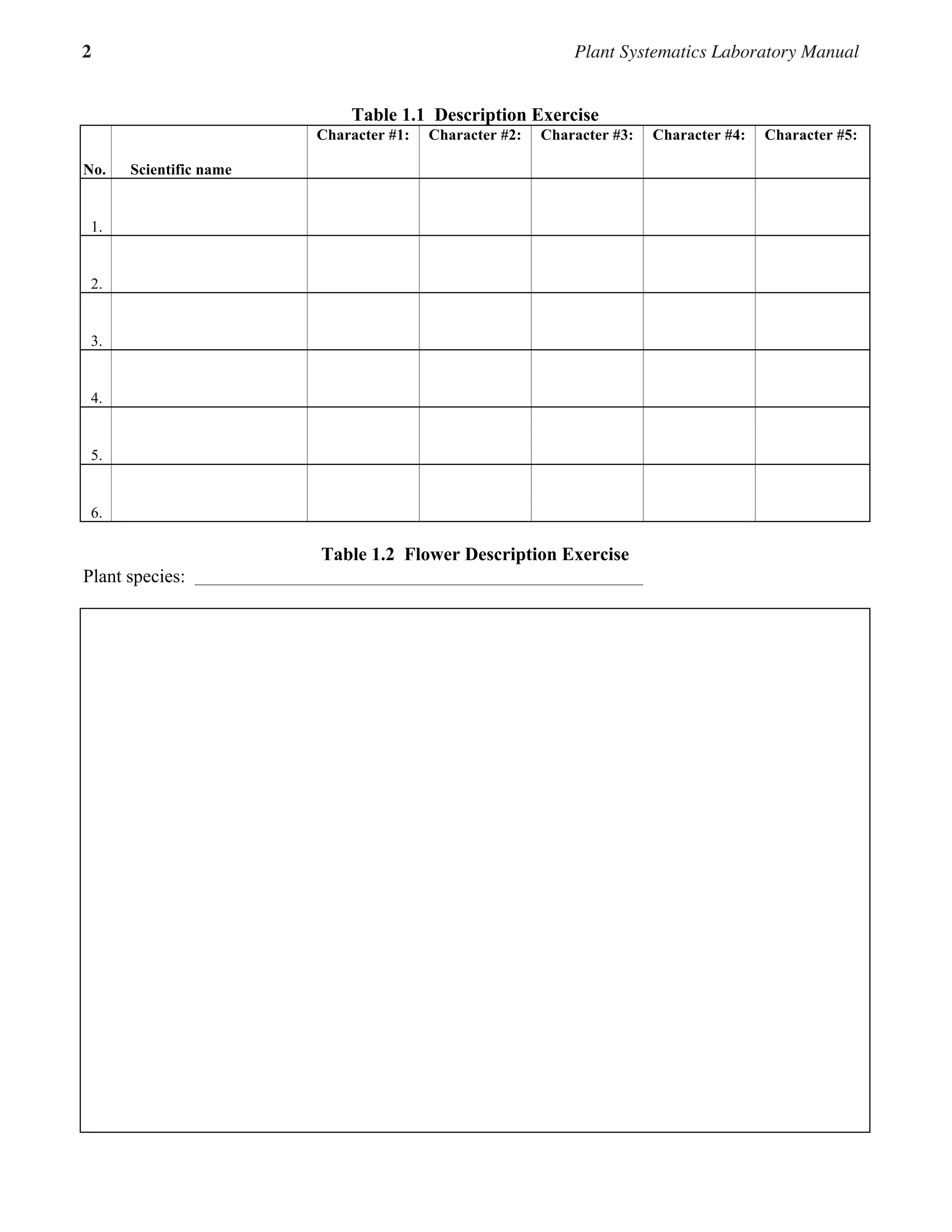
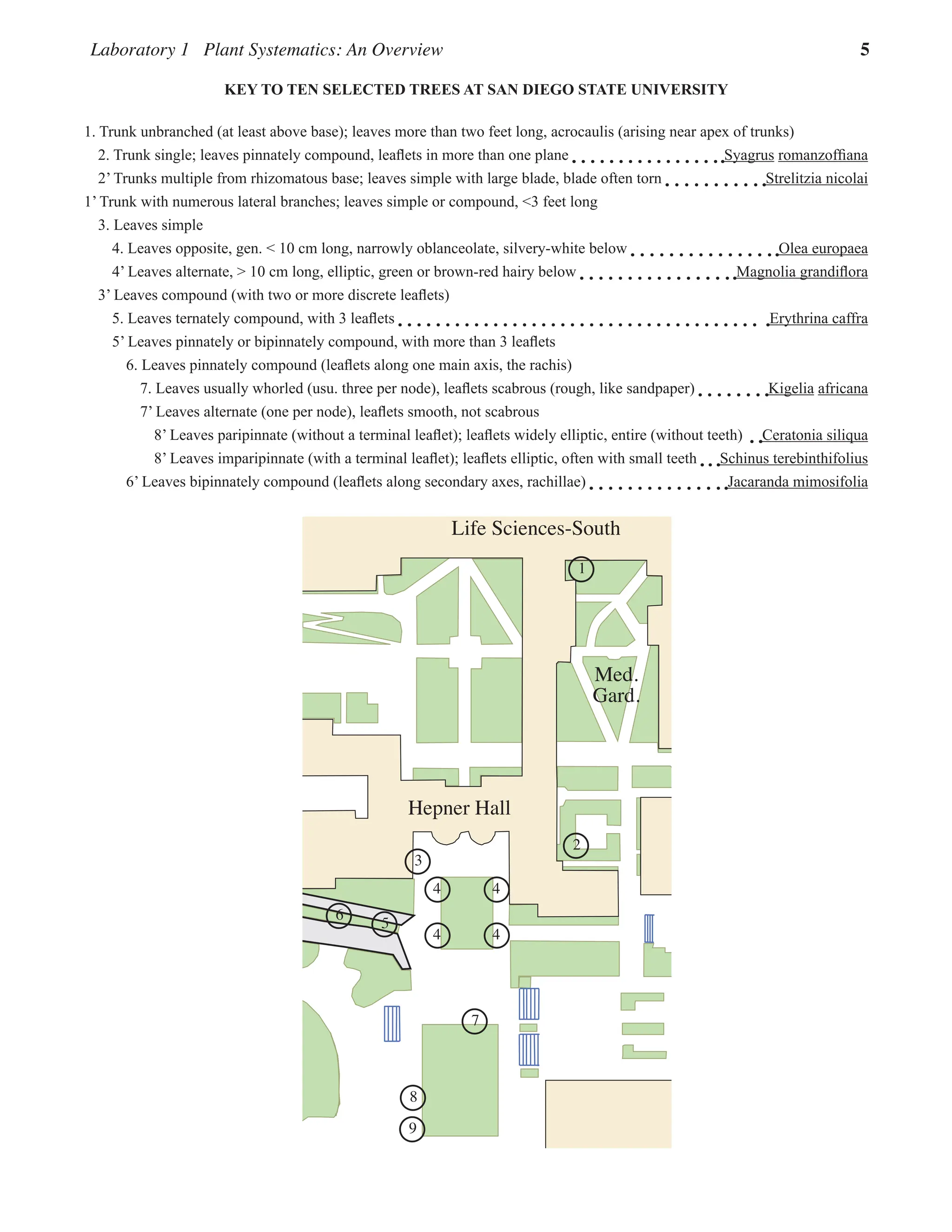

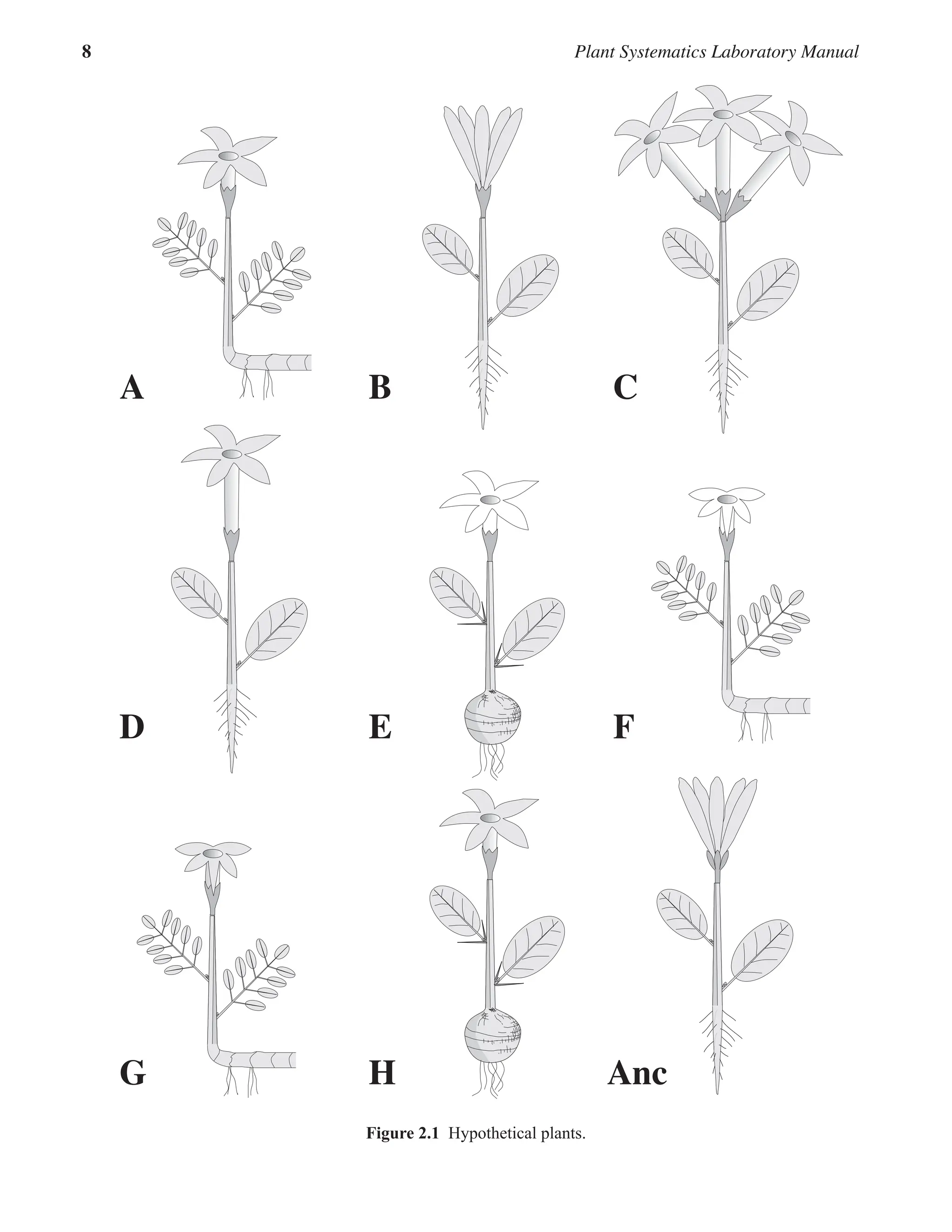
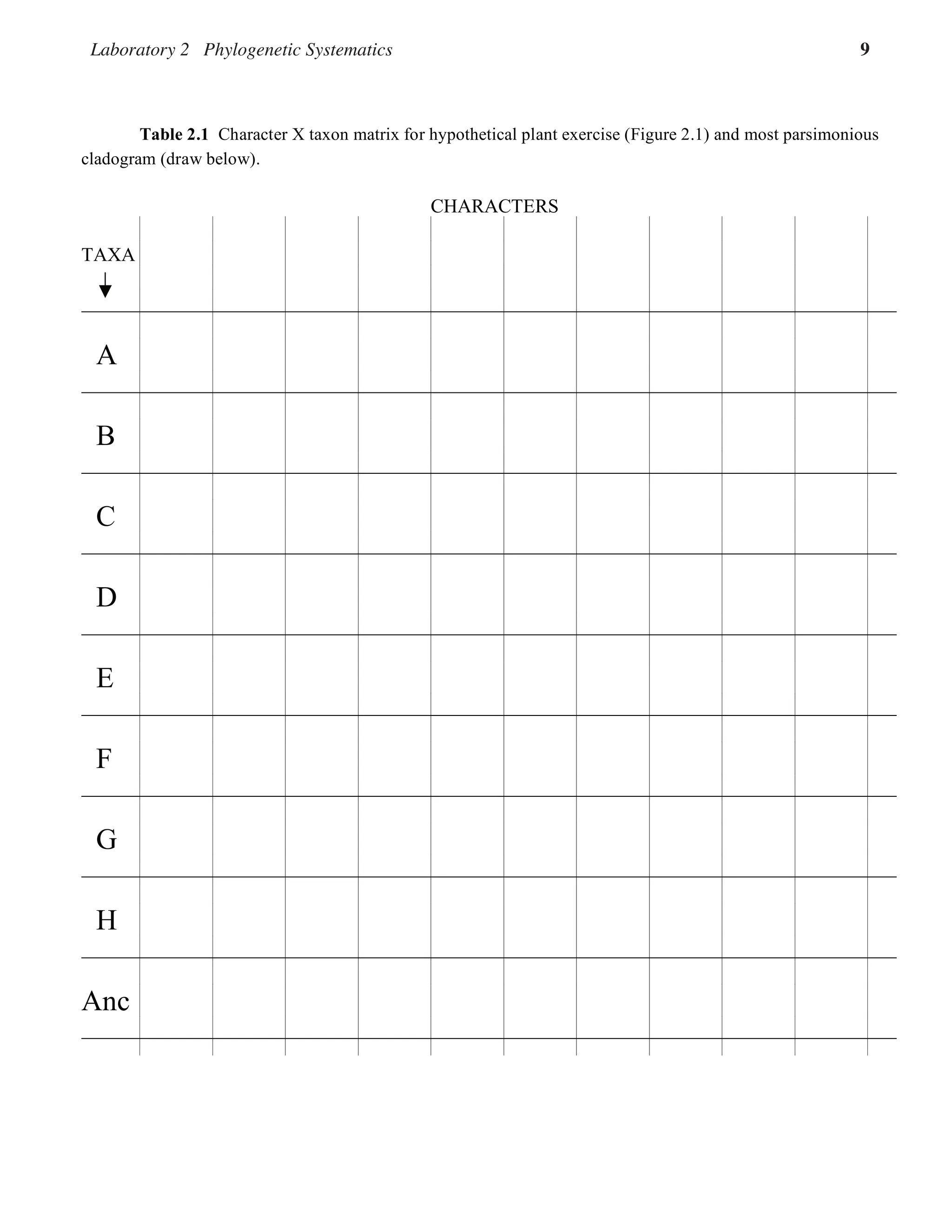

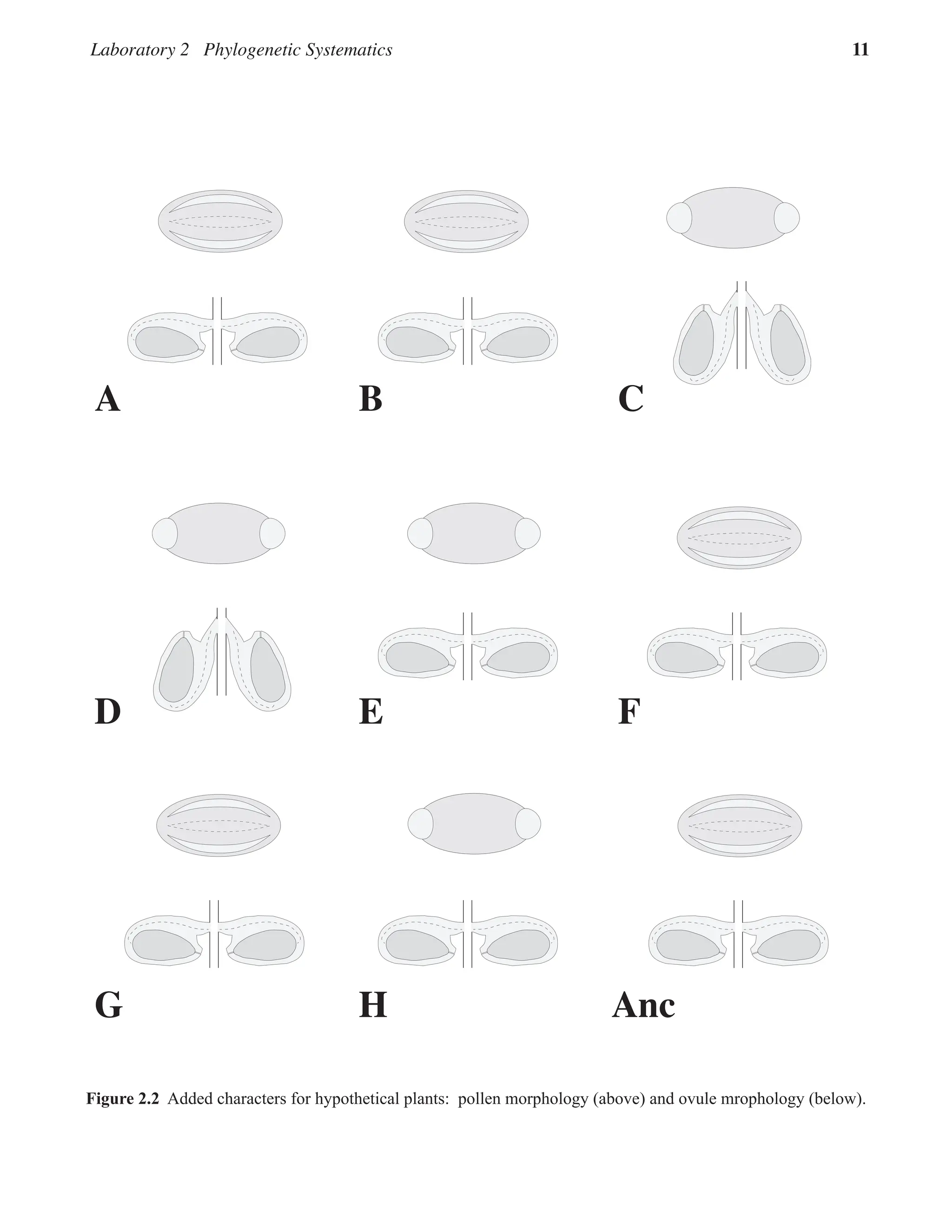

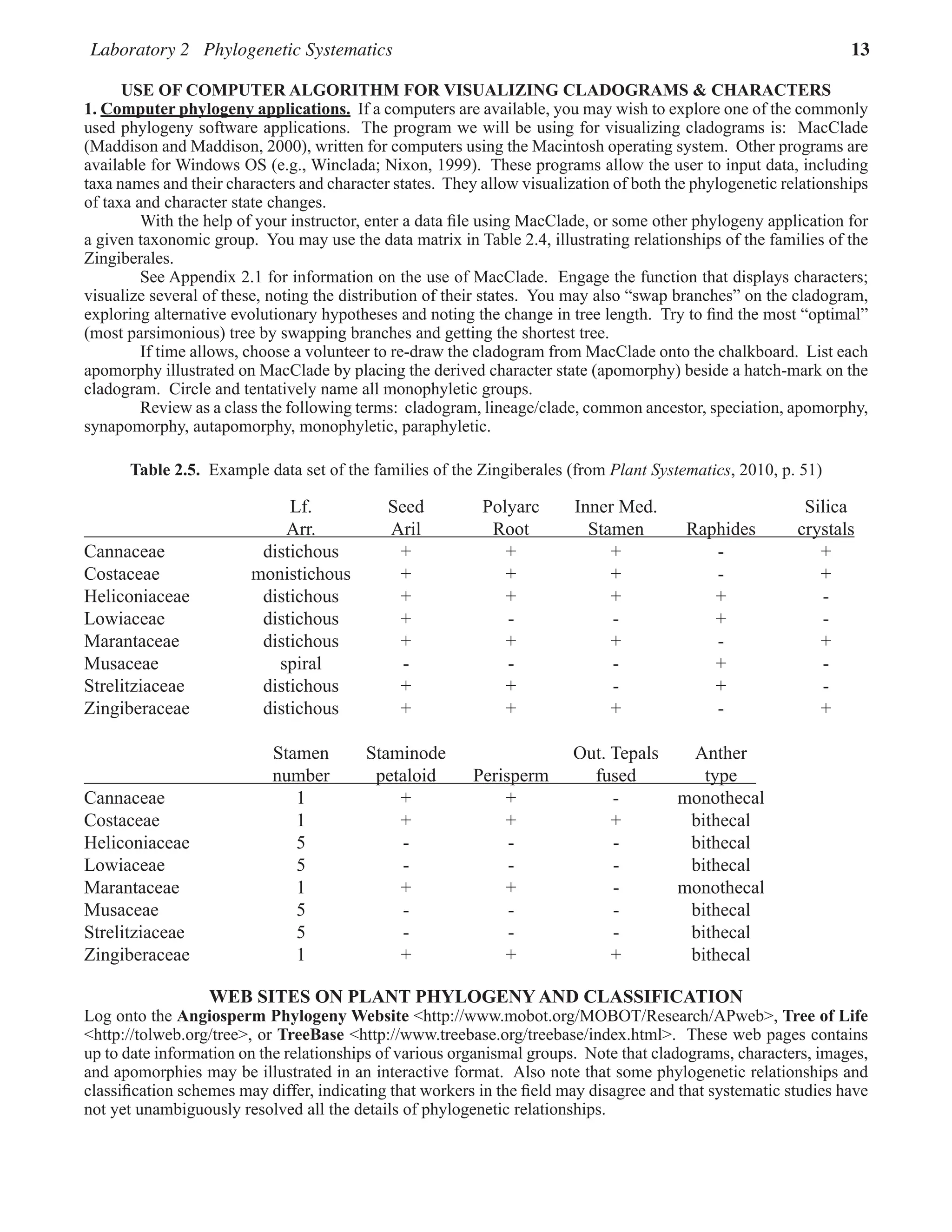
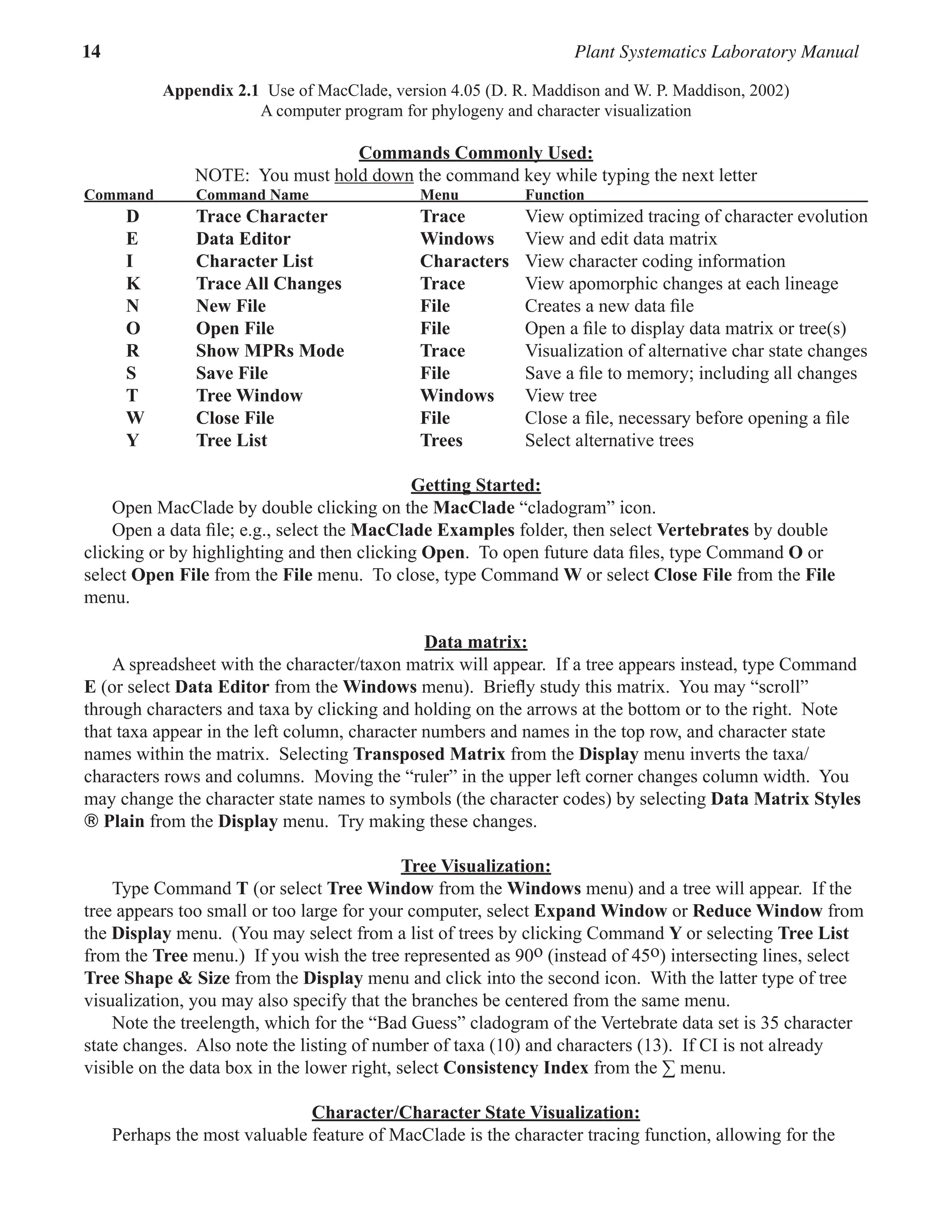
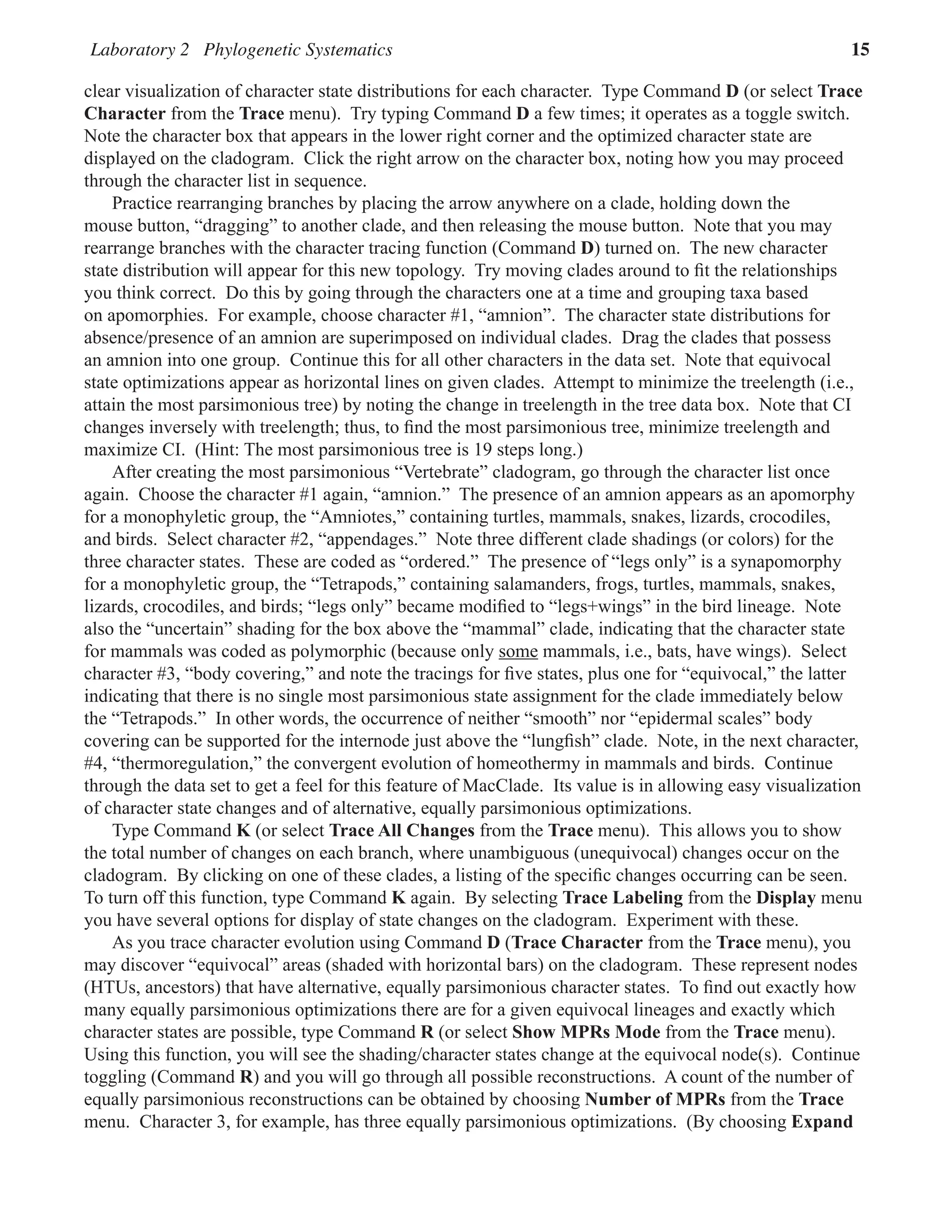
![16 Plant Systematics Laboratory Manual
Clade from the Tools menu, you can click on the node of interest and obtain precisely the number of
reconstructions under the assumption that the outgroup node is ancestral.)
For certain characters, a given cladogram topology may show an “equivocal” condition (shaded
as horizontal bars) at a given internode that can be explained as either of two equally parsimonious
character optimizations: DELTRAN (DELay TRANsformations) or ACCTRAN (ACCelerate
TRANsformations). DELTRAN delays changes away from the root node, which in effect promotes
convergent character evolution; ACCTRAN accelerates changes toward the root node, which maximized
reversals. DELTRAN and ACCTRAN options may be visualized with MacClade as follows. First,
select the character of interest on the tree with the Trace Character (Command D) option on. Then
select Resolving Options from the Trace menu. Click either Deltran or Acctran and then click
OK (or type the Return key). Note the change in character optimization on the tree. Not all equivocal
optimizations are resolved using DELTRAN or ACCTRAN.
Character Status:
Type Command I (or select Character List from the Characters menu). Note the display of
characters, listing: a) character number; b) character name; c) whether included (box with a check)
or excluded from the analysis (box with an “X”); d) character type (unordered, ordered, irreversible,
stratigraphic, Dollo, or user-defined); e) character weight; f) number of character states; g) optimized
number of character steps (for the current tree); and h) character CI. You may alter the first four
variables by clicking on and highlighting a given row and then clicking the small arrow beside the
column headings. To remove the Character Status box, click the upper left red spot (or Command
W). Note that the default character type is unordered; thus, if you wish any to be ordered, irreversible,
statigraphic, Dollo, or user defined, you must specify it.
Tools:
From the Windows menu select Tool Palette and note the Tool box that appears, with several
functions, different in Edit mode (Command E) versus Tree mode (Command T). In Tree & Display
(Command D) mode, these are (from left to right, top to bottom):
1) Search Above Performs a search upward pass and selects that cladogram topology which is
most parsimonious based on that upward pass.
2) Reroot Tree Allows tree to be rerooted at any point.
3) Make Ancestral Allows you to make a terminal OTU a direct ancestor at the immediate node
below.
4) Exclude Clade Allows exclusion of any particular clade; may be reversed by selecting
Include-Exclude Taxa from the Tree menu.
5) Move Branch This is the default setting, allowing you to move clades into different
topologies.
6) Polytomy Exchange Allows branch rearrangements within a polytomy.
7) Rotate Branches Rotates branches at the node immediately above the clade selected.
8) Rotate to Lean Right Rearranges branches such that they are “ladderized”
9) Collapse Clade Arranges every clade above a given branch into a polytomy.
10) Collapse Branch Collapses a given clade, such that the immediate branches above form a
polytomy with that/those below.
11) Test Correlation [Click in and read.]
12) (Unused)
13) List States Will list the character state at a given clade.
14) (Unused)](https://image.slidesharecdn.com/plsyslab-250719064702-ff141168/75/Plant-Systematics-laboratory-manual-techniques-20-2048.jpg)
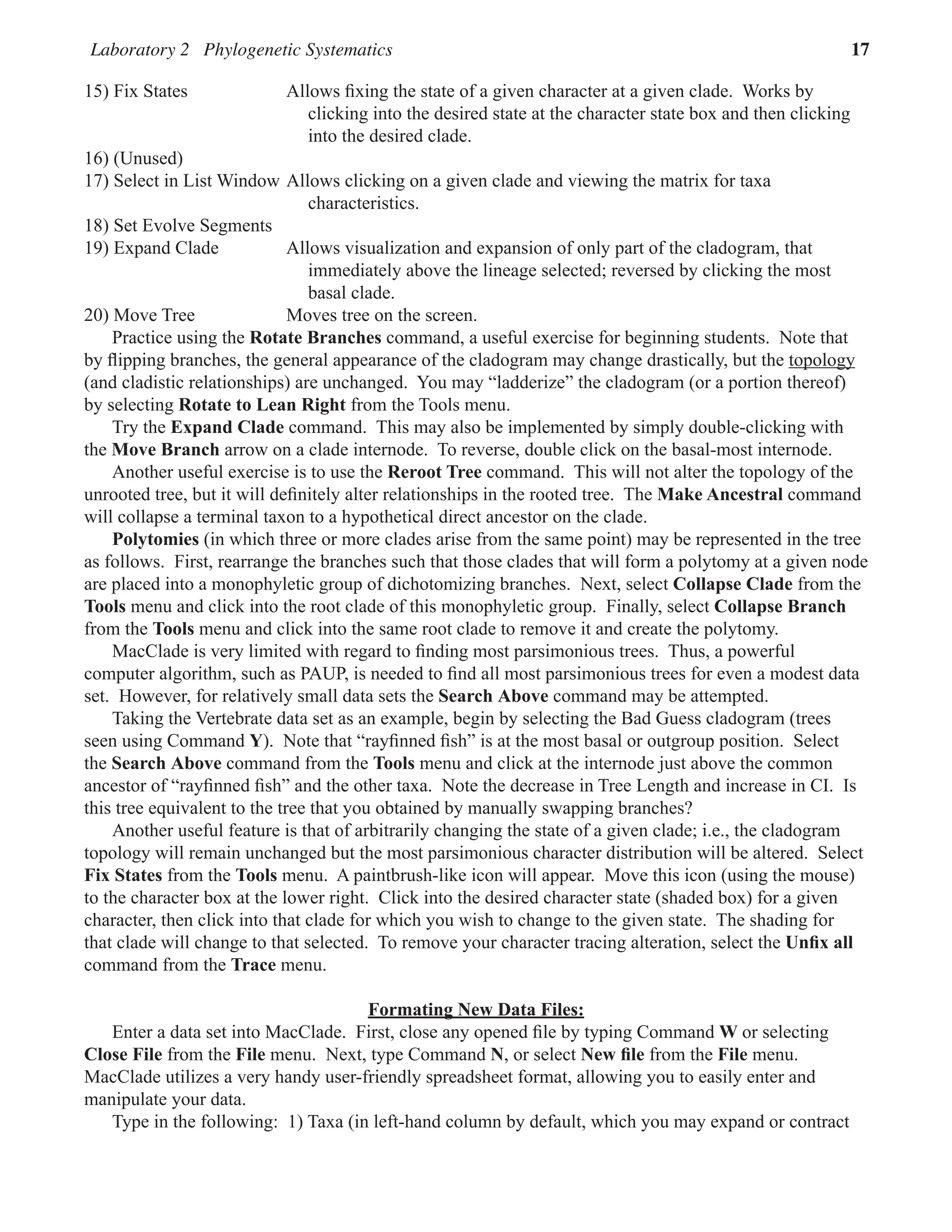
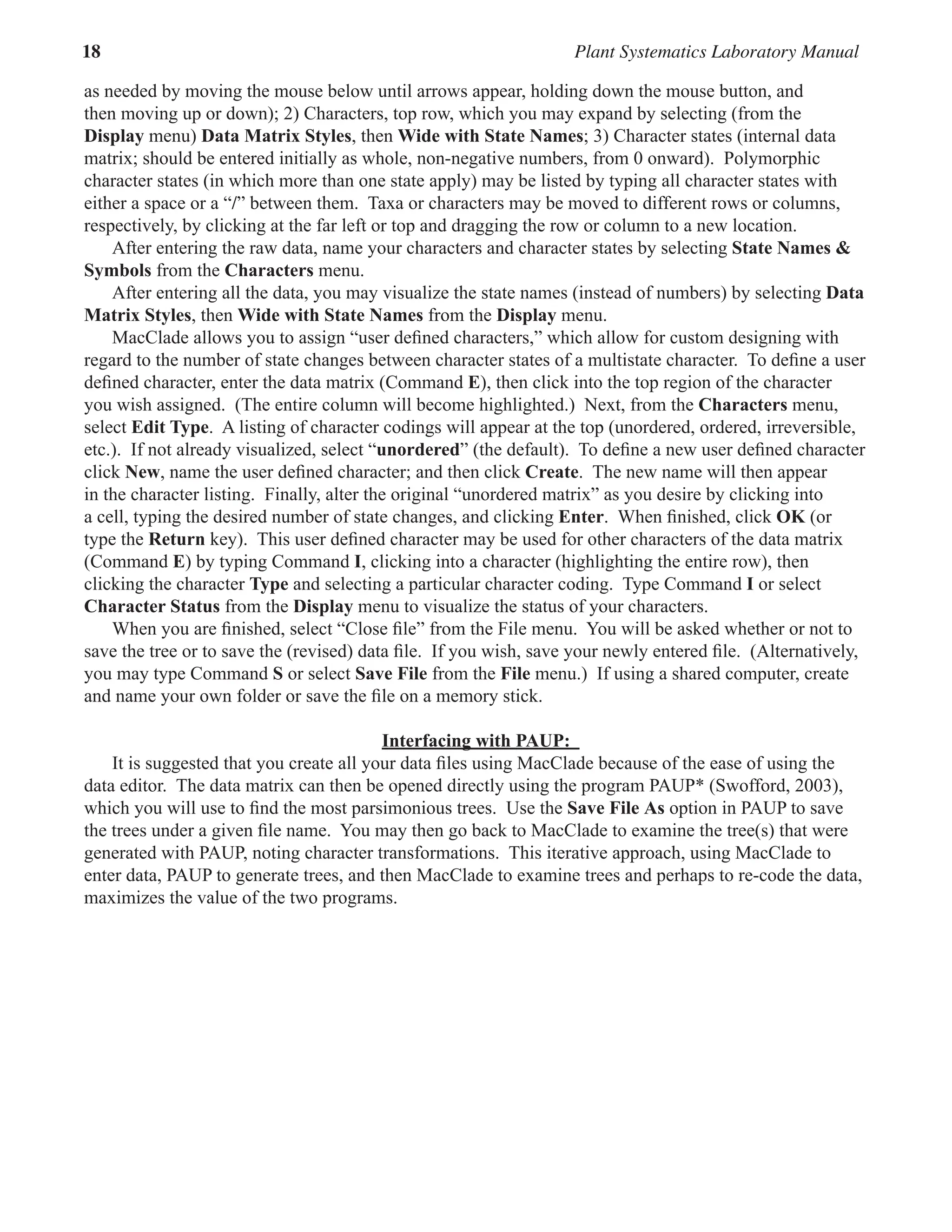
![20 Plant Systematics Laboratory Manual
Observe the material of a leafy liverwort. Note the very different appearance of the gametophyte, which consists of
a terete axis bearing three rows of leaves (generally two above or dorsal and one below or ventral); these leaves evolved
independently from, and are thus not homologous with, those of vascular plants. Draw a leafy liverwort gametophyte in upper
(dorsal) and lower (ventral) views, showing the three ranks of leaves.
Observe the prepared slide of a liverwort sporophyte, e. g., Marchantia. Note that the sporophyte is attached to (and
nutritionally dependent on) the gametophyte. Also note the numerous spores (each a haploid product of meiosis) and surrounding
elaters, specialized structures that hygroscopically aid in spore release. Prepare an outline drawing of the sporophyte and a
close-up drawing of some of the spores and elaters.
Stomates
Stomates are derived features for all land plants, with the exception of the Liverworts. It is as yet unclear if stomates
evolved once or independently two or more times. Make a wet mount in a drop of water of an epidermal peel of the lower
epidermis of available material (e. g., Coleus, Commelina, Graptopetalum, or Zebrina). Observe the stomates (= stomata),
containing two guard cells which control the size of the pore (stoma). Stomata are the only epidermal cells with chloroplasts.
Draw and label a stomate, noting the two guard cells and stoma.
Mosses (Musci)
The true Mosses are a group of non-vascular land plants that have evolved a diversity of morphological forms. Observe
various moss gametophytes, the haploid, green, leafy part of the life cycle. Draw and label a moss gametophyte.
Moss Sporophyte. All land plants have a specialized life cycle phase: the diploid (2n) sporophyte. A young sporophyte
attached to the gametophyte is called an embryo, hence the alternate name Embryophyta for the land plants. In the non-
vascular land plants (“Bryophytes”), the sporophyte is relatively small, short-lived, and generally non-photosynthetic, being
nutritionally dependent on the gametophyte. Observe sporophytes of mosses. These appear as brownish, short to elongate
structures that are attached to the leafy, green gametophyte. Sporophytes grow from the fertilized egg (zygote) within the
archegonium. The sporophyte terminates in an expanded sporangium (also called a “capsule” in “Bryophytes”), a specialized
organ where meiosis occurs, producing spores. Most moss sporangia have teeth-like structures, called peristome teeth, that
are hygroscopic, opening and closing depending on atmospheric moisture, effecting spore dispersal in the process. Draw
and label a moss sporophyte, showing the seta (stalk), capsule (sporangium), operculum (cap), peristome teeth, and spores.
[Optional: observe the capsule longitudinal-section.]
Sphagnum PEAT MOSS. Observe this moss, which grows in wet bogs and chemically modifies its environment by
making the surrounding water acidic. If available, make a wet mount of live Sphagnum leaves and observe with the compound
microscope. The leaves of Sphagnum are unusual in having two cell types: chlorophyllous cells that form a network around
large, clear hyaline cells, the latter having characteristic pores and helical thickenings. The pores of the hyaline cells give
Sphagnum remarkable properties of water absorption and retention, making it quite valuable horticulturally in potting mixtures.
Observe the sample of peat. Peat is fossilized and partially decomposed Sphagnum, and is mined for use in potting mixtures
and as an important fuel source in parts of the world.
Draw and label a portion of a Sphagnum leaf, showing the chlorophyllous cells and hyaline cells, the latter with pores
and helical thickenings:
Observe the prepared slide of germinating moss spores, which develop into a filamentous protonema. The protonema
represents a ancestral vestige, resembling a filamentous green “alga.” It soon grows into a parenchymatous gametophyte. The
spores of mosses and basal vascular plants have a thick outer layer called a perine layer, which may constitute an apomorphy
for mosses and vascular plants. Also, note the 3-lined structure on the spore wall, called a trilete mark, that is the scar from
the junction of the 4 spores after meiosis. Draw and label a spore, showing the trilete mark, a filamentous protonema, and a
young gametophyte, if present.
Hornworts (Anthocerotae)
Observe the live, preserved, or whole mounts of a hornwort, e.g., Anthoceros. Note that the gametophytes of hornworts
are thalloid, very similar to those of the thalloid liverworts. Draw a hornwort, showing the thalloid gametophyte and the
cylindrical sporophyte with a stout foot embedded in the gametophyte and surrounding gametophytic collar.
If available, study the longitudinal-section of a hornwort sporophyte. Draw and label the spores, central columella, and
pseudoelaters, the latter functioning in spore dispersal.](https://image.slidesharecdn.com/plsyslab-250719064702-ff141168/75/Plant-Systematics-laboratory-manual-techniques-24-2048.jpg)
![22 Plant Systematics Laboratory Manual
LYCOPODIOPHYTA - LYCOPOPHYTES
Lycopodium Club-Moss. Note the general morphology of Lycopodium, commonly known as CLUB-MOSS. It
is not, of course, a true moss; how does it differ? Vegetatively, there are numerous spirally arranged leaves, microphylls,
covering the photosynthetic stem. Lycopodium has true roots, present in all vascular plants except the Psilophytes. Note
the yellowish sporangia on top of the small leaves. These produce numerous spores (which develop into what?). In some
species the sporangia are aggregated into a terminal strobilus (cone), consisting of an axis of sporophylls bearing sporangia.
Lycopodium spores were once used as flash powder in photography.
Draw and label a Lycopodium shoot, showing the strobilus. Optional: Make an outline drawing of a strobilus
longitudinal section, showing the sporophylls and sporangia.
Selaginella Spike-Moss, Moss-Fern. Selaginella bigelovii BIGELOW’S MOSSFERN. Note the moss-like
appearance of this plant, which is actually a vascular plant, native to our region. Stems are rhizomatous to decumbent. The
leaves, which are microphylls, are very tiny, spirally arranged, and isomorphic, of one size and shape.
Selaginella apoda. This species differs in being prostrate and in having dimorphic leaves in four rows: two with
small, dorsal leaves and two with larger, ventral leaves. Observe the leaf morphology. Draw and label a close-up, showing
the four rows of dimorphic microphylls.
Selaginella sporangia. Observe the longitudinal-section of Selaginella, showing microsporangia, with microspores,
and megasporangia, with megaspores. Note the vast difference in spore size. What is the evolution of two spore types
termed?
Isoetes Quillwort, Merlin’s Grass. This genus of lycopods occur in wet areas, e. g., vernal pools in our region. In
most species the stem is short and erect, bearing numerous long, thin leaves, which are microphylls. Sporangia are located
at the leaf base (upper surface) of some leaves. Draw and label the whole plant.
Fossil Lycopods. Note the fossil specimens of Lepidodendron [=Stigmaria]. These plants were large trees (some
taller than 100 feet tall), living approximately 200-300 million years ago. Lepidodendron stems are recognizable in having
the remains of diamond-shaped leaf scars covering the surface. Other representative fossil lycopods may include casts,
compressions, or coal-ball peels of Sigillaria (stems), Lepidostrobus (cones), and Lepidophlois. Fossil lycopods are of
economic importance in being a major contributor to present day coal and oil deposits. Learn to recognize Lepidodendron:
EUPHYLLOPHYTA - EUPHYLLOPHYTES
MONILOPHYTA - MONILOPHYTES
EQUISETOPSIDA - HORSETAILS
Equisetum - Equisetaceae. Observe the herbarium sheets and live material of Equisetum, the only extant genus
of this group. The Equisetophytes are recognized by 1) the longitudinal ridges on the outer photosynthetic stem; 2) the
articulate (jointed), septate nodes; and 3) the whorls of leaves (microphylls) present at these nodes.
Species of Equisetum lacking many lateral branches are called “scouring rushes,” after their use in colonial times as
a souring brush to, e. g., clean pots and pans. This use is possible because of the presence of considerable silica in the cell
walls of the stems. Species of Equisetum with numerous lateral branches (arising from the nodes) are called “Horsetails.”
Equisetum hyemale Scouring Rush. Note the rhizomatous underground stem, which often develops into an
extensive clonal colony (sometimes encompassing several acres). Also note the whorled leaves (microphylls), forming an
encircling sheath by virtue of being laterally fused. Terminal strobili (cones) may be visible on stems.
Equisetum arvense Horsetail. Note that this species differs from the above in having dimorphic stems. The sterile,
photosynthetic stems have numerous lateral branches arising at the nodes. The branches actually pierce the base of the
sheath-like leaves and give the plant its characteristic “horsetail” appearance. Strobili (cones) are borne at the tips of non-
photosynthetic stems which lack the lateral branches. Draw and label a close-up of the ridged stem, whorled leaves, and (if
present) lateral branches.
Equisetum strobilus. Observe the strobilus (cone) of Equisetum. This unique structure consists of a central
axis bearing units called sporganiophores. Each sporangiophore is a peltate (umbrella-shaped) structure with a stalk,
outer shield (somewhat hexagonal in shape), and several inwardly-curved, longitudinally-dehiscent sporangia. Observe a
sporganiophore with sporangia. Open up a sporangium under the dissecting microscope to expose the spores. As they dry,
note their amazing movement, caused by hygroscopic elaters attached to the spores that effect spore dispersal. Make a wet-
mount of the spores and view with the compound microscope. Draw and label the strobilus, sporangiophore, and spore.
Fossil Equisetophytes. During the Carboniferous period and beyond, Equisetophytes were much more common
than today and contributed significantly to the biomass of plants. Calamites was a tree Equisetophyte common during this](https://image.slidesharecdn.com/plsyslab-250719064702-ff141168/75/Plant-Systematics-laboratory-manual-techniques-26-2048.jpg)
![Laboratory 4 Evolution and Diversity of Vascular Plants 23
time. It is a major component of coal deposits. Observe the fossil Calamites, which is recognizable from the longitudinal
striations present on this impression of the stem. Other fossil Equisetophytes may include casts, compressions, or coal-ball
peels of Calamodendron and Arthropitys. Learn to recognize Calamites.
PSILOTOPSIDA
Ophioglossales - Ophioglossoid Ferns
Observe the specimens of Ophioglossum and Botrychium spp. in the family Ophioglossaceae. What is distinctive
about their leaf anatomy? What type of gametophyte and sporangium to they have?
Psilotales - Whisk Ferns
Psilotum nudum Whisk Broom (Psilotaceae). Observe and draw a stem and microphyll of Psilotum. What is the
underground portion of the plant? The vascular plants differ from liverworts, hornworts, and mosses in having a dominant,
photosynthetic, long-lived sporophyte generation. The gametophyte is relatively small and short-lived. Thus, the material
you see is diploid sporophyte.
Draw and label a plant of Psilotum, showing the rhizomes (underground stem), dichotomously branched aerial
stem, and microphylls. Also, draw and label a Psilotum synangium, a fusion product of 3 sporangia, and its forked
appendage. Optional: Make a wet-mount preparation of the spores and observe with a microscope.
MARATTIOPSIDA - MARATTIOID FERNS
Observe the examples of marattioid ferns, e.g., Angiopteris, Danaea, Marattia. Note that these look like typical
“ferns,” some being quite large. However, carefully observe the sporangia, located on the abaxial surface of some leaves.
These are eusporangia, which develop from several cells and have a sporangial wall which is many cells thick. This is in
contrast to the leptosporangia of the Polypodiopsia (below).
POLYPODIOPSIDA - LEPTOSPORANGIATE FERNS
Note the fern sporophyte, the most visible phase of the life cycle. Fern leaves (fronds) bear on their underside
sporangia, often grouped together into sori (singlular, sorus). Observe the fiddleheads or croziers (young coiled fern
leaves or fronds), exhibiting circinate vernation. These are collected and used as a vegetable (tastes similar to asparagus),
particularly popular in parts of China.
Salviniales-Aquatic/Heterosporous Ferns
These are true leptosporangiate ferns but are unusual both in being aquatic and heterosporous (producing both male
and female spores, which develop into separate male and female gametophytes). Learn to recognize:
Marsilea sp. water clover Marsileaceae
Pilularia sp., pillwort Marsileaceae
Salvinia sp. water spangles Salviniaceae
Azolla sp. mosquito fern Salviniaceae [Azollaceae]
If available, observe the endosporic female gametophytes of Marsilea, with gelatinous acrolamellae, in which you
may find embedded sperm cells.
Cyatheales
Cyatheaceae Scaly Tree Fern family
Cyathea cooperi Australian Tree Fern Cyatheaceae
Note the very large, bi- to tripinnately compound fronds arising from an erect trunk.
Polypodiales
Aspleniaceae Spleenwort family
Asplenium nidus Bird’s Nest Fern Polypodiaceae
Note simple fronds and linear sori and indusia, the latter diagnostic for this family.
Polypodiaceae Polypody family
Polypodium aureum Hare’s Foot Fern Polypodiaceae
This illustrates a pinnatifid (=pinnately divided) frond division. Note the round sori, which are exindusiate,
characteristic of this family.
Platycerium bifurcatum Staghorn Fern Polypodiaceae Australia, New Guinea
This is an epiphytic fern with dimorphic fronds. Sterile fronds overlap the base and function to trap decaying vegetation.](https://image.slidesharecdn.com/plsyslab-250719064702-ff141168/75/Plant-Systematics-laboratory-manual-techniques-27-2048.jpg)

![Laboratory 5 Evolution and Diversity of Woody and Seed Plants 27
Female cones are determinate shoots consisting of a stem axis which bears ovuliferous scales, each ovuliferous scale
subtended by a bract. The bracts are generally small but can get large, e.g., in Pseudotsuga (DOUGLAS-FIR). Each
ovuliferous scale bears two ovules (which, of course, develop into two seeds) on its adaxial surface. Ovuliferous scales
evolved from much more elaborate lateral branch systems, which became fused and flattened; this fertile shoot system
constitutes a synapomorphy with the Ginkgoales. Pine seeds are often winged. When the female cones are closed, the outer
exposed surface of the ovuliferous scale is called an apophysis; a raised portion of the apophysis is known as an umbo.
The umbo often ends in a prickle. Note first year cones, second year cones, and mature cones that have released the seeds
already.
Observe the prepared slide of a pine female cone, noting ovule, ovuliferous scale, and bract. Draw and label.
Pinaceae. Pine family. Draw and label parts of one female cone of a representative members:
Pinus spp. Pines. Note the representative species of pines, including P. canariensis, P. coulteri, P. jeffreyi, P.
monophylla, and P. torreyana. Note the species differences in the number, shape, and size of the leaves of the
fascicle and differences in female cone morphology.
Abies sp. Fir. Note the petiolate to subsessile, linear leaves of the Fir tree. The cones of Fir are erect.
Picea sp. Spruce. Note the petiolate, linear leaves, which leave behind a characteristic peg-like leaf-scar.
Pseudotsuga sp. Douglas-Fir. Note the petiolate, linear leaves. The female cones are pendant (hang down) and
have elongate, trifid bracts.
Cupressaceae Cypress family (including Taxodiaceae). Members of this family have characteristic small, triangular
(awl-shaped) leaves, which are often (though not always) decussate and closely appressed to the stem.
Calocedrus decurrens [Libocedrus decurrens] Incense-Cedar. A large tree of high altitude, coniferous forests (e.g.,
Cuyamaca, Laguna Mts. of S.D. Co.). Note that the minute, decussate leaves are decurrent along the highly
branched and flattened stems.
Chamaecyparis thyoides White Cedar, eastern U.S.
Cupressus forbesii Tecate-Cypress Note the minute leaves and highly branched shoots of this somewhat rare
species. The female cones are spherical with tightly closed ovuliferous scales bearing a raised umbo.
Cupressus sempervirens var. stricta Italian-Cypress This commonly cultivated tree is tall and very narrow.
Juniperus californica California Juniper. The junipers differ from the cypresses in having succulent, “berry-like”
female cones, caused by a thickening and fusion of the ovuliferous scales.
Metasequoia glyptostroboides Dawn Redwood
Sequoia sempervirens Redwood
Sequoiadendron giganteum Giant Sequoia
Taxodium distichum Bald-Cypress
Taxodium mucronatum Montezuma-Cypress
Thuja occidentalis Eastern White Cedar, T. plicata Western Cedar. This genus can be recognized in part by the
flattened branch systems.
Araucariaceae. Members of this family are found in parts of South America, Australia, Oceania, and s.e. Asia.
Araucaria bidwillii Bunya-Bunya, n. e. Australia
Araucaria heterophylla Norfolk Island-Pine, Norfolk I., Australia
Podocarpaceae. Members of this family have very reduced female cones, appearing as a single seed.
Agathis sp.
Podocarpus gracilior East African Fern Pine (tropical Africa)
Podocarpus macrophyllus Japanese Yew Pine (Japan)
Gnetales
Ephedra sp. MORMON-TEA. Ephedra can be recognized by the photosynthetic, striate (longitudinally ridged) stems
and the very reduced scale-like leaves, only 2 or 3 per node. (NOTE: Don’t confuse with Equisetum; study the differences.)
Male or female cones may be found in the axils of the leaves. Draw and learn to recognize.
Welwitschia mirabilis WELWITSCHIA. Observe the live or preserved material (if available) and photographs of
this weird plant native to deserts of Namibia (southwestern Africa). An underground caudex bears only two leaves, these
becoming quite long and lacerated in old individuals. Male and female cones are born on axes arising from the apex of the
caudex. Draw and learn to recognize.
Gnetum. This plant is a tropical vine with opposite, simple leaves, looking all the world like an angiosperm but, of
course, lacking true flowers. Observe photographs.](https://image.slidesharecdn.com/plsyslab-250719064702-ff141168/75/Plant-Systematics-laboratory-manual-techniques-31-2048.jpg)



![38 Plant Systematics Laboratory Manual
POALES
Bromeliaceae - Bromeliad family (after Swedish medical doctor and botanist, O. Bromell, 1639-1705). 59
genera / 2,400 species.
Note the trichome cover of various bromeliad species. The trichomes function to absorb water from the
atmosphere and water and mineral nutrients from runoff and also function in photoreflectance, perhaps in
protecting the plant from UV radiation. Scrape off some trichomes from the surface of a leaf into a drop of water
or 50% glycerol on a microscope slide and cover with a cover slip. Observe under a high powered compound
microscope. Draw, noting the details of the wall structure.
Note the general morphology of different types of bromeliads. Many bromeliads are epiphytic, some are
“tank” species, in which the sheathing leaf bases form a catchment for rain water and detritus (and sometimes a
home for animals). If available, examine closely the sympodial growth form of Tillandsia usneoides, Spanish-
moss. Carefully draw a shoot, noting the sympodial units.
Dissect a flower and fill out a family sheet. Note the ovary position, which varies from superior to inferior.
Notice if scales are present at the base of the perianth, and note the characteristic twisted style/stigma. Also note
the fruit type (if available), usually a berry (sorosis in Ananas comosus) or a capsule, the latter with winged or
plumose-crowned (comose) seeds.
EXEMPLARS: (Classification of subfamilies after Givnish et al. 2005)
Subfamily Bromelioideae [Some epiphytic, lvs. usu. spinose-serrate, G inferior, fr. berry, seeds w/o append.]
Aechmea (tank bromeliad)
Ananas comosus* Pineapple seedless cultigen, derived from native S. Am. sp.; fruit sorosis
Billbergia lvs. flat; inflor. often pendant; fls. lax
Brocchinia tank bromeliad that is possibly carnivorous
Bromelia
Canistrum infl. head-like; bracts spiral, colorful
Cryptanthus lvs. undulate
Neoregelia lvs. forming “tank;” infl. head-like, from center of rosette
Nidularium lvs. forming “tank;” infl. head-like, from center of rosette
Subfamily Hechtioideae [Usu. terrestrial, G superior, fr. capsule, seeds winged]
Hechtia lf. margin spinose-serrate
Subfamily Pitcairnioideae [Usu. terrestrial, G superior, fr. capsule, seeds winged]
Dyckia lf. margin spinose-serrate
Pitcairnia
Subfamily Puyoideae [Usu. terrestrial, G superior, fr. capsule, seeds winged]
Puya (e. g. P. alpestris) large, coarse lf. rosettes
Subfamily Tillandsioideae [Epiphytic, lvs. usu. entire, G superior, fr. capsule, seeds comose]
Guzmania lvs. flat; inflor. pedunculate; fl. bracts colorful, spiral
Tillandsia lvs. var.; inflor. unit spicate; fls. distichous; bracts colorful
Tillandsia usneoides Spanish Moss s.e. U.S.; epiphytic
Vriesia lvs. flat; inflor. unit spicate; fls. distichous; bracts colorful
Cyperaceae - Sedge family (Gr. for several species of the genus Cyperus). 104 genera / ca. 5,000 species.
If cauline leaves are present, note the closed, sheathing leaf bases and the tristichous leaf arrangement.
Remove, observe, dissect, and draw a sedge spikelet, either in flower or fruit. Study the flower morphology,
noting that the perianth, if present at all, consists of bristle-like tepals. Note the bracts (scales) arranged along
an axis (rachilla), either in a spiral or distichous arrangement. Study and draw the fruit type for this family, an
achene.
EXEMPLARS:
Cyperus involucratus Umbrella Plant W. Indies, S. Am. cultivated ornamental
Cyperus papyrus* Papyrus C. Africa, Nile Valley cult. orn.; early “paper”
Juncaceae - Rush family (L. for binder, in reference to use in weaving and basketry). 7 genera/ca. 350 spp.
If material is available, study the flowers of a member of this family, noting the biseriate-homochlamydeous,
scarious perianth, typically 6 stamens, and 3-carpellate, superior ovary. Draw. Also study and draw the fruit, a
capsule, and contrast this fruit type with that of the Cyperaceae.
EXEMPLAR:
Juncus sp. Rush ecologically important](https://image.slidesharecdn.com/plsyslab-250719064702-ff141168/75/Plant-Systematics-laboratory-manual-techniques-42-2048.jpg)
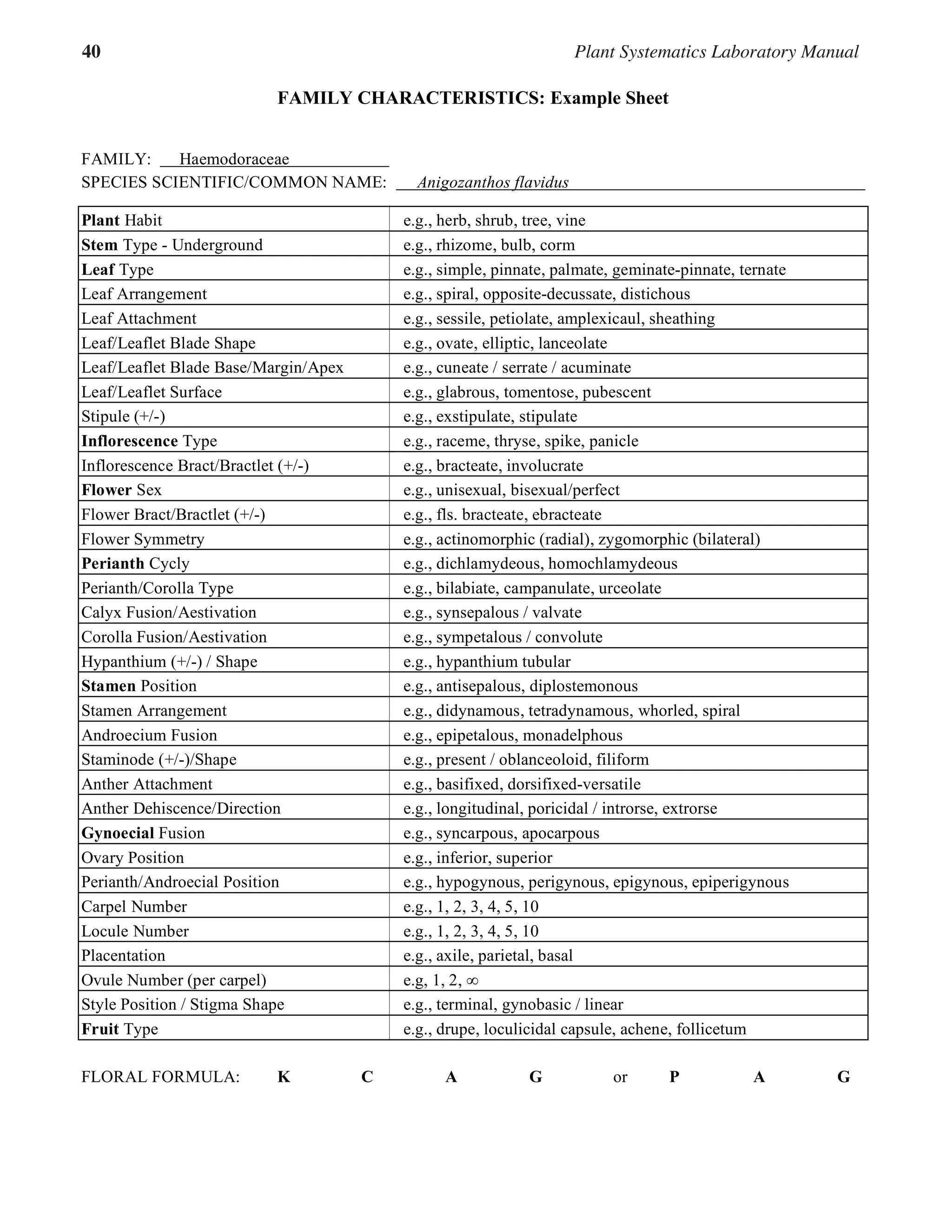
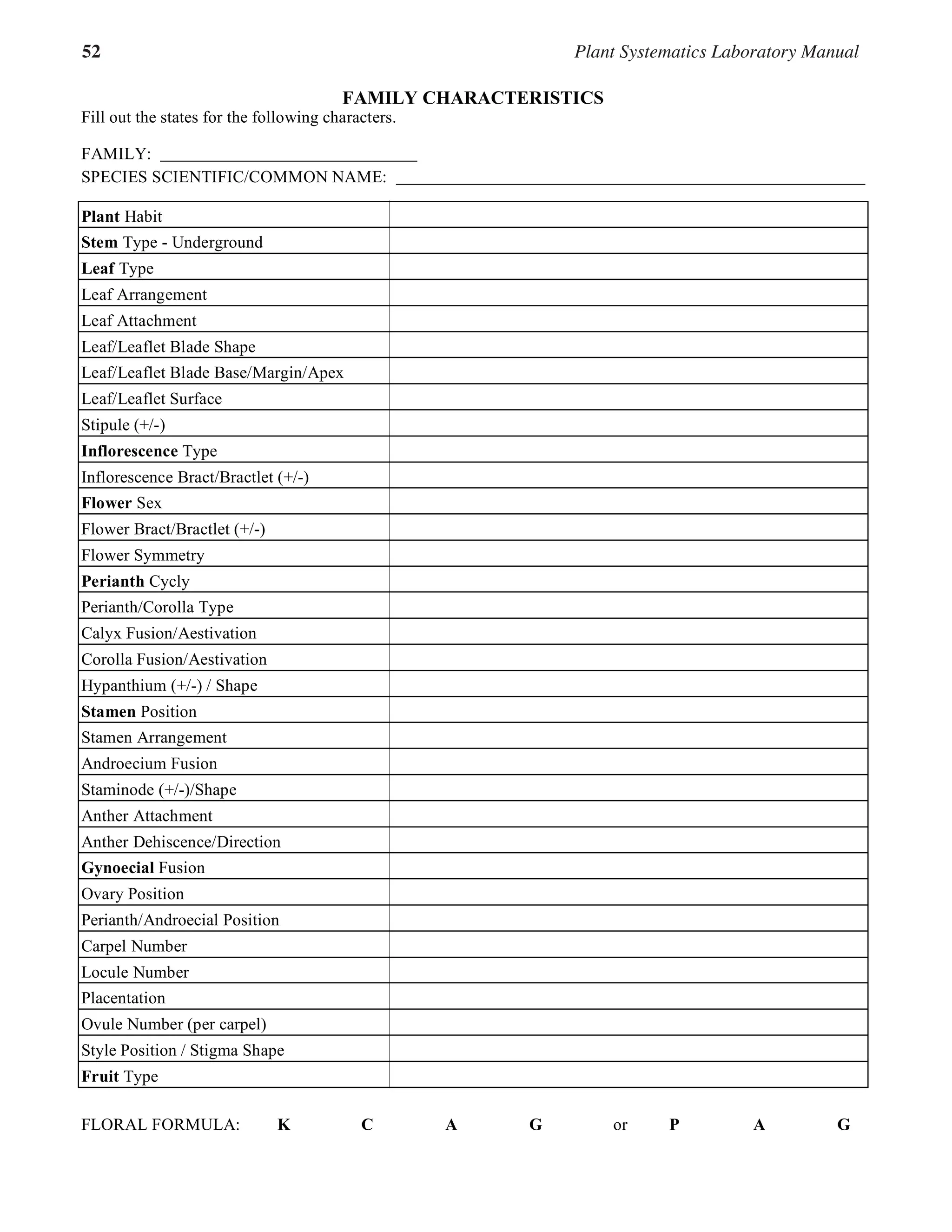
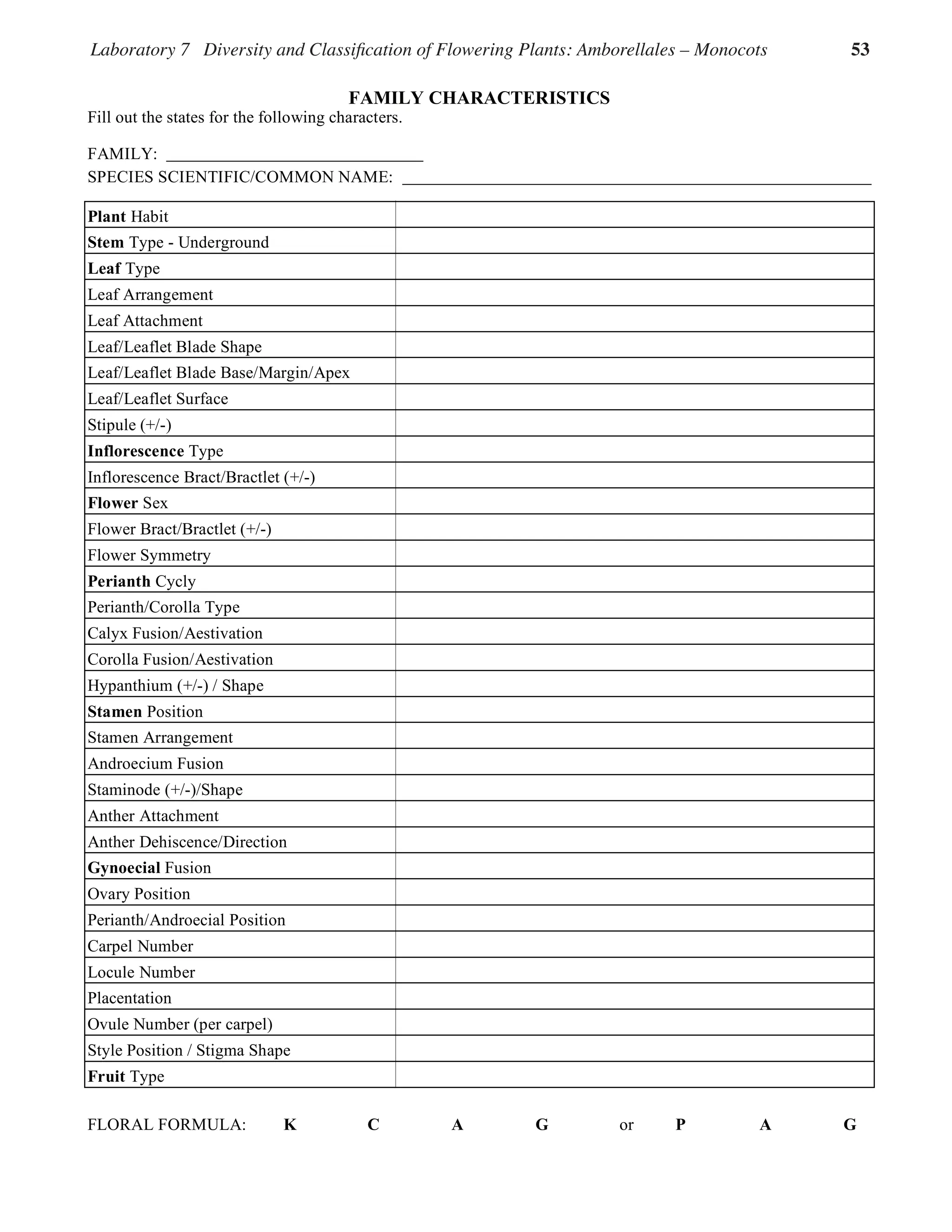
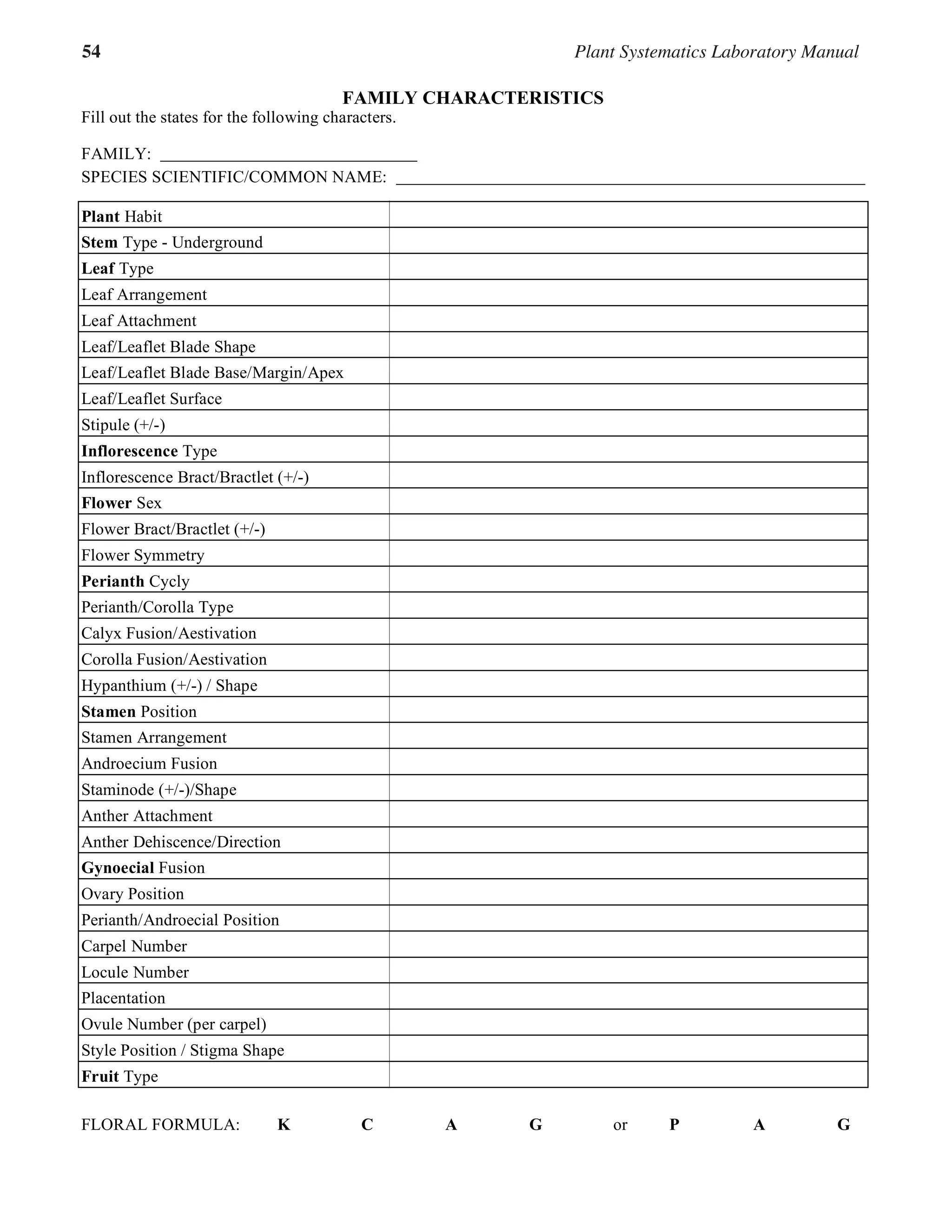
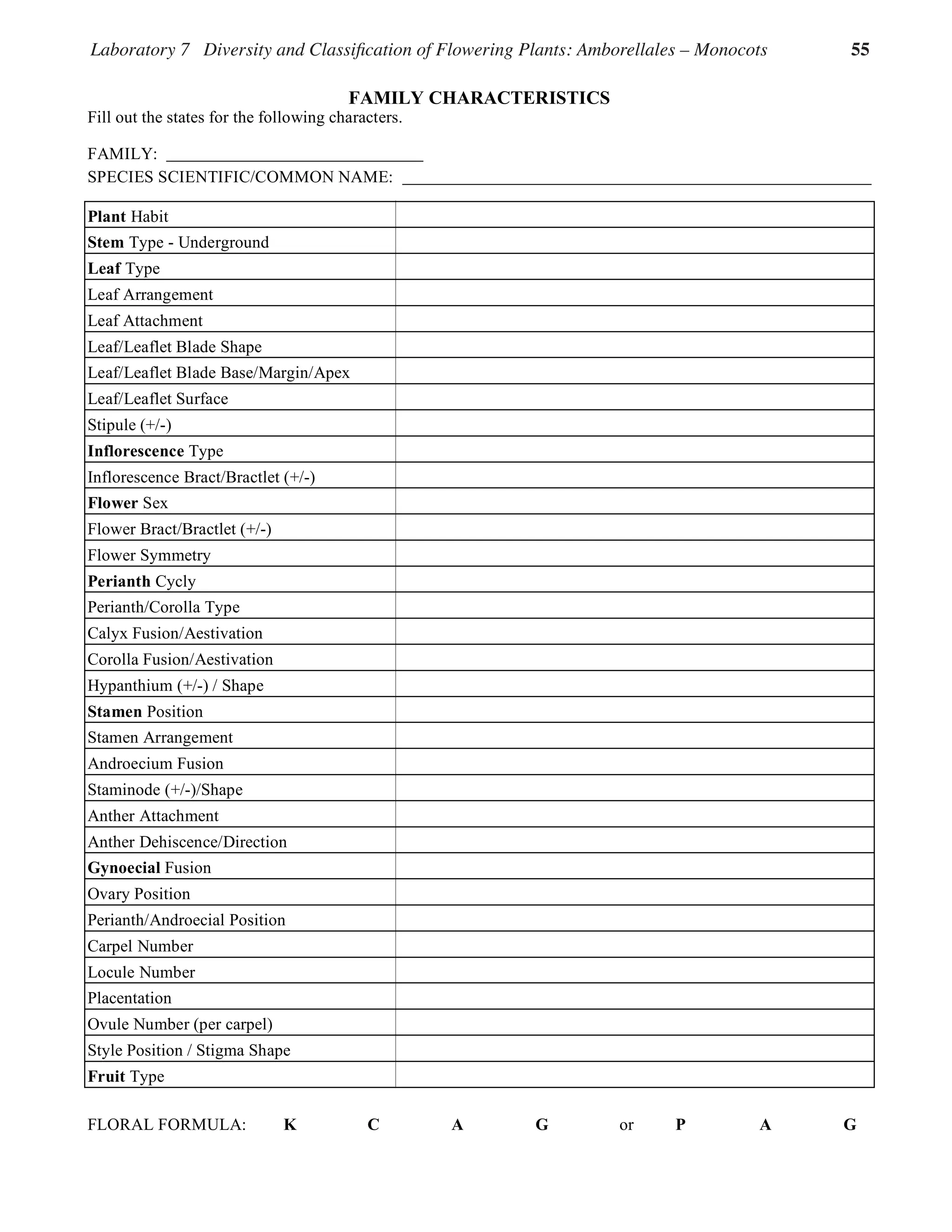
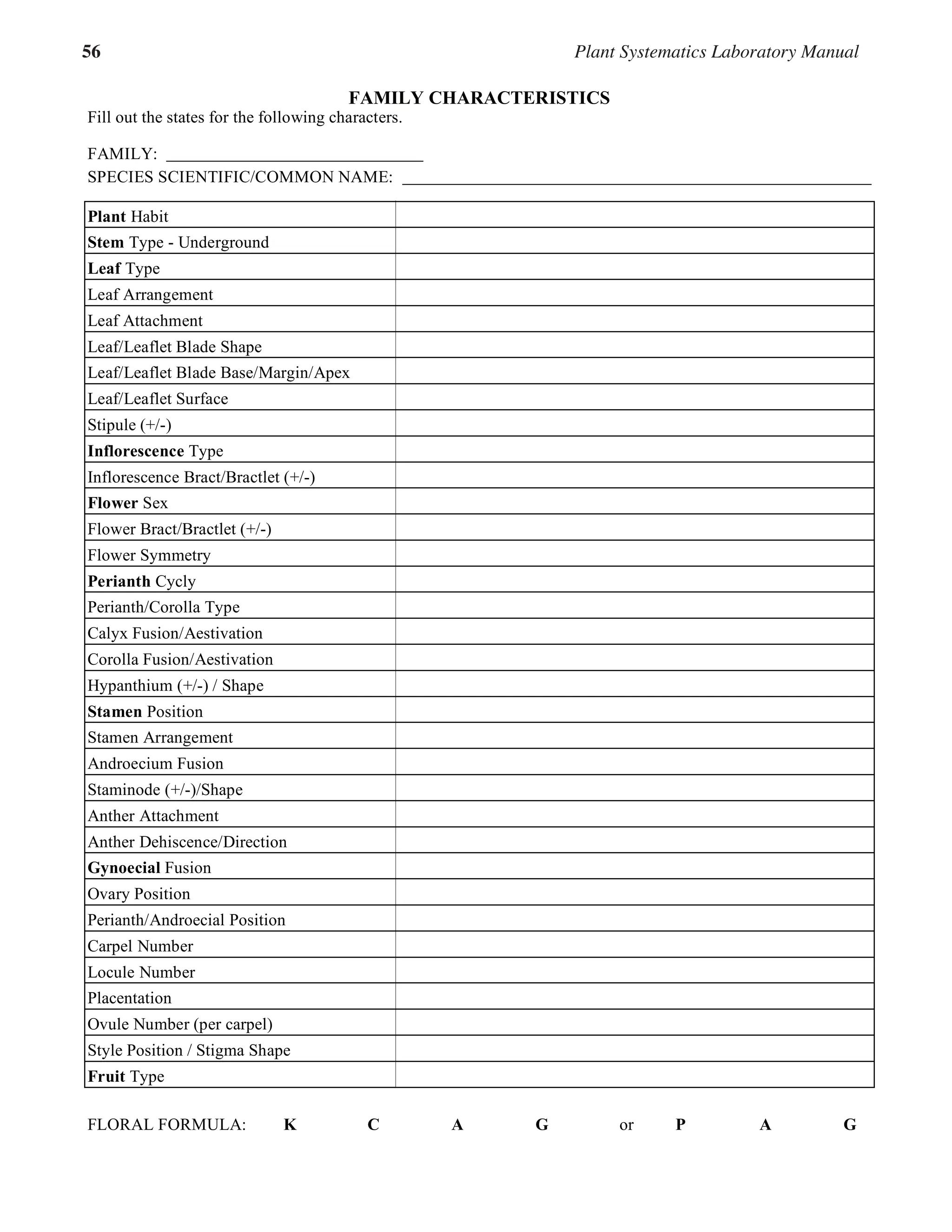
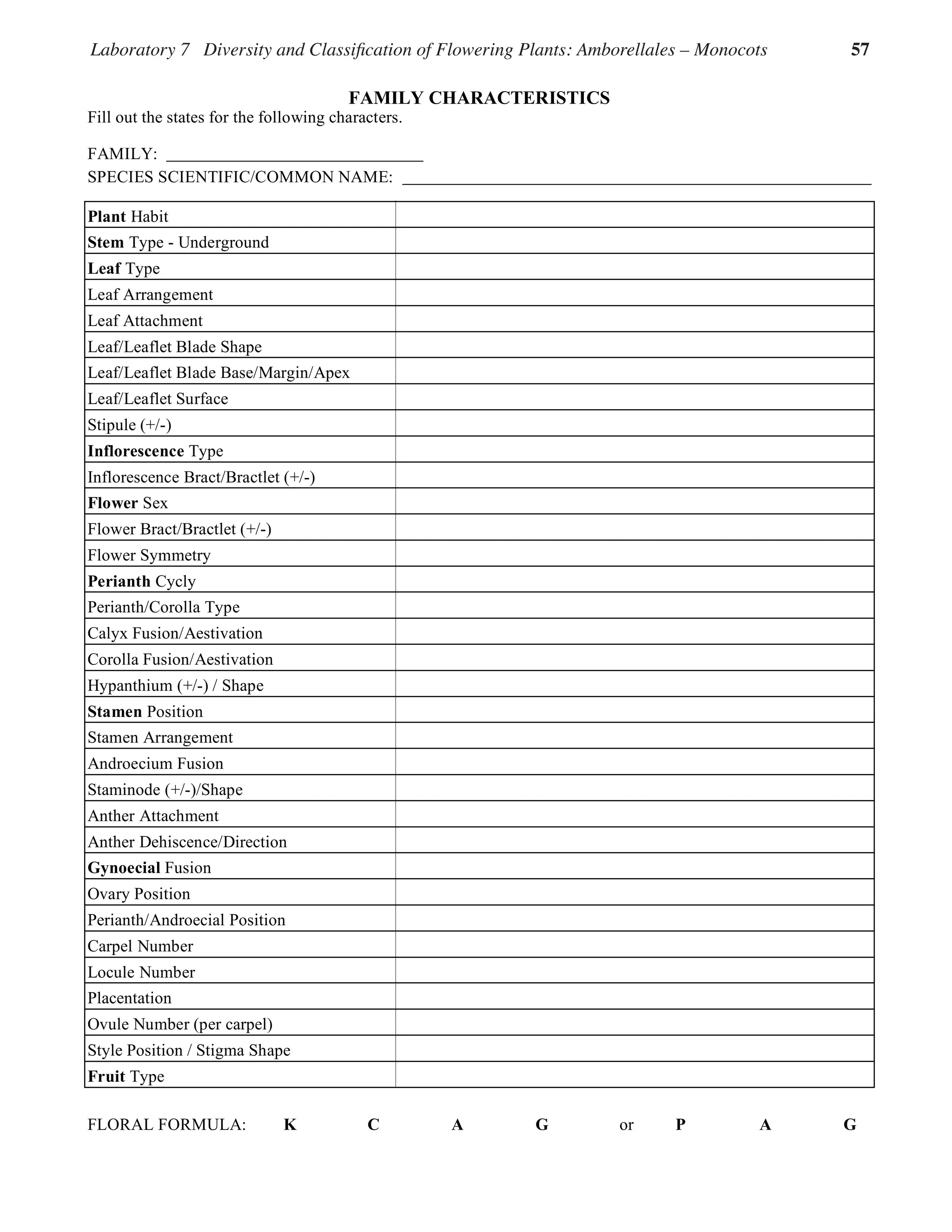
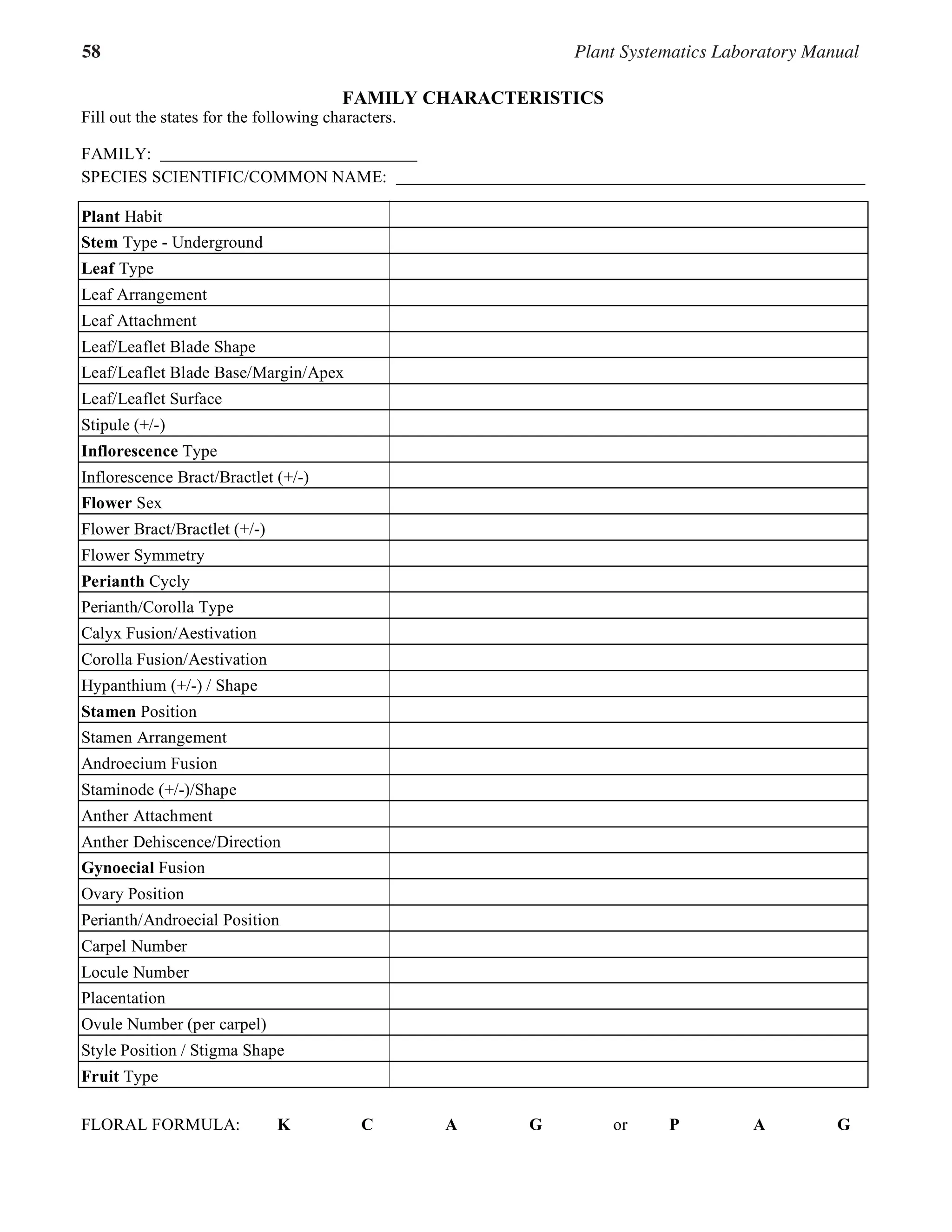
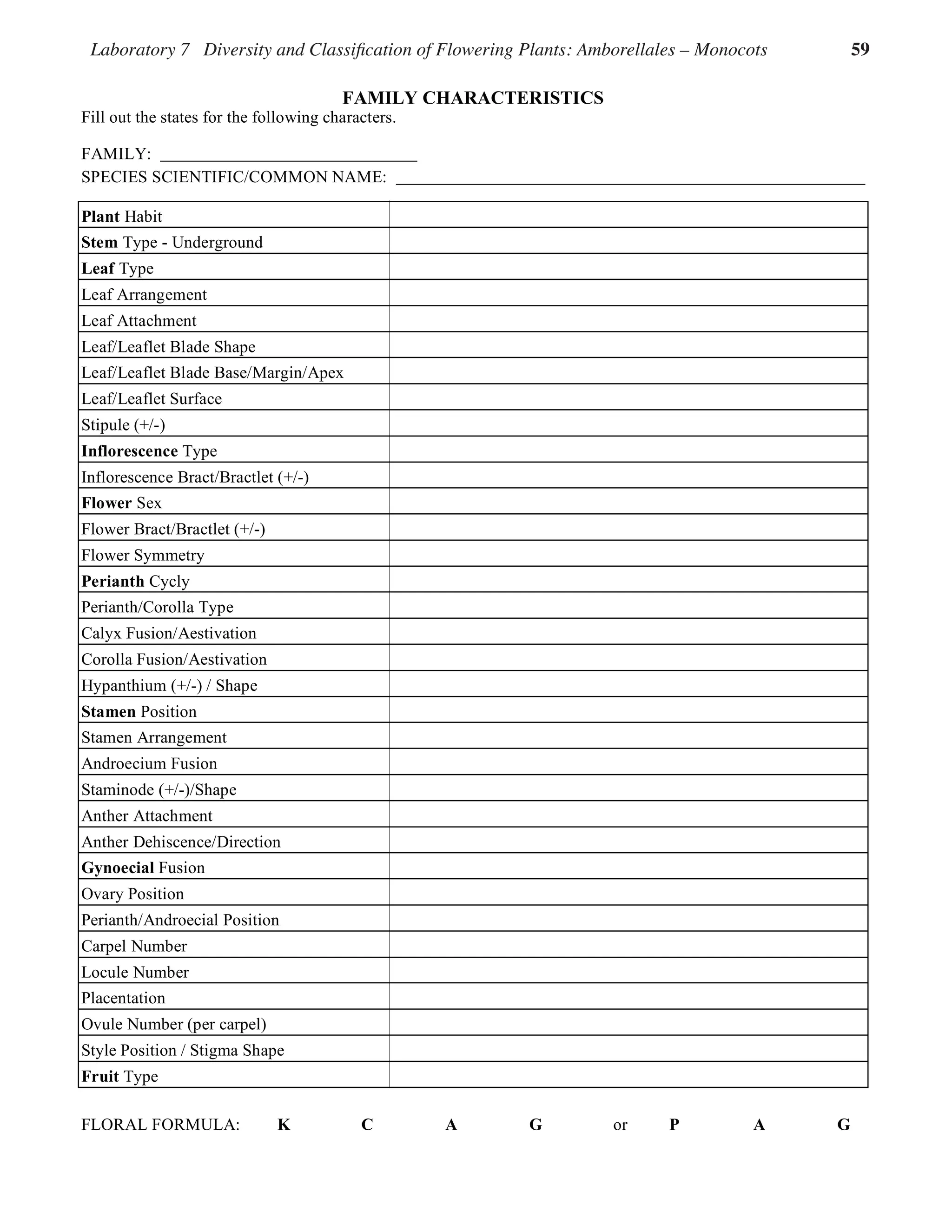
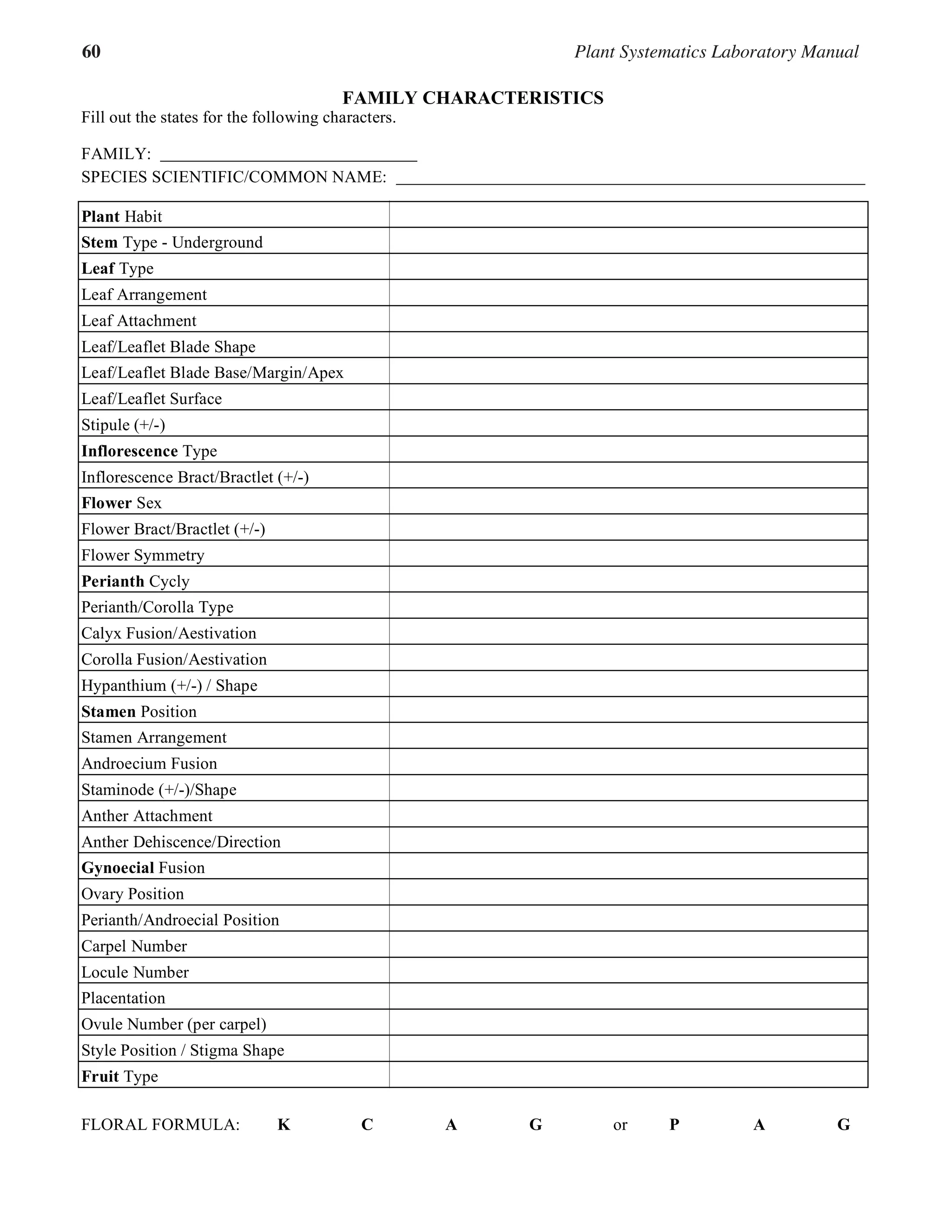
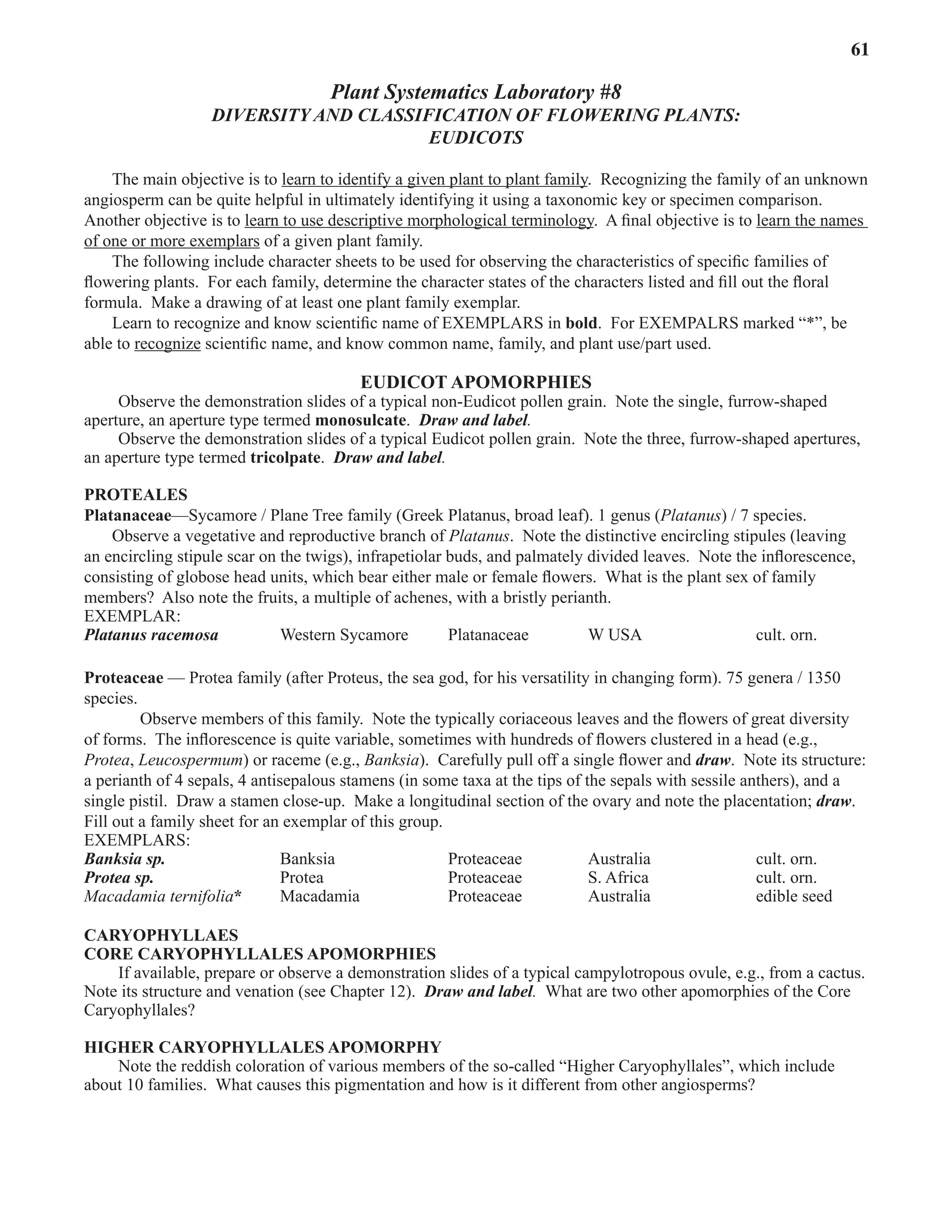
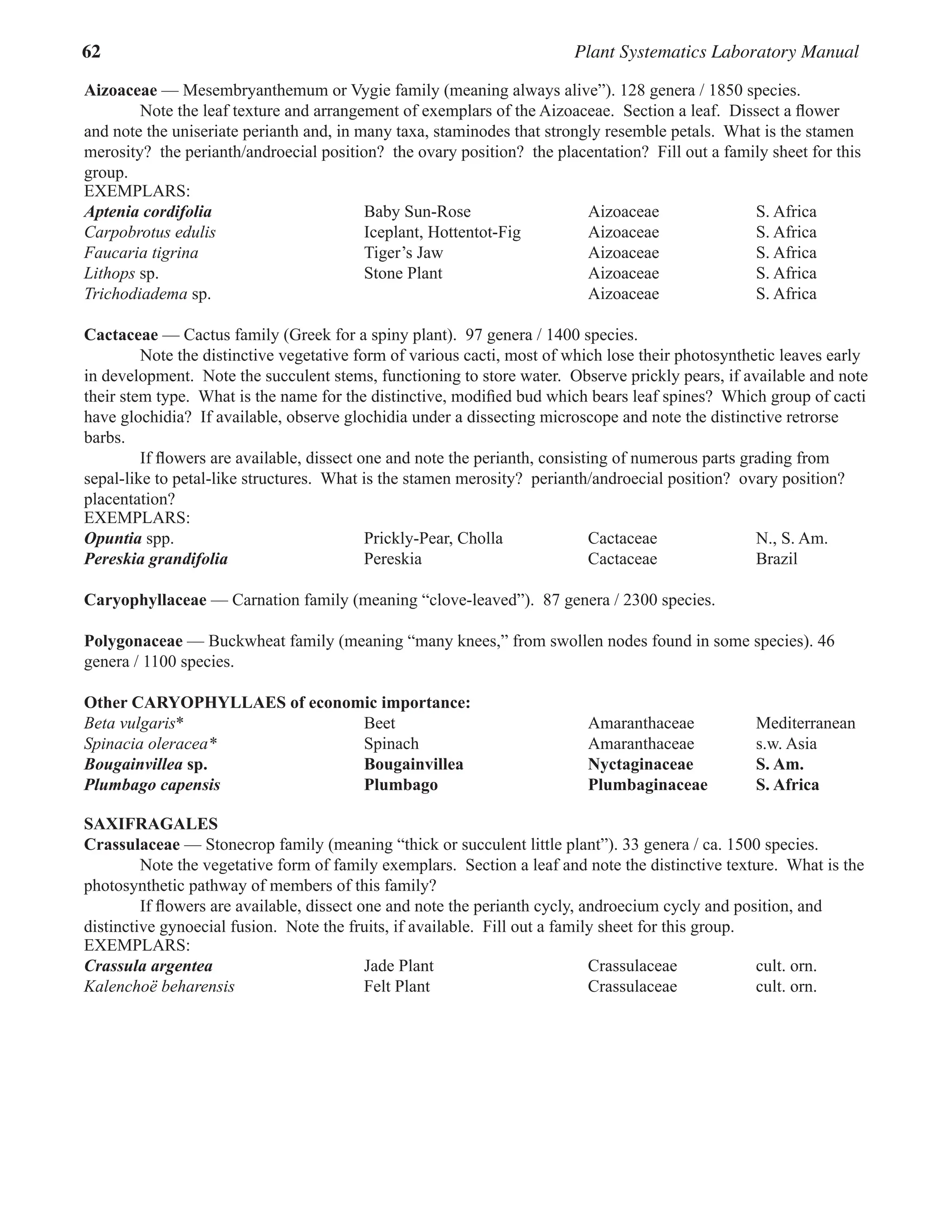
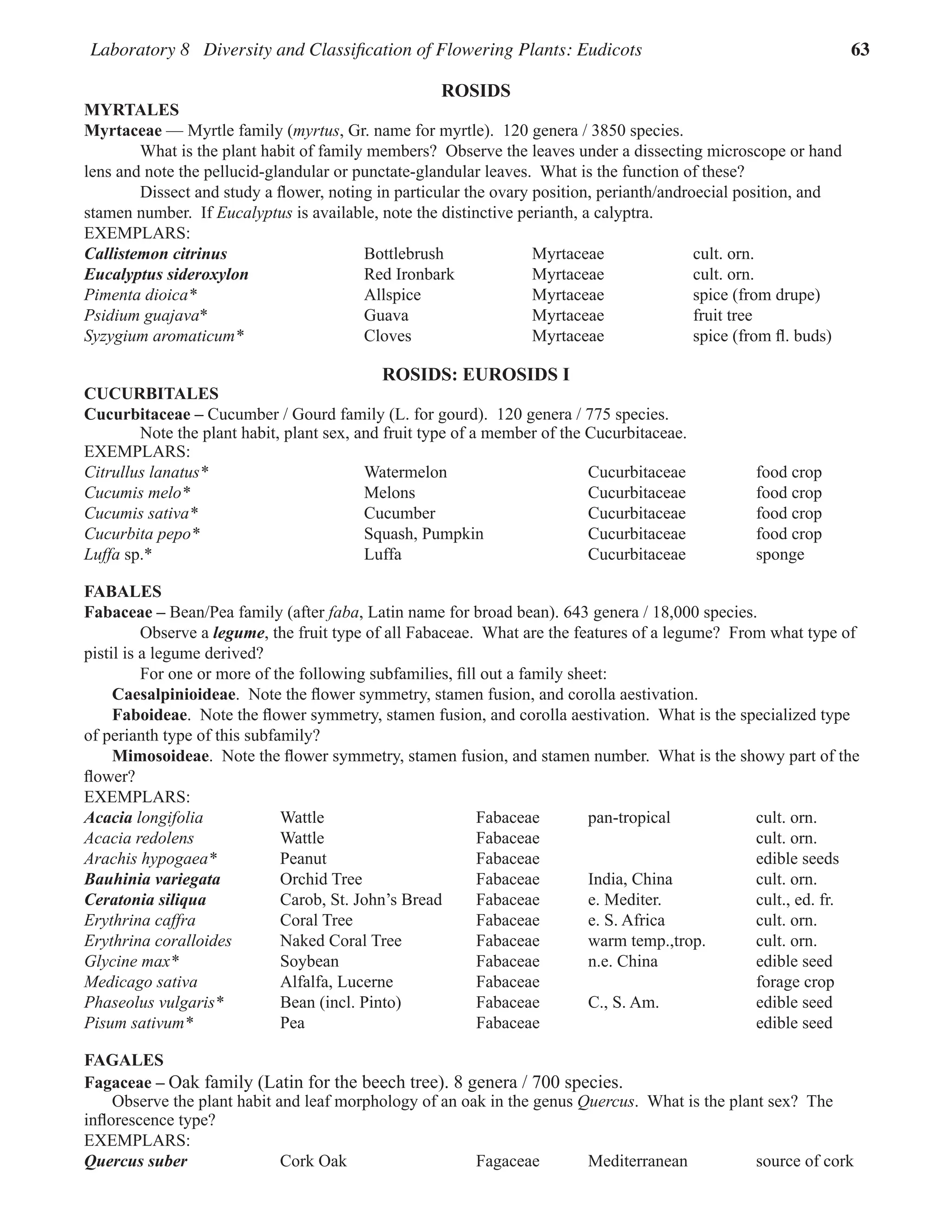
![66 Plant Systematics Laboratory Manual
ASTERIDS
Dissect an ovule from a member of this group and note the unitegmic condition (see Lab 11,
Embryology), an apomorphy for all or most of the Asterids. What other, chemical apomorphy is present? What is
the typical corolla fusion of the Asterids.
Ericales
Ericaceae – [including Empetraceae, Epacridaceae, Monotropaceae, Pyrolaceae] — Heath family (from Erica, a
name used by Pliny, adapted from Theophrastus). 106 genera / ca. 3355 species.
Make a flower longitudinal section and draw, noting the corolla fusion, stamen fusion, nectaries, and
ovary position. Fill out a family sheet.
Obtain fresh (or liquid preserved) material of a member of the Ericaceae exhibiting stages from young
buds to mature flowers. Open the flower buds and draw a stamen from each of 2-4 stages, up to open flowers
at anthesis. Note the 180˚ inversion of the anthers, an apomorphy for most of the group. Note the anther
dehiscence type and direction and any anther appendages that might be present.
Dissect pollen grains from the anther of a member of the Ericaceae. Stain the grains with toludine blue
or acetocarmine. If available, clear the grains in Hoyer’s solution (see Lab 12, Palynology) and view with Phase
contast or Nomarski (DIC) optics. Note that the four pollen grains resulting from meiosis remain attached (at the
time or release) as a tetragonal tetrad, an apomorphy for all but basal members of the Ericaceae. Carefully draw
a pollen tetrad, noting the boundaries of the pollen grains and the intersecting apertures.
EXEMPLARS:
Arbutus unedo Strawberry Tree Ericaceae Mediterranean cult. orn.
Rhododendron spp.* Rhododendron, Azalea Ericaceae cult. orn.
Vaccinium spp.* Blueberry Ericaceae food-berry
Xylococcus bicolor Mission Manzanita Ericaeae California’s native
GENTIANALES
Apocynaceae [incl. Asclepiadaceae] — Dogbane/Milkweed family (Greek for “away from dog,” in reference to
some taxa used as dog poison). 411 genera / 4650 species.
Obtain flowers of an “Asclepiadoid”, a milkweed, formerly classified in the Asclepiadaceae. Study the
unusual flower morphology. Open a flower from the side to expose the gynoecium. Note and draw the two,
distinct ovaries and styles, the latter leading to a common, enlarged stigma. From the side of the flower, note
and draw the unusual anthers, which develop into pollinia. Take a dissecting needle and gently pull up on the
“corpusculum”, to which two arm-like “retinacula” and masses of connate pollen grains are attached. What is the
name of the structure consisting of adnate androecium and gynoecium?
Obtain a flower of a more basal (non-milkweed) member of the Apocynaceae. Make a flower longitudinal
section and note the ovary, style, and stigma, and any appendages that might be present. Do you see resemblances
to the milkweed above?
EXEMPLARS:
Asclepias sp. Milkweed Apocynaceae
Carissa grandiflora Natal Plum Apocynaceae Natal, S. Africa cult. orn.
Nerium oleander Oleander Apocynaceae Mediterranean-Japan cult. orn.
Catharanthus roseus* Madagascar Periwinkle Apocynaceae Madagascar Source of
alkaloids vincristine (leucocristine) & vinblastine (leucoblastine), used to treat childhood leukemia
Rauvolfia serpentina* Snakeroot India Source or reserpine, an important
alkaloid used to treat hypertension (high blood pressure) and psychotic disorders
LAMIALES
Bignoniaceae – Bignoniaceae — Bignonia family (after Abbé Jean-Paul Bignon, 1662–1743, court librarian at
Paris, friend of Tournefort). 109 genera / 750 species.
Draw a flower of this family, especially noting the corolla fusion, corolla symmetry, and stamen
arrangement. Observe and draw the seeds of a typical fruit and note their morphology.
Jacaranda mimosifolia Jacaranda Bignoniaceae N. W. Argentina cult. orn.](https://image.slidesharecdn.com/plsyslab-250719064702-ff141168/75/Plant-Systematics-laboratory-manual-techniques-70-2048.jpg)
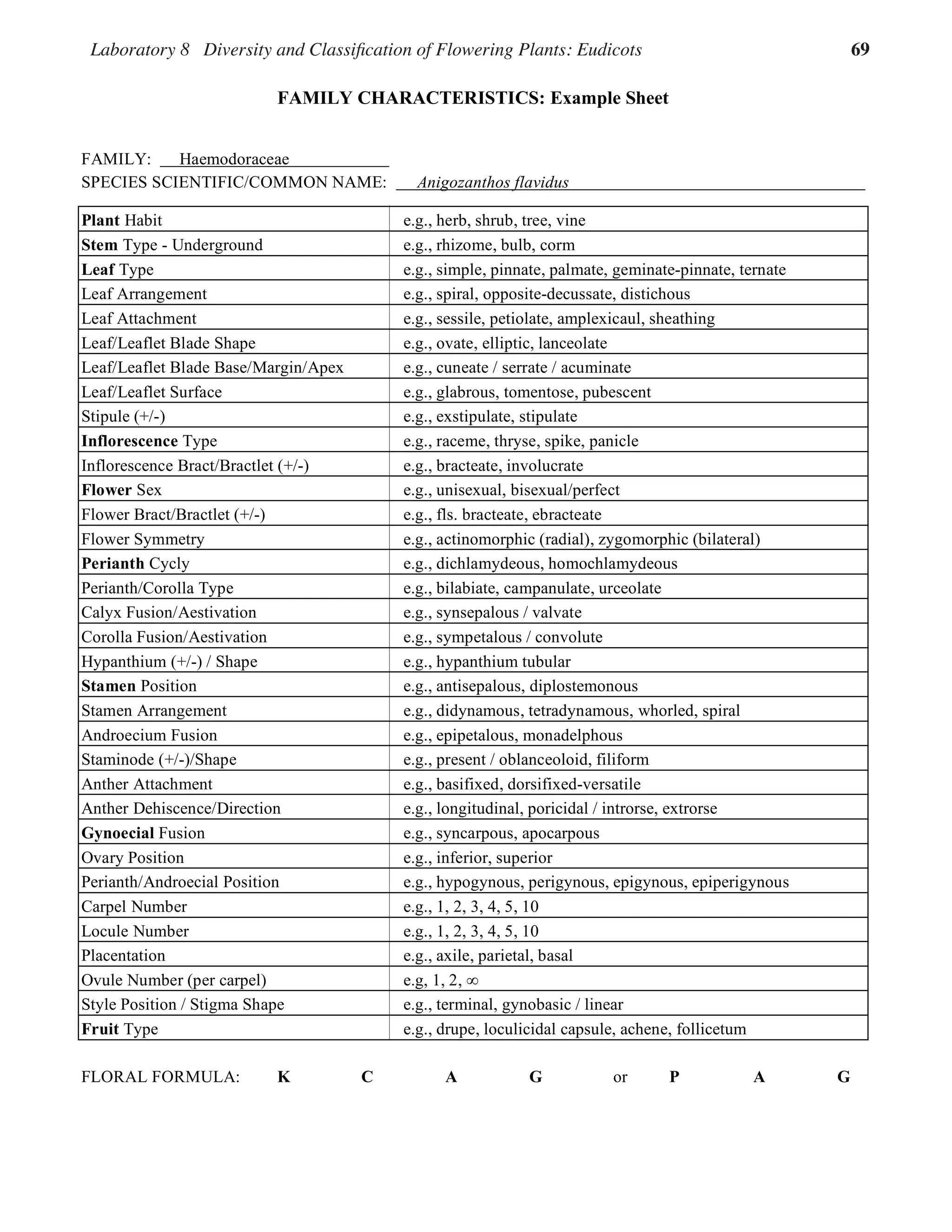
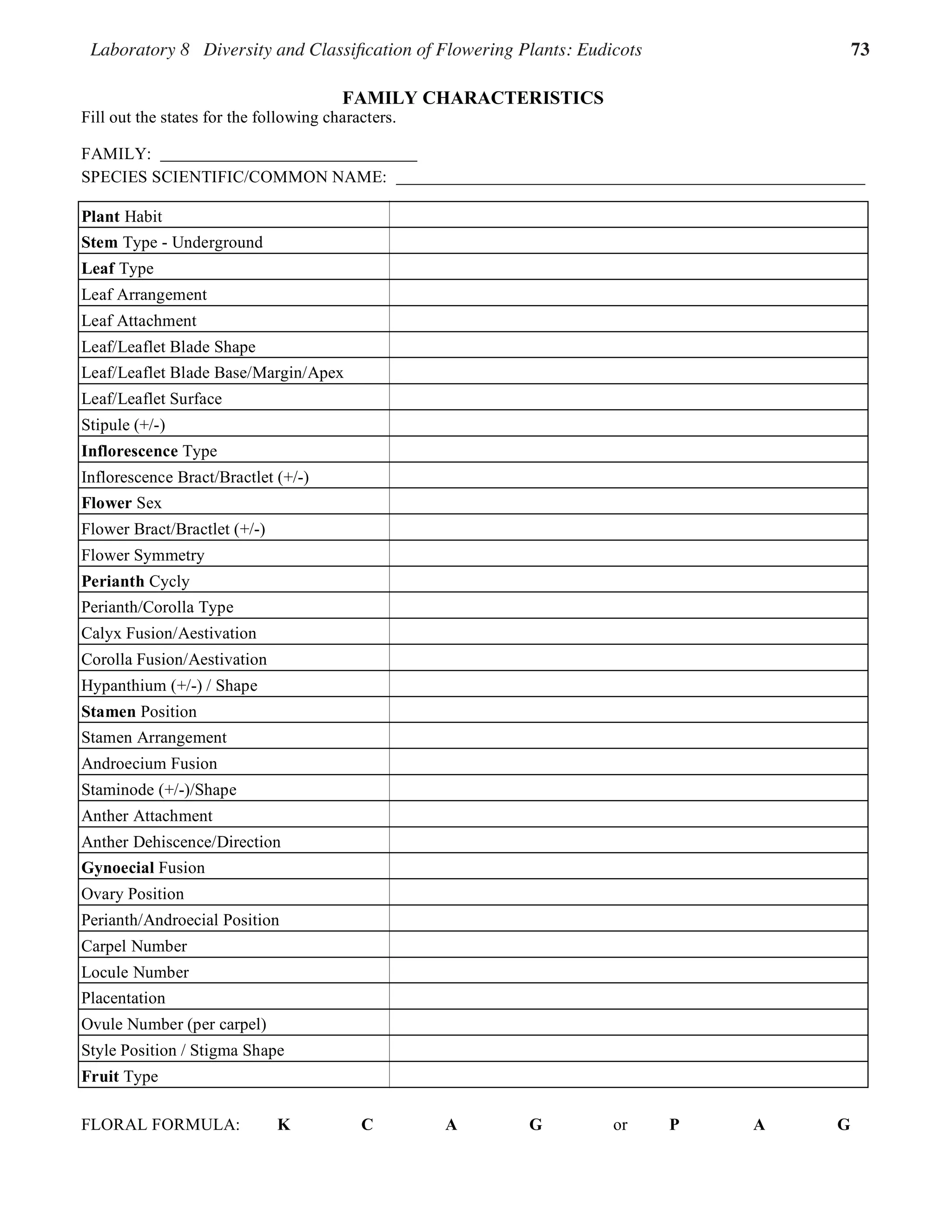
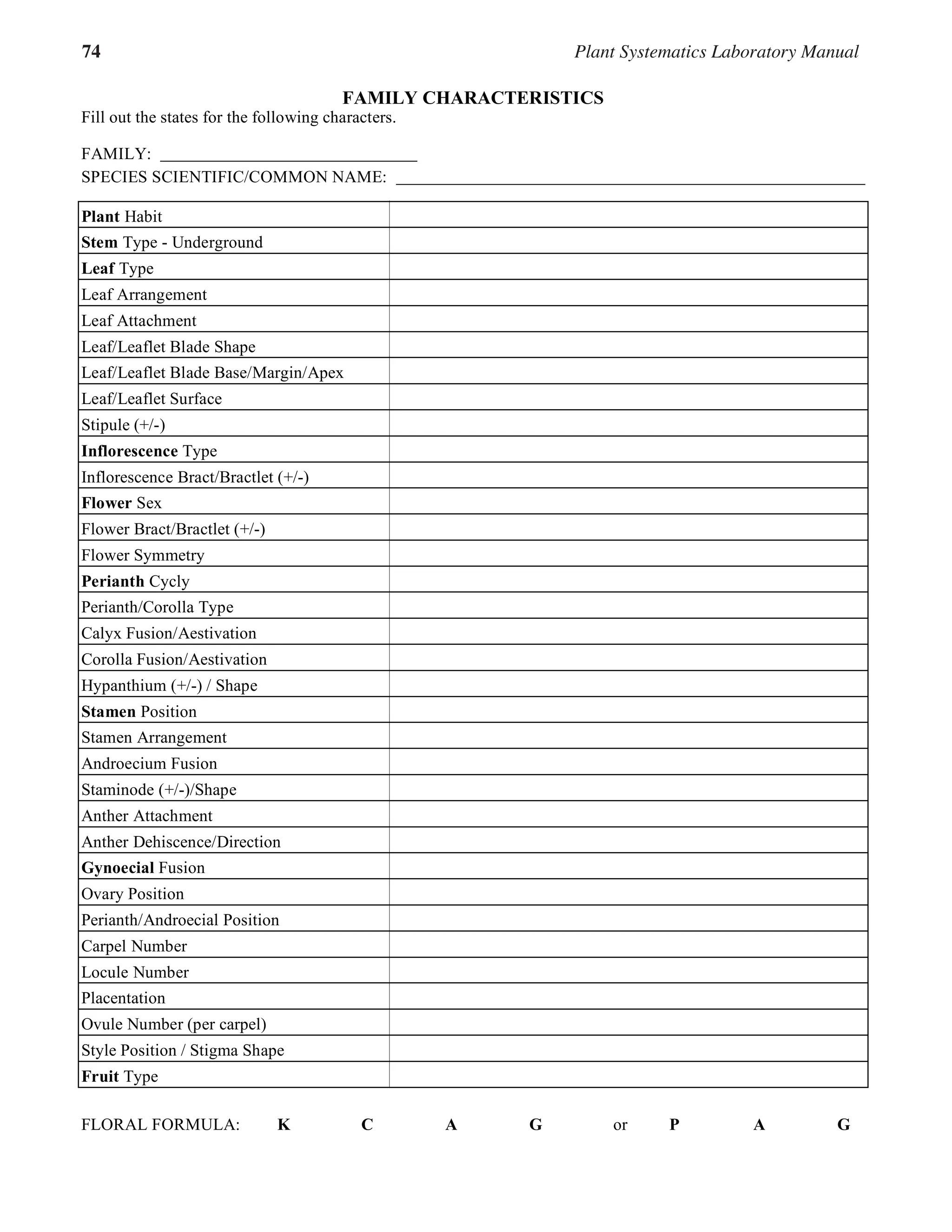
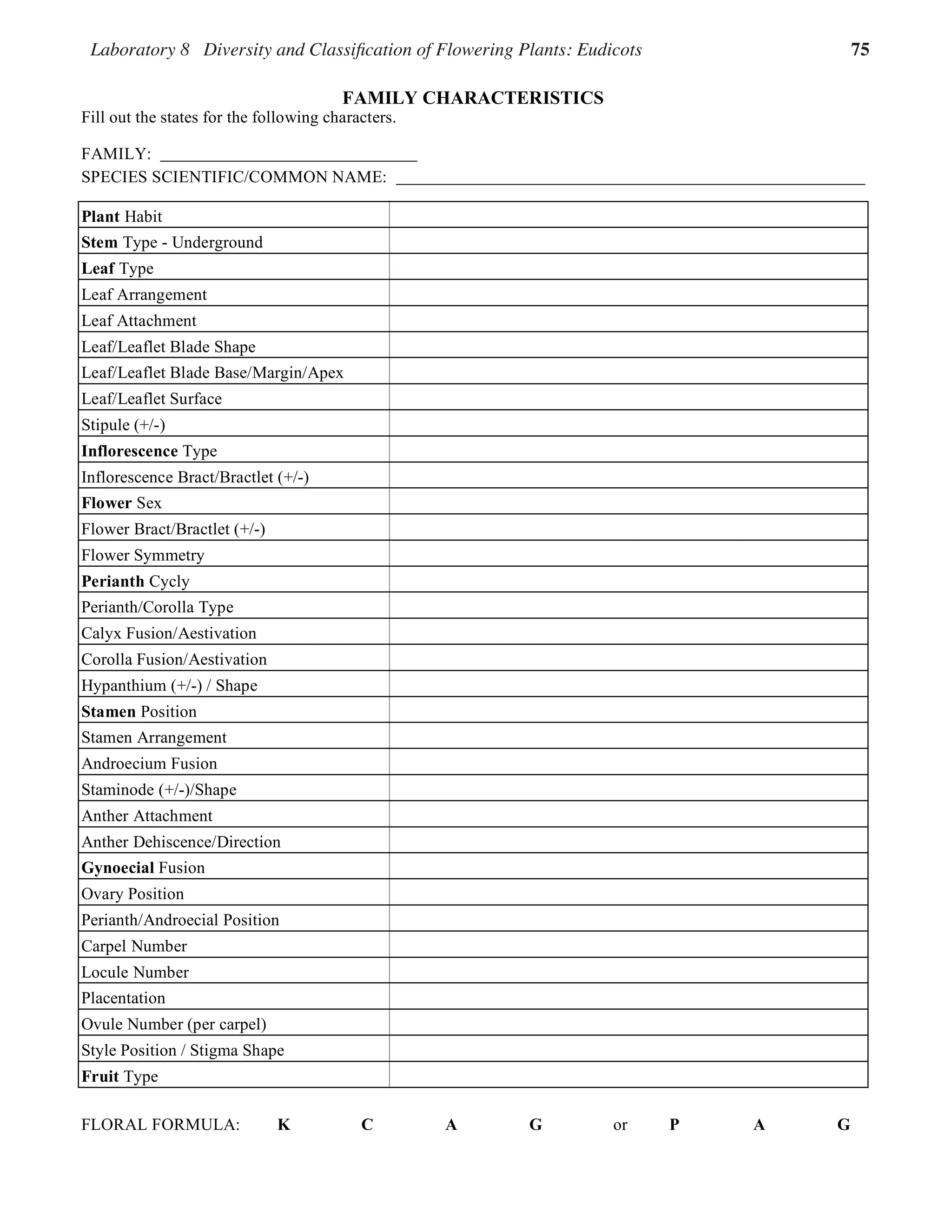
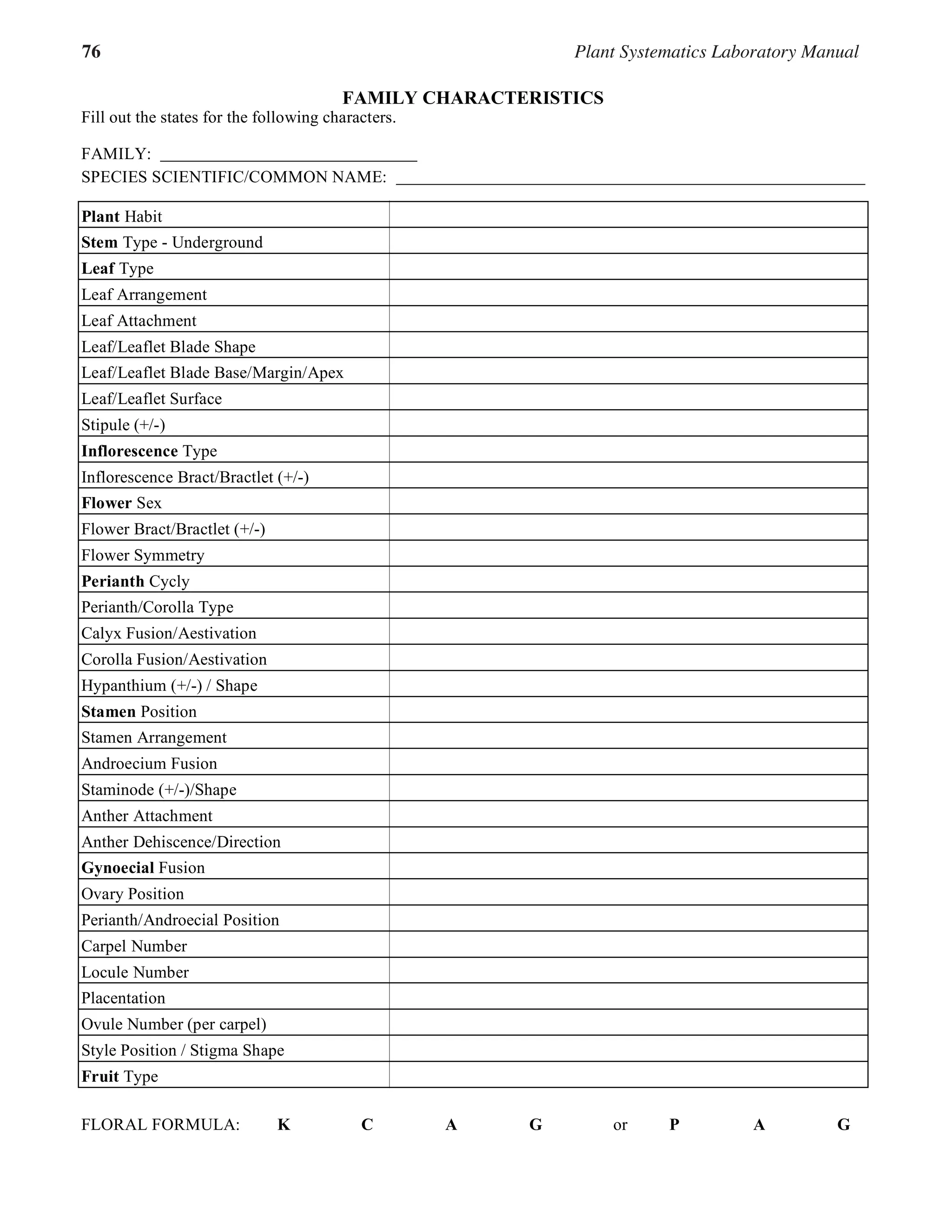
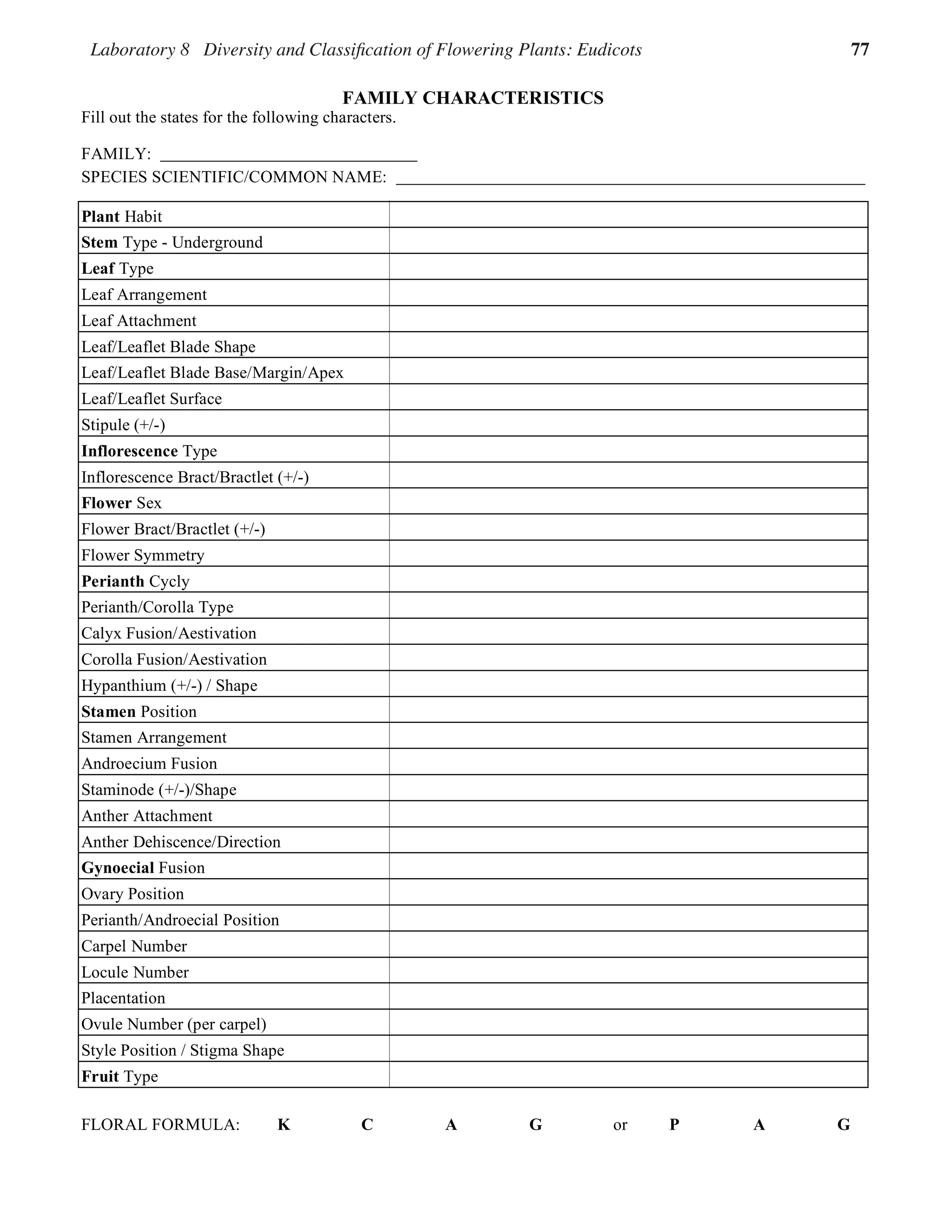
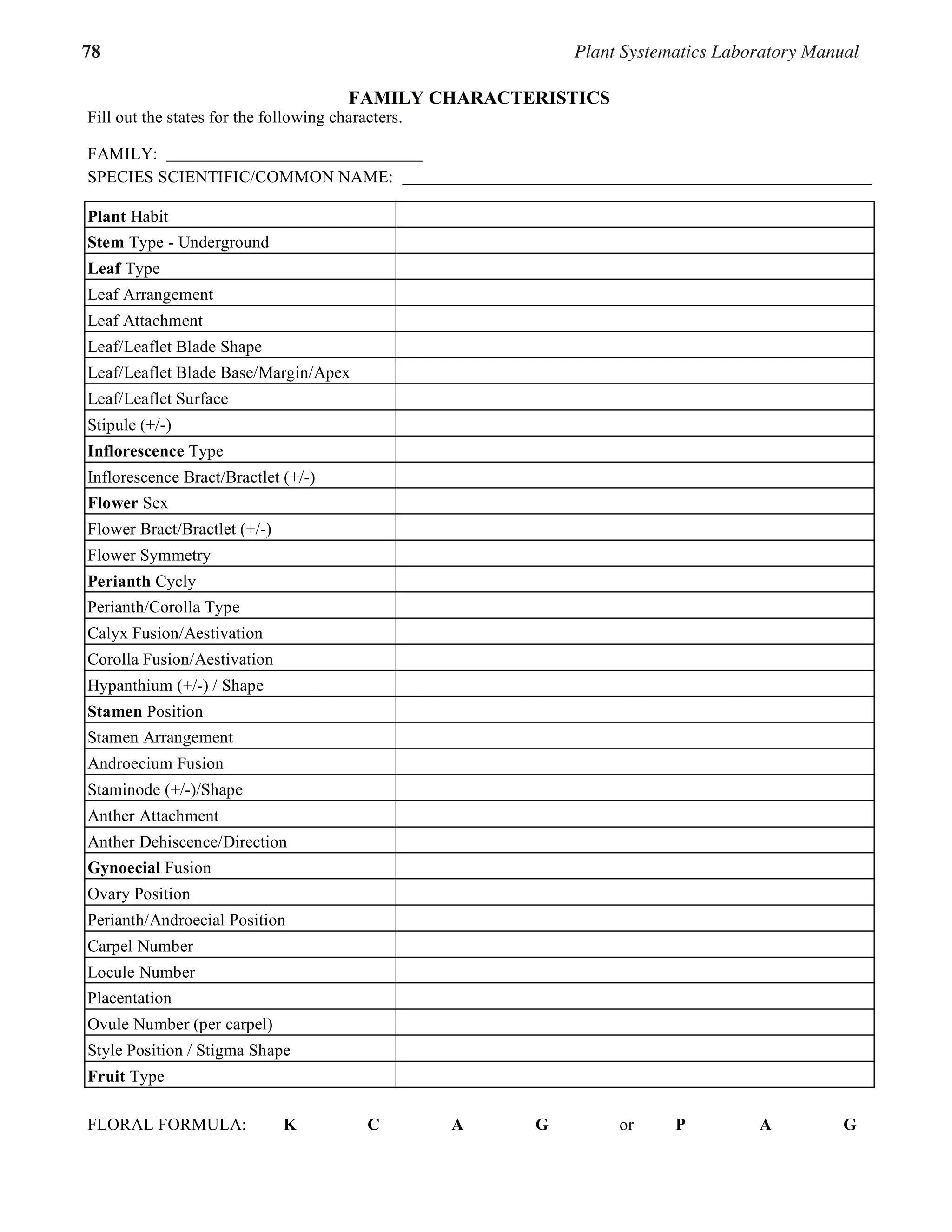
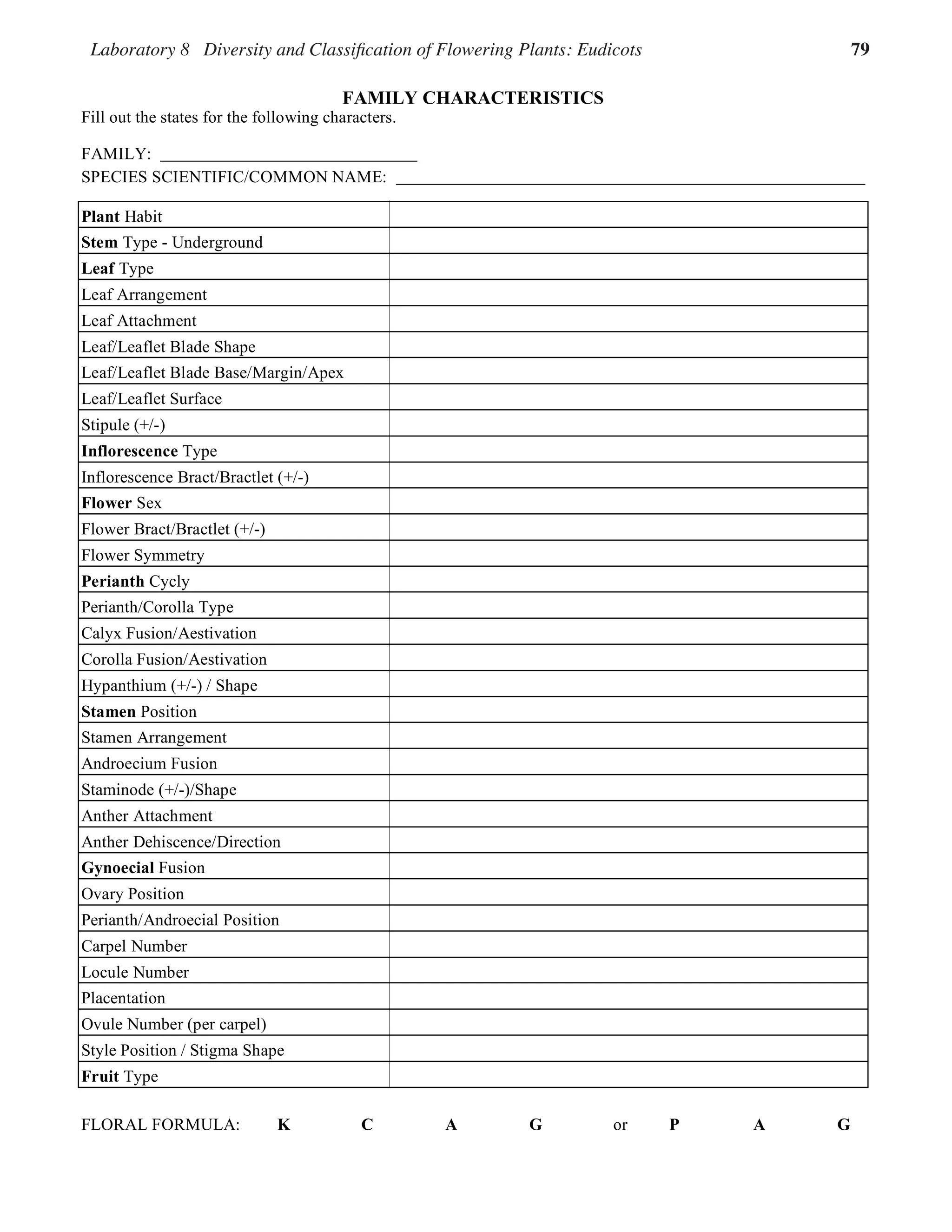
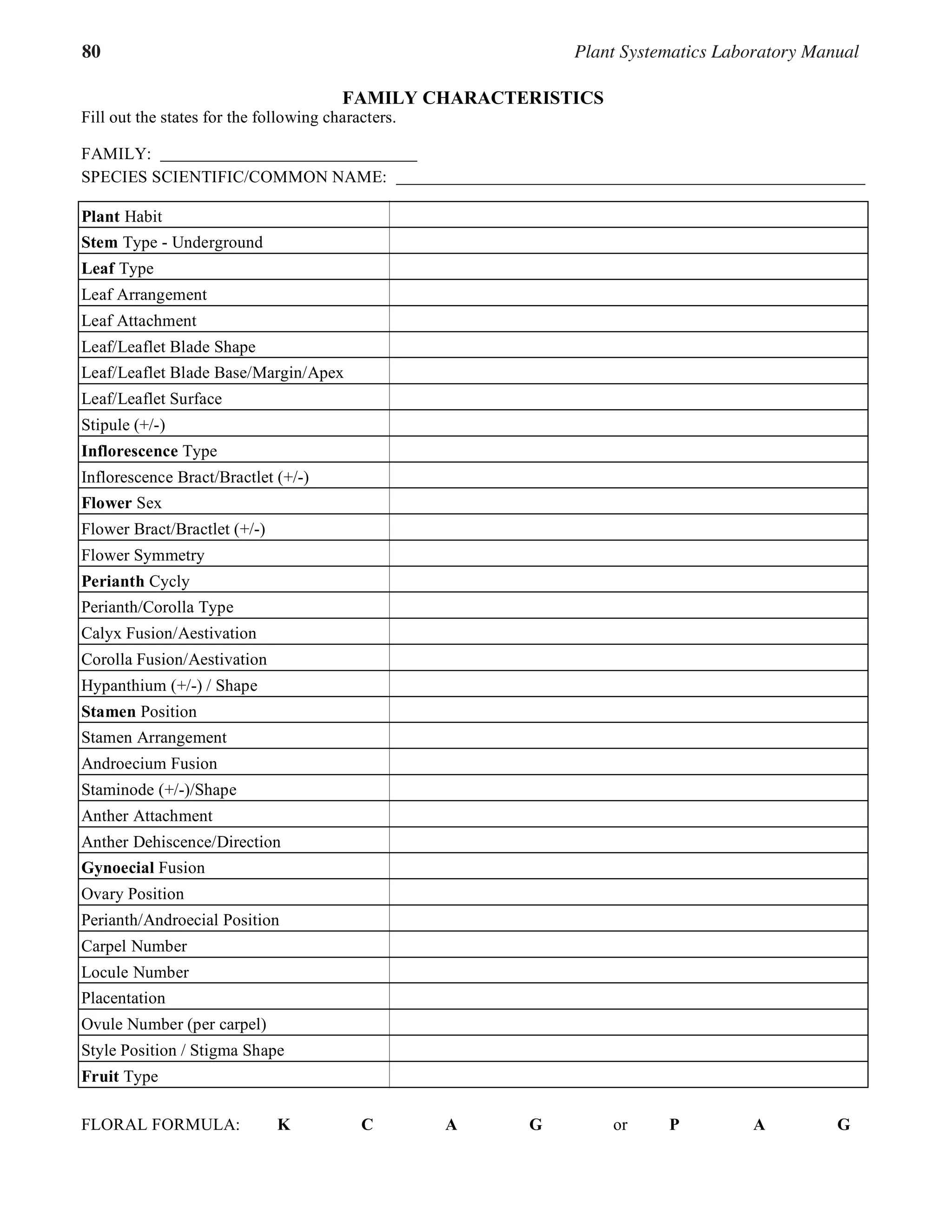
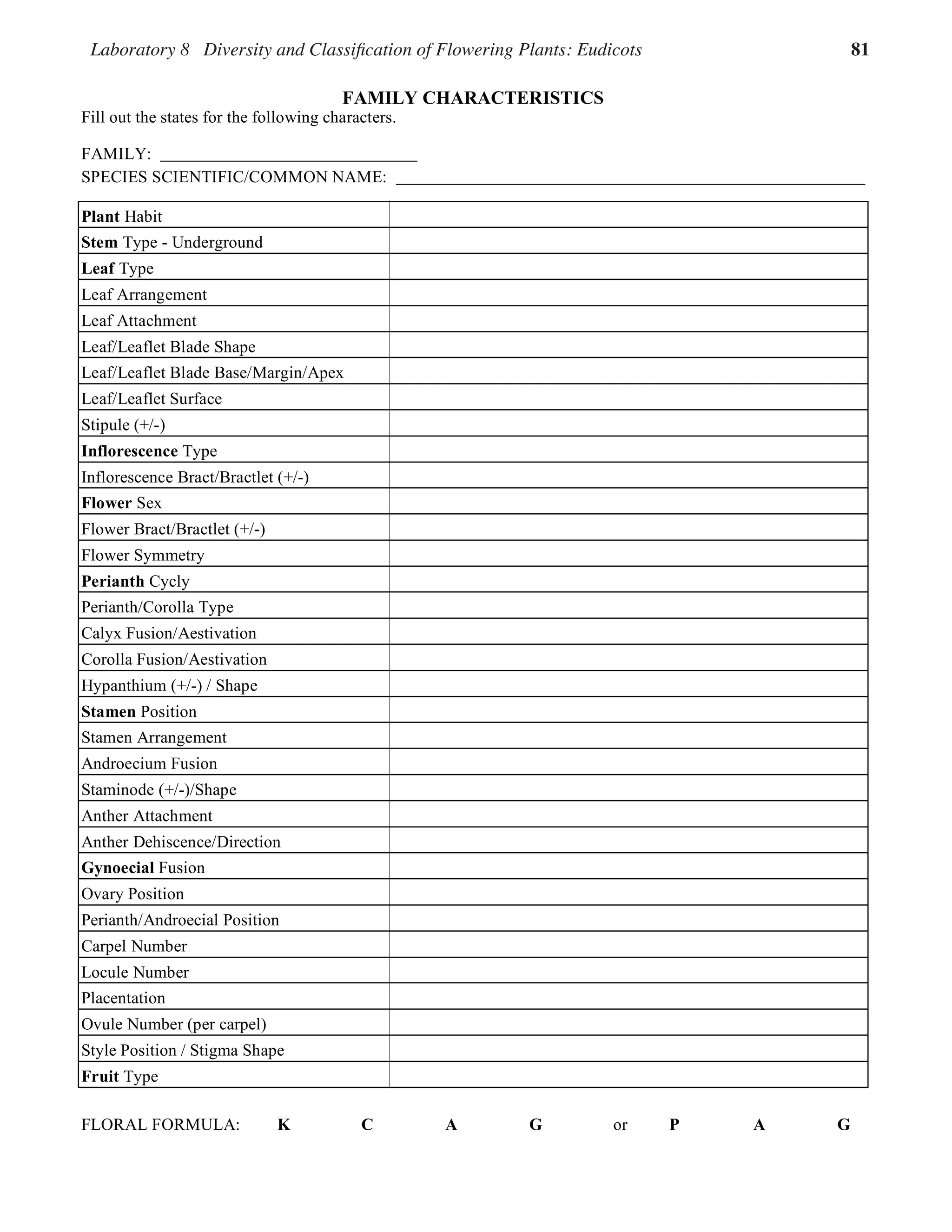
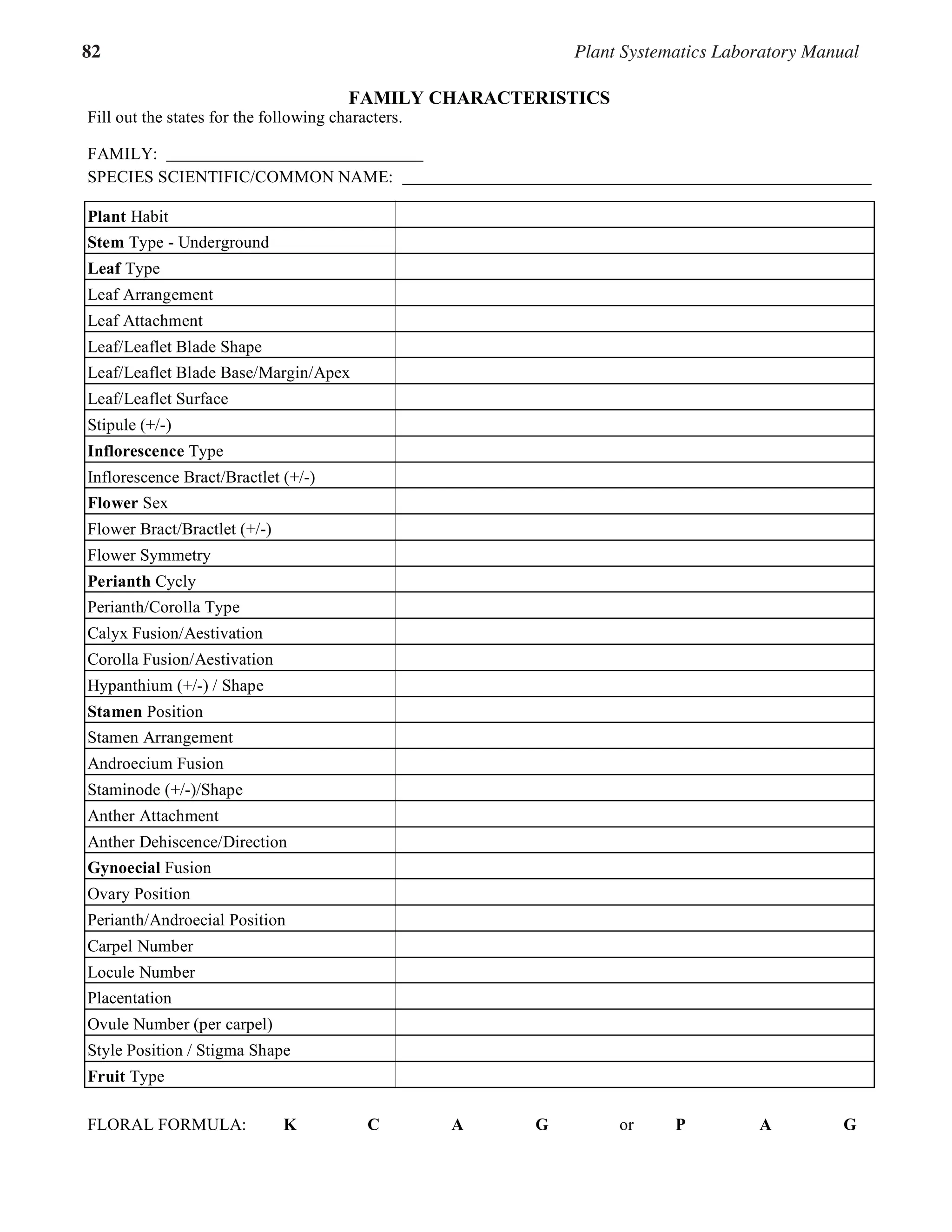
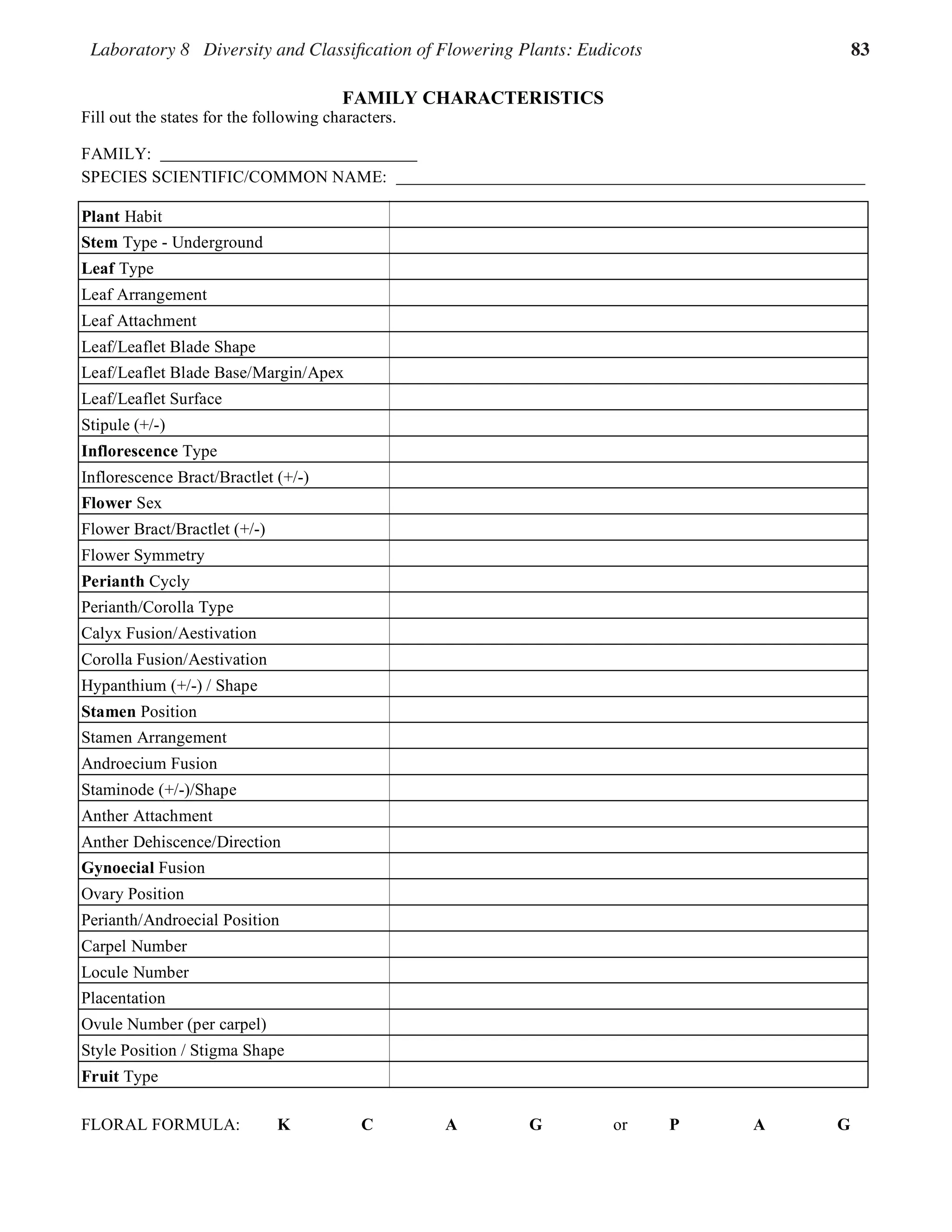
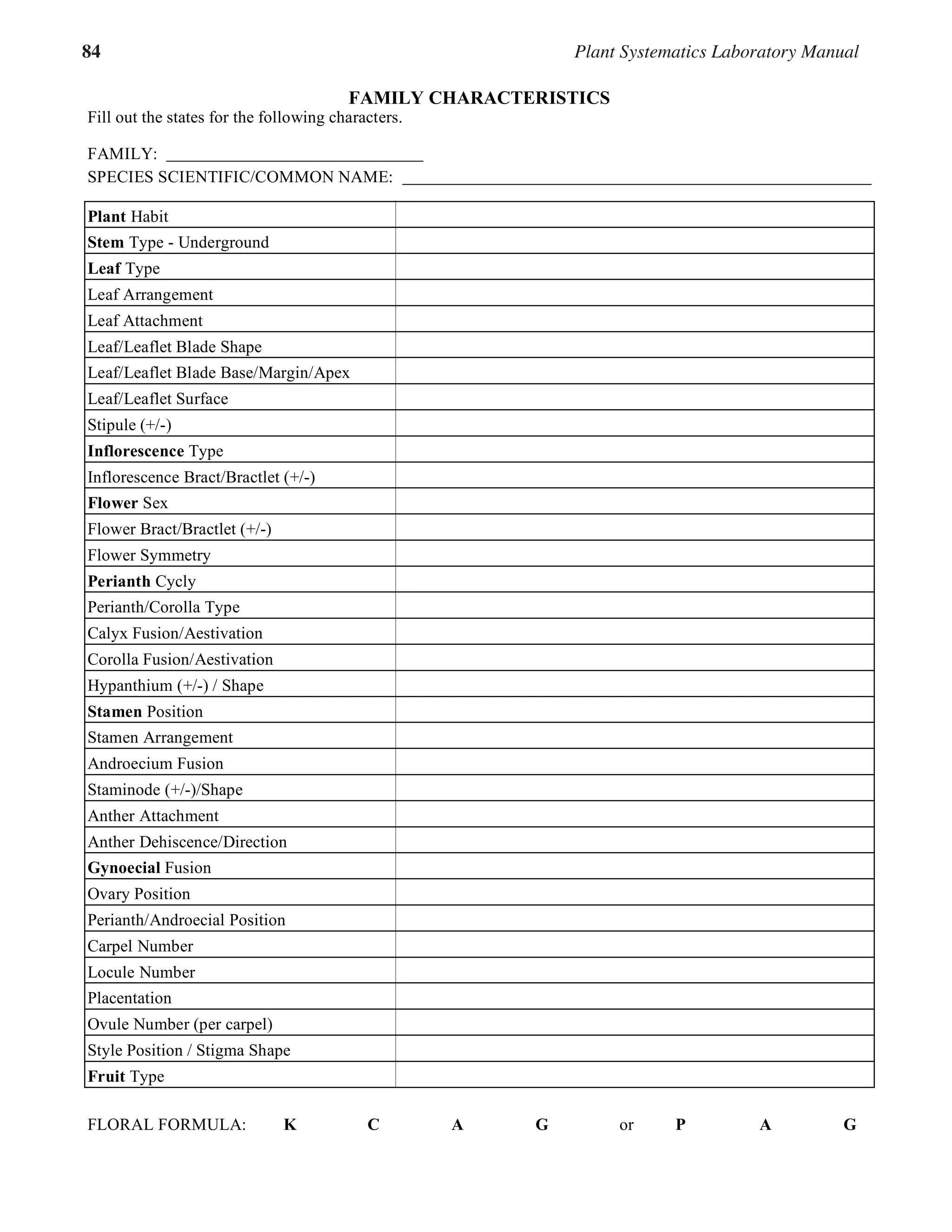
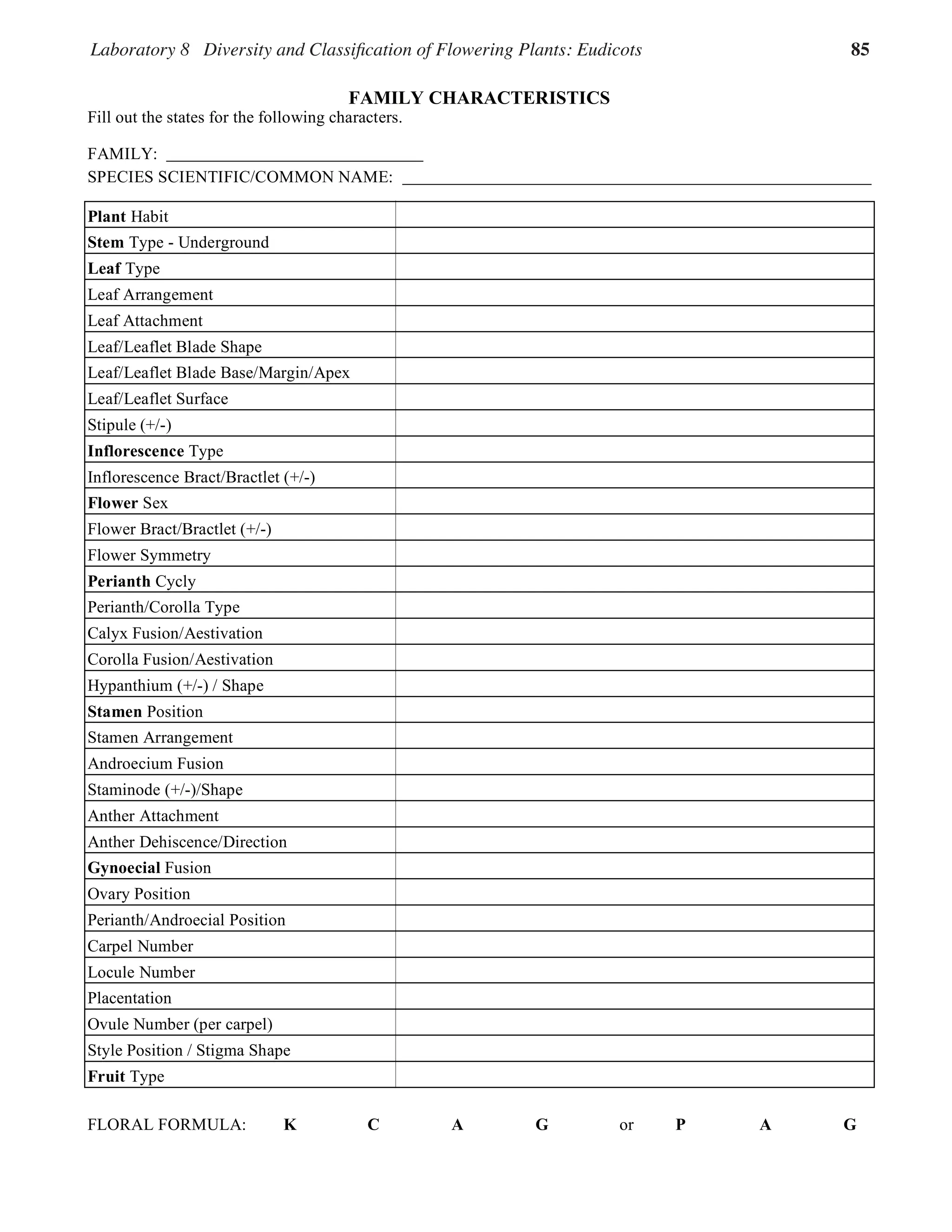
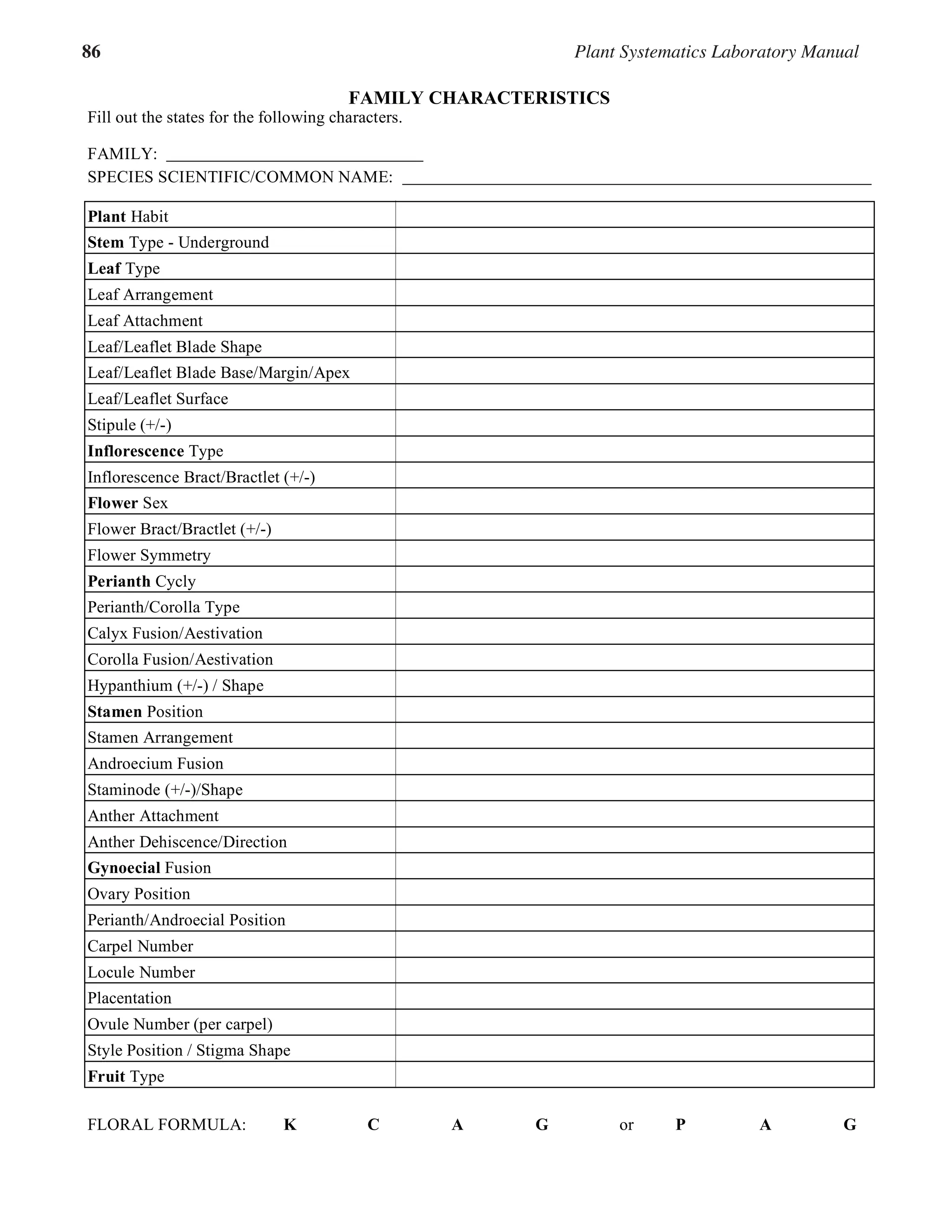
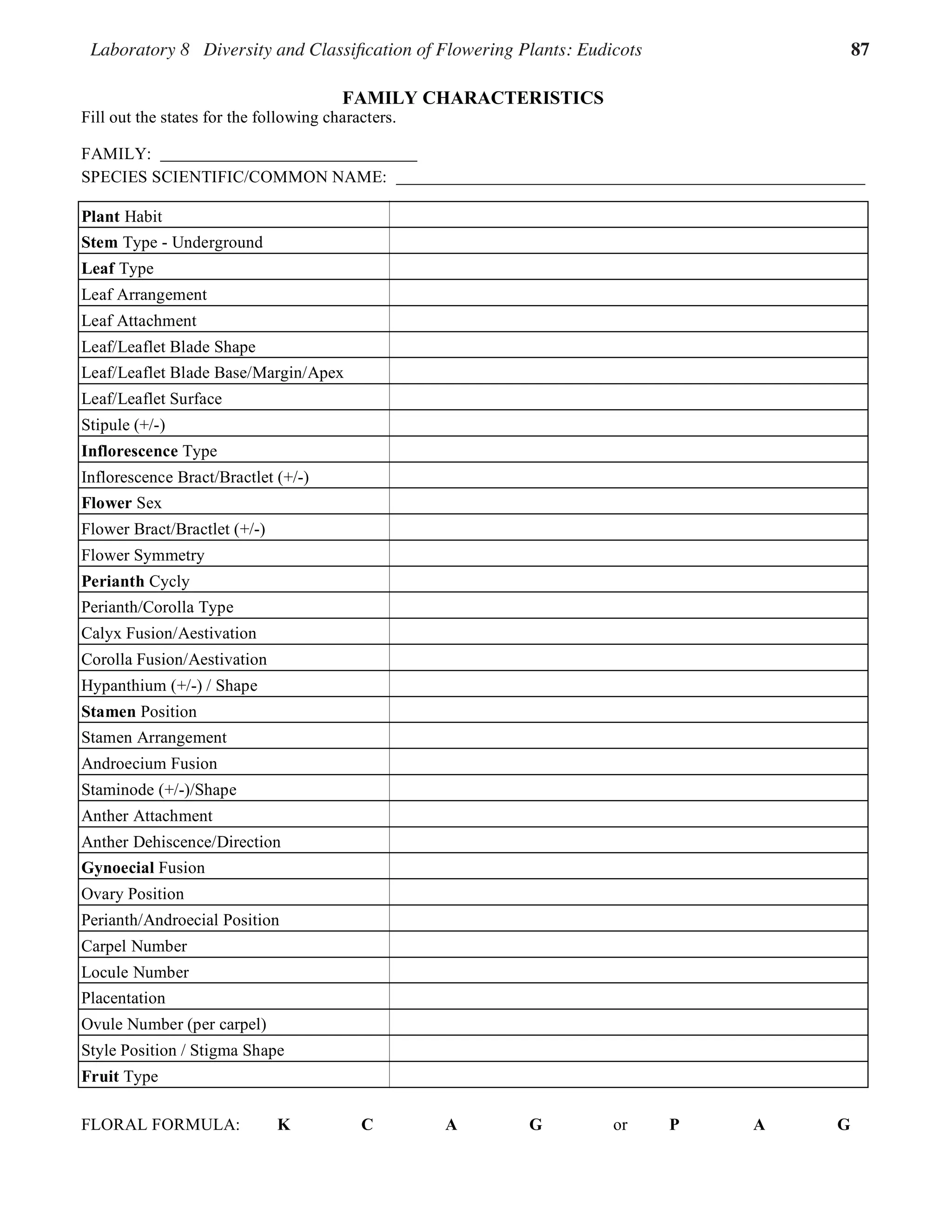
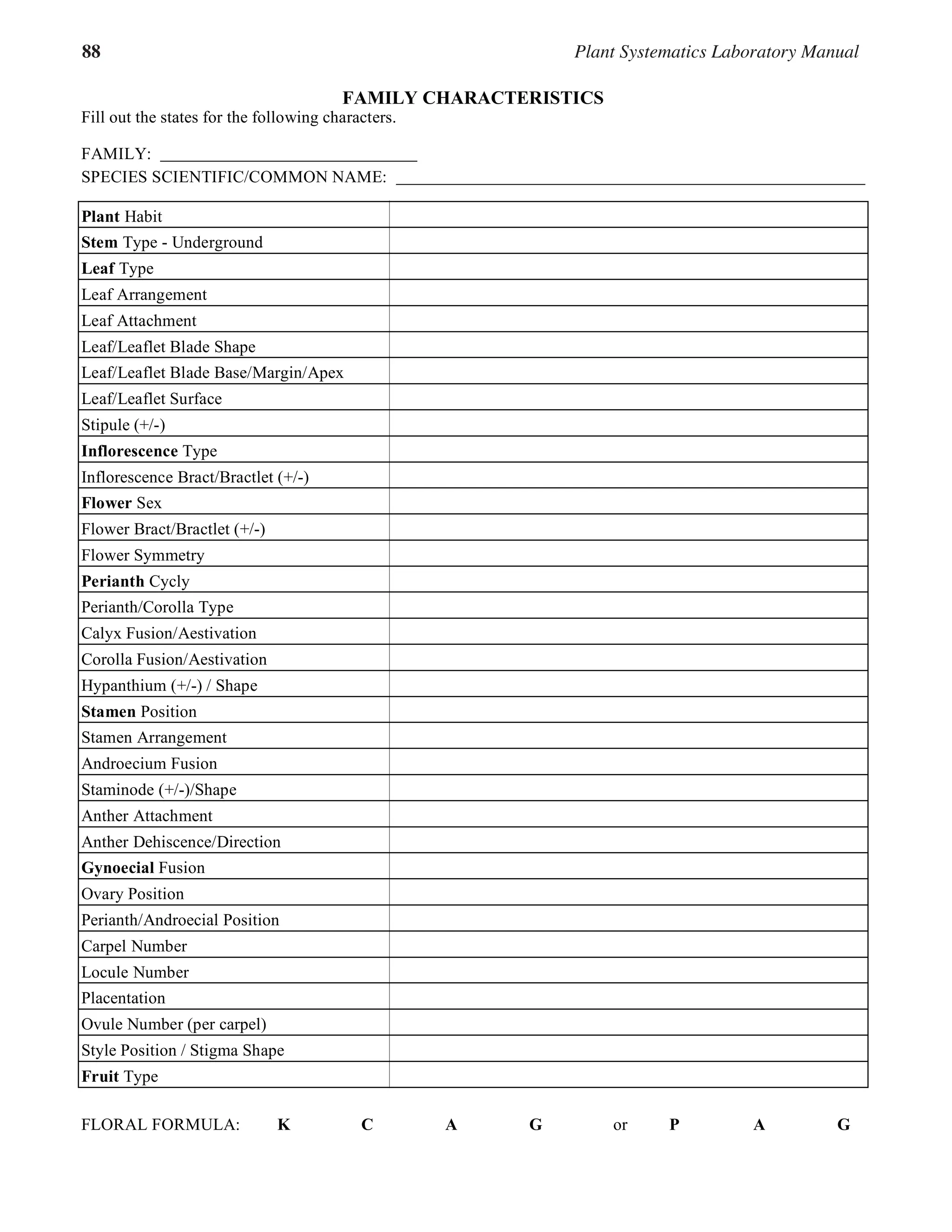
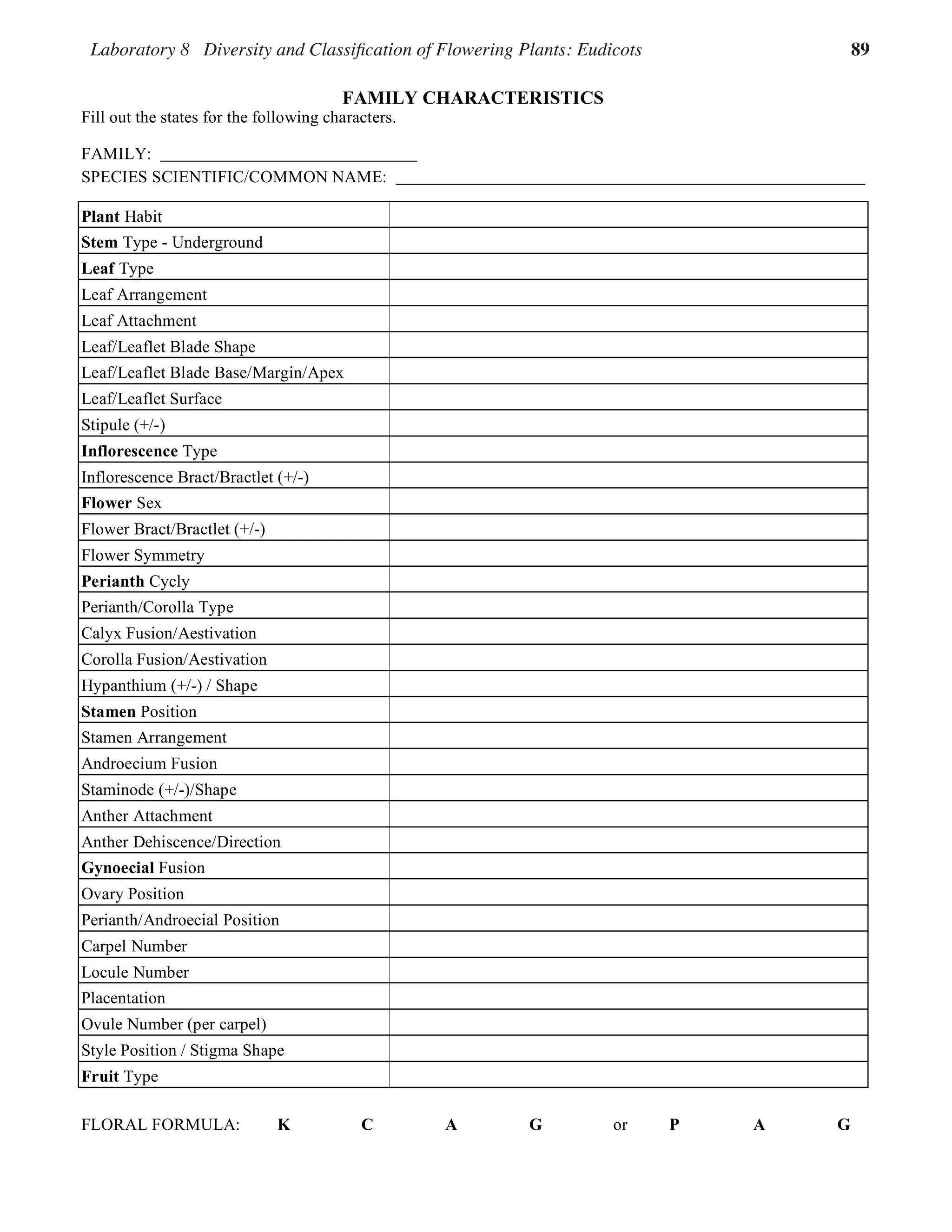
![Plant Systematics Laboratory Manual 91
Plant Taxonomy Laboratory #9
PLANT MORPHOLOGY
A. PLANT HABIT, PLANT HABITAT, ROOTS, STEMS, TWIGS
Objective: To be able to recognize and define the plant characters and character states exemplified
below. Working in pairs, first determine the meaning/concept of a given character state. Then, learn
the specific character state. Review at end. [You need not memorize specific examples on display.]
PLANT HABIT
What does plant habit refer to?
List the character state and define (example optional). Draw or photograph as needed.
Character State Definition Example (optional)
1)
2)
3)
4)
PLANT HABITAT
What does plant habitat refer to?
List the character state and define (example optional). Draw or photograph as needed.
Character State Definition Example (optional)
5)
6)
7)
ROOT TYPE
What is the function of a root?
Observe and list the parts of a root.
List the character state and define (example optional). Draw or photograph as needed.
Character State Definition Example (optional)
8)
9)
10)
11)
12)](https://image.slidesharecdn.com/plsyslab-250719064702-ff141168/75/Plant-Systematics-laboratory-manual-techniques-95-2048.jpg)
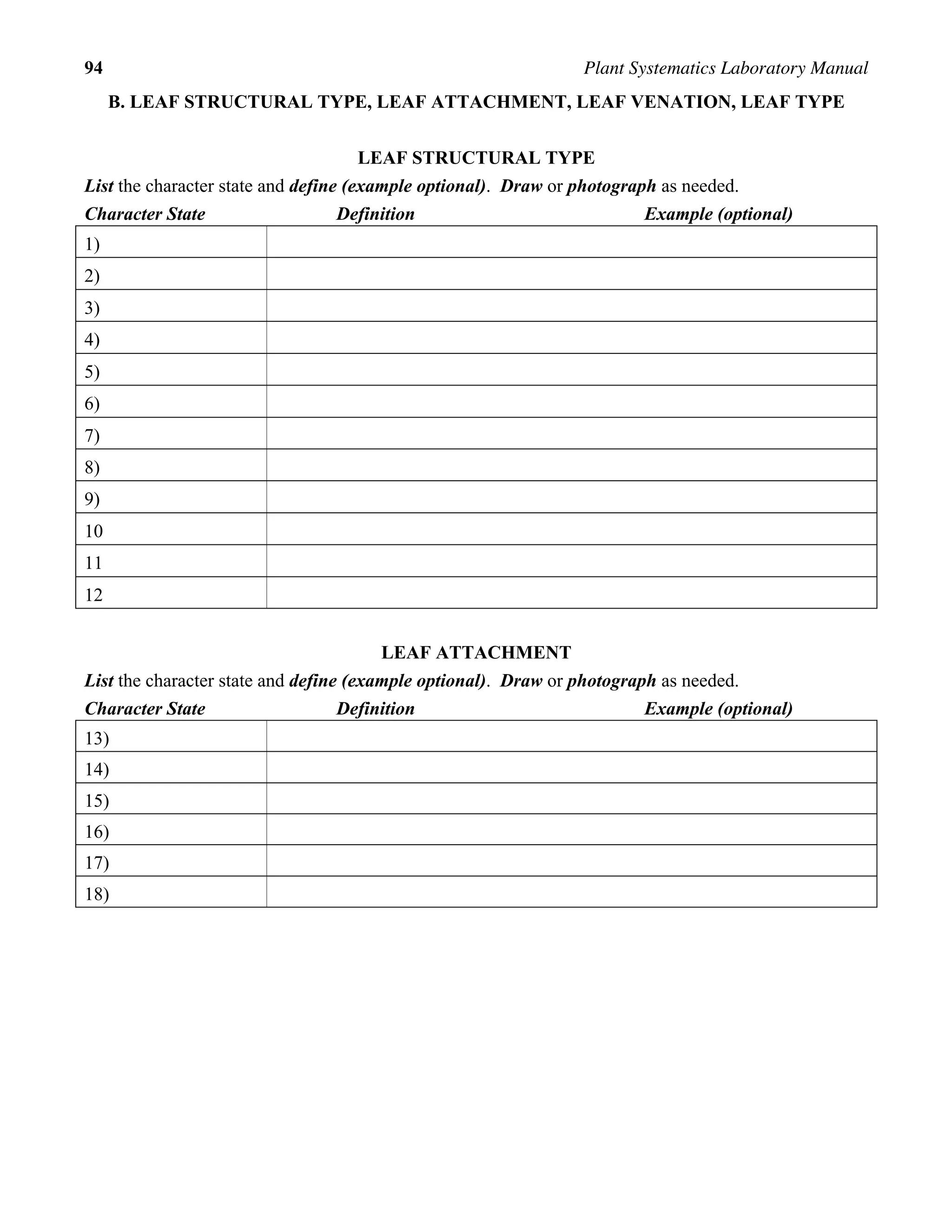
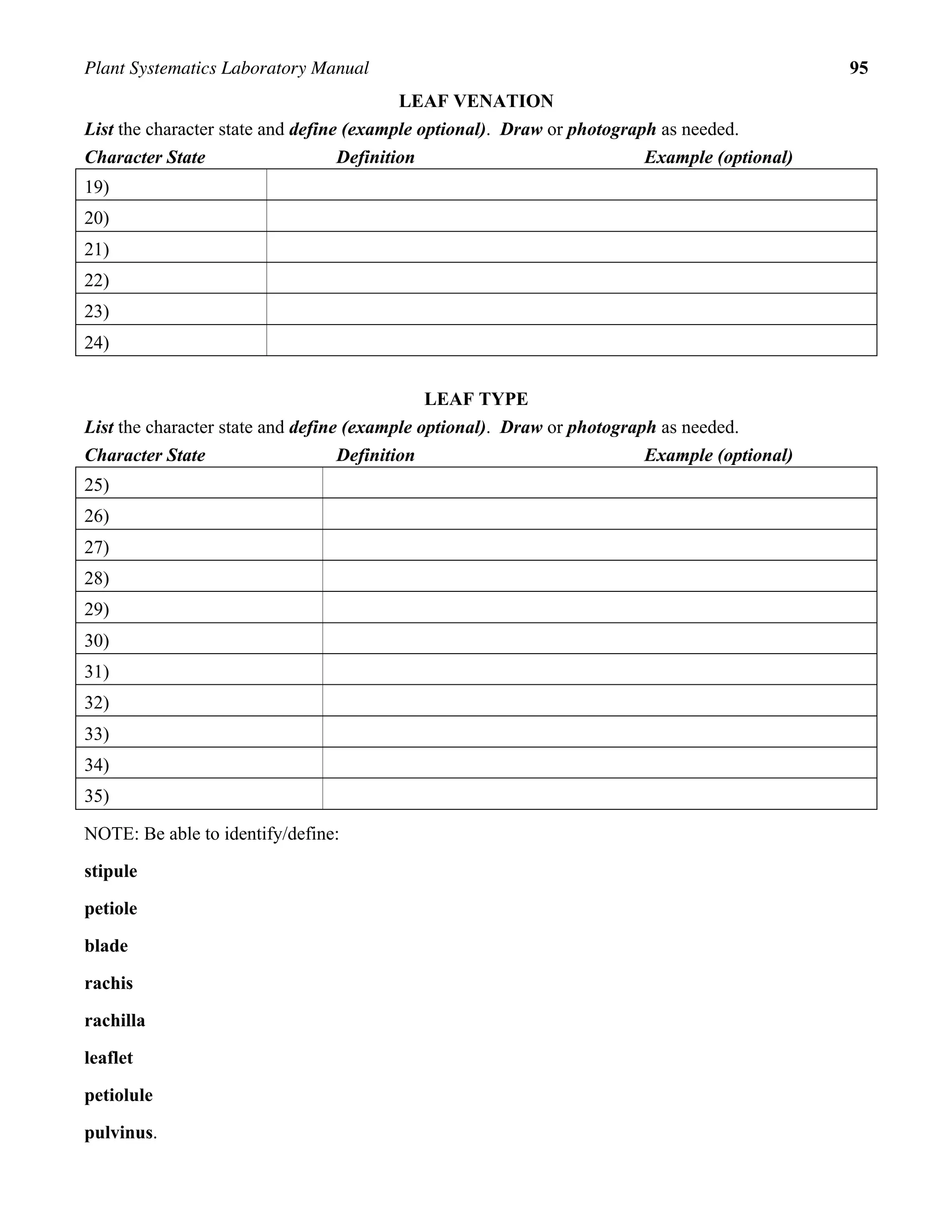
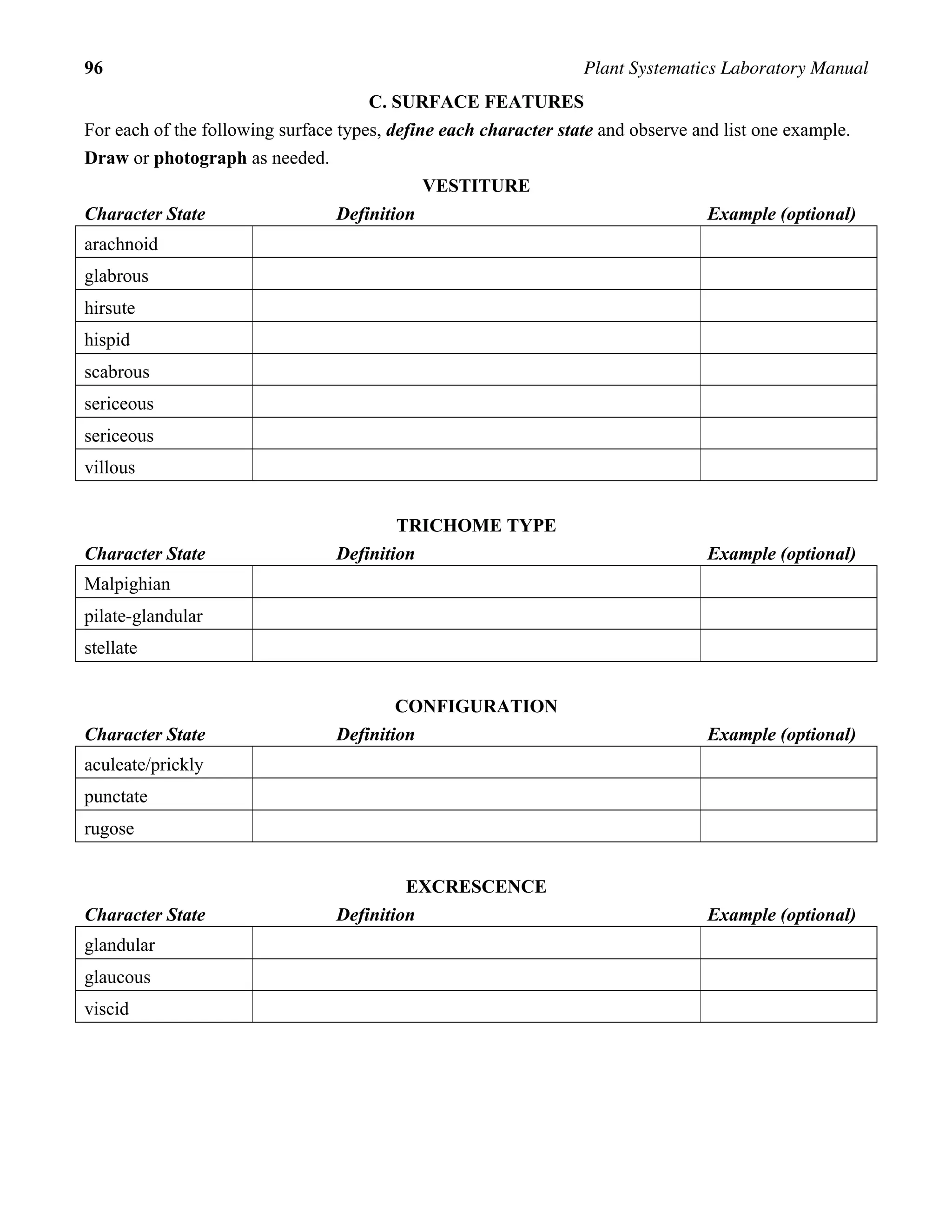
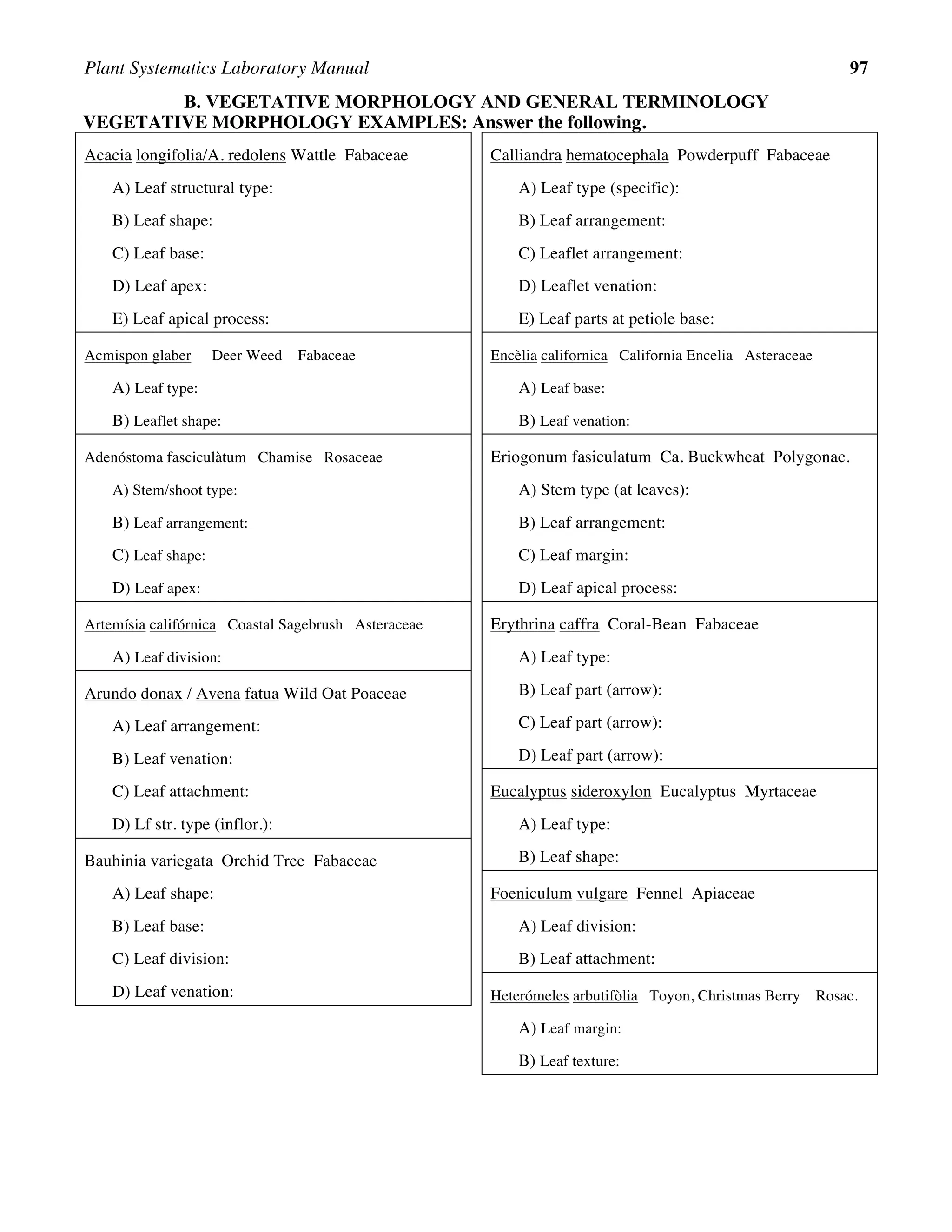
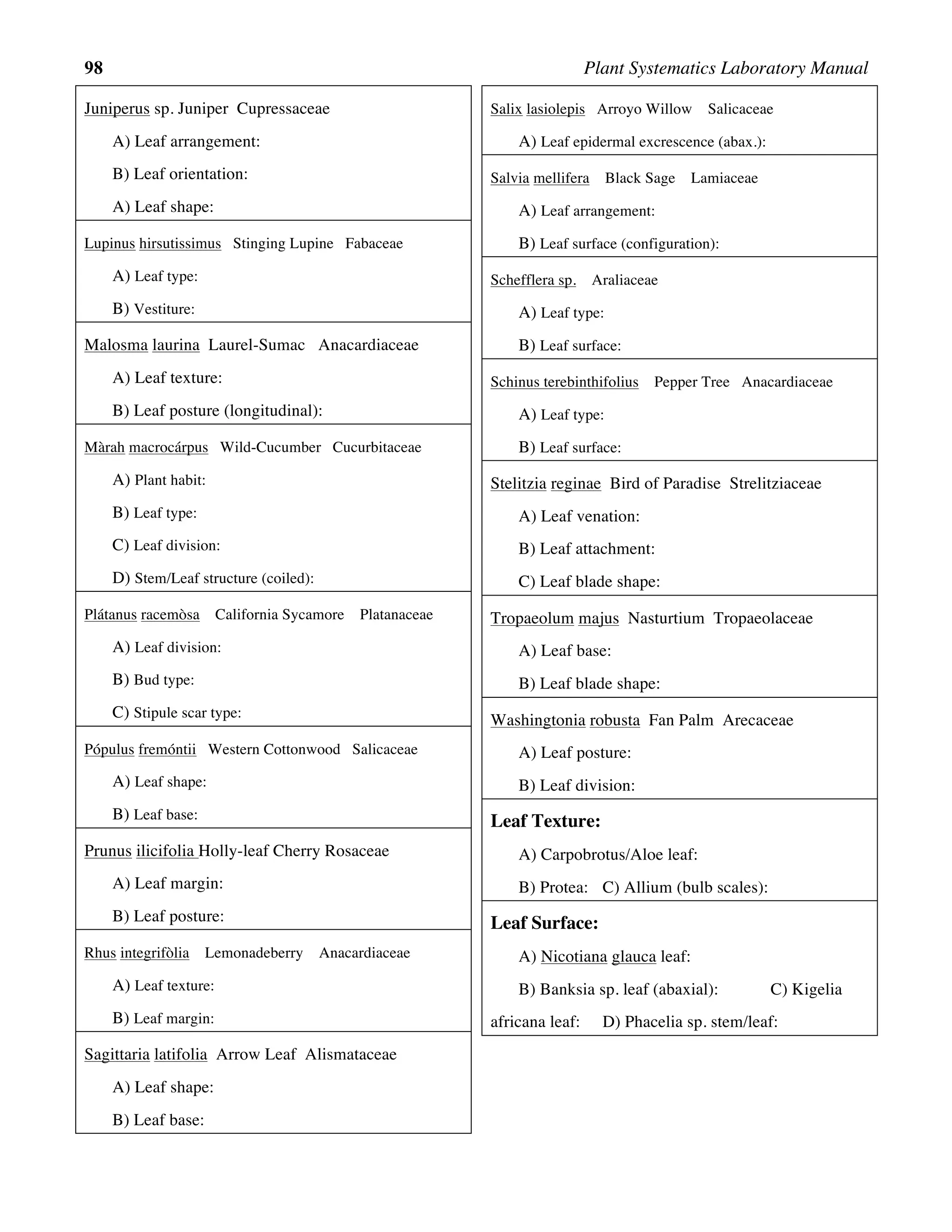
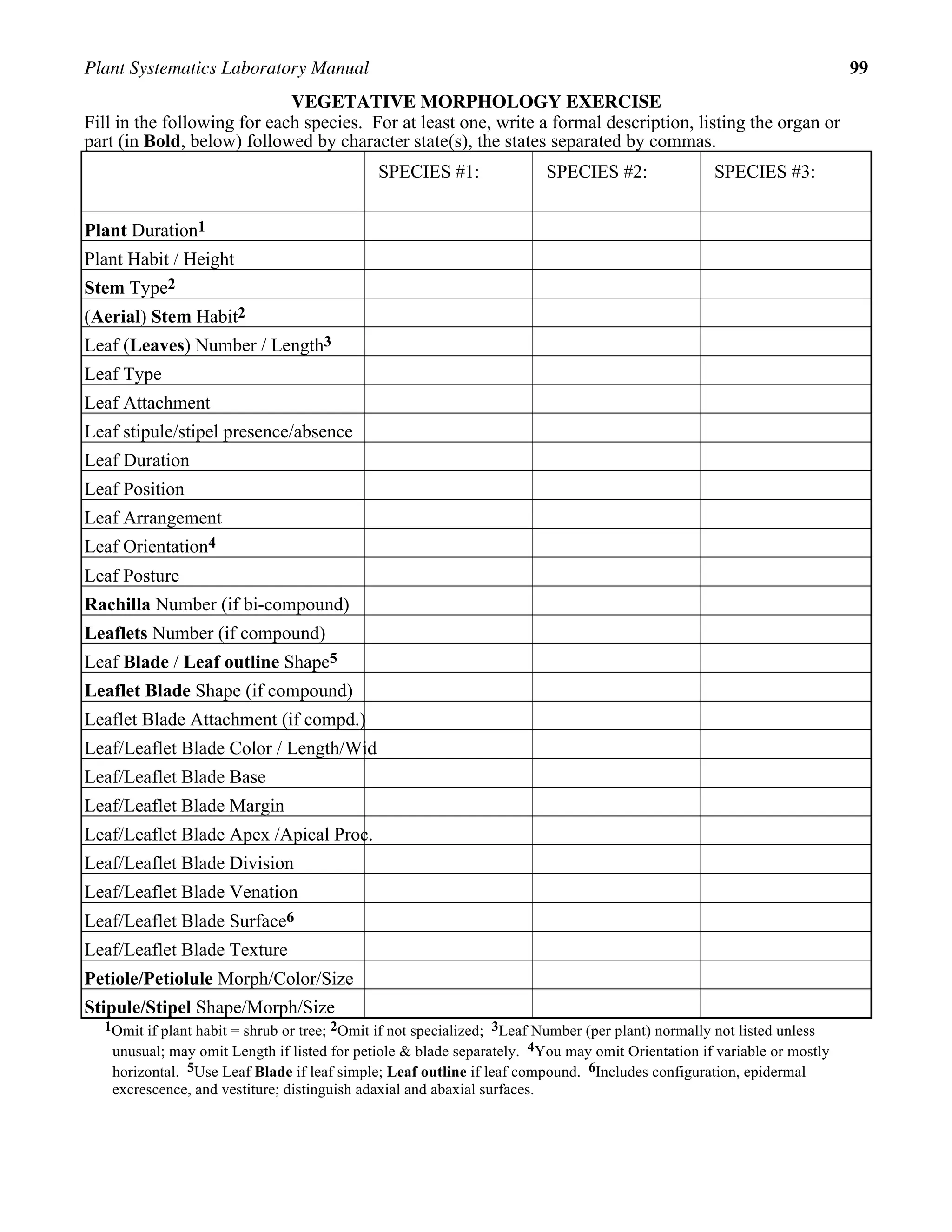
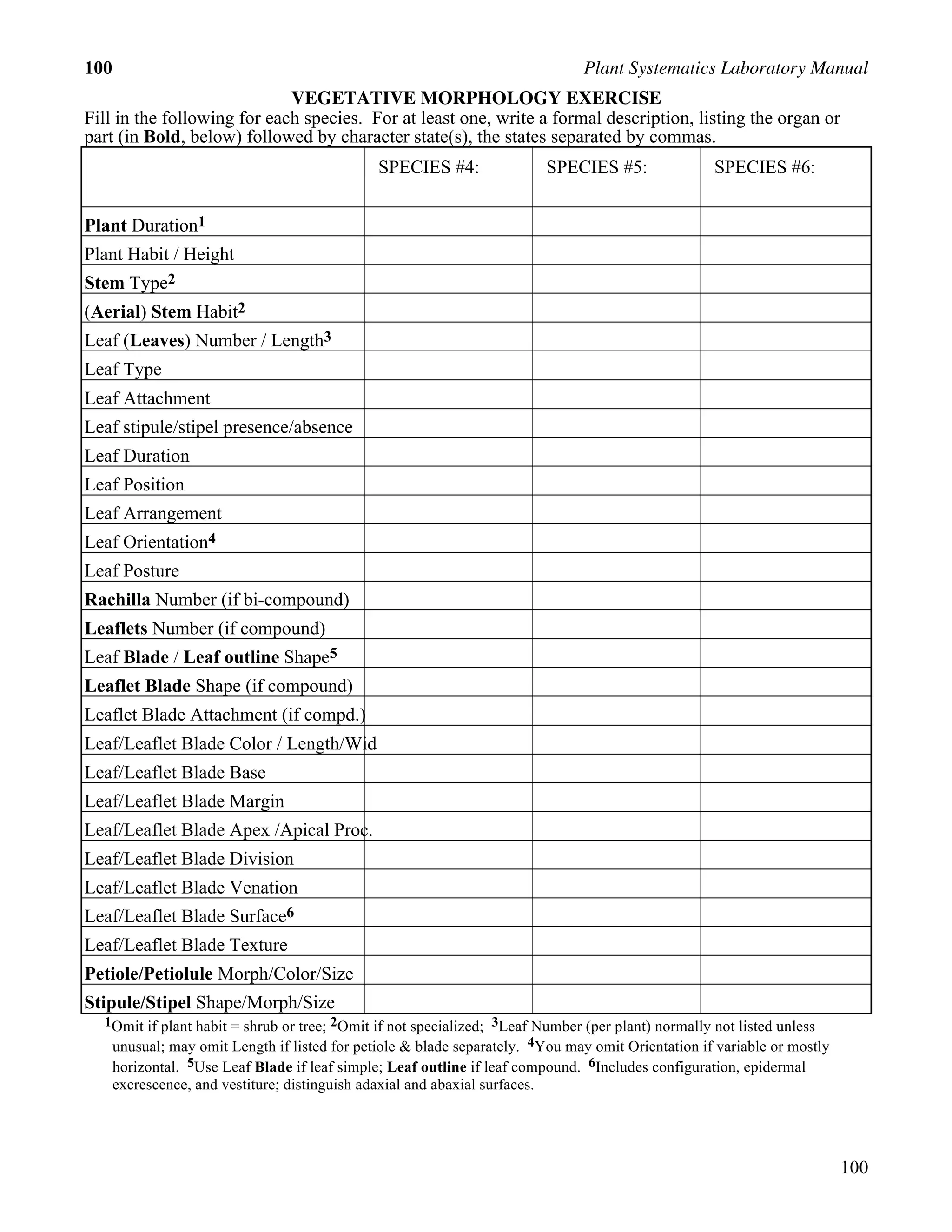
![Plant Systematics Laboratory Manual 101
D. FLOWER & INFLORESCENCE MORPHOLOGY
1) Basic Floral Parts and Dissection
Observe a flower from the outside and identify: bract (if present), pedicel (if present), and
perianth. Note if the perianth consists of tepals or tepal lobes or is clearly delimited into calyx and
corolla. If the latter (dichlamydeous), note the sepals or calyx lobes and the petals or corolla lobes.
Draw.
Now open up the flower by making a longitudinal section of the entire flower with a razor blade.
Note the stamens, and whether laminar or filamentous (consisting of a filament and anther). Draw.
Note the gynoecium, consisting of one or more pistils. Note the ovary position, whether
superior, or inferior. Note if there is a hypanthium, a tube-like or cup-like structure (arising from the
base to the top of the ovary), to which are attached the perianth and androecium. Determine the
perianth/androecial position. Draw.
Now, make an ovary cross-section. If the ovary is large enough, you can do this by holding the
ovary vertically in one hand and slicing it with a razor blade held in the other hand. [You may instead
hold the entire flower upside-down in one hand, such that you will be slicing through the perianth when
making an ovary cross-section.] When slicing the ovary, gently cut across the ovary while sliding the
blade toward you. (Be careful not to slice into a finger!) Make several, sequential slices with the razor
blade. You may leave these on the blade or transfer to a microscope slide using a needle. Observe the
sections with a dissecting microscope and note the placentation. Draw.](https://image.slidesharecdn.com/plsyslab-250719064702-ff141168/75/Plant-Systematics-laboratory-manual-techniques-105-2048.jpg)
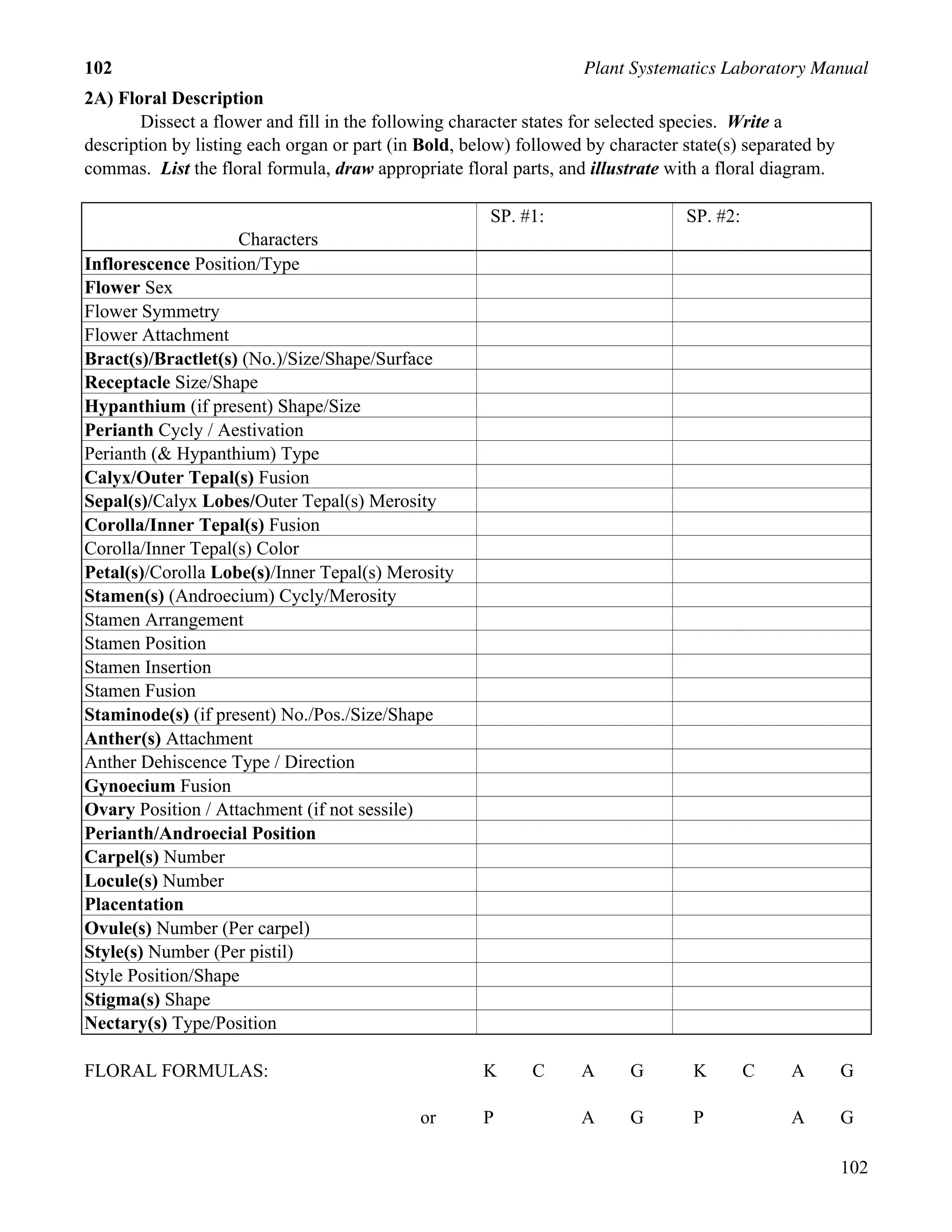
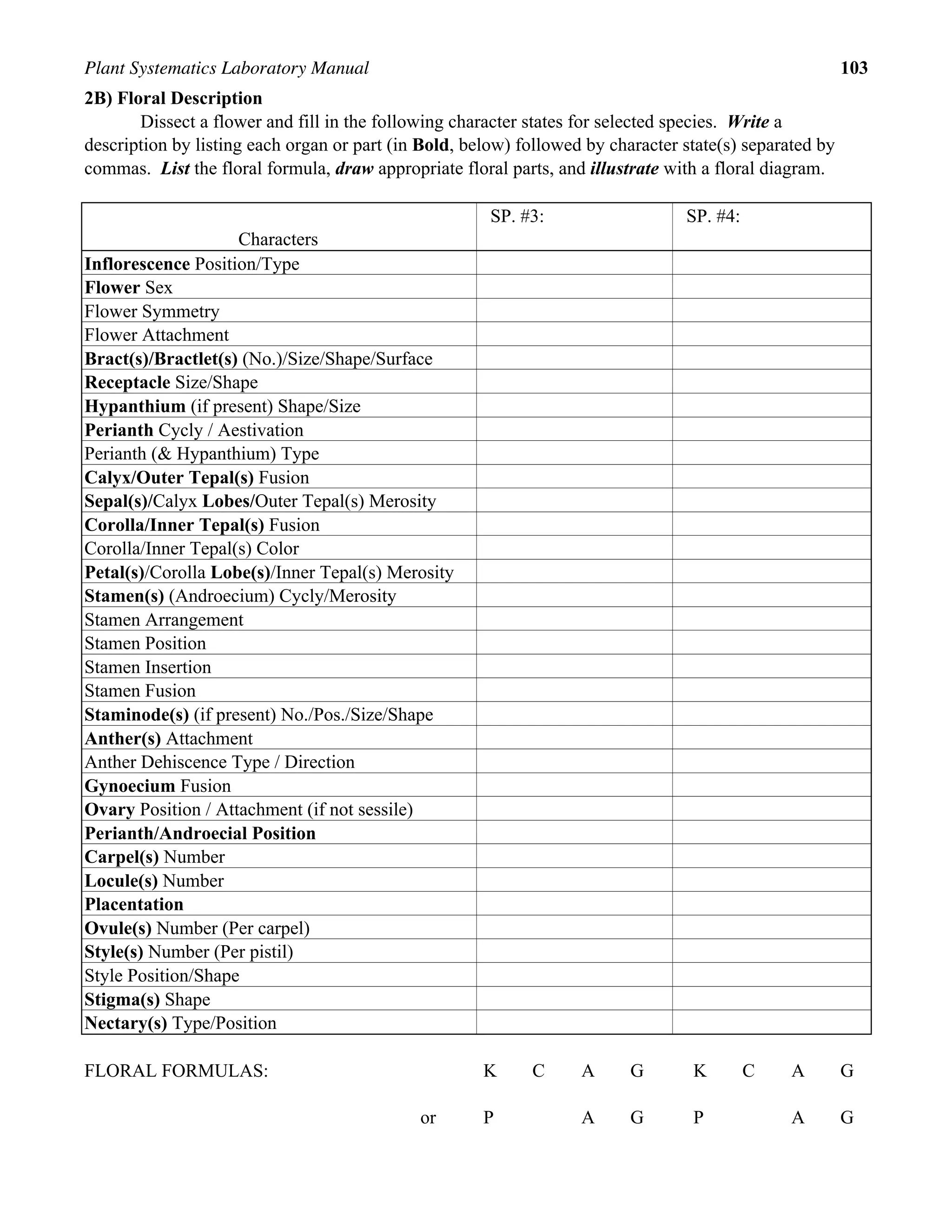
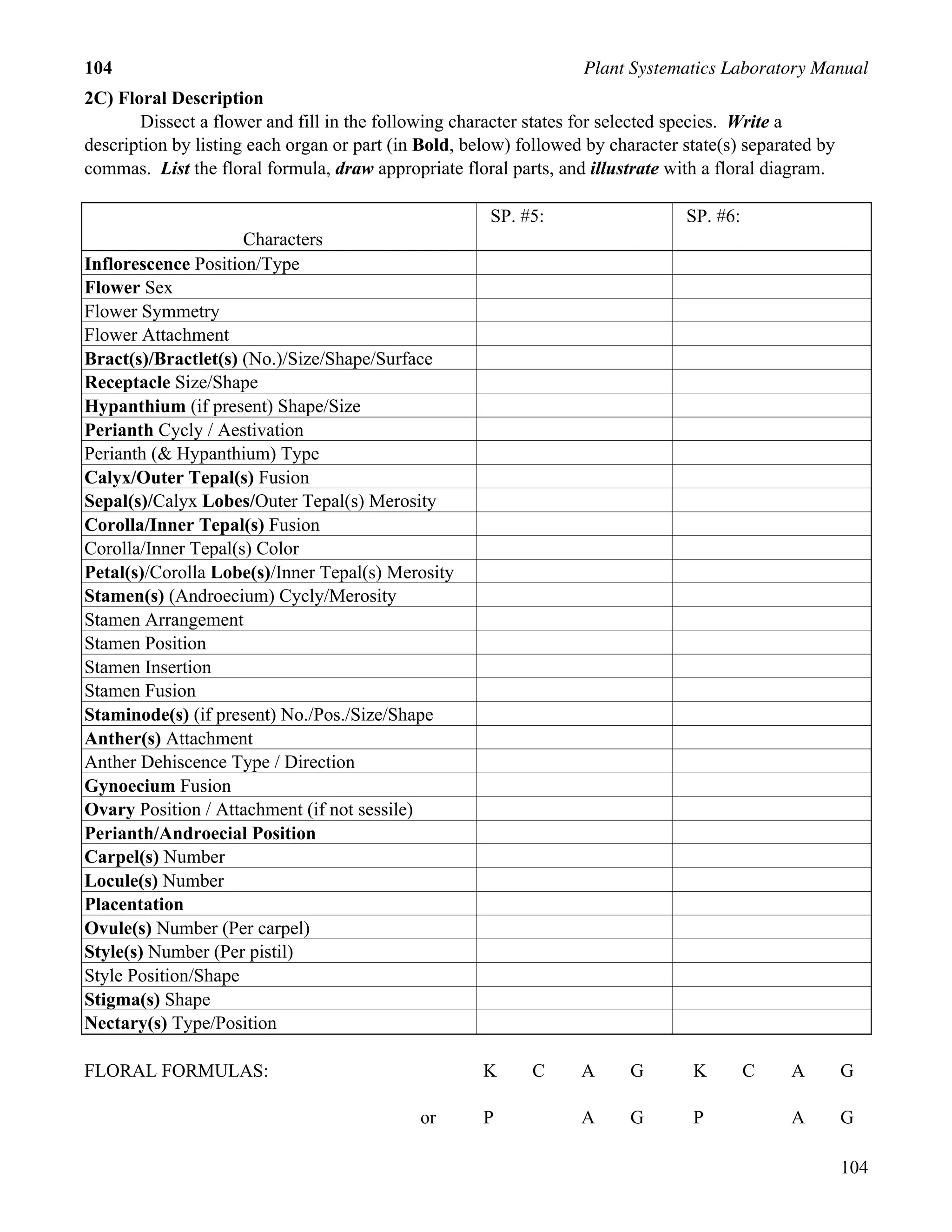
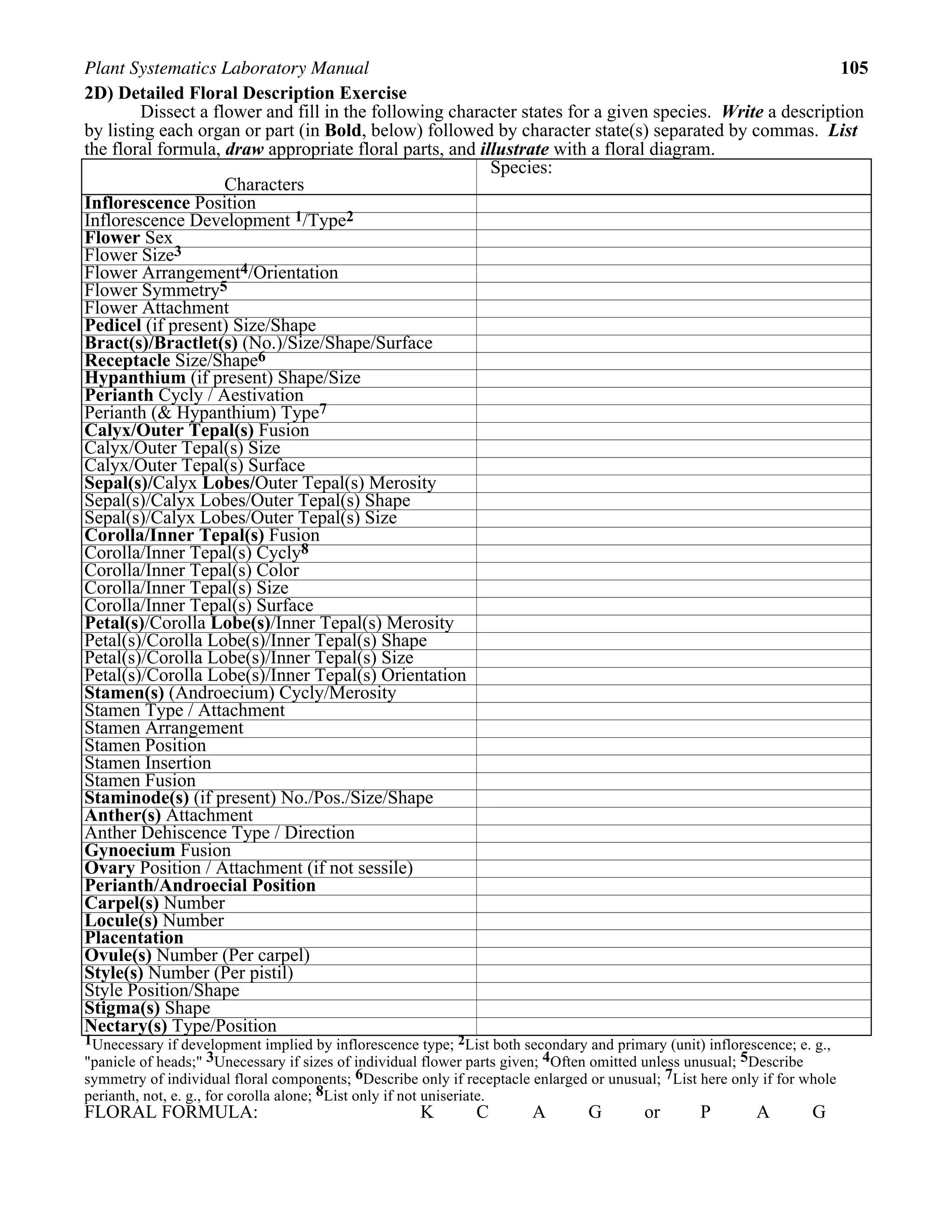
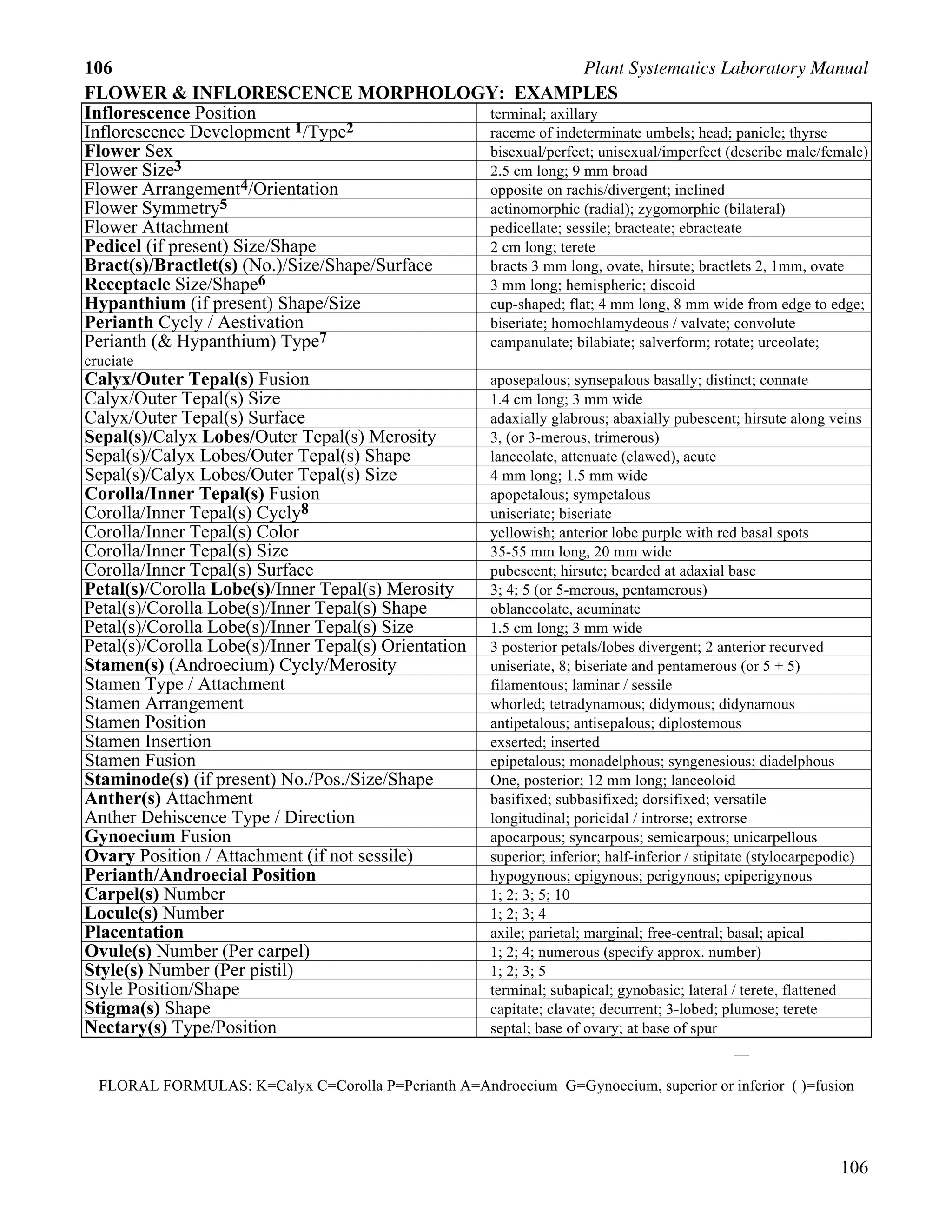
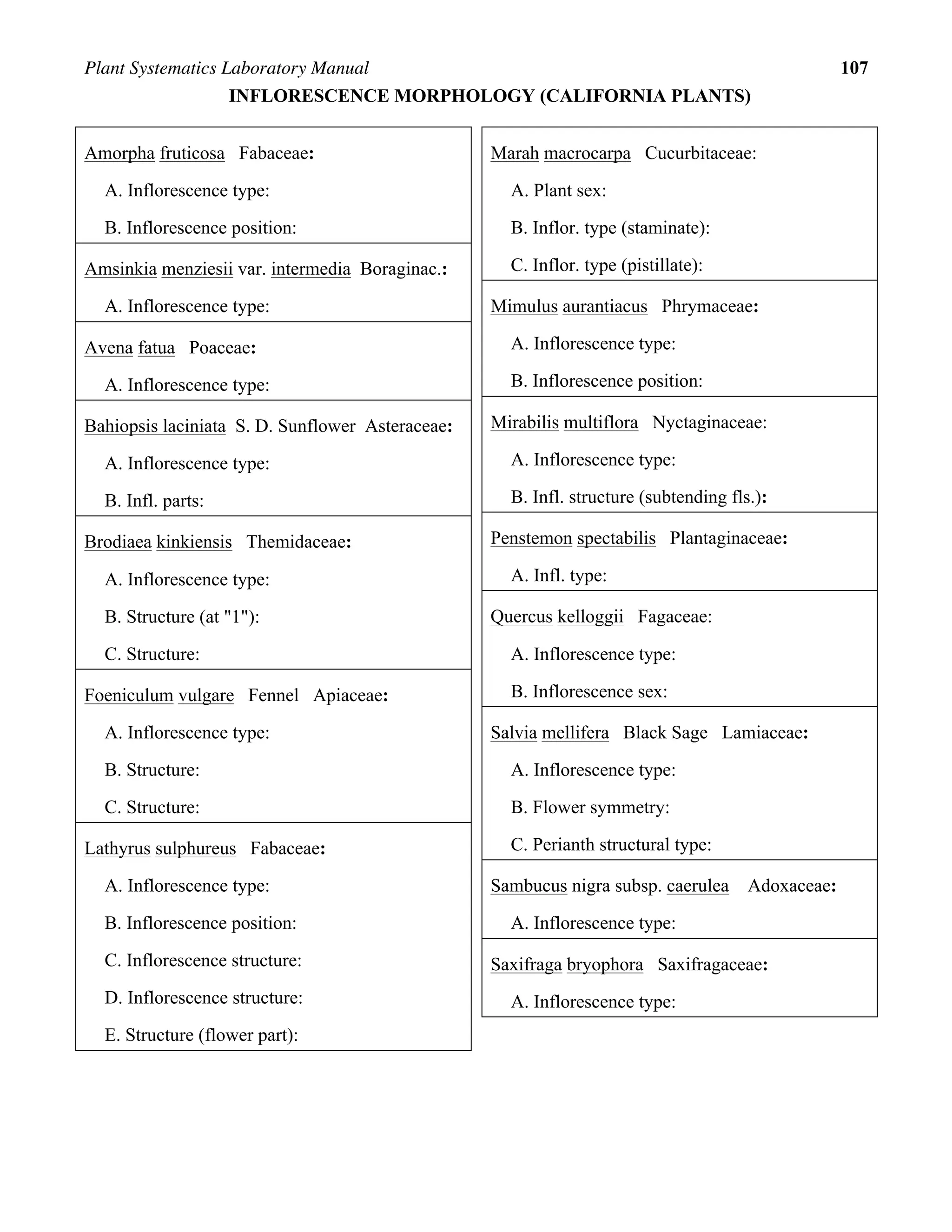
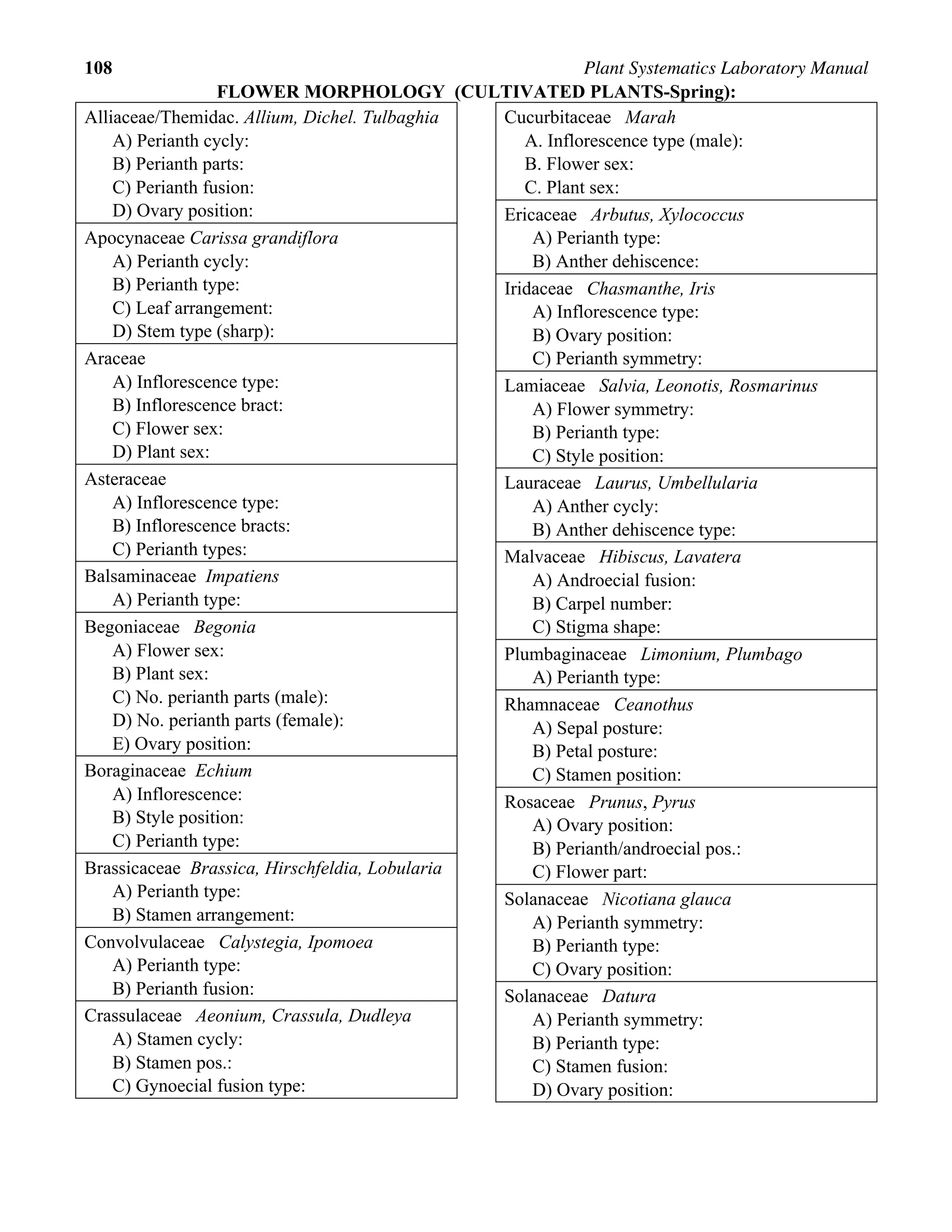
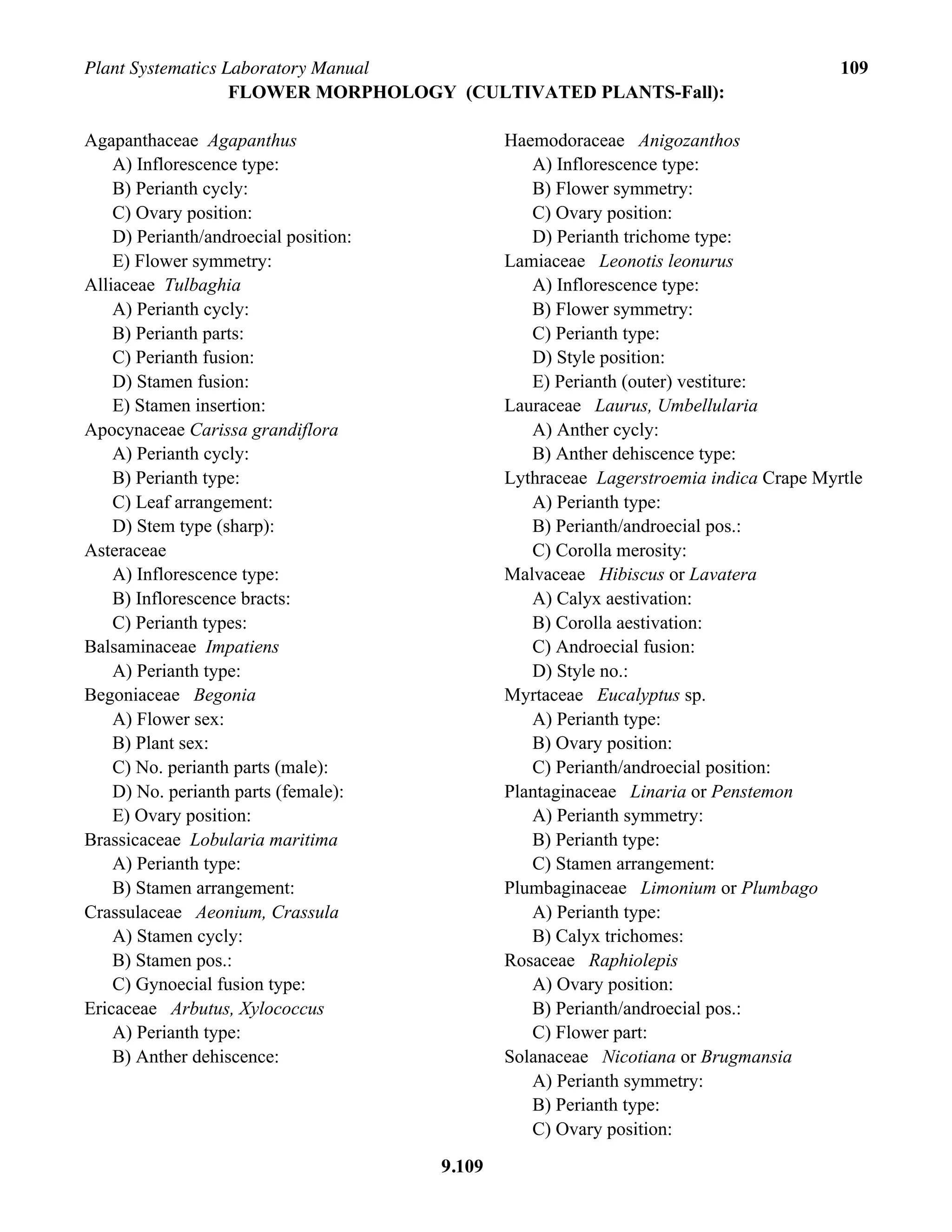
![110 Plant Systematics Laboratory Manual
E. FRUIT AND SEED MORPHOLOGY
Working with another person, complete the answers in this key to specific fruit types.
Fruit derived from a single flower
Fruit derived from a single ovary (pistil) of 1 flower = SIMPLE FRUIT
Pericarp dry at maturity (i. e., at time of seed maturation and dispersal)
Fruit winged 1) ________
[Note: Many fruit types below may be winged; these may be called a samara or, e.g., a "winged achene."]
Fruit not winged
Fruit dehiscent (splitting or opening in a regular manner)
Carpel 1
Fruit dehiscing along a single (ventral) line 2) ________
Fruit dehiscing along two lines 3) ________
Carpel 2 or more
Carpels 2; fruits dehiscent along 2 lines, w/ persistent central septum (replum) bearing seeds
Fruit about as long as broad 4) ________
Fruit 2X or more longer than broad 5) ________
Carpels 2 or more; fruits lacking a persistent central septum
Fruit splitting into 2 or more mericarps enclosing seed(s) at time of splitting 6) ________
[Note: The mericarp may be identified as a specific unit fruit type; e. g., a "schizocarp of follicles."]
Fruit not splitting into mericarps
Fruit dehiscing by pores 7) _________ ________
Fruit dehiscing by lines
Lines of dehiscence transversely oriented 8) _________ ________
Lines of dehiscence vertically oriented
Lines of dehiscence opposite locules 9) _________ ________
Lines of dehiscence along septa 10) _________ ________
Fruit indehiscent
Seed coat fused completely to pericarp 11) ________
Seed coat not fused to pericarp
Pericarp moderately hard; seed attached to pericarp at one point
Pericarp inflated, bladder-like (i.e., pericarp large in relation to seed) 12) ________
Pericarp not inflated or bladder-like (i.e., pericarp ca. same size as seed) 13) ________
Pericarp very hard; seed attached to pericarp at one or more points 14) ________
Pericarp fleshy at maturity (i. e., at time of seed maturation and dispersal)
Endocarp hard and stoney 15) ________
Endocarp not hard and stoney
Ovary superior; endocarp with juice sacs (swollen liquid-filled trichomes) 16) ________
Ovary superior or inferior; juice sacs absent
Ovary inferior; exocarp leathery & placentation parietal or endocarp cartilaginous & plac. axile
Exocarp leathery and placentation parietal 17) ________
Endocarp cartilaginous and placentation axile 18) ________
Ovary superior or inferior; pericarp fleshy, but not a pepo nor a pome 19) ________
Fruit derived from several ovaries (pistils) of 1 flower = AGGREGATE FRUIT. Some types:
Unit fruit fleshy at maturity, with a hard endocarp and fleshy mesocarp 20) ___________
Unit fruit dry at maturity
Unit fruit indehiscent, 1-seeded 21) ___________
Unit fruit dehiscent, with one line of dehiscence 22) ___________
Fruit derived from more than 1 (usu. several) flowers = MULTIPLE FRUIT. Some types:
Unit fruits fleshy, laterally fused, arising along a common central axis 23) ___________
Unit fruits not fused, born inside a fleshy compound receptacle with an apical pore 24) ___________](https://image.slidesharecdn.com/plsyslab-250719064702-ff141168/75/Plant-Systematics-laboratory-manual-techniques-114-2048.jpg)
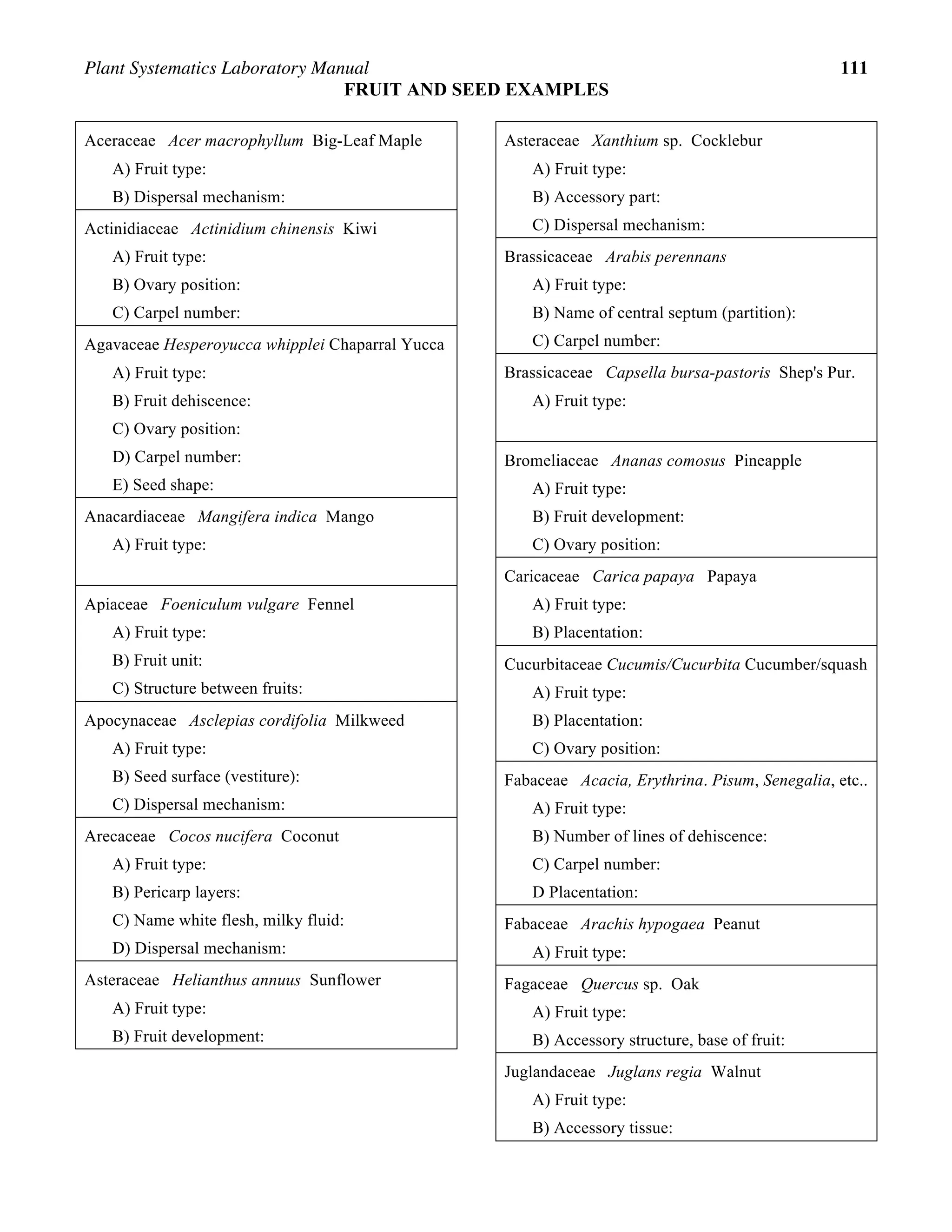
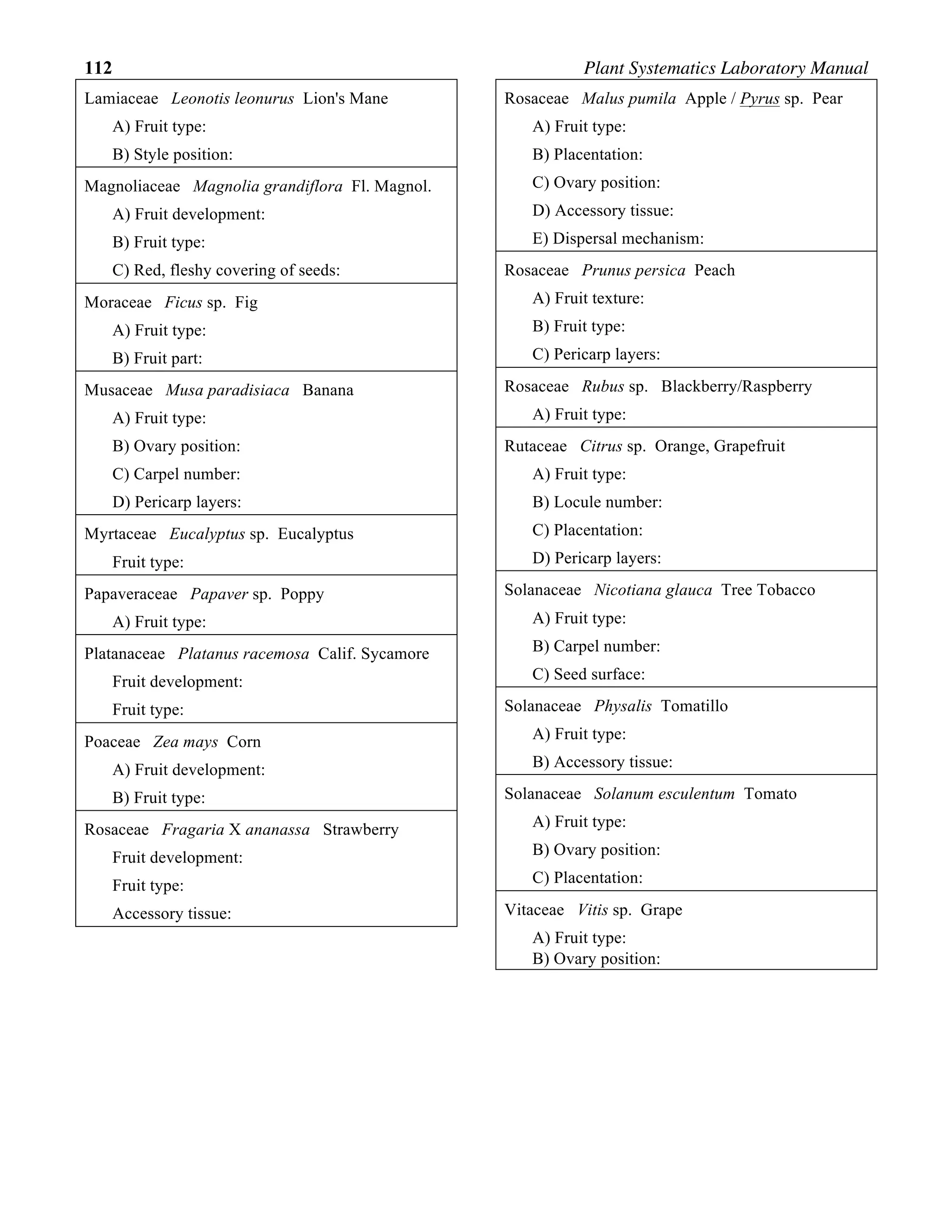
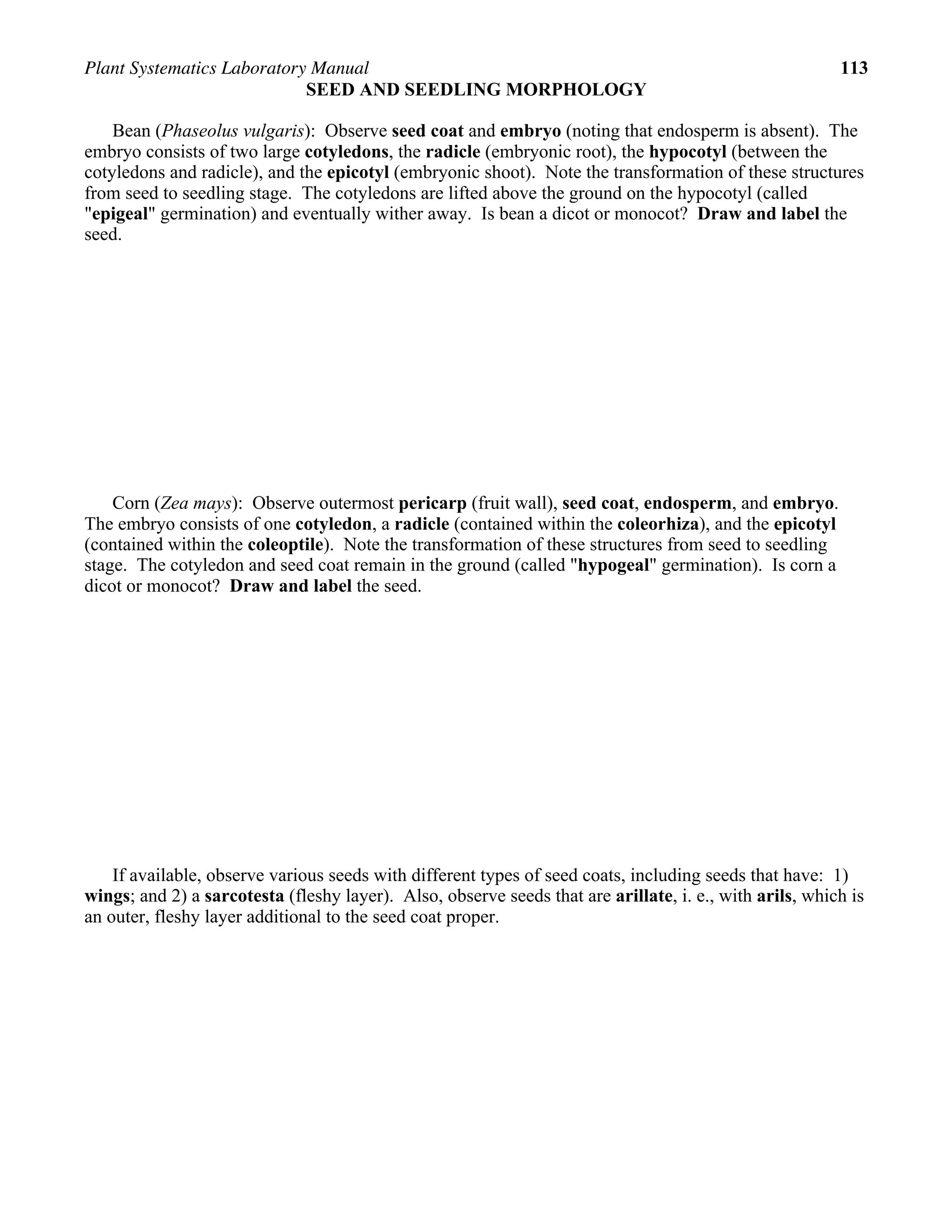
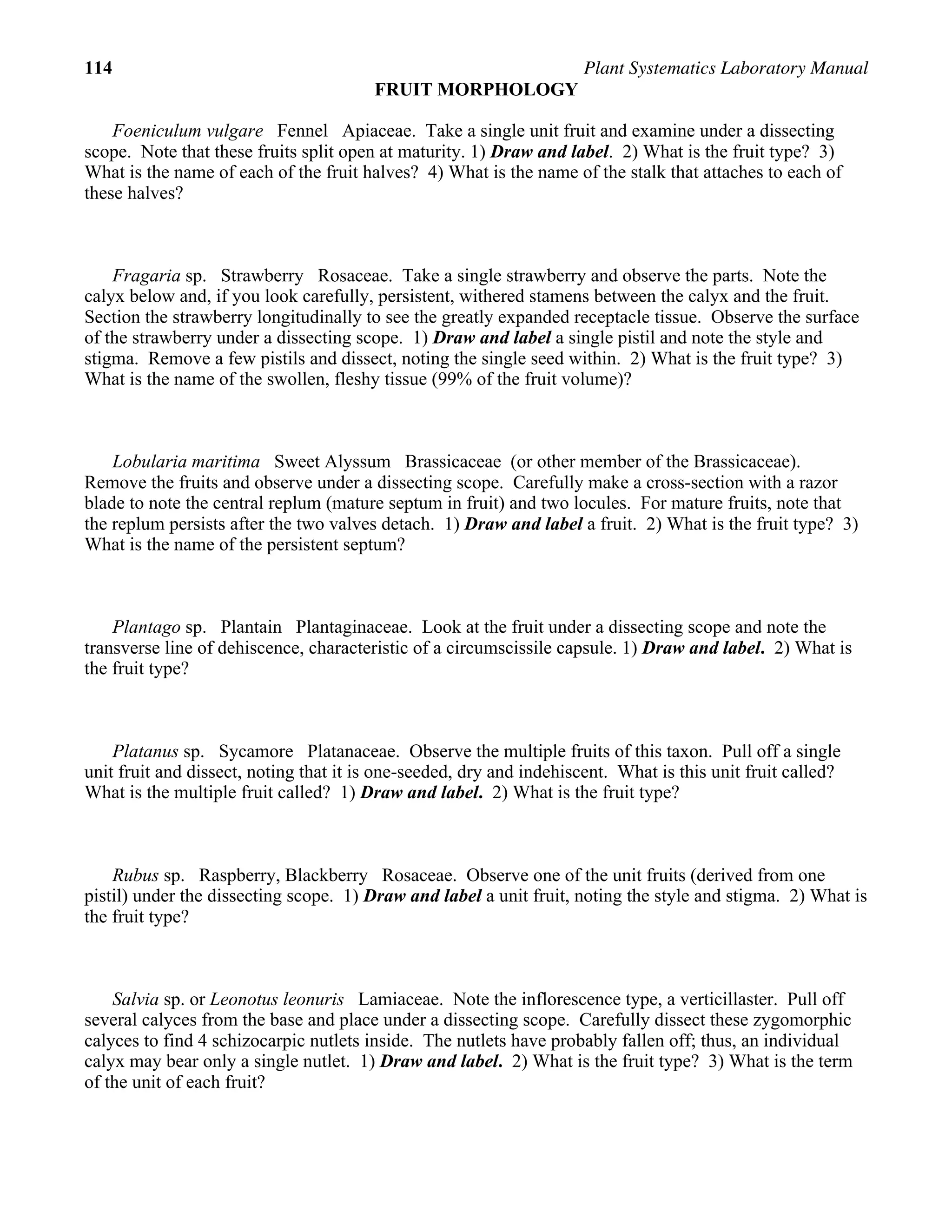
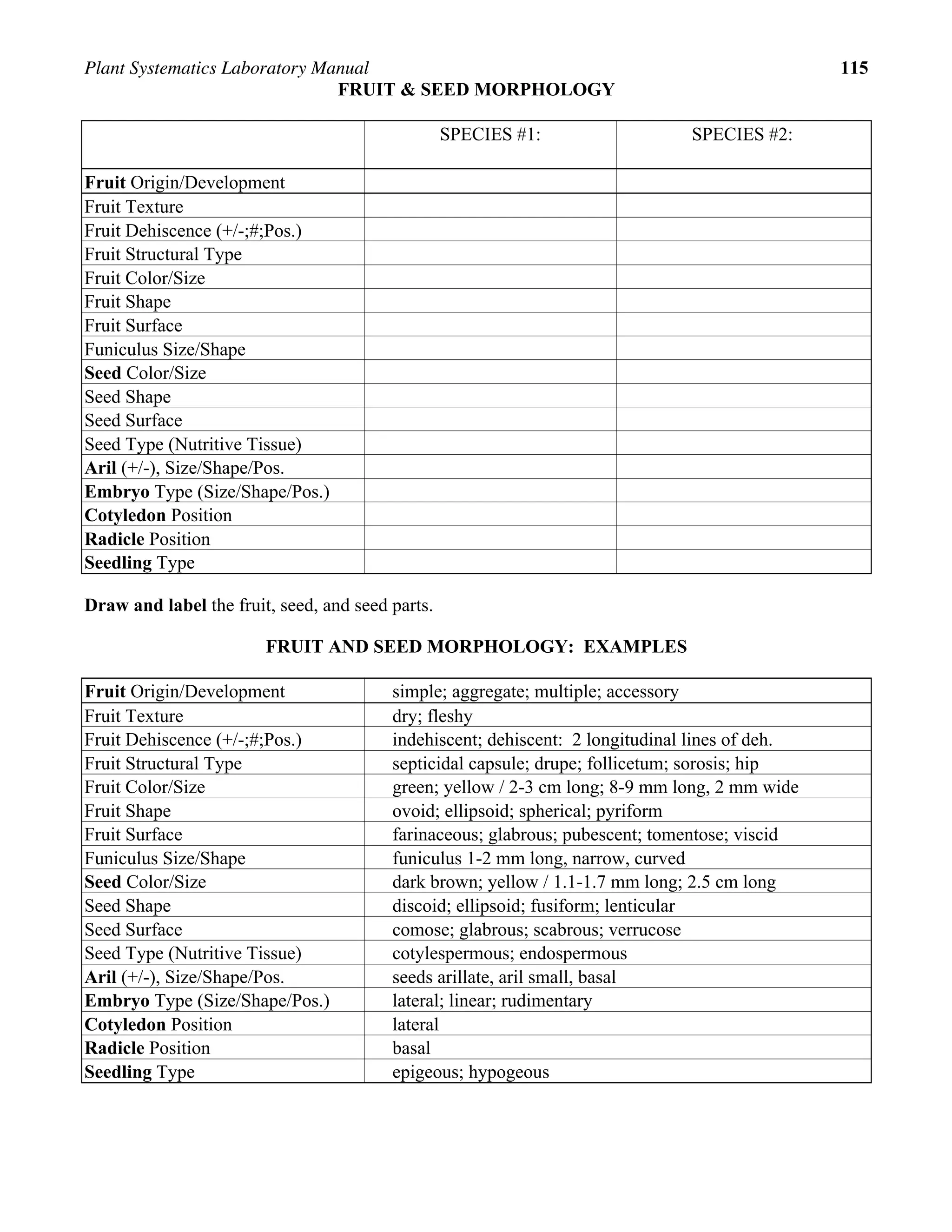
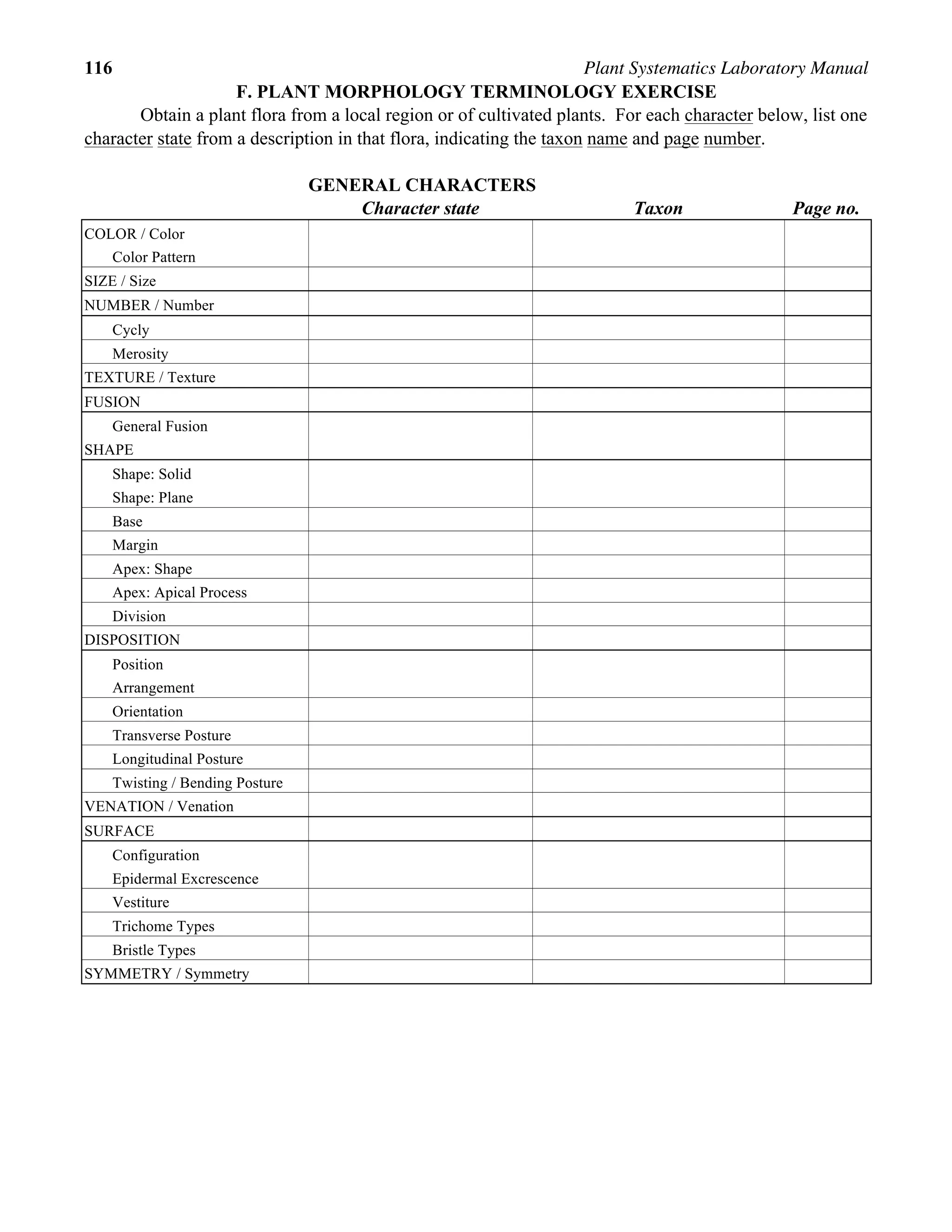
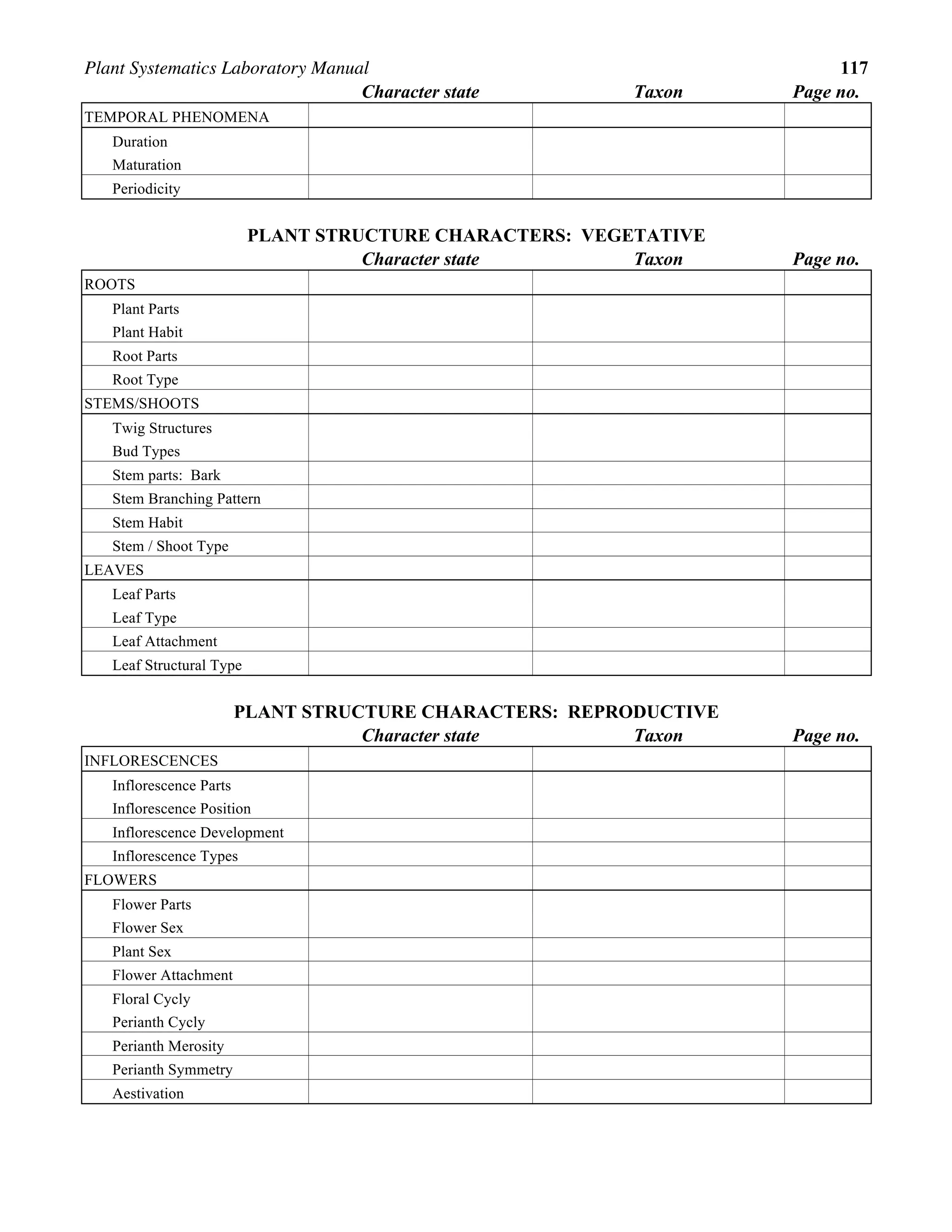
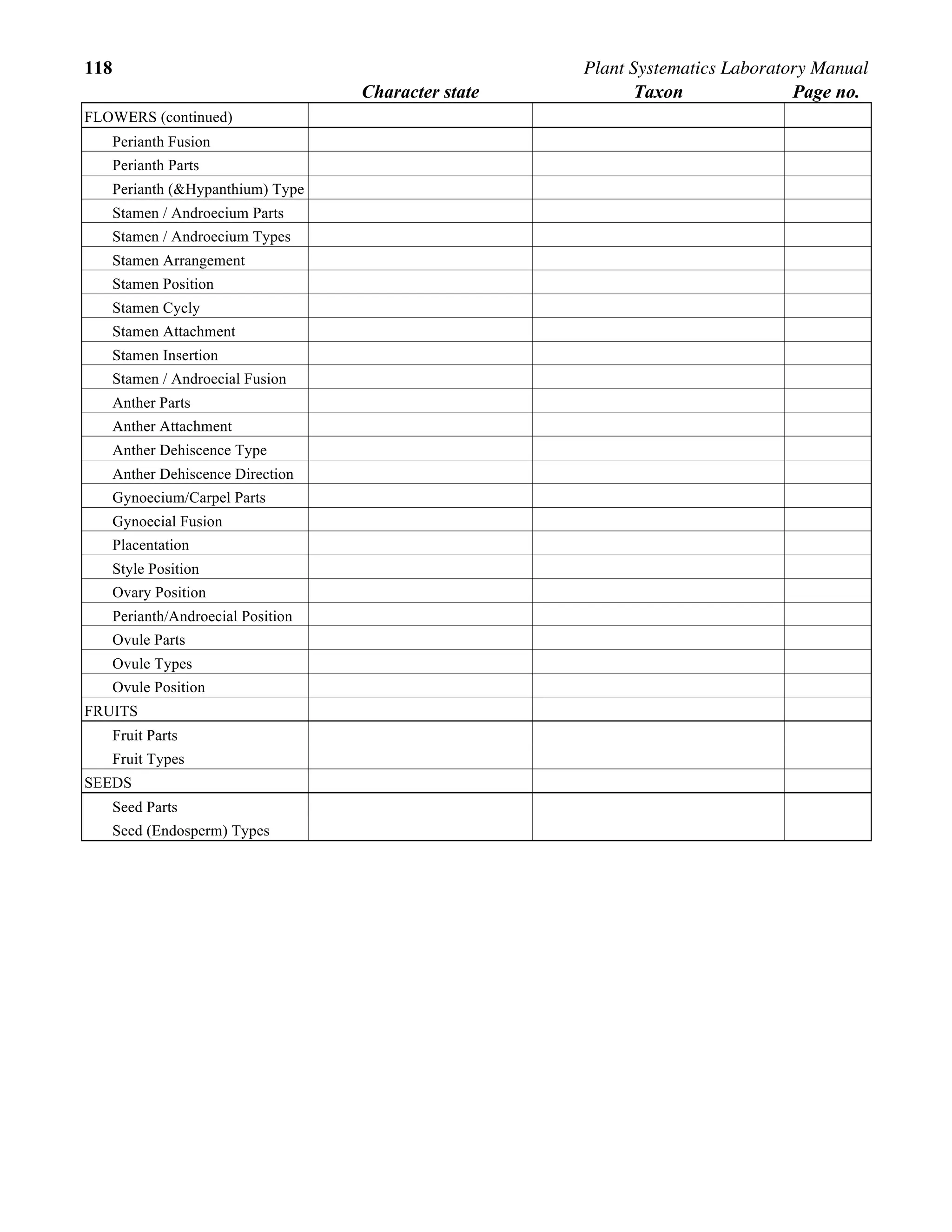
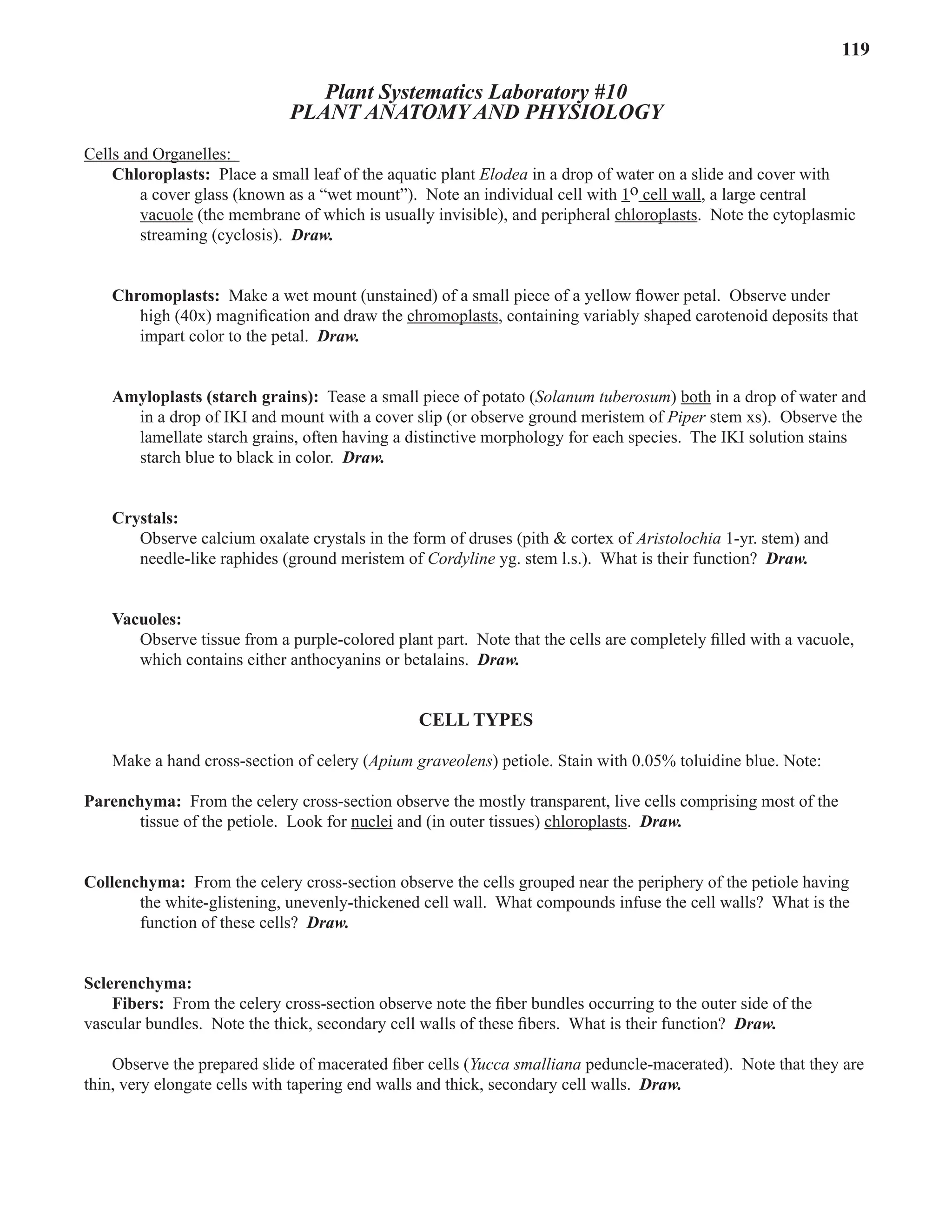
![Laboratory 10 Plant Anatomy and Physiology 121
PLANT ORGANS AND TISSUES
Root:
Root types: (observe)
Pistia stratiotes WATER LETTUCE or Hydrocharis morsus-ranae FROG BIT: Note rootcap
rootcap, root hairs,
root hairs, and
1o & 2o roots
Orchid: Note aerial roots
Zea mays
mays CORN: Note prop roots
prop roots . What is their function?
Root growth: Look at the prepared slide of a root longitudinal section (e. g., Ranunculus or Elodea root tip).
Note the root cap
root cap and apical meristem
apical meristem (region of cell division
region of cell division). Observe that cells elongate as they mature (region
region
of cell elongation
of cell elongation). Check off terms of ROOT handout.
Root mature structure: Look at the root cross-section of a eudicot (e. g., Ranunculus older root mat.
metaxylem) [optionally, of a monocot, e.g., Smilax mature root]. Note epidermis
epidermis, cortex (with starch grains),
endodermis, pericycle
pericycle, xylem
xylem, and phloem
phloem. In particular, note the suberized Casparian strips
Casparian strips of the non-lignified
endodermis. What is their function? In eudicots the xylem is structured as fluted ridges (appearing as “arms”);
in monocots there are numerous xylem “arms” and a central, lignified pith
pith region. Phloem strands alternate with
xylem “arms” in both dicots and monocots. Check off terms of ROOT handout.
Shoot:
Look at the prepared slide of a shoot longitudinal section (Coleus stem tip). Note apical meristem
apical meristem, leaf
primordia
primordia, bud primordia
bud primordia, and young vasculature. Check off terms of SHOOT handout.
Stem:
Make a hand-section or observe a prepared slide of a dicot stem, e. g., Coleus and stain with 0.05% toluidine
blue (or use prepared slides of Helianthus mat. stem). First, note the tissue regions: epidermis
epidermis, cortex, single ring
of vascular bundles, and pith
pith. The epidermis contains a thick, suberized cuticle. Just beneath the epidermis are
3-4 layers of collenchyma
collenchyma, characterized by having pectic-rich (appearing glistening white), unequally thickened
cell walls. Note, from the l.s. that these are elongate cells, functioning in structural support. The bulk of the
cortex is parenchyma
parenchyma cells, including the peripheral chloroplast-containing chlorenchyma
chlorenchyma. The vascular bundles
contain xylem to the inside and phloem to the outside. The xylem is comprised of lignified tracheary
tracheary elements
(vessels and/or tracheids); phloem is made up of non-lignified sieve tube members and companion cells. Fibers
are located in groups touching and to the outside of the phloem, in “bundle caps.” Check off terms of STEM
handout.
Make a hand cross-section or observe a prepared slide of a monocot stem, e. g., Commelina or Zea. Stain
with IKI and note the starch grains present in the parenchyma cells. Note the numerous, scattered vascular
bundles. Each bundle maintains the orientation of xylem and phloem. The vascular bundles tend to have a large
lacuna (hole) where the xylem first differentiates (“protoxylem”). Check off terms of STEM handout.
Leaf:
Observe the prepared slide leaf cross-section of Ligustrum. Note upper epidermis
upper epidermis, palisade mesophyll
palisade mesophyll,
spongy mesophyll
spongy mesophyll, lower epidermis
lower epidermis (with stomata), and vascular bundle (vein). The vascular bundle contains
phloem below and xylem above (when the slide is correctly oriented). Check off terms of LEAF handout.
Wood anatomy:
Wood is technically 2
o
xylem, derived from the vascular cambium.](https://image.slidesharecdn.com/plsyslab-250719064702-ff141168/75/Plant-Systematics-laboratory-manual-techniques-125-2048.jpg)
![Laboratory 10 Plant Anatomy and Physiology 123
WOOD FORENSICS
The Case
A crime has been committed ... the vicious murder of Jack McCaw.
You are a famous, Nobel prize-winning botanist, an expert in wood and plant fibers. The police bring you
samples to identify that may help to nab the criminal.
The First Sample
The first sample is a tiny fragment of wood, found in the skull of the murder victim. Determining the
identity of this wood could be vital to identifying the murder weapon ... and the murderer!
From the sample of wood given to you (already XRT sectioned by your lab technician), determine the
plant genus, using the key below. Then, verify your answer with named samples of the wood.
1. Wood porous, = with vessel elements (having perforation plates), lacking circular bordered pits
2. Wood ring porous (having large vessels in spring wood, small ones in summer wood)
3. Wood rays both multiseriate (with ∞ vertical columns of cells) and uniseriate
(with 1 column of cells) Quercus (oak)
3’ Wood rays mostly biseriate, = having 2 vertical columns of cells Fraxinus (ash)
2’ Wood not ring porous; vessels in spring and summer wood of similar size Salix (willow)
1’ Wood non-porous, = lacking vessels, having only tracheids, with circular bordered pits
[Note: resin canals can falsely appear to be vessels but are not conductive.]
4. Wood with numerous resin canals; rays mostly uniseriate, some multiseriate and associated with
resin cells Pinus (pine)
4’ Wood without resin canals; rays mostly 1-2-seriate Sequoia (redwood)
From this information, infer the murderer, given this information:
A. Professor Plum possesses a cane, inherited from his father, made of solid oak.
B. Mister Green has a collection of baseball bats, made of ash.
C. Colonel Mustard has in his possession a club made of pine wood.
D. Misses Peacock has a hand-carved Indian relict, made of willow wood.
E. Miss Scarlet has a fine vase, made of beautiful redwood.
You testify in court, presenting the evidence. Who is implicated as the murderer?
ADDENDUM:
Material dissection and preparation:
Material dissection and preparation:
A wealth of information can be gained by careful dissection and observation of plants. Look first at the outer
form of the plant, noting the basic plant organs (root, stem, leaves, buds, flowers, fruits) and specific aspects of
these organs. Gently pull apart the plant organs to better see their morphology. For flowers and fruits, use both
your hands and naked eye and dissecting needles under a dissecting scope to examine the components.
Careful anatomical studies usually involves time consuming embedding and microtome sectioning. However,
a simple technique of hand sectioning with a razor blade will allow you to see considerable detail of cell and](https://image.slidesharecdn.com/plsyslab-250719064702-ff141168/75/Plant-Systematics-laboratory-manual-techniques-127-2048.jpg)
![Laboratory 11 Plant Embryology 125
Plant Systematics Laboratory #11
PLANT EMBRYOLOGY
Equipment & supplies needed:
Equipment & supplies needed:
Compound microscope (preferably phase contrast or D.I.C.)
Syracuse dish
Dissecting needles
Fine forceps
Scalpel, w/ #11 blade
Microscope slides
Cover slips (squares or circles)
Kimwipes
Felt-tip pen, rapidograph, or diamond scribe (for marking slides)
Paper and pencil (2H)
Dropper bottles:
Herr’s Clearing Solution
Stock bottles:
F.A.A. [5% formalin (commercial strength), 5% acetic acid
(glacial), 63% ethanol]
Ethanol - 70%
Ethanol - 95%
Ovule Clearings:
Ovule Clearings:
Ovules must be individually removed from the ovary or a flower in order to observe histological and
positional details. Flowering material may be dissected live or fixed beforehand in F.A.A. for 24-48
hours. (Replace F.A.A. with 70% ethanol after fixation.) Dissect in Syracuse dish while viewing under
a dissecting scope, using needles, forceps, and scalpel. Place flower in a dish filled with 95% ethanol
and detach the ovary. Carefully tear open the side of the ovary (from top or bottom) with forceps to
expose the ovule(s); avoid damaging the ovule(s). Observe placentation, ovule type (if apparent), and
ovule position; record information. Place the opened ovary on a small drop of ethanol on a microscope
slide (Don’t let dry out!). Detach the ovule(s) from the base of the funiculus with forceps or needle.
(With patience and skill in dissecting, even the tiniest ovules can be successfully removed.)
Place two cover slips on either side of the ovule(s). Drain most of the ethanol (or allow to
evaporate). Immediately, place 1-2 drops of Herr’s Clearing fluid (Herr, 1971, 1982) directly on
the ovule(s). Cover ovule with a third cover slip, which rests on the edges of the other two. This
arrangement prevents the ovule from being squashed. Add more Herr’s solution from the edge, as
needed.
After ca. 5 minutes, place slide under brightfield, phase contrast, or D.I.C. microscope and observe.
Note:
1) Placentation (axile, parietal, basal, apical, free-central, apical-axile, parietal-septate, laminar)
2) Ovule position (hypotropous, epitropous, pleurotropous; dorsal or ventral)
3) Ovule type (anatropous, orthotropous, or campylotropous & subtypes).
4) Number of integuments (unitegmic or bitegmic).
5) Number of cell layers per integument (1, 2, or more).
6) Micropyle type (amphistomal, exostomal, endostomal, or unistomal).
7) Vasculature traversing funiculus into nucellus.
8) Details of embryo sac (this usually requires careful and considerable observation).
Possible taxa to investigate:
Possible taxa to investigate:
Armeria maritima [Caryophyllales, Plumbaginaceae]:
Aptenia cordifolia [Caryophyllales, Aizoaceae]:
Centranthus ruber [Dipsacales, Valerianaceae]:
Centranthus ruber [Dipsacales, Valerianaceae]:
Centranthus ruber
Eriogonum fasciculatum [Caryophyllales, Polygonaceae]:
Erythrina sp. [Fabales, Fabaceae]:
Euryops pectinata [Asterales, Asteraceae]:
Hedera helix [Apiales, Araliaceae]:
Hedera helix [Apiales, Araliaceae]:
Hedera helix](https://image.slidesharecdn.com/plsyslab-250719064702-ff141168/75/Plant-Systematics-laboratory-manual-techniques-129-2048.jpg)
![126 Plant Systematics Laboratory Manual
Malacothamnus fasciculatus [Malvales, Malvaceae]:
Pereskia grandiflora [Caryophyllales, Cactaceae]:
Phormium tenax [Asparagales, Phormiaceae]:
Phormium tenax [Asparagales, Phormiaceae]:
Phormium tenax
Salvia mellifera [Lamiales, Lamiaceae]:
Pollen Tube Growth
Carefully remove the style of a pollinated flower (e. g., a composite). Place the style in a
couple of drops of aniline blue stain. Cover with a cover slip and slightly squash. Observe under the
fluorescent microscope. Aniline blue is preferential for callose, which is deposited in the pollen tubes.
Pollen tubes appear bright yellow under fluorescence microscopy. Observe.
Female Gametophyte (Embryo Sac) Development
Female Gametophyte (Embryo Sac) Development
Observe the mature female gametophyte of Phormium tenax and of the prepared slides of Lilium,
noting the 3 antipodal cells, 2 polar nuclei, and 3 cells of the egg apparatus. If time permits, observe
earlier developmental stages. Draw.
Embryo morphology:
Embryo morphology:
Dissect out embryos or clear small seeds of a given species and observe under brightfield, phase
contrast, or D.I.C. microscopy. Draw.
Taxa: Capsella bursa-pastoris
Capsella bursa-pastoris Shephard’s Purse or Lepidium
Lepidium sp. Peppergrass (both Brassicaceae)
Seed morphology:
Seed morphology:
Dicot:
Bean (Phaseolus vulgaris
vulgaris): Observe seed coat and
seed coat and
seed coat embryo
embryo (noting that endosperm is absent). The
embryo consists of two large cotyledons
cotyledons, the radicle (embryonic root), the hypocotyl
hypocotyl (between the
cotyledons and radicle, and the epicotyl
epicotyl (embryonic shoot). If available, note the transformation of these
structures from seed to seedling stage. The cotyledons are lifted above the ground on the hypocotyl
(called “epigeal” germination) and eventually wither away. Draw the seed:
Monocots:
Corn (Zea mays
mays) grain: Observe outermost pericarp
pericarp (fruit wall), seed coat, endosperm
endosperm, and embryo
embryo.
The embryo consists of one cotyledon
cotyledon, a radicle (contained within the coleorhiza), and the epicotyl
epicotyl
(contained within the coleoptile). If available, note the transformation of these structures from seed
to seedling stage. The cotyledon and seed coat remain in the ground (called “hypogeal” germination).
Draw the seed:](https://image.slidesharecdn.com/plsyslab-250719064702-ff141168/75/Plant-Systematics-laboratory-manual-techniques-130-2048.jpg)
![Laboratory 12 Palynology 127
Plant Systematics Laboratory #12
PALYNOLOGY
Equipment & supplies needed:
Equipment & supplies needed:
Compound microscope (brightfield, phase contrast, or D.I.C.)
Dissecting needles
Fine forceps (optional)
Microscope slides
Cover slips (22 X 22 squares & 18 circles)
Kimwipes
Paper and pencil (2H)
Felt-tip pen, rapidograph, or diamond scribe (for marking slides)
Dropper bottles:
F.A.A. [5% formalin (commercial strength), 5% acetic acid (glacial), 63% ethanol]
Ethanol - 70%
Basic Fuchsin (in 50% glycerol)
Glycerol - 50%
Herr’s Clearing Solution
Acetocarmine
IKI
Sudan IV (or Sudan III)
Pollen grain observation:
Pollen grain observation: Pollen grains may be observed under brightfield microscopy by teasing apart
anthers in a drop of Basic Fuchsin (in 50% glycerol) on a microscope slide. (Live or fixed material may
be used.) After teasing out pollen grains, remove any large anther fragments, place a cover slip on the
slide, and observe under the microscope. Basic fuchsin stains the outermost exine layer of the pollen
grain, allowing for better visualization of structural detail. (IMPORTANT: Be sure to decrease the
condenser aperture
aperture opening in order to obtain the best contrast.) Optional: You may also wish to mount
pollen grains in 50% glycerol (without the basic fuchsin stain) or in Herr’s clearing solution (preferably
fixed briefly in F.A.A. or alcohol beforehand) and observe with a phase contrast or D.I.C. microscope.
Note the following in your pollen grain samples:
1) Pollen unit (monad is most common; look for tetrads, polyads, or pollinia).
2) Pollen grain shape and size (need an ocular micrometer for the latter).
3) Wall sculpturing (e.g., verrucate, reticulate, echinate, psilate, rugulate).
4) Number, type, and arrangement of aperuture(s) (e.g., tricolpate, tricolporate, monoporate,
monosulcate).
5) Pollen kit (yellowish or orange carotenoid-like material adhering to exine; functions in pollen
dispersal).
Pollen grain nuclear number and storage product:
Pollen grain nuclear number and storage product: The number of nuclei present in a pollen grain at
the time of pollen release may be a valuable taxonomic character. Pollen grains are usually binucleate,
containing one tube cell (consisting of a spherical nucleus with the bulk of the pollen grain acting as
the cell) and one generative cell
generative cell (usually crescent-shaped). In some taxa the mature pollen grains are
trinucleate, vis-à-vis the precocious division of the generative cell into two sperm cells
sperm cells.
Dissect pollen grains of available material in a drop of acetocarmine solution, which stains DNA](https://image.slidesharecdn.com/plsyslab-250719064702-ff141168/75/Plant-Systematics-laboratory-manual-techniques-131-2048.jpg)
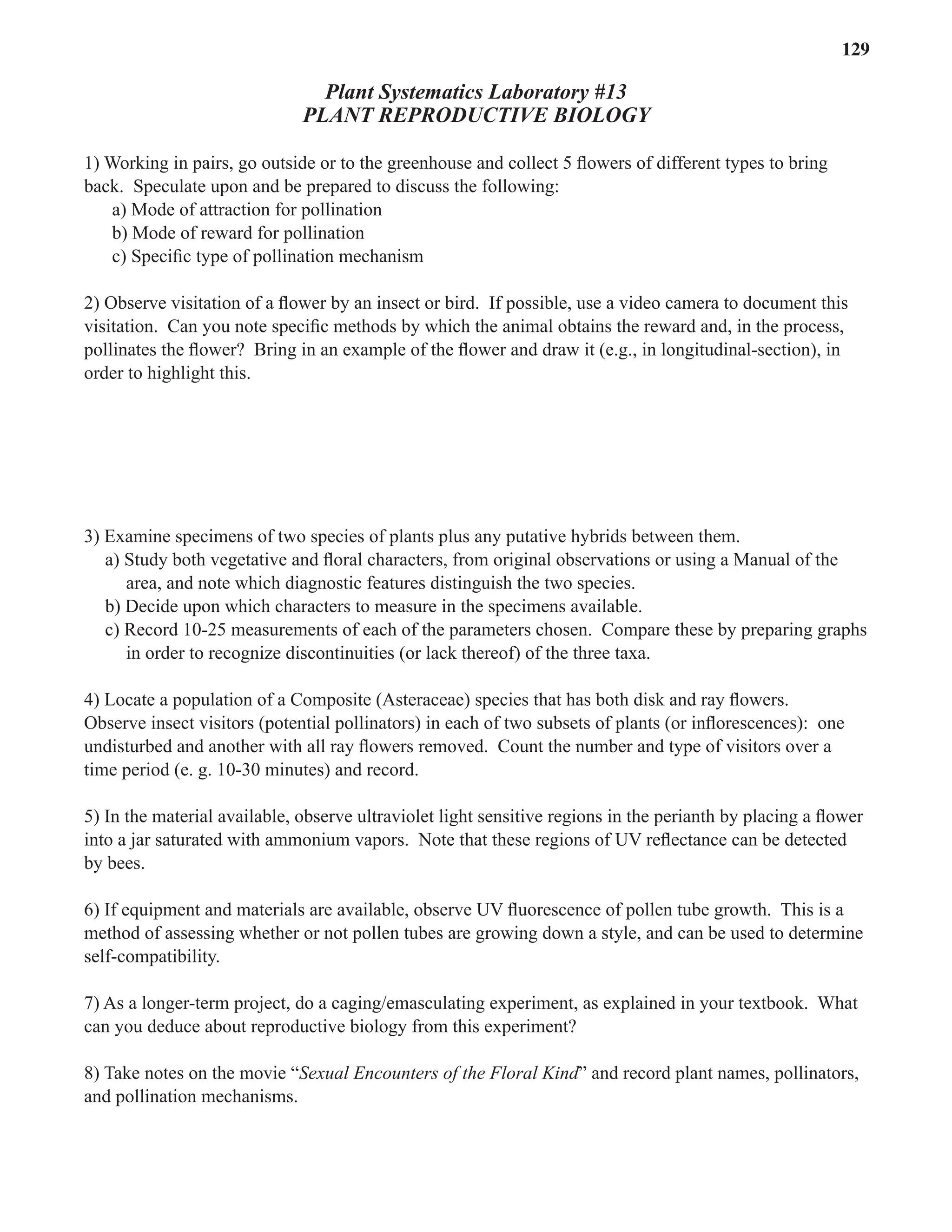
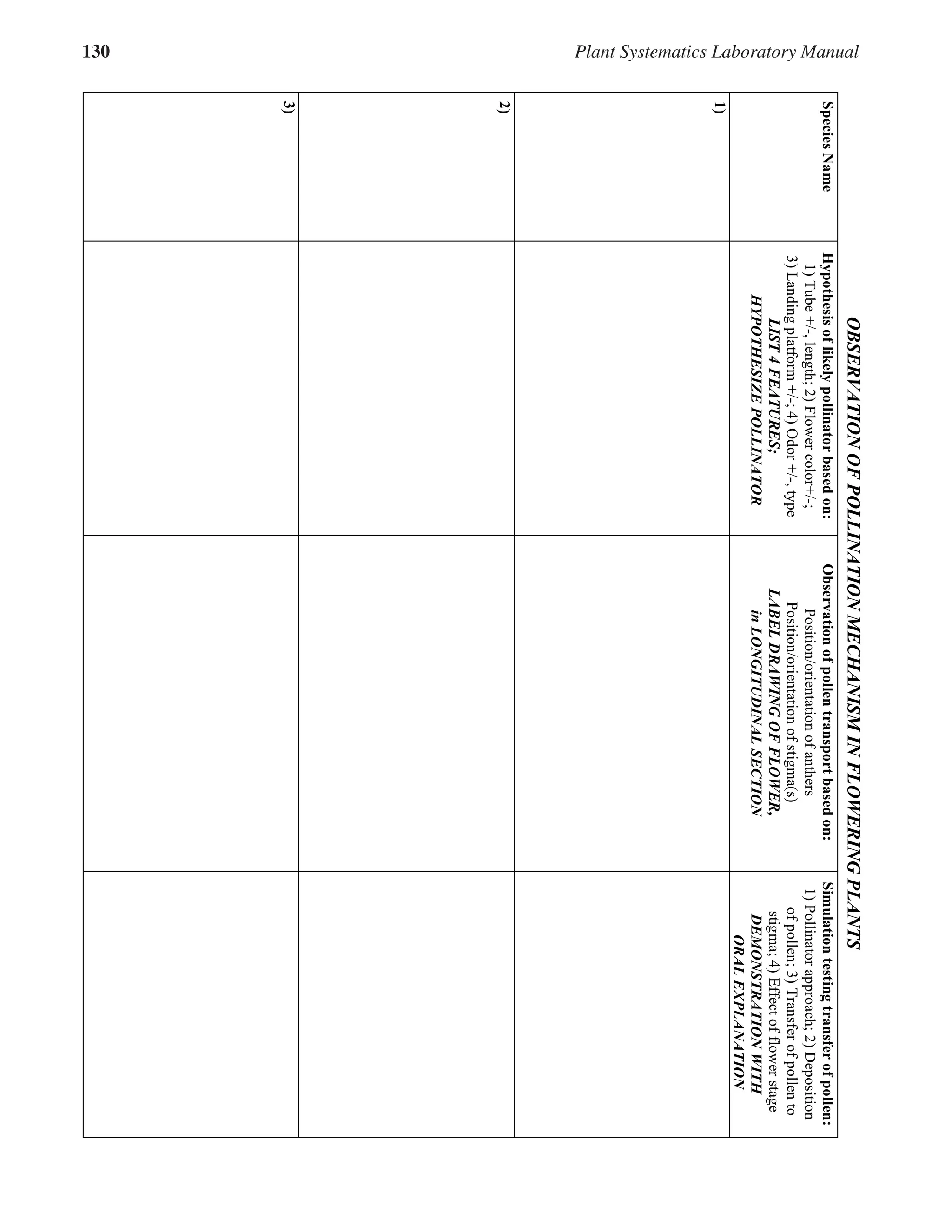
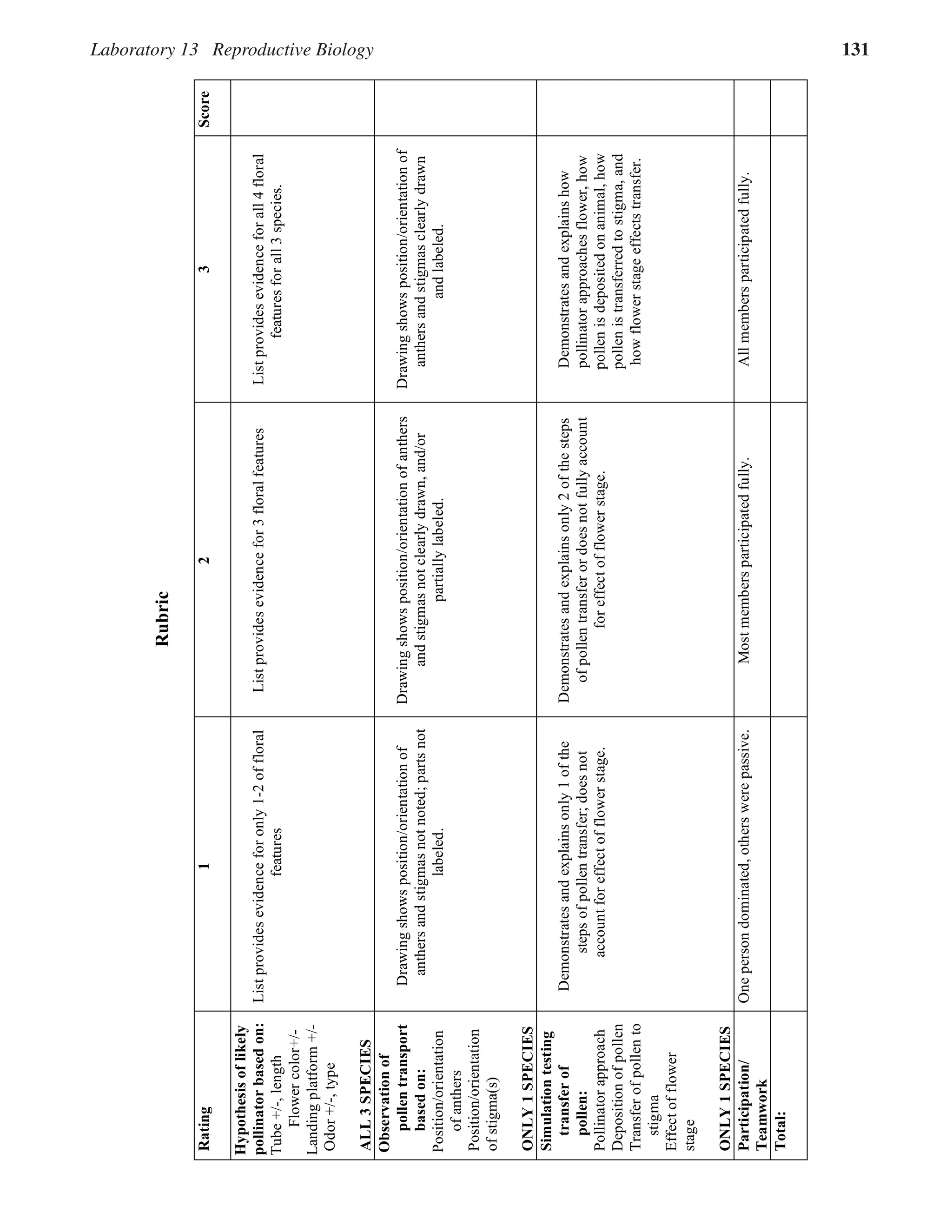

![Laboratory 14 Plant Molecular Systematics 133
Plant Systematics Laboratory #14
PLANT MOLECULAR SYSTEMATICS
1) GENBANK
Log onto GenBank <http://www.ncbi.nih.gov/Genbank> and perform a search on a species or genus for
registered molecular data. For example, under “Entrez”, search for the family name Haemodoraceae. Click the
Nucleotide: sequence database (GenBank) link. (You should see about 50 entries; if not, repeat the search.)
Scroll down all pages and list all types of genes for which sequences are cited. Is each of these a nuclear or
chloroplast gene?
2) MACCLADE
Download an example molecular data set from the course web page <http://www.sci.sdsu.edu/plants/
plsys530> and download the “MacClade Molecular Data Set” by holding down the Option key then clicking the
link. Open MacClade (from the “dock” in Mac OSX) then open this file.
Observe the data matrix [from Windows menu, select Data Editor (or type Command E)] and view cells in
color [from Display menu, select Data Matrix Styles, then Plain Molecular]. Scroll through the data matrix and
note the characters and character states. What do these correspond to? Also note the missing data, indicated by a
hash mark. Are there any large blocks of missing data? What might these correspond to?
Go to tree mode [from Windows menu, select Tree Window (or type Command T)]. Make sure the tool
box shows an arrow tool, then drag the lineage terminating in Kalenchoe to the base of the tree to serve as the
outgroup. From the toolbox select the Search Above tool (the first one) and click this icon at the base of the tree.
After a time, the shortest tree will be calculated. Ladderize the tree by selecting the Rotate to Lean Right tool
(row 2, column 3 of the toolbox) and click this icon at the base of the tree.
Note the monophyletic groups shown. Is your tree similar to others in the class? Is the genus Dudleya
(indicated by “D
(indicated by “D
(indicated by “ .”) monophyletic? What about the genus Sedum? Re-draw the tree (back).](https://image.slidesharecdn.com/plsyslab-250719064702-ff141168/75/Plant-Systematics-laboratory-manual-techniques-137-2048.jpg)
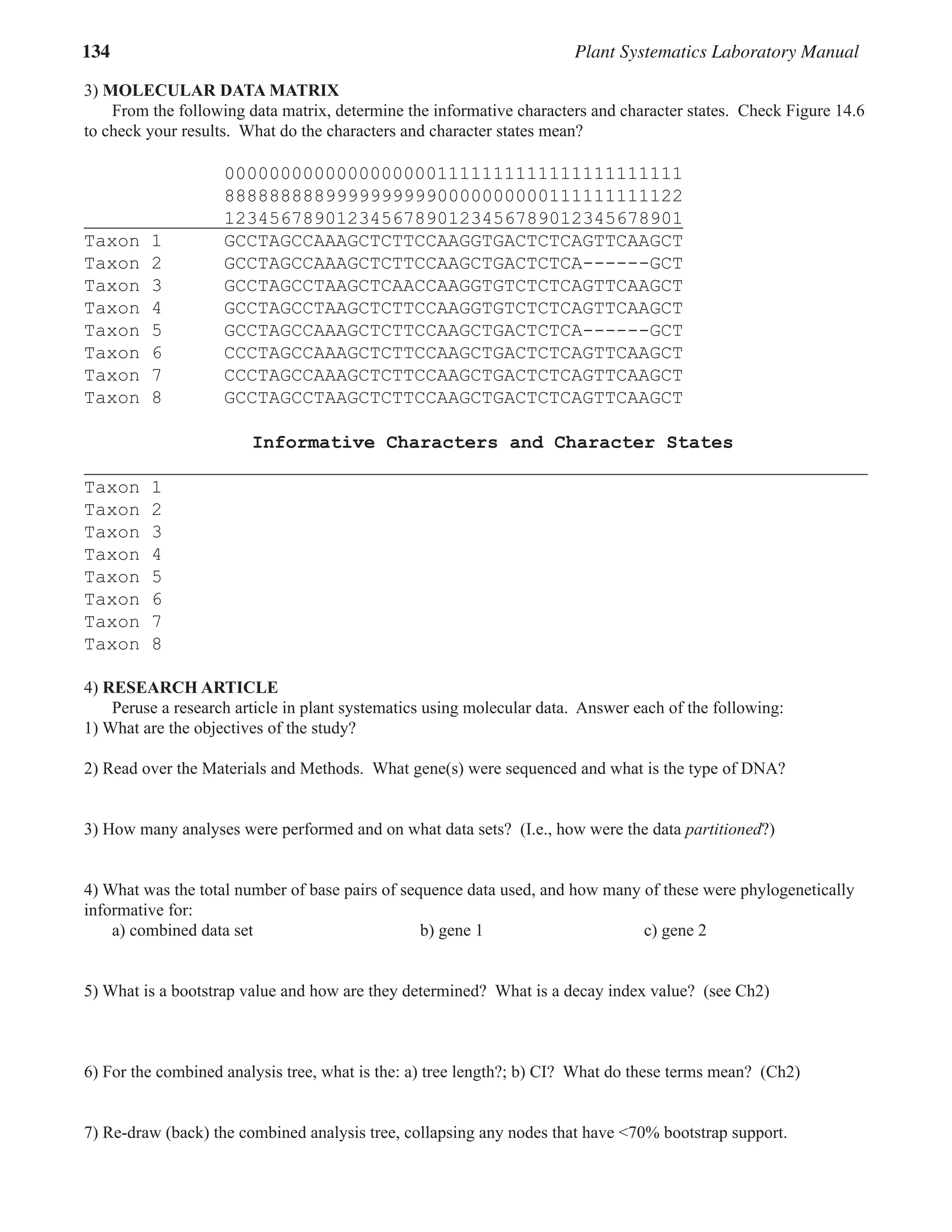
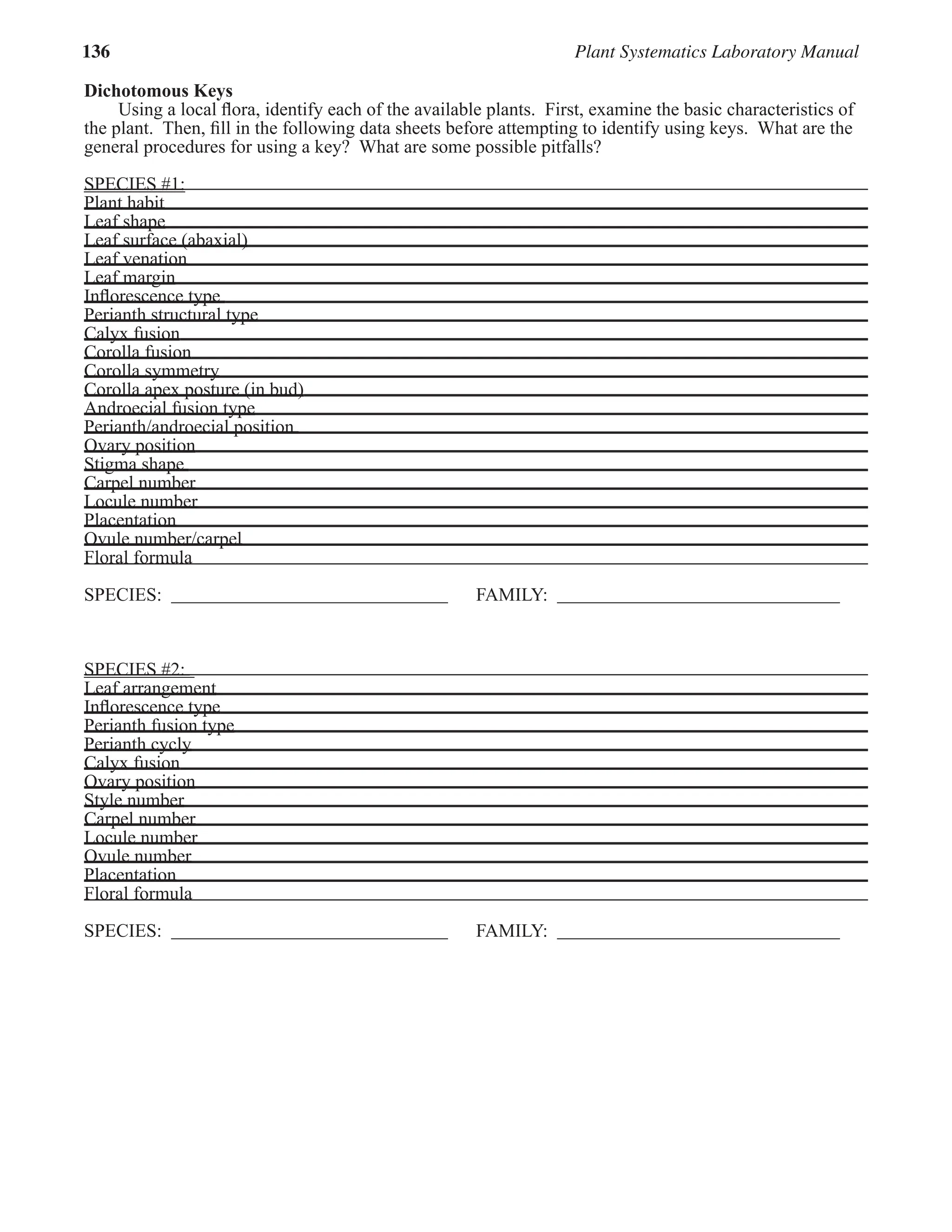
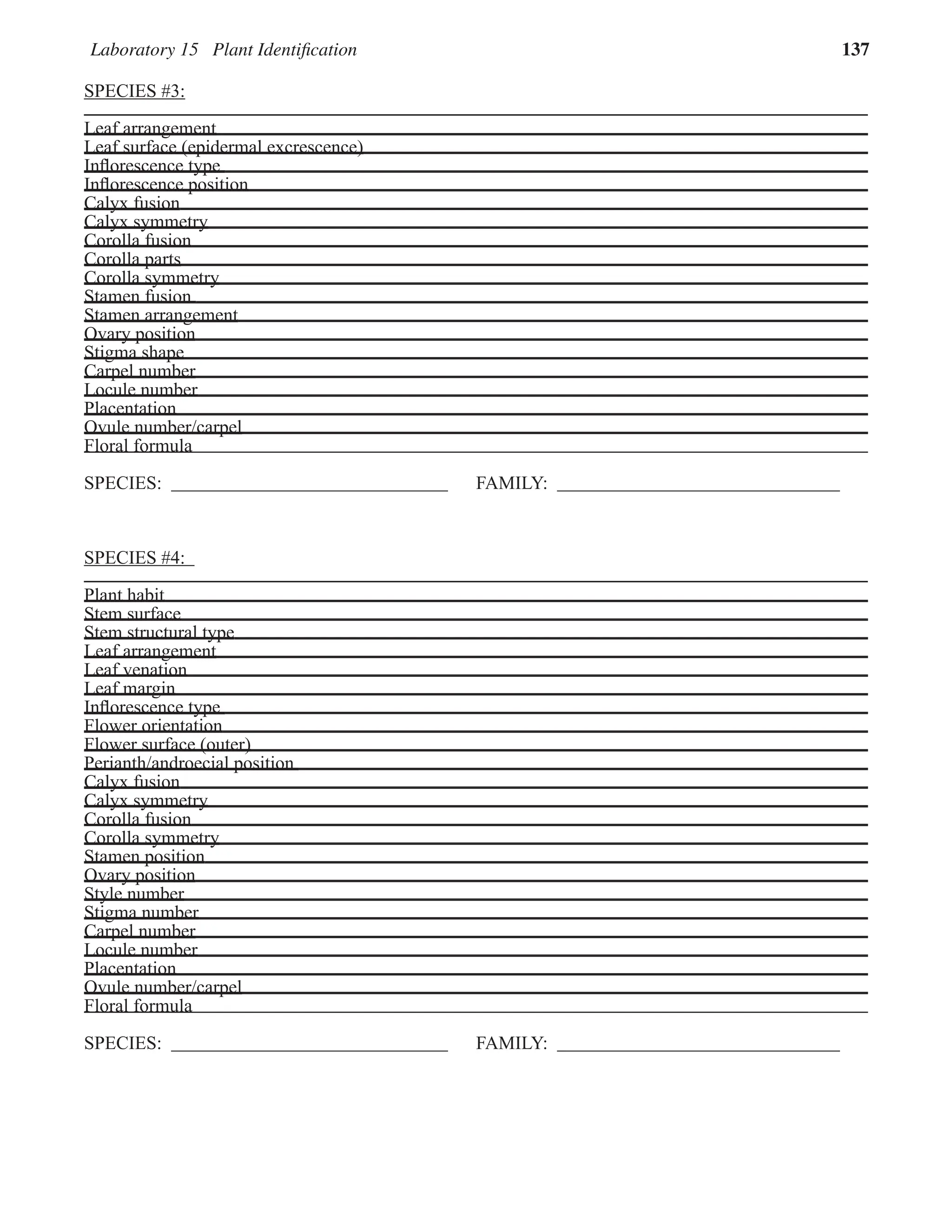
![138 Plant Systematics Laboratory Manual
POLYCLAVE KEYS
Using all or some the same plants as above, utilize a polyclave (multiple-entry) key, either using
a computer program or (preferably) Web site. [See your instructor for Web addresses.] Write down the
characters and the results you obtain below.
What are the advantages of a multiple-entry key? Are there any disadvantages?](https://image.slidesharecdn.com/plsyslab-250719064702-ff141168/75/Plant-Systematics-laboratory-manual-techniques-142-2048.jpg)
![Laboratory 16 Plant Nomenclature 139
Laboratory #16
Plant Nomenclature
Nomenclature Questions
1) Based on taxonomic judgement, a taxonomist decides to split the 60 species of the genus Conostylis into two
genera, the new one to be called Blancoa. To which genus does each group of species belong?
2) A taxonomist decides to unite three genera: Audibertia B. Bentham (1876), Ramona E. Greene (1892), and
Salvia L. (1753). What is the new genus to be called and why?
3) Medicago polymorpha L. var. orbicularis L. was raised to the rank of species by Bartal. (an abbreviation for
Biagio Bartalini).
a) What must the new name be called (including author citation; use the abbreviated name)?
b) Does Bartal. have to retain the name orbicularis by the rules of the ICBN?
c) What is the term we use for the original name, Medicago polymorpha L. var. orbicularis L.? [Note that
this can be answered two ways, to be complete.]
4) Suppose, from above, that another species named Medicago orbicularis Smith had already existed.
a) Is the name proposed above (3a) legitimate? Why or why not?
b) What would the name proposed above (3a) by Bartal. be termed?
c) What must Bartal. (or someone else) do now?
5) Eriogonum polifolium Benth. is changed in rank to a subspecies of E. fasciculatum Benth. by Torrey & A.
Gray. What is the new name?
6) I. M. Johnston decides to treat Cryptantha jonesii A. Gray as a variety of Cryptantha muricata (Hooker &
Arnold) Nelson & J. F. Macbride. Give the full names of the two resulting varieties, including full authorship.
7) What does the “&” mean in Marsilea vestita Hook. & Grev.?
8) What does “ex” mean in Havetia flexilis Spruce ex Plach. & Triana?
9) What does “in” mean in Rhus laurina Nutt. in Torr. & A. Gray?
10) Abbreviate Malosma laurina (Nutt. in Torrey & A. Gray) Nutt. ex Abrams.](https://image.slidesharecdn.com/plsyslab-250719064702-ff141168/75/Plant-Systematics-laboratory-manual-techniques-143-2048.jpg)
![140 Plant Systematics Laboratory Manual
NOMENCLATURE EXERCISES
Author abbreviations
List the full names and years of birth and death for the following author abbreviations, using the International
Plant Names Index <http://www.ipni.org>.
A. Gray L.
Benth. Nutt.
DC. Torrey
Nomenclatural Changes
Search the name Hosackia strigosa on the International Plant Names Index <http://www.ipni.org>.
1) Who is author (abbrev. & full name) and what is the publication (incl. year) from which this name is derived?
2) Do a search for Lotus strigosus and also list the full authorship and publication, incl. the year.
3) Finally, search for Acmispon strigosus and again list the full authorship and publication, incl. the year. What
can you deduce from this information?
Synonyms
Search for Cryptantha intermedia on The Plant List <http://www.theplantlist.org> and record the number of
synonyms. List one homotypic and one heterotypic, noting authorship and publications.
Type Specimens
Do a search for the California Academy of Sciences and find the botanical collection. Do a search for Cryptantha
mohavensis. [Note: search for the type collection first; if necessary search in the general collection.]
1) Who originally collected this specimen, where, and when?
2) Observe the specimen image close-up. What was the original (basionym) name for this species, including
authorship and publication (incl. year)?
3) Find the publication for the basionym on-line. Use the Biodiversity Heritage Library. What does this
publication state?
4) What is the publication/year of the current name for this species, Cryptantha mohavensis? Write down the full
authorship of this name. [Be sure to think about correctly citing the authorship.]
Valid Publication](https://image.slidesharecdn.com/plsyslab-250719064702-ff141168/75/Plant-Systematics-laboratory-manual-techniques-144-2048.jpg)
![Laboratory 16 Plant Nomenclature 141
Do a Google Scholar search for “Novon a new species-Pandanus.” [Novon is the name of a journal.] Find a new
species publication of this genus Pandanus in this journal. List/note the following:
1) Full species name, including authorship
2) Designation of rank
3) Designation of type (collector(s) and collection number)
4) Location of holotype and isotypes
5) Latin diagnosis
6) Description
7) Illustrations/photographs
International Code of Nomenclature for Algae, Fungi, and Plants
Peruse the ICN <http://www.iapt-taxon.org/nomen/main.php>. List/note the following:
1) DIVISION 1. PRINCIPLES
2) SECTION 3. Priority, Article 11
3) CHAPTER V. Valid publication of names, Article 32](https://image.slidesharecdn.com/plsyslab-250719064702-ff141168/75/Plant-Systematics-laboratory-manual-techniques-145-2048.jpg)

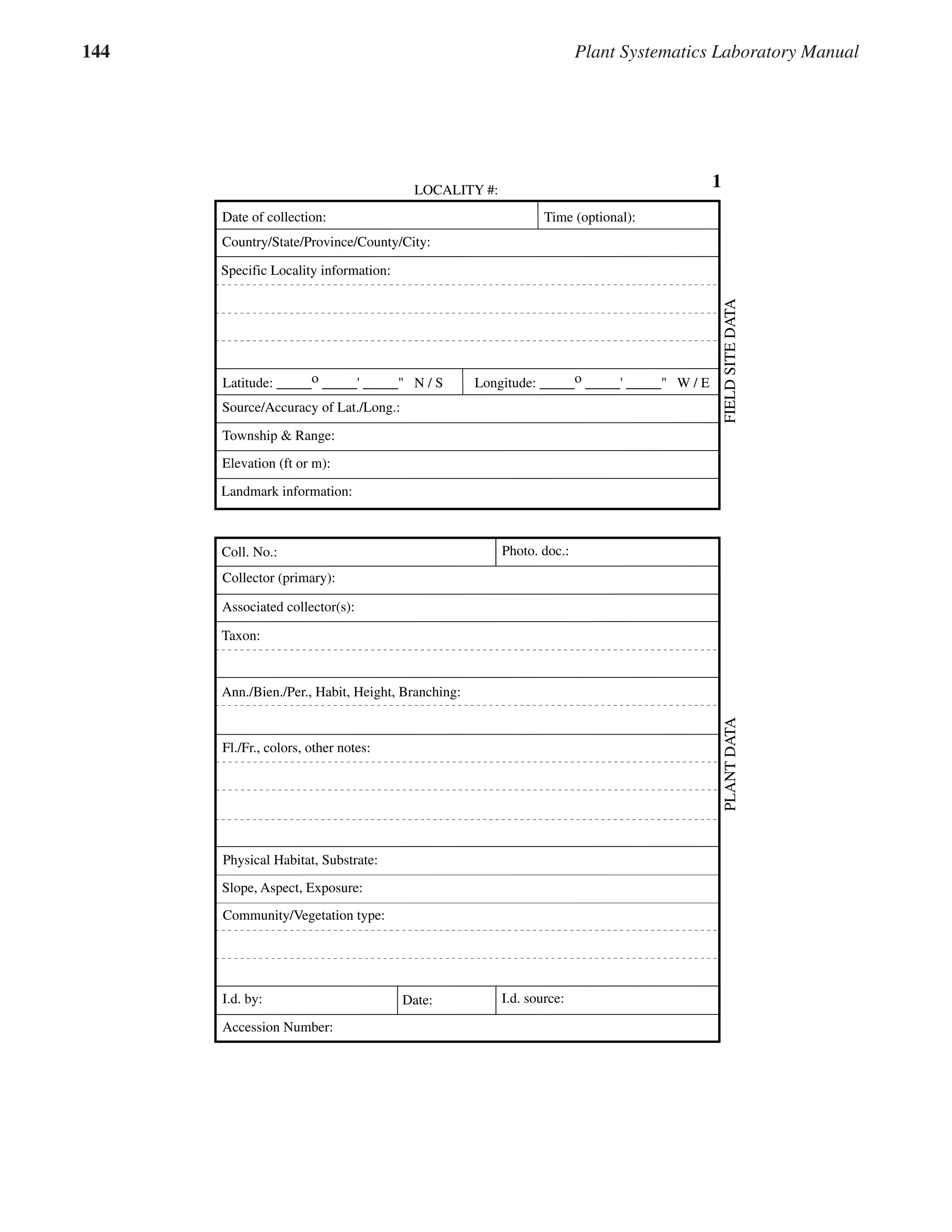
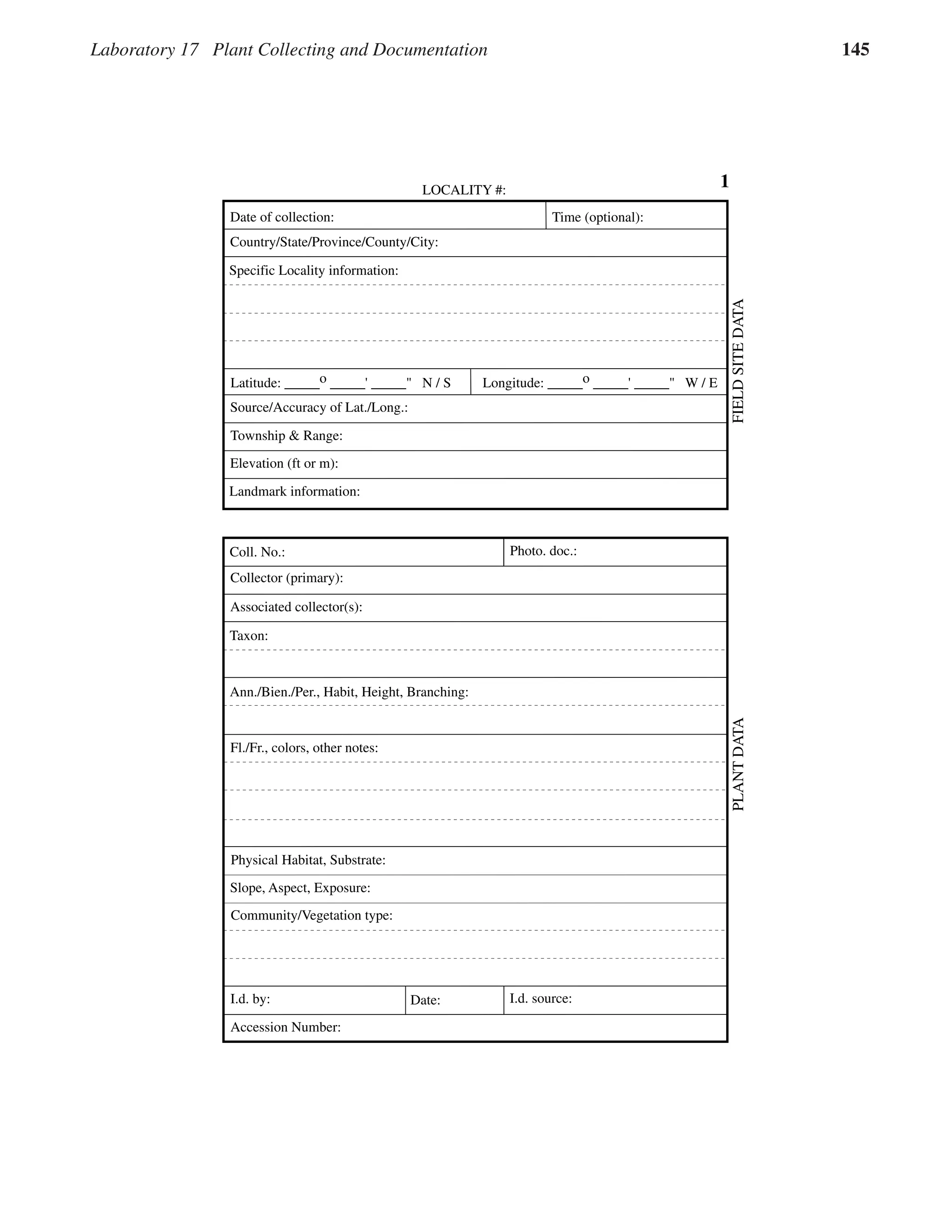
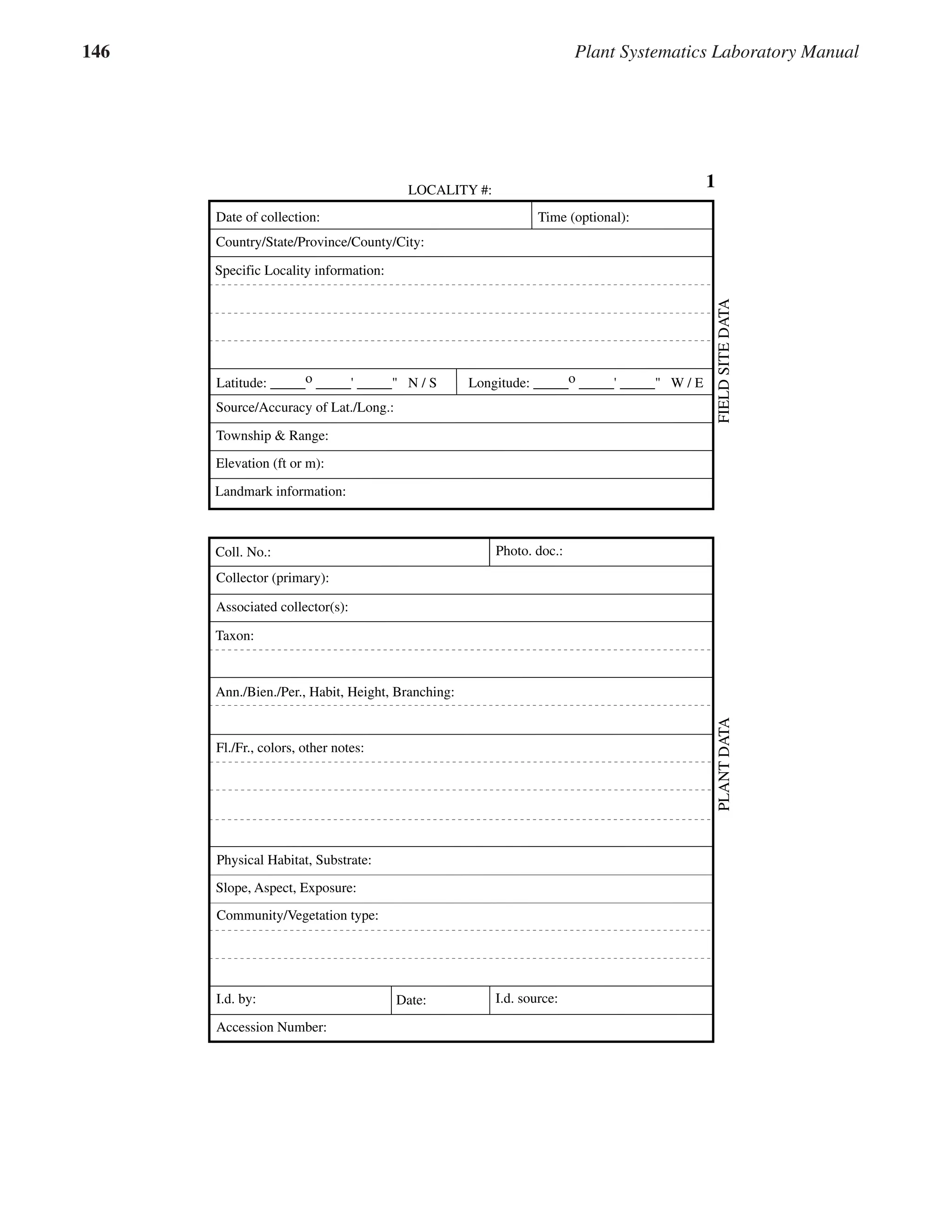
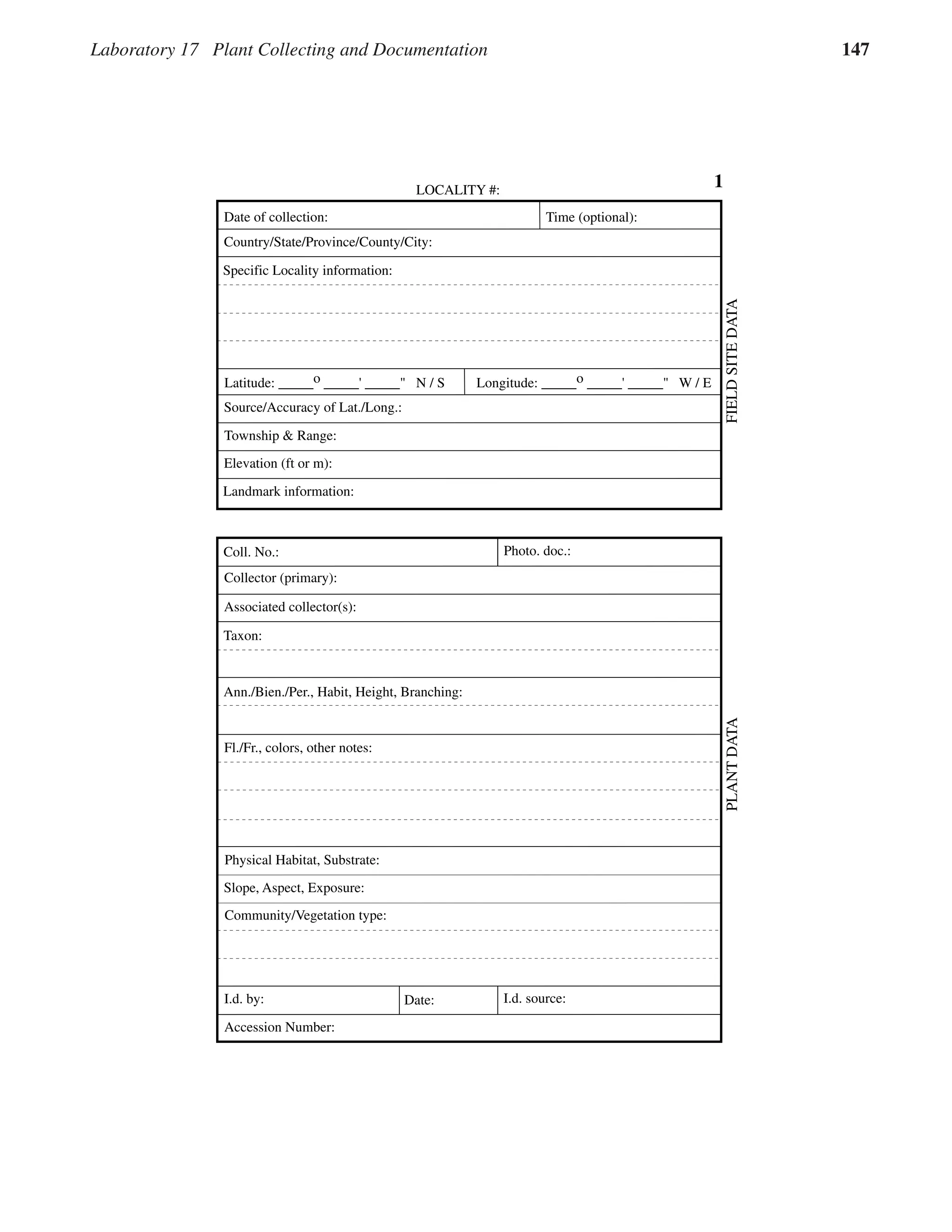
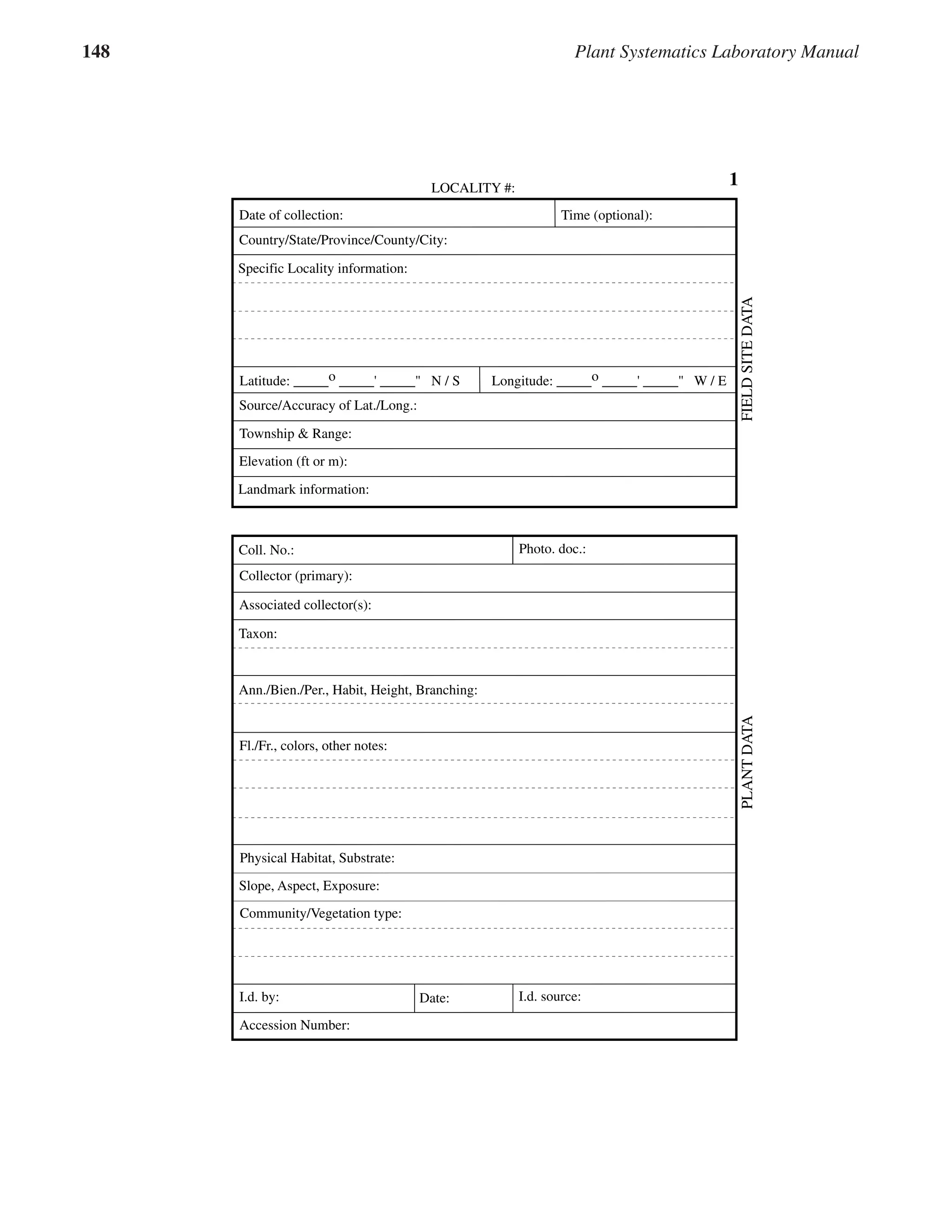
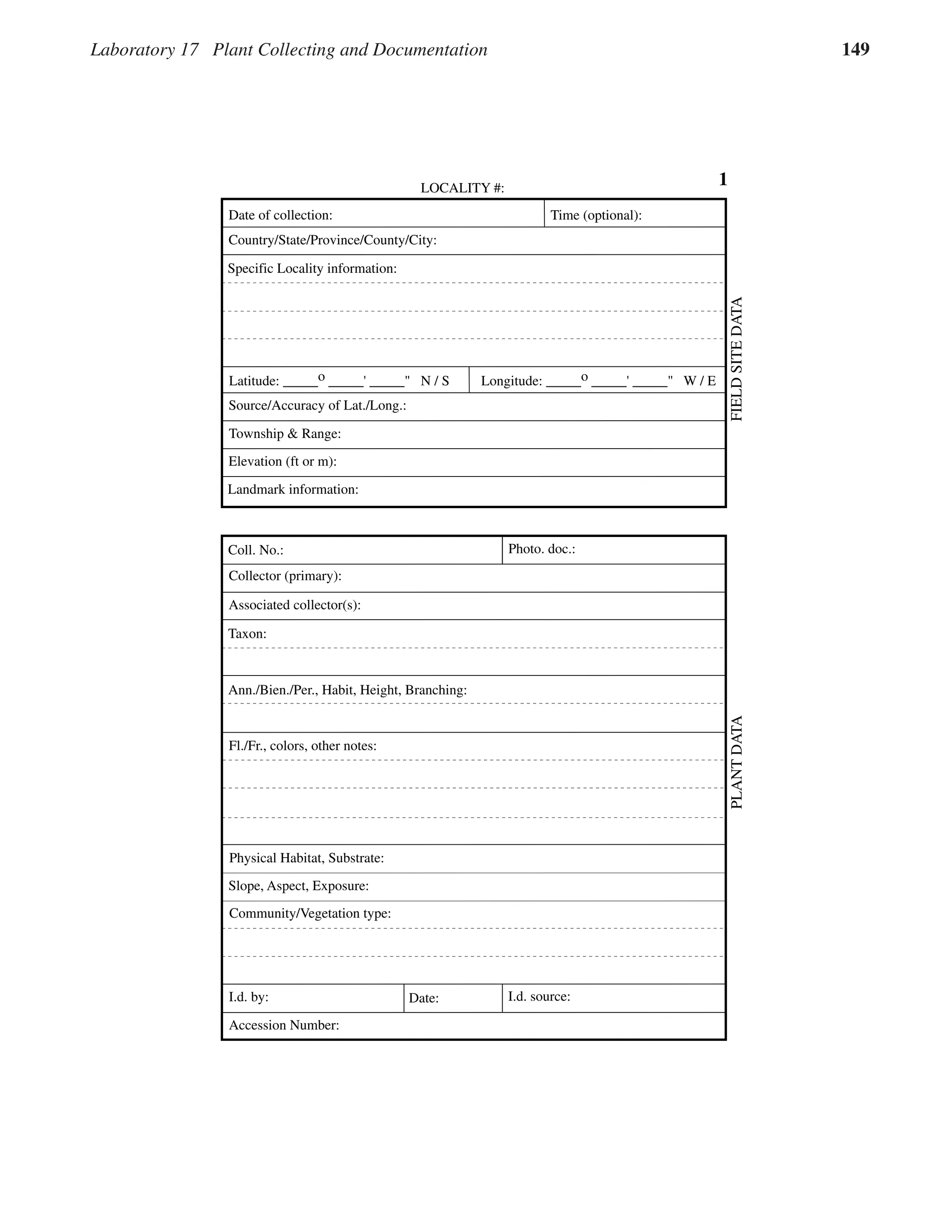
![150 Plant Systematics Laboratory Manual
How to use topographic maps
Topographic maps show topographic features of the landscape by means of isoclines, lines
representing a single elevation above sea level. Isoclines show changes in elevation and help to
visualize three dimensional features such as slopes, flats, canyons, cliffs, and peaks.
The difference in elevation between topographic isoclines is dependent on the scale of the map.
A standard USGS (United States Geological Survey) 7.5 minute quad (quadrangle) topographic map has
major (thicker-lined) isoclines separated by 100 feet and minor (thinner-lined) isoclines separated by 20
feet; thus, there are 4 minor isoclines between every two major ones (on a continuously increasing or
decreasing slope).
Topographic maps also show things like trails, roads (dirt roads, paved streets, and highways),
major power lines, buildings or other structures, rivers and other waterways, and general vegetation
(e.g., woodland areas). Various coordinates are also indicated. Most commonly, and universally, used
are standard longitude and latitude coordinates .
Longitude and latitude are based on imaginary circles drawn on the earth. Each of these
circles is divided into 360˚ (“ ˚ “ = degrees). Each degree may be divided into 60 units termed
minutes (represented by the ‘ symbol), and each minute divided into 60 smaller units termed seconds
(represented by the “ symbol). Thus, there are 60 minutes in a degree and 60 x 60 = 3,600 seconds in
a degree. [At the equator, each degree represents approximately 67 miles in length, each minute a little
over 1 mile, and each second approximately 100 feet.] Degrees can be the sole representation of latitude
and longitude. For example, 32˚ 16’ 58” converts to 32 + (16 / 60) + (58 / 3600) = 32.2669... degrees.
Lines of longitude are circles that pass through the true north and south poles. Longitude
itself is measured from a single line of longitude that passes through Greenwich, England, which by
convention represents 0˚ (zero degrees) longitude. Coordinates of longitude are measured east or west
of this reference (termed the Greenwich Meridian or Prime Meridian) to a the other side of that same
circle half-way around the world, which represents 180˚. Thus, when longitude is measured, it must be
stated as either East or West of the prime meridian. For example, the longitude of a region in San Diego,
California is 117˚ 07’ 32” W (stated as: 177 degrees, 7 seconds, 32 minutes west); a longitude in Cape
Town, South Africa is 18˚ 24’ 48” E (stated as 18 degrees, 24 minutes, 48 seconds east). [Instead of
stating “east” versus “west,” coordinates of longitudes may be distinguished as positive versus negative
numbers, respectively. This is used, e.g., in computerized mapping programs.]
Lines of latitude include the equator itself plus circles that are parallel to the equator and between
the equator and the poles. Thus, only the equator itself represents a circle whose plane passes through
the earth’s center. As lines of latitude get progressively closer to the poles, the circles get smaller and
smaller. Coordinates of latitude are measured from the equator, which represents 0˚ latitude, to either
the north or south pole, each representing 90˚ latitude. Thus, latitude must be stated as either North or
South of the equator. For example, the latitude of a region in San Diego, California is 32˚ 45’ 03” N
(stated as: 32 degrees, 45 seconds, 3 minutes north); a latitude in Cape Town, South Africa is 33˚ 59’ 30”
S (stated as 33 degrees, 59 minutes, 30 seconds south). [Coordinates of latitude, like those of longitude,
may also be represented as positive versus negative numbers, latitude north being positive and latitude
south being negative.]](https://image.slidesharecdn.com/plsyslab-250719064702-ff141168/75/Plant-Systematics-laboratory-manual-techniques-154-2048.jpg)
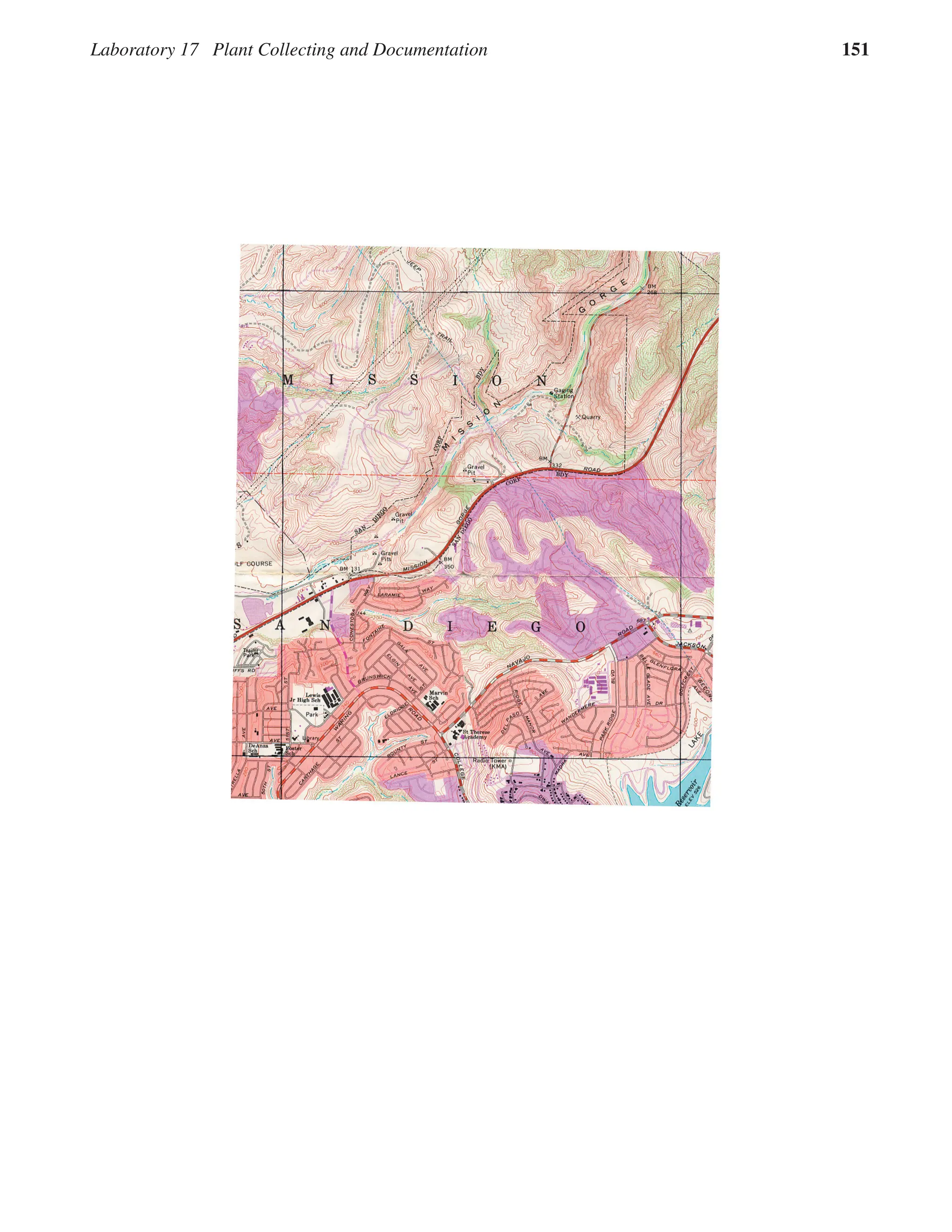
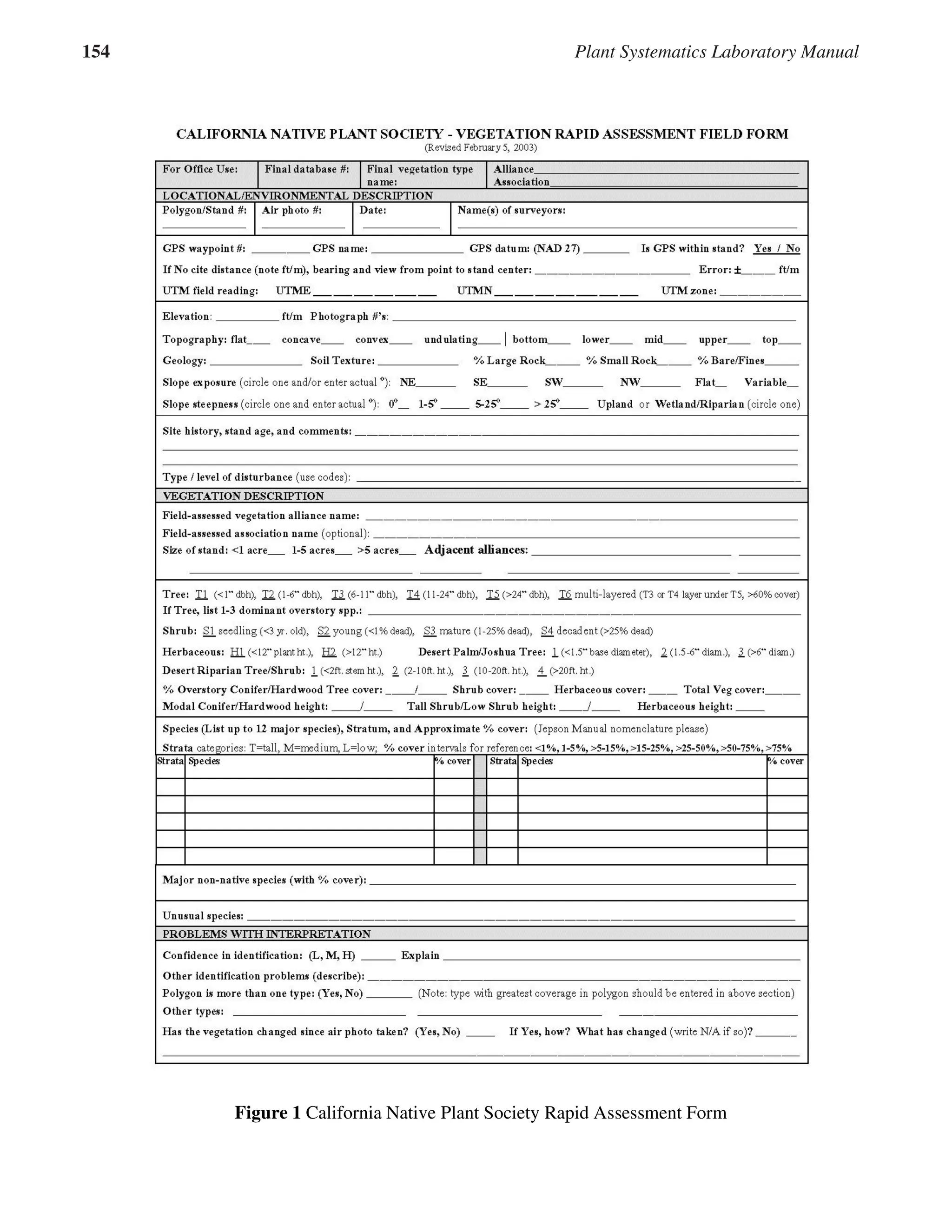
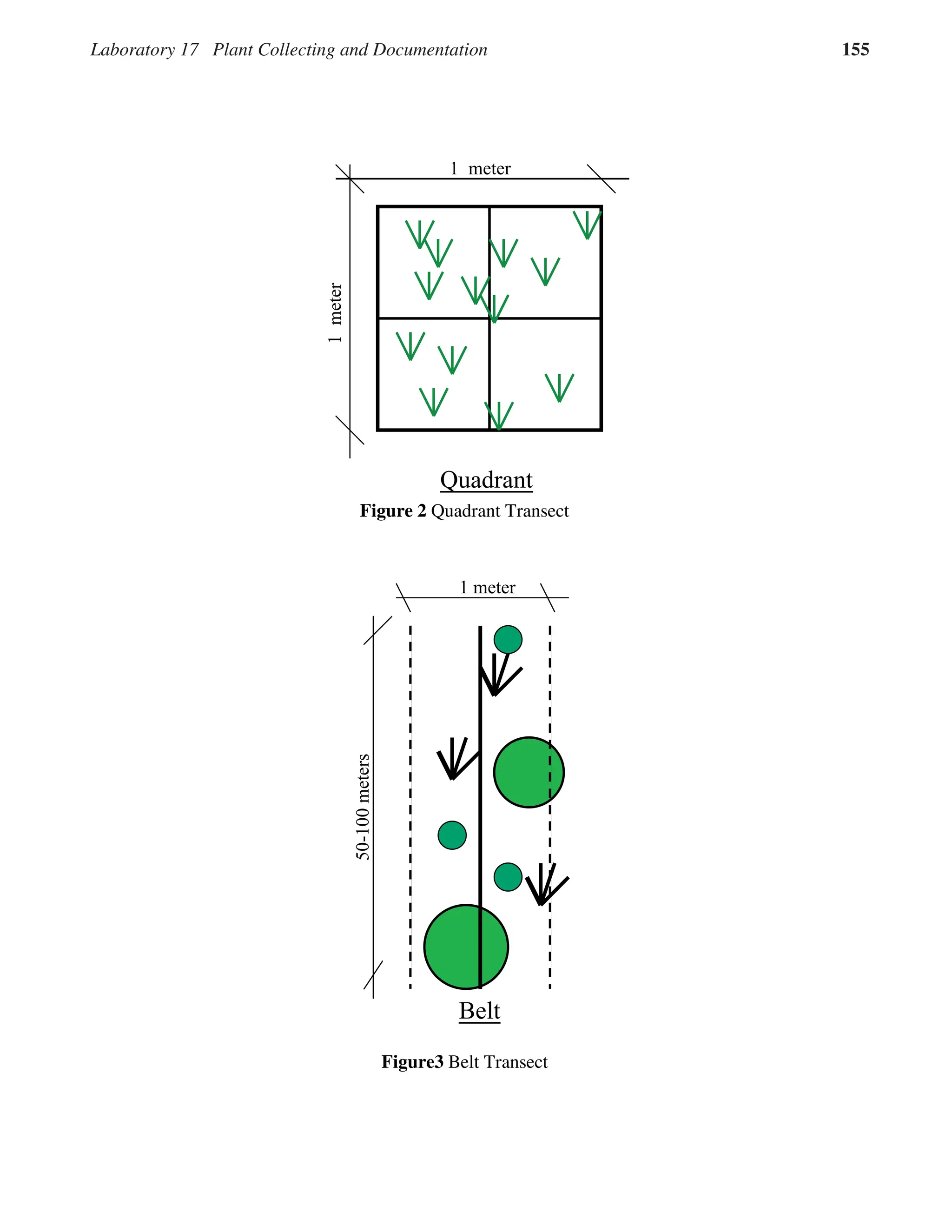
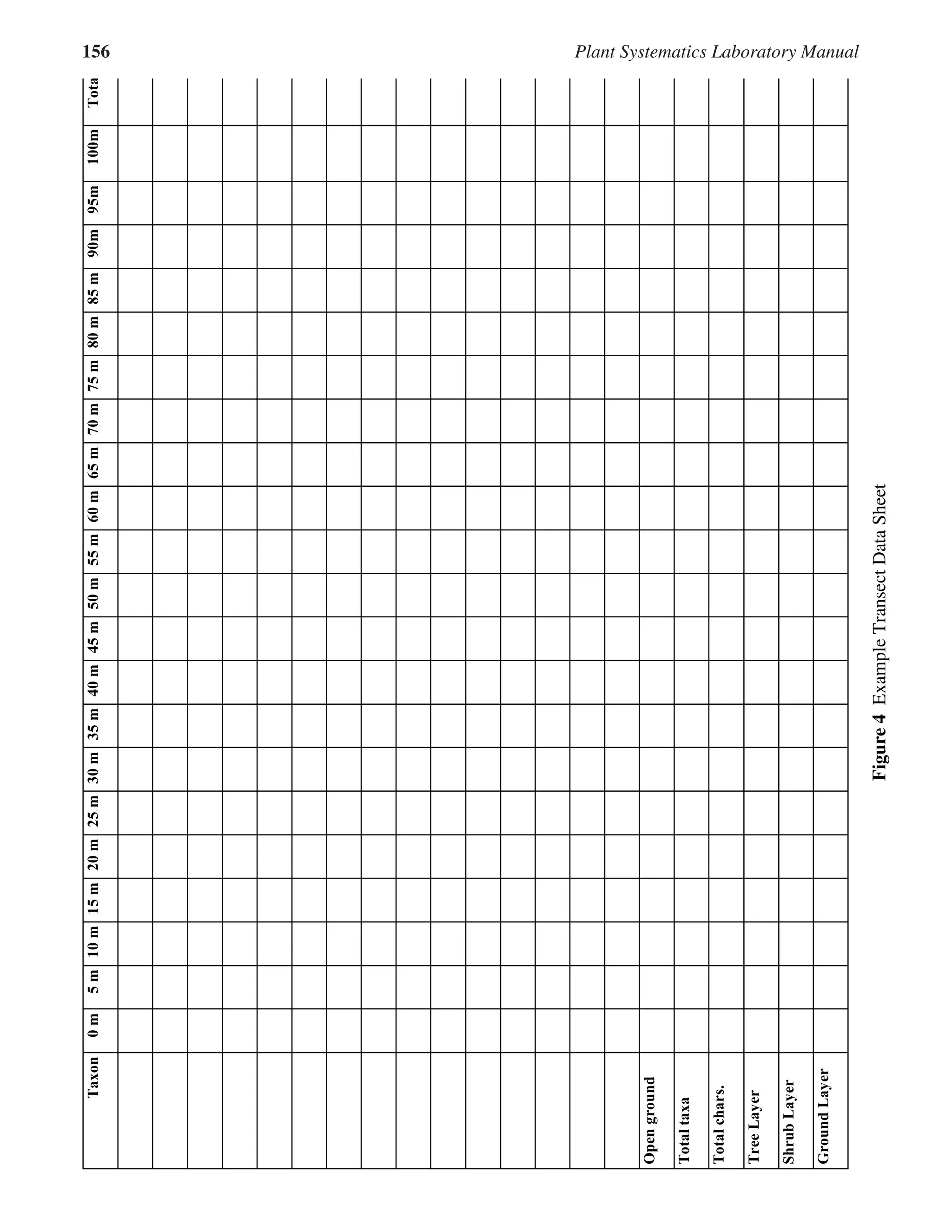
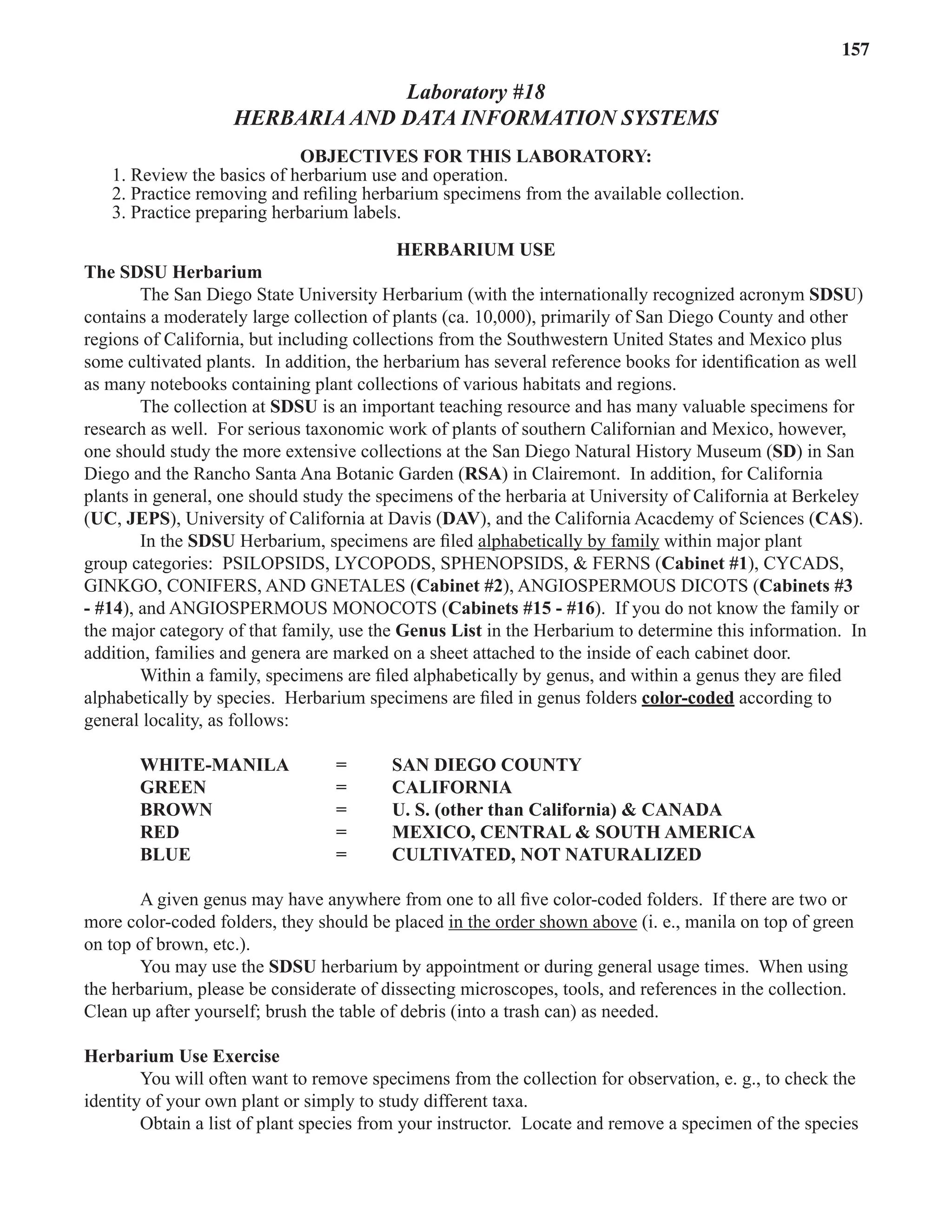
![Laboratory 18 Herbaria and Data Information Systems 159
HERBARIUM LABEL PREPARATION
Making an Herbarium Label Using FileMaker Pro Database program (Mac version)
[Note: The “Command” key is the one just to the left of the spacebar with an apple/4-leaf clover icon.]
I. Getting Started:
1. Log onto http://herbdata.sdsu.edu and click one of the files. (Only 5 files can be open at any one
time; if none work, try again later.) The username is “Admin”. Leave password blank.
2. Records should already be entered that you can access, and the file should appear in Browse mode.
If not, see 3-7. Otherwise, go the II. Entering Data (below).
3. Before beginning, from the Record menu, select New Record (or type Command-N).
4. To begin entering data, select the Browse mode from the Mode menu.
[FileMaker Pro has four four “Modes:” Browse, Find, Layout and Preview. The mode that loads
automatically is the one last used for the document. You will generally be using only two modes:
Browse and Preview. To change modes, click onto the Mode menu and you will see that directly
below it is the listing for the four modes. Pull down to one of these to change the current mode.
(The mode you are currently in will have a check next to it.)]
5. Available layouts are listed by clicking on the rectangle at the upper left of the open data window.
Available layouts that we’ve created are: Data Entry, Labels, Checklist, etc. Click on the
rectangle and select Data Entry. (The one currently engaged is checked in the menu; as with the
modes, the layout that is loaded is that used last.)
6. In Data Entry layout, you will see a list of fields, e.g, SDSU, Specimen Location, Collector:
Lastname, Collector: Firstname, etc. If records have already been entered you will see the
entries. At the upper left of the window, you will see an image that looks like a three-ring
notebook. Clicking on the pages takes you forward or backward through all the records entered.
Pulling that “tab” at the right of the 3-ring notebook takes you quickly through the records.
7. If the Data Entry Layout window is blank, you may begin entering data. If not, create a new
record for your data (if one is not already visible) by selecting New Record from the Mode menu.
II. Entering Data:
NOTE: whenever entering data, do not add a blank space at the end of the data entry. E.g,
type “Smith” not “Smith “.
NOTE: leave the SDSU and Specimen Location fields blank. These are for filing purposes in the
SDSU herbarium.
Note: you may use the tab key to go from one field to another.
1. Click to the right of the field heading, Collector: Lastname. Boxes will appear next to each field
heading. This is where you type the information. (If you have collected the data properly in a field
notebook, the fields will correspond to all or part of the field collection data.) In the Collector:
Lastname box, type the last name of the prmary person who collected the plant. [Remeber:
no blank space after this name.] Then move to the next field by either hitting the tab key or by
clicking on to the next field “box”.
2. Collector: Firstname field, type the full first name and middle initial of the primary collector.
3. Teamcoll field, type the name of the person or persons who helped collect the plant, if there
were any. Type first name (or initial) first. Example: “John J. Jones” or “S. E. Gergus & D.
H. Lawrence.” [Don’t make it too long, however.] Often, it’s best to put my name - Michael G.
Simpson - here, as I have a general collecting permit.](https://image.slidesharecdn.com/plsyslab-250719064702-ff141168/75/Plant-Systematics-laboratory-manual-techniques-163-2048.jpg)
![160 Plant Systematics Laboratory Manual
4. Collection Date field, type the date that the collection was made. Type numerically (not as
text), with slashed (“/”) separating numbers, as month/day/year. You need not put zeros in front
need not put zeros in front
need not
of the month or day; type the year as four digits. Example: type 3/13/2003 for March 13, 2003.
5. Collection Number field, type the collection number that you assigned the specimen. Example:
3 or 28 or 138. Do not put any zero’s before the number. [Note: If your collection number has
prefixes or suffixes, e.g., 13III2000A, type these in the Col. Number Prefix and Col. Number
Suffix fields. E.g., type 13III in Col. Number Prefix, 2000 in Collection Number, and A in
Col. Number Suffix
NOTE: Pop-up menus will appear for many of the entries cited below. If you don’t wish to use these
pop-up entries, then click the field box again and begin typing. Be sure to confirm each of these
entries. It is possible that some recent nomenclatural changes may not be listed in these menus.
6. Country, State/Province, and County boxes type the appropriate information. For country, type
“U.S.A.” For state, type “California.” For county, follow the county name with “Co.”; e.g., “San
Diego Co.”
7. Family field, type the family name of your specimen. Be sure to correctly spell it!
8. Genus field, type the genus name of your specimen. Do not italicize or underline this name, it will
Do not italicize or underline this name, it will
Do not
be done automatically for you when you print the label.
9. Specific Epithet field, type the specific epithet. As with the genus name, do not italicize or
do not italicize or
do not
underline.
10. Spec. Authorship field, type the complete
complete author of the species name, abbreviating where
appropriate. Example: (L.) Nutt. for (Linnaeus) Nuttall. [Remember: if part of an authorship
has parentheses, it will be followed by one or more authors not in parentheses.]
NOTE: If and only if your specimen is a variety or subspecies, type fields 11-13; otherwise go straight
to 14 and do not collect $200.
11 Infra. Type field, type either var. or ssp. (for variety or subspecies, respectively.
12. Infraspecific Name field, type the subspecific or varietal epithet name. As with the genus and
specific epithet fields, you do not italicize or underline.
13. In the Infra Authorship box type the author of the infraspecific (ssp. or var.) name.
author of the infraspecific (ssp. or var.) name.
author
14. Latitude: Degrees, Minutes, Seconds and the Longitude: Degrees, Minutes, Seconds fields,
type the coordinates if you know them. Do not put the symbol for degrees, minutes or seconds,
Do not put the symbol for degrees, minutes or seconds,
Do not
just the numbers. These symbols will be added when you print the label. Do not use decimal
points for any of these! For seconds, round off to the nearest second.
15. Lat Long Source Accur. field, type the source and accuracy of the latitude/longitude coordinates.
Examples: USGS 7.5’ La Mesa quad, ±1” accuracy; GPS unit, ±1” accuracy. [Note: to get the
“±” symbol, hold down both the option and shift key and type “=”.]
16. Elevation in feet field, type the elevation in feet at which the specimen was collected. Only type
the number, do not put “ft.” or “feet” after the number. As soon as you select on the Elevation in
meters box you will see a number. It has already been calculated for you.
17. Identity Determined By field, put the name of the person who identified the specimen, even if it is
the same as the collector.](https://image.slidesharecdn.com/plsyslab-250719064702-ff141168/75/Plant-Systematics-laboratory-manual-techniques-164-2048.jpg)
![Laboratory 18 Herbaria and Data Information Systems 161
18. Det_Date field, put the date that the specimen was identified, even if it is the same as the collection
date. Use the same format that is explained for the collection date box.
19. Det_Source & Type field, put the reference that was used to identify the specimen. (Ignore and
leave blank the Print Date box at the end.)
20. Plant Description field, type the data describing some of the important features of the plant that
may not be readily apparent from an herbarium sheet. Describe (if appropriate) in order the plants
duration, habit, height, branching pattern, phenology, color, or other features that you find
important in identifying the specimen.
21. Habitat Description field, type a few sentences describing the site that the plant was collected
from. Describe (if appropriate) in order the physical habitat, substrate, slope, aspect (direction
of slope), exposure. Follow this by listing the plant community (vegetation) type.
22. Locality field, type a few sentences explaining where you collected the specimen. You should list
any important landmarks that might be useful, distances from known roads, addresses, city, or any
other information that would allow someone to use your locality information to find the site where
you collected the specimen.
Note: When you are ready to enter another record of a plant collected from the same region, often
it is quicker to use this shortcut: First, start another record (Select New Record from Records
menu), then, at every blank cell, press Command “ to duplicate the entry from the previous entered
record.
III. Printing a Label: (Follow these instructions precisely!
Follow these instructions precisely!)
1. To prepare a label, click on the rectangle at the upper left that changes the layout and select
Labels. You will see your data (minus some of the row heading which are not normally put on an
herbarium label) placed in the label format. This is not exactly what your label will look like so
you will want to Preview it before printing.
2. From the Mode menu, select Preview. [If necessary, select Page Setup from the File menu and
orient the page from portrait (vertical) to landscape (horizontal).] You will see the label as it will
appear when it is printed. If more than one record has been placed in the file, you will see all
the labels as they will appear when they are printed. Four labels fit on one page when printed.
Make sure that nothing is in error. [Remember: Herbarium labels should be perfect, with no
misspellings.] If there are errors, go back to the Data Entry layout and to the Browse Mode and
change the information. [If only two, not four, labels appear (and you have more than two), select
Page Setup from the File menu and reduce the label size until four labels appear on the page.]
3. If you are in Preview mode and all appears correct, you are ready to Print (File menu).
PRINT ONLY IF YOU ARE VIEWING THE LABELS IN PREVIEW MODE!!!!
(DO NOT PRINT IN DATA ENTRY OR BROWSE MODES!!!!)
4. To select only certain labels to print, you may do a search for those labels by any category. To
individually select labels to print, do the following:
a. In Data Entry and Browse mode, place today’s (or any other single) date in the Print Date field
at the lower left of the Data Entry Layout. Remember to type the date as, e.g., 3/3/2000.
b. Type this same date (or copy & paste from the first record) to all other records you wish to print.
c. Search for all records having this print date by selecting Find from the Mode menu, typing (or
pasting) the date in the Print Date field, and clicking “Find.” All records with that value will be
selected. You may then print them as before.](https://image.slidesharecdn.com/plsyslab-250719064702-ff141168/75/Plant-Systematics-laboratory-manual-techniques-165-2048.jpg)
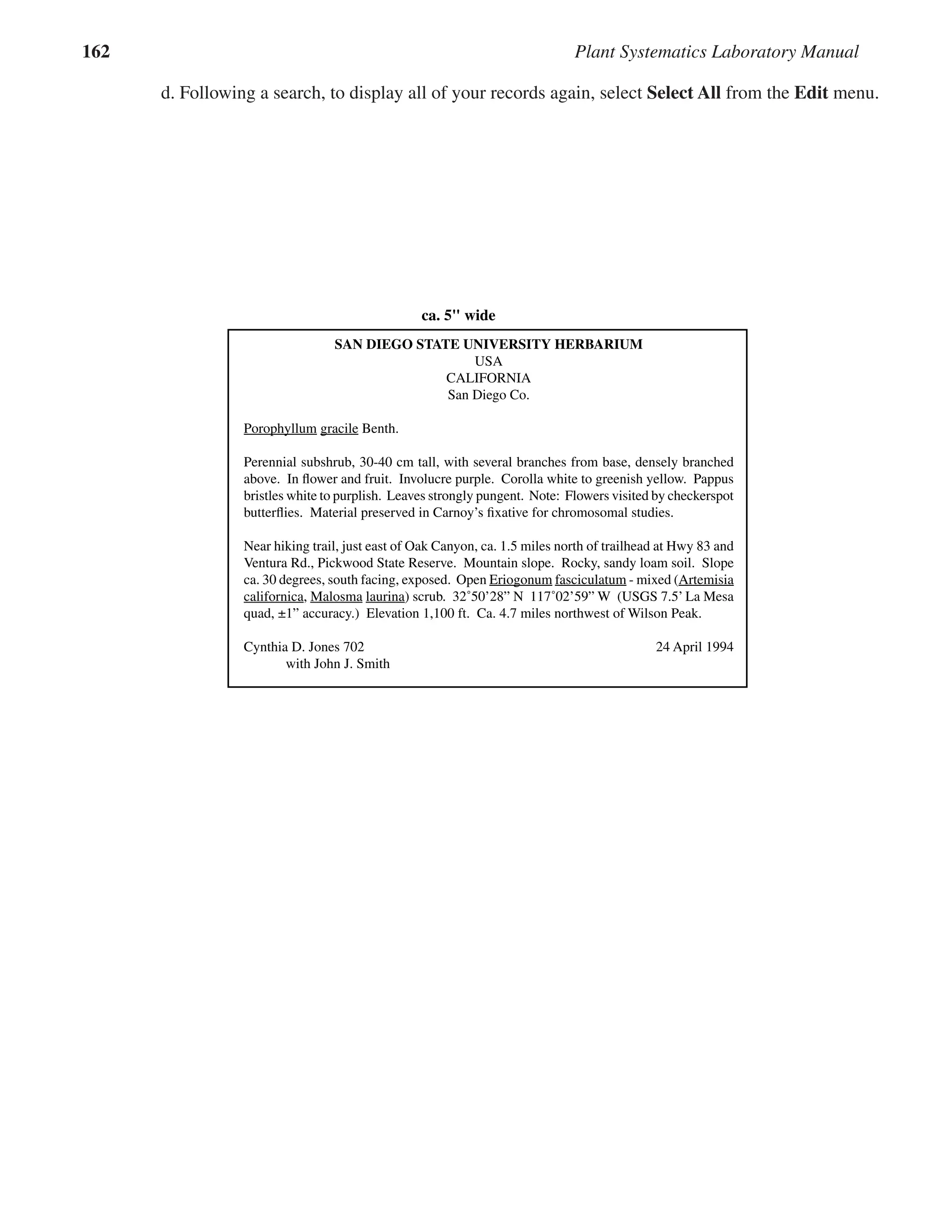
![Appendix 1 Plant Description 163
appendix 1
Plant description
WRITING A PLANT DESCRIPTION
The following list of characters can serve as the basis for a
detailed plant description. The basic form of the description
is to list the plant organ (noted in bold in the character list
below), followed by a listing of all character states that apply
for that plant organ, with each character state separated by
commas. Note that, for any particular species, not all charac-
ters will apply; these are simply omitted. Also note that some
characters are listed with multiple character names, e.g.,
“Sepal/Calyx lobes/Outer tepals.” This is designed as a
guide, with the intention that only one of these three will be
used, depending on whether the outer whorl of the perianth
consists of distinct sepals (Sepal used), of fused sepals (Calyx
lobes used), or of tepals (Outer tepals used).
There are different styles in writing a detailed plant descrip-
tion. Some use a telegraphic style, e.g., “Leaves simple,
sessile, whorled, ovate, entire, glabrous.” This style is
common in floras, where space for text may be at a premium.
Other descriptions use complete sentences, e.g., “Leaves
are simple, sessile, whorled, ovate, entire, and glabrous.” The
use of “the” at the beginning of a sentence is optional, as in
“The leaves are simple, sessile, whorled, ovate, entire, and
glabrous.”
Some general suggestions are as follows:
1. Be sure to only list the plant organs (and list only
once), followed by the character states that apply to that
plant organ. The major plant organs are sometimes placed
in bold text to highlight them. Do not list the specific
Do not list the specific
Do not
character names, unless a clarification is needed.
Examples:
Do write: “Flowers are bisexual, actinomorphic,
pedicellate, 1.5–2.2 cm long (including pedicel) . . .”
[“Flowers” refers to the plant organ; all other terms are
character states.]
Do not write: “
Do not write: “
Do not Flower sex is bisexual, symmetry is
actinomorphic, attachment is pedicellate, length is
1.5–2.2 cm …” [“Sex,” “symmetry,” “attachment,” and
“length” are characters and should not be listed.]
However, do write: “Leaf blades are elliptic, serrate,
rounded at base, obtuse at apex.” [“Rounded” and “obtuse”
could refer to either of the characters base or apex, so
these characters should be listed for clarification.]
2. Description of the major organs may be written in the
singular or plural form, but the latter should be used only
if more than one such organ occurs in an individual. If only
one organ occurs per individual, the singular should be used.
Do write: “Leaves are trifoliolate, alternate, . . .” or “The
leaf is trifoliolate, alternate, . . .” if there are multiple leaves.
leaf is trifoliolate, alternate, . . .” if there are multiple leaves.
leaf
Do write: “The inflorescence is a solitary raceme,. . .”
if there is a single raceme per individual.
3. Always use metric for plant or plant organ heights,
lengths, and widths. Always abbreviate these: “mm” for
millimeters, “cm” for centimeters, “dm” for decimeters,
“m” for meters. Use mm and cm for smaller structures,
dm or m for larger. Use the appropriate unit of measure to
avoid values less than 1, if possible. (E.g., write “2–5 mm”
instead of “0.2–0.5 cm”.) Always place a “0” before a
decimal point, as in “0.5 mm.” Be clear about what you’re
describing. Examples:
Do write: “Flowers are 0.5–1.3 mm long (excluding
pedicel), 2–3 mm wide when fully opened.”
Do not write: “
Do not write: “
Do not Flowers are .5–1.3 mm.”
4. For characters that are variable, either list the range of
variation (e.g., “Leaves oblaceolate to narrowly elliptic,
crenate to dentate . . .”) or list the most common mor-
phology and in brackets list the exceptions (e.g., “Leaves
trifoliolate [rarely pinnate with 5 leaflets]” or “Leaves
4–7 [2.5–10] cm long . . .”).](https://image.slidesharecdn.com/plsyslab-250719064702-ff141168/75/Plant-Systematics-laboratory-manual-techniques-167-2048.jpg)
![164 Plant Systematics Laboratory Manual
COMPLETE MORPHOLOGICAL CHARACTER LIST
[Available as download from Website; Note: Not all characters apply to a given taxon; add characters for specialized structures.]
Species/Infraspecies Name (with authorship) [Common Name]:
Family: Native locality:
Plant Habitat:
Plant Duration:
Plant Sex if not hermaphroditic:
Plant Habit:
Plant Height:
Root Type:
Root Origin (e.g., primary, adventitious):
Underground Stem Type if specialized:
Underground Stem Branching Pattern:
Underground Stem Size:
Aerial Stem Habit:
Aerial Stem Branching Pattern:
BarkType:
Bark Lenticels presence/shape:
Twig Surface/Shape:
Twig Lenticel presence/shape:
Twig Shape/Cross-Sectional Outline:
Pith Type:
Pith Cross-Sectional Outline:
Fruit Scar presence/shape:
Leaf Scar Size/Shape:
Vascular Bundle Scar Number/Pattern:
Stipule Scar presence:
Stipule Scar Position/Shape if present:
Terminal Bud Scale Scars presence/absence:
Bud Type:
Bud Orientation:
Bud Shape/Size:
Bud Position:
Bud Scale Arrangement:
Bud Scale Surface/Texture:
Thorns if present:
Spines if present:
Prickles if present:
Spur Shoot if present:
Leaves/Leaf Number if unusual:
Leaf Type:
Leaf Length/Width:
Leaf Attachment:
Leaf stipule presence:
Leaf Duration:
Leaf Position if not cauline:
Leaf Arrangement:
Leaf Orientation if discrete:
Leaf Posture if discrete:
Petiole Shape:
Petiole Color:
Petiole Length:
Petiole Orientation:
Stipule Shape:
Stipule Surface adaxial:
Stipule Surface abaxial:
Stipule Length:
IF LEAVES SIMPLE:
Leaf Blade Color if unusual:
Leaf Blade Shape:
Leaf Blade Length:
Leaf Blade Width:
Leaf Blade Base:
Leaf Blade Margin:
Leaf Blade Apex:
Leaf Blade Apical Process:
Leaf Blade Division:
Leaf Blade Venation:
Leaf Blade Surface adaxial:
Leaf Blade Surface abaxial:
Leaf Blade Texture:
IF LEAVES COMPOUND:
Leaf Outline Shape:
Rachillae Number if decompound:
Leaflets Number if not very large:
Number if not very large:
Leaflet Arrangement:
Leaflet Blade Shape:
Leaflet Blade Attachment:
Leaflet Blade Color if unusual:
Leaflet Blade Length:
Leaflet Blade Width:
Leaflet Blade Base:
Leaflet Blade Margin:
Leaflet Blade Apex:
Leaflet Blade Apical Process:
Leaflet Blade Division:
Leaflet Blade Venation:
Leaflet Blade Surface adaxial:
Leaflet Blade Surface abaxial:
Leaflet Blade Texture:
Petiolule Shape:](https://image.slidesharecdn.com/plsyslab-250719064702-ff141168/75/Plant-Systematics-laboratory-manual-techniques-168-2048.jpg)
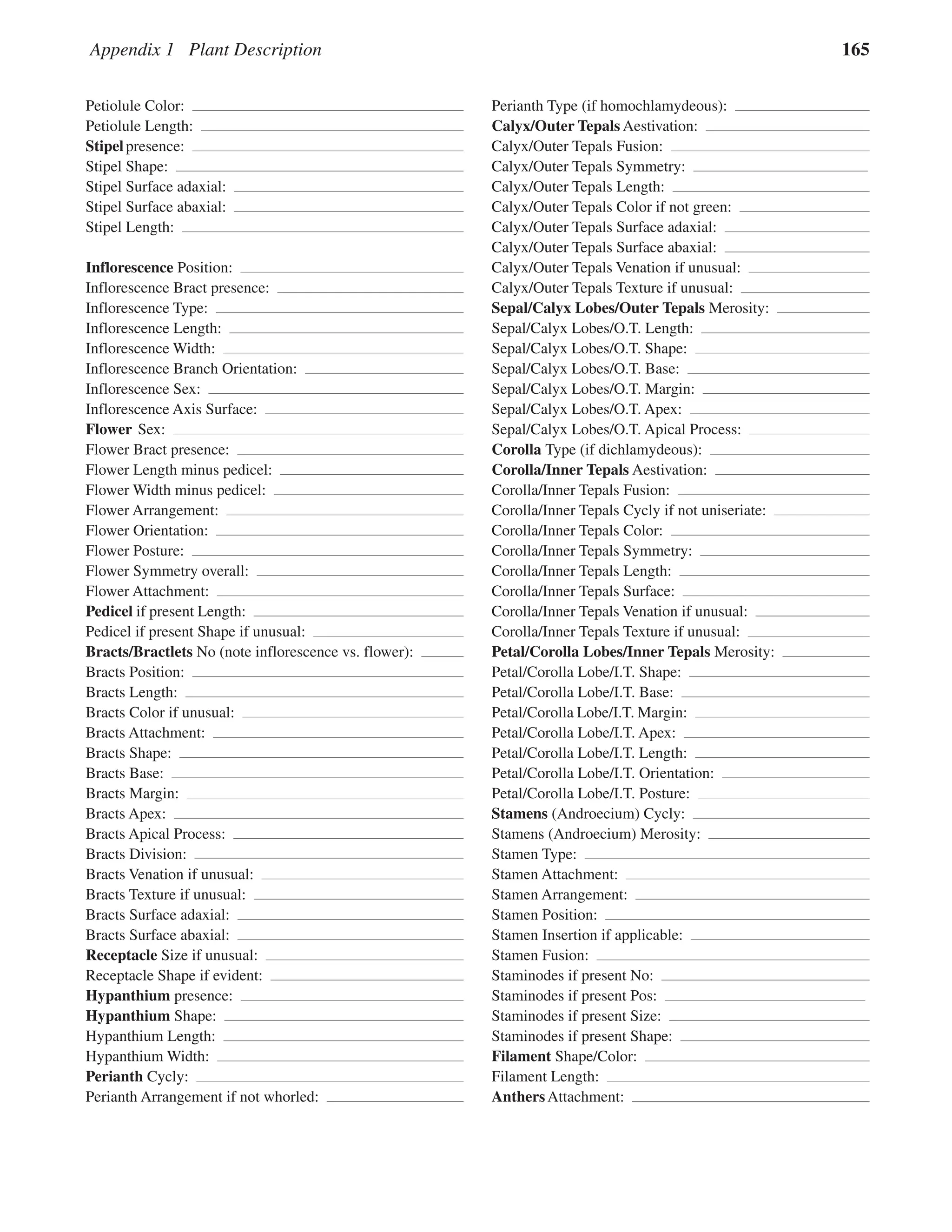
![166 Plant Systematics Laboratory Manual
Anther Type:
Anther Dehiscence Type:
Anther Dehiscence Direction:
Anther Color:
Anther Length:
Anther Shape:
Anther Thecae Arrangement:
Connective Morphology if unusual:
Pollen color:
Gynoecium Fusion:
Perianth Androecial Position:
OvaryPosition:
Ovary Attachment if not sessile:
Ovary Color:
Ovary Length:
Ovary Shape:
Ovary Surface:
Styles Number per pistil:
Style Position:
Style Shape/Color:
Style Disposition/Length:
Stigmas Number:
Stigmas Position:
Stigmas Shape:
Stigmas Surface:
Nectaries presence/absence:
Nectary Type/Position:
Carpels Number:
Median Carpel Position relative to stem axis:
Locules Number:
Placentation:
Placenta Shape/Position if unusual:
Ovules Number per carpel:
Ovule Type:
Ovule Position:
Fruit Type:
Fruit Color:
Fruit Shape:
Fruit Length/Width:
Fruit Surface:
Seed Color:
Seed Shape:
Seed Length:
Seed Surface:
Funiculus Length:
Funiculus Shape:
Aril presence:
Aril Size:
Aril Shape:
Aril Position:
Seeds Nutritive Tissue:
Embryo Type Size/Shape/Position:
Cotyledon Position:
Radicle Position:
Seedling Type:
FLORAL FORMULA:
P A G
P A G
or K C A G
or K C A G
Note: List number of parts after each symbol:
P = # perianth parts or tepals (outer + inner whorls)
or K = # sepals or calyx lobes C = # petals or corolla lobes
A = # stamens of androecium (outer + inner whorls)
G = # carpels of gynoecium (add ovary position)
( ) = fusion of parts [ ] = rare numbers of parts
Optional:
Kz = zygomorphic calyx; Cz = zygomorphic corolla; etc.
E. g., K (5) Cz (5) A 5 [4] G (2), inferior
= calyx synsepalous with 5 lobes
corolla zygomorphic, sympetalous with 5 lobes
stamens 5, rarely 4, distinct, in one whorl
gynoecium syncarpous, carpels 2, ovary inferior
E.g., P 3+3 A 3+3 G 3, superior
= perianth apotepalous with 3 outer and 3 inner tepals
stamens 6, distinct, in two whorls: 3 outer + 3 inner
gynoecium apocarpous, carpels (pistils) 3, ovaries
superior](https://image.slidesharecdn.com/plsyslab-250719064702-ff141168/75/Plant-Systematics-laboratory-manual-techniques-170-2048.jpg)
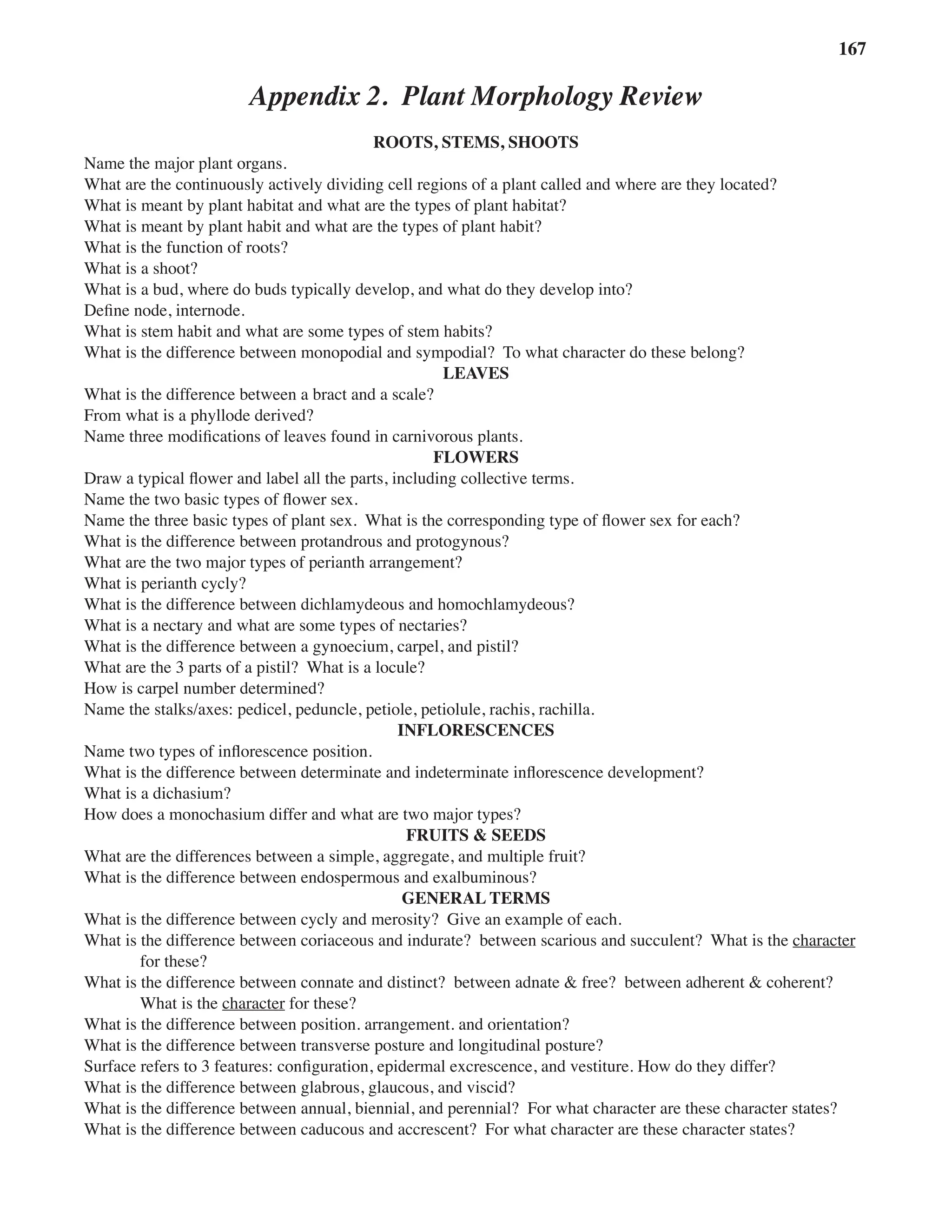
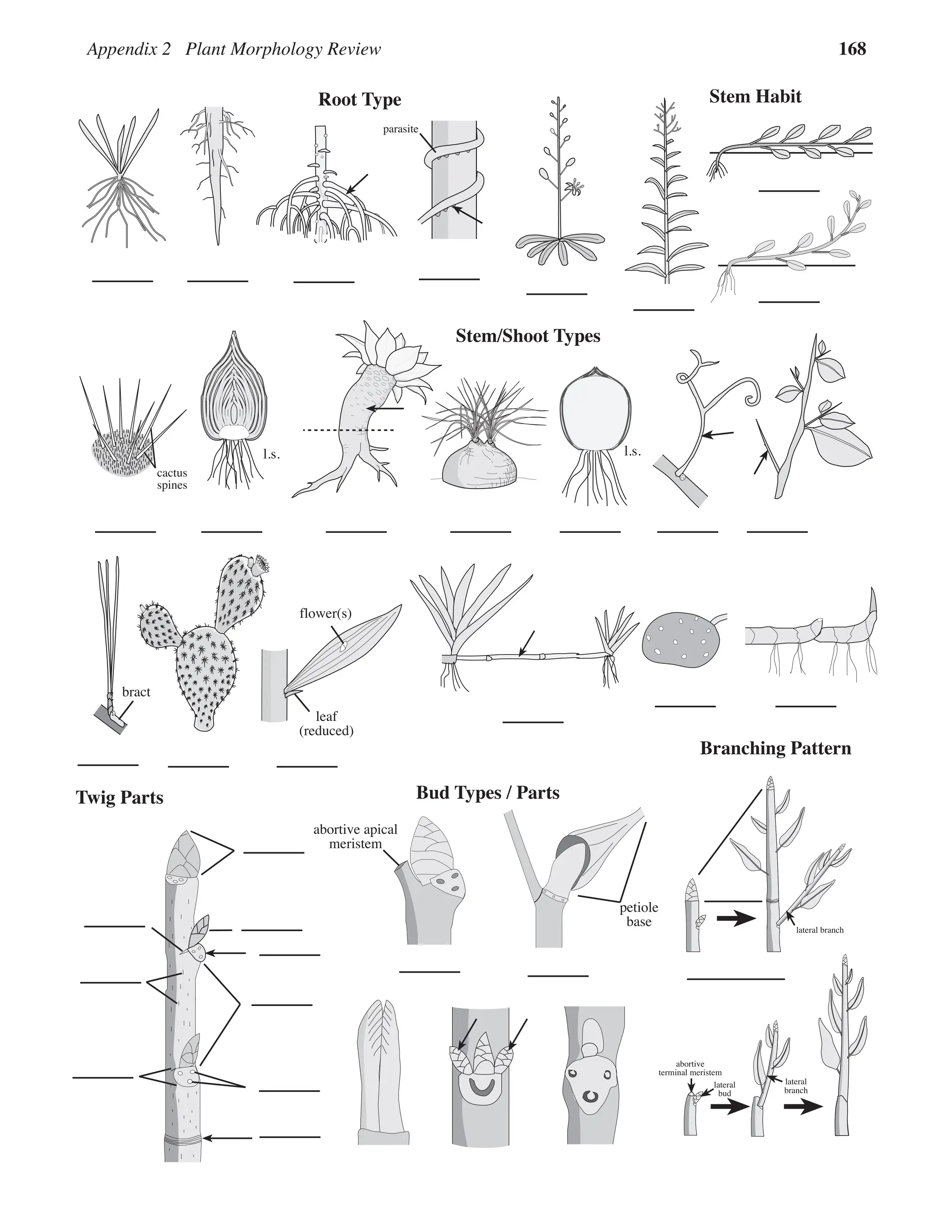
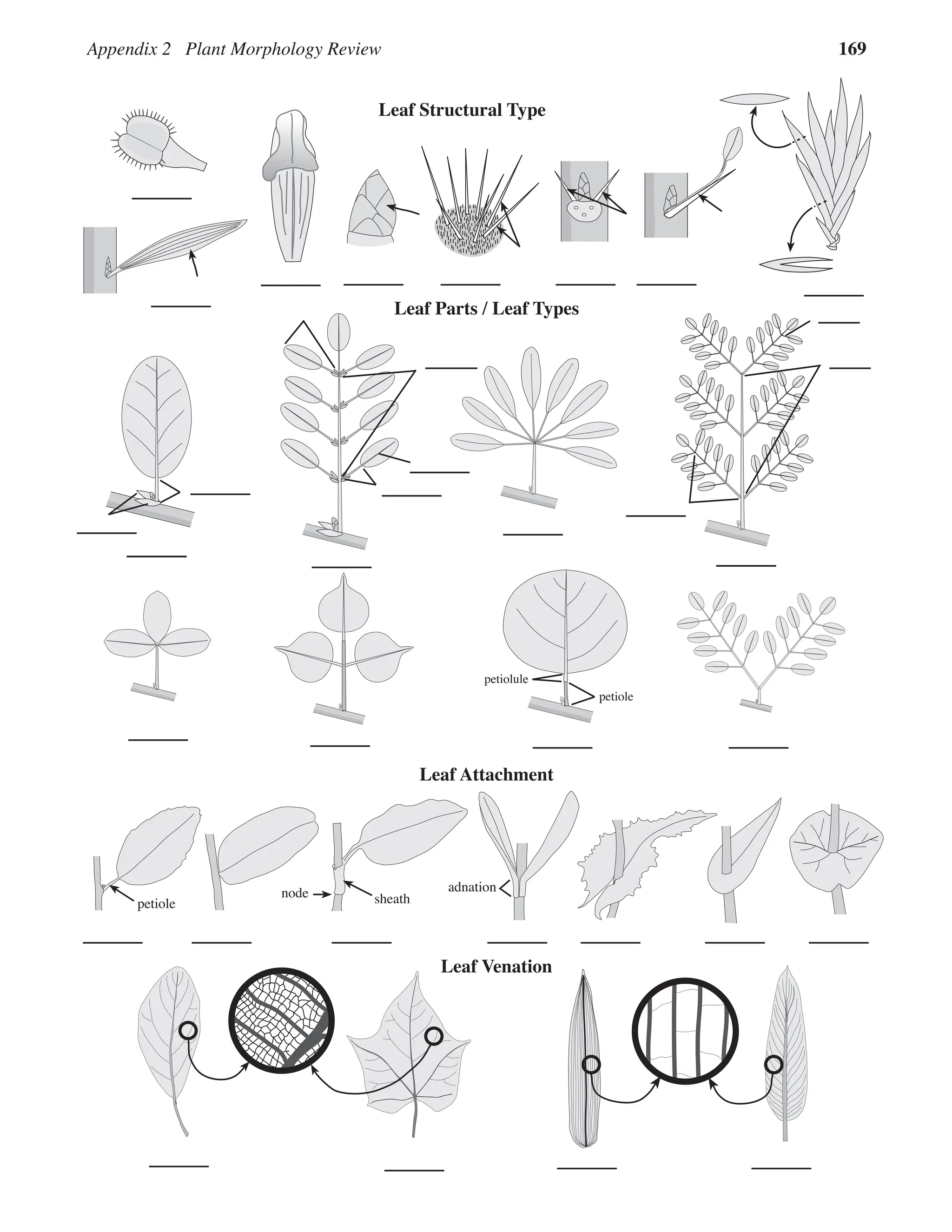
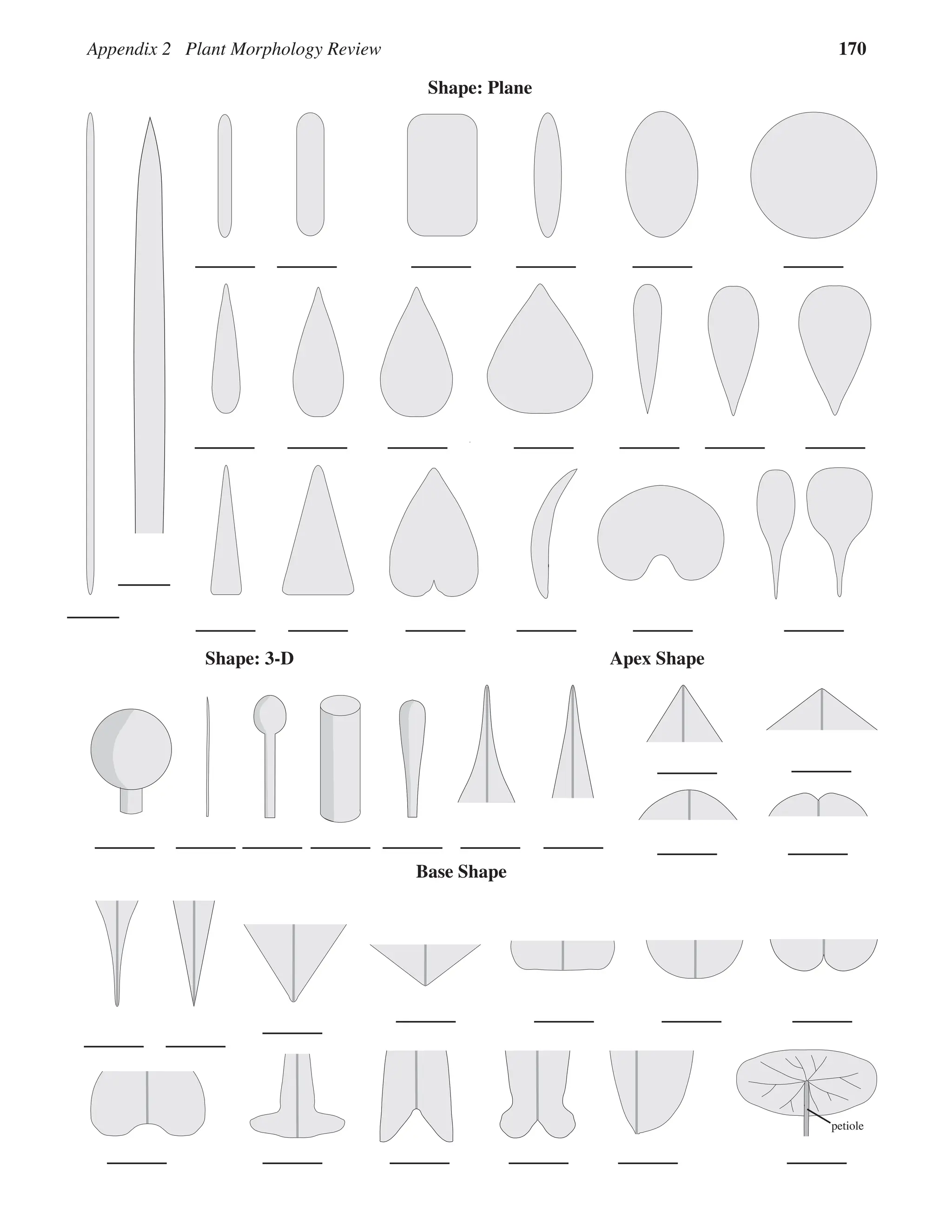
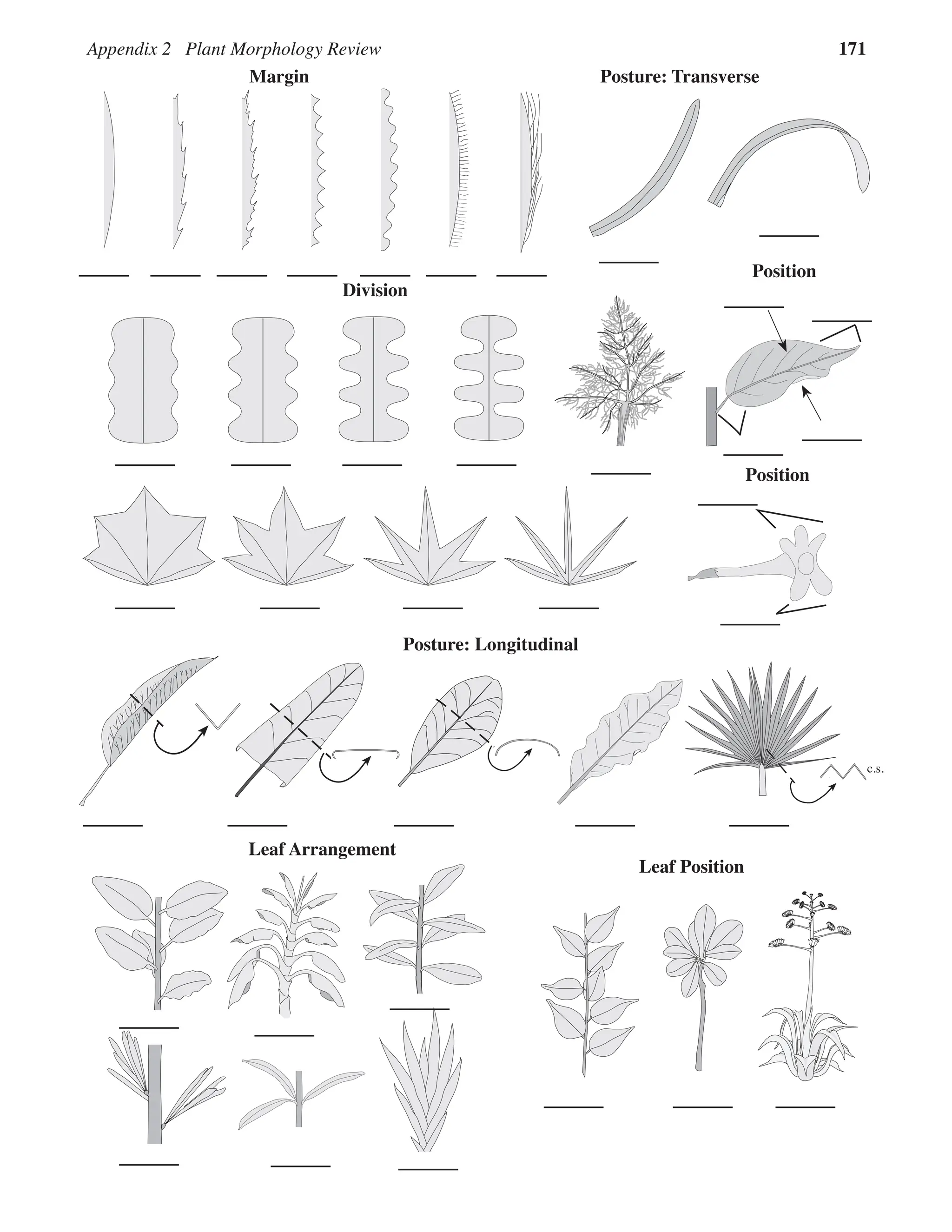
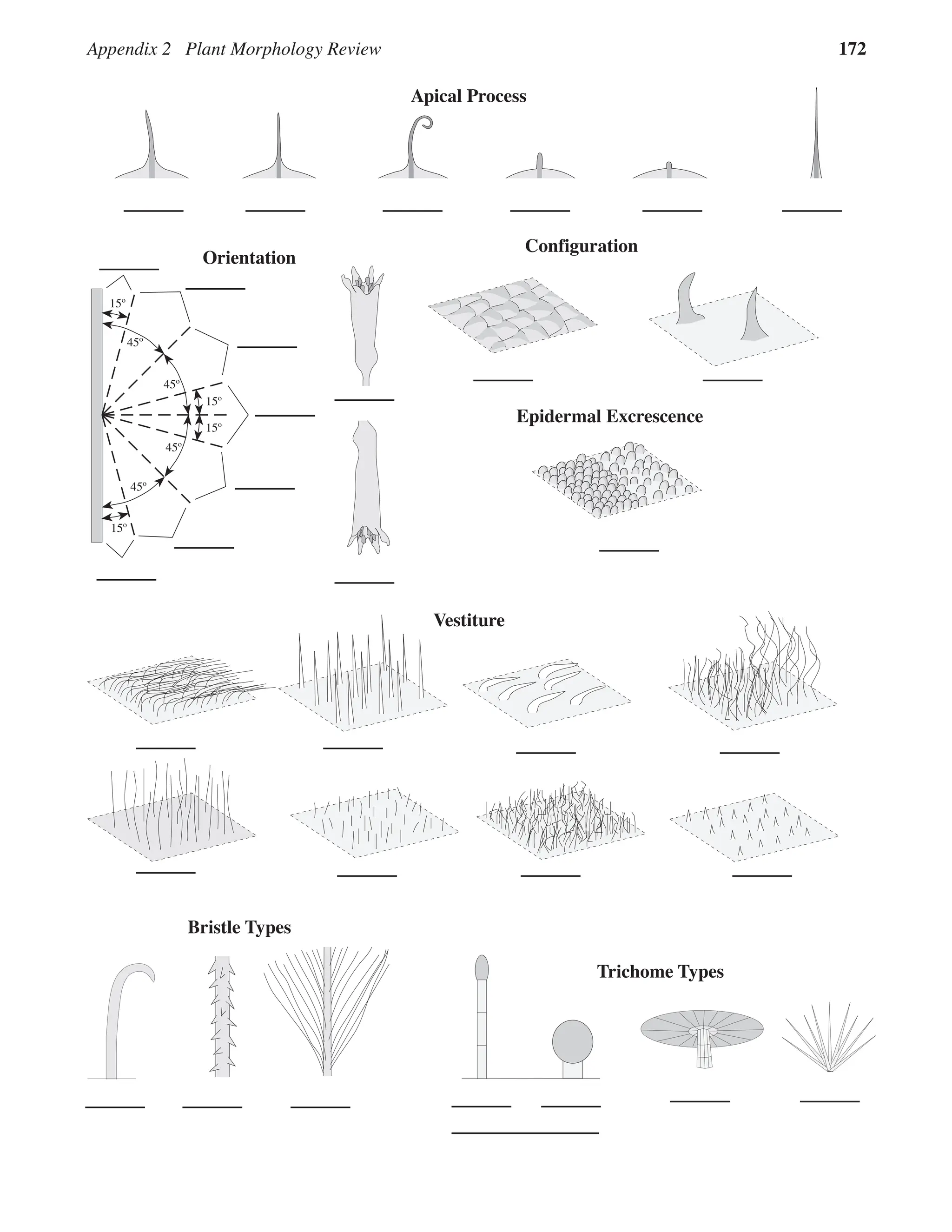
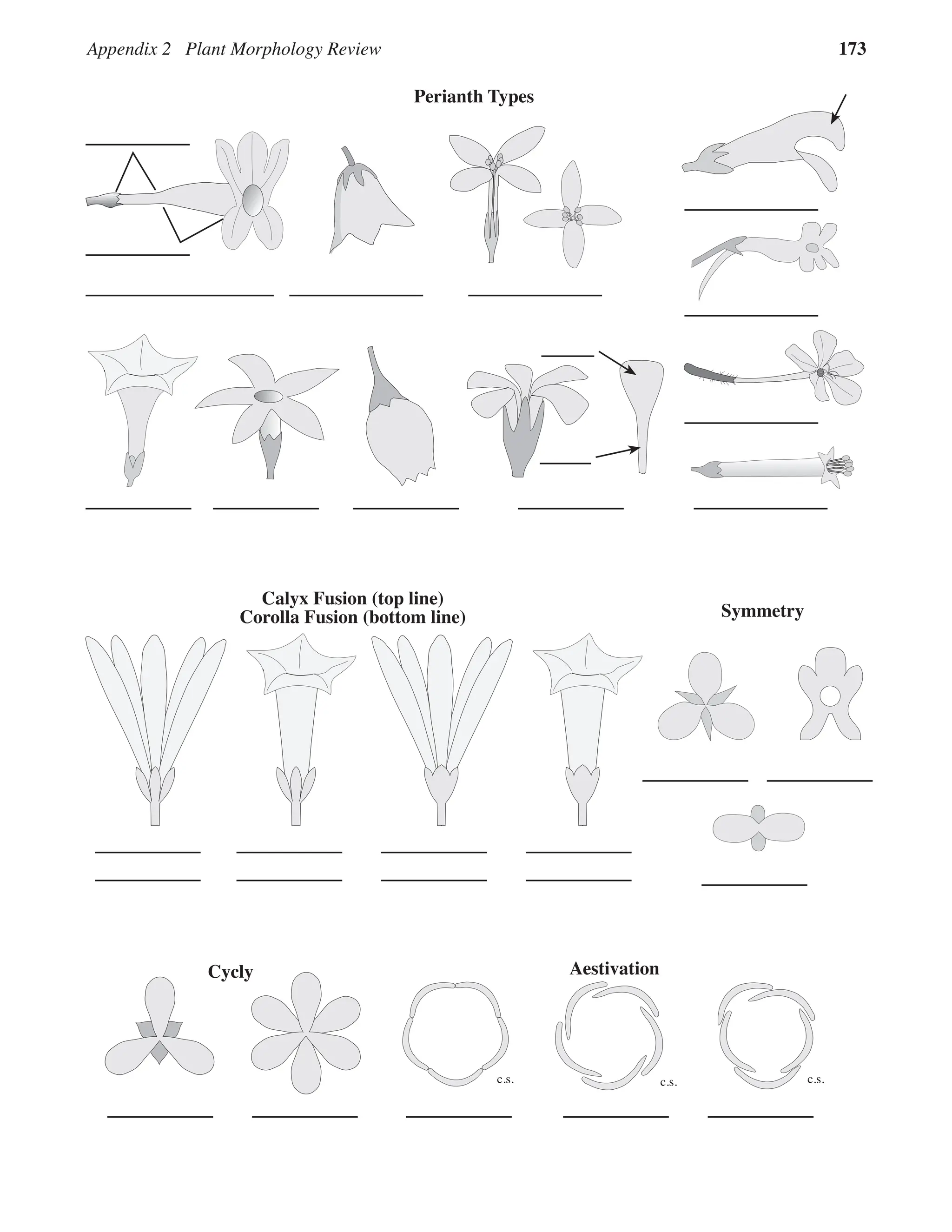
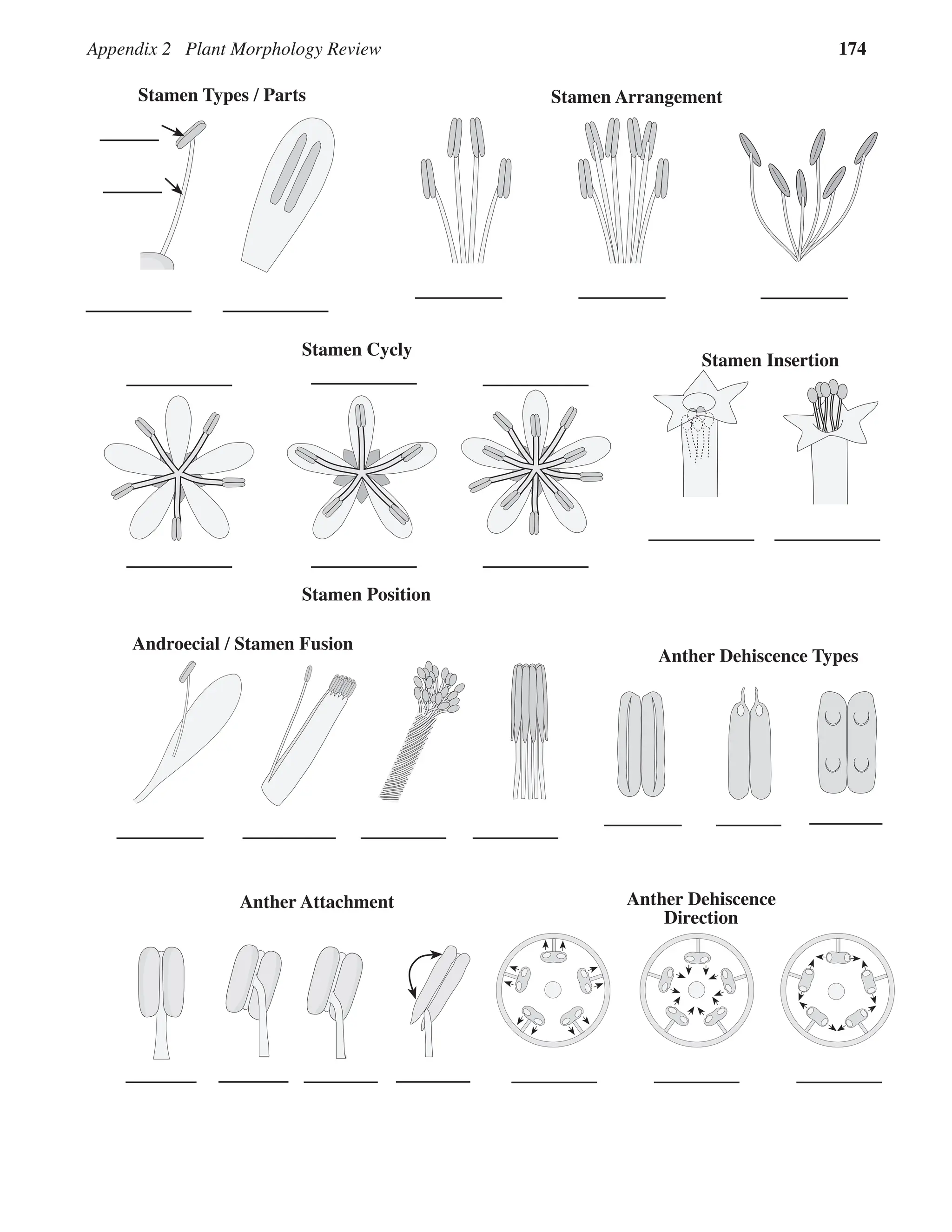
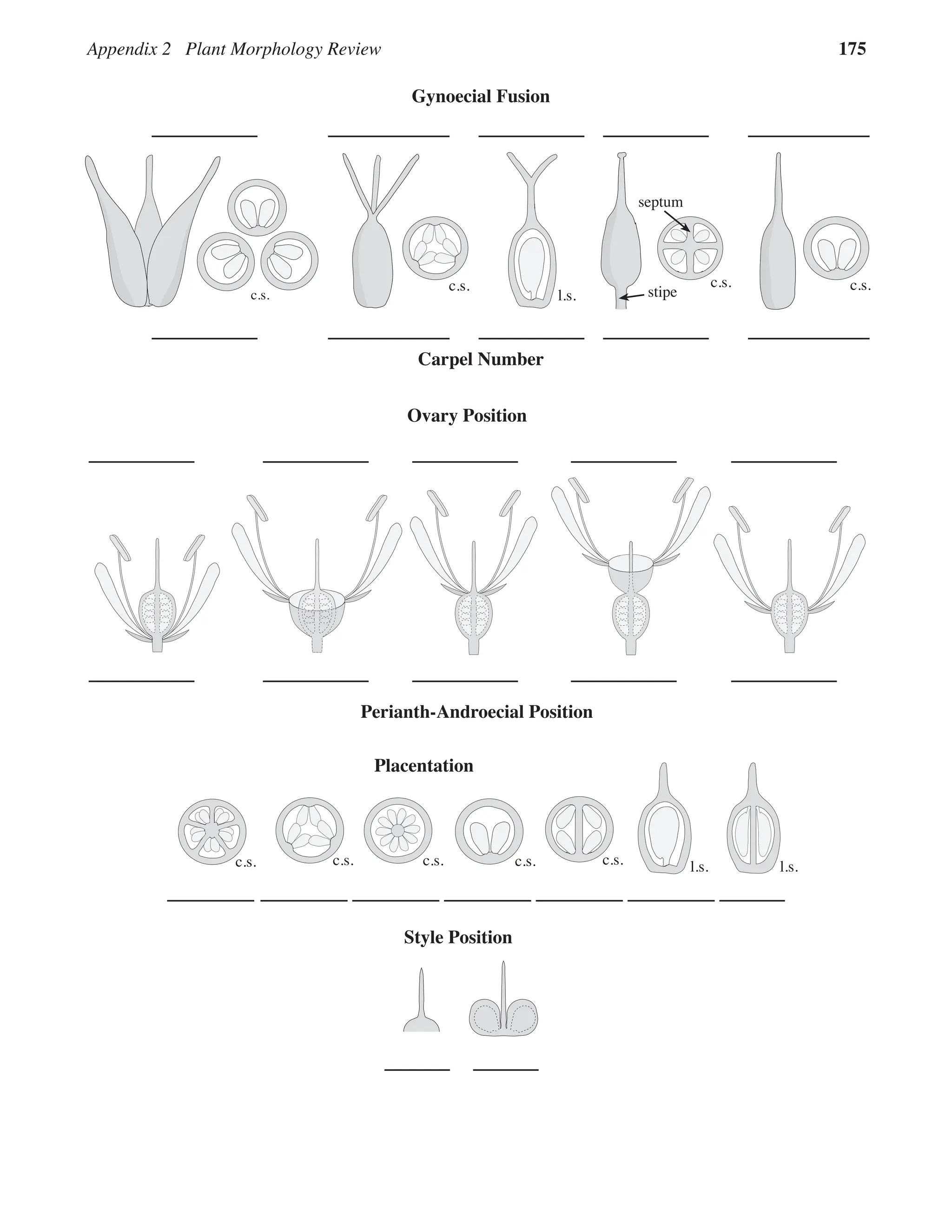
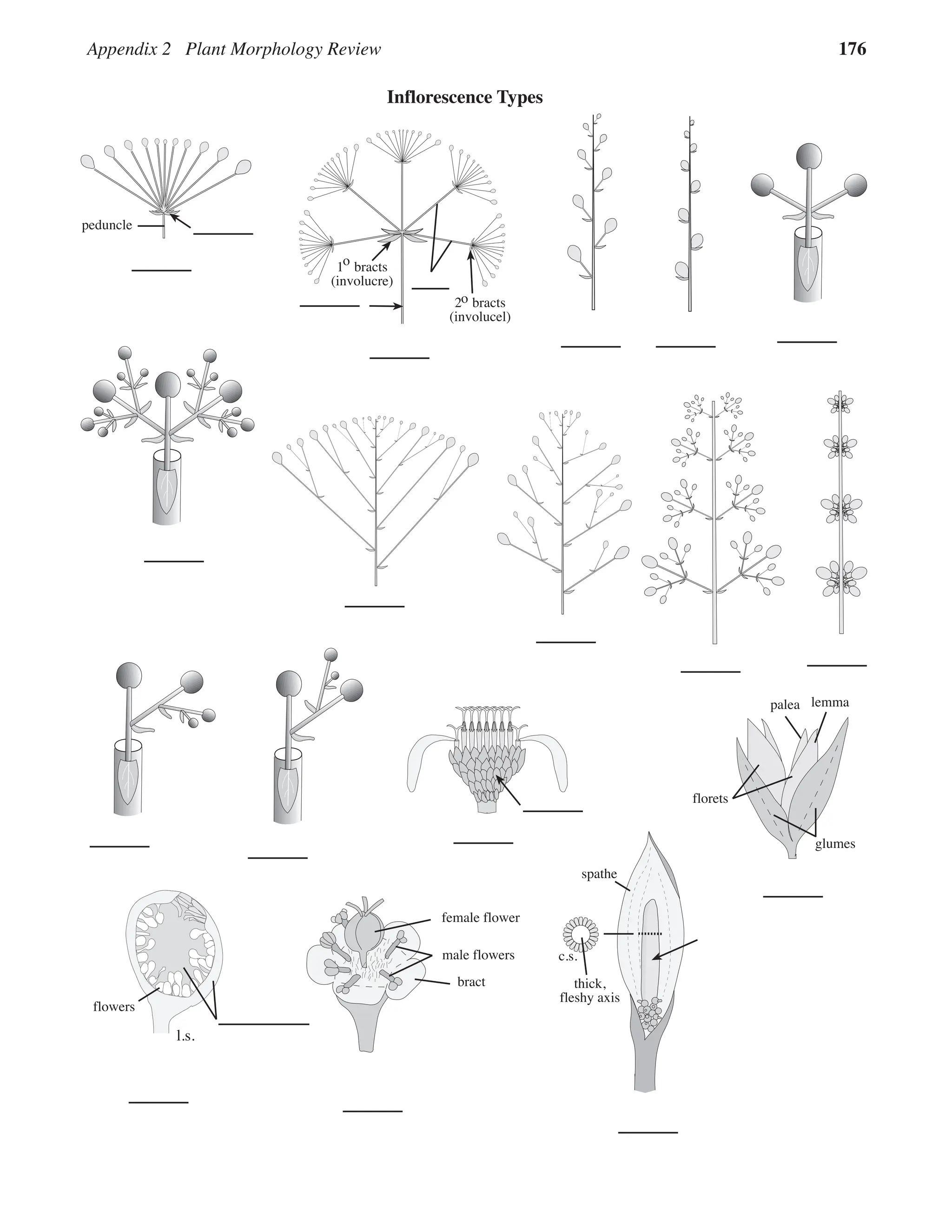
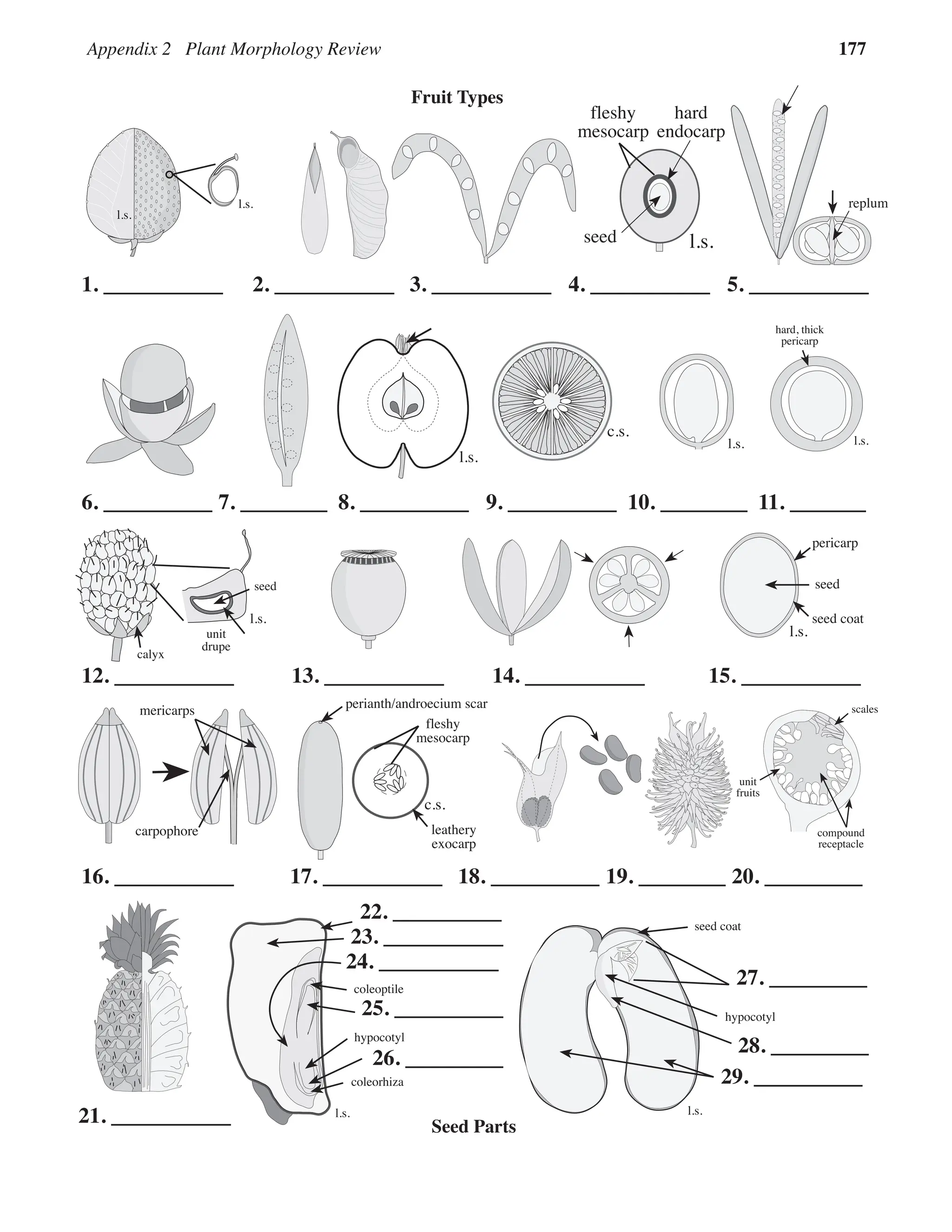


![181
Taxa in alphabetical order of species name abbreviation
Abbr. Scientific name [Synonyms] Common name Family Native range
ACja Acer japonicum Japanese Maple Aceraceae Japan
AClo Acacia longifolia Sydney Golden Wattle Fabaceae e. Australia
ACpe Acacia pendula Weeping Acacia Fabaceae e. Australia
ACsm Acmena smithii Lilly-Pilly Myrtaceae Australia
ACsp Acacia sp. Fabaceae
AGfl Agonis flexuosa Peppermint Tree Myrtaceae w. Australia
AGro Agathis robusta Queensland Kauri Araucariaceae n. e. Australia
ALar Alöe arborescens Candelabra A., Torch Pl. Liliaceae South Africa
ALfo Aleurites fordii Tung Oil Tree Euphorbiaceae central Asia
ALju Albizia julibrissin Mimosa Tree, Silk Tree Fabaceae Iran to Japan
ALrh Alnus rhombifolia White Alder Betulaceae w. North America
ARal Archontophoenix alexandrae Alexandra Palm, King P. Arecaceae n. e. Australia
ARar Araucaria araucana Monkey Puzzle Araucariaceae Chile
ARbi Araucaria bidwillii Bunya-Bunya Araucariaceae n. e. Australia
ARcun Araucaria cunninghamii Hoop-Pine Araucariaceae e. Australia
ARcu Archontophoenix cunninghamiana King Palm Arecaceae e. Australia
ARhe Araucaria heterophylla Norfolk Island-Pine Araucariaceae Norfolk I., Australia
ARun Arbutus unedo Strawberry-Tree Ericaceae s. Europe, Ireland
BAbl Bauhinia blakeana Hong Kong Orchid Tree Fabaceae Canton, China
BAva Bauhinia variegata Purple Orchid Tree Fabaceae India, China
BRac Brachychiton acerifolius Flame Tree Sterculiaceae e. Australia
BRar Brahea armata Mexican Blue Palm Arecaceae Baja Calif., Mexico
BRed Brahea edulis Guadelupe Island Palm Arecaceae Baja Calif., Mexico
BRdi Brachychiton discolor Scrub Bottle Tree Sterculiaceae cent.-n., e. Australia
BUca Butia capitata Pindo Palm, Jelly Palm Arecaceae Brazil, Urug., Argent.
CAca Carpephyllum cafrum S. African Plum Sapindaceae South Africa
CAci Callistemon citrinus Bottlebrush Myrtaceae s. e. Australia
CAcu Casuarina cunninghamiana River She-Oak Casuarinaceae e. Australia
CAmi Caryota mitis Fishtail Palm Arecaceae Myanmar-Java, Phil.
CAsp Caesalpinia spinosa Tara Fabaceae w. South America
CAvi Callistemon viminalis Weeping Bottlebrush Myrtaceae Australia: N.S.W.
CEde Cedrus deodara Deodar Cedar Pinaceae Himalayas
CEli Cedrus libani Cedar of Lebanon Pinaceae Asia Minor
CEsi Ceratonia siliqua Carob, St. John’s Bread Fabaceae e. Mediterranean
CHhu Chamaerops humilis Mediterranean Fan Palm Arecaceae Mediterranean
CHpl Chiranthodendron pentadactylon Monkey Hand Tree Malvaceae [Bombac.] s. Mexico, Guatemala
CHsp Chorisia speciosa Floss-Silk Tree Malvaceae [Bombac.] Brazil, Argentina
CIca Cinnamomum camphora Camphor Tree Lauraceae China, Japan
COau Cordyline australis Palm-Lily Agavaceae New Zealand
COdi Cordia dichotoma Cordia Boraginaceae
COla Cocculus laurifolius Laurel-Leaf Snailseed Menispermaceae Himalayas
COlac Cotoneaster lacteus Cotoneaster Rosaceae w. China
COsp Cotoneaster sp. Cotoneaster Rosaceae
COst Cordyline stricta Australian Dracaena Agavaceae subtrop. Australia
CRag Crotolaria agatiflora Bird’s Beak Fabaceae
CUan Cupaniopsis anacardioides Carrot Wood Tree Sapindaceae Australia](https://image.slidesharecdn.com/plsyslab-250719064702-ff141168/75/Plant-Systematics-laboratory-manual-techniques-185-2048.jpg)
![182 Plants of San Diego State University
CUgu Cupressus guadalupensis forbesii Tecate Cypress Cupressaceae s. California
CUla Cunninghamia lanceolata China Fir Taxodiaceae China
CUma Cupressus macrocarpa Monterey Cypress Cupressaceae Monterey Co., CA.
CUse Cupressus sempervirens Italian Cypress Cupressaceae s. Europe, w. Asia
CUsp Cupressus sp. Cypress Cupressaceae
CYob Cydonia oblonga Quince Rosaceae Mediterranean region
DOvi Dodonaea viscosa ‘purpurea’ Hopseed Sapindaceae Ariz,S.Am,OW trop.
DRdr Dracena draco Dragon Tree Agavaceae Canary Islands
ERca Erythrina caffra Coral Tree Fabaceae E. S. Africa
ERco Erythrina coralloides Naked Coral Tree Fabaceae Warm temp.&tropics
ERja Eriobotrya japonica Loquat Rosaceae China
ESex Escallonia xexoniensis Escallonia Saxifragaceae Cultivar
ESgr Escallonia grahamiana[E. illinita] Escallonia Saxifragaceae Chile
EUca Eucalyptus camaldulensis Red River Gum Myrtaceae Australia
EUci Eucalyptus citriodora Lemon Scented Gum Myrtaceae Queensland, Austral.
EUcl Eucalyptus cladocalyx Gum Myrtaceae Australia
EUco Eucalyptus cornuta Gum Myrtaceae Australia
EUfi Eucalyptus ficifolia Red Flowering Gum Myrtaceae West Australia
EUgl Eucalyptus globulus S. Blue Gum Myrtaceae Australia: NSW,W.A.
EUle Eucalyptus leucoxylon White Ironbark Myrtaceae Australia
EUma Eucalyptus maculata Spotted Gum Myrtaceae Australia
EUpo Eucalyptus polyanthemos Gum Myrtaceae Australia
EUpu Euphorbia pulcherrima Poinsettia Euphorbiaceae Mexico
EUri Eucalyptus risdonii [Angophora r.] Gum Myrtaceae Australia
EUsi Eucalyptus sideroxylon Red Ironbark Myrtaceae Australia
EUsp Eucalyptus sp. Myrtaceae Australia
EUti Euphorbia tirucalli Milkbush Euphorbiaceae Malabar, India
EUto Eucalyptus torquata Gum Myrtaceae Australia
EUvi Eucalyptus viminalis Manna Gum Myrtaceae Southern Australia
FEse Feijoa sellowiana Pineapple-Guava Myrtaceae S. South America
FIbe Ficus benjamina Weeping Fig Moraceae India
FIca Ficus carica Edible Fig Moraceae Mediterranean region
FIel Ficus elastica Rubber Tree Moraceae Nepal,Assam,Myan.
FIni Ficus nitida [F. microcarpa v. n.] Indian Laurel Fig Moraceae India
FIru Ficus rubiginosa Rusty Fig Moraceae Australia
FIsp Ficus sp. Fig Moraceae
FRsp Fraxinus sp. Ash Oleaceae
FRuh Fraxinus uhdei Shamel Ash Oleaceae Mexico
GIbi Ginkgo biloba Maidenhair Tree Ginkgoaceae E. China
HAca Harpephyllum caffrum Kaffir Plum Anacardiaceae S. Africa
HEar Heteromeles arbutifolia Toyon Rosaceae
HOfo Howea forsteriana Thatch Palm Arecaceae Lord Howe I. Austr.
HYfl Hymenosporum flavum Sweetshade Pittosporaceae Australia
ILco Ilex cornuta Chinese or Horned Holly Aquifoliaceae China
JAmi Jacaranda mimosifolia Jacaranda Bignoniaceae N. W. Argentina
JUsp Juniperus sp. Juniper Cupressaceae
KIaf Kigelia africana [K. pinnata] Sausage Tree Bignioniaceae Africa
KObi Koelreuteria bipinnata Chinese Lantern Tree Sapindaceae China, Japan
KOel Koelreuteria elegans Chinese Lantern Tree Sapindaceae China, Japan](https://image.slidesharecdn.com/plsyslab-250719064702-ff141168/75/Plant-Systematics-laboratory-manual-techniques-186-2048.jpg)
![183
KOsp Koelreuteria sp. Sapindaceae
LAin Lagerstroemia indica Crape-Myrtle Lythraceae China
LEsc Leptospermum scoparium Manuka Tea Tree Myrtaceae N. Zealand; Austral.
LIst Liquidambar styraciflua Sweet Gum Hamamelidaceae SE US, Mexico
MAgr Magnolia grandiflora Southern Magnolia Magnoliaceae NC. to FL, TX
MAla Malosma laurina Laurel Sumac Anacardiaceae S. Calif. to Baja
MAob Markhamia obtusifolia Markhamia Bignoniaceae Trop. Africa
MAsp Markhamia sp. Markhamia Bignoniaceae
MEex Metrosideros excelsus N. Zeal. Christmas Tree Myrtaceae New Zealand
MEgl Metasequoia glyptostroboides Dawn Redwood Taxodiaceae China
MEne Melaleuca nesophila Western Tea Myrtle Myrtaceae Australia
MEqu Melaleuca quinquenervia Cajeput Tree Myrtaceae Australia
MIdo Michelia doltsopa Magnoliaceae Asia
MUpa Musa paradisiaca Banana Musaceae India
MYla Myoporum laetum Guitarwood Myoporaceae New Zealand
OLeu Olea europaea Olive Oleaceae Mediterranean region
PEam Persea americana Avocado Lauraceae Trop. Amer.
PHca Phoenix canariensis Canary Island Date Palm Arecaceae Canary Islands
PHda Phoenix dactylifera Date Palm Arecaceae W. Asia & N. Africa
PHre Phoenix reclinata Senegal Date Palm Arecaceae Tropical Africa
PHro Phoenix roebelinii Dwarf Date Palm Arecaceae Laos
PIca Pinus canariensis Canary Island Pine Pinaceae Canary Islands
PIcr Pittosporum crassifolium Karo Pittosporaceae New Zealand
PIeu Pittosporum eugenioides Pittosporaceae Australia
PIha Pinus halepensis Aleppo Pine Pinaceae Mediterranean region
PIpi Pinus pinea Italian Stone Pine Pinaceae Mediterranean region
PIra Pinus radiata Monterey Pine Pinaceae S. California
PIsp Pinus sp. Pine Pinaceae
PIte Pittosporum tenuifolium Pittosporaceae
PIth Pinus thunbergii Japanese Black Pine Pinaceae Japan
PIto Pinus torreyana Torrey Pine Pinaceae S. California
PIun Pittosporum undulatum Victorian Box Tree Pittosporaceae Australia
PIvi Pittosporum viridiflorum Cape Pittosporum Pittosporaceae S. Africa
PLac Platanus acerifolia London Plane Tree Platanaceae North America
PLor Platycladus orientalis [Thuja o.] Oriental Arbor Vitae Cupressaceae N. China; Korea
PLra Platanus racemosa Western Sycamore Platanaceae Calif.; Baja Calif.
PLsp Platanus sp. Sycamore Platanaceae
POfr Populus fremontii Fremont Cottonwood Salicaceae California; Arizona
POgr Podocarpus gracilior East African Fern Pine Podocarpaceae Tropical Africa
POma Podocarpus macrophyllus Japanese Yew Pine Podocarpaceae Japan
POmak Podocarpus macrophyllus v. maki Yew Pine Podocarpaceae Japan
PRar Prunus armenica Common Apricot Rosaceae China
PRce Prunus cerasifera atropurpurea Purple-Leaf Plum Rosaceae Cen. Asia to Balkans
PRdu Prunus dulcis Almond Rosaceae Mediterranean region
PRly Prunus lyonii Catalina Cherry Rosaceae Islands off S. Calif.
PRpe Prunus persica Peach Rosaceae Asia
PRsp Prunus sp. Cherry Rosaceae
PUgr Punica granatum Pomegrante Punicaceae Mediterranean region
PYka Pyrus kawakami Evergreen Pear Rosaceae Taiwan](https://image.slidesharecdn.com/plsyslab-250719064702-ff141168/75/Plant-Systematics-laboratory-manual-techniques-187-2048.jpg)
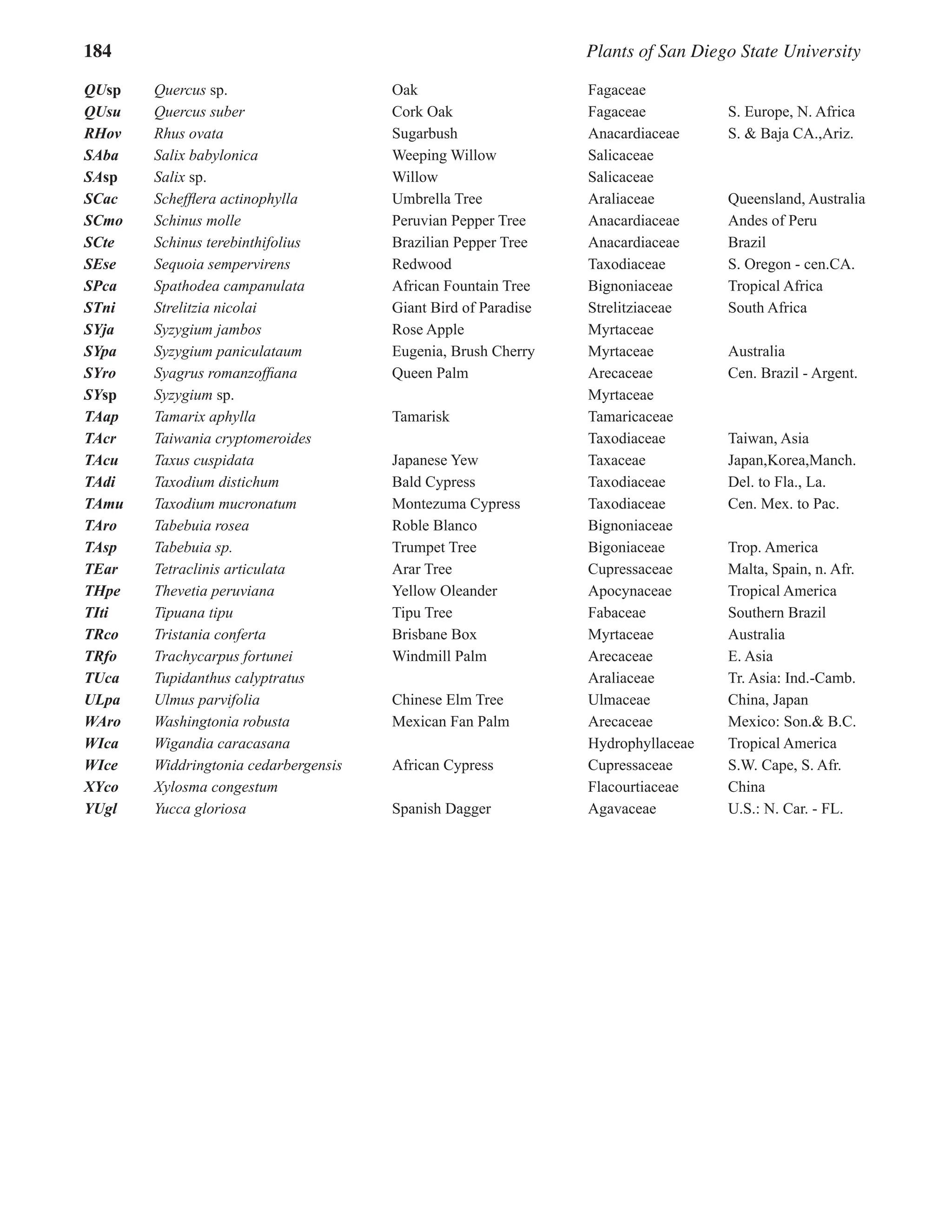
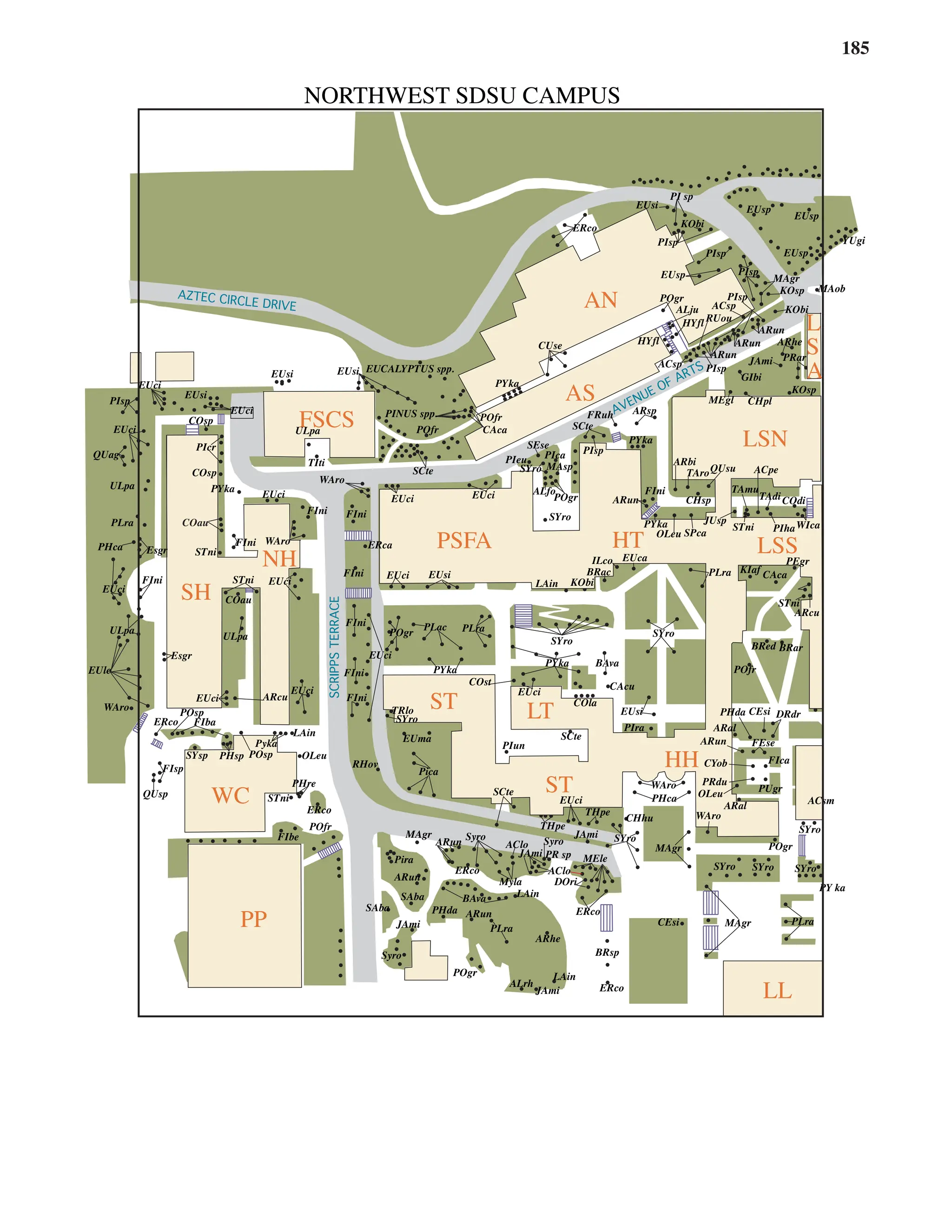
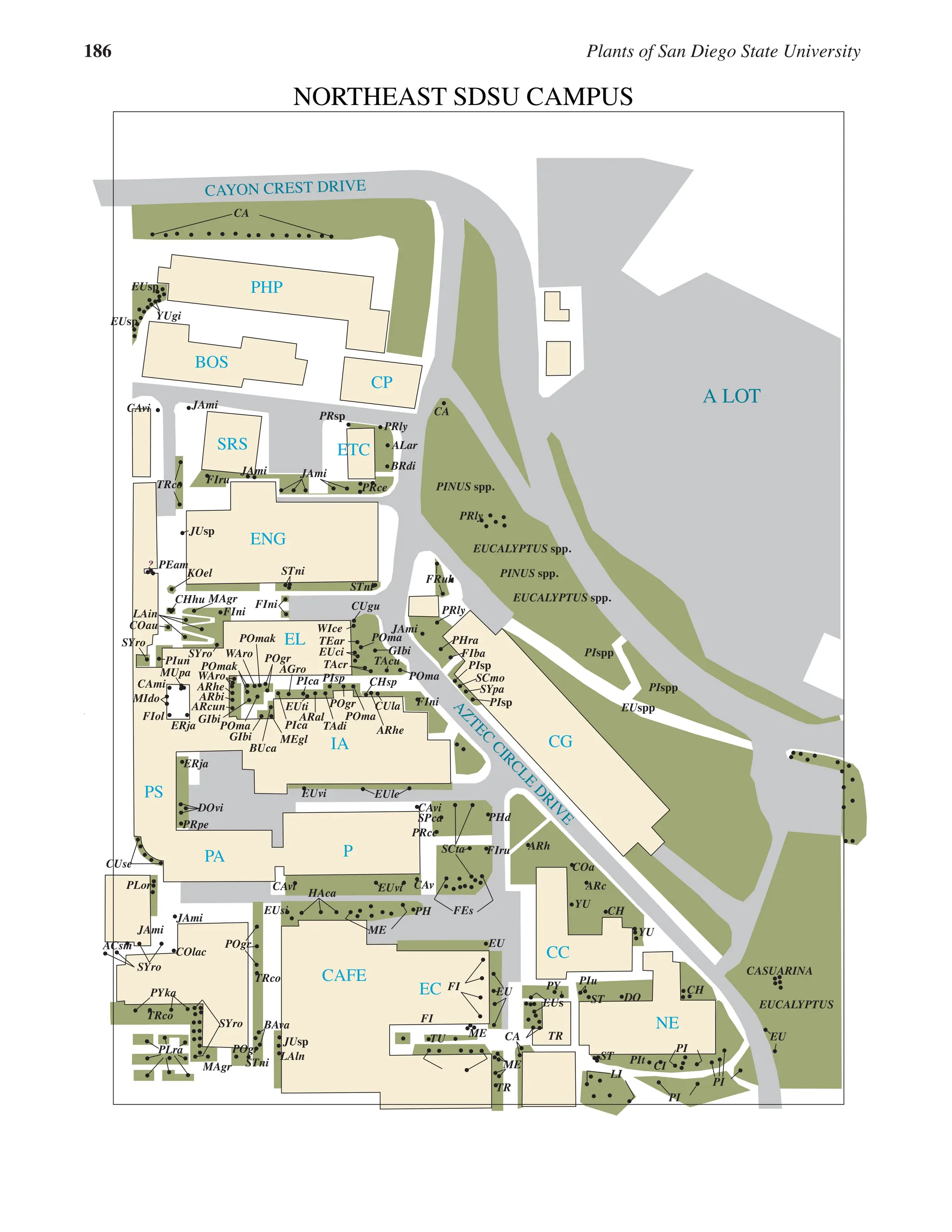
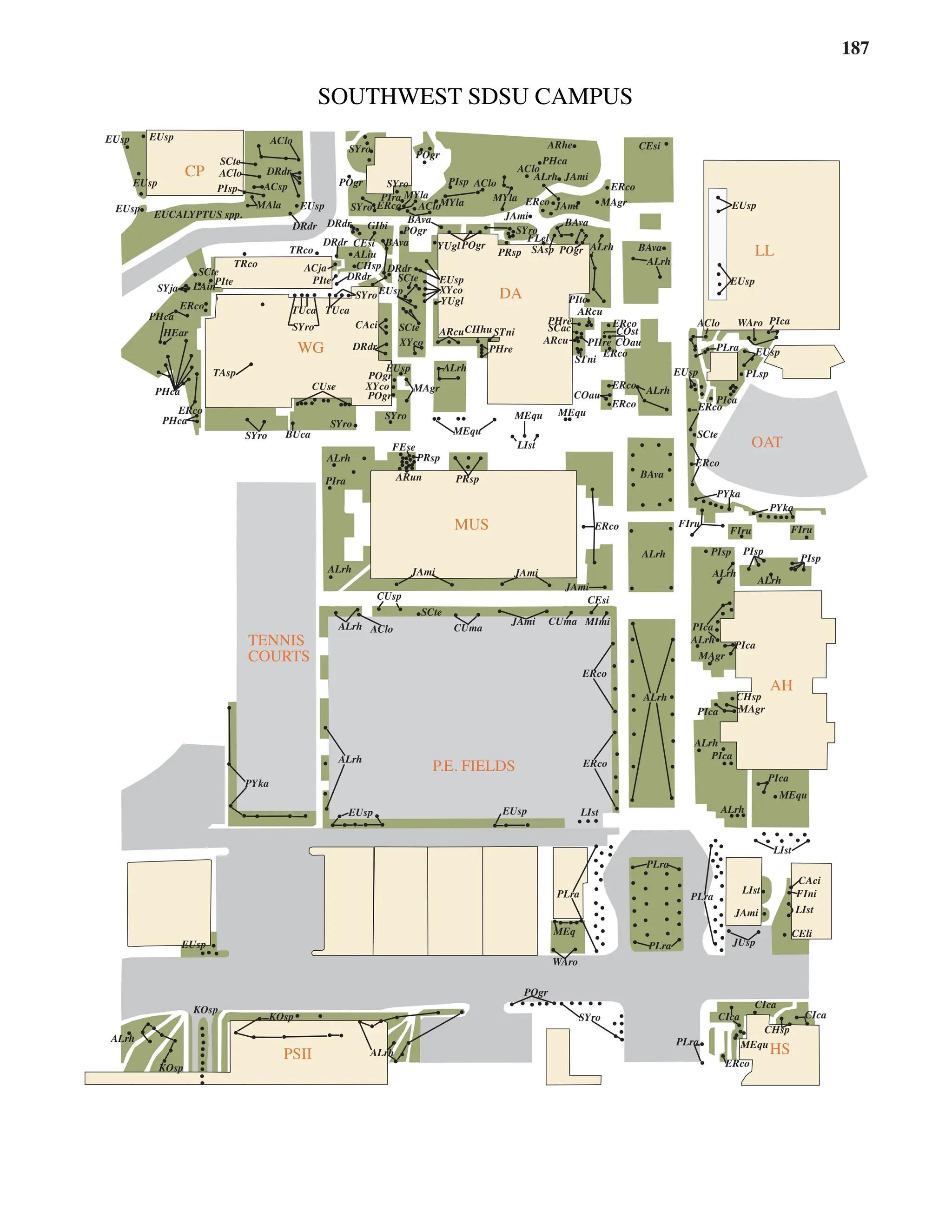
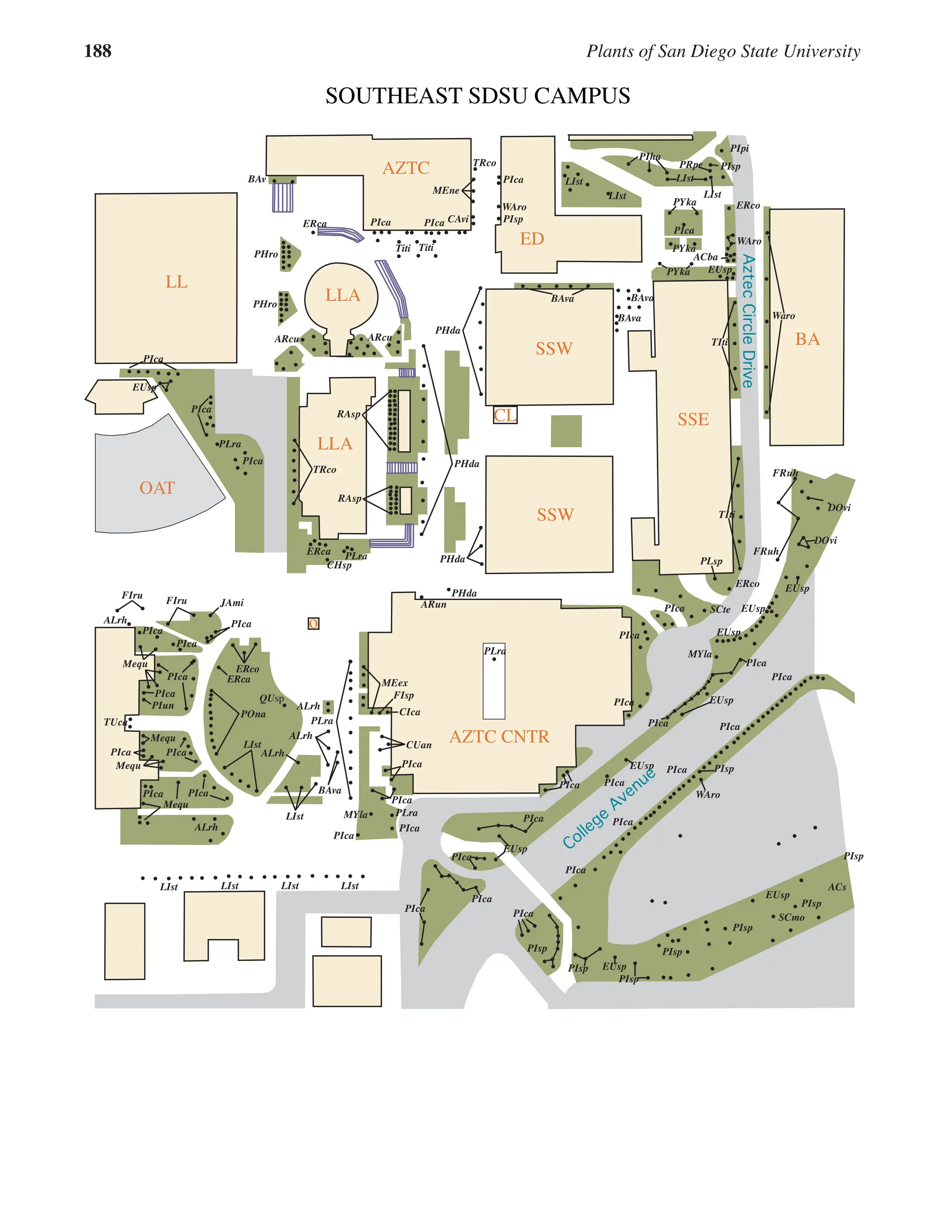
![189
CULTIVATED SHRUBS AND HERBS OF SAN DIEGO STATE UNIVERSITY
Acacia longifolia Fabaceae Australia
Acacia redolens Fabaceae Australia
Agapanthus africanus Lily-of-the-Nile Liliaceae Cape region, S. Afr.
Alocasia macrorhiza Araceae
Alyogyne huegelii [Hibiscus huegelii] Blue Hibiscus Malvaceae S. & W. Australia
Aspidistra elatior Cast-Iron Plant Liliaceae China
Asplenium daucifolium Spleenwort Polypodiaceae Mauritius,Reunion I.
Beloperone brandegeana Shrimp Plant Acanthaceae Mexico
Brahea edulis Guadelupe Palm Arecaceae Guadelupe Is., Mex.
Caesalpinia Fabaceae
Calliandra haematocephala Powderpuff Fabaceae Bolivia
Calodendrum capense Cape Chestnut Rutaceae S. Africa
Camellia sasanqua Camellia Theaceae China, Japan
Carissa grandiflora Natal Plum Apocynaceae Natal, S. Africa
Ceanothus thyrsiflorus Blue Brush Rhamnaceae N. CA.-S. Oregon
Chasmanthe aethiopica Iridaceae South Africa
Clivia miniata Kaffir Lily Amaryllidaceae South Africa
Clytostoma callistegioides Argentine Trumpet Vine Bignoniaceae S. Brazil, Argentina
Cordyline terminalis Ti Agavaceae e. Asia
Cotoneaster lacteus Rosaceae W. China
Cotoneaster pannosa Rosaceae SW China
Crytomium falcatum House Holly Fern Polypodiaceae Jap,China,S.Afr, Poly
Cycas revoluta Sago Palm Cycadaceae Java
Doxantha unguis-cati Cat’s Claw Bignoniaceae W. Indies to Argentina
Dracaena fragrans Corn Plant Agavaceae W. Africa: Upper Guinea
Dryopteris erythrosora Japanese Shield Fern Polypodiaceae China,Japan
Duranta repens Golden Dewdrop Verbenaceae W. Indies, Mex.-Brazil
Echium fastuosum Pride of Madiera Boraginaceae Coastal Eur.; Canary I.
Equisetum hyemale Equisetaceae
Feijoa sellowiana Pineapple Guava Myrtaceae South America
Furcraea sp. Agavaceae Brazil
Grewia occidentalis Lavender Star Flower Tiliaceae S. Africa
Harpullia pendula Tulipwood Sapindaceae E. Africa
Hedychium coronarium Butterfly-Lily Zingiberaceae India, Malaysia
Hibbertia scandens Guinea Gold Vine Dilleniaceae Australia
Hibiscus rosa-sinensis China-Rose Malvaceae China
Iva hayesiana Asteraceae San Diego Co.; Baja Ca.
Lantana camara Lantana Verbenaceae Trop. Amer. to TX, GA
Lantana montevidensis Trailing Lantana Verbenaceae S. Amer.
Lavatera assurgentiflora Malva Rose Malvaceae Santa Barbara Islands
Lonicera japonica var. halliana Hall’s Honeysuckle Caprifoliaceae E. Asia
Lonicera hildebrandiana Giant Honeysuckle Caprifoliaceae Myanmar (Burma)
Mahonia aquifolium Holly Mahonia, Barberry Berberidaceae Brit. Col.-Idaho;Oregon
Myrtus communis ‘Compacta’ Myrtle Myrtaceae W. Asia, Mediter.
Nandina domestica Heavenly Bamboo Beriberidaceae China, Japan
Nemesia fruticans Plantaginaceae
Nerium oleander Oleander Apocynaceae Mediterranean to Japan.](https://image.slidesharecdn.com/plsyslab-250719064702-ff141168/75/Plant-Systematics-laboratory-manual-techniques-193-2048.jpg)
![190 Plants of San Diego State University
Nephrolepis cordifolia Sword Fern Polypodiaceae Tropics and subtropics
Phaedranthus buccinatorius Blood Trumpet Vine Bignoniaceae Mexico
Philodendron selloum Araceae S. Brazil
Photinia fraseri Rosaceae S. & E. Asia
Phyllostachys aurea Golden Bamboo Poaceae China, Japan
Pittosporum rhombifolium Queensland Pittosporum Pittosporaceae Australia
Pittosporum tobira Mock Orange Pittosporaceae Australia
Pittosporum tobira var. variegatum Japanese Pittosporum Pittosporaceae China; Japan
Prunus cerasifera Pinaceae
Punica granatum Pomegranate Punicaceae S. Asia
Pyracantha sp. Firethorn Rosaceae SE Europe, Asia
Raphiolepis indica Indian Hawthorn Rosaceae S. China
Raphiolepis umbellata f. ovata Yeddo Hawthorn Rosaceae Japan, Korea
Saccharum officinarum Sugar Cane Poaceae prob. Asia or E. Indies
Solandra maxima Cup o’ Gold Solanaceae Mexico
Sphaeroptis cooperi Australian Tree Fern Cyatheaceae Australia
Strelitzia reginae Bird of Paradise Strelitziaceae South Africa
Syzygium paniculatum Australian Brush Cherry Myrtaceae Australia
Tabebuia rosea Rosy Trumpet Vine Bignoniaceae Mex. - Venez., Ecuador
Tecomaria capensis Cape Honeysuckle Bignoniaceae South Africa
Trachelospermum jasminoides Star Jasmine Apocynaceae China
Tupidanthus calyptratus Araliaceae India to Cambodia
Viburnum tinus Lauretinus Caprifoliaceae Mediterranean region
Wisteria sinensis Fabaceae China
General References on Cultivated Plants:
Bailey, L. H. 1951. Manual of Cultivated Plants. Macmillan Publishing Co., Inc., New York.
Bailey, L. H. 1976. Hortus Third. Macmillan Publishing Co., Inc., New York.
Graf, A. B. 1976. Exotica, Series 3. Pictorial cyclopedia of exotic plants from tropical and near-tropical regions. 9th ed.
Roehrs Company, Inc., E. Rutherford, New Jersey, U. S. A. [NOTE: A more updated version is available in the science
reference section of the library.]
Graf, A. B. 1986. Tropica. Color Cyclopedia of Exotic Plants and Trees. 3rd Edition. Roehrs Company, Inc., E. Ruther-
ford, New Jersey, U. S. A.
Ritter, M. 2011. A Californian’s Guide to the Trees Among Us. Heyday, Berkeley, California.](https://image.slidesharecdn.com/plsyslab-250719064702-ff141168/75/Plant-Systematics-laboratory-manual-techniques-194-2048.jpg)


![[123doc] - hinh-thai-giai-phau-thuc-vat-bai-giang-danh-cho-sinh-vien.pdf](https://cdn.slidesharecdn.com/ss_thumbnails/123doc-hinh-thai-giai-phau-thuc-vat-bai-giang-danh-cho-sinh-vien-250719064432-3107288d-thumbnail.jpg?width=640&height=640&fit=bounds)


![[123doc] - kha-nang-bieu-hien-tinh-trang-cua-gen-ppt.pdf](https://cdn.slidesharecdn.com/ss_thumbnails/123doc-kha-nang-bieu-hien-tinh-trang-cua-gen-ppt-231221090444-2b41e47c-thumbnail.jpg?width=640&height=640&fit=bounds)
![[123doc] - bai-giang-cong-nghe-gen.ppt](https://cdn.slidesharecdn.com/ss_thumbnails/123doc-bai-giang-cong-nghe-gen-231221090244-3bf26b2e-thumbnail.jpg?width=640&height=640&fit=bounds)


