UNIVERSITY OF TURBAT
DEPARTMENT OF BOTANY
SIMM J AN
Presented By: Keenagi Rasheed
• Plant Taxonomy:
OR
plant systematic:
Combination of two words
Taxa=arrangement
Nomy= rules and regulations.
Definition: it is the branch of botany that deal with
the identification, nomenclature and classification of plants.
Systematic: is the study of taxonomy
SIMM J AN
Identification:
placing of new organisms into previously described group.
OR
It is the assigning of particular plants into a particular group.
Plants are identified in two ways:
1. plants are identified by matching it with a already identified
plants. Or it could be new of science
2. plants are identified on the basis of floras or monograph.
Nomenclature:
naming of plants according to certain rules and regulations
For plants international code for botanical nomenclature(ICBN) is
responsible
SIMM J AN
Classification:
placing of plants into group
Classification is based on the similarities of plant i.e the plants which share
common characters are placed in a same group.
Levels of classification
• Division
• Class
• Order
• Family
• Genus
• species
SIMM J AN
• Number of species with common characters are placed in genus
• Number of Genra are placed in a family
• Number of family form order
• Number of orders form class
• Number of class form division
Samilarties increases from division to species and decreases from species to
division.
Species:
Population of individuals with same in morphological and reproductive
characters so that they can interbreed with each other.
SIMM J AN
Species concept:
1. Morphological species concept:
species is the group of organisms which can be differentiated using
morphological characteristics.
2. Biological species concept:
using reproductive biology to define species.
population group which is able to breed but prevented from gene
exchange with population of other species.
3. Texonomical species concept:
any species which is having similarities or dissimilarities on the basis of
continuous or discontinuous variations
SIMM J AN
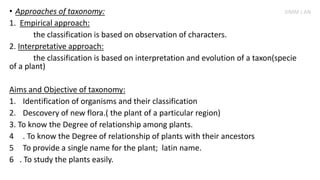
• Approaches of taxonomy:
1. Empirical approach:
the classification is based on observation of characters.
2. Interpretative approach:
the classification is based on interpretation and evolution of a taxon(specie
of a plant)
Aims and Objective of taxonomy:
1. Identification of organisms and their classification
2. Descovery of new flora.( the plant of a particular region)
3. To know the Degree of relationship among plants.
4 . To know the Degree of relationship of plants with their ancestors
5 To provide a single name for the plant; latin name.
6 . To study the plants easily.
SIMM J AN
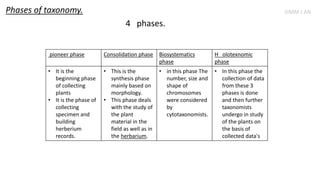
Phases of taxonomy.
4 phases.
pioneer phase Consolidation phase Biosystematics
phase
H olotexnomic
phase
• It is the
beginning phase
of collecting
plants
• It is the phase of
collecting
specimen and
building
herberium
records.
• This is the
synthesis phase
mainly based on
morphology.
• This phase deals
with the study of
the plant
material in the
field as well as in
the herbarium.
• in this phase The
number, size and
shape of
chromosomes
were considered
by
cytotaxonomists.
• In this phase the
collection of data
from these 3
phases is done
and then further
taxonomists
undergo in study
of the plants on
the basis of
collected data's
SIMM J AN
• Components of taxonomy:
1. Alpha taxonomy:
It is study of morphology of the plants and first and second phase lie in this
component.
2. Omega taxonomy:
it is the study of plants at cell level and also in morphologically and 3rd and 4
phase are in here.
the best concept of alpha- omega taxonomy is the alpha form the basis of plant
taxonomy while the final data are analysis in omega taxonomy.
SIMM J AN
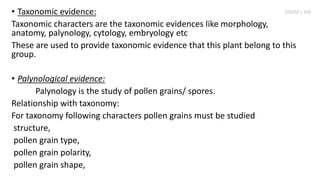
• Taxonomic evidence:
Taxonomic characters are the taxonomic evidences like morphology,
anatomy, palynology, cytology, embryology etc
These are used to provide taxonomic evidence that this plant belong to this
group.
• Palynological evidence:
Palynology is the study of pollen grains/ spores.
Relationship with taxonomy:
For taxonomy following characters pollen grains must be studied
structure,
pollen grain type,
pollen grain polarity,
pollen grain shape,
SIMM J AN
pollen grain symmetry,
pollen grain nuclear state,
pollen grain apperature,
pollen grain position
Sporoderm
etc.
Pollen grains:
are the male reproductive cell of a flowering plant.
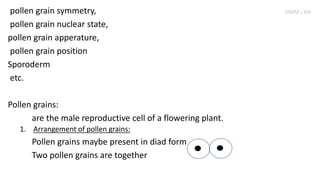
1. Arrangement of pollen grains:
Pollen grains maybe present in diad form
Two pollen grains are together
SIMM J AN
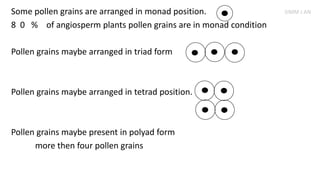
Some pollen grains are arranged in monad position.
8 0 % of angiosperm plants pollen grains are in monad condition
Pollen grains maybe arranged in triad form
Pollen grains maybe arranged in tetrad position.
Pollen grains maybe present in polyad form
more then four pollen grains
SIMM J AN
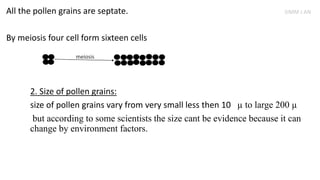
All the pollen grains are septate.
By meiosis four cell form sixteen cells
2. Size of pollen grains:
size of pollen grains vary from very small less then 10 µ to large 200 µ
but according to some scientists the size cant be evidence because it can
change by environment factors.
meiosis
SIMM J AN
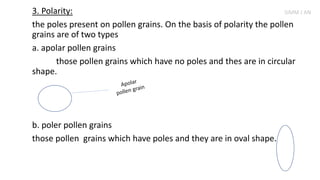
3. Polarity:
the poles present on pollen grains. On the basis of polarity the pollen
grains are of two types
a. apolar pollen grains
those pollen grains which have no poles and thes are in circular
shape.
b. poler pollen grains
those pollen grains which have poles and they are in oval shape.
SIMM J AN
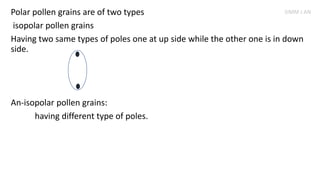
Polar pollen grains are of two types
isopolar pollen grains
Having two same types of poles one at up side while the other one is in down
side.
An-isopolar pollen grains:
having different type of poles.
SIMM J AN
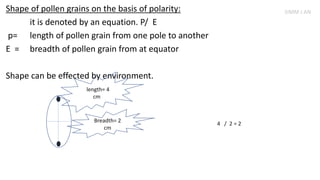
Shape of pollen grains on the basis of polarity:
it is denoted by an equation. P/ E
p= length of pollen grain from one pole to another
E = breadth of pollen grain from at equator
Shape can be effected by environment.
Llength= 4
cm
Breadth= 2
cm
4 / 2 = 2
SIMM J AN
4 . Symmetry:
a pollen grain maybe asymmetric because can’t be divided in equal halves
Pollen grain maybe symmetric when it can be divided in equal halves.
5. Aperture:
a place where pollen tube arises. And the aperature differ in shape, siz e,
positions etc.
Aperature helps the pollens to reach to ovary and then fuse.
Position of aperture maybe polar, equatorial or global.
polar equatorial global
SIMM J AN
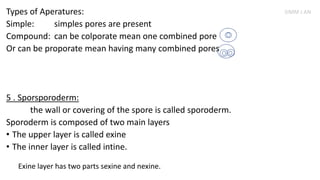
Types of Aperatures:
Simple: simples pores are present
Compound: can be colporate mean one combined pore
Or can be proporate mean having many combined pores
5 . Sporsporoderm:
the wall or covering of the spore is called sporoderm.
Sporoderm is composed of two main layers
• The upper layer is called exine
• The inner layer is called intine.
Exine layer has two parts sexine and nexine.
SIMM J AN
Roles of palynology in taxonomy:
1. stanopalynous:
in many taxons the type of pollen grains is characteristic and constant
mean no variation occurs from species to family then these are called
stanoplynous or unipalynous families.
2. eurypalynous:
the type of taxon in wich the siz e, aperature etc, of pollen grains vary
considerably. Then these families are termed at eurypalynous or
multipalyunous.
SIMM J AN
Taxonomic status of bombax ceiba (cotton tree)
1. At family level;
they have one type of stemen attached together.
due to this character it was placed in malvaceae family
But due to some differences like the pollen grains of malvaeae family are
spherical, apolar, large polyporate etc. while the pollen grains of bombax ceiba
are polar, small .triporate etc.
so then the bombax ceiba was kept in bombaceae family.
SIMM J AN
Taxonomic status of brassospora or trisyngyne specie
At generic level.
produce unisexual flowers so on the basis of unsexual trisyngyne specie
was kept in euphorbiaceae family.
but
the family euphorbiaceae family have compound aperture while the
trysyngyne species have simple aperture so then due to difference the
trisyngyne species was kept in Fagaceae family.
SIMM J AN
• Chemical evidence of plants:
Also called chemotaxonomy or or chemosystematics or chemical evidence :
Definition:
the classification of plants on the basis of chemical contents.
The composition of chemicals differ from species to species.
E. .G:
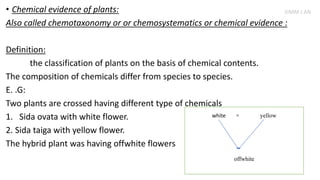
Two plants are crossed having different type of chemicals
1. Sida ovata with white flower.
2. Sida taiga with yellow flower.
The hybrid plant was having offwhite flowers
white × yellow
offwhite
SIMM J AN
The next generation was diierent in colour because of the chemicals in parents
Like ovata sida plant contain dehplidine and ovata taiga contain the chemical
cytnnidin so the hybrid one was having deliphicyanonidin due to this the offspring
was differ in colour with its parents
Techniques used in chemtaxonomy:
1. chromatography:
a technique used for the separation of a mixture.
2. Paper chromatography:
technique used for the separation of the dissolved chemicals across a sheet of
paper.
3. Glass chromatography:
used for the separation of chemicals that can be vaporized.
Another technologies are also used in the field of chemotaxonomy
Like: amino acid sequencing electrophoresis, etc
SIMM J AN
Arrangement of plants on the basis of chemicals:
1. Poisonous plants:
those plants which which are toxic for animals
e. g: rosaery pea:
chemical contained arbin and arbic acid.
2. Medication plants:
those plants which are used for the making of medicines and for the
treatment of diseases.
e. g: cocaine
Chemical contained erythroxylum coca
3. Edible plants:
Those plants which are digested by animals. E g: tomato plant
SIMM J AN
Due to this arrangement two theory was purposed.
1. Those plants which are same in appearance they do same work.
but this theory was rejected.
Because there is some plants which are same in appearance but have different
work like in family papilionaceae one specie is eatable while the other one is
poisonous .
2. This theory state that the appearance of plants is directly related to the
treatment of human organs. i.e liverworts for liver disease anf cordrate leaves
for heart diseases.
This theory was also rejected.
SIMM J AN
Why chemicals are useful for plant taxonomy?
Because the chemical of plant show limited distribution likethe flower of a species have same
chemicals also the flower of other species contain the same chemicals so it is the best mark
for taxonomists to identify the plants easily.
and the chemicals of the plants do not change.
Types of chemicals in plants.
1. Primary metabolites:
Primary metabolites are the product of life related metabolic pathways so due
to lack of variations in these substances so they do not have any systematic value because
they are found in all plants
e.g: chlorophyll, xanthophyll etc
2. Secondary metabolites:
they are found in limited distribution and do not change and produce by non vital
processes. Because of their limited distribution they have a grat value in taxonomy
e. g: phenol, alchol and oil.
3. semantides:
these are the information carrying molecules i.e DNA,RNA and Proteins
The molecules help in taxonomical evidence.
SIMM J AN
• Cytological evidence
or
cytology in relation to taxonomy:
cytology is the study of cell.
Evidence characters of cytology in relation to taxonomy are the
chromosomes number
Structure
chromosomes
meiotic behavior,
ploidy level
type etc
SIMM J AN
1. Chromosomes number:
There are three types of chromosomes
• H aploid chromosomes
these chromosomes are found in germ cells. Denoted by (n)
• Diploid chromosomes:
Found in sporophytic cells. Denoted by (2)
• Polypolid chromosomes:
• Found in joint cells, more then two sets of chromosomes.
• E g: lemon big siz e
SIMM J AN
Classification of plants on the basis of chromosomes No.
haplopappus gracilis 12 24
Morus alba 15 2 30 4
kalonchea 25 0 5 00 0
plant haploid diploid
SIMM J AN
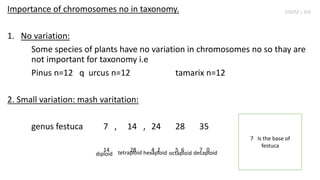
Importance of chromosomes no in taxonomy.
1. No variation:
Some species of plants have no variation in chromosomes no so thay are
not important for taxonomy i.e
Pinus n=12 q urcus n=12 tamarix n=12
2. Small variation: mash varitation:
genus festuca 7 , 14 , 24 28 35
14 28 4 2 5 6 7 0
diploid tetraploid hexaploid octaploid decaploid
7 Is the base of
festuca
SIMM J AN
Occurrence of polyploid:
Polypoid is rare in bryophytes whiles it is common in pteridophytes and 20 to
50%
Occur in angiosperms and gymnosperms
Types of polyploidy
1. autopolyploid:
It is defined as the doubling of the same chromosome occur in same specie.
2. alloploid:
alloploid occur by the hyperdization of two species.
3. Segmented alloploid:
occur due to the same gametes
SIMM J AN