Armen Takhtajan was a Russian botanist who developed an influential system of classification for flowering plants (angiosperms) based on evolutionary relationships. He divided angiosperms into two classes - dicots and monocots - which he further divided into subclasses, superorders, and orders. Takhtajan considered multiple lines of evidence and developed criteria for determining evolutionary relationships between taxa. His system is praised for its small, homogeneous taxonomic units but criticized for overly narrowly defining some groups.
Armen Takhtajanwas born in 1910 and died in
2009
Armen takhtajan who is the head of the
department of higher plants at the komarov
botanical institute in Leningrad, Russia, presented
a system of classification, which was first
published in a very preliminary form in 1942
Takhtajan was inspired by hailier’s attempt to
create a synthetic evolutionary classification of
flowering plants based on darwinian philosophy
and his approach is very much similar to that of
Cronquist
Takhtajan’s system of classification is basically of
Bessey-Hallier tradition which considerd all
evidences from different fields including
morphological, anatomical, embryological, cytol
ogical, palynological, paleobotanical, chemical
and ultrastructural evidences while classifying
angiosperms
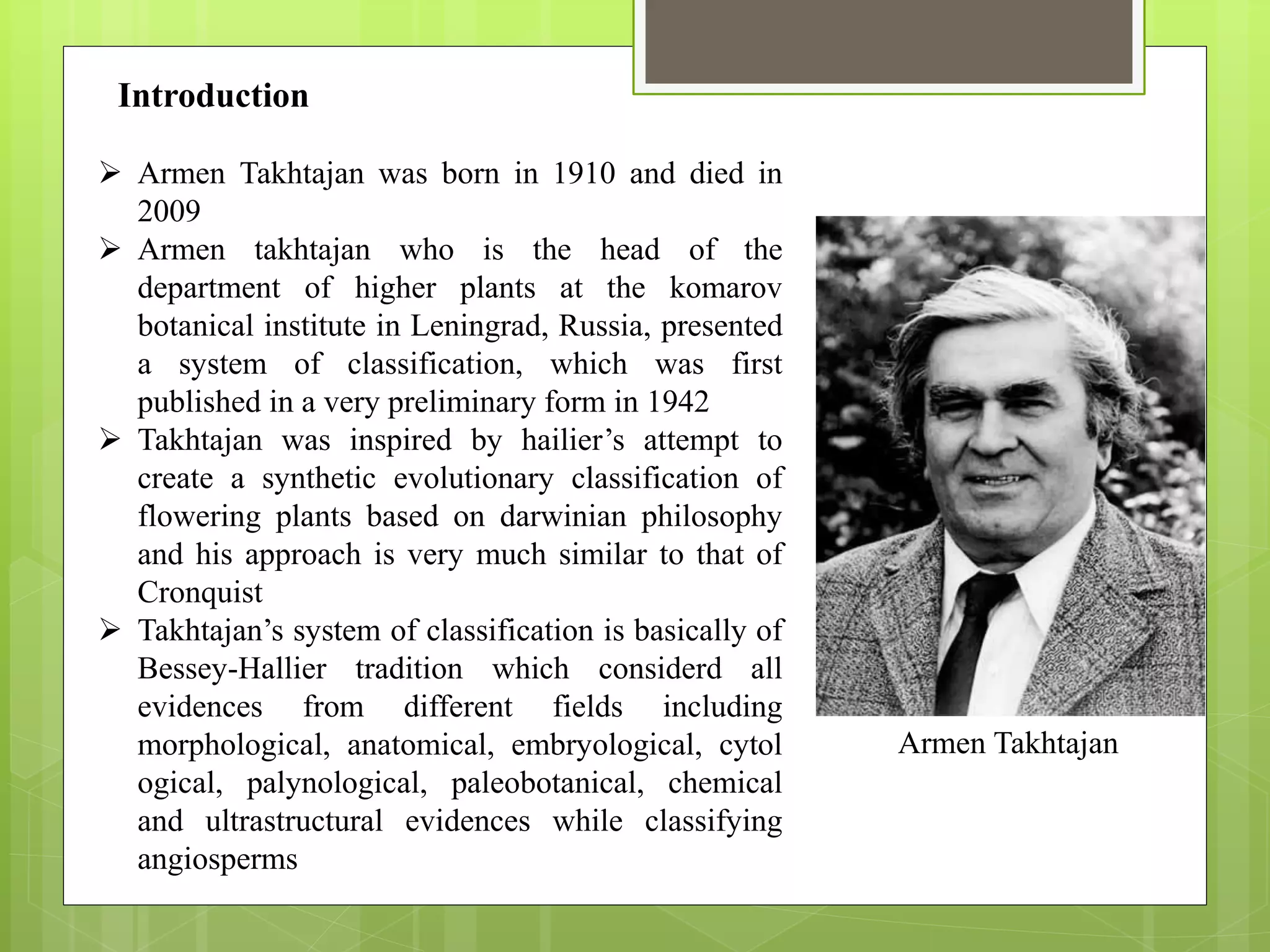
Armen Takhtajan
Introduction
3.
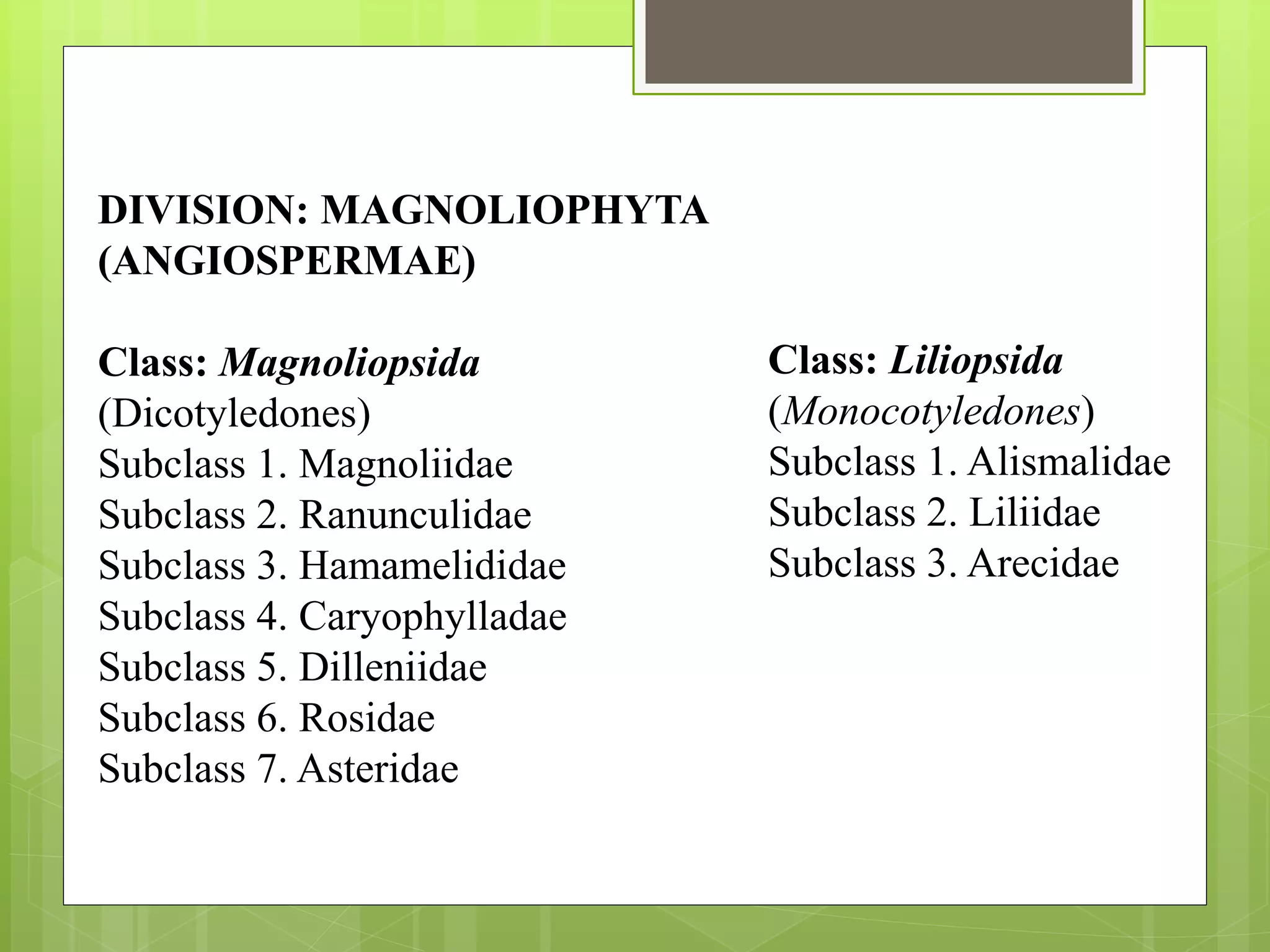
Takhtajan dividedMagnoliophyta (= Angiospermae) into two classes—
Magnoliopsida (Dicots) and Liliopsida (Monocots).
He further divided Magnoliopsida into 7 subclasses, 20 superorders and 71
orders, and Liliopsida into 3 subclasses, 8 superorders, and 21 orders.
Takhtajan (1980) recognizes a total of 92 orders and 410 families among
angiosperms. An outline of his classification up to the level of orders is
undermentioned
Classification
(i) Woody plantsare primitive compared to herbaceous plants;
(ii) Deciduous woody plants are evolved from evergreen plants;
(iii) Parallel venation is most advanced;
(iv) Most primitive leaf arrangement is alternate;
(v) Stomata with subsidiary cells are primitive while those lacking
subsidiary cells are advanced;
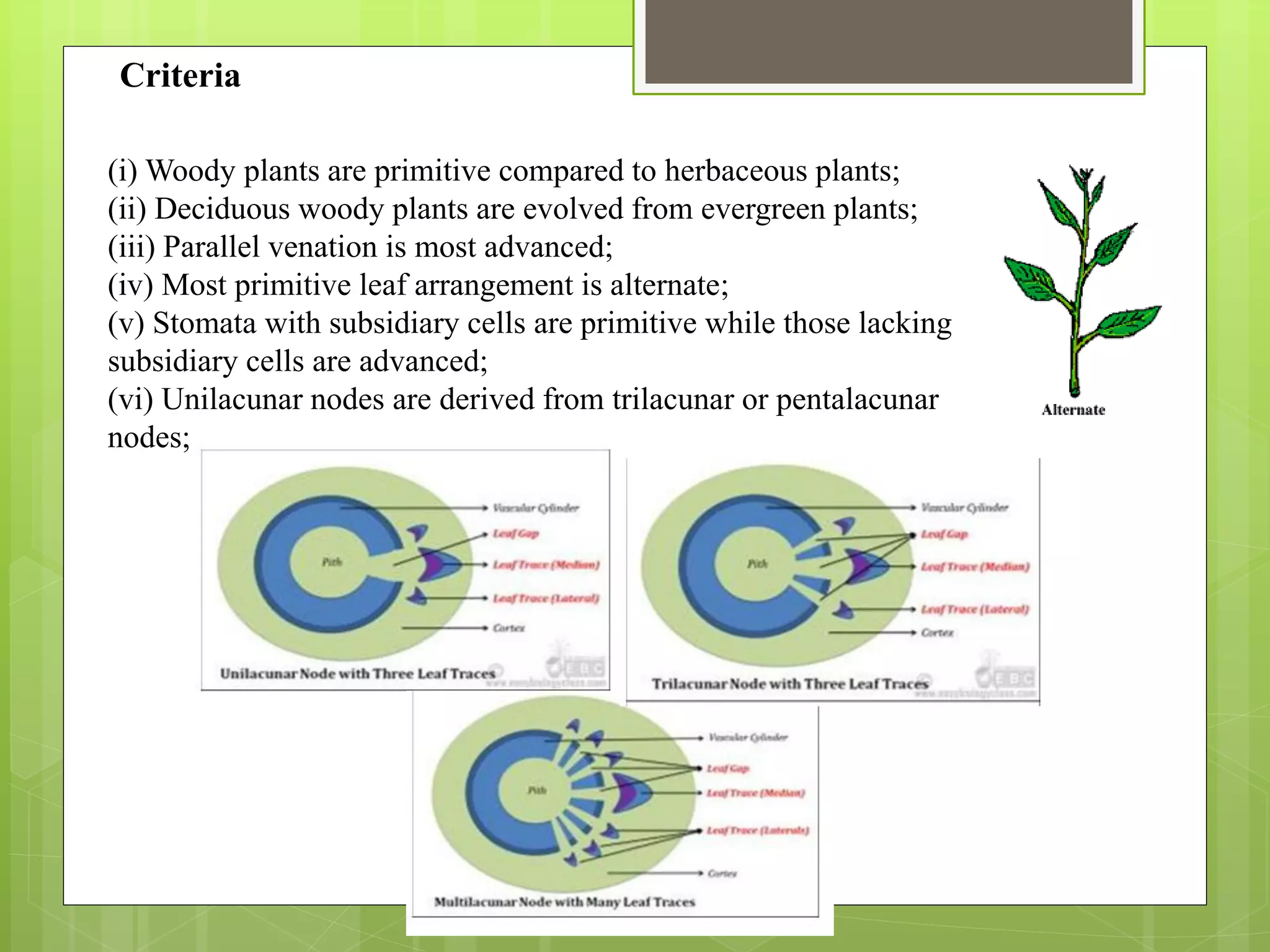
(vi) Unilacunar nodes are derived from trilacunar or pentalacunar
nodes;
Criteria
6.
(vii) Xylem fibresevolved from tracheids to libriform fibres, through fibre
tracheids;
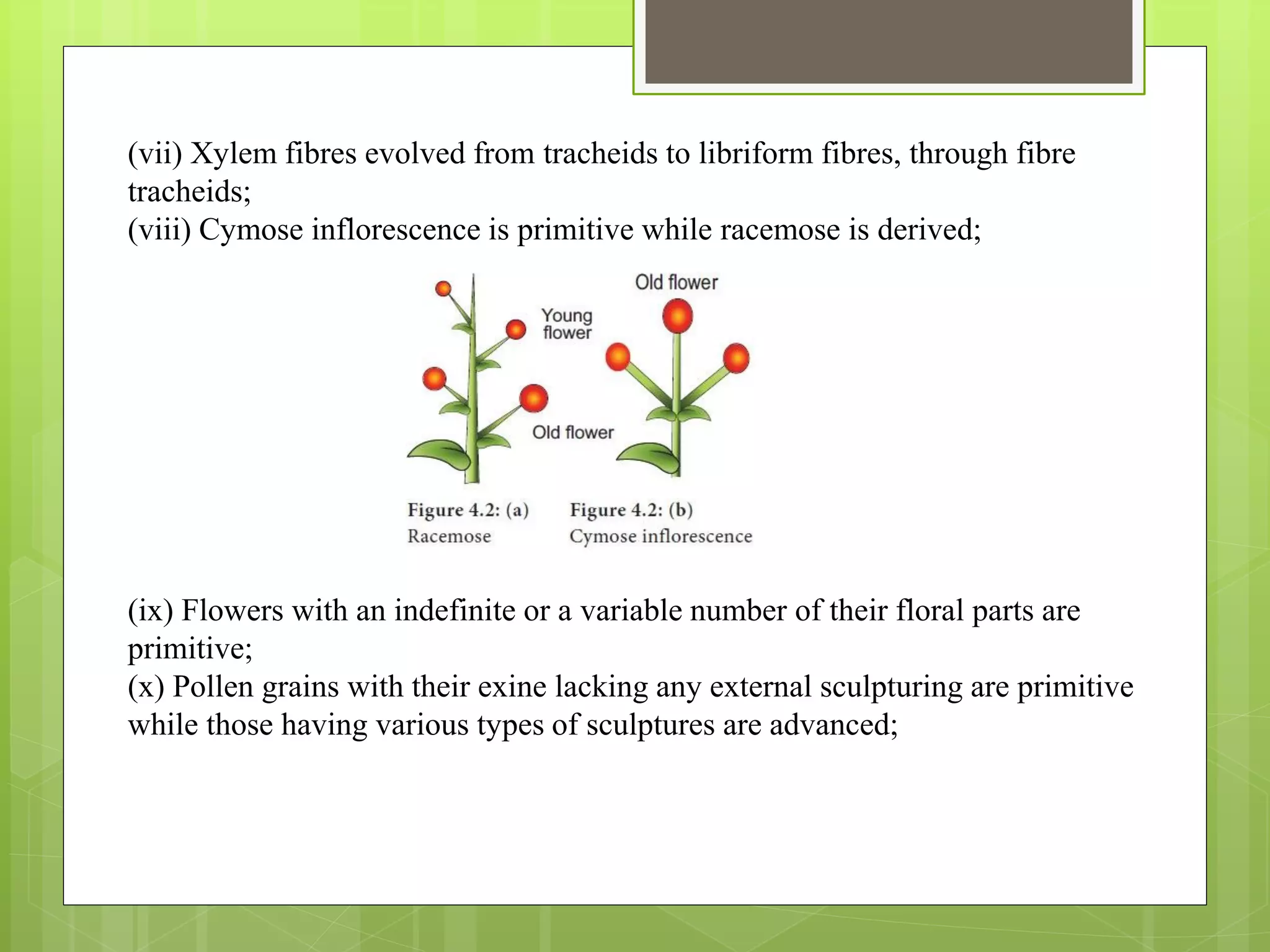
(viii) Cymose inflorescence is primitive while racemose is derived;
(ix) Flowers with an indefinite or a variable number of their floral parts are
primitive;
(x) Pollen grains with their exine lacking any external sculpturing are primitive
while those having various types of sculptures are advanced;
7.
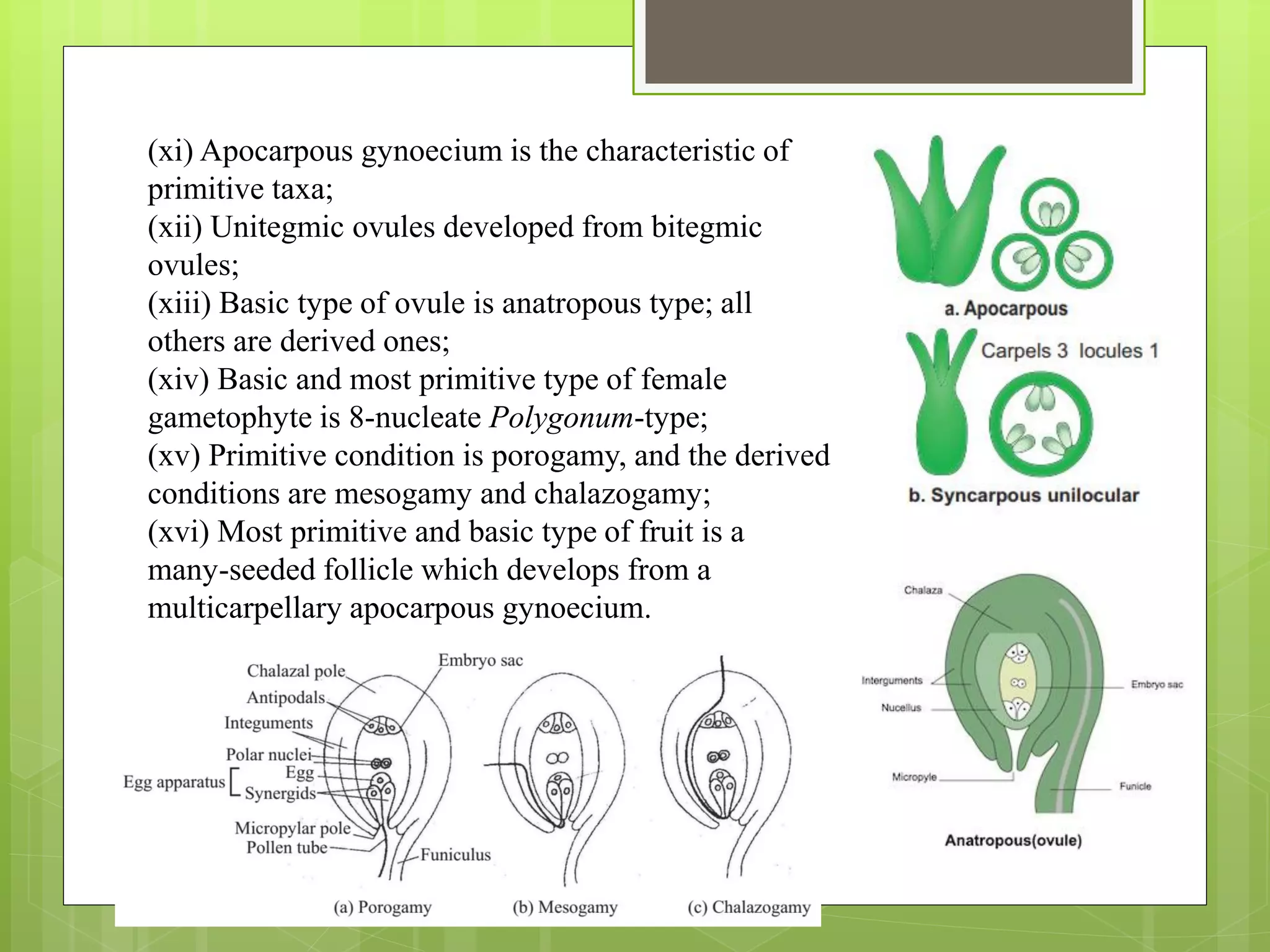
(xi) Apocarpous gynoeciumis the characteristic of
primitive taxa;
(xii) Unitegmic ovules developed from bitegmic
ovules;
(xiii) Basic type of ovule is anatropous type; all
others are derived ones;
(xiv) Basic and most primitive type of female
gametophyte is 8-nucleate Polygonum-type;
(xv) Primitive condition is porogamy, and the derived
conditions are mesogamy and chalazogamy;
(xvi) Most primitive and basic type of fruit is a
many-seeded follicle which develops from a
multicarpellary apocarpous gynoecium.
8.
Merits of theSystem of Takhtajan
1. Dicots (Magnoliopsida) are discussed prior to monocots (Liliopsida).
2. Dicots begin with the Magnoliales which are universally considered to be the
most primitive living angiosperms.
3. In this system the families are small homogeneous units made up of closely
related genera.
4. Division of Dicots into two traditional groups of Engler and Prantl, i.e.
Archichlamydae and Metachlamydae, has been abolished in this system.
5. Alismatales, which are considered to be the most primitive living monocots
these days, are the starting point of monocots in this system.
Demerit of the System of Takhtajan
One strong demerit is the extremely narrowly defined taxa in this system that has
resulted in the unwarranted splitting of the related groups.