MATTER AND ITS PROPERTIES
Branches of Chemistry
 Organic Chemistry- is the study of the compounds of
carbon.
 Inorganic Chemistry – is the study of all elements and
compounds other than organic compounds.
 Physical Chemistry – is the study of the theoretical
aspects of the structure and changes of matter.
 Analytical Chemistry – is the study of what is present
and how much is present.
 Biochemistry – is the study of the chemistry of
biologically important elements and compounds.
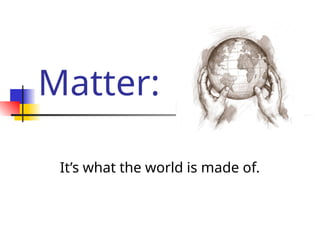
Matter:
It’s what the world is made of.
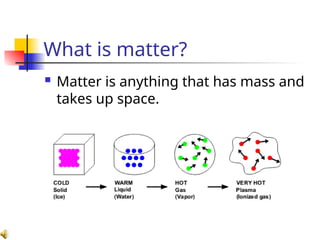
What is matter?
 Matter is anything that has mass and
takes up space.
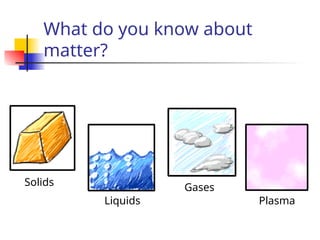
What do you know about
matter?
Solids
Liquids
Gases
Plasma
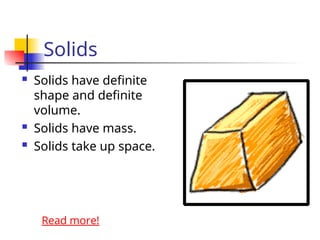
Solids
 Solids have definite
shape and definite
volume.
 Solids have mass.
 Solids take up space.
Read more!
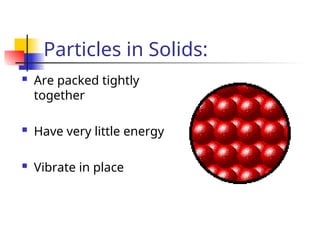
Particles in Solids:
 Are packed tightly
together
 Have very little energy
 Vibrate in place
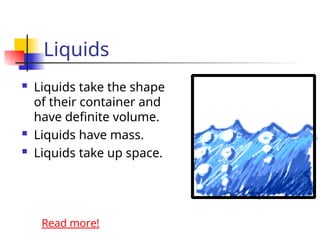
Liquids
 Liquids take the shape
of their container and
have definite volume.
 Liquids have mass.
 Liquids take up space.
Read more!
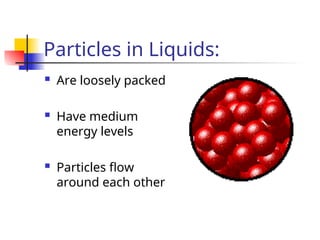
Particles in Liquids:
 Are loosely packed
 Have medium
energy levels
 Particles flow
around each other
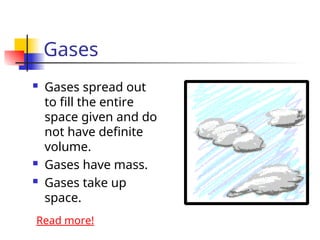
Gases
 Gases spread out
to fill the entire
space given and do
not have definite
volume.
 Gases have mass.
 Gases take up
space.
Read more!
Particles in Gases:
 Move freely
 Have LOTS of
energy
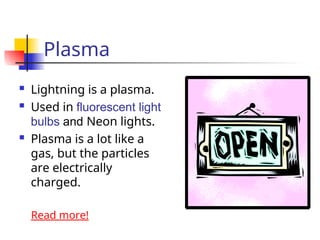
Plasma
 Lightning is a plasma.
 Used in fluorescent light
bulbs and Neon lights.
 Plasma is a lot like a
gas, but the particles
are electrically
charged.
Read more!
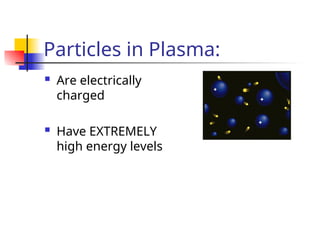
Particles in Plasma:
 Are electrically
charged
 Have EXTREMELY
high energy levels
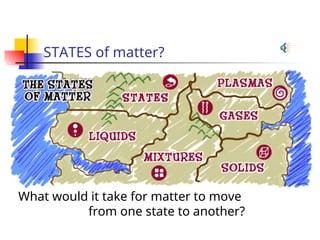
STATES of matter?
What would it take for matter to move
from one state to another?
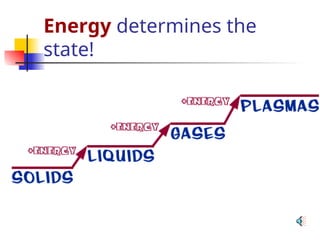
Energy determines the
state!
Properties
- are the specific characteristics that
describe matter
 Matter can be identified using its specific properties
 All matter has the general properties of mass,
weight, volume, and density
 Other properties are physical or chemical
– Physical: Does not change the identity of the
matter
– Chemical: Changes the matter in determining
the property
 A property describes how an object looks, feels, or
Physical vs. Chemical
 Physical properties: observe without
changing the identity of the
substance
 Chemical properties: observe only
when the identity changes
 How do you know if it is chemical or
physical? – If it CHanges, it’s
CHemical
Physical properties
• Physical properties can be observed or
measured without changing the identity of
the matter.
• Basically, properties you notice when using
one of your five senses:
– Feel - mass, volume, texture
– Sight - color
– Hear
– Smell
– Taste
Some Physical Properties
• Boiling Point – Temperature that substance turns from a liquid to a
gas
• Color
• Conductivity – How easily electrical current and heat pass through an
object
• Density – Relative mass to volume
• Ductility – How easily something bends
• Freezing Point – Temperature that a substance turns from a liquid to a
solid
• Hardness
• Luster – How shiny something is
• Malleability – How easily something can be flattened into a sheet
• Mass – Measure of how much matter there is
• Melting Point- Temperature that a substance turns from a solid to a
liquid
• Odor
• Solubility – How easily something dissolves
The physical properties of matter are further
classified into
 Intensive Properties
Independent of the amount of the substance that
is present.
Examples: Density, boiling point, color, etc.
 Extensive Properties
Dependent upon the amount of the substance
present.
Examples: Mass, volume, energy, etc.
Chemical properties
A common chemical property is reactivity.
–Reactive to oxygen
–Reactive to air
–Reactive to water…
• Notice that chemical properties aren’t
EASY to observe, unlike physical
properties
Physical Change
- A change that only involves a
transformation in the physical
properties of a substance.
1. Increase or decrease in a physical property, for
example, mass, volume, temperature, and pressure.
2. Change in state of matter brought about by absorbing
or releasing a certain amount of energy characterized
by a corresponding change in temperature.
a. Melting is the change from solid to liquid.
b. Freezing or solidification is the change from liquid to
solid.
c. Vaporization or evaporation is the change from liquid
to gas.
d. Condensation is the change from gas to liquid.
e. Sublimation is the change from solid to gas without
passing the liquid state.
f. Deposition is the change from gas to solid without
passing the liquid state.
g. Ionization is the change from gas to plasma.
h. Deionization or recombination is the change from
Some examples of
physical changes are as
follows:
Chemical Change
- A change that involves formation
of a new substance.
- A chemical change is actually a
chemical reaction.
Examples:
burning of paper, rusting of
metal, ripening of fruits, and
decomposition of dead bodies.
Indicators of a chemical
change
1. Production of a new detectable
substance
2. Evolution of gas; production of
precipitates, production of
bubbles
3. Change in temperature
4. Production of light
5. Change in color or odor.
CLASSIFICATION OF
MATTER
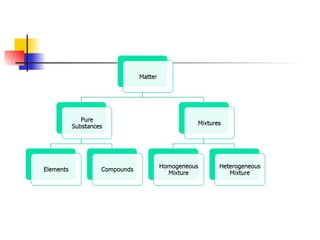
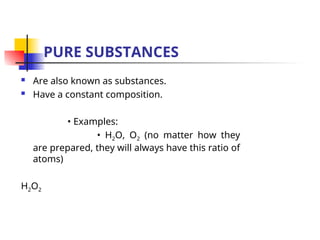
PURE SUBSTANCES
 Are also known as substances.
 Have a constant composition.
• Examples:
• H2O, O2 (no matter how they
are prepared, they will always have this ratio of
atoms)
H2O2
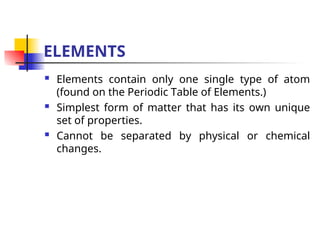
ELEMENTS
 Elements contain only one single type of atom
(found on the Periodic Table of Elements.)
 Simplest form of matter that has its own unique
set of properties.
 Cannot be separated by physical or chemical
changes.
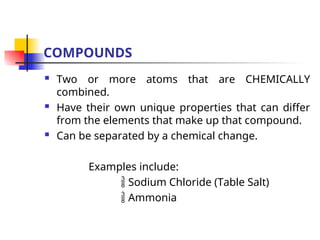
COMPOUNDS
 Two or more atoms that are CHEMICALLY
combined.
 Have their own unique properties that can differ
from the elements that make up that compound.
 Can be separated by a chemical change.
Examples include:
 Sodium Chloride (Table Salt)
 Ammonia
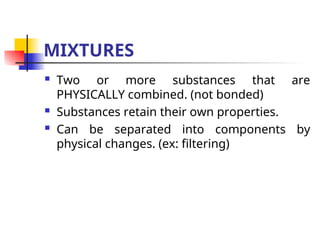
MIXTURES
 Two or more substances that are
PHYSICALLY combined. (not bonded)
 Substances retain their own properties.
 Can be separated into components by
physical changes. (ex: filtering)
HETEROGENEOUS MIXTURE
 An uneven mixture of particles
 Have visible differences
 Are easily separated by filtration.
Examples include:
 Sand and Water
 Oil and Water
 Salt & Pepper
HOMOGENEOUS MIXTURE
 Have no visible differences until you reach the
atomic or molecular level.
 Also known as solutions
 Can be separated back into the pure substances
Examples include:
 Air
 Salt water
 Tap Water
 Metal Alloys (brass, sterling
silver, or steel)

...........Matter-and-Its-Properties.ppt

  • 1.
    MATTER AND ITSPROPERTIES
  • 2.
    Branches of Chemistry Organic Chemistry- is the study of the compounds of carbon.  Inorganic Chemistry – is the study of all elements and compounds other than organic compounds.  Physical Chemistry – is the study of the theoretical aspects of the structure and changes of matter.  Analytical Chemistry – is the study of what is present and how much is present.  Biochemistry – is the study of the chemistry of biologically important elements and compounds.
  • 3.
    Matter: It’s what theworld is made of.
  • 4.
    What is matter? Matter is anything that has mass and takes up space.
  • 5.
    What do youknow about matter? Solids Liquids Gases Plasma
  • 6.
    Solids  Solids havedefinite shape and definite volume.  Solids have mass.  Solids take up space. Read more!
  • 7.
    Particles in Solids: Are packed tightly together  Have very little energy  Vibrate in place
  • 8.
    Liquids  Liquids takethe shape of their container and have definite volume.  Liquids have mass.  Liquids take up space. Read more!
  • 9.
    Particles in Liquids: Are loosely packed  Have medium energy levels  Particles flow around each other
  • 10.
    Gases  Gases spreadout to fill the entire space given and do not have definite volume.  Gases have mass.  Gases take up space. Read more!
  • 11.
    Particles in Gases: Move freely  Have LOTS of energy
  • 12.
    Plasma  Lightning isa plasma.  Used in fluorescent light bulbs and Neon lights.  Plasma is a lot like a gas, but the particles are electrically charged. Read more!
  • 13.
    Particles in Plasma: Are electrically charged  Have EXTREMELY high energy levels
  • 14.
    STATES of matter? Whatwould it take for matter to move from one state to another?
  • 15.
  • 16.
    Properties - are thespecific characteristics that describe matter  Matter can be identified using its specific properties  All matter has the general properties of mass, weight, volume, and density  Other properties are physical or chemical – Physical: Does not change the identity of the matter – Chemical: Changes the matter in determining the property  A property describes how an object looks, feels, or
  • 17.
    Physical vs. Chemical Physical properties: observe without changing the identity of the substance  Chemical properties: observe only when the identity changes  How do you know if it is chemical or physical? – If it CHanges, it’s CHemical
  • 18.
    Physical properties • Physicalproperties can be observed or measured without changing the identity of the matter. • Basically, properties you notice when using one of your five senses: – Feel - mass, volume, texture – Sight - color – Hear – Smell – Taste
  • 19.
    Some Physical Properties •Boiling Point – Temperature that substance turns from a liquid to a gas • Color • Conductivity – How easily electrical current and heat pass through an object • Density – Relative mass to volume • Ductility – How easily something bends • Freezing Point – Temperature that a substance turns from a liquid to a solid • Hardness • Luster – How shiny something is • Malleability – How easily something can be flattened into a sheet • Mass – Measure of how much matter there is • Melting Point- Temperature that a substance turns from a solid to a liquid • Odor • Solubility – How easily something dissolves
  • 20.
    The physical propertiesof matter are further classified into  Intensive Properties Independent of the amount of the substance that is present. Examples: Density, boiling point, color, etc.  Extensive Properties Dependent upon the amount of the substance present. Examples: Mass, volume, energy, etc.
  • 21.
    Chemical properties A commonchemical property is reactivity. –Reactive to oxygen –Reactive to air –Reactive to water… • Notice that chemical properties aren’t EASY to observe, unlike physical properties
  • 22.
    Physical Change - Achange that only involves a transformation in the physical properties of a substance.
  • 23.
    1. Increase ordecrease in a physical property, for example, mass, volume, temperature, and pressure. 2. Change in state of matter brought about by absorbing or releasing a certain amount of energy characterized by a corresponding change in temperature. a. Melting is the change from solid to liquid. b. Freezing or solidification is the change from liquid to solid. c. Vaporization or evaporation is the change from liquid to gas. d. Condensation is the change from gas to liquid. e. Sublimation is the change from solid to gas without passing the liquid state. f. Deposition is the change from gas to solid without passing the liquid state. g. Ionization is the change from gas to plasma. h. Deionization or recombination is the change from Some examples of physical changes are as follows:
  • 24.
    Chemical Change - Achange that involves formation of a new substance. - A chemical change is actually a chemical reaction. Examples: burning of paper, rusting of metal, ripening of fruits, and decomposition of dead bodies.
  • 25.
    Indicators of achemical change 1. Production of a new detectable substance 2. Evolution of gas; production of precipitates, production of bubbles 3. Change in temperature 4. Production of light 5. Change in color or odor.
  • 26.
  • 28.
    PURE SUBSTANCES  Arealso known as substances.  Have a constant composition. • Examples: • H2O, O2 (no matter how they are prepared, they will always have this ratio of atoms) H2O2
  • 29.
    ELEMENTS  Elements containonly one single type of atom (found on the Periodic Table of Elements.)  Simplest form of matter that has its own unique set of properties.  Cannot be separated by physical or chemical changes.
  • 30.
    COMPOUNDS  Two ormore atoms that are CHEMICALLY combined.  Have their own unique properties that can differ from the elements that make up that compound.  Can be separated by a chemical change. Examples include:  Sodium Chloride (Table Salt)  Ammonia
  • 31.
    MIXTURES  Two ormore substances that are PHYSICALLY combined. (not bonded)  Substances retain their own properties.  Can be separated into components by physical changes. (ex: filtering)
  • 32.
    HETEROGENEOUS MIXTURE  Anuneven mixture of particles  Have visible differences  Are easily separated by filtration. Examples include:  Sand and Water  Oil and Water  Salt & Pepper
  • 33.
    HOMOGENEOUS MIXTURE  Haveno visible differences until you reach the atomic or molecular level.  Also known as solutions  Can be separated back into the pure substances Examples include:  Air  Salt water  Tap Water  Metal Alloys (brass, sterling silver, or steel)

Editor's Notes

  • #3 Here are some notes