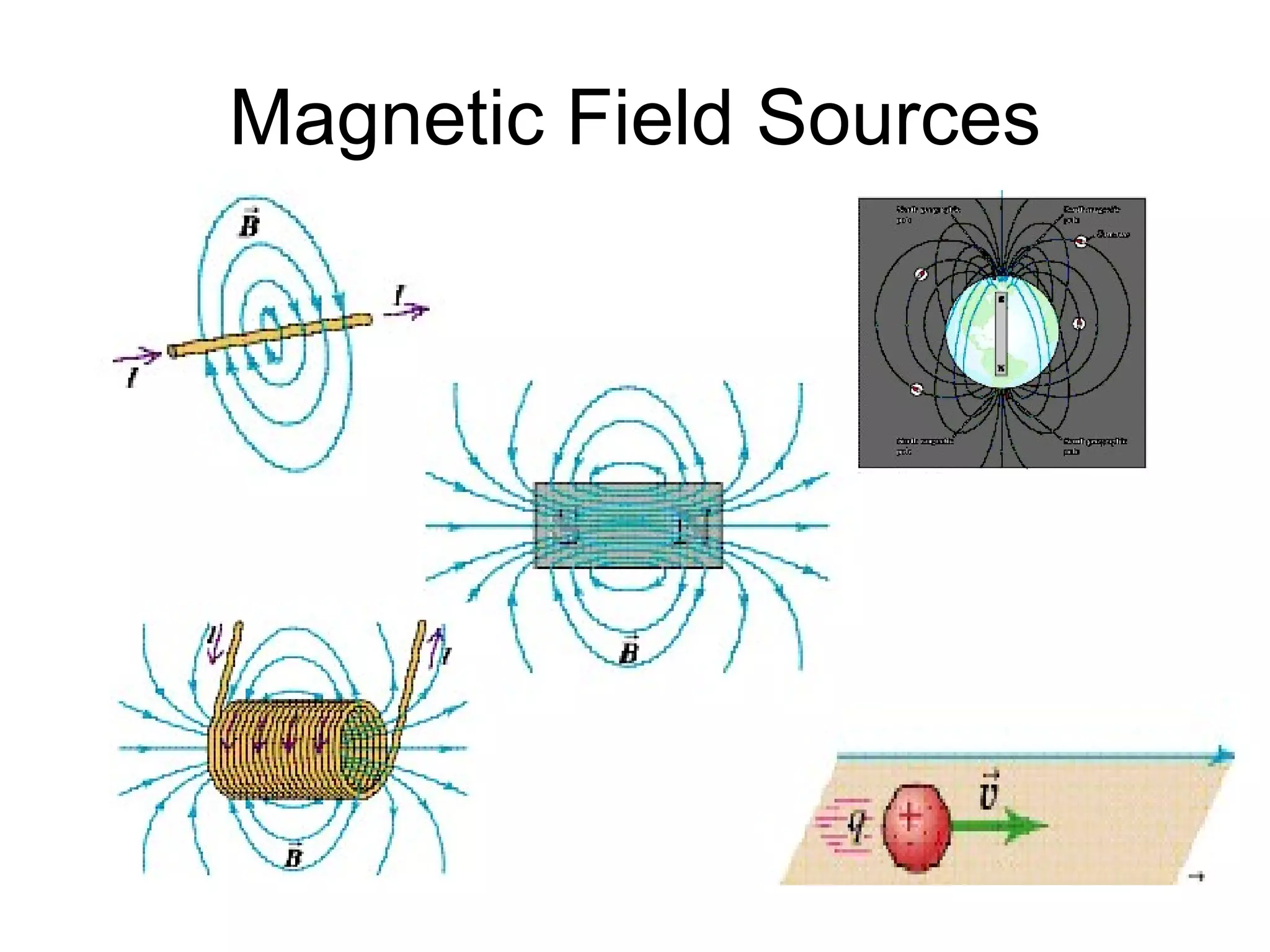
Magnetic Field Sources
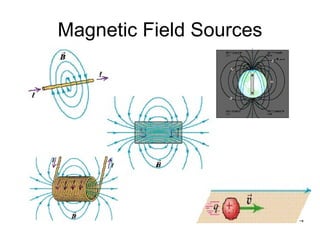
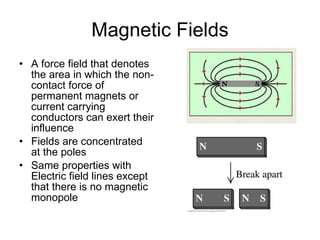
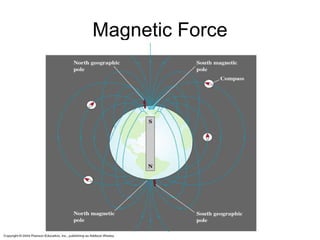
Magnetic Fields A force field that denotes the area in which the non-contact force of permanent magnets or current carrying conductors can exert their influence Fields are concentrated at the poles Same properties with Electric field lines except that there is no magnetic monopole
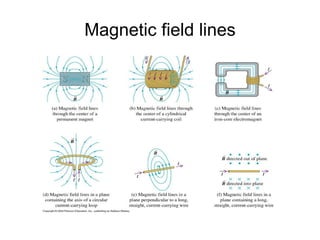
Magnetic field lines
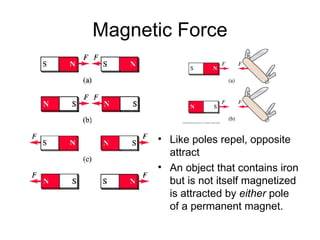
Magnetic Force Like poles repel, opposite attract An object that contains iron but is not itself magnetized is attracted by  either  pole of a permanent magnet.
Magnetic Force
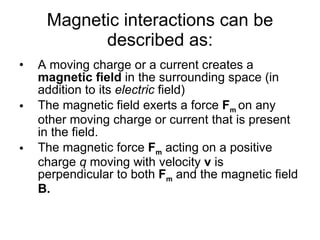
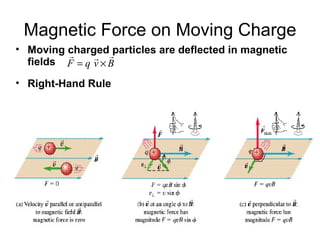
Magnetic interactions can be described as: A moving charge or a current creates a  magnetic field  in the surrounding space (in addition to its  electric  field) The magnetic field exerts a force  F m   on any other moving charge or current that is present in the field. The magnetic force  F m  acting on a positive charge  q  moving with velocity  v  is perpendicular to both  F m  and the magnetic field  B.
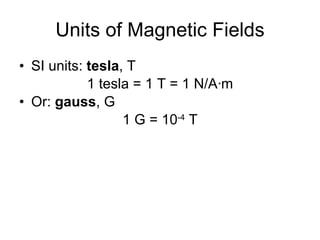
Units of Magnetic Fields SI units:  tesla , T 1 tesla = 1 T = 1 N/A · m Or:  gauss , G 1 G = 10 -4  T
Magnetic Force on Moving Charge Moving charged particles are deflected in magnetic fields Right-Hand Rule
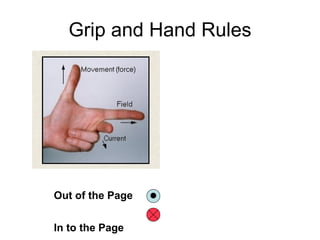
Grip and Hand Rules Out of the Page  In to the Page
 
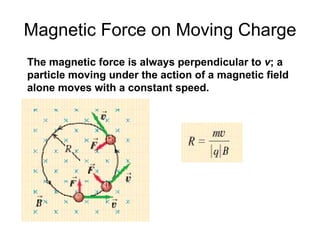
Magnetic Force on Moving Charge The magnetic force is always perpendicular to  v ; a particle moving under the action of a magnetic field alone moves with a constant speed.
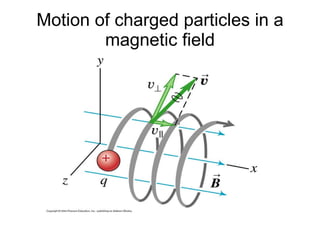
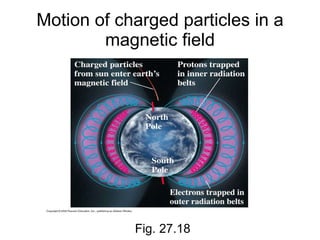
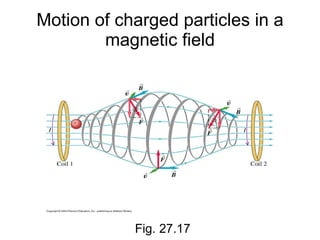
Motion of charged particles in a magnetic field
Motion of charged particles in a magnetic field Fig. 27.18
Motion of charged particles in a magnetic field Fig. 27.17
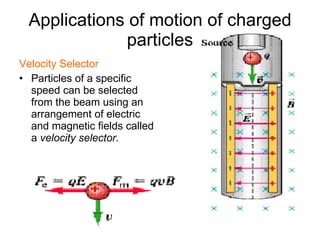
Applications of motion of charged particles Velocity Selector Particles of a specific speed can be selected from the beam using an arrangement of electric and magnetic fields called a  velocity selector.
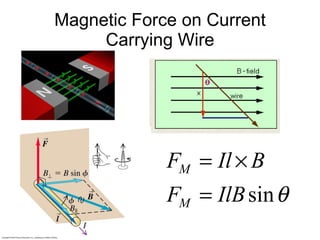
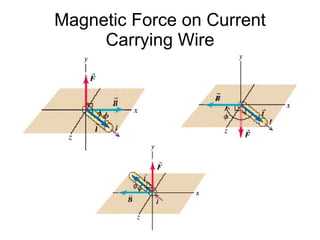
Magnetic Force on Current Carrying Wire
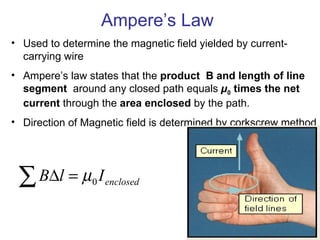
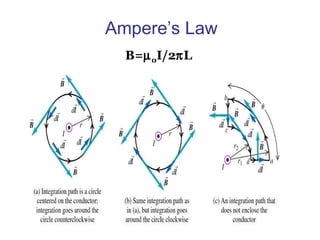
Ampere’s Law Used to determine the magnetic field yielded by current-carrying wire Ampere’s law states that the  product  B and length of line segment   around any closed path equals  µ 0  times the net current  through the  area enclosed  by the path.  Direction of Magnetic field is determined by corkscrew method
Ampere’s Law B=  0 I/2  L
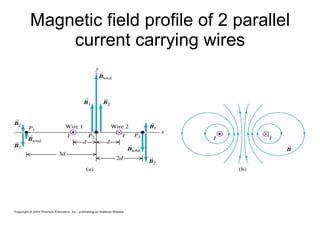
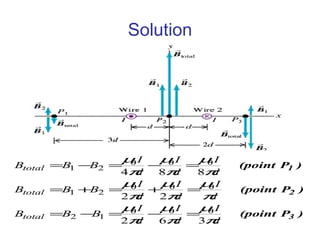
Magnetic field profile of 2 parallel current carrying wires
Solution
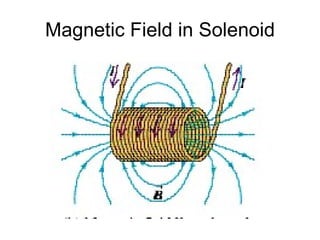
Magnetic Field in Solenoid
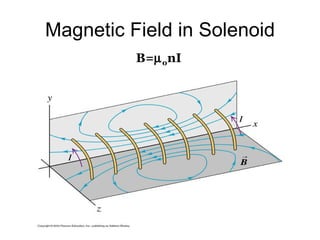
Magnetic Field in Solenoid B=  0 nI
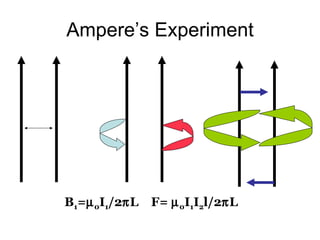
Ampere’s Experiment B 1 =  0 I 1 /2  L  F=   0 I 1 I 2 l/2  L
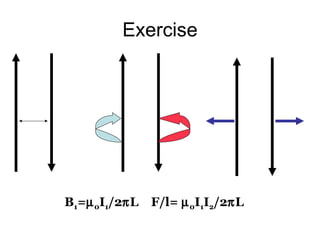
Exercise B 1 =  0 I 1 /2  L  F/l=   0 I 1 I 2 /2  L
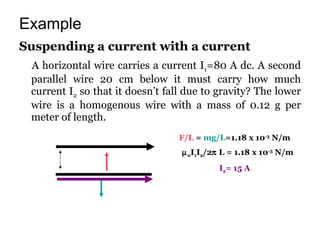
Example Suspending a current with a current A horizontal wire carries a current I 1 =80 A dc. A second parallel wire 20 cm below it must carry how much current I 2  so that it doesn’t fall due to gravity? The lower wire is a homogenous wire with a mass of 0.12 g per meter of length. F/L  =  mg/L =1.18 x 10 -3  N/m  0 I 1 I 2 /2   L = 1.18 x 10 -3  N/m I 2 = 15 A
Definitions Ampere  current flowing in each of the two long parallel conductors 1 m apart, which results in a force of exactly 2 x 10 -7  N/m of length of each conductor. Coulomb  one ampere-second
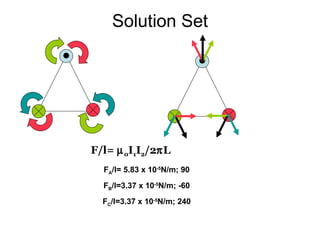
Solution Set F/l=   0 I 1 I 2 /2  L F A /l= 5.83 x 10 -5 N/m; 90 F B /l=3.37 x 10 -5 N/m; -60 F C /l=3.37 x 10 -5 N/m; 240

Magnetic field lines

  • 1.
  • 2.
    Magnetic Fields Aforce field that denotes the area in which the non-contact force of permanent magnets or current carrying conductors can exert their influence Fields are concentrated at the poles Same properties with Electric field lines except that there is no magnetic monopole
  • 3.
  • 4.
    Magnetic Force Likepoles repel, opposite attract An object that contains iron but is not itself magnetized is attracted by either pole of a permanent magnet.
  • 5.
  • 6.
    Magnetic interactions canbe described as: A moving charge or a current creates a magnetic field in the surrounding space (in addition to its electric field) The magnetic field exerts a force F m on any other moving charge or current that is present in the field. The magnetic force F m acting on a positive charge q moving with velocity v is perpendicular to both F m and the magnetic field B.
  • 7.
    Units of MagneticFields SI units: tesla , T 1 tesla = 1 T = 1 N/A · m Or: gauss , G 1 G = 10 -4 T
  • 8.
    Magnetic Force onMoving Charge Moving charged particles are deflected in magnetic fields Right-Hand Rule
  • 9.
    Grip and HandRules Out of the Page In to the Page
  • 10.
  • 11.
    Magnetic Force onMoving Charge The magnetic force is always perpendicular to v ; a particle moving under the action of a magnetic field alone moves with a constant speed.
  • 12.
    Motion of chargedparticles in a magnetic field
  • 13.
    Motion of chargedparticles in a magnetic field Fig. 27.18
  • 14.
    Motion of chargedparticles in a magnetic field Fig. 27.17
  • 15.
    Applications of motionof charged particles Velocity Selector Particles of a specific speed can be selected from the beam using an arrangement of electric and magnetic fields called a velocity selector.
  • 16.
    Magnetic Force onCurrent Carrying Wire
  • 17.
    Magnetic Force onCurrent Carrying Wire
  • 18.
    Ampere’s Law Usedto determine the magnetic field yielded by current-carrying wire Ampere’s law states that the product B and length of line segment around any closed path equals µ 0 times the net current through the area enclosed by the path. Direction of Magnetic field is determined by corkscrew method
  • 19.
    Ampere’s Law B= 0 I/2  L
  • 20.
    Magnetic field profileof 2 parallel current carrying wires
  • 21.
  • 22.
  • 23.
    Magnetic Field inSolenoid B=  0 nI
  • 24.
    Ampere’s Experiment B1 =  0 I 1 /2  L F=  0 I 1 I 2 l/2  L
  • 25.
    Exercise B 1=  0 I 1 /2  L F/l=  0 I 1 I 2 /2  L
  • 26.
    Example Suspending acurrent with a current A horizontal wire carries a current I 1 =80 A dc. A second parallel wire 20 cm below it must carry how much current I 2 so that it doesn’t fall due to gravity? The lower wire is a homogenous wire with a mass of 0.12 g per meter of length. F/L = mg/L =1.18 x 10 -3 N/m  0 I 1 I 2 /2  L = 1.18 x 10 -3 N/m I 2 = 15 A
  • 27.
    Definitions Ampere current flowing in each of the two long parallel conductors 1 m apart, which results in a force of exactly 2 x 10 -7 N/m of length of each conductor. Coulomb one ampere-second
  • 28.
    Solution Set F/l=  0 I 1 I 2 /2  L F A /l= 5.83 x 10 -5 N/m; 90 F B /l=3.37 x 10 -5 N/m; -60 F C /l=3.37 x 10 -5 N/m; 240