Introduction to General
Chemistry
Maxim T. Barikder
Questions
• What do you mean by chemistry? / What is chemistry?
• Describe the branches of chemistry? / Mention the branches of
chemistry?
• Explain the roles & importance of chemistry in medicine.
• Why chemistry is important for nurses?
• Define matter?/What do you mean by matter?
• What is state of matter?
• Describe the state of matter?
• Write down the process of changes of state.
• Write down the special properties of solids and liquids.
Questions
• Define physical property & Chemical property?
• What do you mean by physical property & Chemical
Property?
• Write down the compositions of matter?
• Write down the kinds of matter?
• Define energy?
• Write down the measurement of energy.
• How will you measure energy of food?
• Write down a short note on- Energy.
What is Chemistry?
• The word chemistry is taken from an Egyptian word
"khēmia" meaning transmutation (change of form) of
earth. Eg. Water converts in to steam when heated.
• It is a branch of science.
• It is used to study the composition of matter, there
property and reaction.
• It is also used to form new substances or matter.
• Eg. Oxygen + Hydrogen = Water (H2O)
Branches of Chemistry
1. Analytical chemistry uses qualitative and quantitative observation to identify and
measure the physical and chemical properties of substances. In a sense, all
chemistry is analytical.
2. Physical chemistry combines chemistry with physics. Physical chemists study how
matter and energy interact. Thermodynamics and quantum mechanics are two of
the important branches of physical chemistry.
3. Organic chemistry specifically studies compounds that contain the element carbon.
Carbon has many unique properties that allow it to form complex chemical bonds
and very large molecules. Organic chemistry is known as the "Chemistry of Life"
because all of the molecules that make up living tissue have carbon as part of their
makeup.
4. Inorganic chemistry studies materials such as metals and gases that do not have
carbon as part of their makeup.
5. Biochemistry is the study of chemical processes that occur within living organisms.
Role of Chemistry in
Nursing
• To know the chemistry involved in processes of digestion
and metabolism which will help the student in selecting
and preparing foods in accordance with body
requirements, both in health and disease..
• To know the principles involved in energy, digestion,
drug, preparation of special diets for first aid treatment,
disinfection, the efficient selection and use of chemical
products etc. in the home as well as in the hospital.
Importance of
Chemistry
• To know the composition of drugs or medicines. eg. Drug contents
• To understand the chemical properties of the drug. Eg. Alkaline or acidic, water soluble
or fat soluble.
• Predicting the drug interaction. Eg. Reaction of an antibiotic with an antacid given for
ulcer.
• For sterilizing and sanitation. Eg. Alcohol, phenol, acids used for cleaning.
• In diagnosis of disease. Eg. Use for glucose strips for checking blood sugar.
• To regulate drug distribution. Eg. High dose of as drug which makes blood acidic can be
stabilized by an recommended alkaline drug.
• Decrease the toxic effect.
• To discover new drugs with better effectiveness.
• To study the mechanism of disease.
• To know how the drug acts.
Introduction to Matter
• Anything that takes up space and has mass.
• Matter is made up of molecules.
• Each molecules is composed of atoms.
• The molecules may very in size based on the number of
atoms. Eg oxygen- 2 atoms and organic compounds-
thousand of atoms.
• Based on property of the matter the molecules are either
moving or in stasis.
• Eg. Hydrogen (H), Oxygen(O2), Water(H2O)
State of Matter
• Definition- one of the way in which matter can interact
with itself to form a homogeneous form.
• There are 3 distinct sate of matter -
Solid – wood, rock, steel, etc.
Liquid –water, mercury, oil, etc.
Gas –oxygen , hydrogen, nitrogen, etc.
• Plasma is an rare state of mater found in extreme
environment. Eg. Stars
Solid
• Has definite shape.
• Has definite volume.
• Has there own shapes.
• Molecules are tightly packed together.
• Vibrates against one another.
• Can’t move from place to place.
• Liquids and gases can be changed in to solid when cooled. Eg ice
• Crystalline are also considered as solid. Eg. Salt, sugar, diamond , etc.
• Other examples of solid - wood , rock , metal, etc.
Liquid
• Has no definite shape.
• Has definite volume.
• Molecules are loosely packed but close to one another.
• They take the shape of the container they are placed in.
• Vibrate past one another.
• Little movement.
• Gases can be liquefy when they are cooled. Eg. Steam
• Solid can be liquefied when heated. Eg. lava
• Example of liquids – water, oil, mercury.
Gases
• Has no definite shape.
• Has no definite volume.
• Molecules are not closely packed together.
• Can be compressed.
• Vibrates freely past one another.
• Movement of gases depends on the density of the gas.
• Some gases can be seen and felt where as others are
intangible.
• Example of gases- oxygen, nitrogen, argon, carbon dioxide.
Inter-molecular force
and Symbols
Inter-molecular
• All substances are made of tiny particles called molecules. Molecules attract
one another. These attractive force is called inter- molecular force.
Symbol
• Symbol is a brief presentation of the name of the element
• For some elements the symbol is stated using the first letter of the name of
the element in English/ Latin in capital. Eg. Hydrogen-H, Oxygen-O
• For many elements the symbol is the first capital later of the name along
with another prominent small letter present in the name. Eg. Magnesium-
Mg , Sodium(Natrium in Latin) -Na
General Properties of
Matter:
1. Matter occupies space.
2. Matter has inertia i.e., it is a tendency of bodies in motion
to remain in motion, and bodies at rest to remain at rest,
unless some external force or friction tends to move it orna
3. Matter has mass (or weight)- mass is the amount of matter
or material contained in a body whereas the gravitational
pull on a body is called as weight.
4. Matter is indestructible-nothing can be destroyed or
created, e.g. if a candle is lighted after sometimes it may
disappear but carbon, hydrogen and water vapor produced
will be of the same weight as the candle.
Specific properties
of Solid
• Divisibility- all solid matters can be broken into smaller pieces by
mechanical means .
• Compressibility- can be packed up to a smaller volume when
compressed .
• Expansion- solids undergoes expansion when heated
• Porosity- property which allows liquids, gasses or other solid
particles to pass through.
• Elasticity- property which enables a solid to be compressed and
regain its original form when released.eg rubber , spring
• Hardness- has a dense molecular composition then liquids and gases.
Specific properties
of Liquids
• Has definite volume
• No definite shape and acquires the shape of the
container.
• Flows from a higher level to lower level.
• Intermolecular forces of attraction is not strong as solid.
• Compressibility- can be compressed more than solids.
• Diffusion- Liquids can diffuse into another liquid but
much slower compared to gas.
Changes in state
of matter
Changes in state
of matter
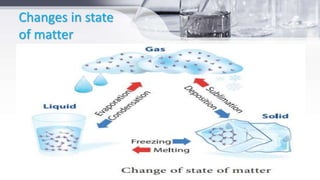
• The state of matter can be changed by applying extreme
temperature or pressure.
Changes in state of
solids to liquid
• Melting
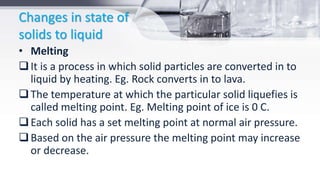
It is a process in which solid particles are converted in to
liquid by heating. Eg. Rock converts in to lava.
The temperature at which the particular solid liquefies is
called melting point. Eg. Melting point of ice is 0 C.
Each solid has a set melting point at normal air pressure.
Based on the air pressure the melting point may increase
or decrease.
Changes in state of
liquid to solids
• Freezing-
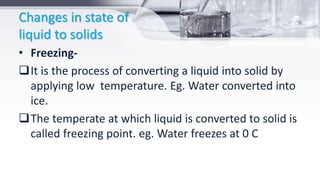
It is the process of converting a liquid into solid by
applying low temperature. Eg. Water converted into
ice.
The temperate at which liquid is converted to solid is
called freezing point. eg. Water freezes at 0 C
Changes in state of
liquid to gas
• Boiling-
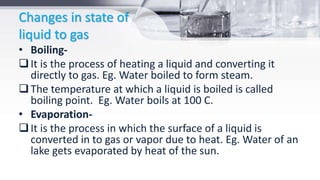
It is the process of heating a liquid and converting it
directly to gas. Eg. Water boiled to form steam.
The temperature at which a liquid is boiled is called
boiling point. Eg. Water boils at 100 C.
• Evaporation-
It is the process in which the surface of a liquid is
converted in to gas or vapor due to heat. Eg. Water of an
lake gets evaporated by heat of the sun.
Changes in state of
gas to liquid
• Condensation-
It is the process of converting gas in to liquid.
Condensation requires lowering of temperature.
Eg. Steam when cooled down converts in to water
Changes in state of
gas to solid
• Deposition –
 It is the process of changing gas directly to solid.
The gas does not have to convert to liquid.
Eg. Warm moist air comes in contact to freezing cold
changes in to ice crystals.
Changes in state of
solid to gas
• Sublimation-
It is the process of converting solid directly in to gas
with out converting into liquid.
Eg. Water ice below 0 C converts in to gas directly.
Classes and Classification
Classification of matter
Pure Substance Impure Substance
• Only one substance is present. Eg. Hydrogen
(H), Oxygen(O2), water(H2O)
• Constant and definite composition. Eg Any
water molecule is always made up of two
hydrogen atoms
• Fixed set of properties. Eg. Water is always
boils at 100 C.
• Can only be separated by chemical
methods. Eg Water (H2O) broken down in to
Hydrogen(H) and Oxygen(O2)
• Types of Pure Substance –
 Elements
 Compounds
• Also known as mixtures.
• It is a combination of 2 or more substances
which does chemically react with each
other.eg Air – nitrogen(N), oxygen(O2),
hydrogen(H), carbon dioxide(CO2) and other
gases.
• The composition varies. Eg Water with
Impurities / Water with Chlorine.
• Properties vary with the composition. Eg.
Salted water has higher boiling point.
Pure Substance
• Pure substance are substances that has constant
composition, properties and contains only one kind
of particles.
Classes/Types of pure substance :
Elements
Compounds
Elements
• This are pure substances which has only one type of
atom and no other type of atom are present.
• This atoms can not be broken by ordinary means .
• Example- Hydrogen(H2), Oxygen(O2), Sodium (Na),
Carbon(C)
Types of Element
Elements are of 2 type-
 Metal - a solid material which is typically hard, shiny,
malleable, fusible, and ductile, with good electrical
and thermal conductivity . E.g. iron, gold, silver,
aluminum, etc.
 Non-metal - anything which are not metals or shows
the same properties as metals. E.g. nitrogen,
hydrogen, sodium, etc.
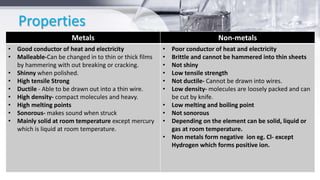
Properties
Metals Non-metals
• Good conductor of heat and electricity
• Malleable-Can be changed in to thin or thick films
by hammering with out breaking or cracking.
• Shinny when polished.
• High tensile Strong
• Ductile - Able to be drawn out into a thin wire.
• High density- compact molecules and heavy.
• High melting points
• Sonorous- makes sound when struck
• Mainly solid at room temperature except mercury
which is liquid at room temperature.
• Poor conductor of heat and electricity
• Brittle and cannot be hammered into thin sheets
• Not shiny
• Low tensile strength
• Not ductile- Cannot be drawn into wires.
• Low density- molecules are loosely packed and can
be cut by knife.
• Low melting and boiling point
• Not sonorous
• Depending on the element can be solid, liquid or
gas at room temperature.
• Non metals form negative ion eg. Cl- except
Hydrogen which forms positive ion.
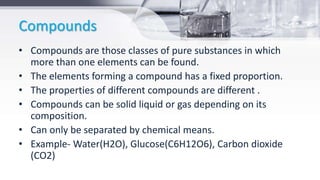
Compounds
• Compounds are those classes of pure substances in which
more than one elements can be found.
• The elements forming a compound has a fixed proportion.
• The properties of different compounds are different .
• Compounds can be solid liquid or gas depending on its
composition.
• Can only be separated by chemical means.
• Example- Water(H2O), Glucose(C6H12O6), Carbon dioxide
(CO2)
Impure Substances (Mixture)
• When two or more substances are mixed together
and do not chemically reacts with each other , then it
is called impure substances (Mixture)
• The substances mixed together can be separated by
physical method.
• Example – salt in water, soil, Blood, etc.
Types of Mixtures
• Homogeneous mixture.
• Heterogeneous mixture.
Homogeneous Mixture
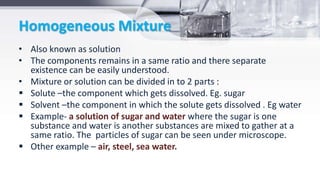
• Also known as solution
• The components remains in a same ratio and there separate
existence can be easily understood.
• Mixture or solution can be divided in to 2 parts :
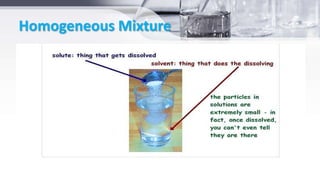
 Solute –the component which gets dissolved. Eg. sugar
 Solvent –the component in which the solute gets dissolved . Eg water
 Example- a solution of sugar and water where the sugar is one
substance and water is another substances are mixed to gather at a
same ratio. The particles of sugar can be seen under microscope.
 Other example – air, steel, sea water.
Homogeneous Mixture
Heterogeneous Mixture
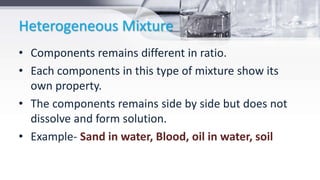
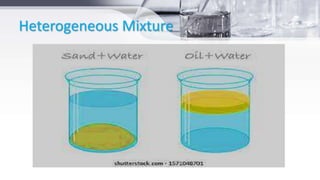
• Components remains different in ratio.
• Each components in this type of mixture show its
own property.
• The components remains side by side but does not
dissolve and form solution.
• Example- Sand in water, Blood, oil in water, soil
Heterogeneous Mixture
Properties of Matter
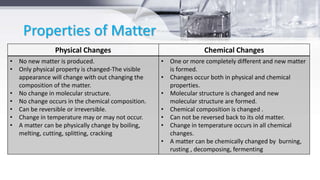
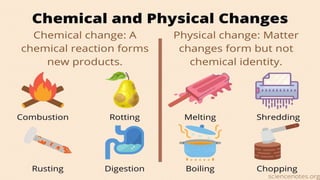
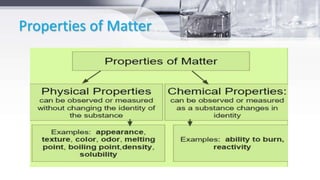
Physical Changes Chemical Changes
• No new matter is produced.
• Only physical property is changed-The visible
appearance will change with out changing the
composition of the matter.
• No change in molecular structure.
• No change occurs in the chemical composition.
• Can be reversible or irreversible.
• Change in temperature may or may not occur.
• A matter can be physically change by boiling,
melting, cutting, splitting, cracking
• One or more completely different and new matter
is formed.
• Changes occur both in physical and chemical
properties.
• Molecular structure is changed and new
molecular structure are formed.
• Chemical composition is changed .
• Can not be reversed back to its old matter.
• Change in temperature occurs in all chemical
changes.
• A matter can be chemically changed by burning,
rusting , decomposing, fermenting
Energy
• Energy is the ability to cause change.
• In chemistry energy is stored in the bond between the
molecules of the chemicals compounds.
• S.I unit of energy is joule (J).
• Other units of energy
 Calories- amount of heat required to raise the temperature of
1 gram of water through 1C.
 Kilogram Calories- amount of heat required to raise 1000 C.C
of water 1C. This unit is used for energy produced when
breaking down food. Kcal is the abbreviation used
Types of energy
• Kinetic energy- energy associated with motion.
Calculated with the formula 𝐾𝐸 = 1 2𝑚𝑣2
, where m
is the mass of the object and v is the velocity.
• Potential energy- stored energy which depends on
the objects composition or position. Potential energy
changes in to kinetic energy.
Chemical energy
• It is a potential that can be changed to other form when
reactions take place.
• Many reaction releases its energy in the form of heat,
light, sound, electricity etc.
• The law of conversion states that energy can neither be
created nor destroyed, it can only be transformed from
to another.
• Heat producing reaction is called exothermic and heat
absorbing reaction is called endothermic.

1. introduction to general chemistry.pptx

  • 1.
  • 2.
    Questions • What doyou mean by chemistry? / What is chemistry? • Describe the branches of chemistry? / Mention the branches of chemistry? • Explain the roles & importance of chemistry in medicine. • Why chemistry is important for nurses? • Define matter?/What do you mean by matter? • What is state of matter? • Describe the state of matter? • Write down the process of changes of state. • Write down the special properties of solids and liquids.
  • 3.
    Questions • Define physicalproperty & Chemical property? • What do you mean by physical property & Chemical Property? • Write down the compositions of matter? • Write down the kinds of matter? • Define energy? • Write down the measurement of energy. • How will you measure energy of food? • Write down a short note on- Energy.
  • 4.
    What is Chemistry? •The word chemistry is taken from an Egyptian word "khēmia" meaning transmutation (change of form) of earth. Eg. Water converts in to steam when heated. • It is a branch of science. • It is used to study the composition of matter, there property and reaction. • It is also used to form new substances or matter. • Eg. Oxygen + Hydrogen = Water (H2O)
  • 5.
    Branches of Chemistry 1.Analytical chemistry uses qualitative and quantitative observation to identify and measure the physical and chemical properties of substances. In a sense, all chemistry is analytical. 2. Physical chemistry combines chemistry with physics. Physical chemists study how matter and energy interact. Thermodynamics and quantum mechanics are two of the important branches of physical chemistry. 3. Organic chemistry specifically studies compounds that contain the element carbon. Carbon has many unique properties that allow it to form complex chemical bonds and very large molecules. Organic chemistry is known as the "Chemistry of Life" because all of the molecules that make up living tissue have carbon as part of their makeup. 4. Inorganic chemistry studies materials such as metals and gases that do not have carbon as part of their makeup. 5. Biochemistry is the study of chemical processes that occur within living organisms.
  • 6.
    Role of Chemistryin Nursing • To know the chemistry involved in processes of digestion and metabolism which will help the student in selecting and preparing foods in accordance with body requirements, both in health and disease.. • To know the principles involved in energy, digestion, drug, preparation of special diets for first aid treatment, disinfection, the efficient selection and use of chemical products etc. in the home as well as in the hospital.
  • 7.
    Importance of Chemistry • Toknow the composition of drugs or medicines. eg. Drug contents • To understand the chemical properties of the drug. Eg. Alkaline or acidic, water soluble or fat soluble. • Predicting the drug interaction. Eg. Reaction of an antibiotic with an antacid given for ulcer. • For sterilizing and sanitation. Eg. Alcohol, phenol, acids used for cleaning. • In diagnosis of disease. Eg. Use for glucose strips for checking blood sugar. • To regulate drug distribution. Eg. High dose of as drug which makes blood acidic can be stabilized by an recommended alkaline drug. • Decrease the toxic effect. • To discover new drugs with better effectiveness. • To study the mechanism of disease. • To know how the drug acts.
  • 8.
    Introduction to Matter •Anything that takes up space and has mass. • Matter is made up of molecules. • Each molecules is composed of atoms. • The molecules may very in size based on the number of atoms. Eg oxygen- 2 atoms and organic compounds- thousand of atoms. • Based on property of the matter the molecules are either moving or in stasis. • Eg. Hydrogen (H), Oxygen(O2), Water(H2O)
  • 9.
    State of Matter •Definition- one of the way in which matter can interact with itself to form a homogeneous form. • There are 3 distinct sate of matter - Solid – wood, rock, steel, etc. Liquid –water, mercury, oil, etc. Gas –oxygen , hydrogen, nitrogen, etc. • Plasma is an rare state of mater found in extreme environment. Eg. Stars
  • 10.
    Solid • Has definiteshape. • Has definite volume. • Has there own shapes. • Molecules are tightly packed together. • Vibrates against one another. • Can’t move from place to place. • Liquids and gases can be changed in to solid when cooled. Eg ice • Crystalline are also considered as solid. Eg. Salt, sugar, diamond , etc. • Other examples of solid - wood , rock , metal, etc.
  • 11.
    Liquid • Has nodefinite shape. • Has definite volume. • Molecules are loosely packed but close to one another. • They take the shape of the container they are placed in. • Vibrate past one another. • Little movement. • Gases can be liquefy when they are cooled. Eg. Steam • Solid can be liquefied when heated. Eg. lava • Example of liquids – water, oil, mercury.
  • 12.
    Gases • Has nodefinite shape. • Has no definite volume. • Molecules are not closely packed together. • Can be compressed. • Vibrates freely past one another. • Movement of gases depends on the density of the gas. • Some gases can be seen and felt where as others are intangible. • Example of gases- oxygen, nitrogen, argon, carbon dioxide.
  • 13.
    Inter-molecular force and Symbols Inter-molecular •All substances are made of tiny particles called molecules. Molecules attract one another. These attractive force is called inter- molecular force. Symbol • Symbol is a brief presentation of the name of the element • For some elements the symbol is stated using the first letter of the name of the element in English/ Latin in capital. Eg. Hydrogen-H, Oxygen-O • For many elements the symbol is the first capital later of the name along with another prominent small letter present in the name. Eg. Magnesium- Mg , Sodium(Natrium in Latin) -Na
  • 14.
    General Properties of Matter: 1.Matter occupies space. 2. Matter has inertia i.e., it is a tendency of bodies in motion to remain in motion, and bodies at rest to remain at rest, unless some external force or friction tends to move it orna 3. Matter has mass (or weight)- mass is the amount of matter or material contained in a body whereas the gravitational pull on a body is called as weight. 4. Matter is indestructible-nothing can be destroyed or created, e.g. if a candle is lighted after sometimes it may disappear but carbon, hydrogen and water vapor produced will be of the same weight as the candle.
  • 15.
    Specific properties of Solid •Divisibility- all solid matters can be broken into smaller pieces by mechanical means . • Compressibility- can be packed up to a smaller volume when compressed . • Expansion- solids undergoes expansion when heated • Porosity- property which allows liquids, gasses or other solid particles to pass through. • Elasticity- property which enables a solid to be compressed and regain its original form when released.eg rubber , spring • Hardness- has a dense molecular composition then liquids and gases.
  • 16.
    Specific properties of Liquids •Has definite volume • No definite shape and acquires the shape of the container. • Flows from a higher level to lower level. • Intermolecular forces of attraction is not strong as solid. • Compressibility- can be compressed more than solids. • Diffusion- Liquids can diffuse into another liquid but much slower compared to gas.
  • 17.
  • 18.
    Changes in state ofmatter • The state of matter can be changed by applying extreme temperature or pressure.
  • 19.
    Changes in stateof solids to liquid • Melting It is a process in which solid particles are converted in to liquid by heating. Eg. Rock converts in to lava. The temperature at which the particular solid liquefies is called melting point. Eg. Melting point of ice is 0 C. Each solid has a set melting point at normal air pressure. Based on the air pressure the melting point may increase or decrease.
  • 20.
    Changes in stateof liquid to solids • Freezing- It is the process of converting a liquid into solid by applying low temperature. Eg. Water converted into ice. The temperate at which liquid is converted to solid is called freezing point. eg. Water freezes at 0 C
  • 21.
    Changes in stateof liquid to gas • Boiling- It is the process of heating a liquid and converting it directly to gas. Eg. Water boiled to form steam. The temperature at which a liquid is boiled is called boiling point. Eg. Water boils at 100 C. • Evaporation- It is the process in which the surface of a liquid is converted in to gas or vapor due to heat. Eg. Water of an lake gets evaporated by heat of the sun.
  • 22.
    Changes in stateof gas to liquid • Condensation- It is the process of converting gas in to liquid. Condensation requires lowering of temperature. Eg. Steam when cooled down converts in to water
  • 23.
    Changes in stateof gas to solid • Deposition –  It is the process of changing gas directly to solid. The gas does not have to convert to liquid. Eg. Warm moist air comes in contact to freezing cold changes in to ice crystals.
  • 24.
    Changes in stateof solid to gas • Sublimation- It is the process of converting solid directly in to gas with out converting into liquid. Eg. Water ice below 0 C converts in to gas directly.
  • 25.
  • 26.
    Classification of matter PureSubstance Impure Substance • Only one substance is present. Eg. Hydrogen (H), Oxygen(O2), water(H2O) • Constant and definite composition. Eg Any water molecule is always made up of two hydrogen atoms • Fixed set of properties. Eg. Water is always boils at 100 C. • Can only be separated by chemical methods. Eg Water (H2O) broken down in to Hydrogen(H) and Oxygen(O2) • Types of Pure Substance –  Elements  Compounds • Also known as mixtures. • It is a combination of 2 or more substances which does chemically react with each other.eg Air – nitrogen(N), oxygen(O2), hydrogen(H), carbon dioxide(CO2) and other gases. • The composition varies. Eg Water with Impurities / Water with Chlorine. • Properties vary with the composition. Eg. Salted water has higher boiling point.
  • 27.
    Pure Substance • Puresubstance are substances that has constant composition, properties and contains only one kind of particles. Classes/Types of pure substance : Elements Compounds
  • 28.
    Elements • This arepure substances which has only one type of atom and no other type of atom are present. • This atoms can not be broken by ordinary means . • Example- Hydrogen(H2), Oxygen(O2), Sodium (Na), Carbon(C)
  • 29.
    Types of Element Elementsare of 2 type-  Metal - a solid material which is typically hard, shiny, malleable, fusible, and ductile, with good electrical and thermal conductivity . E.g. iron, gold, silver, aluminum, etc.  Non-metal - anything which are not metals or shows the same properties as metals. E.g. nitrogen, hydrogen, sodium, etc.
  • 30.
    Properties Metals Non-metals • Goodconductor of heat and electricity • Malleable-Can be changed in to thin or thick films by hammering with out breaking or cracking. • Shinny when polished. • High tensile Strong • Ductile - Able to be drawn out into a thin wire. • High density- compact molecules and heavy. • High melting points • Sonorous- makes sound when struck • Mainly solid at room temperature except mercury which is liquid at room temperature. • Poor conductor of heat and electricity • Brittle and cannot be hammered into thin sheets • Not shiny • Low tensile strength • Not ductile- Cannot be drawn into wires. • Low density- molecules are loosely packed and can be cut by knife. • Low melting and boiling point • Not sonorous • Depending on the element can be solid, liquid or gas at room temperature. • Non metals form negative ion eg. Cl- except Hydrogen which forms positive ion.
  • 31.
    Compounds • Compounds arethose classes of pure substances in which more than one elements can be found. • The elements forming a compound has a fixed proportion. • The properties of different compounds are different . • Compounds can be solid liquid or gas depending on its composition. • Can only be separated by chemical means. • Example- Water(H2O), Glucose(C6H12O6), Carbon dioxide (CO2)
  • 32.
    Impure Substances (Mixture) •When two or more substances are mixed together and do not chemically reacts with each other , then it is called impure substances (Mixture) • The substances mixed together can be separated by physical method. • Example – salt in water, soil, Blood, etc.
  • 33.
    Types of Mixtures •Homogeneous mixture. • Heterogeneous mixture.
  • 34.
    Homogeneous Mixture • Alsoknown as solution • The components remains in a same ratio and there separate existence can be easily understood. • Mixture or solution can be divided in to 2 parts :  Solute –the component which gets dissolved. Eg. sugar  Solvent –the component in which the solute gets dissolved . Eg water  Example- a solution of sugar and water where the sugar is one substance and water is another substances are mixed to gather at a same ratio. The particles of sugar can be seen under microscope.  Other example – air, steel, sea water.
  • 35.
  • 36.
    Heterogeneous Mixture • Componentsremains different in ratio. • Each components in this type of mixture show its own property. • The components remains side by side but does not dissolve and form solution. • Example- Sand in water, Blood, oil in water, soil
  • 37.
  • 38.
  • 39.
    Properties of Matter PhysicalChanges Chemical Changes • No new matter is produced. • Only physical property is changed-The visible appearance will change with out changing the composition of the matter. • No change in molecular structure. • No change occurs in the chemical composition. • Can be reversible or irreversible. • Change in temperature may or may not occur. • A matter can be physically change by boiling, melting, cutting, splitting, cracking • One or more completely different and new matter is formed. • Changes occur both in physical and chemical properties. • Molecular structure is changed and new molecular structure are formed. • Chemical composition is changed . • Can not be reversed back to its old matter. • Change in temperature occurs in all chemical changes. • A matter can be chemically changed by burning, rusting , decomposing, fermenting
  • 41.
    Energy • Energy isthe ability to cause change. • In chemistry energy is stored in the bond between the molecules of the chemicals compounds. • S.I unit of energy is joule (J). • Other units of energy  Calories- amount of heat required to raise the temperature of 1 gram of water through 1C.  Kilogram Calories- amount of heat required to raise 1000 C.C of water 1C. This unit is used for energy produced when breaking down food. Kcal is the abbreviation used
  • 42.
    Types of energy •Kinetic energy- energy associated with motion. Calculated with the formula 𝐾𝐸 = 1 2𝑚𝑣2 , where m is the mass of the object and v is the velocity. • Potential energy- stored energy which depends on the objects composition or position. Potential energy changes in to kinetic energy.
  • 43.
    Chemical energy • Itis a potential that can be changed to other form when reactions take place. • Many reaction releases its energy in the form of heat, light, sound, electricity etc. • The law of conversion states that energy can neither be created nor destroyed, it can only be transformed from to another. • Heat producing reaction is called exothermic and heat absorbing reaction is called endothermic.