The Particulate
Nature of Matter
presented by Jamaica Ricamara
Lesson Objectives
• Understand the Properties of Matter:
• Differentiate physical and chemical properties.
• Classify substances as pure substances or mixtures.
• Explore the States of Matter:
• Describe the macroscopic and microscopic characteristics of
solids, liquids, and gases.
• Apply Mixture Separation Techniques:
• Demonstrate basic separation methods like filtration,
evaporation, and decantation.
What is a Matter?
Matter is anything that has mass and takes
up space. It can exist in different states,
such as solid, liquid, or gas, and can be
composed of various elements and
compounds.
PARTICULATE NATURE OF
MATTER
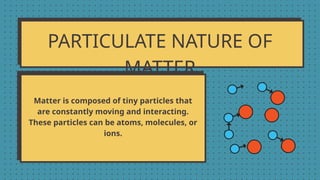
Matter is composed of tiny particles that
are constantly moving and interacting.
These particles can be atoms, molecules, or
ions.
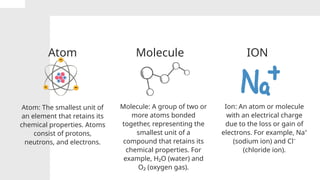
Atom: The smallest unit of
an element that retains its
chemical properties. Atoms
consist of protons,
neutrons, and electrons.
Atom ION
Ion: An atom or molecule
with an electrical charge
due to the loss or gain of
electrons. For example, Na⁺
(sodium ion) and Cl⁻
(chloride ion).
Molecule
Molecule: A group of two or
more atoms bonded
together, representing the
smallest unit of a
compound that retains its
chemical properties. For
example, H₂O (water) and
O₂ (oxygen gas).
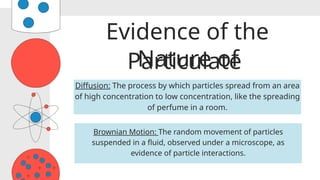
Evidence of the
Particulate
Nature of
Matter:
Diffusion: The process by which particles spread from an area
of high concentration to low concentration, like the spreading
of perfume in a room.
Brownian Motion: The random movement of particles
suspended in a fluid, observed under a microscope, as
evidence of particle interactions.
STATES OF Matter
MACROSCOPIC VIEW
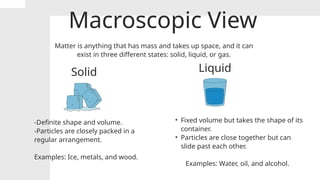
Macroscopic View
Matter is anything that has mass and takes up space, and it can
exist in three different states: solid, liquid, or gas.
Solid Liquid
-Definite shape and volume.
-Particles are closely packed in a
regular arrangement.
Examples: Ice, metals, and wood.
• Fixed volume but takes the shape of its
container.
• Particles are close together but can
slide past each other.
Examples: Water, oil, and alcohol.
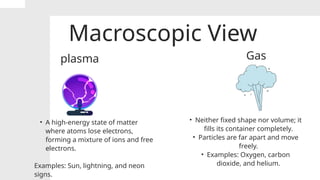
Macroscopic View
plasma
• A high-energy state of matter
where atoms lose electrons,
forming a mixture of ions and free
electrons.
Examples: Sun, lightning, and neon
signs.
Gas
• Neither fixed shape nor volume; it
fills its container completely.
• Particles are far apart and move
freely.
• Examples: Oxygen, carbon
dioxide, and helium.
STATES OF Matter
MACROSCOPIC VIEW
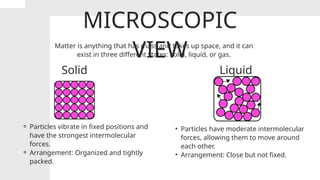
MICROSCOPIC
VIEW
Matter is anything that has mass and takes up space, and it can
exist in three different states: solid, liquid, or gas.
Solid Liquid
⚬ Particles vibrate in fixed positions and
have the strongest intermolecular
forces.
⚬ Arrangement: Organized and tightly
packed.
• Particles have moderate intermolecular
forces, allowing them to move around
each other.
• Arrangement: Close but not fixed.
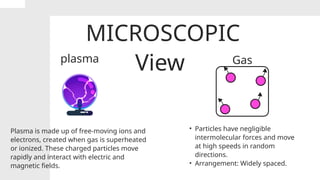
MICROSCOPIC
View
plasma
Plasma is made up of free-moving ions and
electrons, created when gas is superheated
or ionized. These charged particles move
rapidly and interact with electric and
magnetic fields.
Gas
• Particles have negligible
intermolecular forces and move
at high speeds in random
directions.
• Arrangement: Widely spaced.
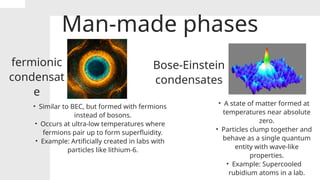
Man-made phases
fermionic
condensat
e
Bose-Einstein
condensates
• Similar to BEC, but formed with fermions
instead of bosons.
• Occurs at ultra-low temperatures where
fermions pair up to form superfluidity.
• Example: Artificially created in labs with
particles like lithium-6.
• A state of matter formed at
temperatures near absolute
zero.
• Particles clump together and
behave as a single quantum
entity with wave-like
properties.
• Example: Supercooled
rubidium atoms in a lab.
PROPERTIES OF
MATTER
Physical pROPERTY
• Characteristics of a substance that can be observed or
measured without changing its chemical identity.
• Examples:
⚬ Color: Red, blue, etc.
⚬ Odor: Pleasant or pungent.
⚬ Density: Mass per unit volume.
⚬ Melting Point: Temperature at which a solid turns into a
liquid.
⚬ Boiling Point: Temperature at which a liquid turns into
a gas.
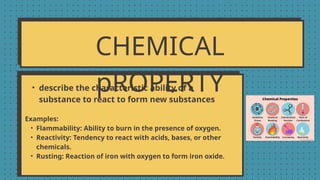
CHEMICAL
pROPERTY
• describe the characteristic ability of a
substance to react to form new substances
Examples:
• Flammability: Ability to burn in the presence of oxygen.
• Reactivity: Tendency to react with acids, bases, or other
chemicals.
• Rusting: Reaction of iron with oxygen to form iron oxide.
EXTENSIVE VS
INTENSIVE
• Independent of the amount of matter
present.
• Examples:
⚬ Density: Ratio of mass to volume
(e.g., g/cm³).
⚬ Boiling Point: The temperature at
which a liquid boils.
⚬ Color: The visual perception of a
substance.
INTENSIVE
• Depend on the amount of matter
present.
Examples:
• Mass: The quantity of matter in an
object.
• Volume: The amount of space
occupied by matter.
• Length: The measurement of an object
from end to end.
EXTENSIVE
CLASSIFYI
NG
WAYS OF
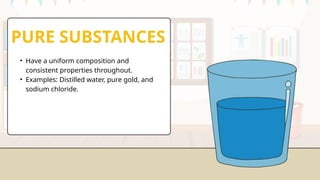
PURE SUBSTANCES
• Have a uniform composition and
consistent properties throughout.
• Examples: Distilled water, pure gold, and
sodium chloride.
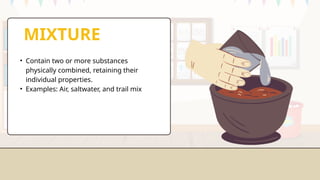
MIXTURE
• Contain two or more substances
physically combined, retaining their
individual properties.
• Examples: Air, saltwater, and trail mix
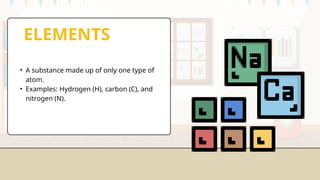
ELEMENTS
• A substance made up of only one type of
atom.
• Examples: Hydrogen (H), carbon (C), and
nitrogen (N).
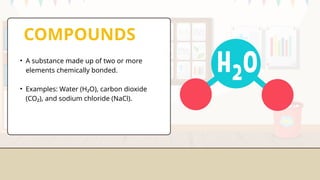
COMPOUNDS
• A substance made up of two or more
elements chemically bonded.
• Examples: Water (H₂O), carbon dioxide
(CO₂), and sodium chloride (NaCl).
COMPOUNDS
• A substance made up of two or more
elements chemically bonded.
• Examples: Water (H₂O), carbon dioxide
(CO₂), and sodium chloride (NaCl).
Mixtures
Types and Examples
• Uniform composition
throughout; also called
solutions.
• Examples: Vinegar, sugar
dissolved in water, saltwater
HOMOGENOUS
MIXTURE
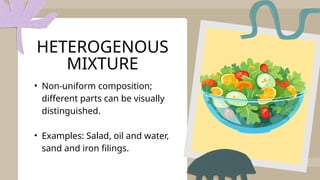
• Non-uniform composition;
different parts can be visually
distinguished.
• Examples: Salad, oil and water,
sand and iron filings.
HETEROGENOUS
MIXTURE
6. Methods of
Separating
Mixtures
METHODS OF SEPARATING MIXTURES
Physical Methods
of Separation:
Separates insoluble solids from liquids using a
porous barrier.
Example: Sand from water.
Filtration:
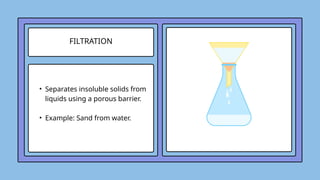
FILTRATION
• Separates insoluble solids from
liquids using a porous barrier.
• Example: Sand from water.
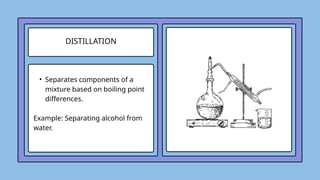
DISTILLATION
• Separates components of a
mixture based on boiling point
differences.
Example: Separating alcohol from
water.
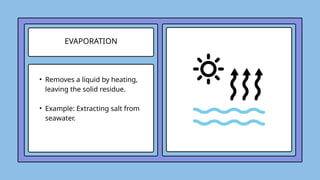
EVAPORATION
• Removes a liquid by heating,
leaving the solid residue.
• Example: Extracting salt from
seawater.
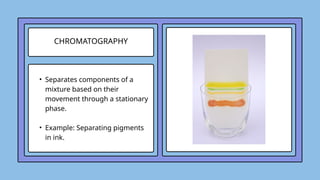
CHROMATOGRAPHY
• Separates components of a
mixture based on their
movement through a stationary
phase.
• Example: Separating pigments
in ink.
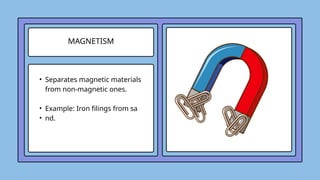
MAGNETISM
• Separates magnetic materials
from non-magnetic ones.
• Example: Iron filings from sa
• nd.
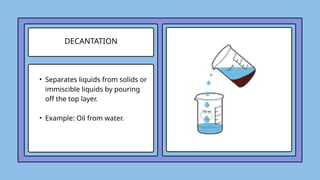
DECANTATION
• Separates liquids from solids or
immiscible liquids by pouring
off the top layer.
• Example: Oil from water.
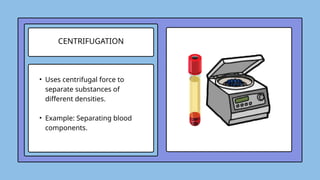
CENTRIFUGATION
• Uses centrifugal force to
separate substances of
different densities.
• Example: Separating blood
components.
• Matter consists of particles that
determine its physical and chemical
properties.
• Understanding the states of matter
and their microscopic views helps
explain observable phenomena.
• Properties of matter are classified
into physical, chemical, extensive,
and intensive.
• Matter can be pure or a mixture, and
mixtures can be separated using
physical methods.
Summary:
Experiment Time!

Presentation (created from your Doc) (1).pptx

  • 1.
    The Particulate Nature ofMatter presented by Jamaica Ricamara
  • 2.
    Lesson Objectives • Understandthe Properties of Matter: • Differentiate physical and chemical properties. • Classify substances as pure substances or mixtures. • Explore the States of Matter: • Describe the macroscopic and microscopic characteristics of solids, liquids, and gases. • Apply Mixture Separation Techniques: • Demonstrate basic separation methods like filtration, evaporation, and decantation.
  • 3.
    What is aMatter? Matter is anything that has mass and takes up space. It can exist in different states, such as solid, liquid, or gas, and can be composed of various elements and compounds.
  • 4.
    PARTICULATE NATURE OF MATTER Matteris composed of tiny particles that are constantly moving and interacting. These particles can be atoms, molecules, or ions.
  • 5.
    Atom: The smallestunit of an element that retains its chemical properties. Atoms consist of protons, neutrons, and electrons. Atom ION Ion: An atom or molecule with an electrical charge due to the loss or gain of electrons. For example, Na⁺ (sodium ion) and Cl⁻ (chloride ion). Molecule Molecule: A group of two or more atoms bonded together, representing the smallest unit of a compound that retains its chemical properties. For example, H₂O (water) and O₂ (oxygen gas).
  • 6.
    Evidence of the Particulate Natureof Matter: Diffusion: The process by which particles spread from an area of high concentration to low concentration, like the spreading of perfume in a room. Brownian Motion: The random movement of particles suspended in a fluid, observed under a microscope, as evidence of particle interactions.
  • 7.
  • 8.
    Macroscopic View Matter isanything that has mass and takes up space, and it can exist in three different states: solid, liquid, or gas. Solid Liquid -Definite shape and volume. -Particles are closely packed in a regular arrangement. Examples: Ice, metals, and wood. • Fixed volume but takes the shape of its container. • Particles are close together but can slide past each other. Examples: Water, oil, and alcohol.
  • 9.
    Macroscopic View plasma • Ahigh-energy state of matter where atoms lose electrons, forming a mixture of ions and free electrons. Examples: Sun, lightning, and neon signs. Gas • Neither fixed shape nor volume; it fills its container completely. • Particles are far apart and move freely. • Examples: Oxygen, carbon dioxide, and helium.
  • 10.
  • 11.
    MICROSCOPIC VIEW Matter is anythingthat has mass and takes up space, and it can exist in three different states: solid, liquid, or gas. Solid Liquid ⚬ Particles vibrate in fixed positions and have the strongest intermolecular forces. ⚬ Arrangement: Organized and tightly packed. • Particles have moderate intermolecular forces, allowing them to move around each other. • Arrangement: Close but not fixed.
  • 12.
    MICROSCOPIC View plasma Plasma is madeup of free-moving ions and electrons, created when gas is superheated or ionized. These charged particles move rapidly and interact with electric and magnetic fields. Gas • Particles have negligible intermolecular forces and move at high speeds in random directions. • Arrangement: Widely spaced.
  • 13.
    Man-made phases fermionic condensat e Bose-Einstein condensates • Similarto BEC, but formed with fermions instead of bosons. • Occurs at ultra-low temperatures where fermions pair up to form superfluidity. • Example: Artificially created in labs with particles like lithium-6. • A state of matter formed at temperatures near absolute zero. • Particles clump together and behave as a single quantum entity with wave-like properties. • Example: Supercooled rubidium atoms in a lab.
  • 14.
  • 15.
    Physical pROPERTY • Characteristicsof a substance that can be observed or measured without changing its chemical identity. • Examples: ⚬ Color: Red, blue, etc. ⚬ Odor: Pleasant or pungent. ⚬ Density: Mass per unit volume. ⚬ Melting Point: Temperature at which a solid turns into a liquid. ⚬ Boiling Point: Temperature at which a liquid turns into a gas.
  • 16.
    CHEMICAL pROPERTY • describe thecharacteristic ability of a substance to react to form new substances Examples: • Flammability: Ability to burn in the presence of oxygen. • Reactivity: Tendency to react with acids, bases, or other chemicals. • Rusting: Reaction of iron with oxygen to form iron oxide.
  • 17.
  • 18.
    • Independent ofthe amount of matter present. • Examples: ⚬ Density: Ratio of mass to volume (e.g., g/cm³). ⚬ Boiling Point: The temperature at which a liquid boils. ⚬ Color: The visual perception of a substance. INTENSIVE
  • 19.
    • Depend onthe amount of matter present. Examples: • Mass: The quantity of matter in an object. • Volume: The amount of space occupied by matter. • Length: The measurement of an object from end to end. EXTENSIVE
  • 20.
  • 21.
    PURE SUBSTANCES • Havea uniform composition and consistent properties throughout. • Examples: Distilled water, pure gold, and sodium chloride.
  • 22.
    MIXTURE • Contain twoor more substances physically combined, retaining their individual properties. • Examples: Air, saltwater, and trail mix
  • 23.
    ELEMENTS • A substancemade up of only one type of atom. • Examples: Hydrogen (H), carbon (C), and nitrogen (N).
  • 24.
    COMPOUNDS • A substancemade up of two or more elements chemically bonded. • Examples: Water (H₂O), carbon dioxide (CO₂), and sodium chloride (NaCl).
  • 25.
    COMPOUNDS • A substancemade up of two or more elements chemically bonded. • Examples: Water (H₂O), carbon dioxide (CO₂), and sodium chloride (NaCl).
  • 26.
  • 27.
    • Uniform composition throughout;also called solutions. • Examples: Vinegar, sugar dissolved in water, saltwater HOMOGENOUS MIXTURE
  • 28.
    • Non-uniform composition; differentparts can be visually distinguished. • Examples: Salad, oil and water, sand and iron filings. HETEROGENOUS MIXTURE
  • 29.
  • 30.
  • 31.
  • 32.
    Separates insoluble solidsfrom liquids using a porous barrier. Example: Sand from water. Filtration:
  • 33.
    FILTRATION • Separates insolublesolids from liquids using a porous barrier. • Example: Sand from water.
  • 34.
    DISTILLATION • Separates componentsof a mixture based on boiling point differences. Example: Separating alcohol from water.
  • 35.
    EVAPORATION • Removes aliquid by heating, leaving the solid residue. • Example: Extracting salt from seawater.
  • 36.
    CHROMATOGRAPHY • Separates componentsof a mixture based on their movement through a stationary phase. • Example: Separating pigments in ink.
  • 37.
    MAGNETISM • Separates magneticmaterials from non-magnetic ones. • Example: Iron filings from sa • nd.
  • 38.
    DECANTATION • Separates liquidsfrom solids or immiscible liquids by pouring off the top layer. • Example: Oil from water.
  • 39.
    CENTRIFUGATION • Uses centrifugalforce to separate substances of different densities. • Example: Separating blood components.
  • 40.
    • Matter consistsof particles that determine its physical and chemical properties. • Understanding the states of matter and their microscopic views helps explain observable phenomena. • Properties of matter are classified into physical, chemical, extensive, and intensive. • Matter can be pure or a mixture, and mixtures can be separated using physical methods. Summary:
  • 41.