Electron orbital's
  and sublevels
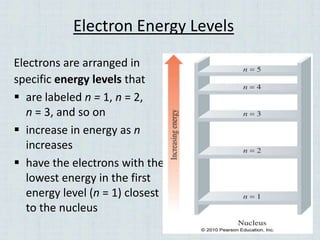
Electron Energy Levels
Electrons are arranged in
specific energy levels that
 are labeled n = 1, n = 2,
  n = 3, and so on
 increase in energy as n
  increases
 have the electrons with the
  lowest energy in the first
  energy level (n = 1) closest
  to the nucleus
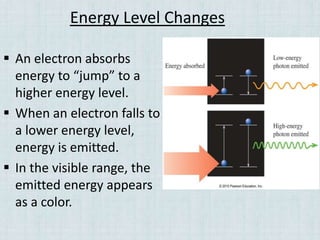
Energy Level Changes

 An electron absorbs
  energy to “jump” to a
  higher energy level.
 When an electron falls to
  a lower energy level,
  energy is emitted.
 In the visible range, the
  emitted energy appears
  as a color.
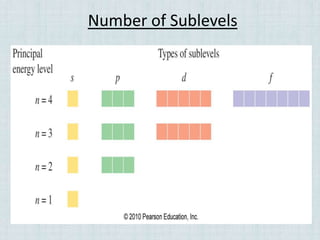
Number of Sublevels
Energy of Sublevels
In any energy level
-> thes sublevel has the lowest energy
 the s sublevel is followed by the p, d,
  and f sublevels (in order of increasing
  energy)
Orbitals
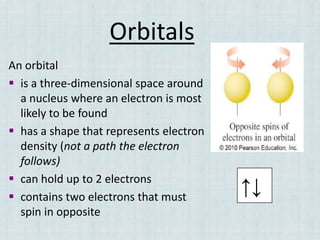
An orbital
 is a three-dimensional space around
  a nucleus where an electron is most
  likely to be found
 has a shape that represents electron
  density (not a path the electron
  follows)
 can hold up to 2 electrons
 contains two electrons that must
                                         ↑↓
  spin in opposite
s Orbital's
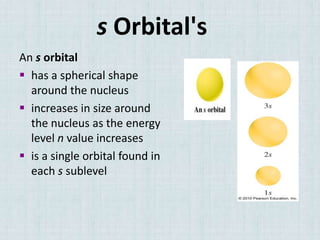
An s orbital
 has a spherical shape
  around the nucleus
 increases in size around
  the nucleus as the energy
  level n value increases
 is a single orbital found in
  each s sublevel
p Orbitals
A p orbital
 has a two-lobed shape
 is one of three p orbitals that make up
  each p sublevel
 increases in size as the value of n increases
Sublevels and Orbitals
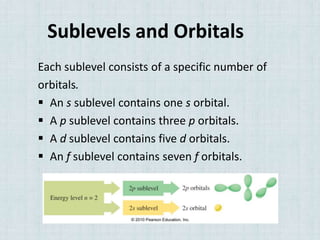
Each sublevel consists of a specific number of
orbitals.
 An s sublevel contains one s orbital.
 A p sublevel contains three p orbitals.
 A d sublevel contains five d orbitals.
 An f sublevel contains seven f orbitals.
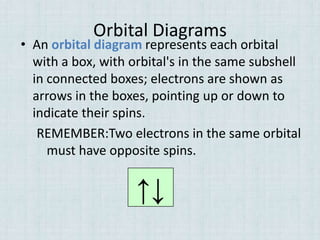
Orbital Diagrams
• An orbital diagram represents each orbital
  with a box, with orbital's in the same subshell
  in connected boxes; electrons are shown as
  arrows in the boxes, pointing up or down to
  indicate their spins.
   REMEMBER:Two electrons in the same orbital
     must have opposite spins.


                    ↑↓
That’s all about
Electron orbital's and
      sublevels

 Thank you for your attention 

Chemistry: Electron orbitals and sub levels

  • 1.
    Electron orbital's and sublevels
  • 2.
    Electron Energy Levels Electronsare arranged in specific energy levels that  are labeled n = 1, n = 2, n = 3, and so on  increase in energy as n increases  have the electrons with the lowest energy in the first energy level (n = 1) closest to the nucleus
  • 3.
    Energy Level Changes An electron absorbs energy to “jump” to a higher energy level.  When an electron falls to a lower energy level, energy is emitted.  In the visible range, the emitted energy appears as a color.
  • 4.
  • 5.
    Energy of Sublevels Inany energy level -> thes sublevel has the lowest energy  the s sublevel is followed by the p, d, and f sublevels (in order of increasing energy)
  • 6.
    Orbitals An orbital  isa three-dimensional space around a nucleus where an electron is most likely to be found  has a shape that represents electron density (not a path the electron follows)  can hold up to 2 electrons  contains two electrons that must ↑↓ spin in opposite
  • 7.
    s Orbital's An sorbital  has a spherical shape around the nucleus  increases in size around the nucleus as the energy level n value increases  is a single orbital found in each s sublevel
  • 8.
    p Orbitals A porbital  has a two-lobed shape  is one of three p orbitals that make up each p sublevel  increases in size as the value of n increases
  • 9.
    Sublevels and Orbitals Eachsublevel consists of a specific number of orbitals.  An s sublevel contains one s orbital.  A p sublevel contains three p orbitals.  A d sublevel contains five d orbitals.  An f sublevel contains seven f orbitals.
  • 10.
    Orbital Diagrams • Anorbital diagram represents each orbital with a box, with orbital's in the same subshell in connected boxes; electrons are shown as arrows in the boxes, pointing up or down to indicate their spins. REMEMBER:Two electrons in the same orbital must have opposite spins. ↑↓
  • 11.
    That’s all about Electronorbital's and sublevels  Thank you for your attention 