Phylogenetics and Sequence Analysis
Fall 2015
Kurt Wollenberg, PhD
Phylogenetics Specialist
Bioinformatics and Computational Biosciences Branch
Office of Cyber Infrastructure and Computational Biology
Course Organization
•Building a clean sequence
•Collecting homologs
•Aligning your sequences
•Building trees
•Further Analysis
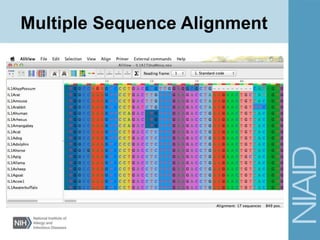
Multiple Sequence Alignment
What’s next?
Building trees with our MSA
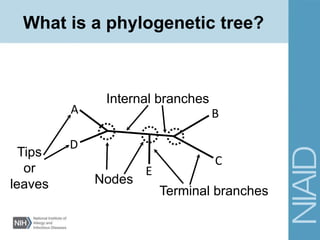
What is a phylogenetic tree?
• Reconstruction of biological history
• Based on similarities and differences among
homologous attributes (characters) of the entities
under scrutiny
• Molecular characters (sequences, usually) are most
often found only in extant organisms
A
D
E
C
B
Internal branches
Terminal branches
Tips
or
leaves Nodes
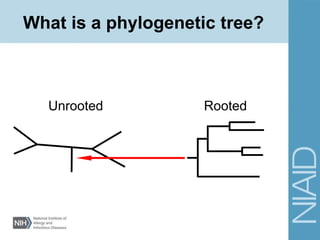
What is a phylogenetic tree?
Unrooted Rooted
What is a phylogenetic tree?
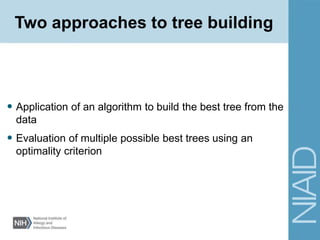
Two approaches to tree building
• Application of an algorithm to build the best tree from the
data
• Evaluation of multiple possible best trees using an
optimality criterion
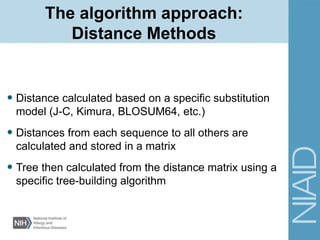
The algorithm approach:
Distance Methods
• Distance calculated based on a specific substitution
model (J-C, Kimura, BLOSUM64, etc.)
• Distances from each sequence to all others are
calculated and stored in a matrix
• Tree then calculated from the distance matrix using a
specific tree-building algorithm
Tree-Building Algorithms
•UPGMA
•Neighbor-Joining
The algorithm approach:
Distance Methods
The algorithm approach:
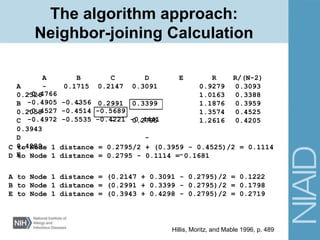
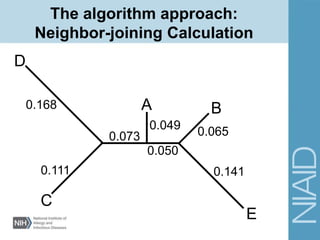
Neighbor-joining Calculation
Hillis, Moritz, and Mable 1996, p. 489
A to Node 1 distance = (0.2147 + 0.3091 - 0.2795)/2 = 0.1222
B to Node 1 distance = (0.2991 + 0.3399 - 0.2795)/2 = 0.1798
E to Node 1 distance = (0.3943 + 0.4298 - 0.2795)/2 = 0.2719
C to Node 1 distance = 0.2795/2 + (0.3959 - 0.4525)/2 = 0.1114
D to Node 1 distance = 0.2795 - 0.1114 = 0.1681
R/(N-2)
0.3093
0.3388
0.3959
0.4525
0.4205
R
0.9279
1.0163
1.1876
1.3574
1.2616
A B C D E
A - 0.1715 0.2147 0.3091
0.2326
B - 0.2991 0.3399
0.2058
C - 0.2795
0.3943
D -
0.4289
E -
-0.4766
-0.4905 -0.4356
-0.4527 -0.4514 -0.5689
-0.4972 -0.5535 -0.4221 -0.4441
Hillis, Moritz, and Mable 1996, p. 489
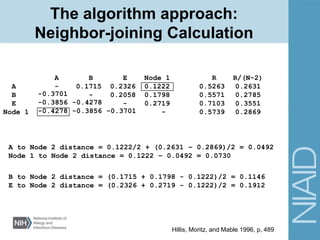
B to Node 2 distance = (0.1715 + 0.1798 - 0.1222)/2 = 0.1146
E to Node 2 distance = (0.2326 + 0.2719 - 0.1222)/2 = 0.1912
A to Node 2 distance = 0.1222/2 + (0.2631 – 0.2869)/2 = 0.0492
Node 1 to Node 2 distance = 0.1222 – 0.0492 = 0.0730
R/(N-2)
0.2631
0.2785
0.3551
0.2869
R
0.5263
0.5571
0.7103
0.5739
A B E Node 1
A - 0.1715 0.2326 0.1222
B - 0.2058 0.1798
E - 0.2719
Node 1 -
-0.3701
-0.3856 -0.4278
-0.4278 -0.3856 -0.3701
The algorithm approach:
Neighbor-joining Calculation
Hillis, Moritz, and Mable 1996, p. 489
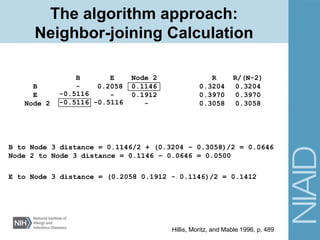
E to Node 3 distance = (0.2058 0.1912 - 0.1146)/2 = 0.1412
B to Node 3 distance = 0.1146/2 + (0.3204 – 0.3058)/2 = 0.0646
Node 2 to Node 3 distance = 0.1146 – 0.0646 = 0.0500
R/(N-2)
0.3204
0.3970
0.3058
R
0.3204
0.3970
0.3058
B E Node 2
B - 0.2058 0.1146
E - 0.1912
Node 2 -
-0.5116
-0.5116 -0.5116
The algorithm approach:
Neighbor-joining Calculation
A B
C
D
E
0.141
0.065
0.050
0.049
0.073
0.168
0.111
The algorithm approach:
Neighbor-joining Calculation
The optimality criterion approach
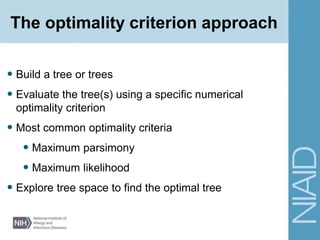
• Build a tree or trees
• Evaluate the tree(s) using a specific numerical
optimality criterion
• Most common optimality criteria
• Maximum parsimony
• Maximum likelihood
• Explore tree space to find the optimal tree
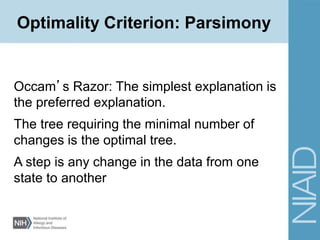
Occam’s Razor: The simplest explanation is
the preferred explanation.
The tree requiring the minimal number of
changes is the optimal tree.
A step is any change in the data from one
state to another
Optimality Criterion: Parsimony
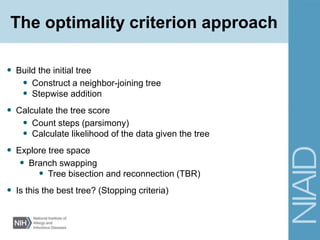
• Build the initial tree
• Construct a neighbor-joining tree
• Stepwise addition
• Calculate the tree score
• Count steps (parsimony)
• Calculate likelihood of the data given the tree
• Explore tree space
• Branch swapping
• Tree bisection and reconnection (TBR)
• Is this the best tree? (Stopping criteria)
The optimality criterion approach
•Stepwise addition
•Choose three taxa and join
•Random, or closest
•Select a new taxon to add
•Calculate the optimal 4-taxa tree
•Repeat until all taxa are joined
Building the initial tree
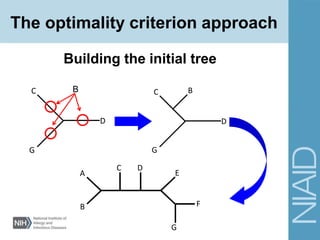
The optimality criterion approach
Building the initial tree
BC
D
G
C
D
G
A
B
C D
E
F
G
B
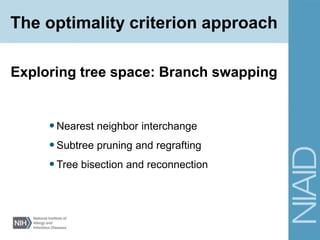
The optimality criterion approach
•Nearest neighbor interchange
•Subtree pruning and regrafting
•Tree bisection and reconnection
Exploring tree space: Branch swapping
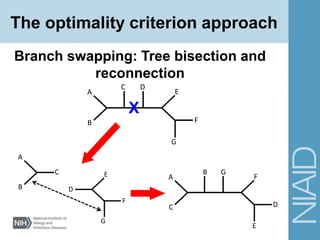
The optimality criterion approach
Branch swapping: Tree bisection and
reconnection
A
B
C D
E
F
G
X
C
A
B D
E
F
G
A
C
B G
F
D
E
The optimality criterion approach
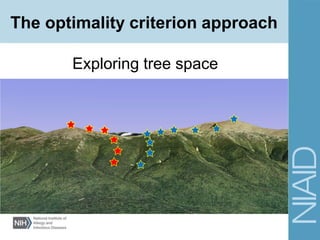
Beware! Hill climbing can often
lead to local maxima rather than
a global solution.
Exploring tree space
The optimality criterion approach
Exploring tree space
The optimality criterion approach
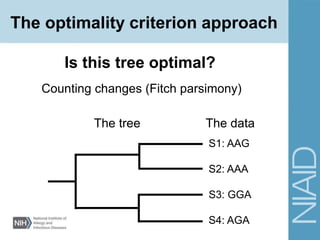
Counting changes (Fitch parsimony)
Is this tree optimal?
The tree The data
S1: AAG
S2: AAA
S3: GGA
S4: AGA
The optimality criterion approach
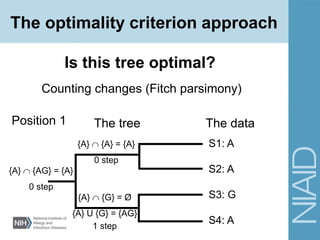
Counting changes (Fitch parsimony)
Is this tree optimal?
The tree The data
S1: A
S2: A
S3: G
S4: A
{A}  {A} = {A}
0 step
{A}  {AG} = {A}
0 step
{A}  {G} = Ø
{A} U {G} = {AG}
1 step
Position 1
The optimality criterion approach
Counting changes (Fitch parsimony)
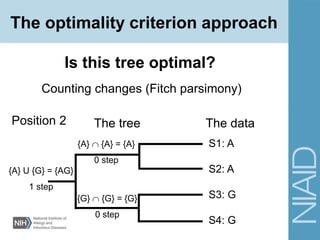
Is this tree optimal?
The tree The data
S1: A
S2: A
S3: G
S4: G
{A}  {A} = {A}
0 step
{A} U {G} = {AG}
1 step
{G}  {G} = {G}
0 step
Position 2
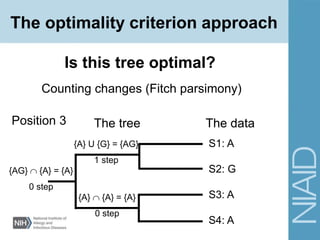
The optimality criterion approach
Counting changes (Fitch parsimony)
Is this tree optimal?
The tree The data
S1: A
S2: G
S3: A
S4: A
{A} U {G} = {AG}
1 step
{AG}  {A} = {A}
0 step
{A}  {A} = {A}
0 step
Position 3
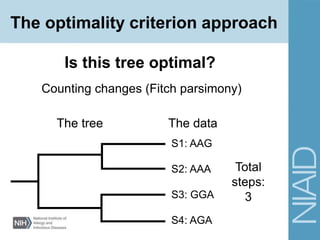
The optimality criterion approach
Counting changes (Fitch parsimony)
Is this tree optimal?
The tree The data
S1: AAG
S2: AAA
S3: GGA
S4: AGA
Total
steps:
3
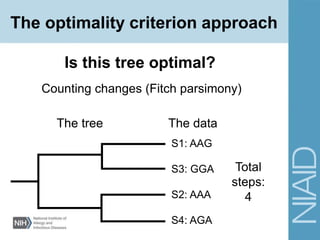
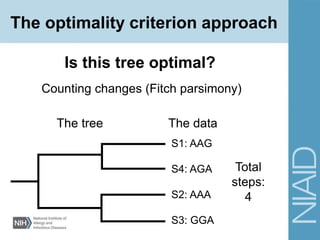
The optimality criterion approach
Counting changes (Fitch parsimony)
Is this tree optimal?
The tree The data
S1: AAG
S3: GGA
S2: AAA
S4: AGA
Total
steps:
4
The optimality criterion approach
Counting changes (Fitch parsimony)
Is this tree optimal?
The tree The data
S1: AAG
S4: AGA
S2: AAA
S3: GGA
Total
steps:
4
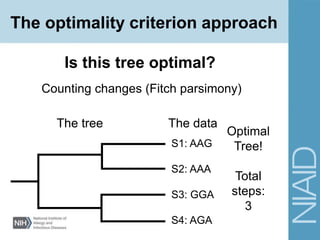
The optimality criterion approach
Counting changes (Fitch parsimony)
Is this tree optimal?
The tree The data
S1: AAG
S2: AAA
S3: GGA
S4: AGA
Optimal
Tree!
Total
steps:
3
The optimality criterion approach
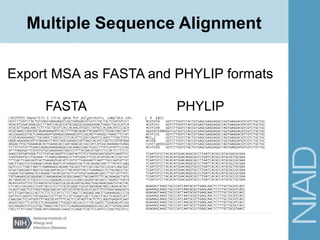
Export MSA as FASTA and PHYLIP formats
FASTA PHYLIP
Multiple Sequence Alignment
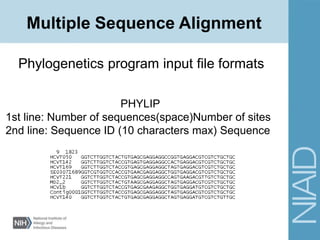
Phylogenetics program input file formats
PHYLIP
1st line: Number of sequences(space)Number of sites
2nd line: Sequence ID (10 characters max) Sequence
Multiple Sequence Alignment
NEXUS
#NEXUS
[Name: HCVT050 Len: 1823 Check: 5A341084]
[Name: HCVT142 Len: 1823 Check: AB5C0B76]
[Name: HCVT169 Len: 1823 Check: 7EAF66DA]
[Name: SE03071689 Len: 1823 Check: 1EFF8405]
[Name: HCVT221 Len: 1823 Check: 3D0C96F0]
[Name: MD2_2 Len: 1823 Check: 1E2A0948]
[Name: HCV1b Len: 1823 Check: BC29D7FB]
[Name: Contig0001 Len: 1823 Check: CD240524]
[Name: HCVT140 Len: 1823 Check: 2A5C0D4E]
begin data;
dimensions ntax=9 nchar=1823;
format datatype=dna interleave missing=-;
matrix
HCVT050 GGTCTTGGTCTACTGTGAGC GAGGAGGCCGGTGAGGACGT
HCVT142 GGTCTTGGTCTACCGTGAGT GAGGAGGCCACTGAGGACGT
HCVT169 GGTCTTGGTCTACCGTGAGC GAGGAGGCTAGTGAGGACGT
SE0307168 GGTCGTGGTCCACCGTGAAC GAGGAGGCTGGTGAGGACGT
HCVT221 GGTCTTGGTCTACCGTGAGC GAGGAGGCCAGTGAAGACGT
MD2_2 GGTCTTGGTCTACTGTAAGC GAGGAGGCTAGTGAGGACGT
HCV1b GGTCTTGGTCTACCGTGAGC GAAGAGGCTGGTGAGGATGT
Contig000 GGTCTTGGTCTACCGTGAGC GAGGAGGCTAGTGAGGACGT
HCVT140 GGTCTTGGTCTACTGTGAGC GAGGAGGCTAGTGAGGATGT
;
end;
Phylogenetics program input file formats
Multiple Sequence Alignment
Phylogenetics program input data guidelines
• Make sequence IDs different in the first ten characters
• Only letters, numbers, and “_” in sequence IDs
• Make sure all sequences overlap each other
Multiple Sequence Alignment
How reliable are my trees?
Bootstrapping (nonparametric)
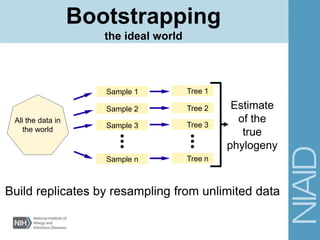
Bootstrapping
the ideal world
Build replicates by resampling from unlimited data
All the data in
the world
Sample n
Sample 3
Sample 2
Sample 1 Tree 1
Tree 2
Tree 3
Tree n
Estimate
of the
true
phylogeny
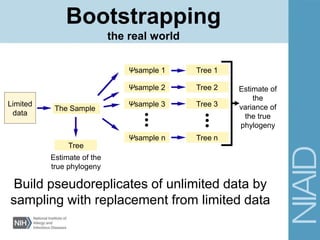
Build pseudoreplicates of unlimited data by
sampling with replacement from limited data
Limited
data
The Sample
Tree 1
Tree 2
Tree 3
Tree n
Estimate of
the
variance of
the true
phylogeny
Ψsample n
Ψsample 3
Ψsample 2
Ψsample 1
Tree
Estimate of the
true phylogeny
Bootstrapping
the real world
Let’s build some trees!
Phylogenetic programs (distance and parsimony)
PAUP* – Phylogenetic Analysis Using Parsimony
*and other methods
PHYLIP – a suite of phylogenetic programs
MEGA – An integrated phylogenetic analysis
package
Let’s build some trees!
Importing a FASTA-formatted alignment
File > Convert to MEGA format
Navigate to FASTA file
Data Format > .fasta (FASTA format)
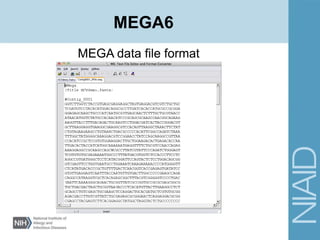
MEGA6
MEGA data file format
MEGA6
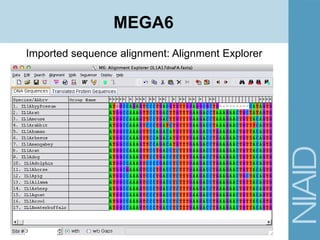
Imported sequence alignment: Alignment Explorer
MEGA6
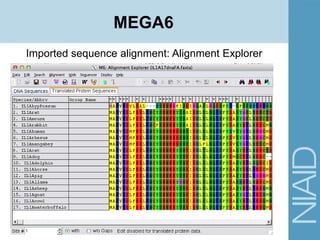
Imported sequence alignment: Alignment Explorer
MEGA6
Imported sequence alignment: Alignment Explorer
MEGA6
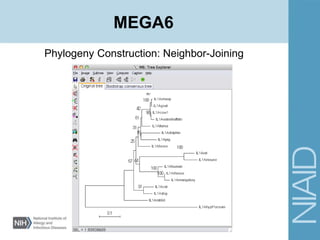
Phylogeny Construction: Neighbor-Joining
MEGA6
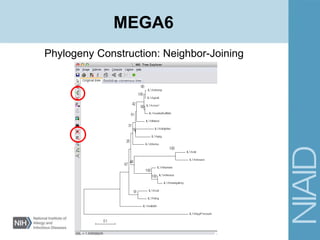
Phylogeny Construction: Neighbor-Joining
MEGA6
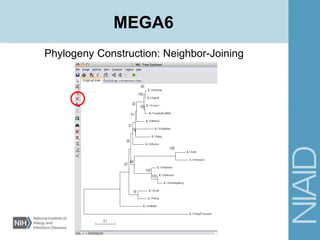
Phylogeny Construction: Neighbor-Joining
MEGA6
Phylogeny Construction: Neighbor-Joining
MEGA6
Phylogeny Construction: Neighbor-Joining
MEGA6
Phylogeny Construction: Neighbor-Joining
MEGA6
Phylogeny Construction: Neighbor-Joining
MEGA6
Phylogeny Construction: Neighbor-Joining
MEGA6
Phylogeny Construction: The Caption Option
MEGA6
Recapitulation
• What is a phylogenetic tree?
• How to build trees
•Distance
•Parsimony
• Calculated bootstrap support
Where have we been? What have we done?
Seminar Follow-Up Site
 For access to past recordings, handouts, slides visit this site from the
NIH network:
http://collab.niaid.nih.gov/sites/research/SIG/Bioinformatics/
56
1. Select a
Subject Matter
View:
• Seminar Details
• Handout and
Reference Docs
• Relevant Links
• Seminar
Recording Links
2. Select a
Topic
Recommended Browsers:
• IE for Windows,
• Safari for Mac (Firefox on a
Mac is incompatible with
NIH Authentication
technology)
Login
• If prompted to log in use
“NIH” in front of your
username
57
Retrieving Slides/Handouts
This lecture
series
58
Retrieving Slides/Handouts
This lecture
These slides
59
Questions?
60
Next
jModeltest: Fitting analysis parameters to your data
GARLi: Genetic Algorithm for Rapid Likelihood inference
MrBayes: Robust statistical phylogeny inference
Tuesday, 10 November at 0930

Phylogenetics: Tree building

  • 1.
    Phylogenetics and SequenceAnalysis Fall 2015 Kurt Wollenberg, PhD Phylogenetics Specialist Bioinformatics and Computational Biosciences Branch Office of Cyber Infrastructure and Computational Biology
  • 2.
    Course Organization •Building aclean sequence •Collecting homologs •Aligning your sequences •Building trees •Further Analysis
  • 3.
  • 4.
  • 5.
    What is aphylogenetic tree? • Reconstruction of biological history • Based on similarities and differences among homologous attributes (characters) of the entities under scrutiny • Molecular characters (sequences, usually) are most often found only in extant organisms
  • 6.
  • 7.
    Unrooted Rooted What isa phylogenetic tree?
  • 8.
    Two approaches totree building • Application of an algorithm to build the best tree from the data • Evaluation of multiple possible best trees using an optimality criterion
  • 9.
    The algorithm approach: DistanceMethods • Distance calculated based on a specific substitution model (J-C, Kimura, BLOSUM64, etc.) • Distances from each sequence to all others are calculated and stored in a matrix • Tree then calculated from the distance matrix using a specific tree-building algorithm
  • 10.
  • 11.
    The algorithm approach: Neighbor-joiningCalculation Hillis, Moritz, and Mable 1996, p. 489 A to Node 1 distance = (0.2147 + 0.3091 - 0.2795)/2 = 0.1222 B to Node 1 distance = (0.2991 + 0.3399 - 0.2795)/2 = 0.1798 E to Node 1 distance = (0.3943 + 0.4298 - 0.2795)/2 = 0.2719 C to Node 1 distance = 0.2795/2 + (0.3959 - 0.4525)/2 = 0.1114 D to Node 1 distance = 0.2795 - 0.1114 = 0.1681 R/(N-2) 0.3093 0.3388 0.3959 0.4525 0.4205 R 0.9279 1.0163 1.1876 1.3574 1.2616 A B C D E A - 0.1715 0.2147 0.3091 0.2326 B - 0.2991 0.3399 0.2058 C - 0.2795 0.3943 D - 0.4289 E - -0.4766 -0.4905 -0.4356 -0.4527 -0.4514 -0.5689 -0.4972 -0.5535 -0.4221 -0.4441
  • 12.
    Hillis, Moritz, andMable 1996, p. 489 B to Node 2 distance = (0.1715 + 0.1798 - 0.1222)/2 = 0.1146 E to Node 2 distance = (0.2326 + 0.2719 - 0.1222)/2 = 0.1912 A to Node 2 distance = 0.1222/2 + (0.2631 – 0.2869)/2 = 0.0492 Node 1 to Node 2 distance = 0.1222 – 0.0492 = 0.0730 R/(N-2) 0.2631 0.2785 0.3551 0.2869 R 0.5263 0.5571 0.7103 0.5739 A B E Node 1 A - 0.1715 0.2326 0.1222 B - 0.2058 0.1798 E - 0.2719 Node 1 - -0.3701 -0.3856 -0.4278 -0.4278 -0.3856 -0.3701 The algorithm approach: Neighbor-joining Calculation
  • 13.
    Hillis, Moritz, andMable 1996, p. 489 E to Node 3 distance = (0.2058 0.1912 - 0.1146)/2 = 0.1412 B to Node 3 distance = 0.1146/2 + (0.3204 – 0.3058)/2 = 0.0646 Node 2 to Node 3 distance = 0.1146 – 0.0646 = 0.0500 R/(N-2) 0.3204 0.3970 0.3058 R 0.3204 0.3970 0.3058 B E Node 2 B - 0.2058 0.1146 E - 0.1912 Node 2 - -0.5116 -0.5116 -0.5116 The algorithm approach: Neighbor-joining Calculation
  • 14.
  • 15.
    The optimality criterionapproach • Build a tree or trees • Evaluate the tree(s) using a specific numerical optimality criterion • Most common optimality criteria • Maximum parsimony • Maximum likelihood • Explore tree space to find the optimal tree
  • 16.
    Occam’s Razor: Thesimplest explanation is the preferred explanation. The tree requiring the minimal number of changes is the optimal tree. A step is any change in the data from one state to another Optimality Criterion: Parsimony
  • 17.
    • Build theinitial tree • Construct a neighbor-joining tree • Stepwise addition • Calculate the tree score • Count steps (parsimony) • Calculate likelihood of the data given the tree • Explore tree space • Branch swapping • Tree bisection and reconnection (TBR) • Is this the best tree? (Stopping criteria) The optimality criterion approach
  • 18.
    •Stepwise addition •Choose threetaxa and join •Random, or closest •Select a new taxon to add •Calculate the optimal 4-taxa tree •Repeat until all taxa are joined Building the initial tree The optimality criterion approach
  • 19.
    Building the initialtree BC D G C D G A B C D E F G B The optimality criterion approach
  • 20.
    •Nearest neighbor interchange •Subtreepruning and regrafting •Tree bisection and reconnection Exploring tree space: Branch swapping The optimality criterion approach
  • 21.
    Branch swapping: Treebisection and reconnection A B C D E F G X C A B D E F G A C B G F D E The optimality criterion approach
  • 22.
    Beware! Hill climbingcan often lead to local maxima rather than a global solution. Exploring tree space The optimality criterion approach
  • 23.
    Exploring tree space Theoptimality criterion approach
  • 24.
    Counting changes (Fitchparsimony) Is this tree optimal? The tree The data S1: AAG S2: AAA S3: GGA S4: AGA The optimality criterion approach
  • 25.
    Counting changes (Fitchparsimony) Is this tree optimal? The tree The data S1: A S2: A S3: G S4: A {A}  {A} = {A} 0 step {A}  {AG} = {A} 0 step {A}  {G} = Ø {A} U {G} = {AG} 1 step Position 1 The optimality criterion approach
  • 26.
    Counting changes (Fitchparsimony) Is this tree optimal? The tree The data S1: A S2: A S3: G S4: G {A}  {A} = {A} 0 step {A} U {G} = {AG} 1 step {G}  {G} = {G} 0 step Position 2 The optimality criterion approach
  • 27.
    Counting changes (Fitchparsimony) Is this tree optimal? The tree The data S1: A S2: G S3: A S4: A {A} U {G} = {AG} 1 step {AG}  {A} = {A} 0 step {A}  {A} = {A} 0 step Position 3 The optimality criterion approach
  • 28.
    Counting changes (Fitchparsimony) Is this tree optimal? The tree The data S1: AAG S2: AAA S3: GGA S4: AGA Total steps: 3 The optimality criterion approach
  • 29.
    Counting changes (Fitchparsimony) Is this tree optimal? The tree The data S1: AAG S3: GGA S2: AAA S4: AGA Total steps: 4 The optimality criterion approach
  • 30.
    Counting changes (Fitchparsimony) Is this tree optimal? The tree The data S1: AAG S4: AGA S2: AAA S3: GGA Total steps: 4 The optimality criterion approach
  • 31.
    Counting changes (Fitchparsimony) Is this tree optimal? The tree The data S1: AAG S2: AAA S3: GGA S4: AGA Optimal Tree! Total steps: 3 The optimality criterion approach
  • 32.
    Export MSA asFASTA and PHYLIP formats FASTA PHYLIP Multiple Sequence Alignment
  • 33.
    Phylogenetics program inputfile formats PHYLIP 1st line: Number of sequences(space)Number of sites 2nd line: Sequence ID (10 characters max) Sequence Multiple Sequence Alignment
  • 34.
    NEXUS #NEXUS [Name: HCVT050 Len:1823 Check: 5A341084] [Name: HCVT142 Len: 1823 Check: AB5C0B76] [Name: HCVT169 Len: 1823 Check: 7EAF66DA] [Name: SE03071689 Len: 1823 Check: 1EFF8405] [Name: HCVT221 Len: 1823 Check: 3D0C96F0] [Name: MD2_2 Len: 1823 Check: 1E2A0948] [Name: HCV1b Len: 1823 Check: BC29D7FB] [Name: Contig0001 Len: 1823 Check: CD240524] [Name: HCVT140 Len: 1823 Check: 2A5C0D4E] begin data; dimensions ntax=9 nchar=1823; format datatype=dna interleave missing=-; matrix HCVT050 GGTCTTGGTCTACTGTGAGC GAGGAGGCCGGTGAGGACGT HCVT142 GGTCTTGGTCTACCGTGAGT GAGGAGGCCACTGAGGACGT HCVT169 GGTCTTGGTCTACCGTGAGC GAGGAGGCTAGTGAGGACGT SE0307168 GGTCGTGGTCCACCGTGAAC GAGGAGGCTGGTGAGGACGT HCVT221 GGTCTTGGTCTACCGTGAGC GAGGAGGCCAGTGAAGACGT MD2_2 GGTCTTGGTCTACTGTAAGC GAGGAGGCTAGTGAGGACGT HCV1b GGTCTTGGTCTACCGTGAGC GAAGAGGCTGGTGAGGATGT Contig000 GGTCTTGGTCTACCGTGAGC GAGGAGGCTAGTGAGGACGT HCVT140 GGTCTTGGTCTACTGTGAGC GAGGAGGCTAGTGAGGATGT ; end; Phylogenetics program input file formats Multiple Sequence Alignment
  • 35.
    Phylogenetics program inputdata guidelines • Make sequence IDs different in the first ten characters • Only letters, numbers, and “_” in sequence IDs • Make sure all sequences overlap each other Multiple Sequence Alignment
  • 36.
    How reliable aremy trees? Bootstrapping (nonparametric)
  • 37.
    Bootstrapping the ideal world Buildreplicates by resampling from unlimited data All the data in the world Sample n Sample 3 Sample 2 Sample 1 Tree 1 Tree 2 Tree 3 Tree n Estimate of the true phylogeny
  • 38.
    Build pseudoreplicates ofunlimited data by sampling with replacement from limited data Limited data The Sample Tree 1 Tree 2 Tree 3 Tree n Estimate of the variance of the true phylogeny Ψsample n Ψsample 3 Ψsample 2 Ψsample 1 Tree Estimate of the true phylogeny Bootstrapping the real world
  • 39.
    Let’s build sometrees! Phylogenetic programs (distance and parsimony) PAUP* – Phylogenetic Analysis Using Parsimony *and other methods PHYLIP – a suite of phylogenetic programs MEGA – An integrated phylogenetic analysis package
  • 40.
  • 41.
    Importing a FASTA-formattedalignment File > Convert to MEGA format Navigate to FASTA file Data Format > .fasta (FASTA format) MEGA6
  • 42.
    MEGA data fileformat MEGA6
  • 43.
    Imported sequence alignment:Alignment Explorer MEGA6
  • 44.
    Imported sequence alignment:Alignment Explorer MEGA6
  • 45.
    Imported sequence alignment:Alignment Explorer MEGA6
  • 46.
  • 47.
  • 48.
  • 49.
  • 50.
  • 51.
  • 52.
  • 53.
  • 54.
    Phylogeny Construction: TheCaption Option MEGA6
  • 55.
    Recapitulation • What isa phylogenetic tree? • How to build trees •Distance •Parsimony • Calculated bootstrap support Where have we been? What have we done?
  • 56.
    Seminar Follow-Up Site For access to past recordings, handouts, slides visit this site from the NIH network: http://collab.niaid.nih.gov/sites/research/SIG/Bioinformatics/ 56 1. Select a Subject Matter View: • Seminar Details • Handout and Reference Docs • Relevant Links • Seminar Recording Links 2. Select a Topic Recommended Browsers: • IE for Windows, • Safari for Mac (Firefox on a Mac is incompatible with NIH Authentication technology) Login • If prompted to log in use “NIH” in front of your username
  • 57.
  • 58.
  • 59.
  • 60.
    60 Next jModeltest: Fitting analysisparameters to your data GARLi: Genetic Algorithm for Rapid Likelihood inference MrBayes: Robust statistical phylogeny inference Tuesday, 10 November at 0930

Editor's Notes

  • #12 Lower half of matrix = rate-corrected pairwise distance = M R = row totals of uncorrected distances M = dij – (Ri+Rj)/(N-2)