This document discusses restriction mapping and primer design. It describes restriction mapping as a way to characterize unknown DNA using restriction enzymes that cut DNA at specific sequences. It outlines criteria for designing effective primers for applications like PCR, including length, GC content, specificity, and melting temperature. Computer programs can help design primers and generate in silico restriction maps from DNA sequences. Degenerate primers allow amplification of related gene sequences.
RESTRICTION MAPPING
• Arestriction map is a description of restriction
endonuclease cleavage sites within a piece of DNA.
3.
RESTRICTION ENZYME -THE TOOL
RE – Enzymes that recognize a specific sequence in a DNA
molecule and cuts
Types
I and III – Recognize specific sequence but cuts
elsewhere
II –Cuts only within the the recognition site
Arrangement of breaks – Blunt and Cohesive
A particular RE generates a unique family of fragments
from a particular DNA molecule
4.
Generating such amap is usually the first step in
characterizing an unknown DNA
Typically, restriction enzymes that cleave DNA
infrequently (e.g. 6 bp recognition sites) are used
The DNA to be restriction mapped it usually contained
within a well-characterized plasmid or bacteriophage vector
for which the sequence is known.
In fact, there are usually multiple known (MCS) restriction
sites immediately flanking the uncharacterized DNA,
which facilitates making the map.
5.
APPLICATIONS
• Identifying thesize of the insert
• Check the orientation of gene in cloning
• Mutation studies
• Removing part of gene
• To check whether the sequence you get back from
sequencing lab/company corresponds to the piece of DNA
you sent out
• To check whether the sequence assembly is correct in case
of shotgun sequencing of genomes
6.
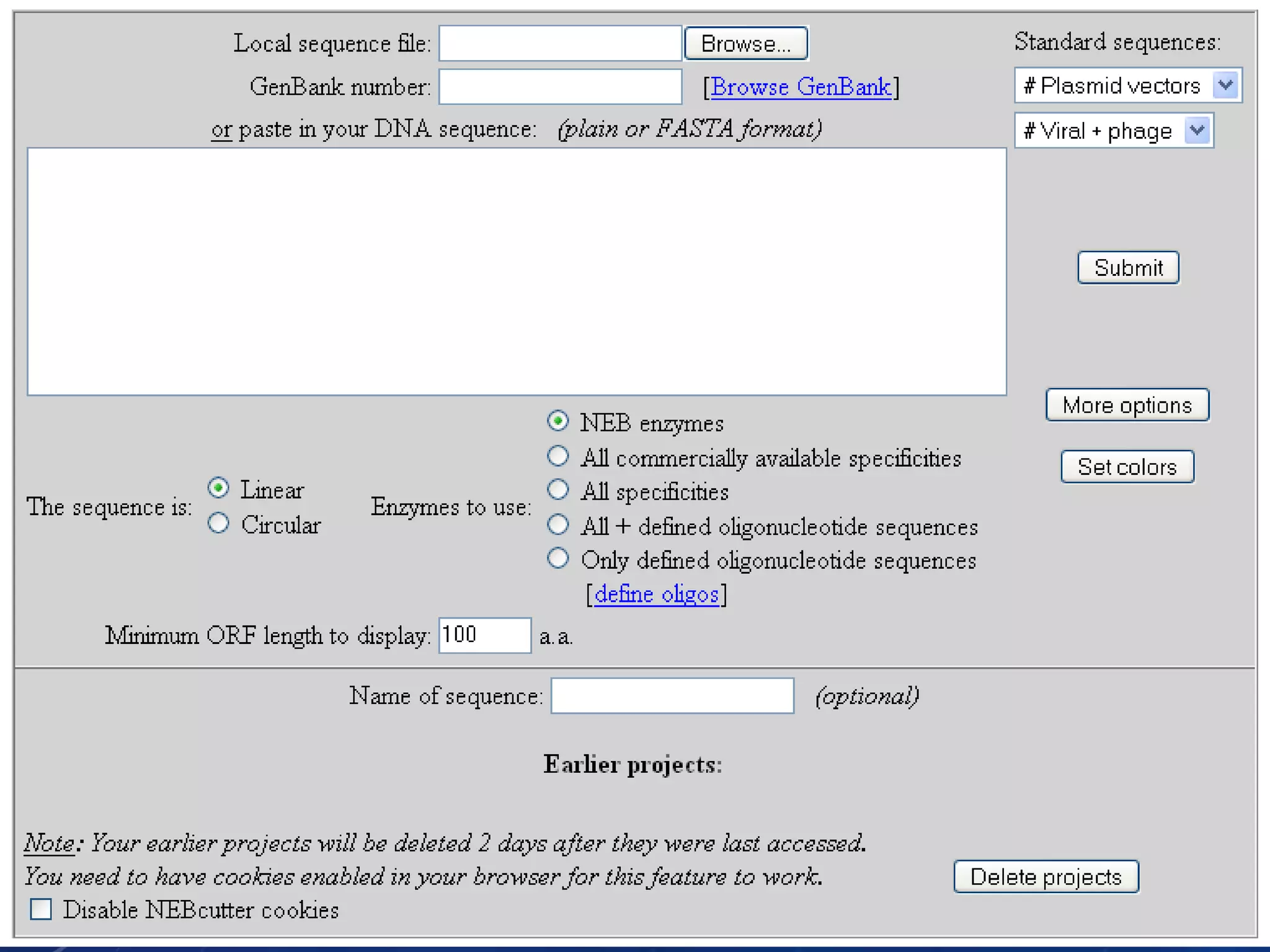
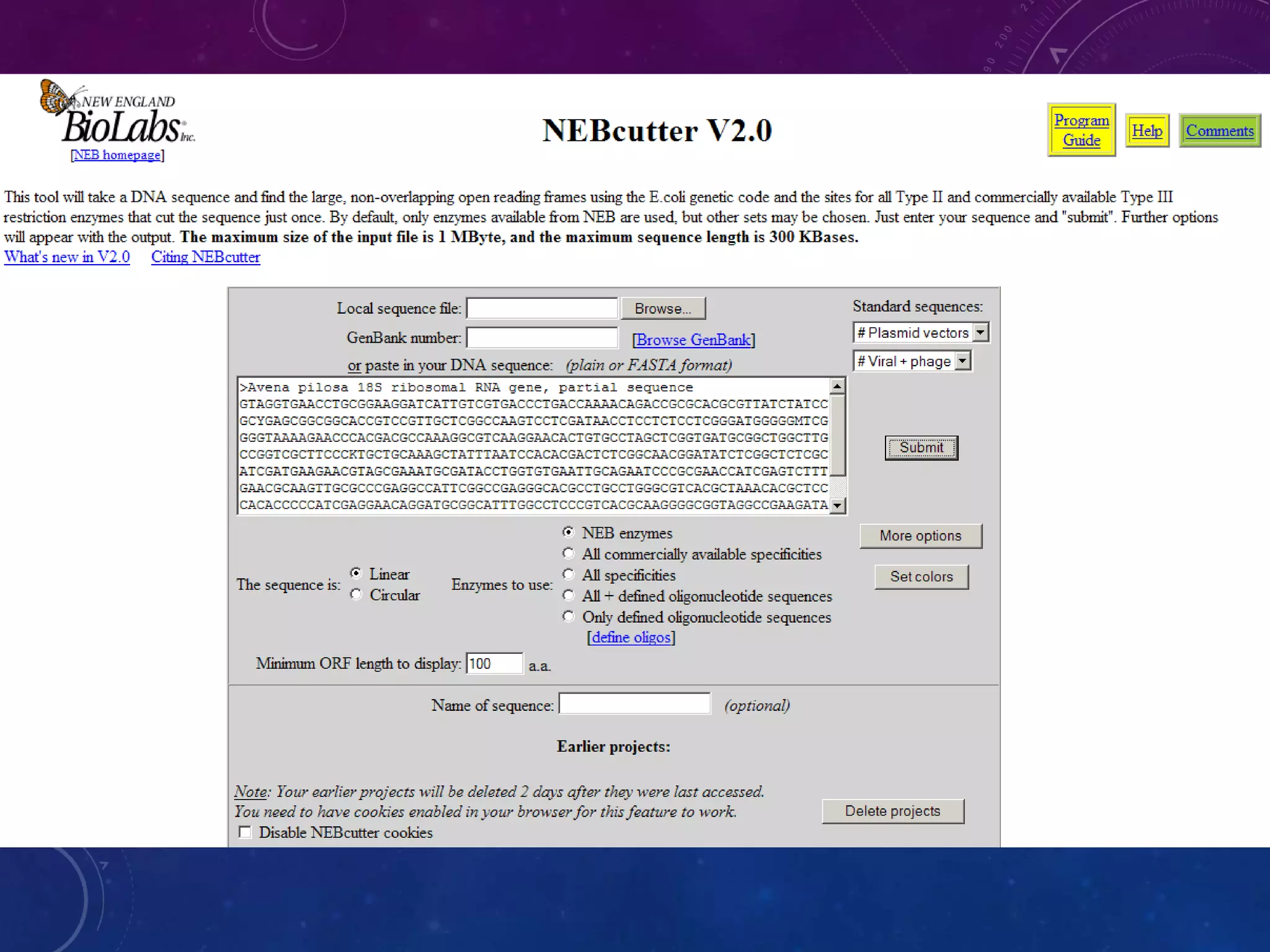
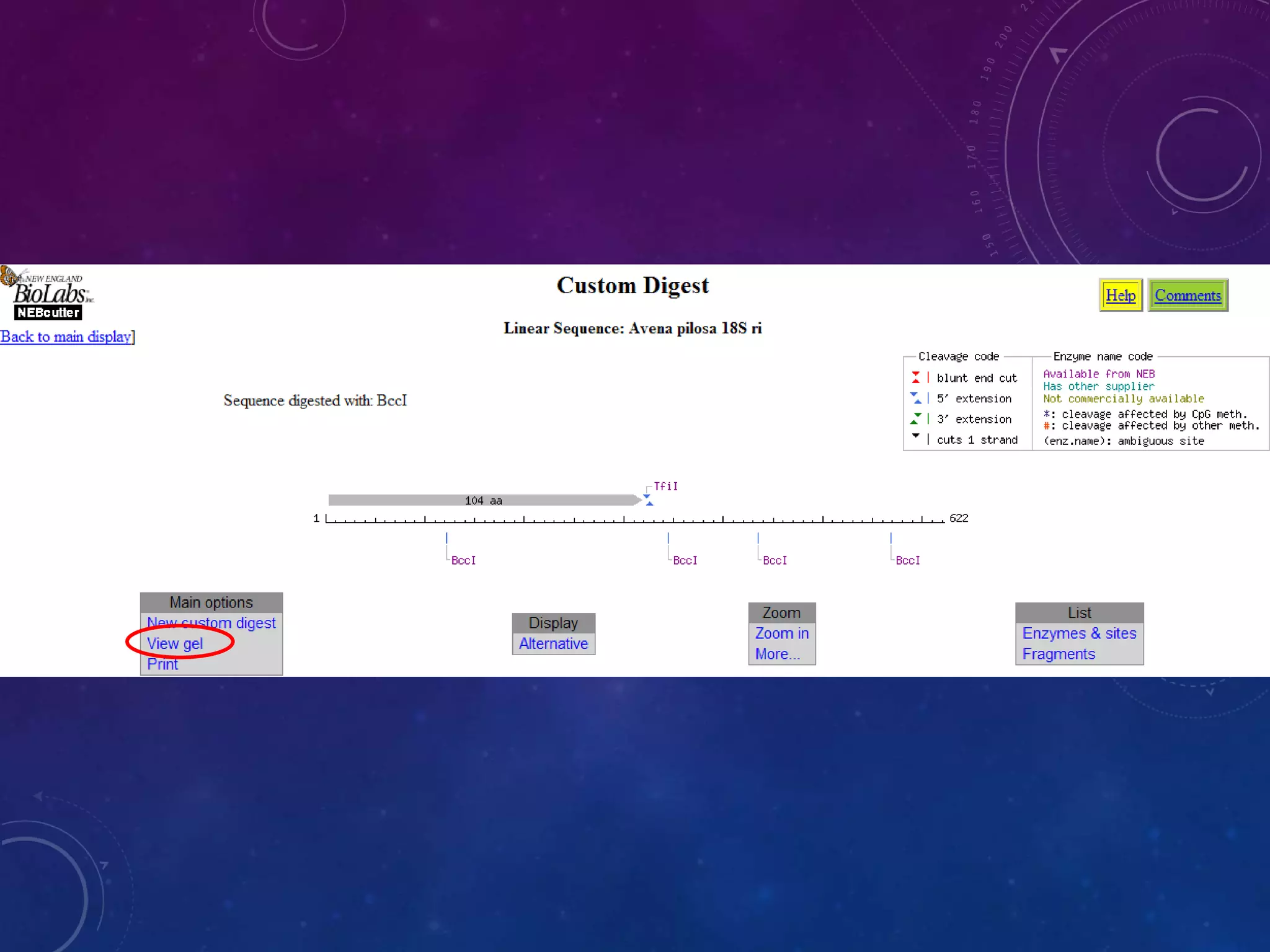
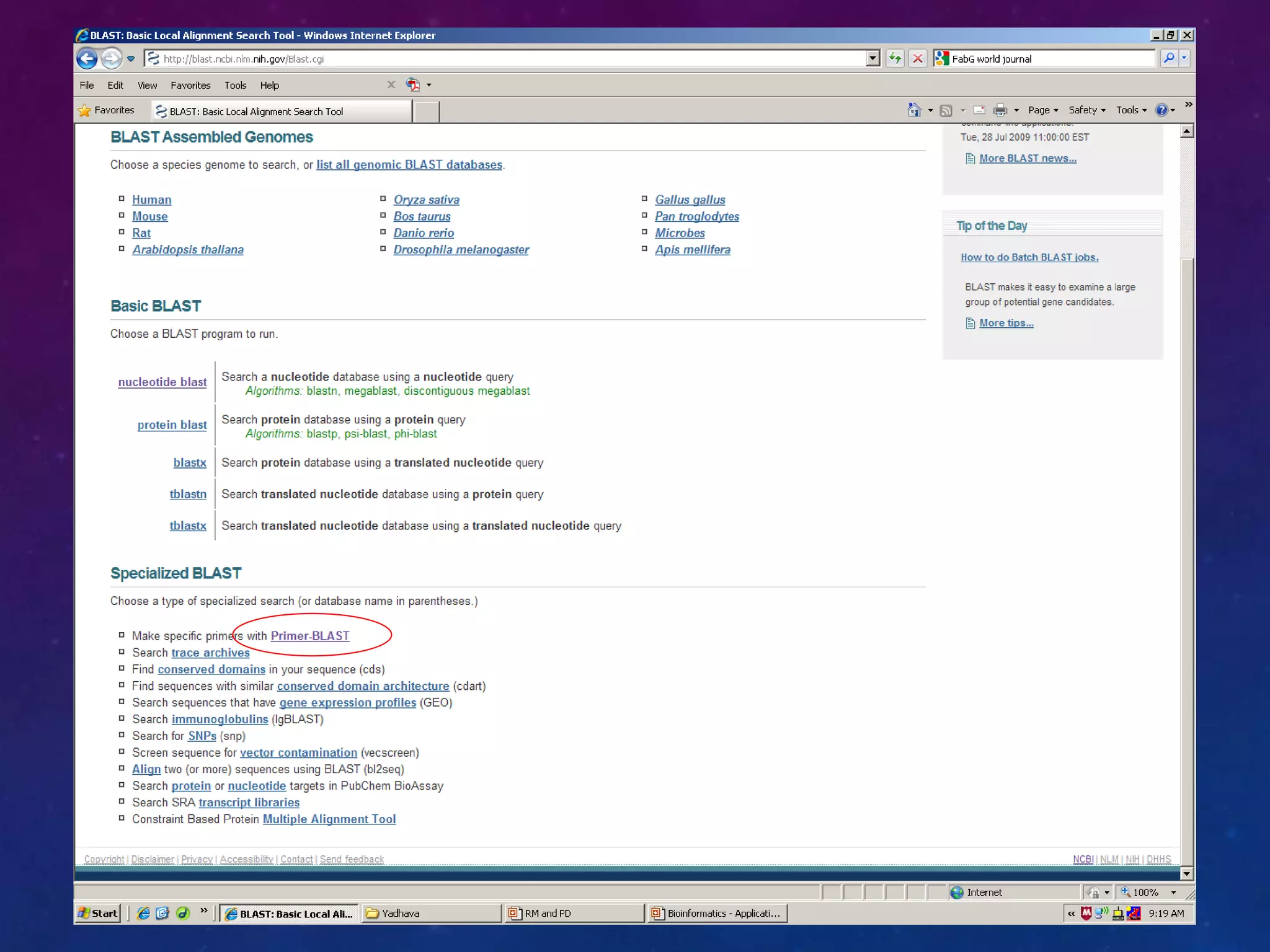
USING A COMPUTERTO GENERATE RESTRICTION MAPS
• Need to have the sequence of the DNA.
• If the sequence is known, it is a simple matter to feed that
sequence into any number of computer programs, which
will search the sequence for dozens of restriction enzyme
recognition sites and build a map for you.
PRIMER
A short singlestranded oligonucleotide
Binds to single stranded template molecule
Acts as the starting point for complementary strand
synthesis in 5’ 3’
Popular application: PCR application
16.
PRIMER SELECTION CRITERIA
•Choose primers of 15 – 30 nucleotides in length. Longer
primers provides sufficient specificity
• GC content of 40% - 60% Uniformly distributed
• More than 3 G/C nucleotide at the 3’ end should be avoided
as nonspecific priming may occur
• Primers should end (3') in a G or C, or CG or GC: this
prevents "breathing" of ends and increases efficiency of
priming
17.
PRIMER SELECTION CRITERIA
Shouldnot be self-complementary or
complementary to other primers in the reaction to
avoid primer dimer (self/cross) and hairpin
Tm of flanking primers should not differ by over
5 °C, so the GC content should be chosen
accordingly
For degenerate primers at least 3 conservative
nucleotides must be located at the primers’ 3’ end
DNA SEQUENCING
• AutomatedDNA sequencing allow much longer reads than
manual but sequence length obtained from single run is
limited
• As the fragments get larger, the degree of separation
between bands is less and amount of product in each band
is reduced, making the signal weak and hence becomes less
reliable
• Few hundred bases may be sufficient for looking at
variations of specific region between different species, but
if we want to sequence whole gene or genome, then we will
require longer sequence data
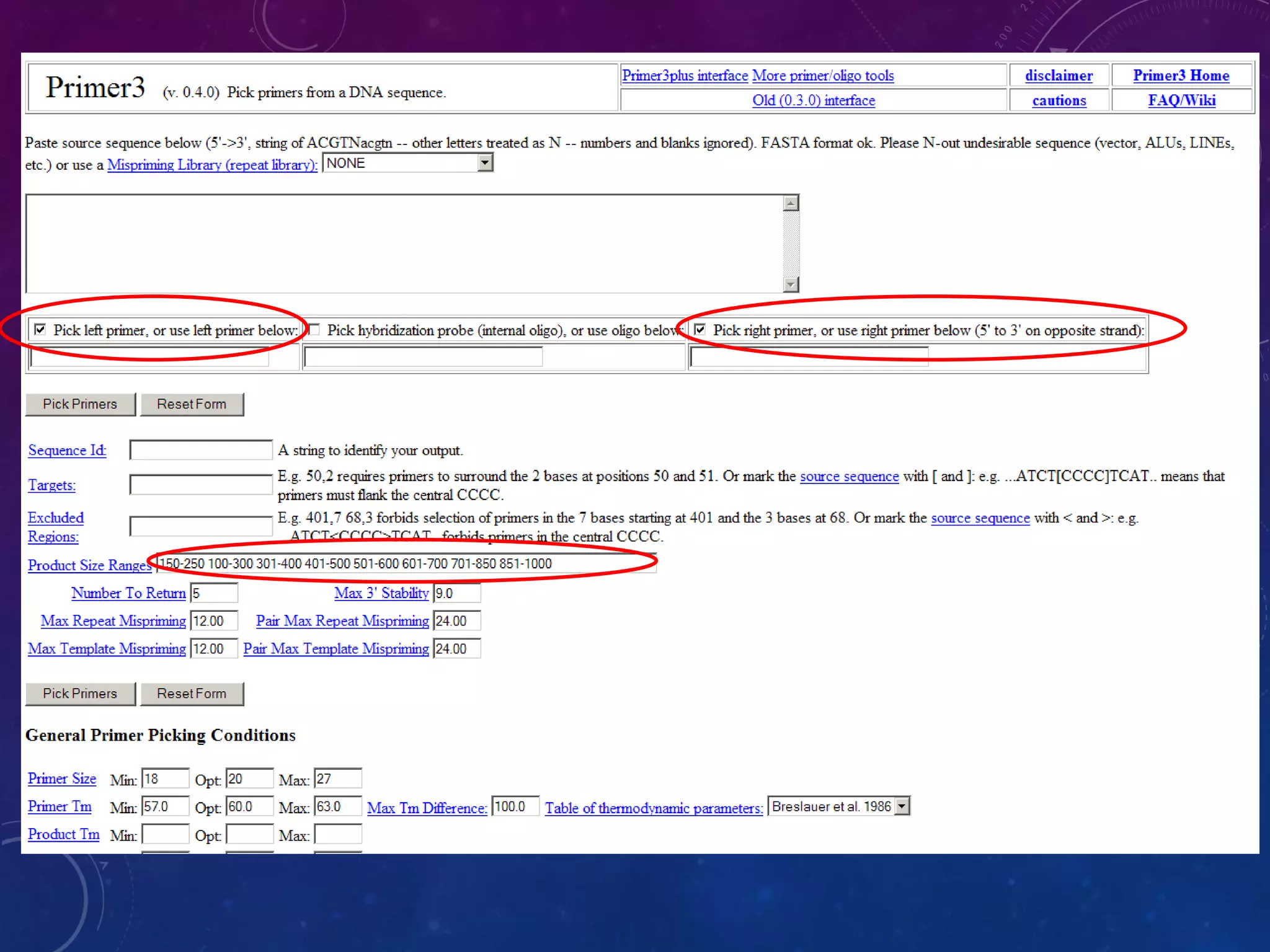
USING COMPUTER PROGRAMS
•Useful when many primers to designed and synthesized
• These tools may reduce the cost and time involved in
experimentation by lowering the chances of failed
experimentation
• Both free and commercial software available
• Digitized primer sequences can be downloaded to
synthesizers
DEGENERATE PRIMERS
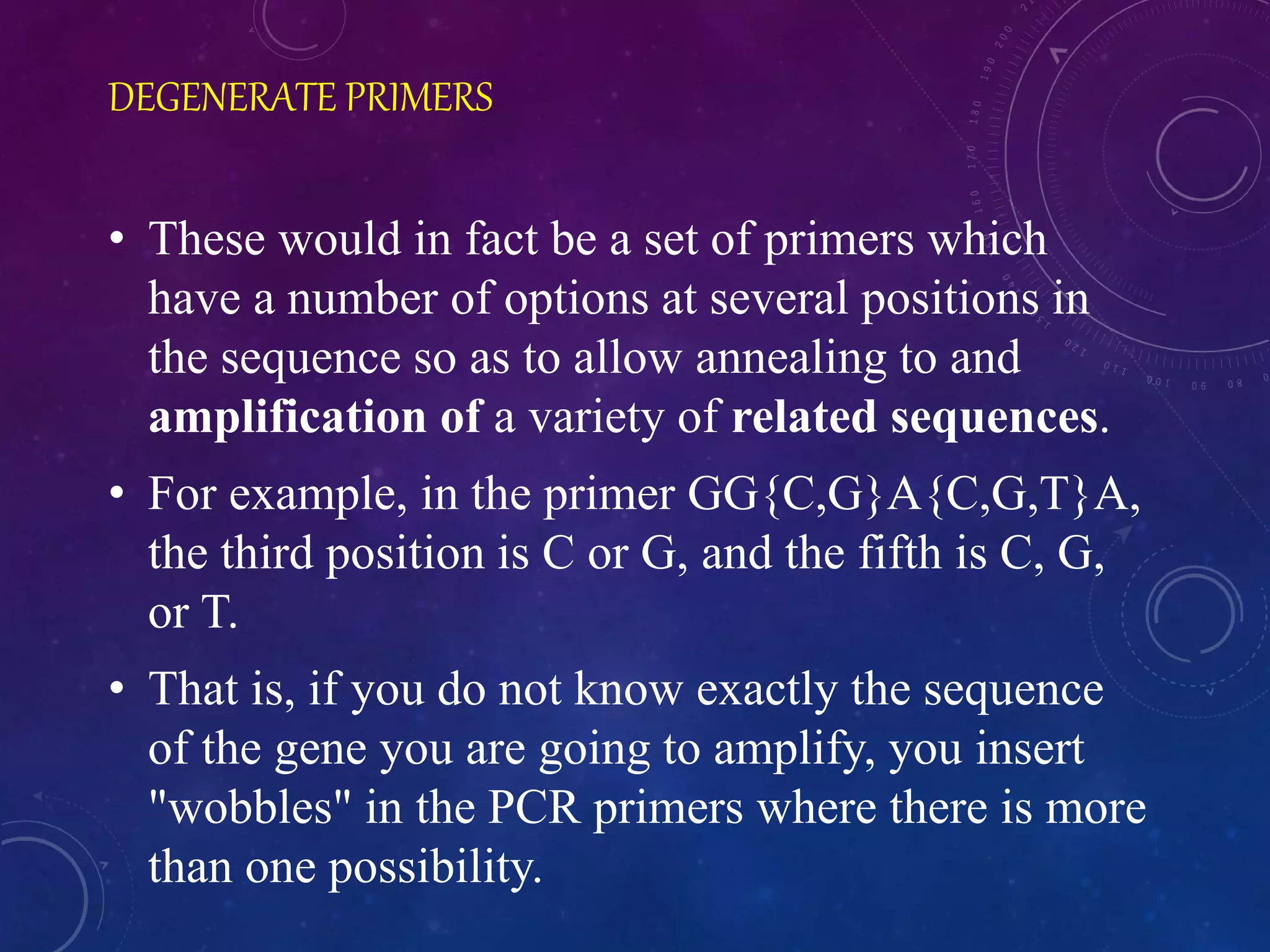
• Thesewould in fact be a set of primers which
have a number of options at several positions in
the sequence so as to allow annealing to and
amplification of a variety of related sequences.
• For example, in the primer GG{C,G}A{C,G,T}A,
the third position is C or G, and the fifth is C, G,
or T.
• That is, if you do not know exactly the sequence
of the gene you are going to amplify, you insert
"wobbles" in the PCR primers where there is more
than one possibility.
34.
• For instanceif you just have a protein motif, you can back-
translate the protein motif to the corresponding nucleotide
motif. (Protein --> DNA Sequence).
• Example of a degenerate PCR primer designed after a protein
motif.
Trp Asp Thr Ala Gly Gln Glu
5' TGG GAY ACN GCN GGN CAR GA 3'
This gives a mix of 256 different oligonucleotides.
Where the Y=C or T, R=G or A, N=G, A, T or C.
Degenerate nucleotide codes: R=AG, Y=CT, M=AC, K=GT,
W=AT, S=CG, B=CGT, D=AGT, H=ACT, V=ACG,
N=ACGT.
35.
REMEMBER
• Degeneracy obviouslyreduce the specificity of the primer(s), meaning
mismatch opportunities are greater, and background noise increases
• Also, increased degeneracy means concentration of the individual
primers decreases; thus, greater than 512-fold degeneracy should be
avoided.
36.
WHY USE DEGENERATEPCR?
• Degenerate PCR has proven to be a very powerful tool to
find "new" genes or gene families.
• Most genes comes in families which share structural
similarities.
• By aligning the protein sequences from a number of related
proteins we can find which parts of the protein is conserved
or which is variable.