Submitted By- Neha kumari
Roll no.-CUHP18ZOO17
SUBMITTED TO
MISS EKTA
GULERIA
CENTRAL UNIVERSITY
OF HIMACHAL
PRADESH
WHAT IS PHYLOGENY
PHYLOGENY - It is the evolutionary
history of a taxonomic group of organisms.
 It is closely related branch of science that make use of
phylogenetic tree diagrams to study evolutionary
history and relatedness among various group of
organisms is phylogenetics.
GOALS OF PHYLOGENY
 GOAL- Relationship between species, populations,
individual organisms.
 RESULT- Tree present as collection of nodes and
branches .
 Branch length shows---- Evolutionary time.
 Trees may be
 1 )Bifurcating
 2)Multifurcating
 ON THE BASIS OF BRANCH LENGTH
 Trees are of 3 types
1) Scaled tree
 2)Additive tree
 3)Unscaled tree
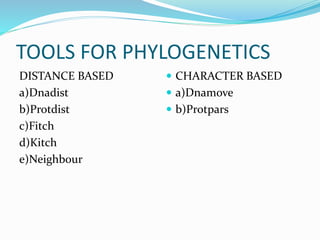
TOOLS FOR PHYLOGENETICS
DISTANCE BASED
a)Dnadist
b)Protdist
c)Fitch
d)Kitch
e)Neighbour
 CHARACTER BASED
 a)Dnamove
 b)Protpars
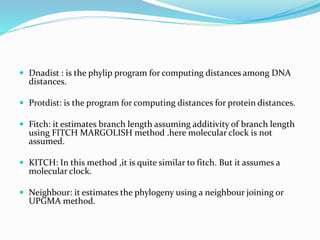
 Dnadist : is the phylip program for computing distances among DNA
distances.
 Protdist: is the program for computing distances for protein distances.
 Fitch: it estimates branch length assuming additivity of branch length
using FITCH MARGOLISH method .here molecular clock is not
assumed.
 KITCH: In this method ,it is quite similar to fitch. But it assumes a
molecular clock.
 Neighbour: it estimates the phylogeny using a neighbour joining or
UPGMA method.
METHODS TO BUILD A TREE
 UPGMA
 NEIGHBOUR JOINING
 DISTANCE BASED
 MAXIMUM PARSIMONEY
 MAXIMUM LIKELIHOOD METHOD
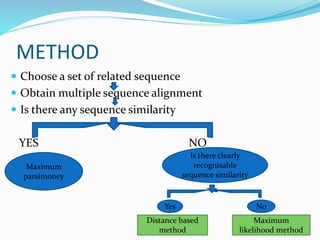
METHOD
 Choose a set of related sequence
 Obtain multiple sequence alignment
 Is there any sequence similarity
YES NO
Is there clearly
recognisable
sequence similarity
Maximum
parsimoney
Yes No
Distance based
method
Maximum
likelihood method
 The main distance based method include the UPGMA (
Unweighted pair Group Method With Airthmatic Mean)
and Neighbour joining method (NJ)
 Distnace based method method are used for the analysis of
large sequence.
 These methods use number of amino acids, changes
between the sequence .
 example: we can calculate the amino acid similarity
between each pair of protein in the multiple sequence
alignment.
 Dog and rabbit beta-globin are very closely related and
will be placed closed in a tree.
 Insect globin and soyabean globin are more distant
than the other sequence and are placed far away on the
tree.
UPGMA
 It is a sequential clustring algorithm.
 Pairwise distance between sequence are computed
and phylogenetic tree is built in a stepwise manner.
 Identify among all that are more similar to each other
&then treat them as a new single branch.
 In this we identify highest similarity among all
NEIGHBOUR JOINING METHOD
 It is an algorithm for constructing phylogenetic tree
 Once a distance measurement is done between a set of
sequences has been determined a neighbour joining
algorithm will find the two closest group
 Then look for next closest ,until all sequences are fit
into a tree.
MEGA
 It is a useful software in constructing phylogeny and
visulising them and also for data conversion.
 MEGA tree explorer is helpful in editing trees very easily.
 DENDROSCOPE: Helpful in visualizing large trees.
 PHYLOTREE.JS : It is a javascript based library to visualize
tree.
 One can upload trees using PHYLOTREE.JS.
 It is good for comparison of trees.
 TREE VIEW: Software to view the phylogenetic tree
with the provision of changing view.
 JS TREE: An open source library for viewing and
editing phylogeny tree for presentation improvement.
 PHYLIP: A package for phylogenetic studies.
 PMMLA: Based on maximum likelihood method .
 MOLPHY: Molecular phylogenetic evolutionary tool
based on maximum likelihood method.
 MEGA : Use to study the evolutionary closeness.
 TREE TOP: Phylogenetic tree prediction
 TREE OF LIFE: Information about phylogeny and
biodiversity.
 TREEGEN: Tree genration from distance data.
CHARACTER BASED
 Dnamove :It perform parsimoney and compatiblity
interactively.
 Protpars: It is based on the number of mutations to
change a codon for amin acid 1 to change a codon for
amino acid 2 for non synonymous changes only.
 With
gratitude .

Tools in phylogeny

  • 1.
    Submitted By- Nehakumari Roll no.-CUHP18ZOO17 SUBMITTED TO MISS EKTA GULERIA CENTRAL UNIVERSITY OF HIMACHAL PRADESH
  • 2.
    WHAT IS PHYLOGENY PHYLOGENY- It is the evolutionary history of a taxonomic group of organisms.  It is closely related branch of science that make use of phylogenetic tree diagrams to study evolutionary history and relatedness among various group of organisms is phylogenetics.
  • 3.
    GOALS OF PHYLOGENY GOAL- Relationship between species, populations, individual organisms.  RESULT- Tree present as collection of nodes and branches .  Branch length shows---- Evolutionary time.
  • 4.
     Trees maybe  1 )Bifurcating  2)Multifurcating  ON THE BASIS OF BRANCH LENGTH  Trees are of 3 types 1) Scaled tree  2)Additive tree  3)Unscaled tree
  • 5.
    TOOLS FOR PHYLOGENETICS DISTANCEBASED a)Dnadist b)Protdist c)Fitch d)Kitch e)Neighbour  CHARACTER BASED  a)Dnamove  b)Protpars
  • 6.
     Dnadist :is the phylip program for computing distances among DNA distances.  Protdist: is the program for computing distances for protein distances.  Fitch: it estimates branch length assuming additivity of branch length using FITCH MARGOLISH method .here molecular clock is not assumed.  KITCH: In this method ,it is quite similar to fitch. But it assumes a molecular clock.  Neighbour: it estimates the phylogeny using a neighbour joining or UPGMA method.
  • 7.
    METHODS TO BUILDA TREE  UPGMA  NEIGHBOUR JOINING  DISTANCE BASED  MAXIMUM PARSIMONEY  MAXIMUM LIKELIHOOD METHOD
  • 8.
    METHOD  Choose aset of related sequence  Obtain multiple sequence alignment  Is there any sequence similarity YES NO Is there clearly recognisable sequence similarity Maximum parsimoney Yes No Distance based method Maximum likelihood method
  • 9.
     The maindistance based method include the UPGMA ( Unweighted pair Group Method With Airthmatic Mean) and Neighbour joining method (NJ)  Distnace based method method are used for the analysis of large sequence.  These methods use number of amino acids, changes between the sequence .  example: we can calculate the amino acid similarity between each pair of protein in the multiple sequence alignment.
  • 10.
     Dog andrabbit beta-globin are very closely related and will be placed closed in a tree.  Insect globin and soyabean globin are more distant than the other sequence and are placed far away on the tree.
  • 11.
    UPGMA  It isa sequential clustring algorithm.  Pairwise distance between sequence are computed and phylogenetic tree is built in a stepwise manner.  Identify among all that are more similar to each other &then treat them as a new single branch.  In this we identify highest similarity among all
  • 12.
    NEIGHBOUR JOINING METHOD It is an algorithm for constructing phylogenetic tree  Once a distance measurement is done between a set of sequences has been determined a neighbour joining algorithm will find the two closest group  Then look for next closest ,until all sequences are fit into a tree.
  • 13.
    MEGA  It isa useful software in constructing phylogeny and visulising them and also for data conversion.  MEGA tree explorer is helpful in editing trees very easily.  DENDROSCOPE: Helpful in visualizing large trees.  PHYLOTREE.JS : It is a javascript based library to visualize tree.  One can upload trees using PHYLOTREE.JS.  It is good for comparison of trees.
  • 14.
     TREE VIEW:Software to view the phylogenetic tree with the provision of changing view.  JS TREE: An open source library for viewing and editing phylogeny tree for presentation improvement.  PHYLIP: A package for phylogenetic studies.  PMMLA: Based on maximum likelihood method .  MOLPHY: Molecular phylogenetic evolutionary tool based on maximum likelihood method.  MEGA : Use to study the evolutionary closeness.
  • 15.
     TREE TOP:Phylogenetic tree prediction  TREE OF LIFE: Information about phylogeny and biodiversity.  TREEGEN: Tree genration from distance data.
  • 16.
    CHARACTER BASED  Dnamove:It perform parsimoney and compatiblity interactively.  Protpars: It is based on the number of mutations to change a codon for amin acid 1 to change a codon for amino acid 2 for non synonymous changes only.
  • 17.