Softwares For Phylogentic Analysis Survey of Software Programs Available For Phylogenetic Analysis UNIT V S. Prasanth Kumar, II M.Sc (BIOINFORMATICS), Alagappa University, India. prasanthbioinformatics@gmail.com
Three Major Reasons for Using Phylogenetics Determining the closest relatives of the organism that you’re interested Discovering the function of a gene Retracing the origin of a gene
Survey of Various Phylogenetic Programs
An assumption by which molecular sequences  evolve at constant rates  so that the amount of accumulated mutations is proportional to evolutionary time Based on this hypothesis, branch lengths on a tree can be used to estimate  divergence time Molecular Clock
Desirable Qualities of Algorithms Time consuming if large data sets are used for phylogenetic analysis Algorithms should be heuristic (i.e. a rule of thumb: skipping unnecessary steps and concentrating more on reliable steps) Recursion and Iteration steps for efficient tree construction
All Substitution models to be used for correct phylogeny assessment Location of  Transitions and Transversions e.g. Jukes-Cantor, Kimura model, etc Our phylogenetic analysis depends upon the MSA generated The MSA should concentrate on Structural alignments rather than Sequence alignments Substitution Models Assessment
Manual inspection of MSA is always required. It can be done using MSA editors Methods used for phylogenetic analysis should contribute to all the following attributes: Minimum Evolution Evolutionary distance Not purely based on Mathematical calculations  Desirable attributes of Phylogeny
We should ensure that the phylogenetic tree has been constructed based on Informative sites (i.e. column of conserved residues) There should be no error in the initial alignment because it would affect the whole procedure to generate phylogenetic tree leading to erroneous tree (s) Stress on “Initial Alignment”
More than 1 substitution models is acceptable for efficient evolutionary predictions Randomness is accepted only in analyzing the reliability of the phylogenetic tree as in Bootstrapping technique Choosing the program should be dependent on our datasets (sequences) Choosing the Right Program
If only one tree has been generated as does by Distance methods, Bootstrapping is appreciated It will be always good to work on different topologies of a phylogenetic tree Equal importance should be given to the sequences (excluding the pair of sequence taken for initial alignment) that has closest relationship Different Topologies
Programs should consider Informative sites discarding Non informative sites and not on the alignment score of the informative sites Closest sequences does not mean biologically the pair of sequences having the highest alignment score, hence care should be given to choose molecular markers (explained in next slide) Selecting Closest Sequences
Choice of Molecular Markers Different individuals within a population Non coding regions of mitochondrial DNA are often used.  More widely divergent groups of organisms One may choose either slowly evolving nucleotide sequences, such as ribosomal RNA or protein sequences.  If the phylogenetic relationships to be delineated are at the deepest level, such as between bacteria and eukaryotes,  Conserved protein sequences makes more sense than using nucleotide sequences.
Codon usage table for model organisms should be used if we are finding out phylogeny within a species using nucleotide species Methods exploring different topologies is appreciable since these methods explore minimum evolution Codon Preference
Weighted Parsimony Weighted parsimony is better than Unweighted parsimony  (treats all mutations as equivalent) mutations of some sites are known to occur less frequently than others, for example, transversions versus transitions, functionally important sites versus neutral sites. Therefore, a weighting scheme that takes into account the different kinds of mutations helps to select tree topologies more accurately
User Requirements The program should be user-friendly. It should display tree with  higher graphical resolution Choosing substitution models for our study can be quite confusing. Hence, tools for selecting substitution models will be a good practice Modeltest , a program for selecting appropriate substitution models for nucleotide sequences
Sequence Divergence & Choice of Methods If sequence divergence is low: go for Character based methods which can provide information about homoplasy If sequence divergence is high and the mount of homoplasies is large: go for Distance based methods Parsimonious tree considers only informative sites. There is chance of loss of phylogenetic signal
Tree Topology Assessment Heuristic Algorithms for Probability based Methods Maximum Likelihood (ML) uses probabilistic models to choose a best tree that has the highest probability or likelihood of reproducing the observed data. Choosing an unrealistic substitution model may lead to an incorrect tree Some of the new heuristics used are: Quartet Puzzling Bayesian Inference Quartet Puzzling : the total number of taxa are divided into many subsets of four taxa known as  quartets . An optimal ML tree is constructed from each of these quartets
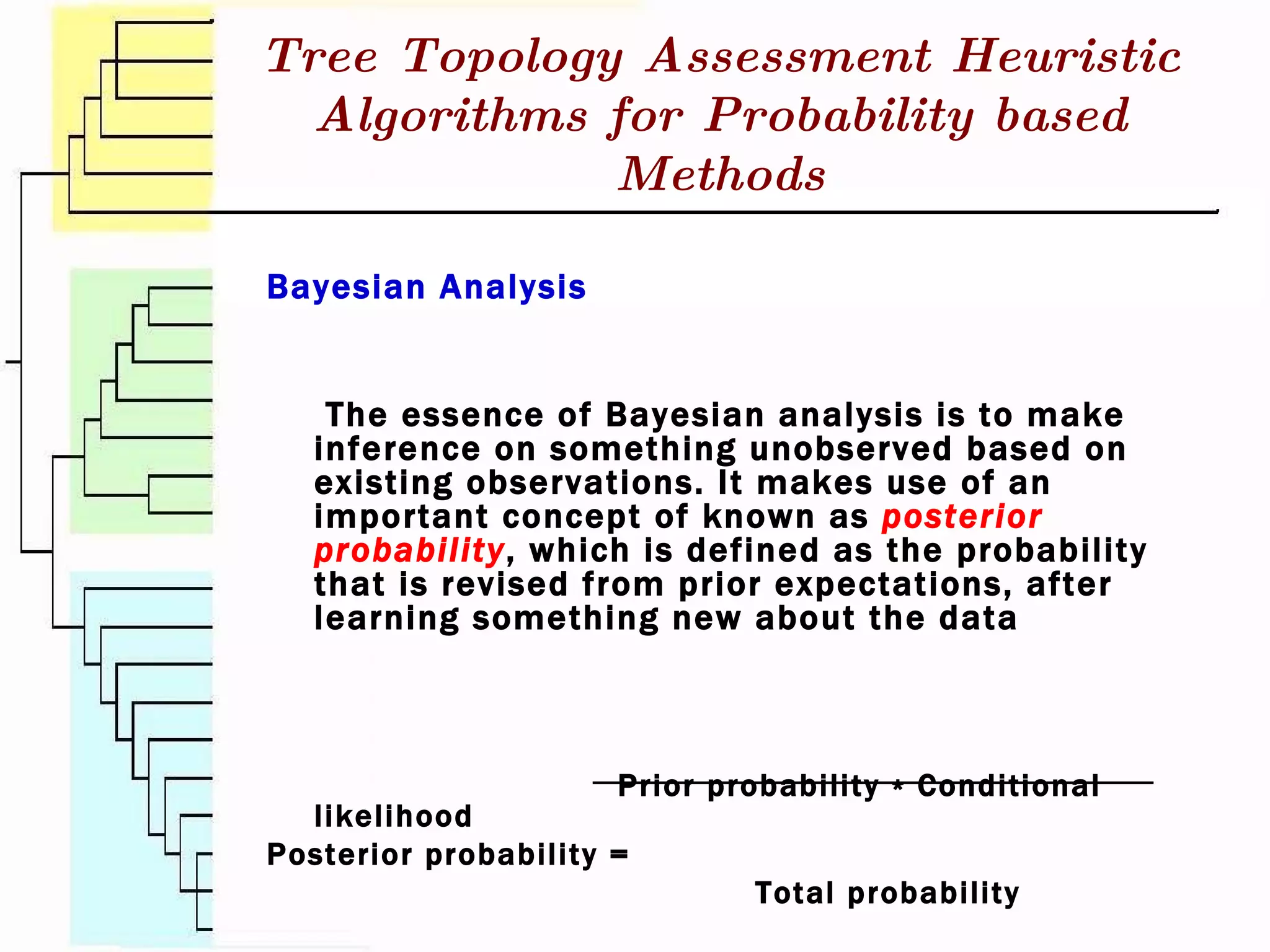
Bayesian Analysis The essence of Bayesian analysis is to make inference on something unobserved based on existing observations. It makes use of an important concept of known as  posterior probability , which is defined as the probability that is revised from prior expectations, after learning something new about the data   Prior probability ∗ Conditional likelihood Posterior probability =   Total probability Tree Topology Assessment Heuristic Algorithms for Probability based Methods
Analyzing Mutations These mutations are easily detected by multiple alignment Base Substitutions Indel - Insertions & Deletions These mutations are not easily detected by multiple alignments Transposition Exon (domain) Shuffling Hence manual intervention is required. The organization of proteins should be addressed previously so as to identify these types of mutations
Protein Sequences Are Preferable Than Nucleotide Sequences Reason : Degeneracy of the genetic code “  61 codons encode for 20 amino acids ” A change in a codon may not result in a change in amino acid DNA sequences are sometimes more biased than protein sequences because of preferential codon usage in different organisms
Improving Alignment Quality Improve alignment by correcting alignment errors and removing potentially unrelated or highly divergent sequences Programs :  Rascal and NorMD Detect and eliminate the poorly aligned positions and divergent regions Programs :  Gblocks
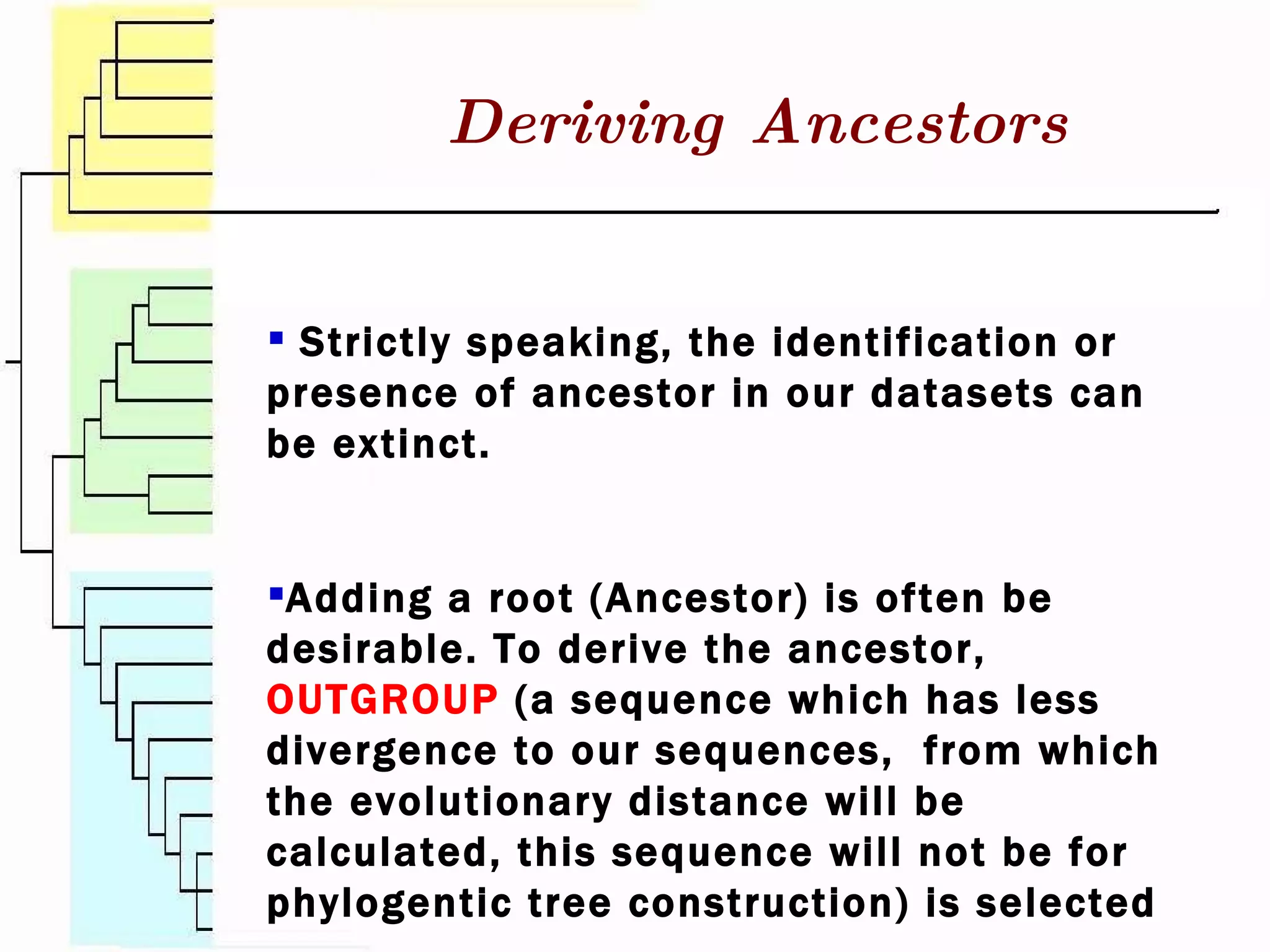
Deriving Ancestors Strictly speaking, the identification or  presence of ancestor in our datasets can be extinct. Adding a root (Ancestor) is often be desirable. To derive the ancestor,  OUTGROUP  (a sequence which has less divergence to our sequences,  from which the evolutionary distance will be calculated, this sequence will not be for phylogentic tree construction) is selected
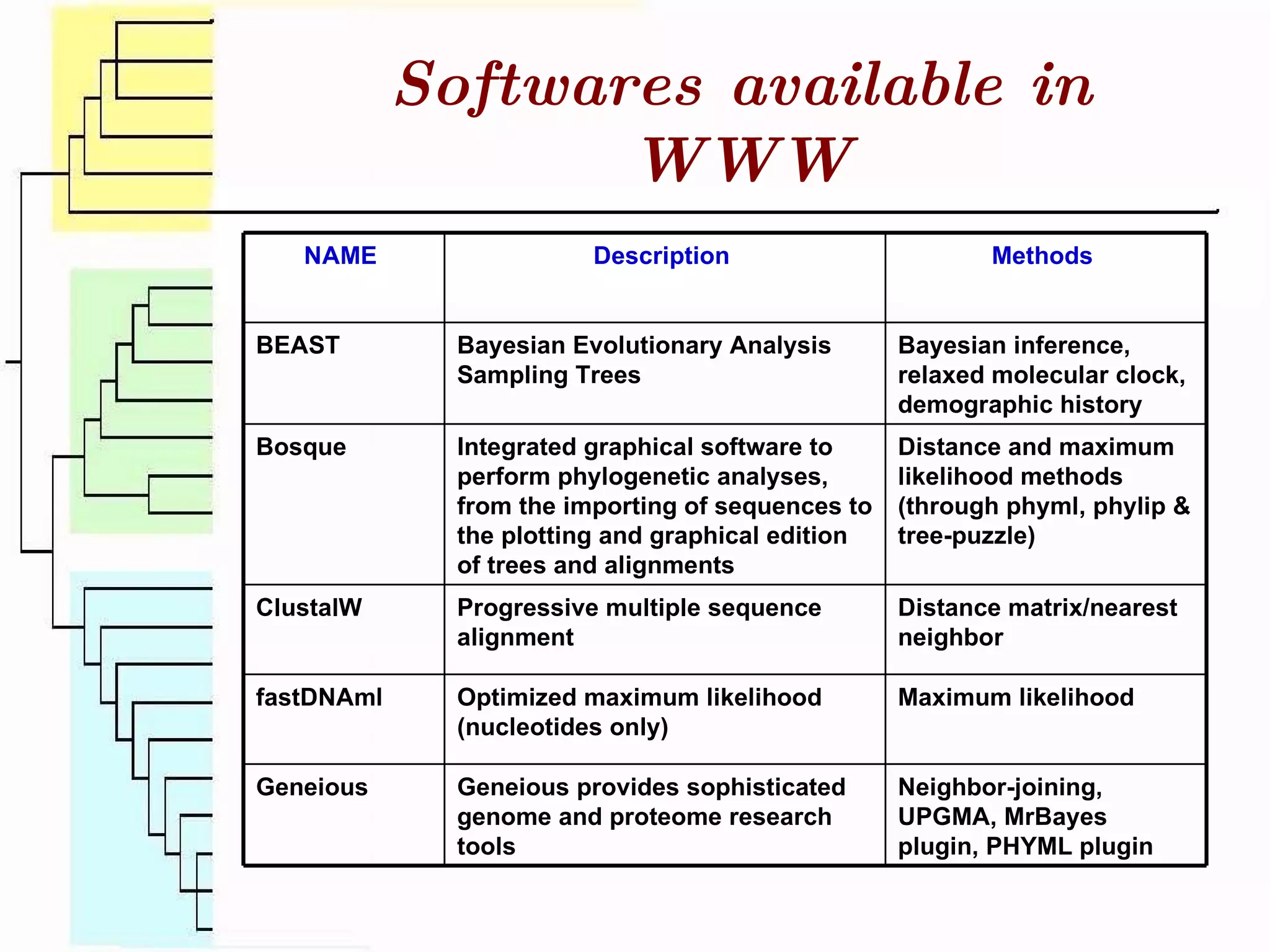
Softwares available in WWW NAME  Description  Methods  BEAST  Bayesian Evolutionary Analysis Sampling Trees  Bayesian inference, relaxed molecular clock, demographic history  Bosque  Integrated graphical software to perform phylogenetic analyses, from the importing of sequences to the plotting and graphical edition of trees and alignments  Distance and maximum likelihood methods (through phyml, phylip & tree-puzzle)  ClustalW  Progressive multiple sequence alignment  Distance matrix/nearest neighbor  fastDNAml  Optimized maximum likelihood (nucleotides only) Maximum likelihood  Geneious  Geneious provides sophisticated genome and proteome research tools  Neighbor-joining, UPGMA, MrBayes plugin, PHYML plugin
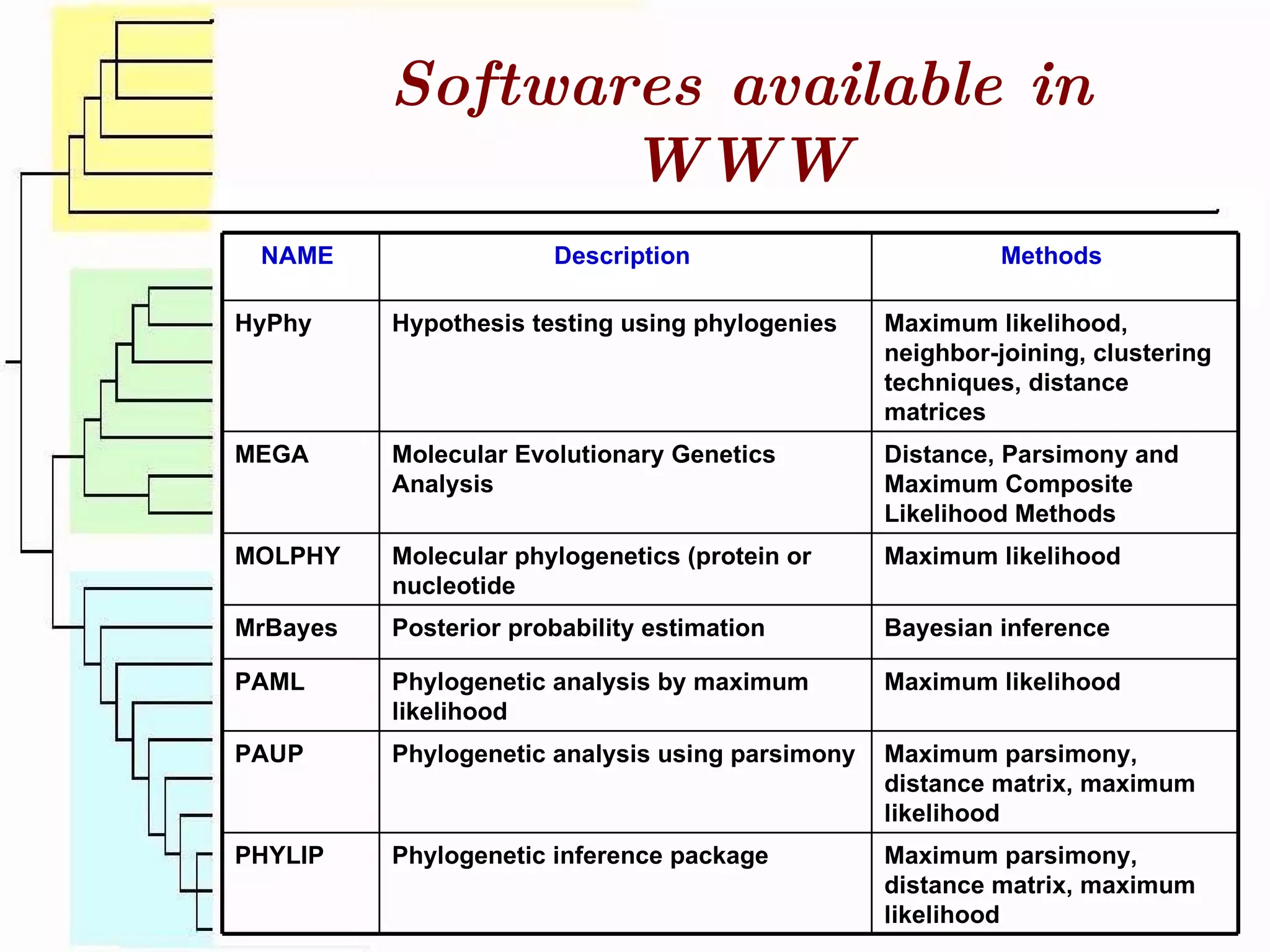
Softwares available in WWW NAME  Description  Methods  HyPhy  Hypothesis testing using phylogenies  Maximum likelihood, neighbor-joining, clustering techniques, distance matrices  MEGA  Molecular Evolutionary Genetics Analysis  Distance, Parsimony and Maximum Composite Likelihood Methods  MOLPHY  Molecular phylogenetics (protein or nucleotide  Maximum likelihood  MrBayes  Posterior probability estimation  Bayesian inference  PAML  Phylogenetic analysis by maximum likelihood  Maximum likelihood  PAUP  Phylogenetic analysis using parsimony  Maximum parsimony, distance matrix, maximum likelihood  PHYLIP  Phylogenetic inference package  Maximum parsimony, distance matrix, maximum likelihood
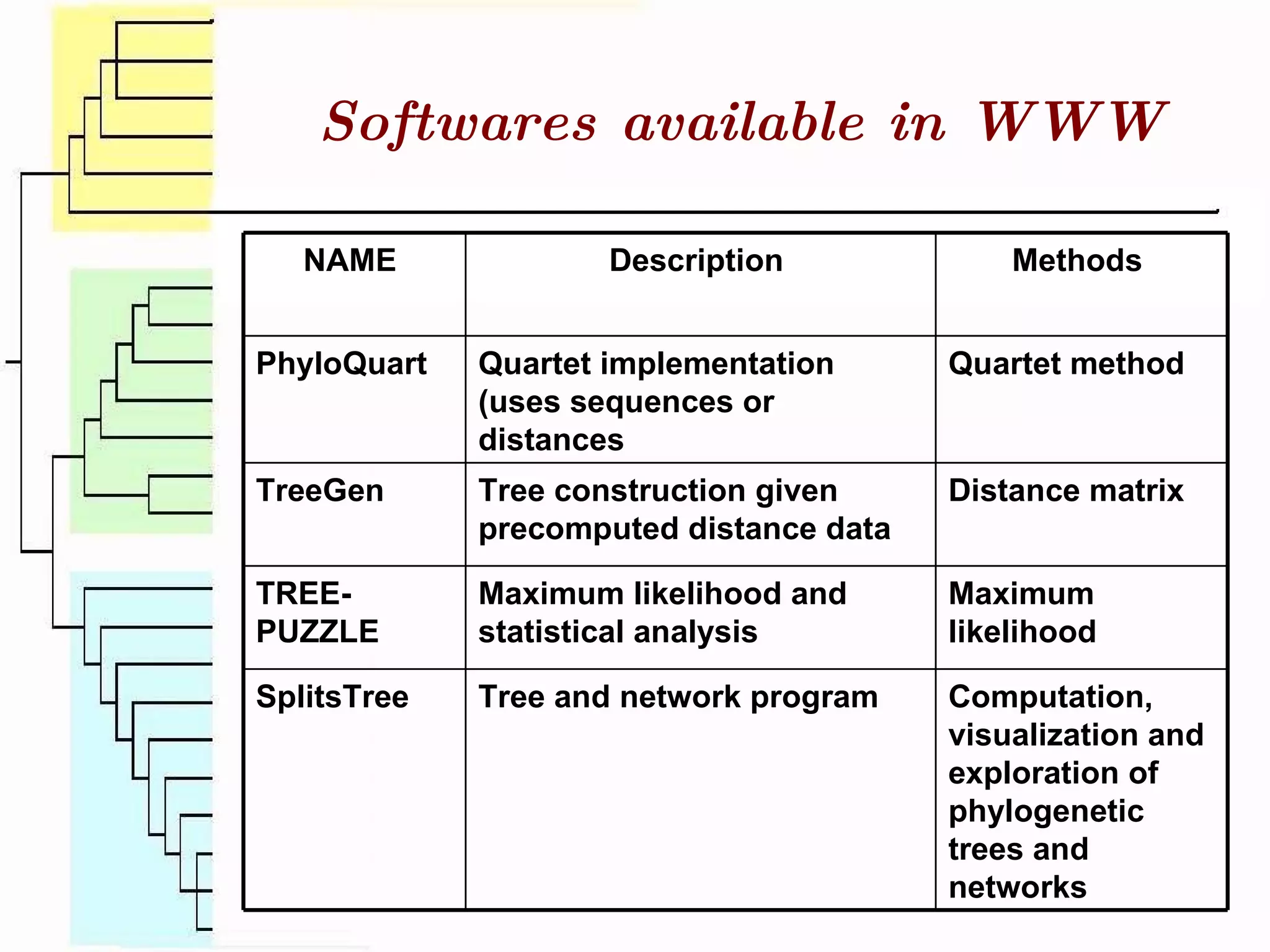
Softwares available in WWW NAME  Description  Methods  PhyloQuart  Quartet implementation (uses sequences or distances  Quartet method  TreeGen  Tree construction given precomputed distance data  Distance matrix  TREE-PUZZLE  Maximum likelihood and statistical analysis  Maximum likelihood  SplitsTree  Tree and network program  Computation, visualization and exploration of phylogenetic trees and networks

Softwares For Phylogentic Analysis

  • 1.
    Softwares For PhylogenticAnalysis Survey of Software Programs Available For Phylogenetic Analysis UNIT V S. Prasanth Kumar, II M.Sc (BIOINFORMATICS), Alagappa University, India. prasanthbioinformatics@gmail.com
  • 2.
    Three Major Reasonsfor Using Phylogenetics Determining the closest relatives of the organism that you’re interested Discovering the function of a gene Retracing the origin of a gene
  • 3.
    Survey of VariousPhylogenetic Programs
  • 4.
    An assumption bywhich molecular sequences evolve at constant rates so that the amount of accumulated mutations is proportional to evolutionary time Based on this hypothesis, branch lengths on a tree can be used to estimate divergence time Molecular Clock
  • 5.
    Desirable Qualities ofAlgorithms Time consuming if large data sets are used for phylogenetic analysis Algorithms should be heuristic (i.e. a rule of thumb: skipping unnecessary steps and concentrating more on reliable steps) Recursion and Iteration steps for efficient tree construction
  • 6.
    All Substitution modelsto be used for correct phylogeny assessment Location of Transitions and Transversions e.g. Jukes-Cantor, Kimura model, etc Our phylogenetic analysis depends upon the MSA generated The MSA should concentrate on Structural alignments rather than Sequence alignments Substitution Models Assessment
  • 7.
    Manual inspection ofMSA is always required. It can be done using MSA editors Methods used for phylogenetic analysis should contribute to all the following attributes: Minimum Evolution Evolutionary distance Not purely based on Mathematical calculations Desirable attributes of Phylogeny
  • 8.
    We should ensurethat the phylogenetic tree has been constructed based on Informative sites (i.e. column of conserved residues) There should be no error in the initial alignment because it would affect the whole procedure to generate phylogenetic tree leading to erroneous tree (s) Stress on “Initial Alignment”
  • 9.
    More than 1substitution models is acceptable for efficient evolutionary predictions Randomness is accepted only in analyzing the reliability of the phylogenetic tree as in Bootstrapping technique Choosing the program should be dependent on our datasets (sequences) Choosing the Right Program
  • 10.
    If only onetree has been generated as does by Distance methods, Bootstrapping is appreciated It will be always good to work on different topologies of a phylogenetic tree Equal importance should be given to the sequences (excluding the pair of sequence taken for initial alignment) that has closest relationship Different Topologies
  • 11.
    Programs should considerInformative sites discarding Non informative sites and not on the alignment score of the informative sites Closest sequences does not mean biologically the pair of sequences having the highest alignment score, hence care should be given to choose molecular markers (explained in next slide) Selecting Closest Sequences
  • 12.
    Choice of MolecularMarkers Different individuals within a population Non coding regions of mitochondrial DNA are often used. More widely divergent groups of organisms One may choose either slowly evolving nucleotide sequences, such as ribosomal RNA or protein sequences. If the phylogenetic relationships to be delineated are at the deepest level, such as between bacteria and eukaryotes, Conserved protein sequences makes more sense than using nucleotide sequences.
  • 13.
    Codon usage tablefor model organisms should be used if we are finding out phylogeny within a species using nucleotide species Methods exploring different topologies is appreciable since these methods explore minimum evolution Codon Preference
  • 14.
    Weighted Parsimony Weightedparsimony is better than Unweighted parsimony (treats all mutations as equivalent) mutations of some sites are known to occur less frequently than others, for example, transversions versus transitions, functionally important sites versus neutral sites. Therefore, a weighting scheme that takes into account the different kinds of mutations helps to select tree topologies more accurately
  • 15.
    User Requirements Theprogram should be user-friendly. It should display tree with higher graphical resolution Choosing substitution models for our study can be quite confusing. Hence, tools for selecting substitution models will be a good practice Modeltest , a program for selecting appropriate substitution models for nucleotide sequences
  • 16.
    Sequence Divergence &Choice of Methods If sequence divergence is low: go for Character based methods which can provide information about homoplasy If sequence divergence is high and the mount of homoplasies is large: go for Distance based methods Parsimonious tree considers only informative sites. There is chance of loss of phylogenetic signal
  • 17.
    Tree Topology AssessmentHeuristic Algorithms for Probability based Methods Maximum Likelihood (ML) uses probabilistic models to choose a best tree that has the highest probability or likelihood of reproducing the observed data. Choosing an unrealistic substitution model may lead to an incorrect tree Some of the new heuristics used are: Quartet Puzzling Bayesian Inference Quartet Puzzling : the total number of taxa are divided into many subsets of four taxa known as quartets . An optimal ML tree is constructed from each of these quartets
  • 18.
    Bayesian Analysis Theessence of Bayesian analysis is to make inference on something unobserved based on existing observations. It makes use of an important concept of known as posterior probability , which is defined as the probability that is revised from prior expectations, after learning something new about the data Prior probability ∗ Conditional likelihood Posterior probability = Total probability Tree Topology Assessment Heuristic Algorithms for Probability based Methods
  • 19.
    Analyzing Mutations Thesemutations are easily detected by multiple alignment Base Substitutions Indel - Insertions & Deletions These mutations are not easily detected by multiple alignments Transposition Exon (domain) Shuffling Hence manual intervention is required. The organization of proteins should be addressed previously so as to identify these types of mutations
  • 20.
    Protein Sequences ArePreferable Than Nucleotide Sequences Reason : Degeneracy of the genetic code “ 61 codons encode for 20 amino acids ” A change in a codon may not result in a change in amino acid DNA sequences are sometimes more biased than protein sequences because of preferential codon usage in different organisms
  • 21.
    Improving Alignment QualityImprove alignment by correcting alignment errors and removing potentially unrelated or highly divergent sequences Programs : Rascal and NorMD Detect and eliminate the poorly aligned positions and divergent regions Programs : Gblocks
  • 22.
    Deriving Ancestors Strictlyspeaking, the identification or presence of ancestor in our datasets can be extinct. Adding a root (Ancestor) is often be desirable. To derive the ancestor, OUTGROUP (a sequence which has less divergence to our sequences, from which the evolutionary distance will be calculated, this sequence will not be for phylogentic tree construction) is selected
  • 23.
    Softwares available inWWW NAME Description Methods BEAST Bayesian Evolutionary Analysis Sampling Trees Bayesian inference, relaxed molecular clock, demographic history Bosque Integrated graphical software to perform phylogenetic analyses, from the importing of sequences to the plotting and graphical edition of trees and alignments Distance and maximum likelihood methods (through phyml, phylip & tree-puzzle) ClustalW Progressive multiple sequence alignment Distance matrix/nearest neighbor fastDNAml Optimized maximum likelihood (nucleotides only) Maximum likelihood Geneious Geneious provides sophisticated genome and proteome research tools Neighbor-joining, UPGMA, MrBayes plugin, PHYML plugin
  • 24.
    Softwares available inWWW NAME Description Methods HyPhy Hypothesis testing using phylogenies Maximum likelihood, neighbor-joining, clustering techniques, distance matrices MEGA Molecular Evolutionary Genetics Analysis Distance, Parsimony and Maximum Composite Likelihood Methods MOLPHY Molecular phylogenetics (protein or nucleotide Maximum likelihood MrBayes Posterior probability estimation Bayesian inference PAML Phylogenetic analysis by maximum likelihood Maximum likelihood PAUP Phylogenetic analysis using parsimony Maximum parsimony, distance matrix, maximum likelihood PHYLIP Phylogenetic inference package Maximum parsimony, distance matrix, maximum likelihood
  • 25.
    Softwares available inWWW NAME Description Methods PhyloQuart Quartet implementation (uses sequences or distances Quartet method TreeGen Tree construction given precomputed distance data Distance matrix TREE-PUZZLE Maximum likelihood and statistical analysis Maximum likelihood SplitsTree Tree and network program Computation, visualization and exploration of phylogenetic trees and networks