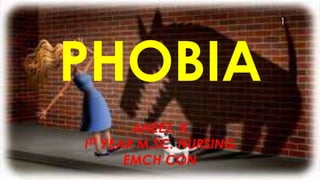
PHOBIA
ANEEZ. K
IST YEAR M.SC. NURSING
EMCH CON
1
TYPES OF PHOBIA
Agoraphobia
Specific Phobia
Social Phobia
2
AGORAPHOBIA
Fear of being in places or situations from which escape
might be difficult, or in which help might not be
available
3
SPECIFIC PHOBIA
Specific phobia, or simple phobia, is an intense,
unreasonable, and persistent fear caused by the presence
or anticipation of a specific object or situation.
4
SUBTYPE OF SPECIFIC
PHOBIA
Phobias are classified into different subtypes.
Situational type: concerns a specific situation, such as
the fear of flying, bridges, elevators, driving, etc.
Blood-injection-injury type: also includes any
invasive medical procedure. This kind of phobia is
often associated with fear of seeing blood or wounds,
having injection and other medical procedures.
5
Natural environment type: fear of storms, heights, the
dark, water, etc.
Animal type: fear of insects, dogs, snakes, rodents,
spiders, etc.
Other type: phobias can be caused by a wide variety of
objects or situations that don’t fit the categories listed
above. These include a fear of choking, loud noises,
contracting an illness, vomiting, etc.
6
SOCIAL PHOBIA
Also known as social anxiety disorder, the person
becomes severely anxious to the point of panic or
incapacitation when confronting situations involving
people.
7
ONSET AND CLINICAL
COURSE
Life time prevalence of agoraphobia - 0.6 to 6%. half of
the agoraphobic patients have panic disorder.
Specific phobia is the most common mental disorder
among women and the second most common in men
Six months prevalence being 5 to 10 % females suffering
twice as compared to males
8
Six months prevalence for social phobia is about 2 to 3%
Age of onset is usually in childhood and adolescence
Onset is earliest in animal phobias, intermediate in social
phobias and latest in agoraphobia.
9
AETIOLOGY
Psychoanalytic Theories
Behavioural Factors
 Stimulus response model
 Operant Conditioning Theory
Genetic-Environmental Factors
10
PSYCHOANALYTIC THEORIES
The anxiety is usually dealt with the defence
mechanism of repression. When repression fails to
function adequately, other secondary defence
mechanisms of ego come into action. In phobia, this
secondary defence mechanism is displacement.
11
BEHAVIOURAL FACTORS
Stimulus response model:- Anxiety is aroused by a
naturally frightening stimulus
Operant Conditioning Theory:- The conditioned
stimulus gradually loses its potency to arouse a response.
The symptom may last for years without any apparent
external reinforcement.
12
BIOLOGICAL THEORIES
Genetic factors such as evidence for the presence of
familial factors in social phobias
13
DIAGNOSTIC EVALUATION
History collection
MSE
Drug screen
EEG
ECG
14
TREATMENT
Psychotherapy
Insight-oriented psychotherapy enables the patient to
understand the origin of the phobia, the phenomena of
secondary gain and the role of resistance, and enables the
patient to seek healthy way of dealing with anxiety
provoking stimuli.
15
Cognitive-behavior therapy
Cognitive-behavior therapy and various techniques of
behavior therapy like desensitization, flooding and exposure
and response prevention training are used.
16
Pharmacological management
Anti-anxiety
Antidepressants
17
ASSIGNMENT
Name and identify different phobias in detail and submit
it on 19.8.2015 before 4 pm. Minimum 20 phobias
should enlisted. Total mark is 20.
18
BIBLIOGRAPHY
 TERESA L. SCHEID, TONY N. BROWN. A Handbook for the Study of
Mental Health, 2nd Ed. New York: Cambridge University Press; 2009.
 Mary C. Townsend. Psychiatric Mental Health Nursing Concepts of Care
in Evidence-Based Practice, 6th ed. Philadelphia: F. A. DAVIS
COMPANY; 2009.
 Niraj Ahuja. A Short Textbook of Psychiatry, 7th Ed. New Delhi: Jaypee
Brothers Medical Publishers (P) Ltd; 2011.
19
 Michael G. Gelder, Juan J. Lopez-Ibor, Nancy Andreasen, Jaun J.
Lopez-Idor. New Oxford Textbook of Psychiatry. New York: Oxford
University Press; 2003.
 Sheila L. Videbeck. Psychiatric Mental Health Nursing, 5th ed.
China: Wolters Kluwer Health, Lippincott Williams & Wilkins; 2011.
20

Phobia

  • 1.
    PHOBIA ANEEZ. K IST YEARM.SC. NURSING EMCH CON 1
  • 2.
  • 3.
    AGORAPHOBIA Fear of beingin places or situations from which escape might be difficult, or in which help might not be available 3
  • 4.
    SPECIFIC PHOBIA Specific phobia,or simple phobia, is an intense, unreasonable, and persistent fear caused by the presence or anticipation of a specific object or situation. 4
  • 5.
    SUBTYPE OF SPECIFIC PHOBIA Phobiasare classified into different subtypes. Situational type: concerns a specific situation, such as the fear of flying, bridges, elevators, driving, etc. Blood-injection-injury type: also includes any invasive medical procedure. This kind of phobia is often associated with fear of seeing blood or wounds, having injection and other medical procedures. 5
  • 6.
    Natural environment type:fear of storms, heights, the dark, water, etc. Animal type: fear of insects, dogs, snakes, rodents, spiders, etc. Other type: phobias can be caused by a wide variety of objects or situations that don’t fit the categories listed above. These include a fear of choking, loud noises, contracting an illness, vomiting, etc. 6
  • 7.
    SOCIAL PHOBIA Also knownas social anxiety disorder, the person becomes severely anxious to the point of panic or incapacitation when confronting situations involving people. 7
  • 8.
    ONSET AND CLINICAL COURSE Lifetime prevalence of agoraphobia - 0.6 to 6%. half of the agoraphobic patients have panic disorder. Specific phobia is the most common mental disorder among women and the second most common in men Six months prevalence being 5 to 10 % females suffering twice as compared to males 8
  • 9.
    Six months prevalencefor social phobia is about 2 to 3% Age of onset is usually in childhood and adolescence Onset is earliest in animal phobias, intermediate in social phobias and latest in agoraphobia. 9
  • 10.
    AETIOLOGY Psychoanalytic Theories Behavioural Factors Stimulus response model  Operant Conditioning Theory Genetic-Environmental Factors 10
  • 11.
    PSYCHOANALYTIC THEORIES The anxietyis usually dealt with the defence mechanism of repression. When repression fails to function adequately, other secondary defence mechanisms of ego come into action. In phobia, this secondary defence mechanism is displacement. 11
  • 12.
    BEHAVIOURAL FACTORS Stimulus responsemodel:- Anxiety is aroused by a naturally frightening stimulus Operant Conditioning Theory:- The conditioned stimulus gradually loses its potency to arouse a response. The symptom may last for years without any apparent external reinforcement. 12
  • 13.
    BIOLOGICAL THEORIES Genetic factorssuch as evidence for the presence of familial factors in social phobias 13
  • 14.
  • 15.
    TREATMENT Psychotherapy Insight-oriented psychotherapy enablesthe patient to understand the origin of the phobia, the phenomena of secondary gain and the role of resistance, and enables the patient to seek healthy way of dealing with anxiety provoking stimuli. 15
  • 16.
    Cognitive-behavior therapy Cognitive-behavior therapyand various techniques of behavior therapy like desensitization, flooding and exposure and response prevention training are used. 16
  • 17.
  • 18.
    ASSIGNMENT Name and identifydifferent phobias in detail and submit it on 19.8.2015 before 4 pm. Minimum 20 phobias should enlisted. Total mark is 20. 18
  • 19.
    BIBLIOGRAPHY  TERESA L.SCHEID, TONY N. BROWN. A Handbook for the Study of Mental Health, 2nd Ed. New York: Cambridge University Press; 2009.  Mary C. Townsend. Psychiatric Mental Health Nursing Concepts of Care in Evidence-Based Practice, 6th ed. Philadelphia: F. A. DAVIS COMPANY; 2009.  Niraj Ahuja. A Short Textbook of Psychiatry, 7th Ed. New Delhi: Jaypee Brothers Medical Publishers (P) Ltd; 2011. 19
  • 20.
     Michael G.Gelder, Juan J. Lopez-Ibor, Nancy Andreasen, Jaun J. Lopez-Idor. New Oxford Textbook of Psychiatry. New York: Oxford University Press; 2003.  Sheila L. Videbeck. Psychiatric Mental Health Nursing, 5th ed. China: Wolters Kluwer Health, Lippincott Williams & Wilkins; 2011. 20