www.helpingpsychology.com Social  Phobia
Social Phobia,  also called  Social Anxiety Disorder , is characterized by an intense fear of experiencing humiliation in social situations.  www.helpingpsychology.com http://www.anxietydepressioncenter.org/wp-content/uploads/2010/03/social-anxiety.jpg
www.helpingpsychology.com This disorder affects around 13.3 percent of the population and seems to affect women more often than men at a ratio of 1.5:1.  http://resolveanxiety.com/images/social-phobia.jpg
www.helpingpsychology.com It can be  hereditary  and may subsequently result in depression or alcoholism, particularly if it goes undiagnosed.  http://www.clivir.com/pictures/depress/dep19.jpg
www.helpingpsychology.com Social anxiety disorder  generally appears in adolescence, but can occur at a younger age.  http://www.socialsecurityinsider.com/wp-content/uploads/2008/11/istock_000004250579xsmall.jpg
www.helpingpsychology.com The most common form of the disorder is a fear of  public speaking.   While often thought of as simple shyness, the two differ completely.   http://h2training.com/Pictures/fear_of_public_speaking.jpg
www.helpingpsychology.com Someone who is shy does not usually experience the extreme anxiety or panic attacks that a  social phobic  does.  Shy people also don’t generally seek to avoid social situations that make them feel uncomfortable, as phobics tend to do.  http://www.truesubliminals.com/images%20alt/subliminal%20cds/social-anxiety.jpg
www.helpingpsychology.com Social phobics  may be totally comfortable with strangers most of the time, but there may be specific circumstances that trigger their anxiety and panic.  http://www.nativeremedies.com/images/design/ailmentPhotoSocialAnxiety.jpg
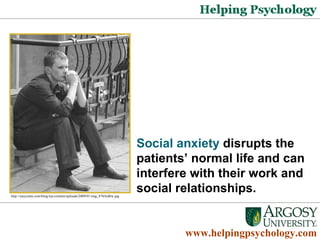
www.helpingpsychology.com Social anxiety  disrupts the patients’ normal life and can interfere with their work and social relationships.  http://easycalm.com/blog/wp-content/uploads/2009/01/img_8765edbw.jpg
www.helpingpsychology.com The  symptoms of social anxiety   disorder  include:  Persistent fear of social situations where the patient is exposed to unfamiliar people or to scrutiny. Feelings of anxiety invariably result from exposure to a  social situation, often producing a panic attack. Recognition that the fear is unreasonable. Avoidance of the feared situation, or endurance with  intense anxiety. Reactions interfere significantly with patient’s normal routine or relationships. Reactions are not due to a medication, a medical condition  or other mental disorder.
Social anxiety disorder  can be diagnosed as either specific, if only very particular situations trigger the phobia, or general, if the patient experiences a chronic, persistent and intense fear of being judged by others.  www.helpingpsychology.com http://www.lenapopehome.org/Content/stk93908cor.jpg
Treatment can include medication or psychotherapy, but in the long run,  psychotherapy  has shown more consistent results.  At any rate, psychotherapy should be the first option, but do not appear to block the underlying cause of panic attacks.   www.helpingpsychology.com http://www.onlinemedicinetips.com/images/Natural-Remedy-For-Social-Anxiety-Disorder.jpg
The best treatment option is usually  Cognitive-Behavioral Therapy .  With the cognitive component, the therapist can help the patient question how he or she can be certain that others are watching and judging.  With the behavioral component, the therapist tries to change reactions to the anxiety-provoking situations, often through systematic desensitization.  www.helpingpsychology.com
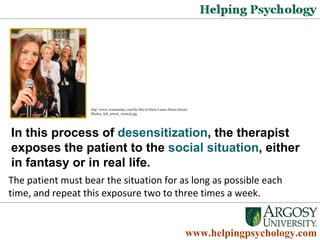
In this process of  desensitization , the therapist exposes the patient to the  social situation , either in fantasy or in real life.  The patient must bear the situation for as long as possible each time, and repeat this exposure two to three times a week.   www.helpingpsychology.com http://www.womansday.com/So-Shy-it-Hurts-Learn-About-Social-Phobia_full_article_vertical.jpg
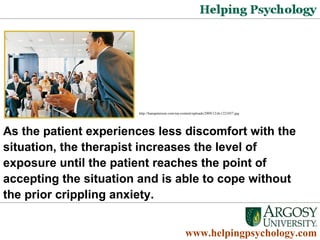
As the patient experiences less discomfort with the situation, the therapist increases the level of exposure until the patient reaches the point of accepting the situation and is able to cope without the prior crippling anxiety.  www.helpingpsychology.com http://hanspeterson.com/wp-content/uploads/2009/12/dv1221057.jpg
www.argosy.edu www.HelpingPsychology.com Helping Psychology Is Sponsored By

Social Phobia

  • 1.
  • 2.
    Social Phobia, also called Social Anxiety Disorder , is characterized by an intense fear of experiencing humiliation in social situations. www.helpingpsychology.com http://www.anxietydepressioncenter.org/wp-content/uploads/2010/03/social-anxiety.jpg
  • 3.
    www.helpingpsychology.com This disorderaffects around 13.3 percent of the population and seems to affect women more often than men at a ratio of 1.5:1. http://resolveanxiety.com/images/social-phobia.jpg
  • 4.
    www.helpingpsychology.com It canbe hereditary and may subsequently result in depression or alcoholism, particularly if it goes undiagnosed. http://www.clivir.com/pictures/depress/dep19.jpg
  • 5.
    www.helpingpsychology.com Social anxietydisorder generally appears in adolescence, but can occur at a younger age. http://www.socialsecurityinsider.com/wp-content/uploads/2008/11/istock_000004250579xsmall.jpg
  • 6.
    www.helpingpsychology.com The mostcommon form of the disorder is a fear of public speaking. While often thought of as simple shyness, the two differ completely. http://h2training.com/Pictures/fear_of_public_speaking.jpg
  • 7.
    www.helpingpsychology.com Someone whois shy does not usually experience the extreme anxiety or panic attacks that a social phobic does. Shy people also don’t generally seek to avoid social situations that make them feel uncomfortable, as phobics tend to do. http://www.truesubliminals.com/images%20alt/subliminal%20cds/social-anxiety.jpg
  • 8.
    www.helpingpsychology.com Social phobics may be totally comfortable with strangers most of the time, but there may be specific circumstances that trigger their anxiety and panic. http://www.nativeremedies.com/images/design/ailmentPhotoSocialAnxiety.jpg
  • 9.
    www.helpingpsychology.com Social anxiety disrupts the patients’ normal life and can interfere with their work and social relationships. http://easycalm.com/blog/wp-content/uploads/2009/01/img_8765edbw.jpg
  • 10.
    www.helpingpsychology.com The symptoms of social anxiety disorder include: Persistent fear of social situations where the patient is exposed to unfamiliar people or to scrutiny. Feelings of anxiety invariably result from exposure to a social situation, often producing a panic attack. Recognition that the fear is unreasonable. Avoidance of the feared situation, or endurance with intense anxiety. Reactions interfere significantly with patient’s normal routine or relationships. Reactions are not due to a medication, a medical condition or other mental disorder.
  • 11.
    Social anxiety disorder can be diagnosed as either specific, if only very particular situations trigger the phobia, or general, if the patient experiences a chronic, persistent and intense fear of being judged by others. www.helpingpsychology.com http://www.lenapopehome.org/Content/stk93908cor.jpg
  • 12.
    Treatment can includemedication or psychotherapy, but in the long run, psychotherapy has shown more consistent results. At any rate, psychotherapy should be the first option, but do not appear to block the underlying cause of panic attacks. www.helpingpsychology.com http://www.onlinemedicinetips.com/images/Natural-Remedy-For-Social-Anxiety-Disorder.jpg
  • 13.
    The best treatmentoption is usually Cognitive-Behavioral Therapy . With the cognitive component, the therapist can help the patient question how he or she can be certain that others are watching and judging. With the behavioral component, the therapist tries to change reactions to the anxiety-provoking situations, often through systematic desensitization. www.helpingpsychology.com
  • 14.
    In this processof desensitization , the therapist exposes the patient to the social situation , either in fantasy or in real life. The patient must bear the situation for as long as possible each time, and repeat this exposure two to three times a week. www.helpingpsychology.com http://www.womansday.com/So-Shy-it-Hurts-Learn-About-Social-Phobia_full_article_vertical.jpg
  • 15.
    As the patientexperiences less discomfort with the situation, the therapist increases the level of exposure until the patient reaches the point of accepting the situation and is able to cope without the prior crippling anxiety. www.helpingpsychology.com http://hanspeterson.com/wp-content/uploads/2009/12/dv1221057.jpg
  • 16.