SUSHEEL
DAYALWANSI
POST TRAUMATIC STRESS DISORDER
Post traumatic stress disorder is a
severe anxiety disorder that can develop
after exposure to any event which results
in psychological trauma,
Such as earthquake, floods, war, rape,
tsunami, or serious physical assault.
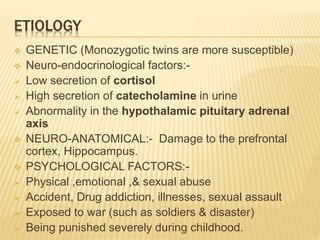
ETIOLOGY
 GENETIC (Monozygotic twins are more susceptible)
 Neuro-endocrinological factors:-
 Low secretion of cortisol
 High secretion of catecholamine in urine
 Abnormality in the hypothalamic pituitary adrenal
axis
 NEURO-ANATOMICAL:- Damage to the prefrontal
cortex, Hippocampus.
 PSYCHOLOGICAL FACTORS:-
 Physical ,emotional ,& sexual abuse
 Accident, Drug addiction, illnesses, sexual assault
 Exposed to war (such as soldiers & disaster)
 Being punished severely during childhood.
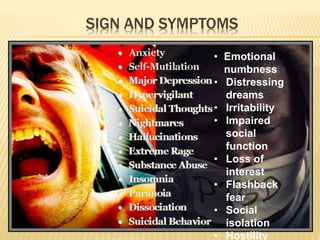
SIGN AND SYMPTOMS
• Emotional
numbness
• Distressing
dreams
• Irritability
• Impaired
social
function
• Loss of
interest
• Flashback
fear
• Social
isolation
• Hostility
DIAGNOSTIC EVALUATION
 History collection about the events
exposure
 Assess Physical and psychological
symptoms
 Observation method
 Check the Level of depression
 Others psychological methods
TREATMENTS
A. PHARMACOTHERAPY:-
 SSRIs (First line drug for
the treatment of PTSD
such as citalopram,
fluvoxamine)
 Tricyclic antidepressants
 Beta blockers
(propranolol)
 Mood stabilizers (Lithium
carbonate &
carbamazepine)
 Benzodiazepines
 Anticonvulsant such as
clonidine
B. PSYHOTHERAPY:-
 Counselling
 Exposure therapy
 Cognitive therapy
 Relaxation therapy
 Interpersonal
psychotherapy
 EMDR (Eye movement
Desensitization &
Reprocessing , is an
psychotherapy treatment
that alleviate the distress
associated with traumatic
memories)
NURSING MANAGEMANT
1. ASSESSMENT:-
 Assist the patient past exposure situation &
flashbacks.
 Assist the physical movement and symptoms of the
patient exposure about any events.
2. NURSING DIAGNOSIS:-
 Post trauma syndrome related to distressing event
considered to be outside the range of usual human
experience evidenced by flashbacks, nightmares,
psychological numbness related to the event.
 Complicated grieving related to post traumatic events
evidenced by irritability, verbalization of guilt.
NURSING INTERVENTION
 Establish therapeutic nurse patient
relationship.
 Provide calm, quiet & non stimulating
environment.
 Do not leave client alone.
 Observe the client for suicidal tendency,
ideation or thoughts.
 Provide situational support to the client &
family members.
 Support the client in rehabilitative process.