PRESENTED BY
SRADHANJALI BISWAL
TUTOR
KALINGA INSTITUTE OF NURSING SCIENCES
KIIT DEEMED TO BE UNIVERSITY, BHUBANESWAR
INTRODUCTION
• The term ‘mood disorders’ groups together a
number of clinical conditions whose common
and essential feature is a disturbance of mood,
accompanied by related cognitive,
psychomotor, psychophysiological, and
interpersonal difficulties.
• MOOD :
Mood refers to an internal emotional state of the
individual.
• Affect is the external expression of internal
emotional content.
• Mood disorders include major depression,
bipolar disorder (combining episodes of both
mania and depression) and dysthymia.
INCIDENCE
• The onset of mood disorders usually occurs during
adolescence.
• Approximately 8% of adults will experience major
depression at some time in their lives.
• Approximately 1% will experience bipolar disorder.
• Worldwide, major depression is the leading cause of
years lived with disability, and the fourth cause of
disability adjusted life years (DALYs).
• Mood disorders have a major economic impact through
associated health care costs as well as lost work
productivity.
Cont…..
• Hospitalizations for mood disorders in general hospitals
are approximately one and a half times higher among
women than men.
• The wide disparity among age groups in hospitalization
rates for depression in general hospitals has narrowed
in recent years, because of a greater decrease in
hospitalization rates in older age groups.
• Hospitalization rates for bipolar disorder in general
hospitals are increasing among women and men
between15 and 24 years of age.
• Individuals with mood disorders are at high risk of
suicide.
Normal Vs. Pathological Mood
SL.
NO
FEATURES NORMAL MOOD PATHOLOGICAL MOOD
1 BODY
FUNCTIONS
NORMAL BODILY
FUNCTIONS[ E.g.
adequate sleep, appetite]
IMPAIRMENTS OF BODY FUNCTIONS
[e.g. disturbances in sleep, appetite, sexual
interest, gastro intestinal activity]
2 SOCIAL ROLES WELL SOCIALISED
PERFORM ALL THE
EXPECTED ROLES
REDUCED DESIRE AND ABILTY TO
PERFORM USUAL EXPECTED ROLES
[e.g. family responsibilities, at work, in
school]
3 SUICIDEAL
IDEATIONS
SUICIDAL THOUGHTS
OR ACTS ABSENT
SUICIDAL THOUGHTS OR ACTS
PRESENT
4 REALITY
TESTING
NORMAL REALITY
TESTING[ No delusion,
hallucination, confusion
present]
DISTRUBANCES IN REALITY
TESTING[e.g. delusions present,
hallucinations, confusion present]
Cont…
• Mood disorders may involve depression only
(also referred to as “unipolar depression”) or
they may include manic episodes (as in bipolar
disorder, which is classically known as “manic
depressive illness”).
MANIC EPISODE
• It is a state of abnormally elevated or irritable
mood, arousal, and/or energy levels.
• A manic episode is a mood state characterizes
by period of at least one week where an
elevated , expansive , or unusually irritable
mood exists.
Cont.…
• A person experiencing a manic episode is
usually engaged in significant goal-directed
activity beyond their normal activities.
• People describes a manic mood as feeling very
euphoric, “on top of the world,” and being able
to do or accomplish anything.
• The feeling is like extreme optimism – but on
steroids.
STAGESOFMANIA
• As an individual moves between these stages,
his mood, thinking, and behaviour may all
change.
• Affected individual may go into and out of
episodes of mania that may last a few days to
many weeks.
• In between these stages some individuals also
lead highly productive lives
STAGES OF MANIA
STAGE – I [EUPHORIA ] STAGE – II [ELATION] STAGE – III [EXALTATION]
MOOD Liability of affect,
euphoria predominates,
irritability if demands
not satisfied.
Increased dysphoria
and depression, open
hostility and anger
Clear dysphoric , panic
stricken hopeless
COGNITION Expansive, grandiosity,
over-confidence,
thoughts coherent, but
occasionally tangential
, sexual and religious
pre-occupation. Racing
of thoughts
Flight of ideas,
disorganization of
cognitive state,
delusions
Incoherent, definite
loosening of association,
bizarre and idio –
syncratic delusions,
hallucinations in one –
third of the patients,
occasional ideas of
reference .
BEHAVIOR Increased psychomotor
activity, increased
initiation and rate of
speech, increased
spending, smoking,
telephone use.
Continued increased
psychomotor
acceleration, increased
pressured speech,
occasional assaultive
behaviour.
Frenzied and frequently
bizarre psychomotor
activity.
Triggers of Mania
• Not sleeping properly or missing a night's sleep
• Stress at work
• Being really busy with activities and hobbies
• Being away a lot at weekends or not having
enough downtime to relax
• Drinking too much caffeine or alcohol
• Skipping meals
Warning signs of Mania
• staying up until early hours of the morning,
and finding it hard to stop activities and go to
bed
• being more chatty than usual and wanting to
be with other people all the time
• buying lots of new clothes and wanting to
wear quite loud outfits I wouldn't normally
Cont.…
• spending a lot of time on social media
• feeling impatient with people, like they can't
keep up with me.
ETIOLOGY OF MANIA
1. Genetic Or Hereditary Factors
2. Neurotransmitter And Structural
Hypothesis
3. Psychodynamic Theories
4. Organic disorders
5. Stress
1.Genetic Or Hereditary Factors
• Individuals with depression and bipolar disorder often
find a history of these disorders in immediate family
members.
• The exact genetic factors that are involved in mood
disorders remain unknown.
• Mono-zygotic (identical) twins have a higher rate of
incidence than normal siblings and close relatives.
• Siblings and closer relatives have a higher incidence of
manic-depressive illness than a general population.
• First degree relatives ; 5-10% chances
• Identical twins with bipolar disorders : 40-70%
chances
2. Neurotransmitter And Structural Hypothesis
• Monoamine neurotransmitter systems,
especially those of epinephrine and serotonin,
their metabolites, and their receptors, are
altered during manic episode
• Biologic findings suggest that lesions are
more common in this population in areas of
the brain such as the right hemisphere or
bilateral sub-cortical and periventricular gray
matter.
Cont. ….
• Kindling Theory
- External environmental stressors activate internal physiologic
stress responses, which trigger the first episode of a mood
disorder, the first episode then creates electrophysiologic
sensitivity to future episodes so that less stress is required to
evoke another episode
3.Psychosocial Factors
• Psychosocial explanation for the development
of mood disorder represents a range of
theoretic positions, including psychoanalytic
theory, learned helplessness, cognitive theory
and personality theory.
a. Psychoanalytic Theory:
• The basic premise of psychoanalytic theory is that unconscious
processes result in expression of symptoms, including
depression and mania.
• Psycho-dynamically, mania is explained as a defences against
depression. The client denies feelings of anger, low self esteem,
and worthlessness and reverses the effect such that there is a
triumphant feeling of self-confidence.
• Mania represents a conquered superego with little inclination
to control id impulses.
• Its references may be in the early childhood environment in
which loss, disruption, may triggers the physiologic
mechanisms .
Life events and stress Theory
• Malkoff – Schwartz et al (2000) studied the
influence of social rhythm disruption as a
stressful life event on clients with pure mania
,depression , cycling episodes and recurrent
unipolar depression .
• The researcher found that the onset of manic
episode was influenced by stressful life events,
especially those involve social rhythm
disruption
Organic disorders
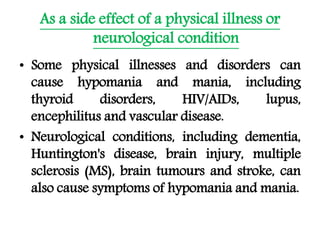
• Some physical illnesses and disorders can
cause hypomania and mania, including
thyroid disorders, HIV/AIDs, lupus,
encephilitus and vascular disease.
• Neurological conditions, including dementia,
Huntington's disease, brain injury, multiple
sclerosis (MS), brain tumours and stroke, can
also cause symptoms of hypomania and mania.
• high levels of stress
• changes in sleep patterns or lack of sleep
• use of stimulants such as drugs or alcohol
• seasonal changes – some people are more
likely to experience hypomania and mania in
spring
• a significant change in your life – moving
house or going through a divorce, for example
As a side effect of medication
• Some medications can cause hypomania or
mania as a side-effect, either while taking
them or as a withdrawal symptom when stop.
• This includes medications for physical
conditions and psychiatric medications –
including some antidepressants (particularly
specific serotonin reuptake inhibitors (SSRIs)).
As a side effect of a physical illness or
neurological condition
• Some physical illnesses and disorders can
cause hypomania and mania, including
thyroid disorders, HIV/AIDs, lupus,
encephilitus and vascular disease.
• Neurological conditions, including dementia,
Huntington's disease, brain injury, multiple
sclerosis (MS), brain tumours and stroke, can
also cause symptoms of hypomania and mania.
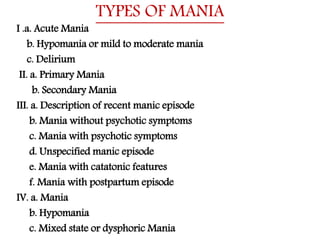
TYPES OF MANIA
I .a. Acute Mania
b. Hypomania or mild to moderate mania
c. Delirium
II. a. Primary Mania
b. Secondary Mania
III. a. Description of recent manic episode
b. Mania without psychotic symptoms
c. Mania with psychotic symptoms
d. Unspecified manic episode
e. Mania with catatonic features
f. Mania with postpartum episode
IV. a. Mania
b. Hypomania
c. Mixed state or dysphoric Mania
CONT….
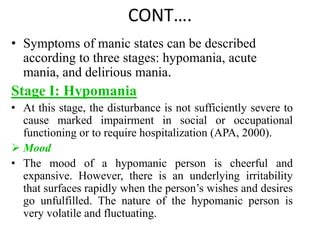
• Symptoms of manic states can be described
according to three stages: hypomania, acute
mania, and delirious mania.
Stage I: Hypomania
• At this stage, the disturbance is not sufficiently severe to
cause marked impairment in social or occupational
functioning or to require hospitalization (APA, 2000).
 Mood
• The mood of a hypomanic person is cheerful and
expansive. However, there is an underlying irritability
that surfaces rapidly when the person’s wishes and desires
go unfulfilled. The nature of the hypomanic person is
very volatile and fluctuating.
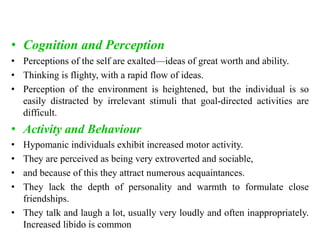
• Cognition and Perception
• Perceptions of the self are exalted—ideas of great worth and ability.
• Thinking is flighty, with a rapid flow of ideas.
• Perception of the environment is heightened, but the individual is so
easily distracted by irrelevant stimuli that goal-directed activities are
difficult.
• Activity and Behaviour
• Hypomanic individuals exhibit increased motor activity.
• They are perceived as being very extroverted and sociable,
• and because of this they attract numerous acquaintances.
• They lack the depth of personality and warmth to formulate close
friendships.
• They talk and laugh a lot, usually very loudly and often inappropriately.
Increased libido is common
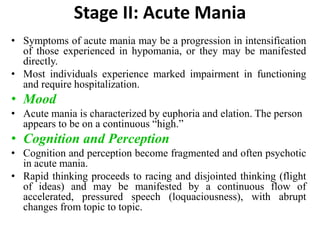
Stage II: Acute Mania
• Symptoms of acute mania may be a progression in intensification
of those experienced in hypomania, or they may be manifested
directly.
• Most individuals experience marked impairment in functioning
and require hospitalization.
• Mood
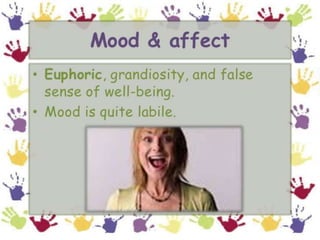
• Acute mania is characterized by euphoria and elation. The person
appears to be on a continuous “high.”
• Cognition and Perception
• Cognition and perception become fragmented and often psychotic
in acute mania.
• Rapid thinking proceeds to racing and disjointed thinking (flight
of ideas) and may be manifested by a continuous flow of
accelerated, pressured speech (loquaciousness), with abrupt
changes from topic to topic.
• Activity and Behaviour
• Psychomotor activity is excessive. Sexual interest is increased.
• There is poor impulse control, and the individual who is normally
discreet may become socially and sexually uninhibited.
• Energy seems inexhaustible, and the need for sleep is diminished.
• They may go for many days without sleep and still not feel tired.
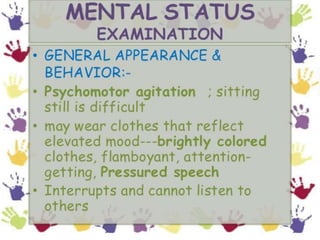
• Hygiene and grooming may be neglected. Dress may be
disorganized, flamboyant, Or bizarre, and the use of excessive
make-up or jewellery is common.
Stage III: Delirious Mania
• Delirious mania is a grave form of the disorder
characterized by severe clouding of consciousness and an
intensification of the symptoms associated with acute
mania.
• This condition has become relatively rare since the
availability of antipsychotic medication.
• Mood
• The mood of the delirious person is very labile.
• He or she may exhibit feelings of despair, quickly
converting to unrestrained merriment and ecstasy or
becoming irritable or totally indifferent to the
environment
• Cognition and Perception
• Cognition and perception are characterized by a clouding of
consciousness, with accompanying confusion,
disorientation, and sometimes stupor.
• Other common manifestations include religiosity, delusions
of grandeur or persecution, and auditory or visual
hallucinations.
• The individual is extremely distractible and incoherent.
• Activity and Behaviour
• Psychomotor activity is frenzied and characterized by
agitated, purposeless movements.
• The safety of these individuals is at stake unless this activity
is curtailed.
• Exhaustion, injury to self or others, and eventually death
could occur without intervention.
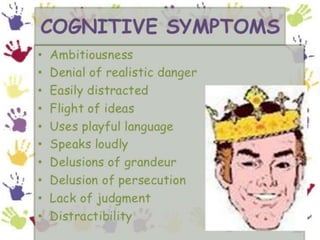
SYMPTOMS OF MANIA
Typical symptoms of Mania:
• Heightened, grandiose, or agitated mood
• Exaggerated self-esteem
• Sleeplessness
• Pressured speech
• Flight of ideas
• Reduces ability to filter out extraneous stimuli; easily
distractible
• Increased number of activities with increased energy
• Multiple, grandiose, high-risk activities, using poor
judgment, with severe consequences
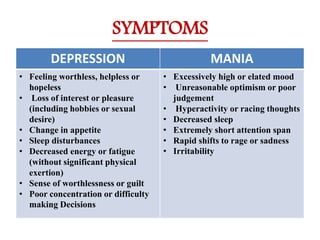
SYMPTOMS
DEPRESSION MANIA
• Feeling worthless, helpless or
hopeless
• Loss of interest or pleasure
(including hobbies or sexual
desire)
• Change in appetite
• Sleep disturbances
• Decreased energy or fatigue
(without significant physical
exertion)
• Sense of worthlessness or guilt
• Poor concentration or difficulty
making Decisions
• Excessively high or elated mood
• Unreasonable optimism or poor
judgement
• Hyperactivity or racing thoughts
• Decreased sleep
• Extremely short attention span
• Rapid shifts to rage or sadness
• Irritability
TREATMENT
PHARMACOLOGICAL TREATMENT:-
• Monotherapy with the traditional mood stabilizers (e.g.,
lithium, divalproex, carbamazepine) or atypical
antipsychotics (e.g., olanzapine, quetiapine, risperidone)
was determined to be the first-line treatment.
• Lithium carbonate was the first drug approved by the
U.S. Food and Drug Administration (FDA) for acute
manic episodes and for maintenance therapy to prevent
or diminish the intensity of subsequent manic episodes.
Cont….
• A number of other medications are used for the
treatment of mania, with varying degrees of success.
• Examples include anticonvulsants (e.g., carbamazepine,
clonazepam, valproic acid, lamotrigine, gabapentin,
oxcarbazepine, and topiramate) and calcium channel
blockers (verapamil).
• Several antipsychotic medications have been approved
by the FDA for the treatment of bipolar mania. These
include chlorpromazine and the newer atypical
antipsychotics olanzapine, risperidone, aripiprazole,
ziprasidone, and quetiapine.
Cont….
• Chlorpromazine is gradually becoming obsolete in the
treatment of bipolar mania owing to the more favourable side
effect profile of the atypical antipsychotics.
• Depending on the severity of the symptoms, these medications
may be used alone or in combination with lithium.
• Another atypical antipsychotic, clozapine, has also been used
in the treatment of acute mania; however, its usefulness is
limited by the potential for seizures and agranulocytosis
OTHER TREATMENT
• Cognitive behavioural therapy (CBT) – a short-term,
practical therapy that aims to help you identify patterns
that can lead to hypomania and develop ways to change
these.
• Mindfulness-based cognitive therapy (MBCT) – a therapy
focused on living and paying attention to the present
moment.
• Psych education – a brief intervention to help you learn
coping strategies, either on your own or in a group.
• Interpersonal therapy – this looks at any problems you
have in communicating and interacting with other people,
or relationship problems.
• Family-focused therapy – this involves working as a family
to look at behavioural traits, identify risks and build
communication and problem-solving skills.
Electroconvulsive therapy (ECT)
• Very rarely, a treatment called electroconvulsive
therapy (ECT) may be offered. According to NICE
(National Institute for Health and Care Excellence)
guidelines, this could be if: patient experiencing a long
period of mania, and other treatments have not
worked, or the situation is life-threatening.
• Episodes of acute mania are occasionally treated with
ECT, particularly when the client does not tolerate or
fails to respond to lithium or other drug treatment, or
when life is threatened by dangerous behaviour or
exhaustion.
Nursing Diagnosis
• Risk for other-directed violence
• Risk for injury
• Imbalanced Nutrition: Less than body requirements
• Ineffective coping
• Noncompliance
• Ineffective role performance
• Self-Care deficit
• Chronic low self-esteem
• Disturbed sleep pattern
Outcome Identification
The client will:
• Not injure self or others.
• Establish a balance of rest, sleep, and activity.
• Establish adequate nutrition, hydration, and
elimination.
• Participate in self-care activities.
• Evaluate personal qualities realistically.
• Engage in socially appropriate, reality-based
interaction.
• The client will verbalize knowledge of his or her illness
and treatment.
Interventions
• Providing for Safety
-Provide a safe environment for clients and others.
-Assess directly for suicidal ideation.
- Set limits. Clearly identify the unacceptable behaviour and the
expected, appropriate behaviour.
- Remind the client to respect distances between staff and others.
•Promoting Appropriate Behaviours
- Direct the clients’ need for movement into socially acceptable,
large motor activities such as arranging chairs or walking.
- Protect the client’s dignity when inappropriate behaviour occurs
CONT….
•Managing Medications
- Monitor serum lithium levels.
- Clients should drink adequate water and continue with the usual
amount of dietary table salt. (table)
- Too much salt and water = Lithium blood level is too low
- Too little salt and water = Lithium toxicity

Mood disorder

  • 1.
    PRESENTED BY SRADHANJALI BISWAL TUTOR KALINGAINSTITUTE OF NURSING SCIENCES KIIT DEEMED TO BE UNIVERSITY, BHUBANESWAR
  • 2.
    INTRODUCTION • The term‘mood disorders’ groups together a number of clinical conditions whose common and essential feature is a disturbance of mood, accompanied by related cognitive, psychomotor, psychophysiological, and interpersonal difficulties.
  • 3.
    • MOOD : Moodrefers to an internal emotional state of the individual. • Affect is the external expression of internal emotional content.
  • 4.
    • Mood disordersinclude major depression, bipolar disorder (combining episodes of both mania and depression) and dysthymia.
  • 5.
    INCIDENCE • The onsetof mood disorders usually occurs during adolescence. • Approximately 8% of adults will experience major depression at some time in their lives. • Approximately 1% will experience bipolar disorder. • Worldwide, major depression is the leading cause of years lived with disability, and the fourth cause of disability adjusted life years (DALYs). • Mood disorders have a major economic impact through associated health care costs as well as lost work productivity.
  • 6.
    Cont….. • Hospitalizations formood disorders in general hospitals are approximately one and a half times higher among women than men. • The wide disparity among age groups in hospitalization rates for depression in general hospitals has narrowed in recent years, because of a greater decrease in hospitalization rates in older age groups. • Hospitalization rates for bipolar disorder in general hospitals are increasing among women and men between15 and 24 years of age. • Individuals with mood disorders are at high risk of suicide.
  • 7.
    Normal Vs. PathologicalMood SL. NO FEATURES NORMAL MOOD PATHOLOGICAL MOOD 1 BODY FUNCTIONS NORMAL BODILY FUNCTIONS[ E.g. adequate sleep, appetite] IMPAIRMENTS OF BODY FUNCTIONS [e.g. disturbances in sleep, appetite, sexual interest, gastro intestinal activity] 2 SOCIAL ROLES WELL SOCIALISED PERFORM ALL THE EXPECTED ROLES REDUCED DESIRE AND ABILTY TO PERFORM USUAL EXPECTED ROLES [e.g. family responsibilities, at work, in school] 3 SUICIDEAL IDEATIONS SUICIDAL THOUGHTS OR ACTS ABSENT SUICIDAL THOUGHTS OR ACTS PRESENT 4 REALITY TESTING NORMAL REALITY TESTING[ No delusion, hallucination, confusion present] DISTRUBANCES IN REALITY TESTING[e.g. delusions present, hallucinations, confusion present]
  • 10.
    Cont… • Mood disordersmay involve depression only (also referred to as “unipolar depression”) or they may include manic episodes (as in bipolar disorder, which is classically known as “manic depressive illness”).
  • 12.
    MANIC EPISODE • Itis a state of abnormally elevated or irritable mood, arousal, and/or energy levels. • A manic episode is a mood state characterizes by period of at least one week where an elevated , expansive , or unusually irritable mood exists.
  • 13.
    Cont.… • A personexperiencing a manic episode is usually engaged in significant goal-directed activity beyond their normal activities. • People describes a manic mood as feeling very euphoric, “on top of the world,” and being able to do or accomplish anything. • The feeling is like extreme optimism – but on steroids.
  • 14.
    STAGESOFMANIA • As anindividual moves between these stages, his mood, thinking, and behaviour may all change. • Affected individual may go into and out of episodes of mania that may last a few days to many weeks. • In between these stages some individuals also lead highly productive lives
  • 15.
    STAGES OF MANIA STAGE– I [EUPHORIA ] STAGE – II [ELATION] STAGE – III [EXALTATION] MOOD Liability of affect, euphoria predominates, irritability if demands not satisfied. Increased dysphoria and depression, open hostility and anger Clear dysphoric , panic stricken hopeless COGNITION Expansive, grandiosity, over-confidence, thoughts coherent, but occasionally tangential , sexual and religious pre-occupation. Racing of thoughts Flight of ideas, disorganization of cognitive state, delusions Incoherent, definite loosening of association, bizarre and idio – syncratic delusions, hallucinations in one – third of the patients, occasional ideas of reference . BEHAVIOR Increased psychomotor activity, increased initiation and rate of speech, increased spending, smoking, telephone use. Continued increased psychomotor acceleration, increased pressured speech, occasional assaultive behaviour. Frenzied and frequently bizarre psychomotor activity.
  • 16.
    Triggers of Mania •Not sleeping properly or missing a night's sleep • Stress at work • Being really busy with activities and hobbies • Being away a lot at weekends or not having enough downtime to relax • Drinking too much caffeine or alcohol • Skipping meals
  • 17.
    Warning signs ofMania • staying up until early hours of the morning, and finding it hard to stop activities and go to bed • being more chatty than usual and wanting to be with other people all the time • buying lots of new clothes and wanting to wear quite loud outfits I wouldn't normally
  • 18.
    Cont.… • spending alot of time on social media • feeling impatient with people, like they can't keep up with me.
  • 19.
    ETIOLOGY OF MANIA 1.Genetic Or Hereditary Factors 2. Neurotransmitter And Structural Hypothesis 3. Psychodynamic Theories 4. Organic disorders 5. Stress
  • 20.
    1.Genetic Or HereditaryFactors • Individuals with depression and bipolar disorder often find a history of these disorders in immediate family members. • The exact genetic factors that are involved in mood disorders remain unknown. • Mono-zygotic (identical) twins have a higher rate of incidence than normal siblings and close relatives. • Siblings and closer relatives have a higher incidence of manic-depressive illness than a general population. • First degree relatives ; 5-10% chances • Identical twins with bipolar disorders : 40-70% chances
  • 21.
    2. Neurotransmitter AndStructural Hypothesis • Monoamine neurotransmitter systems, especially those of epinephrine and serotonin, their metabolites, and their receptors, are altered during manic episode • Biologic findings suggest that lesions are more common in this population in areas of the brain such as the right hemisphere or bilateral sub-cortical and periventricular gray matter.
  • 22.
    Cont. …. • KindlingTheory - External environmental stressors activate internal physiologic stress responses, which trigger the first episode of a mood disorder, the first episode then creates electrophysiologic sensitivity to future episodes so that less stress is required to evoke another episode
  • 23.
    3.Psychosocial Factors • Psychosocialexplanation for the development of mood disorder represents a range of theoretic positions, including psychoanalytic theory, learned helplessness, cognitive theory and personality theory.
  • 24.
    a. Psychoanalytic Theory: •The basic premise of psychoanalytic theory is that unconscious processes result in expression of symptoms, including depression and mania. • Psycho-dynamically, mania is explained as a defences against depression. The client denies feelings of anger, low self esteem, and worthlessness and reverses the effect such that there is a triumphant feeling of self-confidence. • Mania represents a conquered superego with little inclination to control id impulses. • Its references may be in the early childhood environment in which loss, disruption, may triggers the physiologic mechanisms .
  • 25.
    Life events andstress Theory • Malkoff – Schwartz et al (2000) studied the influence of social rhythm disruption as a stressful life event on clients with pure mania ,depression , cycling episodes and recurrent unipolar depression . • The researcher found that the onset of manic episode was influenced by stressful life events, especially those involve social rhythm disruption
  • 26.
    Organic disorders • Somephysical illnesses and disorders can cause hypomania and mania, including thyroid disorders, HIV/AIDs, lupus, encephilitus and vascular disease. • Neurological conditions, including dementia, Huntington's disease, brain injury, multiple sclerosis (MS), brain tumours and stroke, can also cause symptoms of hypomania and mania.
  • 27.
    • high levelsof stress • changes in sleep patterns or lack of sleep • use of stimulants such as drugs or alcohol • seasonal changes – some people are more likely to experience hypomania and mania in spring • a significant change in your life – moving house or going through a divorce, for example
  • 28.
    As a sideeffect of medication • Some medications can cause hypomania or mania as a side-effect, either while taking them or as a withdrawal symptom when stop. • This includes medications for physical conditions and psychiatric medications – including some antidepressants (particularly specific serotonin reuptake inhibitors (SSRIs)).
  • 29.
    As a sideeffect of a physical illness or neurological condition • Some physical illnesses and disorders can cause hypomania and mania, including thyroid disorders, HIV/AIDs, lupus, encephilitus and vascular disease. • Neurological conditions, including dementia, Huntington's disease, brain injury, multiple sclerosis (MS), brain tumours and stroke, can also cause symptoms of hypomania and mania.
  • 38.
    TYPES OF MANIA I.a. Acute Mania b. Hypomania or mild to moderate mania c. Delirium II. a. Primary Mania b. Secondary Mania III. a. Description of recent manic episode b. Mania without psychotic symptoms c. Mania with psychotic symptoms d. Unspecified manic episode e. Mania with catatonic features f. Mania with postpartum episode IV. a. Mania b. Hypomania c. Mixed state or dysphoric Mania
  • 39.
    CONT…. • Symptoms ofmanic states can be described according to three stages: hypomania, acute mania, and delirious mania. Stage I: Hypomania • At this stage, the disturbance is not sufficiently severe to cause marked impairment in social or occupational functioning or to require hospitalization (APA, 2000).  Mood • The mood of a hypomanic person is cheerful and expansive. However, there is an underlying irritability that surfaces rapidly when the person’s wishes and desires go unfulfilled. The nature of the hypomanic person is very volatile and fluctuating.
  • 40.
    • Cognition andPerception • Perceptions of the self are exalted—ideas of great worth and ability. • Thinking is flighty, with a rapid flow of ideas. • Perception of the environment is heightened, but the individual is so easily distracted by irrelevant stimuli that goal-directed activities are difficult. • Activity and Behaviour • Hypomanic individuals exhibit increased motor activity. • They are perceived as being very extroverted and sociable, • and because of this they attract numerous acquaintances. • They lack the depth of personality and warmth to formulate close friendships. • They talk and laugh a lot, usually very loudly and often inappropriately. Increased libido is common
  • 41.
    Stage II: AcuteMania • Symptoms of acute mania may be a progression in intensification of those experienced in hypomania, or they may be manifested directly. • Most individuals experience marked impairment in functioning and require hospitalization. • Mood • Acute mania is characterized by euphoria and elation. The person appears to be on a continuous “high.” • Cognition and Perception • Cognition and perception become fragmented and often psychotic in acute mania. • Rapid thinking proceeds to racing and disjointed thinking (flight of ideas) and may be manifested by a continuous flow of accelerated, pressured speech (loquaciousness), with abrupt changes from topic to topic.
  • 42.
    • Activity andBehaviour • Psychomotor activity is excessive. Sexual interest is increased. • There is poor impulse control, and the individual who is normally discreet may become socially and sexually uninhibited. • Energy seems inexhaustible, and the need for sleep is diminished. • They may go for many days without sleep and still not feel tired. • Hygiene and grooming may be neglected. Dress may be disorganized, flamboyant, Or bizarre, and the use of excessive make-up or jewellery is common.
  • 43.
    Stage III: DeliriousMania • Delirious mania is a grave form of the disorder characterized by severe clouding of consciousness and an intensification of the symptoms associated with acute mania. • This condition has become relatively rare since the availability of antipsychotic medication. • Mood • The mood of the delirious person is very labile. • He or she may exhibit feelings of despair, quickly converting to unrestrained merriment and ecstasy or becoming irritable or totally indifferent to the environment
  • 44.
    • Cognition andPerception • Cognition and perception are characterized by a clouding of consciousness, with accompanying confusion, disorientation, and sometimes stupor. • Other common manifestations include religiosity, delusions of grandeur or persecution, and auditory or visual hallucinations. • The individual is extremely distractible and incoherent. • Activity and Behaviour • Psychomotor activity is frenzied and characterized by agitated, purposeless movements. • The safety of these individuals is at stake unless this activity is curtailed. • Exhaustion, injury to self or others, and eventually death could occur without intervention.
  • 45.
    SYMPTOMS OF MANIA Typicalsymptoms of Mania: • Heightened, grandiose, or agitated mood • Exaggerated self-esteem • Sleeplessness • Pressured speech • Flight of ideas • Reduces ability to filter out extraneous stimuli; easily distractible • Increased number of activities with increased energy • Multiple, grandiose, high-risk activities, using poor judgment, with severe consequences
  • 46.
    SYMPTOMS DEPRESSION MANIA • Feelingworthless, helpless or hopeless • Loss of interest or pleasure (including hobbies or sexual desire) • Change in appetite • Sleep disturbances • Decreased energy or fatigue (without significant physical exertion) • Sense of worthlessness or guilt • Poor concentration or difficulty making Decisions • Excessively high or elated mood • Unreasonable optimism or poor judgement • Hyperactivity or racing thoughts • Decreased sleep • Extremely short attention span • Rapid shifts to rage or sadness • Irritability
  • 51.
    TREATMENT PHARMACOLOGICAL TREATMENT:- • Monotherapywith the traditional mood stabilizers (e.g., lithium, divalproex, carbamazepine) or atypical antipsychotics (e.g., olanzapine, quetiapine, risperidone) was determined to be the first-line treatment. • Lithium carbonate was the first drug approved by the U.S. Food and Drug Administration (FDA) for acute manic episodes and for maintenance therapy to prevent or diminish the intensity of subsequent manic episodes.
  • 52.
    Cont…. • A numberof other medications are used for the treatment of mania, with varying degrees of success. • Examples include anticonvulsants (e.g., carbamazepine, clonazepam, valproic acid, lamotrigine, gabapentin, oxcarbazepine, and topiramate) and calcium channel blockers (verapamil). • Several antipsychotic medications have been approved by the FDA for the treatment of bipolar mania. These include chlorpromazine and the newer atypical antipsychotics olanzapine, risperidone, aripiprazole, ziprasidone, and quetiapine.
  • 53.
    Cont…. • Chlorpromazine isgradually becoming obsolete in the treatment of bipolar mania owing to the more favourable side effect profile of the atypical antipsychotics. • Depending on the severity of the symptoms, these medications may be used alone or in combination with lithium. • Another atypical antipsychotic, clozapine, has also been used in the treatment of acute mania; however, its usefulness is limited by the potential for seizures and agranulocytosis
  • 54.
    OTHER TREATMENT • Cognitivebehavioural therapy (CBT) – a short-term, practical therapy that aims to help you identify patterns that can lead to hypomania and develop ways to change these. • Mindfulness-based cognitive therapy (MBCT) – a therapy focused on living and paying attention to the present moment. • Psych education – a brief intervention to help you learn coping strategies, either on your own or in a group. • Interpersonal therapy – this looks at any problems you have in communicating and interacting with other people, or relationship problems. • Family-focused therapy – this involves working as a family to look at behavioural traits, identify risks and build communication and problem-solving skills.
  • 55.
    Electroconvulsive therapy (ECT) •Very rarely, a treatment called electroconvulsive therapy (ECT) may be offered. According to NICE (National Institute for Health and Care Excellence) guidelines, this could be if: patient experiencing a long period of mania, and other treatments have not worked, or the situation is life-threatening. • Episodes of acute mania are occasionally treated with ECT, particularly when the client does not tolerate or fails to respond to lithium or other drug treatment, or when life is threatened by dangerous behaviour or exhaustion.
  • 56.
    Nursing Diagnosis • Riskfor other-directed violence • Risk for injury • Imbalanced Nutrition: Less than body requirements • Ineffective coping • Noncompliance • Ineffective role performance • Self-Care deficit • Chronic low self-esteem • Disturbed sleep pattern
  • 57.
    Outcome Identification The clientwill: • Not injure self or others. • Establish a balance of rest, sleep, and activity. • Establish adequate nutrition, hydration, and elimination. • Participate in self-care activities. • Evaluate personal qualities realistically. • Engage in socially appropriate, reality-based interaction. • The client will verbalize knowledge of his or her illness and treatment.
  • 58.
    Interventions • Providing forSafety -Provide a safe environment for clients and others. -Assess directly for suicidal ideation. - Set limits. Clearly identify the unacceptable behaviour and the expected, appropriate behaviour. - Remind the client to respect distances between staff and others. •Promoting Appropriate Behaviours - Direct the clients’ need for movement into socially acceptable, large motor activities such as arranging chairs or walking. - Protect the client’s dignity when inappropriate behaviour occurs
  • 59.
    CONT…. •Managing Medications - Monitorserum lithium levels. - Clients should drink adequate water and continue with the usual amount of dietary table salt. (table) - Too much salt and water = Lithium blood level is too low - Too little salt and water = Lithium toxicity