-Mr. ANEEZ. K
Ist year M.Sc. Nursing
EMCH CON
The concept of therapeutic community
was first developed by Maxwell in1953.
He wrote a book entitled “ social
psychiatry” which was first published in
England.
Later on when it was published in the
United states, its title was changed to
“Therapeutic Community.”
Small cohesive communities where
patients have a significant
involvement in decision-making and
the practicalities of running the
unit.
Collective responsibility
Citizenship
Empowerment
Encourages personal responsibility
Avoids unhelpful
dependency on professionals
 To use patient’s social environment to
provide a therapeutic experience for
him.
To enable the patient to be an active
participant in his own care and become
involved in daily activities of his
community.
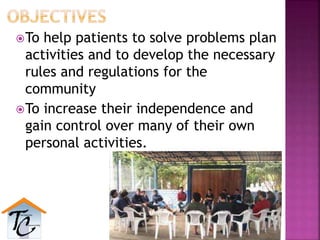
To help patients to solve problems plan
activities and to develop the necessary
rules and regulations for the
community
To increase their independence and
gain control over many of their own
personal activities.
To enable the patients to become
aware of how their behavior affects
others.
Dependence syndrome
Depressive disorders
Neurosis
Somatoform disorder
Personality disorder
 Self harming nature
Drug abuse
Violent patients
Schizophrenia
Enduring mental illness
Size of the unit
Duration of treatment
Relationship with the parents,
organizations and wider community
 Free communication
 Shared responsibilities
 Active participation
 Involvement in decision making
 Understanding of roles, responsibilities,
limitations and authorities
1. Daily Community meetings
 composed of 60-90 patients.
 All levels of unit staff are involved
 including administrative personnel
 acute patients are not involved in the meetings.
 Discussion should focus mainly on day to day life in
the unit.
1. Daily Community meetings
 During discussions patient’s feelings and behaviors
are examined by other members.
 Frank discussions are encouraged
 much outpouring of emotions and anger.
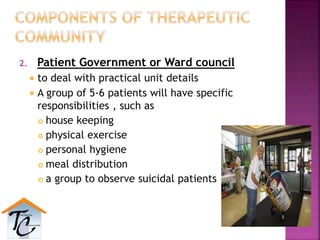
2. Patient Government or Ward council
 to deal with practical unit details
 A group of 5-6 patients will have specific
responsibilities , such as
 house keeping
 physical exercise
 personal hygiene
 meal distribution
 a group to observe suicidal patients
2. Patient Government or Ward council
 staff members should be available always.
 All decisions should be feedback to the
community through the community meetings.
3. Staff Meetings or Review
 A staff meetings should be held following each
community meetings
 patients are excluded and only staff are present
 In this meeting the staff would examine their own
responses, expectations and prejudices.
4. Living and learning Opportunities
 provided within the social milieu
 provide realistic learning experiences for the
patients.
Psychiatrist
Psychiatric nurse
Clinical psychologist
Psychiatric social function
Occupational therapist
Recreational therapist
Art therapist
Music therapist
Dietician
Psychiatric nurse
 Authoritarian role
Social role
 Therapeutic role
Psychiatrist
 Leader
 Diagnose and treatment
Clinical psychologist
 Assist to diagnose by psychological
test
Psychiatric social worker
 Concerned with client need
 Fulfil family and community
requirement
Assist in conduction of therapeutic
skill
Recreational therapist
 Encourage to express their feeling
Occupational therapist
 Develop independent skill
 Assist to productive
 Creative activities and skills are
developed
 Patient develop harmonious relationships with
other members in the community.
 Gains self confidence
 Develops Leadership skills.
 Learns to understand and solve problems of
self and others.
 Becomes Socio- Centric.
 Learns to live and think collectively with the
members of the community
 provides opportunities to participate in the
formulation of hospital rules and regulations
that affect patient’s personal liberties like
bedtime , meal time, weekend permission,
control of radio or T.V, Social activities, late
night privileges, etc.
 Role blurring between staff and patients
 Group responsibility can easily become
nobody’s responsibility.
 Individual needs and concerns may not be
met.
 Patient may find the transition to community
difficult.
Identify the difference between
therapeutic community and milieu
therapy in detail and submit it on
21.8.2015 before 4 pm. Total mark is
20
Townsend M C. Psychiatric Mental Health
Nursing-concepts of care. (3 rd edition).
F.H Davis Publishers; Philadelphia: 2000.
Pg.No. 158-160.
Kapoor B. Text book of psychiatric
nursing. Publishers of medical and
nursing books; Delhi: 2006.Pg.No. 12-57.
Sreevani R.A guide to mental health
and psychiatric nursing. Jaypee
Brothers Medical Publishers; New
Delhi: (2006). Pg.No. 148-149.
Stuart gail.w. principles & practices
of Psychiatric Nursing. (9th edition).
Elsevier publishers: 2011. Pg. No.
115-120.
www.austinecc.edu/richb/thercom.
html
http//nursing.planet.com/pn/thera
peutic-communication.html
ANY DOUBT
Therapeutic community

Therapeutic community

  • 1.
    -Mr. ANEEZ. K Istyear M.Sc. Nursing EMCH CON
  • 2.
    The concept oftherapeutic community was first developed by Maxwell in1953. He wrote a book entitled “ social psychiatry” which was first published in England. Later on when it was published in the United states, its title was changed to “Therapeutic Community.”
  • 3.
    Small cohesive communitieswhere patients have a significant involvement in decision-making and the practicalities of running the unit.
  • 4.
    Collective responsibility Citizenship Empowerment Encourages personalresponsibility Avoids unhelpful dependency on professionals
  • 5.
     To usepatient’s social environment to provide a therapeutic experience for him. To enable the patient to be an active participant in his own care and become involved in daily activities of his community.
  • 6.
    To help patientsto solve problems plan activities and to develop the necessary rules and regulations for the community To increase their independence and gain control over many of their own personal activities.
  • 7.
    To enable thepatients to become aware of how their behavior affects others.
  • 8.
  • 9.
     Self harmingnature Drug abuse Violent patients Schizophrenia Enduring mental illness
  • 10.
    Size of theunit Duration of treatment Relationship with the parents, organizations and wider community
  • 11.
     Free communication Shared responsibilities  Active participation  Involvement in decision making  Understanding of roles, responsibilities, limitations and authorities
  • 12.
    1. Daily Communitymeetings  composed of 60-90 patients.  All levels of unit staff are involved  including administrative personnel  acute patients are not involved in the meetings.  Discussion should focus mainly on day to day life in the unit.
  • 13.
    1. Daily Communitymeetings  During discussions patient’s feelings and behaviors are examined by other members.  Frank discussions are encouraged  much outpouring of emotions and anger.
  • 14.
    2. Patient Governmentor Ward council  to deal with practical unit details  A group of 5-6 patients will have specific responsibilities , such as  house keeping  physical exercise  personal hygiene  meal distribution  a group to observe suicidal patients
  • 15.
    2. Patient Governmentor Ward council  staff members should be available always.  All decisions should be feedback to the community through the community meetings.
  • 16.
    3. Staff Meetingsor Review  A staff meetings should be held following each community meetings  patients are excluded and only staff are present  In this meeting the staff would examine their own responses, expectations and prejudices.
  • 17.
    4. Living andlearning Opportunities  provided within the social milieu  provide realistic learning experiences for the patients.
  • 18.
  • 19.
    Occupational therapist Recreational therapist Arttherapist Music therapist Dietician
  • 20.
    Psychiatric nurse  Authoritarianrole Social role  Therapeutic role Psychiatrist  Leader  Diagnose and treatment
  • 21.
    Clinical psychologist  Assistto diagnose by psychological test Psychiatric social worker  Concerned with client need  Fulfil family and community requirement Assist in conduction of therapeutic skill
  • 22.
    Recreational therapist  Encourageto express their feeling Occupational therapist  Develop independent skill  Assist to productive  Creative activities and skills are developed
  • 23.
     Patient developharmonious relationships with other members in the community.  Gains self confidence  Develops Leadership skills.  Learns to understand and solve problems of self and others.  Becomes Socio- Centric.
  • 24.
     Learns tolive and think collectively with the members of the community  provides opportunities to participate in the formulation of hospital rules and regulations that affect patient’s personal liberties like bedtime , meal time, weekend permission, control of radio or T.V, Social activities, late night privileges, etc.
  • 25.
     Role blurringbetween staff and patients  Group responsibility can easily become nobody’s responsibility.  Individual needs and concerns may not be met.  Patient may find the transition to community difficult.
  • 26.
    Identify the differencebetween therapeutic community and milieu therapy in detail and submit it on 21.8.2015 before 4 pm. Total mark is 20
  • 27.
    Townsend M C.Psychiatric Mental Health Nursing-concepts of care. (3 rd edition). F.H Davis Publishers; Philadelphia: 2000. Pg.No. 158-160. Kapoor B. Text book of psychiatric nursing. Publishers of medical and nursing books; Delhi: 2006.Pg.No. 12-57.
  • 28.
    Sreevani R.A guideto mental health and psychiatric nursing. Jaypee Brothers Medical Publishers; New Delhi: (2006). Pg.No. 148-149. Stuart gail.w. principles & practices of Psychiatric Nursing. (9th edition). Elsevier publishers: 2011. Pg. No. 115-120. www.austinecc.edu/richb/thercom. html http//nursing.planet.com/pn/thera peutic-communication.html
  • 29.