Panic Disorder with Agoraphobia a case presentation vanessa   villamia sochat abnormal psychology July 11, 2008
Panic Disorder with Agoraphobia  An Introduction
WHO  is our client? WHAT  are his symptoms and diagnosis? WHY  did he develop this disorder? HOW  do we treat it? Outline
WHO WHAT WHY HOW ? Who is our client? John Donahue DEMOGRAPHICS Forty five years ago  High school principal Father of three CLINICAL HISTORY First attack 15 years ago Alcoholism Anxiety Clinic What does John think of his attacks?
WHO WHAT WHY HOW ? An example of John’s typical panic attack
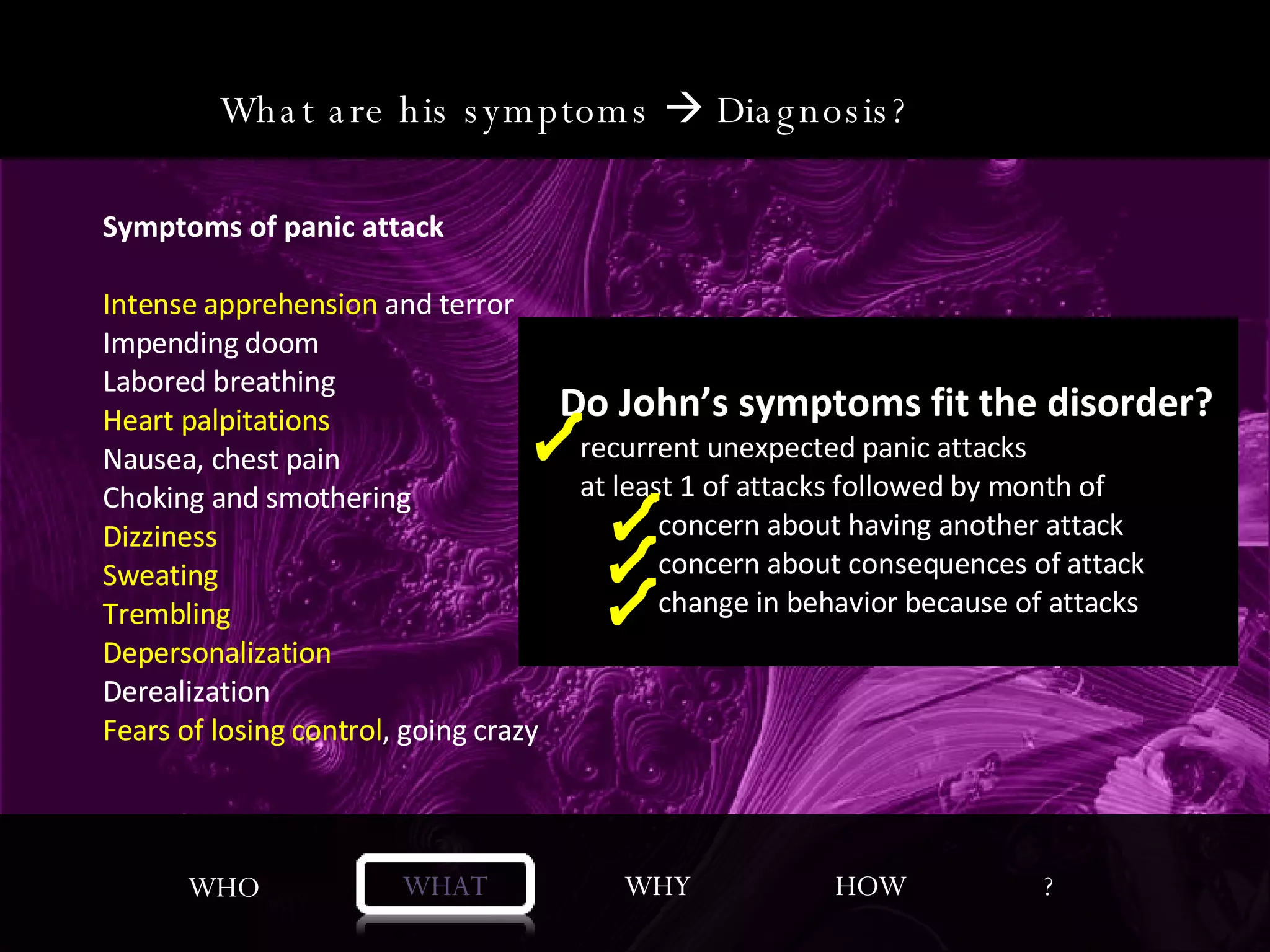
WHO WHAT WHY HOW ? Symptoms of panic attack Intense apprehension and terror Impending doom Labored breathing Heart palpitations Nausea, chest pain Choking and smothering Dizziness Sweating Trembling Depersonalization Derealization  Fears of losing control, going crazy Panic Disorder with Agoraphobia “ Anxiety about situations which would be embarrassing or difficult to escape if panic symptoms occurred” What are his symptoms    Diagnosis?  Symptoms of panic attack Intense apprehension  and terror Impending doom Labored breathing Heart palpitations Nausea, chest pain Choking and smothering Dizziness Sweating Trembling Depersonalization Derealization  Fears of losing control , going crazy Do John’s symptoms fit the disorder? recurrent unexpected panic attacks   at least 1 of attacks followed by month of  concern about having another attack  concern about consequences of attack  change in behavior because of attacks
Axis I:  300.21 Panic disorder with agoraphobia Axis II:  No diagnosis on axis II Axis III:  None Axis IV:  Relocation to new state, job change,  stressful work schedule Axis V:  Global assessment of functioning =  58 WHO WHAT WHY HOW ? What is John’s official DSM-IV-TR diagnosis?  DMS-IV-TR Diagnosis Based on: Anxiety about situations/events Avoidance of these situations/events Anxiety not better accounted for by another disorder!
WHO WHAT WHY HOW ? Integrative Model of Causes and Maintenance of Panic Disorder Genetic factors Social Factors Physiological Factors Cognition (personality) Life Events Why did he develop this disorder? Etiology of Panic Disorder with Agoraphobia “ Fear of Fear” Hypothesis
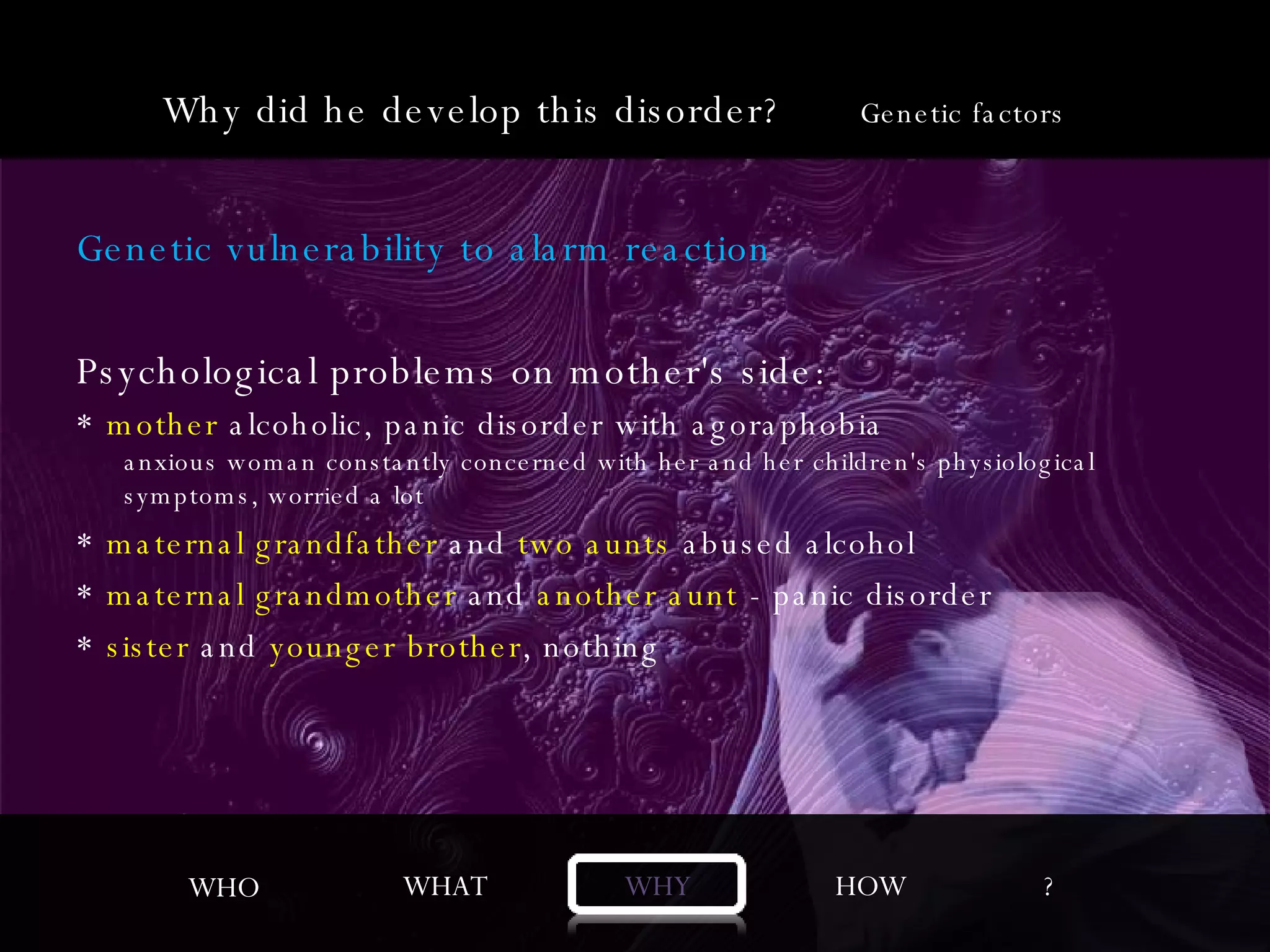
Genetic vulnerability to alarm reaction Psychological problems on mother's side: *  mother  alcoholic, panic disorder with agoraphobia anxious woman constantly concerned with her and her children's physiological symptoms, worried a lot *  maternal grandfather  and  two aunts  abused alcohol  *  maternal grandmother  and  another aunt  - panic disorder *  sister  and  younger brother , nothing WHO WHAT WHY HOW ? Why did he develop this disorder?  Genetic factors
Stressful environment triggers vulnerability Interoceptive conditioning (learned alarms) WHO WHAT WHY HOW ? Why did he develop this disorder?  s ocial/environment  factors   Behavioral Factors   Physiological/biological Factors
WHO WHAT WHY HOW ? Why did he develop this disorder?  cognition Safety behaviors and safety signals 24 access to anti anxiety medication driving to side of road holding onto stationary objects remaining near walls Safety behaviors serve to maintain beliefs  about the consequences of panic Lack of control over environment More attentive to signs of threat
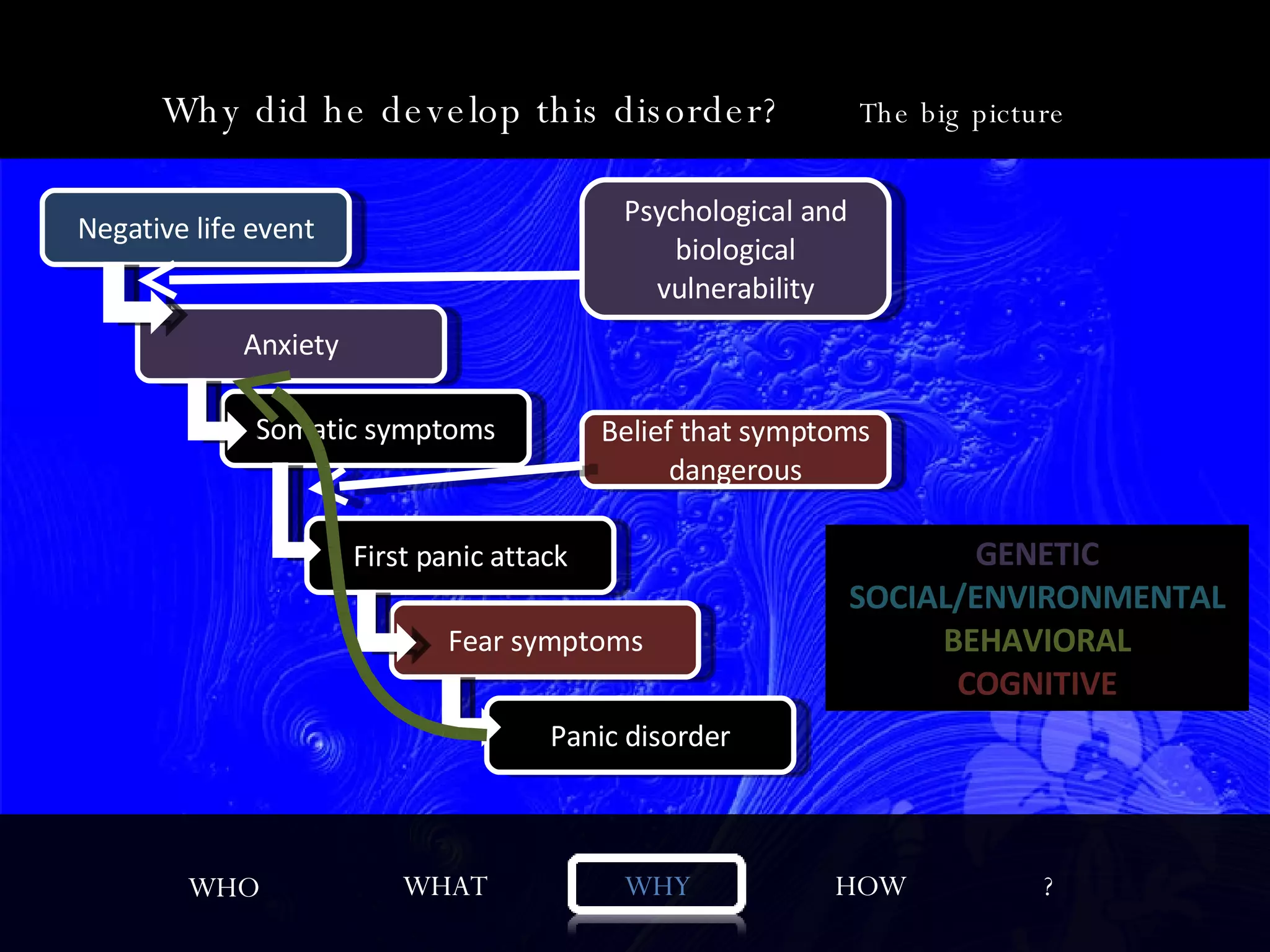
WHO WHAT WHY HOW ? Negative life event Anxiety Somatic symptoms First panic attack Fear symptoms Panic disorder Psychological and biological vulnerability Belief that symptoms dangerous Why did he develop this disorder?  The big picture GENETIC SOCIAL/ENVIRONMENTAL BEHAVIORAL COGNITIVE
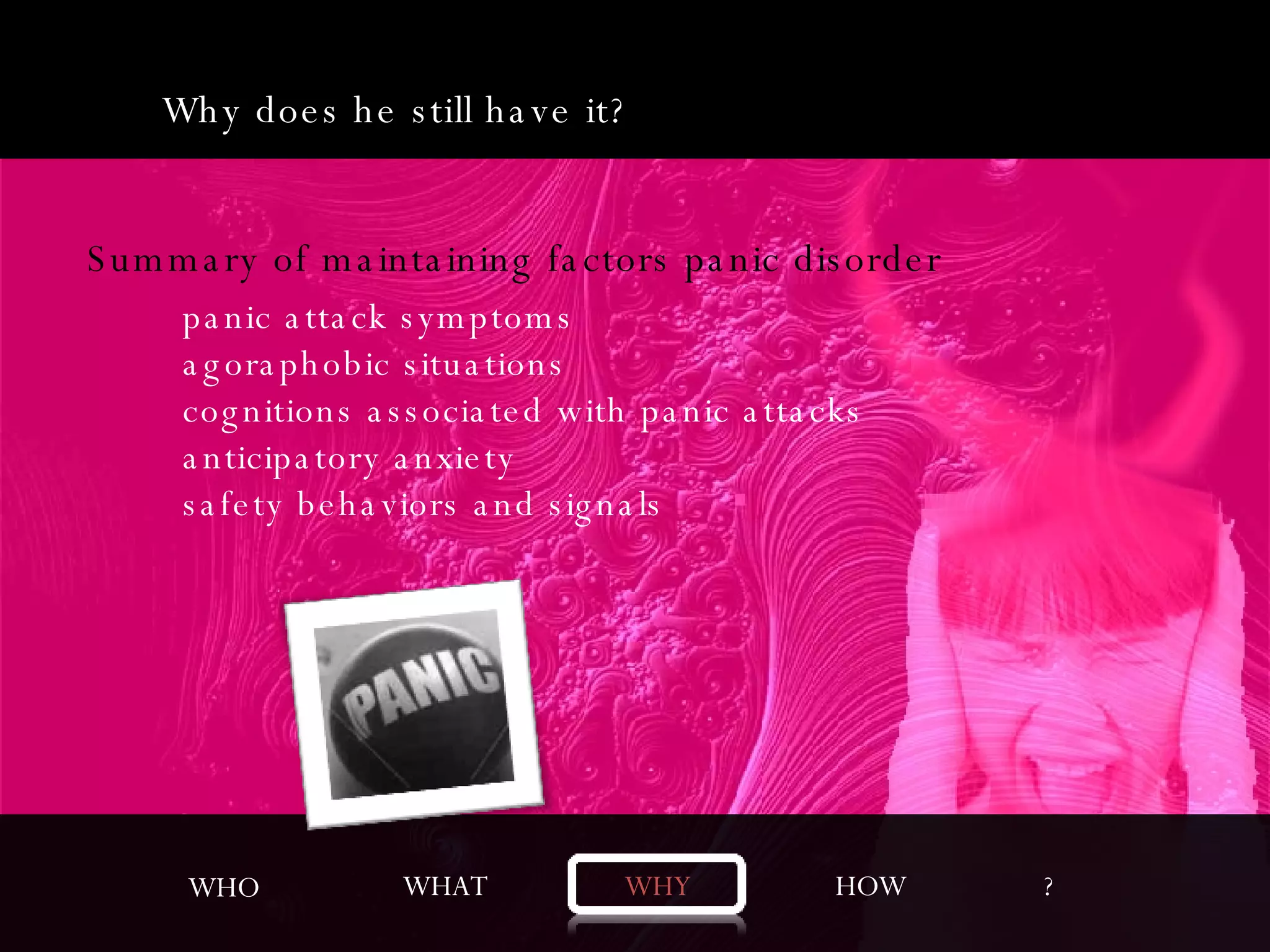
Summary of maintaining factors panic disorder   panic attack symptoms     agoraphobic situations     cognitions associated with panic attacks     anticipatory anxiety     safety behaviors and signals WHO WHAT WHY HOW ? Why does he still have it?
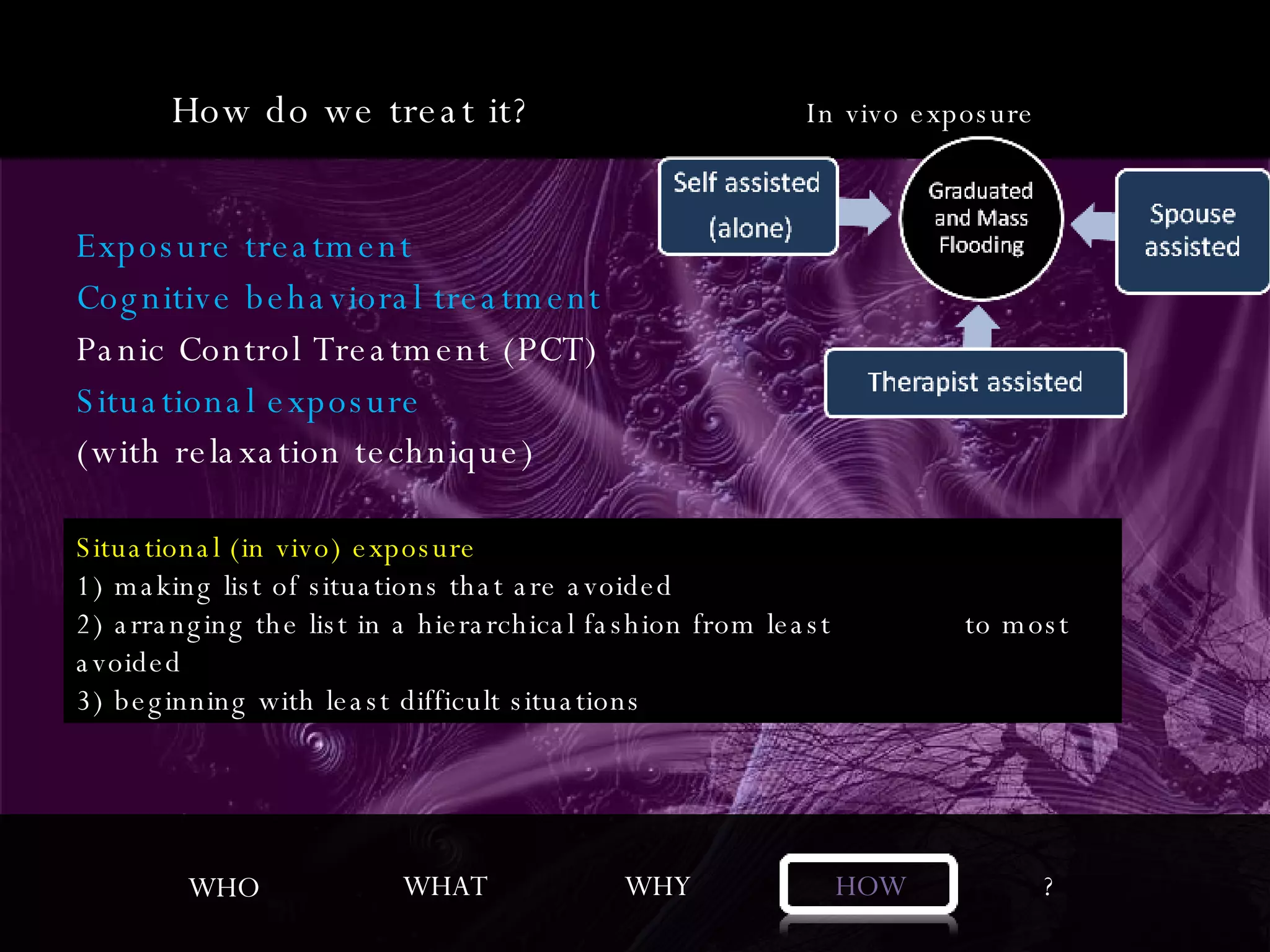
Exposure treatment Cognitive behavioral treatment  Panic Control Treatment (PCT) Situational exposure   (with relaxation technique) WHO WHAT WHY HOW ? How do we treat it?  In vivo exposure Situational (in vivo) exposure 1) making list of situations that are avoided 2) arranging the list in a hierarchical fashion from least  to most avoided 3) beginning with least difficult situations
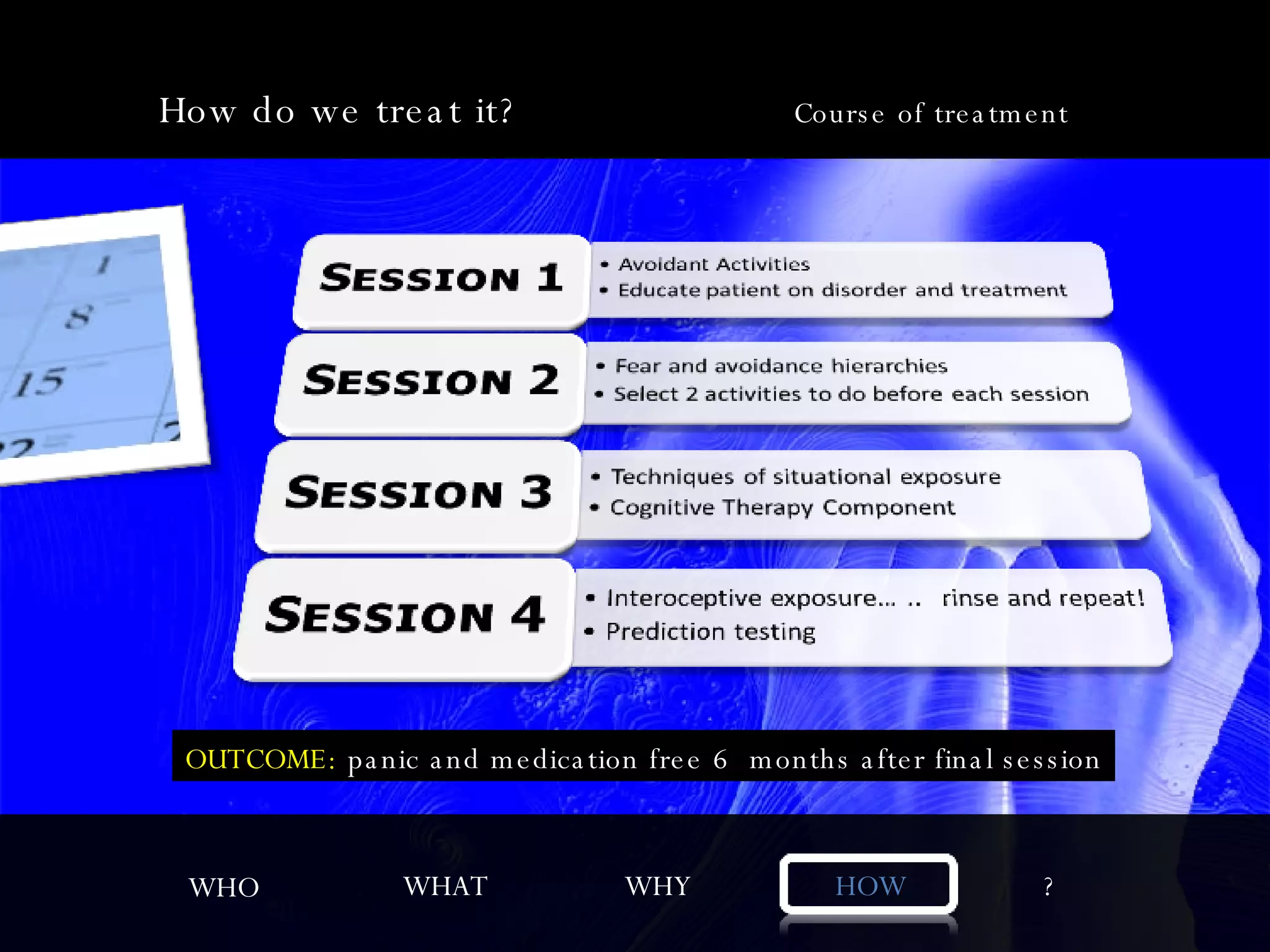
WHO WHAT WHY HOW ? How do we treat it?  Course of treatment OUTCOME:  panic and medication free 6  months after final session
Why might women outnumber men? Why do men turn to substance abuse, and women to avoidance? How might a psychoanalytical paradigm explain not perceiving to have a sense of control? Medication? Why is remaining in feared situations important for in vivo exposure? Public awareness of this disorder? How would you respond? Advantages and disadvantages of having spouse/friend? WHO WHAT WHY HOW ? Discussion
Works Cited Brown, Timothy.  Casebook in abnormal psychology . Thomson  Higher Education, Belmont CA, 2007: 18-35. Kring, Ann.  Abnormal Psychology .  John Wiley and Sons,  United States, 20077: 121-155. Panic Disorder and Agoraphobia.  http://en.wikipedia.org/wiki/Agoraphobia WHO WHAT WHY HOW ?

Panic Disorder with Agoraphobia

  • 1.
    Panic Disorder withAgoraphobia a case presentation vanessa villamia sochat abnormal psychology July 11, 2008
  • 2.
    Panic Disorder withAgoraphobia An Introduction
  • 3.
    WHO isour client? WHAT are his symptoms and diagnosis? WHY did he develop this disorder? HOW do we treat it? Outline
  • 4.
    WHO WHAT WHYHOW ? Who is our client? John Donahue DEMOGRAPHICS Forty five years ago High school principal Father of three CLINICAL HISTORY First attack 15 years ago Alcoholism Anxiety Clinic What does John think of his attacks?
  • 5.
    WHO WHAT WHYHOW ? An example of John’s typical panic attack
  • 6.
    WHO WHAT WHYHOW ? Symptoms of panic attack Intense apprehension and terror Impending doom Labored breathing Heart palpitations Nausea, chest pain Choking and smothering Dizziness Sweating Trembling Depersonalization Derealization Fears of losing control, going crazy Panic Disorder with Agoraphobia “ Anxiety about situations which would be embarrassing or difficult to escape if panic symptoms occurred” What are his symptoms  Diagnosis? Symptoms of panic attack Intense apprehension and terror Impending doom Labored breathing Heart palpitations Nausea, chest pain Choking and smothering Dizziness Sweating Trembling Depersonalization Derealization Fears of losing control , going crazy Do John’s symptoms fit the disorder? recurrent unexpected panic attacks at least 1 of attacks followed by month of concern about having another attack concern about consequences of attack change in behavior because of attacks
  • 7.
    Axis I: 300.21 Panic disorder with agoraphobia Axis II: No diagnosis on axis II Axis III: None Axis IV: Relocation to new state, job change, stressful work schedule Axis V: Global assessment of functioning = 58 WHO WHAT WHY HOW ? What is John’s official DSM-IV-TR diagnosis? DMS-IV-TR Diagnosis Based on: Anxiety about situations/events Avoidance of these situations/events Anxiety not better accounted for by another disorder!
  • 8.
    WHO WHAT WHYHOW ? Integrative Model of Causes and Maintenance of Panic Disorder Genetic factors Social Factors Physiological Factors Cognition (personality) Life Events Why did he develop this disorder? Etiology of Panic Disorder with Agoraphobia “ Fear of Fear” Hypothesis
  • 9.
    Genetic vulnerability toalarm reaction Psychological problems on mother's side: * mother alcoholic, panic disorder with agoraphobia anxious woman constantly concerned with her and her children's physiological symptoms, worried a lot * maternal grandfather and two aunts abused alcohol * maternal grandmother and another aunt - panic disorder * sister and younger brother , nothing WHO WHAT WHY HOW ? Why did he develop this disorder? Genetic factors
  • 10.
    Stressful environment triggersvulnerability Interoceptive conditioning (learned alarms) WHO WHAT WHY HOW ? Why did he develop this disorder? s ocial/environment factors Behavioral Factors Physiological/biological Factors
  • 11.
    WHO WHAT WHYHOW ? Why did he develop this disorder? cognition Safety behaviors and safety signals 24 access to anti anxiety medication driving to side of road holding onto stationary objects remaining near walls Safety behaviors serve to maintain beliefs about the consequences of panic Lack of control over environment More attentive to signs of threat
  • 12.
    WHO WHAT WHYHOW ? Negative life event Anxiety Somatic symptoms First panic attack Fear symptoms Panic disorder Psychological and biological vulnerability Belief that symptoms dangerous Why did he develop this disorder? The big picture GENETIC SOCIAL/ENVIRONMENTAL BEHAVIORAL COGNITIVE
  • 13.
    Summary of maintainingfactors panic disorder panic attack symptoms     agoraphobic situations     cognitions associated with panic attacks     anticipatory anxiety     safety behaviors and signals WHO WHAT WHY HOW ? Why does he still have it?
  • 14.
    Exposure treatment Cognitivebehavioral treatment Panic Control Treatment (PCT) Situational exposure (with relaxation technique) WHO WHAT WHY HOW ? How do we treat it? In vivo exposure Situational (in vivo) exposure 1) making list of situations that are avoided 2) arranging the list in a hierarchical fashion from least to most avoided 3) beginning with least difficult situations
  • 15.
    WHO WHAT WHYHOW ? How do we treat it? Course of treatment OUTCOME: panic and medication free 6 months after final session
  • 16.
    Why might womenoutnumber men? Why do men turn to substance abuse, and women to avoidance? How might a psychoanalytical paradigm explain not perceiving to have a sense of control? Medication? Why is remaining in feared situations important for in vivo exposure? Public awareness of this disorder? How would you respond? Advantages and disadvantages of having spouse/friend? WHO WHAT WHY HOW ? Discussion
  • 17.
    Works Cited Brown,Timothy. Casebook in abnormal psychology . Thomson Higher Education, Belmont CA, 2007: 18-35. Kring, Ann. Abnormal Psychology . John Wiley and Sons, United States, 20077: 121-155. Panic Disorder and Agoraphobia. http://en.wikipedia.org/wiki/Agoraphobia WHO WHAT WHY HOW ?