PRESENTED BY
ANJANI.S.KAMAL
1ST YEAR MSC (N)
The fact or process of losing something
or someone.
-oxford dictionary
Unrecoverable and usually unanticipated
and non- recurring removal of, or
decrease in, an asset or resource.
Grief is an emotional response to
a loss.
Grief is a deep emotional and
mental anguish that is a response
to the subjective experience of
loss of something significant.
Mourning is the psychological
process through which the
individual passes on to successful
adaptation to the loss of a valued
object.
Bereavement includes grief and
mourning-the inner feeling and
outward reactions of survivor
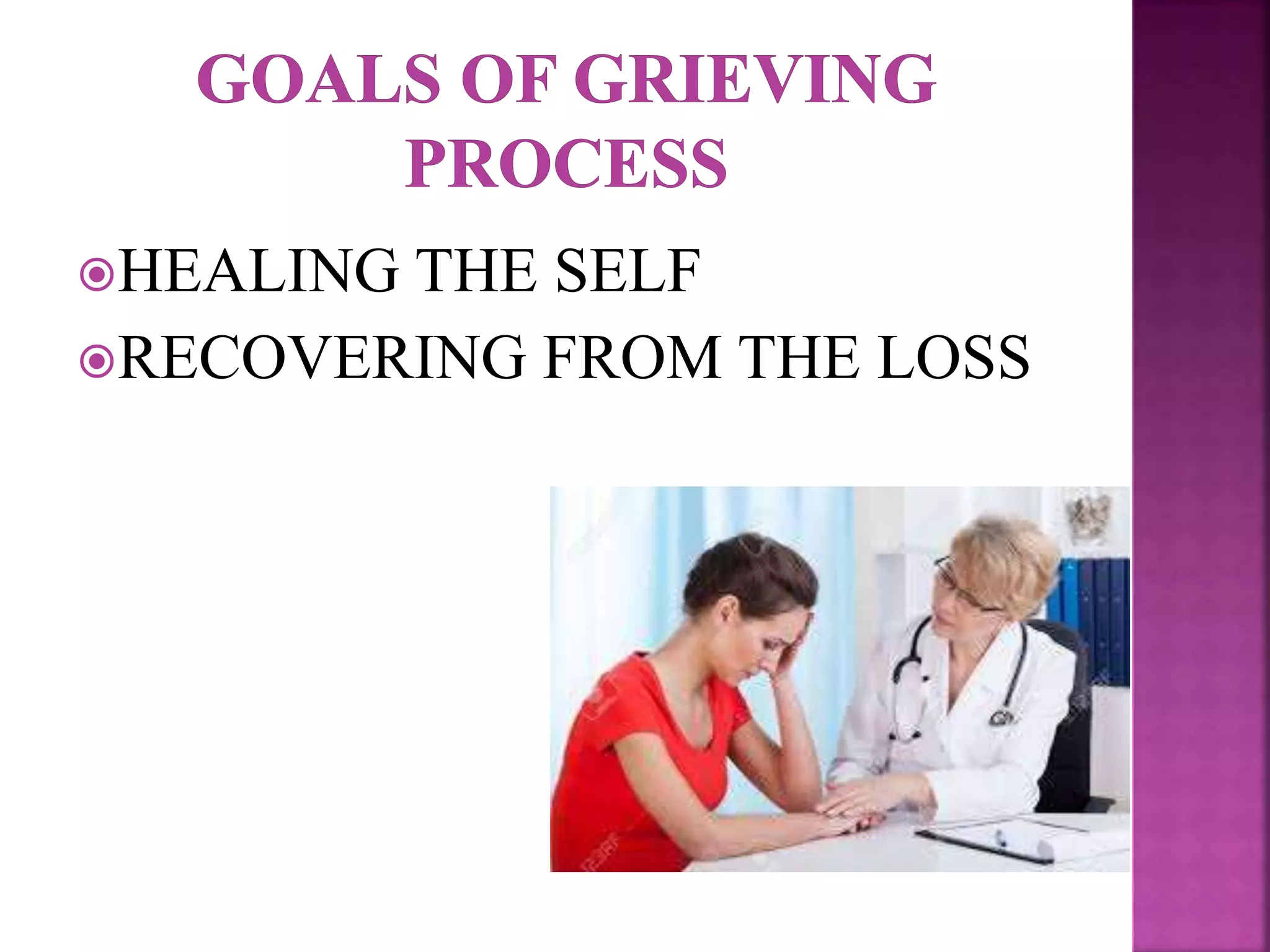
HEALING THE SELF
RECOVERING FROM THE LOSS
The sadness of losing someone you
love never goes away completely, but
it shouldn’t remain center stage.
If the pain of the loss is so constant
and severe that it keeps you from
resuming your life, you may be
suffering from a condition known
as complicated grief .
.
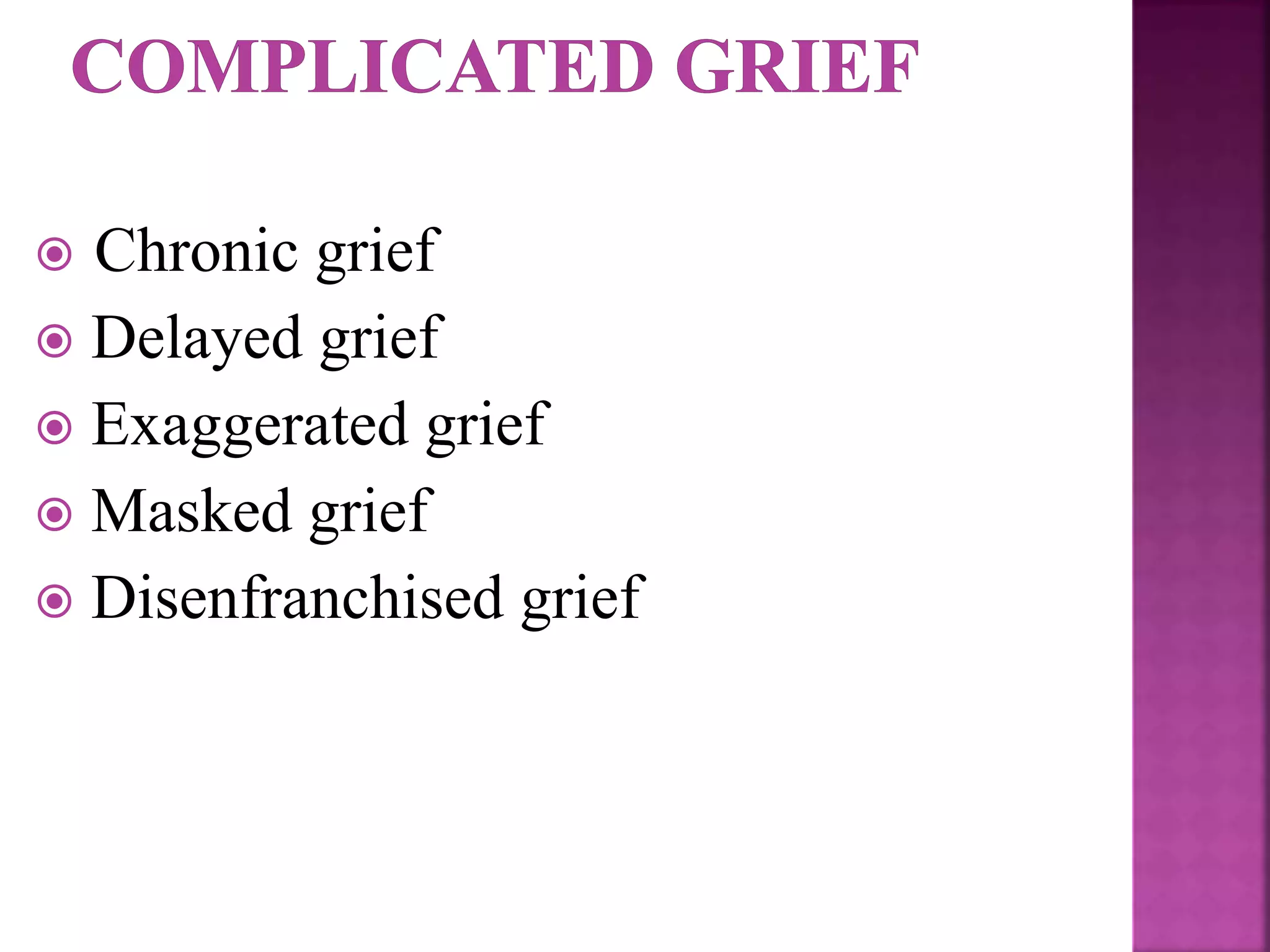
 Chronic grief
 Delayed grief
 Exaggerated grief
 Masked grief
 Disenfranchised grief
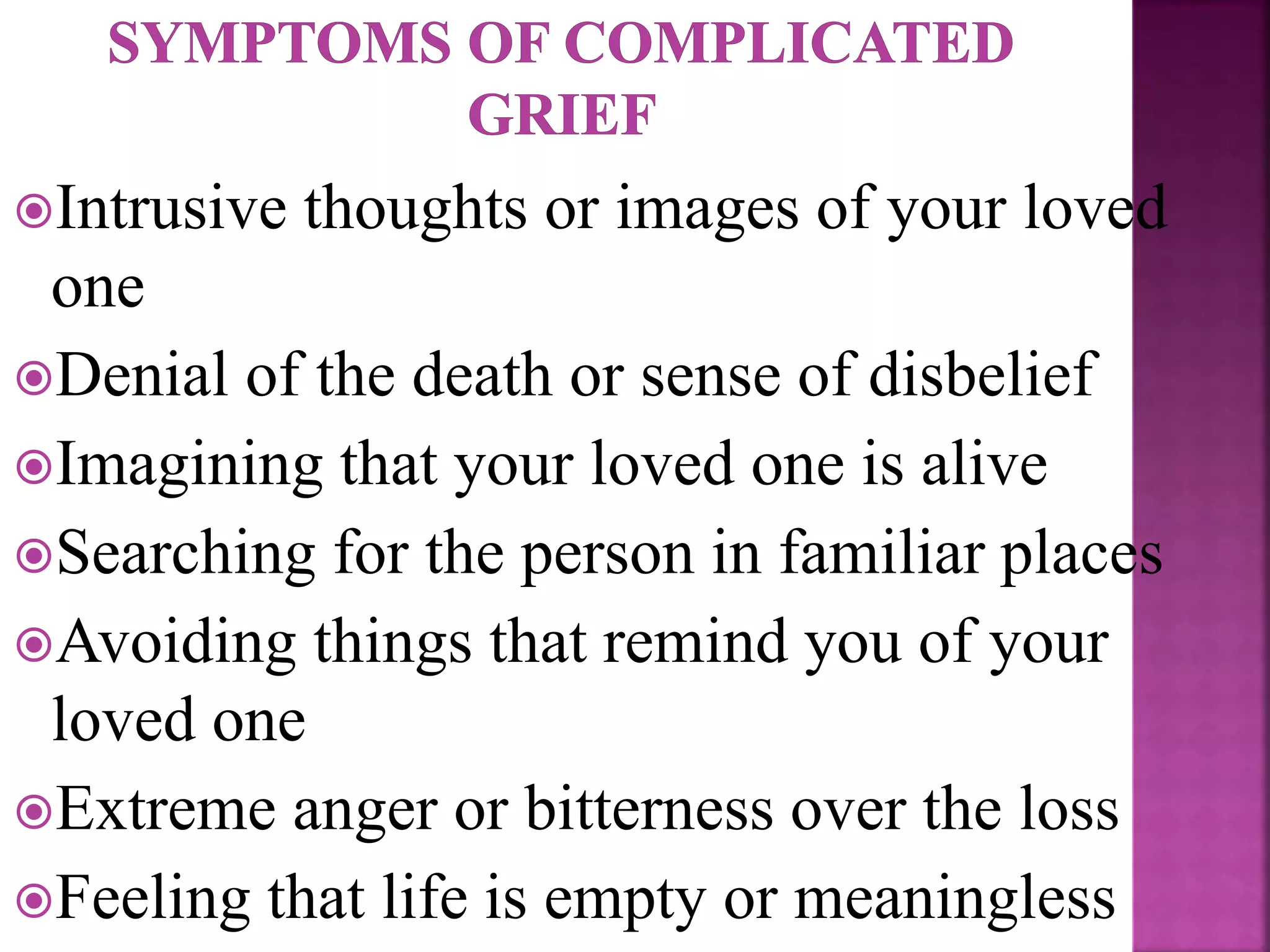
Intrusive thoughts or images of your loved
one
Denial of the death or sense of disbelief
Imagining that your loved one is alive
Searching for the person in familiar places
Avoiding things that remind you of your
loved one
Extreme anger or bitterness over the loss
Feeling that life is empty or meaningless
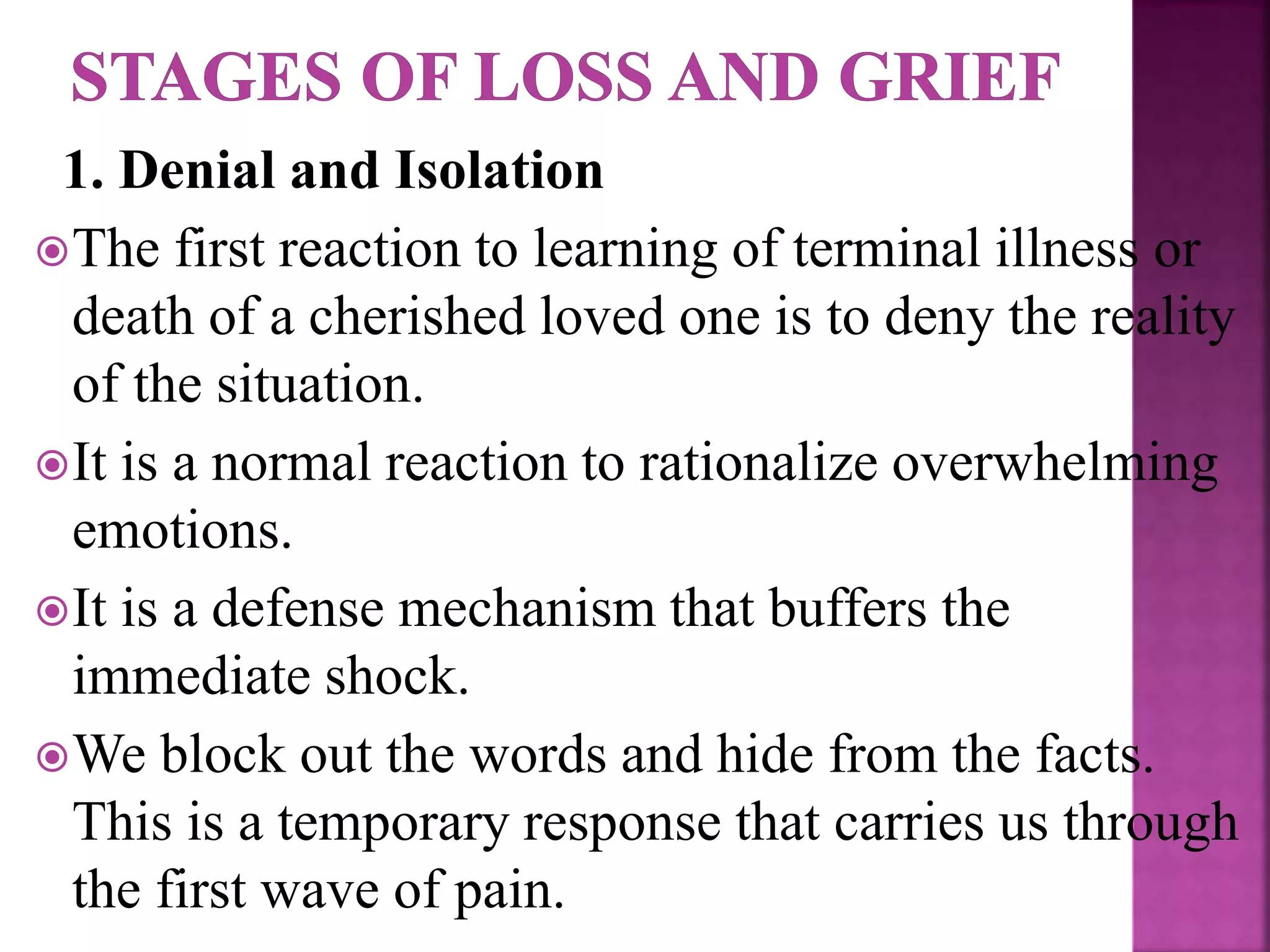
1. Denial and Isolation
The first reaction to learning of terminal illness or
death of a cherished loved one is to deny the reality
of the situation.
It is a normal reaction to rationalize overwhelming
emotions.
It is a defense mechanism that buffers the
immediate shock.
We block out the words and hide from the facts.
This is a temporary response that carries us through
the first wave of pain.
2. Anger
 As the masking effects of denial and isolation
begin to wear, reality and its pain re-emerge. We are
not ready.
 The intense emotion is deflected from our
vulnerable core, redirected and expressed instead as
anger.
 The anger may be aimed at inanimate objects,
complete strangers, friends or family.
Anger may be directed at our dying or deceased
loved one. Rationally, we know the person is not to
be blamed.
3. Bargaining
The normal reaction to feelings of helplessness and
vulnerability is often a need to regain control.
If only we had sought medical attention sooner
If only we got a second opinion from another
doctor.
If only we had tried to be a better person toward
them.
Secretly, we may make a deal with God or our
higher power in an attempt to postpone the
inevitable. This is a weaker line of defense to
protect us from the painful reality.
4. Depression
Two types of depression are associated with
mourning.
The first one is a reaction to practical implications
relating to the loss. Sadness and regret predominate
this type of depression.
This phase may be eased by simple clarification and
reassurance. We may need a bit of helpful
cooperation and a few kind words.
The second type of depression is more subtle and,
in a sense, perhaps more private. It is our quiet
preparation to separate and to bid our loved one
farewell.
5. Acceptance
Reaching this stage of mourning is a gift
not afforded to everyone.
Death may be sudden and unexpected or
we may never see beyond our anger or
denial. It is not necessarily a mark of
bravery to resist the inevitable and to deny
ourselves the opportunity to make our
peace.
This phase is marked by withdrawal and
calm. This is not a period of happiness and
must be distinguished from depression.
Shock and disbelief
Sadness
Guilt
Anger
Fear
Physical symptoms
(1) Acceptance of the loss,
(2) Acknowledgment of the intensity
of the pain,
(3) Adaptation to life after the loss,
and
(4) Cultivation of new relationships
and activities
.
Coping with death, one's own or a loved
one's, is considered the ultimate challenge.
The idea of death is threatening and anxiety
provoking to many people.
Kubler-Ross stated, 'The key to the question
of death unlocks the door of life. For those
who seek to understand it, death is a highly
creative force.“
Common fears of dying people are fear of
the unknown, pain, suffering, loneliness,
loss of the body, and loss of personal
control.
The first is referred to as peaks and valleys or
periods of hope and periods of depression.
The second pattern is one described as distinct
but descending plateaus.
The third pattern is a clear downward slope
with many physiologic parameters indicating
that death is imminent.
The last pattern is a downward slant that
reveals a crisis event, such as a severe cerebral
hemorrhage with almost no hope of recovery.
 Nursing care involves providing comfort
,maintaining safety ,addressing physical and
emotional needs ,and teaching coping strategies
to terminally ill patients and their families .
More than ever ,the nurse must explain what is
happening to the patient and the family and be a
confident who listens to them talk about dying.
Hospice care , attention to family and individual
psychosocial issues ,and symptom and pain
management are all part of the nurse's
responsibilities.
The nurse must also be concerned with ethical
considerations and quality-of-life issues that
affect dying people.
Of utmost importance to the patient is
assistance with the transition from living to
dying, maintaining and sustaining
relationships, finishing well with the family,
and accomplishing what needs to be said and
done.
In the hospital, in long-term care facilities, and
in home settings, the nurse explores choices
and end-of-life decisions with the patient and
family.
Referrals to home care and hospice services,
as well as specific referrals appropriate for the
management of the situation, are initiated.
The nurse is also an advocate for the dying
person and works to uphold that person's
rights. The use of living wills and advance
directives allows the patient to exercise the
right to have a"good death or to die with
dignity.
The nurse assesses spiritual strength by inquiring
about the person's sense of spiritual well-being, hope,
and peace.
The nurse assesses current and past participation in
religious or spiritual practices and notes the patient's
response to questions about spiritual needs.
Another simple assessment technique is to inquire
about the patient's and family's desire for spiritual
support.
For nurses to provide spiritual care, they must be open
to be present and supportive when patients experience
doubt, fear, suffering, despair, or other difficult
psychological states of being.
Interventions that foster spiritual growth or
reconciliation include being fully present; listening
actively; conveying a sense of caring, respect, and
acceptance; using therapeutic communication
techniques to encourage expression; suggesting the
use of prayer, meditation, or imagery; and facilitating
contact with spiritual leaders or performance of
spiritual rituals.
Nurses can alleviate distress and suffering and
enhance wellness by meeting their patients' spiritual
needs.
 Potter and Perry (2005) “Fundamentals of nursing”
published by most by an imprint of Elsevier, 6th edition.
New Delhi. Page no 1068 – 1071
 Shabeer.p.Basheer,” A concise text book of advanced
nursing practice”, EMMESS medical publications,1st
edition , page no:638-643
 Sreevani R A Guide to mental health and psychiatric
nursing jaypee medical publishers (p) ltd third edition
page no 46-51
 Mary c Townsend mental health nursing concepts of care
in evidenced based practice jaypee publications fifth
edition page no 24-27
 Gail W Stuart principles and practice of psychiatric
nursing mosby publications 9th edition page no 33,35-38

Loss and Grief

  • 1.
  • 2.
    The fact orprocess of losing something or someone. -oxford dictionary Unrecoverable and usually unanticipated and non- recurring removal of, or decrease in, an asset or resource.
  • 3.
    Grief is anemotional response to a loss. Grief is a deep emotional and mental anguish that is a response to the subjective experience of loss of something significant.
  • 4.
    Mourning is thepsychological process through which the individual passes on to successful adaptation to the loss of a valued object. Bereavement includes grief and mourning-the inner feeling and outward reactions of survivor
  • 5.
  • 6.
    The sadness oflosing someone you love never goes away completely, but it shouldn’t remain center stage. If the pain of the loss is so constant and severe that it keeps you from resuming your life, you may be suffering from a condition known as complicated grief . .
  • 7.
     Chronic grief Delayed grief  Exaggerated grief  Masked grief  Disenfranchised grief
  • 8.
    Intrusive thoughts orimages of your loved one Denial of the death or sense of disbelief Imagining that your loved one is alive Searching for the person in familiar places Avoiding things that remind you of your loved one Extreme anger or bitterness over the loss Feeling that life is empty or meaningless
  • 9.
    1. Denial andIsolation The first reaction to learning of terminal illness or death of a cherished loved one is to deny the reality of the situation. It is a normal reaction to rationalize overwhelming emotions. It is a defense mechanism that buffers the immediate shock. We block out the words and hide from the facts. This is a temporary response that carries us through the first wave of pain.
  • 10.
    2. Anger  Asthe masking effects of denial and isolation begin to wear, reality and its pain re-emerge. We are not ready.  The intense emotion is deflected from our vulnerable core, redirected and expressed instead as anger.  The anger may be aimed at inanimate objects, complete strangers, friends or family. Anger may be directed at our dying or deceased loved one. Rationally, we know the person is not to be blamed.
  • 11.
    3. Bargaining The normalreaction to feelings of helplessness and vulnerability is often a need to regain control. If only we had sought medical attention sooner If only we got a second opinion from another doctor. If only we had tried to be a better person toward them. Secretly, we may make a deal with God or our higher power in an attempt to postpone the inevitable. This is a weaker line of defense to protect us from the painful reality.
  • 12.
    4. Depression Two typesof depression are associated with mourning. The first one is a reaction to practical implications relating to the loss. Sadness and regret predominate this type of depression. This phase may be eased by simple clarification and reassurance. We may need a bit of helpful cooperation and a few kind words. The second type of depression is more subtle and, in a sense, perhaps more private. It is our quiet preparation to separate and to bid our loved one farewell.
  • 13.
    5. Acceptance Reaching thisstage of mourning is a gift not afforded to everyone. Death may be sudden and unexpected or we may never see beyond our anger or denial. It is not necessarily a mark of bravery to resist the inevitable and to deny ourselves the opportunity to make our peace. This phase is marked by withdrawal and calm. This is not a period of happiness and must be distinguished from depression.
  • 14.
  • 15.
    (1) Acceptance ofthe loss, (2) Acknowledgment of the intensity of the pain, (3) Adaptation to life after the loss, and (4) Cultivation of new relationships and activities .
  • 16.
    Coping with death,one's own or a loved one's, is considered the ultimate challenge. The idea of death is threatening and anxiety provoking to many people. Kubler-Ross stated, 'The key to the question of death unlocks the door of life. For those who seek to understand it, death is a highly creative force.“ Common fears of dying people are fear of the unknown, pain, suffering, loneliness, loss of the body, and loss of personal control.
  • 17.
    The first isreferred to as peaks and valleys or periods of hope and periods of depression. The second pattern is one described as distinct but descending plateaus. The third pattern is a clear downward slope with many physiologic parameters indicating that death is imminent. The last pattern is a downward slant that reveals a crisis event, such as a severe cerebral hemorrhage with almost no hope of recovery.
  • 18.
     Nursing careinvolves providing comfort ,maintaining safety ,addressing physical and emotional needs ,and teaching coping strategies to terminally ill patients and their families . More than ever ,the nurse must explain what is happening to the patient and the family and be a confident who listens to them talk about dying. Hospice care , attention to family and individual psychosocial issues ,and symptom and pain management are all part of the nurse's responsibilities.
  • 19.
    The nurse mustalso be concerned with ethical considerations and quality-of-life issues that affect dying people. Of utmost importance to the patient is assistance with the transition from living to dying, maintaining and sustaining relationships, finishing well with the family, and accomplishing what needs to be said and done. In the hospital, in long-term care facilities, and in home settings, the nurse explores choices and end-of-life decisions with the patient and family.
  • 20.
    Referrals to homecare and hospice services, as well as specific referrals appropriate for the management of the situation, are initiated. The nurse is also an advocate for the dying person and works to uphold that person's rights. The use of living wills and advance directives allows the patient to exercise the right to have a"good death or to die with dignity.
  • 21.
    The nurse assessesspiritual strength by inquiring about the person's sense of spiritual well-being, hope, and peace. The nurse assesses current and past participation in religious or spiritual practices and notes the patient's response to questions about spiritual needs. Another simple assessment technique is to inquire about the patient's and family's desire for spiritual support. For nurses to provide spiritual care, they must be open to be present and supportive when patients experience doubt, fear, suffering, despair, or other difficult psychological states of being.
  • 22.
    Interventions that fosterspiritual growth or reconciliation include being fully present; listening actively; conveying a sense of caring, respect, and acceptance; using therapeutic communication techniques to encourage expression; suggesting the use of prayer, meditation, or imagery; and facilitating contact with spiritual leaders or performance of spiritual rituals. Nurses can alleviate distress and suffering and enhance wellness by meeting their patients' spiritual needs.
  • 23.
     Potter andPerry (2005) “Fundamentals of nursing” published by most by an imprint of Elsevier, 6th edition. New Delhi. Page no 1068 – 1071  Shabeer.p.Basheer,” A concise text book of advanced nursing practice”, EMMESS medical publications,1st edition , page no:638-643  Sreevani R A Guide to mental health and psychiatric nursing jaypee medical publishers (p) ltd third edition page no 46-51  Mary c Townsend mental health nursing concepts of care in evidenced based practice jaypee publications fifth edition page no 24-27  Gail W Stuart principles and practice of psychiatric nursing mosby publications 9th edition page no 33,35-38