PANIC DISORDERS
DR. MOHAMMED FEROS
2ND YEAR POST GRADUATE
GENERAL MEDICINE
Neurotic , Stress related &
Somatoform disorders
1. Phobic anxiety disorder
2. Other anxiety disorder
3. Obsessive compulsive disorder
Phobic disorder
• “ Irrational fear of a specific object, situation or activity,
often leading to persistent avoidance of the feared object,
situation or activity.”
1. Agoraphobia
2. Social phobia
3. Specific (Simple) phobia
ANXIETY
• “ A diffuse unpleasant vague sense of apprehension often
accompanied by autonomic symptoms usually caused by
anticipation of danger”
• Anxiety is a response to a threat that is unknown,
internal, vague or conflictual.
• Fear is response to a known, external , definite or non
conflictual threat.
• Cognitive behavioural view: anxiety is a conditioned
response.
1. Trait anxiety
2. State anxiety
• Trait: Habitual tendency to be anxious in general and is
exemplified by “ I often feel anxious”
• State: Anxiety felt at present, and is exemplified by “ I
feel anxious now”
• Persons with trait anxiety often have episodes of state
anxiety.
Aetiology
1. Psychodynamic theory
2. Behavioural Theory
3. Cognitive behavioural theory
4. Biological theory
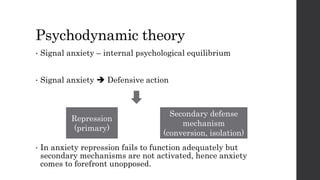
Psychodynamic theory
• Signal anxiety – internal psychological equilibrium
• Signal anxiety  Defensive action
• In anxiety repression fails to function adequately but
secondary mechanisms are not activated, hence anxiety
comes to forefront unopposed.
Repression
(primary)
Secondary defense
mechanism
(conversion, isolation)
• Developmentally primitive anxiety is manifested as
somatic symptomatology while developmentally advanced
anxiety is signal anxiety.
• According to this theory panic anxiety – closely related to
separation anxiety of childhood
Behavioural theory
• According to this theory : Anxiety – unconditioned
inherent response of the organism to painful or
dangerous stimuli.
Cognitive behavioural theory(CBT)
• According to CBT:
• In anxiety disorders there is evidence of selective
information processing (with more attention paid to
threat related information )
• Cognitive distortions
• Negative automatic thoughts
• Perception of decreased control over both internal and
external stimuli.
Biological theory
• Genetic evidence: 15- 20% 1st degree relative.
• Concordance rate in monozygotic twins of patients with
panic disorders is as high as 80%.
• Chemically induced anxiety states:
• Infusion of chemicals( Na lactate, isoproterenol, caffeine)
• Inhalation of 5% CO2 can produce panic episodes in
predisposed individuals.
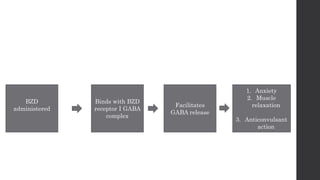
• GABA- BZD receptors:
• 2 types: Type I – GABA and chloride independent
• Type II - GABA and chloride dependent
• BZD facilitates GABA transmission causing generalised
effect on CNS – relieves anxiety
• BZD antagonist(flumazenil) and inverse agonist (beta
carbolines) cause anxiety – supports this hypothesis
BZD
administered
Binds with BZD
receptor I GABA
complex
Facilitates
GABA release
1. Anxiety
2. Muscle
relaxation
3. Anticonvulsant
action
• Organic anxiety disorder:
• Presence of anxiety secondary to various medical
disorders – hyperthyroidism, pheochromocytoma, CAD
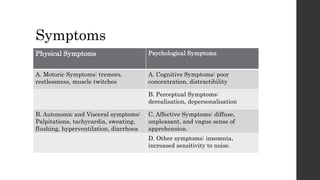
Symptoms
Physical Symptoms Psychological Symptoms
A. Motoric Symptoms: tremors,
restlessness, muscle twitches
A. Cognitive Symptoms: poor
concentration, distractibility
B. Perceptual Symptoms:
derealisation, depersonalisation
B. Autonomic and Visceral symptoms:
Palpitations, tachycardia, sweating,
flushing, hyperventilation, diarrhoea
C. Affective Symptoms: diffuse,
unpleasant, and vague sense of
apprehension.
D. Other symptoms: insomnia,
increased sensitivity to noise.
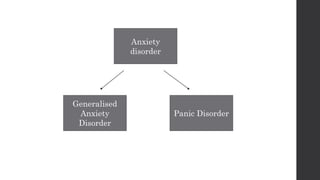
Generalised
Anxiety
Disorder
Panic Disorder
Anxiety
disorder
Panic disorder
• “ Presence of recurrent and unpredictable panic attacks,
which are distinct episodes of intense fear and discomfort
associated with variety of physical symptoms including
• Palpitations or rapid heart rate,
• Breathlessness
• Feeling unsteady, dizzy, light-headed or faint
• Trembling or shaking
• Sweating
•Having a hot flush or chills
• Chest pain or discomfort
• Numbness or tingling sensations
• Feeling as if you or surroundings are unreal
• Nausea or burning stomach
• Choking
• Fear of dying
• Fear of losing control or going crazy
• At least 4 panic attacks over 4 weeks for diagnosis.
• Onset usually in early third decade with often c/c course
• Sudden onset developing within 10 min, resolving within
1 hour.
• Frequency and severity of panic attacks vary ranging
from once a week to clusters separated by months of well-
being.
• D/D: Cardio respiratory disorders, Pheochromocytoma,
Hypoglycemia.
• Life time prevalence: 1.5-2% with 3-4% sub syndromal
panic symptoms
• Panic disorders and Agoraphobia often co exist
Agoraphobia
• Marked and consistently manifest fear of crowds, public
places, travelling alone, travelling away from home
• Avoidance of these phobic situation is important
symptom.
• Symptoms of anxiety in the feared situation including
autonomic arousal, difficulty in breathing, choking,
abdominal discomfort, dizziness, fear of losing
control/dying.
Treatment
• Non pharmacological management
1. Cognitive therapy
2. Relaxation training, biofeedback
3. Respiratory training, breathing exercises
4. Exposure therapy
• Pharmacological management
1. SSRI
2. BZD
3. SNRI
• SSRI benefit majority of panic disorders and do not have
adverse effects of TCA.
• Drugs should be started 1/3 rd of their usual
antidepressant dose.
• MAOIs effective in patients with atypical depression –
(hypersomnia and weight gain)
• Because of anticipatory anxiety and need for immediate
relief of panic symptoms BZD are useful early in course of
treatment.
Thank you

Panic disorders

  • 1.
    PANIC DISORDERS DR. MOHAMMEDFEROS 2ND YEAR POST GRADUATE GENERAL MEDICINE
  • 2.
    Neurotic , Stressrelated & Somatoform disorders 1. Phobic anxiety disorder 2. Other anxiety disorder 3. Obsessive compulsive disorder
  • 3.
    Phobic disorder • “Irrational fear of a specific object, situation or activity, often leading to persistent avoidance of the feared object, situation or activity.” 1. Agoraphobia 2. Social phobia 3. Specific (Simple) phobia
  • 4.
    ANXIETY • “ Adiffuse unpleasant vague sense of apprehension often accompanied by autonomic symptoms usually caused by anticipation of danger” • Anxiety is a response to a threat that is unknown, internal, vague or conflictual. • Fear is response to a known, external , definite or non conflictual threat. • Cognitive behavioural view: anxiety is a conditioned response.
  • 5.
    1. Trait anxiety 2.State anxiety • Trait: Habitual tendency to be anxious in general and is exemplified by “ I often feel anxious” • State: Anxiety felt at present, and is exemplified by “ I feel anxious now” • Persons with trait anxiety often have episodes of state anxiety.
  • 6.
    Aetiology 1. Psychodynamic theory 2.Behavioural Theory 3. Cognitive behavioural theory 4. Biological theory
  • 7.
    Psychodynamic theory • Signalanxiety – internal psychological equilibrium • Signal anxiety  Defensive action • In anxiety repression fails to function adequately but secondary mechanisms are not activated, hence anxiety comes to forefront unopposed. Repression (primary) Secondary defense mechanism (conversion, isolation)
  • 8.
    • Developmentally primitiveanxiety is manifested as somatic symptomatology while developmentally advanced anxiety is signal anxiety. • According to this theory panic anxiety – closely related to separation anxiety of childhood
  • 9.
    Behavioural theory • Accordingto this theory : Anxiety – unconditioned inherent response of the organism to painful or dangerous stimuli.
  • 10.
    Cognitive behavioural theory(CBT) •According to CBT: • In anxiety disorders there is evidence of selective information processing (with more attention paid to threat related information ) • Cognitive distortions • Negative automatic thoughts • Perception of decreased control over both internal and external stimuli.
  • 11.
    Biological theory • Geneticevidence: 15- 20% 1st degree relative. • Concordance rate in monozygotic twins of patients with panic disorders is as high as 80%. • Chemically induced anxiety states: • Infusion of chemicals( Na lactate, isoproterenol, caffeine) • Inhalation of 5% CO2 can produce panic episodes in predisposed individuals.
  • 12.
    • GABA- BZDreceptors: • 2 types: Type I – GABA and chloride independent • Type II - GABA and chloride dependent • BZD facilitates GABA transmission causing generalised effect on CNS – relieves anxiety • BZD antagonist(flumazenil) and inverse agonist (beta carbolines) cause anxiety – supports this hypothesis
  • 13.
    BZD administered Binds with BZD receptorI GABA complex Facilitates GABA release 1. Anxiety 2. Muscle relaxation 3. Anticonvulsant action
  • 14.
    • Organic anxietydisorder: • Presence of anxiety secondary to various medical disorders – hyperthyroidism, pheochromocytoma, CAD
  • 15.
    Symptoms Physical Symptoms PsychologicalSymptoms A. Motoric Symptoms: tremors, restlessness, muscle twitches A. Cognitive Symptoms: poor concentration, distractibility B. Perceptual Symptoms: derealisation, depersonalisation B. Autonomic and Visceral symptoms: Palpitations, tachycardia, sweating, flushing, hyperventilation, diarrhoea C. Affective Symptoms: diffuse, unpleasant, and vague sense of apprehension. D. Other symptoms: insomnia, increased sensitivity to noise.
  • 16.
  • 17.
    Panic disorder • “Presence of recurrent and unpredictable panic attacks, which are distinct episodes of intense fear and discomfort associated with variety of physical symptoms including • Palpitations or rapid heart rate, • Breathlessness • Feeling unsteady, dizzy, light-headed or faint • Trembling or shaking • Sweating
  • 18.
    •Having a hotflush or chills • Chest pain or discomfort • Numbness or tingling sensations • Feeling as if you or surroundings are unreal • Nausea or burning stomach • Choking • Fear of dying • Fear of losing control or going crazy • At least 4 panic attacks over 4 weeks for diagnosis.
  • 19.
    • Onset usuallyin early third decade with often c/c course • Sudden onset developing within 10 min, resolving within 1 hour. • Frequency and severity of panic attacks vary ranging from once a week to clusters separated by months of well- being. • D/D: Cardio respiratory disorders, Pheochromocytoma, Hypoglycemia. • Life time prevalence: 1.5-2% with 3-4% sub syndromal panic symptoms • Panic disorders and Agoraphobia often co exist
  • 20.
    Agoraphobia • Marked andconsistently manifest fear of crowds, public places, travelling alone, travelling away from home • Avoidance of these phobic situation is important symptom. • Symptoms of anxiety in the feared situation including autonomic arousal, difficulty in breathing, choking, abdominal discomfort, dizziness, fear of losing control/dying.
  • 21.
    Treatment • Non pharmacologicalmanagement 1. Cognitive therapy 2. Relaxation training, biofeedback 3. Respiratory training, breathing exercises 4. Exposure therapy
  • 22.
  • 23.
    • SSRI benefitmajority of panic disorders and do not have adverse effects of TCA. • Drugs should be started 1/3 rd of their usual antidepressant dose. • MAOIs effective in patients with atypical depression – (hypersomnia and weight gain) • Because of anticipatory anxiety and need for immediate relief of panic symptoms BZD are useful early in course of treatment.
  • 24.