


By
MS NEHA BHATT
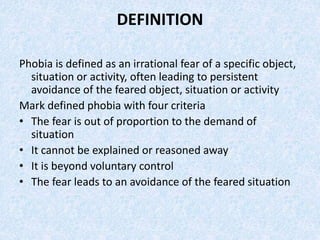
DEFINITION
Phobia is defined as an irrational fear of a specific object,
situation or activity, often leading to persistent
avoidance of the feared object, situation or activity
Mark defined phobia with four criteria
• The fear is out of proportion to the demand of
situation
• It cannot be explained or reasoned away
• It is beyond voluntary control
• The fear leads to an avoidance of the feared situation
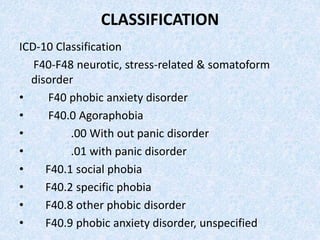
CLASSIFICATION
ICD-10 Classification
F40-F48 neurotic, stress-related & somatoform
disorder
• F40 phobic anxiety disorder
• F40.0 Agoraphobia
• .00 With out panic disorder
• .01 with panic disorder
• F40.1 social phobia
• F40.2 specific phobia
• F40.8 other phobic disorder
• F40.9 phobic anxiety disorder, unspecified
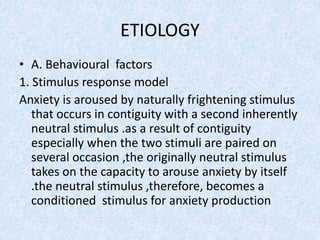
ETIOLOGY
• A. Behavioural factors
1. Stimulus response model
Anxiety is aroused by naturally frightening stimulus
that occurs in contiguity with a second inherently
neutral stimulus .as a result of contiguity
especially when the two stimuli are paired on
several occasion ,the originally neutral stimulus
takes on the capacity to arouse anxiety by itself
.the neutral stimulus ,therefore, becomes a
conditioned stimulus for anxiety production
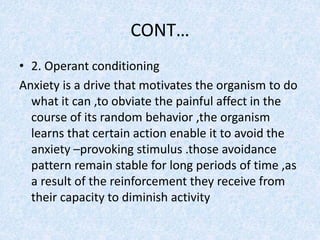
CONT…
• 2. Operant conditioning
Anxiety is a drive that motivates the organism to do
what it can ,to obviate the painful affect in the
course of its random behavior ,the organism
learns that certain action enable it to avoid the
anxiety –provoking stimulus .those avoidance
pattern remain stable for long periods of time ,as
a result of the reinforcement they receive from
their capacity to diminish activity
CONT…
• B. Psychoanalytic theories
The major function of anxiety is a signal to the
ego ,that a forbidden unconscious drive in
pushing for conscious expression thus altering
the ego to strengthen & marshal its defenses
against the threatening instinctual force
CLINICAL FEATURES
AGORAPHOBIA
• It is characterized by an irrational fear of being
in places away from the familiar setting of home,
in crowds or in situation that the patient cannot
leave easily
• As the agoraphobia increases in severity, there is
a gradual restriction in normal day to day
activities. The activity may become so severely
restricted that the person becomes self
imprisoned at home.
CONT…
Signs and Symptoms
• Overriding fear of open or public space
• Deep concern that help might not be available
in such places
• Avoidance of public places and confinement
to home
• When accompanied by panic disorder, fear
that having panic attack in public will lead to
embarrassment or inability to escape
CONT…
SIMPLE PHOBIA
• It is an irrational fear of a specific object or stimulus.
Simple phobias are common in childhood. By early
teenage most of these fears are lost, but a few
persist till adult life. Sometimes they may reappear
after a symptom free period.
CONT…
Signs and Symptoms
• Irrational and persistent fear of object or situation
• Immediate anxiety on contact with feared objects or
situation
• Loss of control, fainting or panic response
• Avoidance of activities involving feared stimulus
• Anxiety when thinking about stimulus
• Worry with anticipatory anxiety
• Possible impaired social or work functioning
SOCIAL PHOBIA
It is an irrational fear of performing activities in the presence of
other people or interacting with others. The patient is afraid of
his own actions being viewed by others critically insulting in
embarrassment or humiliation.
• Hyperventilation
• Sweating, Cold, clammy
hands
• Blushing
• Palpitations
• Gastrointestinal
symptoms
• Trembling hands and
voice
• Urinary urgency
• Muscle tension
• Anticipatory anxiety
• Fear or embarrassment
or ridicule
• Confusion
Signs and Symptoms
CONT…
DIAGNOSIS
• No specific diagnostic test, diagnosis
confirmed if ICD10 criteria met
• History of anxiety when exposed to or
anticipatory specific entity or situation
TREATMENT
PHARMACOTHERAPY
• Benzodiazepines (for example alprazolam,
clonazepam, lorazepam, diazepam )
• Antidepressants ( for example imipramine,
sertraline, phenelzine)
TREATMENT
BEHAVIOR THERAPY
• Desensitization therapy to gradually reintroduce
the feared situation while coaching the patient
on relaxation techniques (progressive muscle
relaxation, deep breathing exercises, listening to
calming music)
• Role playing in guided imagery to allow the
patient to rehearse ways to relax while
confronting a feared object or situation
• Assertiveness training to help the patient become
assertive in her interpersonal interactions.
CONT….
Modeling behavior:
• Patient observes someone modeling or
demonstrating appropriate behavior when
confronting with feared situation
CONT….
A cognitive behavioural technique called negative
thought stopping to reduce the frequency and
duration of disturbing thoughts by interrupting
them and substituting competing thoughts:
• Teaches patients to recognize negative thoughts
• Involves using an intense distracting stimulus to
stop the thought
• With practice, allows patient to control thoughts
without using distracting stimulus.
CONT…
PSYCHOTHERAPY
• Supportive psychotherapy is a helpful adjunct
to behavior therapy and drug treatment.
NURSING MANAGEMENT
• NURSING ASSESSMENT
History &MSE
Nursing Diagnosis
Fear related to specific stimulus or causing embarrassment to
self in front of others, evidenced by behavior directed
towards avoidance of the feared object / situation.
Nursing Interventions
• Reassure the patient that he is safe
• Explore patient’s perception of the threat to self concept
• Include patient in making decisions related to selection of
alternative coping strategies
• If the patient elects to work on eliminating the fear,
techniques of desensitization or implosion therapy may be
employed
• Encourage patients to explore underlying feelings that may
be contributing to irrational fears.
Nursing diagnosis
• Social isolation related to fear of being in a place from which
one is unable to escape, evidenced by staying alone, refusing
to leave home/room.
Nursing Interventions
• Convey an accepting attitude and unconditional positive
regard. Make brief, frequent contacts. Be honest
• Attend group activities with the patient that may be
frightening for him
• Administer anti-anxiety medications as ordered by physician,
monitor for effectiveness and adverse affects
• Discuss with the patient signs and symptoms of increasing
anxiety and techniques to interrupt the response.
• Give recognition and positive reinforcement for voluntary
interactions with others.
Phobia

Phobia

  • 1.
  • 2.
    DEFINITION Phobia is definedas an irrational fear of a specific object, situation or activity, often leading to persistent avoidance of the feared object, situation or activity Mark defined phobia with four criteria • The fear is out of proportion to the demand of situation • It cannot be explained or reasoned away • It is beyond voluntary control • The fear leads to an avoidance of the feared situation
  • 3.
    CLASSIFICATION ICD-10 Classification F40-F48 neurotic,stress-related & somatoform disorder • F40 phobic anxiety disorder • F40.0 Agoraphobia • .00 With out panic disorder • .01 with panic disorder • F40.1 social phobia • F40.2 specific phobia • F40.8 other phobic disorder • F40.9 phobic anxiety disorder, unspecified
  • 4.
    ETIOLOGY • A. Behaviouralfactors 1. Stimulus response model Anxiety is aroused by naturally frightening stimulus that occurs in contiguity with a second inherently neutral stimulus .as a result of contiguity especially when the two stimuli are paired on several occasion ,the originally neutral stimulus takes on the capacity to arouse anxiety by itself .the neutral stimulus ,therefore, becomes a conditioned stimulus for anxiety production
  • 5.
    CONT… • 2. Operantconditioning Anxiety is a drive that motivates the organism to do what it can ,to obviate the painful affect in the course of its random behavior ,the organism learns that certain action enable it to avoid the anxiety –provoking stimulus .those avoidance pattern remain stable for long periods of time ,as a result of the reinforcement they receive from their capacity to diminish activity
  • 6.
    CONT… • B. Psychoanalytictheories The major function of anxiety is a signal to the ego ,that a forbidden unconscious drive in pushing for conscious expression thus altering the ego to strengthen & marshal its defenses against the threatening instinctual force
  • 7.
    CLINICAL FEATURES AGORAPHOBIA • Itis characterized by an irrational fear of being in places away from the familiar setting of home, in crowds or in situation that the patient cannot leave easily • As the agoraphobia increases in severity, there is a gradual restriction in normal day to day activities. The activity may become so severely restricted that the person becomes self imprisoned at home.
  • 8.
    CONT… Signs and Symptoms •Overriding fear of open or public space • Deep concern that help might not be available in such places • Avoidance of public places and confinement to home • When accompanied by panic disorder, fear that having panic attack in public will lead to embarrassment or inability to escape
  • 9.
    CONT… SIMPLE PHOBIA • Itis an irrational fear of a specific object or stimulus. Simple phobias are common in childhood. By early teenage most of these fears are lost, but a few persist till adult life. Sometimes they may reappear after a symptom free period.
  • 10.
    CONT… Signs and Symptoms •Irrational and persistent fear of object or situation • Immediate anxiety on contact with feared objects or situation • Loss of control, fainting or panic response • Avoidance of activities involving feared stimulus • Anxiety when thinking about stimulus • Worry with anticipatory anxiety • Possible impaired social or work functioning
  • 11.
    SOCIAL PHOBIA It isan irrational fear of performing activities in the presence of other people or interacting with others. The patient is afraid of his own actions being viewed by others critically insulting in embarrassment or humiliation. • Hyperventilation • Sweating, Cold, clammy hands • Blushing • Palpitations • Gastrointestinal symptoms • Trembling hands and voice • Urinary urgency • Muscle tension • Anticipatory anxiety • Fear or embarrassment or ridicule • Confusion Signs and Symptoms
  • 12.
    CONT… DIAGNOSIS • No specificdiagnostic test, diagnosis confirmed if ICD10 criteria met • History of anxiety when exposed to or anticipatory specific entity or situation
  • 13.
    TREATMENT PHARMACOTHERAPY • Benzodiazepines (forexample alprazolam, clonazepam, lorazepam, diazepam ) • Antidepressants ( for example imipramine, sertraline, phenelzine)
  • 14.
    TREATMENT BEHAVIOR THERAPY • Desensitizationtherapy to gradually reintroduce the feared situation while coaching the patient on relaxation techniques (progressive muscle relaxation, deep breathing exercises, listening to calming music) • Role playing in guided imagery to allow the patient to rehearse ways to relax while confronting a feared object or situation • Assertiveness training to help the patient become assertive in her interpersonal interactions.
  • 15.
    CONT…. Modeling behavior: • Patientobserves someone modeling or demonstrating appropriate behavior when confronting with feared situation
  • 16.
    CONT…. A cognitive behaviouraltechnique called negative thought stopping to reduce the frequency and duration of disturbing thoughts by interrupting them and substituting competing thoughts: • Teaches patients to recognize negative thoughts • Involves using an intense distracting stimulus to stop the thought • With practice, allows patient to control thoughts without using distracting stimulus.
  • 17.
    CONT… PSYCHOTHERAPY • Supportive psychotherapyis a helpful adjunct to behavior therapy and drug treatment. NURSING MANAGEMENT • NURSING ASSESSMENT History &MSE
  • 18.
    Nursing Diagnosis Fear relatedto specific stimulus or causing embarrassment to self in front of others, evidenced by behavior directed towards avoidance of the feared object / situation. Nursing Interventions • Reassure the patient that he is safe • Explore patient’s perception of the threat to self concept • Include patient in making decisions related to selection of alternative coping strategies • If the patient elects to work on eliminating the fear, techniques of desensitization or implosion therapy may be employed • Encourage patients to explore underlying feelings that may be contributing to irrational fears.
  • 19.
    Nursing diagnosis • Socialisolation related to fear of being in a place from which one is unable to escape, evidenced by staying alone, refusing to leave home/room. Nursing Interventions • Convey an accepting attitude and unconditional positive regard. Make brief, frequent contacts. Be honest • Attend group activities with the patient that may be frightening for him • Administer anti-anxiety medications as ordered by physician, monitor for effectiveness and adverse affects • Discuss with the patient signs and symptoms of increasing anxiety and techniques to interrupt the response. • Give recognition and positive reinforcement for voluntary interactions with others.