
09.12.2014
Social Phobia
Or shyness in disguise
Fatma Tuba Aydın
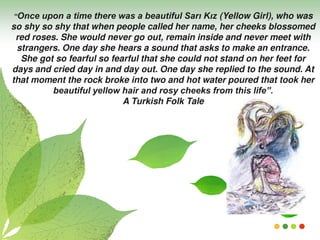
“Once upon a time there was a beautiful Sarı Kız (Yellow Girl), who was
so shy so shy that when people called her name, her cheeks blossomed
red roses. She would never go out, remain inside and never meet with
strangers. One day she hears a sound that asks to make an entrance.
She got so fearful so fearful that she could not stand on her feet for
days and cried day in and day out. One day she replied to the sound. At
that moment the rock broke into two and hot water poured that took her
beautiful yellow hair and rosy cheeks from this life”.
A Turkish Folk Tale
Shyness is associated with the virtue
construct.
 Society praises Yellow Girl to be shy but is it also
adoptive?
 Why to seek treatment if it is only a shyness?
DSM IV Social Phobia
“A severe, irrational fear and avoidance of social interactions and/or
situations that involve performance before others, evaluation by
others, and possible negative consequences such as embarrassment”
Introduction
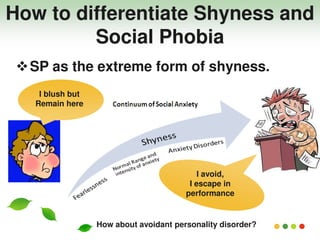
SP as the extreme form of shyness.
How to differentiate Shyness and
Social Phobia
I avoid,
I escape in
performance
I blush but
Remain here
How about avoidant personality disorder?
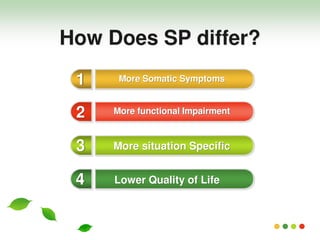
More situation Specific
How Does SP differ?
More Somatic Symptoms
More functional Impairment
1
2
3
4 Lower Quality of Life
Public Speech.
Performing before others.
Eating and drinking in public.
Using public bathroom.
Circumstances They Suffer
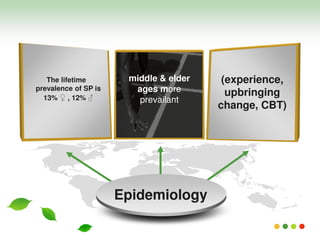
The lifetime
prevalence of SP is
13% ♀ , 12% ♂
(experience,
upbringing
change, CBT)
middle & elder
ages more
prevailant
Epidemiology
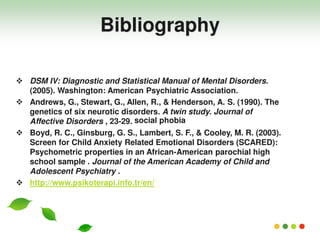
 DSM IV: Diagnostic and Statistical Manual of Mental Disorders.
(2005). Washington: American Psychiatric Association.
 Andrews, G., Stewart, G., Allen, R., & Henderson, A. S. (1990). The
genetics of six neurotic disorders. A twin study. Journal of
Affective Disorders , 23-29.
 Boyd, R. C., Ginsburg, G. S., Lambert, S. F., & Cooley, M. R. (2003).
Screen for Child Anxiety Related Emotional Disorders (SCARED):
Psychometric properties in an African-American parochial high
school sample . Journal of the American Academy of Child and
Adolescent Psychiatry .
 http://www.psikoterapi.info.tr/en/
Bibliography
social phobia
For further information visit http://www.psikoterapi.info.tr/en/
Bibliography

Social phobia or shyness

  • 1.
    09.12.2014 Social Phobia Or shynessin disguise Fatma Tuba Aydın
  • 2.
    “Once upon atime there was a beautiful Sarı Kız (Yellow Girl), who was so shy so shy that when people called her name, her cheeks blossomed red roses. She would never go out, remain inside and never meet with strangers. One day she hears a sound that asks to make an entrance. She got so fearful so fearful that she could not stand on her feet for days and cried day in and day out. One day she replied to the sound. At that moment the rock broke into two and hot water poured that took her beautiful yellow hair and rosy cheeks from this life”. A Turkish Folk Tale
  • 3.
    Shyness is associatedwith the virtue construct.  Society praises Yellow Girl to be shy but is it also adoptive?  Why to seek treatment if it is only a shyness? DSM IV Social Phobia “A severe, irrational fear and avoidance of social interactions and/or situations that involve performance before others, evaluation by others, and possible negative consequences such as embarrassment” Introduction
  • 4.
    SP as theextreme form of shyness. How to differentiate Shyness and Social Phobia I avoid, I escape in performance I blush but Remain here How about avoidant personality disorder?
  • 5.
    More situation Specific HowDoes SP differ? More Somatic Symptoms More functional Impairment 1 2 3 4 Lower Quality of Life
  • 6.
    Public Speech. Performing beforeothers. Eating and drinking in public. Using public bathroom. Circumstances They Suffer
  • 7.
    The lifetime prevalence ofSP is 13% ♀ , 12% ♂ (experience, upbringing change, CBT) middle & elder ages more prevailant Epidemiology
  • 10.
     DSM IV:Diagnostic and Statistical Manual of Mental Disorders. (2005). Washington: American Psychiatric Association.  Andrews, G., Stewart, G., Allen, R., & Henderson, A. S. (1990). The genetics of six neurotic disorders. A twin study. Journal of Affective Disorders , 23-29.  Boyd, R. C., Ginsburg, G. S., Lambert, S. F., & Cooley, M. R. (2003). Screen for Child Anxiety Related Emotional Disorders (SCARED): Psychometric properties in an African-American parochial high school sample . Journal of the American Academy of Child and Adolescent Psychiatry .  http://www.psikoterapi.info.tr/en/ Bibliography social phobia
  • 11.
    For further informationvisit http://www.psikoterapi.info.tr/en/ Bibliography