ANXIETY
DISORDER


Presented By :- Olivia,
  Jivtesh and Geeta.
WHAT IS ANXIETY?

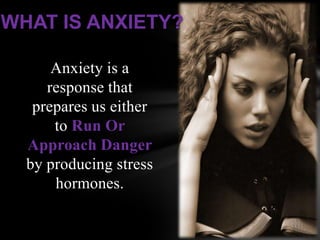
      Anxiety is a
     response that
   prepares us either
      to Run Or
  Approach Danger
  by producing stress
      hormones.
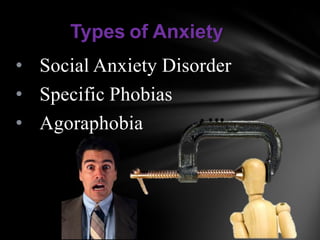
Types of Anxiety
• Social Anxiety Disorder
• Specific Phobias
• Agoraphobia
SOCIAL ANXIETY DISORDER /
     SOCIAL PHOBIA
      People facing Social
      Phobia are Scared of
     Public Interactions and
      Group Associations.
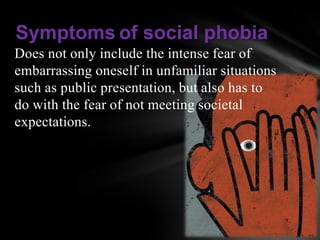
Symptoms of social phobia
Does not only include the intense fear of
embarrassing oneself in unfamiliar situations
such as public presentation, but also has to
do with the fear of not meeting societal
expectations.
CAUSES OF SOCIAL
PHOBIA
• Hereditary
• Environmental
For example, there is a high possibility that
a child born to a parent with anxiety
problem will inherit it.
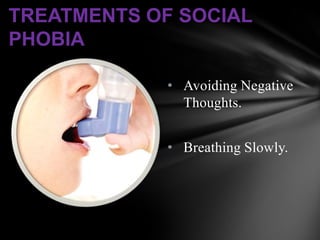
TREATMENTS OF SOCIAL
PHOBIA

             • Avoiding Negative
               Thoughts.


             • Breathing Slowly.
SPECIFIC PHOBIAS
A specific phobia results out of an Irrational
Fear or a Meaningless Fear arising as a
result of a situation or a specific object.
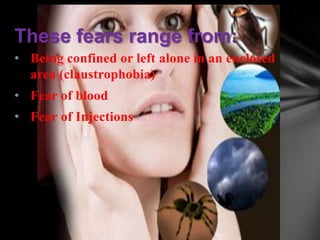
These fears range from:
• Being confined or left alone in an enclosed
  area (claustrophobia)
• Fear of blood
• Fear of Injections
SYMPTOMS OF SPECIFIC
PHOBIA
• Intense nervousness.
• Lack of concentration.
CAUSES OF SPECIFIC
PHOBIA
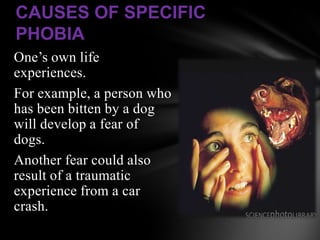
One’s own life
experiences.
For example, a person who
has been bitten by a dog
will develop a fear of
dogs.
Another fear could also
result of a traumatic
experience from a car
crash.
TREATMENT FOR SPECIFIC
PHOBIAS

 A psychiatrist or psychologist can help in
such situations by constant exposure to that
 particular situation or that object until the
  situation no longer triggers the Phobia.
AGORAPHOBIA: “FEAR OF THE
MARKET PLACE.”
It is the fear of being in a particular
place where there is absolutely no
possibility of escaping in case of an
emergency.
An example will be travelling in an
airplane or in a car.
SYMPTOMS OF AGORAPHOBIA
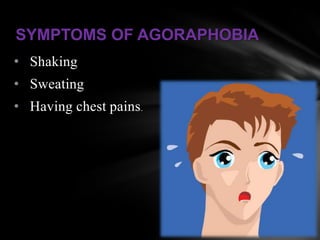
• Shaking
• Sweating
• Having chest pains.
CAUSES OF AGORAPHOBIA
Intensive fear that can lead to panic attacks.
In situations like this the individual loses
control or feels like he is dying.
TREATMENT OF AGORAPHOBIA

• Medications such as Alprazolam and
  clonazepam relieve fear and anxiety.
• Counselling can also help alongside with
  these medications.
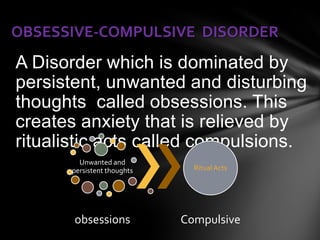
OBSESSIVE-COMPULSIVE DISORDER
A Disorder which is dominated by
persistent, unwanted and disturbing
thoughts called obsessions. This
creates anxiety that is relieved by
ritualistic acts called compulsions.
        Unwanted and
      persistent thoughts     Ritual Acts


       obsessions           Compulsive
When Worry become a Obsession?
Don’t we all have worries and
doubts?
Yes, we do
OCD occurs only when:
• Worries become obsessions
• Followed by excessive rituals
• Which in turn starts
  dominating and controlling
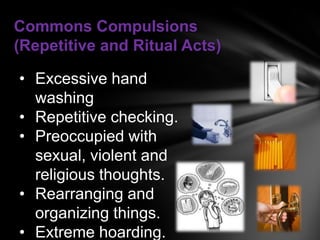
Commons Compulsions
(Repetitive and Ritual Acts)

• Excessive hand
  washing
• Repetitive checking.
• Preoccupied with
  sexual, violent and
  religious thoughts.
• Rearranging and
  organizing things.
• Extreme hoarding.
What Causes OCD?
Psychological factors
• Intruding thoughts and worries
• Excessive anxiety and stress


Biological Factors
• Genetic
• Neurological Disorders
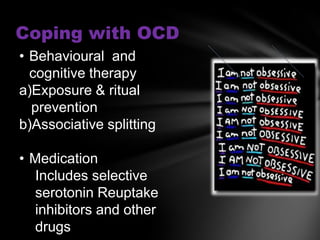
Coping with OCD
• Behavioural and
  cognitive therapy
a)Exposure & ritual
  prevention
b)Associative splitting

• Medication
   Includes selective
   serotonin Reuptake
   inhibitors and other
   drugs
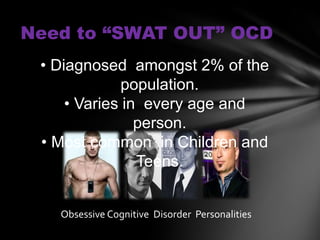
Need to “SWAT OUT” OCD
 • Diagnosed amongst 2% of the
              population.
     • Varies in every age and
                person.
 • Most common in Children and
                Teens.


   Obsessive Cognitive Disorder Personalities
Need to “SWAT OUT” OCD
DONOT LET OCD CONTROLS YOUR LIFE ,
IT’S YOU
WHO NEEDS TO CONTROL IT.
STOP OCD , STOP DOING
THINGS OVER AND OVER AGAIN
GENERALIZED ANXIETY DISORDER

  A Disorder in which a
  person has feelings of
  dread and impending
     doom along with
  Physical symptoms of
  stress, which lasts six
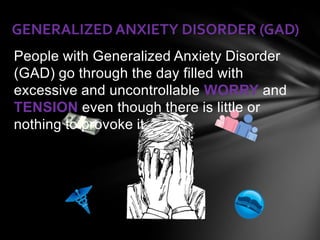
GENERALIZED ANXIETY DISORDER (GAD)
People with Generalized Anxiety Disorder
(GAD) go through the day filled with
excessive and uncontrollable WORRY and
TENSION even though there is little or
nothing to provoke it.
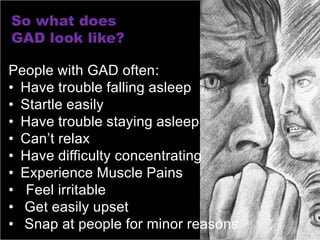
So what does
GAD look like?

People with GAD often:
• Have trouble falling asleep
• Startle easily
• Have trouble staying asleep
• Can’t relax
• Have difficulty concentrating
• Experience Muscle Pains
• Feel irritable
• Get easily upset
• Snap at people for minor reasons
How do People with GAD act in
Daily Life (other than worrying)?

• Excessive reassurance-
  seeking
• Checking
• Information Seeking or List
  Making
• Refusal to delegate to others
• Avoidance / Procrastination
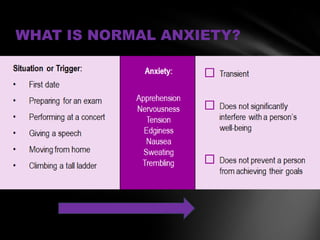
WHAT IS NORMAL ANXIETY?
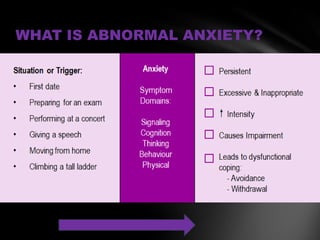
WHAT IS ABNORMAL ANXIETY?
CAUSES OF ANXIETY DISORDERS
• Genetic
• Biological
• Developmental
• Socio Economic
• Workplace Stress
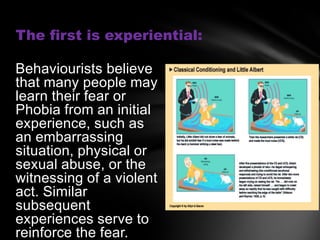
The first is experiential:

Behaviourists believe
that many people may
learn their fear or
Phobia from an initial
experience, such as
an embarrassing
situation, physical or
sexual abuse, or the
witnessing of a violent
act. Similar
subsequent
experiences serve to
reinforce the fear.
A second theory related to Cognition or
thinking:

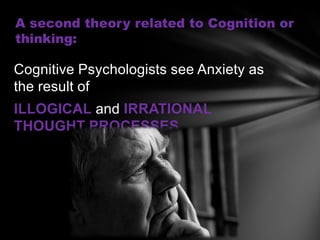
Cognitive Psychologists see Anxiety as
the result of
ILLOGICAL and IRRATIONAL
THOUGHT PROCESSES.
IRRATIONAL THOUGHT PROCCESSES

Magnification:- Is to make mountains out
of Molehills
All-or-nothing thinking:- In which a
person believes that his or her
performance must be perfect or the
result will be a total failure.
Overgeneralization:- A single negative
event interpreted as a never ending
pattern of defeat.
Minimization:- Giving little or no
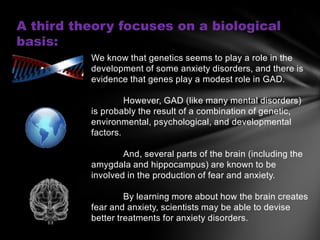
A third theory focuses on a biological
basis:
          We know that genetics seems to play a role in the
          development of some anxiety disorders, and there is
          evidence that genes play a modest role in GAD.

                   However, GAD (like many mental disorders)
          is probably the result of a combination of genetic,
          environmental, psychological, and developmental
          factors.

                  And, several parts of the brain (including the
          amygdala and hippocampus) are known to be
          involved in the production of fear and anxiety.

                   By learning more about how the brain creates
          fear and anxiety, scientists may be able to devise
          better treatments for anxiety disorders.
TREATMENT FOR GAD

THERAPY
Cognitive Therapy
Behavioural Therapy

MEDICATIONS
The Medications used for GAD include:
Anti – Depressants
Anti – Anxiety Drugs
Beta Blockers
MEDICATIONS FOR ANXIETY DISORDERS

   Medications will NOT CURE anxiety
disorders, but can keep them under control
    while the patient receives therapy.

 With proper treatment, many people with
anxiety disorders can lead normal, fulfilling
                   lives!
Bibliography
• Anonymous. (October 2002). Information from your
  family doctor: Panic disorder: Panic attacks and
  agoraphobia. American Family Physician, 66 (7), 1293-
  4. Retrieved from:
  http://search.proquest.com/docview/234321802?accou
  ntid=3455
• Kamkar, K. (2008). High cost of anxiety. Canadian HR
  Reporter, 21(22), 34-34. Retrieved from
  http://search.proquest.com/docview/220804374?accou
  ntid=3455
• Parker-Pope, T.( May 31, 2005). Health mailbox. Wall
  Street Journal, pp. D.7-D.7. Retrieved from:
  http://search.proquest.com/docview/398949518?accou
  ntid=3455
Bibliography
• Rayuso (2012). What causes social phobia. Mental
  Health. Retrieved from
• http://rayuso.hubpages.com/hub/What-Causes-
  Social-Phobia
• Smith, M. A. A., & Jaffe-Gill, M.A.( June
  2011).Symptoms, self-help and treatment. Social
  Anxiety Disorder and Social Phobia. Retrieved from
  http://www.helpguide.org/mental/social_anxiety_su
  pport_symptom_causes_treatment.htm
• Fotosearch. (2012). Retrieved from:
  http://www.fotosearch.com/BLG017/080176bl/
Bibliography
•   Canadian Mental Health Association. (2008). Retrieved from cmha.ca:
    http://www.cmha.ca/bins/content_page.asp?cid=3-94-95&lang=1
•   Psych Central learn share. Grow. (2011). Retrieved from
    http://psychcentral.com/ocdquiz.htm
•   MedicineNet. (n.d.). Retrieved from
    http://www.medicinenet.com/obsessive_compulsive_disorder_ocd/pa
    ge2.htm
•   Obsessive Compulsive Disorder, Anxiety Disorder. (n.d.). Retrieved
    from American Psychological Association: http://www.cmha.ca
•   Obsessive Compulsive Disorder. (n.d.). Retrieved from The OCD
    Closet: http://www.theocdcloset.com/ocd-treatment/ocd-self-help/

•   Obsessive–compulsive disorder. (n. d.). Retrieved from
    en.wikipedia.org:
    http://en.wikipedia.org/wiki/Obsessive%E2%80%93compulsive_disor
    der
Bibliography
• Anxiety BC “What is Generalized Anxiety Disorder”
  Retrieved from
  http://www.anxietybc.com/resources/generalized.php
• Dr. Stan Kutcher (2008, November 3) “Understanding GAD”
  Retrieved from
  http://www.slideshare.net/teenmentalhealth/understandin
  g-generalized-anxiety-disorder-
  presentation?src=related_normal&rel=3439665
• Public Health Agency of Canada “Chapter 4 – Anxiety
  Disorder” Retrieved from
  http://www.phac-aspc.gc.ca/publicat/miic

Anxiety disorder

  • 1.
    ANXIETY DISORDER Presented By :-Olivia, Jivtesh and Geeta.
  • 2.
    WHAT IS ANXIETY? Anxiety is a response that prepares us either to Run Or Approach Danger by producing stress hormones.
  • 3.
    Types of Anxiety •Social Anxiety Disorder • Specific Phobias • Agoraphobia
  • 4.
    SOCIAL ANXIETY DISORDER/ SOCIAL PHOBIA People facing Social Phobia are Scared of Public Interactions and Group Associations.
  • 5.
    Symptoms of socialphobia Does not only include the intense fear of embarrassing oneself in unfamiliar situations such as public presentation, but also has to do with the fear of not meeting societal expectations.
  • 6.
    CAUSES OF SOCIAL PHOBIA •Hereditary • Environmental For example, there is a high possibility that a child born to a parent with anxiety problem will inherit it.
  • 7.
    TREATMENTS OF SOCIAL PHOBIA • Avoiding Negative Thoughts. • Breathing Slowly.
  • 8.
    SPECIFIC PHOBIAS A specificphobia results out of an Irrational Fear or a Meaningless Fear arising as a result of a situation or a specific object.
  • 9.
    These fears rangefrom: • Being confined or left alone in an enclosed area (claustrophobia) • Fear of blood • Fear of Injections
  • 10.
    SYMPTOMS OF SPECIFIC PHOBIA •Intense nervousness. • Lack of concentration.
  • 11.
    CAUSES OF SPECIFIC PHOBIA One’sown life experiences. For example, a person who has been bitten by a dog will develop a fear of dogs. Another fear could also result of a traumatic experience from a car crash.
  • 12.
    TREATMENT FOR SPECIFIC PHOBIAS A psychiatrist or psychologist can help in such situations by constant exposure to that particular situation or that object until the situation no longer triggers the Phobia.
  • 13.
    AGORAPHOBIA: “FEAR OFTHE MARKET PLACE.” It is the fear of being in a particular place where there is absolutely no possibility of escaping in case of an emergency. An example will be travelling in an airplane or in a car.
  • 14.
    SYMPTOMS OF AGORAPHOBIA •Shaking • Sweating • Having chest pains.
  • 15.
    CAUSES OF AGORAPHOBIA Intensivefear that can lead to panic attacks. In situations like this the individual loses control or feels like he is dying.
  • 16.
    TREATMENT OF AGORAPHOBIA •Medications such as Alprazolam and clonazepam relieve fear and anxiety. • Counselling can also help alongside with these medications.
  • 17.
    OBSESSIVE-COMPULSIVE DISORDER A Disorderwhich is dominated by persistent, unwanted and disturbing thoughts called obsessions. This creates anxiety that is relieved by ritualistic acts called compulsions. Unwanted and persistent thoughts Ritual Acts obsessions Compulsive
  • 18.
    When Worry becomea Obsession? Don’t we all have worries and doubts? Yes, we do OCD occurs only when: • Worries become obsessions • Followed by excessive rituals • Which in turn starts dominating and controlling
  • 19.
    Commons Compulsions (Repetitive andRitual Acts) • Excessive hand washing • Repetitive checking. • Preoccupied with sexual, violent and religious thoughts. • Rearranging and organizing things. • Extreme hoarding.
  • 20.
    What Causes OCD? Psychologicalfactors • Intruding thoughts and worries • Excessive anxiety and stress Biological Factors • Genetic • Neurological Disorders
  • 21.
    Coping with OCD •Behavioural and cognitive therapy a)Exposure & ritual prevention b)Associative splitting • Medication Includes selective serotonin Reuptake inhibitors and other drugs
  • 22.
    Need to “SWATOUT” OCD • Diagnosed amongst 2% of the population. • Varies in every age and person. • Most common in Children and Teens. Obsessive Cognitive Disorder Personalities
  • 23.
    Need to “SWATOUT” OCD DONOT LET OCD CONTROLS YOUR LIFE , IT’S YOU WHO NEEDS TO CONTROL IT. STOP OCD , STOP DOING THINGS OVER AND OVER AGAIN
  • 24.
    GENERALIZED ANXIETY DISORDER A Disorder in which a person has feelings of dread and impending doom along with Physical symptoms of stress, which lasts six
  • 25.
    GENERALIZED ANXIETY DISORDER(GAD) People with Generalized Anxiety Disorder (GAD) go through the day filled with excessive and uncontrollable WORRY and TENSION even though there is little or nothing to provoke it.
  • 26.
    So what does GADlook like? People with GAD often: • Have trouble falling asleep • Startle easily • Have trouble staying asleep • Can’t relax • Have difficulty concentrating • Experience Muscle Pains • Feel irritable • Get easily upset • Snap at people for minor reasons
  • 27.
    How do Peoplewith GAD act in Daily Life (other than worrying)? • Excessive reassurance- seeking • Checking • Information Seeking or List Making • Refusal to delegate to others • Avoidance / Procrastination
  • 28.
  • 29.
  • 30.
    CAUSES OF ANXIETYDISORDERS • Genetic • Biological • Developmental • Socio Economic • Workplace Stress
  • 31.
    The first isexperiential: Behaviourists believe that many people may learn their fear or Phobia from an initial experience, such as an embarrassing situation, physical or sexual abuse, or the witnessing of a violent act. Similar subsequent experiences serve to reinforce the fear.
  • 32.
    A second theoryrelated to Cognition or thinking: Cognitive Psychologists see Anxiety as the result of ILLOGICAL and IRRATIONAL THOUGHT PROCESSES.
  • 33.
    IRRATIONAL THOUGHT PROCCESSES Magnification:-Is to make mountains out of Molehills All-or-nothing thinking:- In which a person believes that his or her performance must be perfect or the result will be a total failure. Overgeneralization:- A single negative event interpreted as a never ending pattern of defeat. Minimization:- Giving little or no
  • 34.
    A third theoryfocuses on a biological basis: We know that genetics seems to play a role in the development of some anxiety disorders, and there is evidence that genes play a modest role in GAD. However, GAD (like many mental disorders) is probably the result of a combination of genetic, environmental, psychological, and developmental factors. And, several parts of the brain (including the amygdala and hippocampus) are known to be involved in the production of fear and anxiety. By learning more about how the brain creates fear and anxiety, scientists may be able to devise better treatments for anxiety disorders.
  • 35.
    TREATMENT FOR GAD THERAPY CognitiveTherapy Behavioural Therapy MEDICATIONS The Medications used for GAD include: Anti – Depressants Anti – Anxiety Drugs Beta Blockers
  • 36.
    MEDICATIONS FOR ANXIETYDISORDERS Medications will NOT CURE anxiety disorders, but can keep them under control while the patient receives therapy. With proper treatment, many people with anxiety disorders can lead normal, fulfilling lives!
  • 37.
    Bibliography • Anonymous. (October2002). Information from your family doctor: Panic disorder: Panic attacks and agoraphobia. American Family Physician, 66 (7), 1293- 4. Retrieved from: http://search.proquest.com/docview/234321802?accou ntid=3455 • Kamkar, K. (2008). High cost of anxiety. Canadian HR Reporter, 21(22), 34-34. Retrieved from http://search.proquest.com/docview/220804374?accou ntid=3455 • Parker-Pope, T.( May 31, 2005). Health mailbox. Wall Street Journal, pp. D.7-D.7. Retrieved from: http://search.proquest.com/docview/398949518?accou ntid=3455
  • 38.
    Bibliography • Rayuso (2012).What causes social phobia. Mental Health. Retrieved from • http://rayuso.hubpages.com/hub/What-Causes- Social-Phobia • Smith, M. A. A., & Jaffe-Gill, M.A.( June 2011).Symptoms, self-help and treatment. Social Anxiety Disorder and Social Phobia. Retrieved from http://www.helpguide.org/mental/social_anxiety_su pport_symptom_causes_treatment.htm • Fotosearch. (2012). Retrieved from: http://www.fotosearch.com/BLG017/080176bl/
  • 39.
    Bibliography • Canadian Mental Health Association. (2008). Retrieved from cmha.ca: http://www.cmha.ca/bins/content_page.asp?cid=3-94-95&lang=1 • Psych Central learn share. Grow. (2011). Retrieved from http://psychcentral.com/ocdquiz.htm • MedicineNet. (n.d.). Retrieved from http://www.medicinenet.com/obsessive_compulsive_disorder_ocd/pa ge2.htm • Obsessive Compulsive Disorder, Anxiety Disorder. (n.d.). Retrieved from American Psychological Association: http://www.cmha.ca • Obsessive Compulsive Disorder. (n.d.). Retrieved from The OCD Closet: http://www.theocdcloset.com/ocd-treatment/ocd-self-help/ • Obsessive–compulsive disorder. (n. d.). Retrieved from en.wikipedia.org: http://en.wikipedia.org/wiki/Obsessive%E2%80%93compulsive_disor der
  • 40.
    Bibliography • Anxiety BC“What is Generalized Anxiety Disorder” Retrieved from http://www.anxietybc.com/resources/generalized.php • Dr. Stan Kutcher (2008, November 3) “Understanding GAD” Retrieved from http://www.slideshare.net/teenmentalhealth/understandin g-generalized-anxiety-disorder- presentation?src=related_normal&rel=3439665 • Public Health Agency of Canada “Chapter 4 – Anxiety Disorder” Retrieved from http://www.phac-aspc.gc.ca/publicat/miic

Editor's Notes

  • #25 People with this disorder think that everything is the end and they cant do anything about it. 6 months / more
  • #26 People with this disorder are just plain worriers, they worry about money, their children, their lives, their friends, the dog and anything else that they think might possibly go wrong.
  • #28 1) Asking seeralppls opinion befremkin a decision 2) eg calling loved one to see if OK 3) making elaborate to do lists (grocery list, reading all buksbefremkin decision) 4) eg not allowin ny1 else to do chores cz u wna doo it ryt 5) avoiding opportunities / tasks befre completing it so u ha little tym to wry abt it.
  • #29 Momentary - transient
  • #30 Persistant = continuing, impairment = damage
  • #32 http://www.phac-aspc.gc.ca/publicat/miic-mmac/chap_4-eng.php (Little Albert eg.)
  • #33 Cognitive Psychologists see Anxiety as the result of ILLOGICAL, IRRATIONAL THOUGHT PROCESSES.
  • #34 3) Im not gna talk to any1 czths person didn’t talk to me. 4) 'Minimization is one of the most common ways we reduce our feelings of guilt..."It's not that big of a deal"'
  • #35 Write abet about OCD causes.