Definition
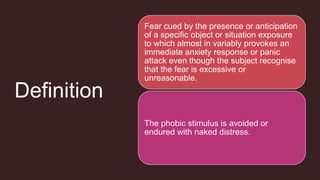
Fear cued by the presence or anticipation
of a specific object or situation exposure
to which almost in variably provokes an
immediate anxiety response or panic
attack even though the subject recognise
that the fear is excessive or
unreasonable.
The phobic stimulus is avoided or
endured with naked distress.
Etiology
Psychoanalytic Theory : - Freud believed that phobia developed when
a child experience normal incestual feeling towards the opposite
gender parent and fear ,aggresion from same gender parents. Modern
day psychoanalyst believe in the same concept of phobic development.
eg: a female child who was sexually abused by an adult male family
friend when he was taking her for a ride in his boat .
Learning Theory :- A stressful stimulus produce an unconditioned
response of fear . When the stressful stimulus is repeatedly paired with
a harmless object. Phobia also maybe acquired by direct learning
(modelling). eg: A mother who exhibit fear towards an object will
provide a model for the child, who may also develop a phobia of the
same object.
Cognitive Theory :- Cognitive Theorist expose that an anxiety is the
product of faulty cognition or anxiety inducing self instruction. Two
type of faulty thinking have been investigated . NEGATIVE SELF
STATEMENT AND IRRATIONAL BELIEVES and these produce
anxiety reaction.
Classification
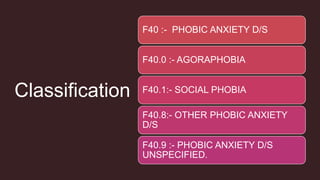
F40 :- PHOBIC ANXIETY D/S
F40.0 :- AGORAPHOBIA
F40.1:- SOCIAL PHOBIA
F40.8:- OTHER PHOBIC ANXIETY
D/S
F40.9 :- PHOBIC ANXIETY D/S
UNSPECIFIED.
Clinical
Manifestations
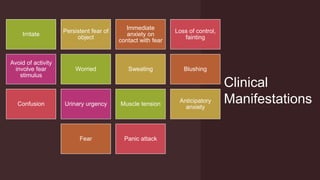
Irritate
Persistent fear of
object
Immediate
anxiety on
contact with fear
Loss of control,
fainting
Avoid of activity
involve fear
stimulus
Worried Sweating Blushing
Confusion Urinary urgency Muscle tension
Anticipatory
anxiety
Fear Panic attack
Types
AGORAPHOBIA : In this D/S there is a fear of being in places or situation from which escape might be difficult or in
which help might not be available if a limited symptoms attack or panic like symptoms should occur. Onset of symptoms
commonly occur in the 20s & 30s and persist for many years . It’s is diagnosed more commonly in women than in men .
SOCIAL PHOBIA. : It is an excessive fear of situation in which a person might do something embarrassing or be evaluated
negatively by others .The individual has extreme concern being exposed to possible scrutining by others and fear social or
performance situation in which embarrassment may occur. It appear to be equally common among men and women.
SPECIFIC PHOBIA. : Was formally called SIMPLE PHOBIA The essential feature of this D/S is a marked ,persistent and
excessive or unreasonable fear when in the presence of or when anticipating an encounter with a specific object or situation.
The DSM IV – TR identify subtype of the most common specific phobia they include the following :
ANIMAL TYPE : This subtype would be identified as part of the diagnosis of the fear is of animals or insects .
NATURAL ENVIRONMENT TYPE : Example of this subtype include object or situation that occur within the natural environment
such as heights,storms and water.
BLOOD – INJECTION INJURY TYPE : This diagnosis should be specified if the fear is of seeing blood or an injury or receiving an
injection or other medical procedure.
SITUATIONAL TYPE. : This subtype is designated if the fear is of a specific situation such as public transportation
,tunnel,bridges,elevators,flying,driving or places.
OTHER TYPE. :
Diagnostic
Evaluation
No specific
evaluation test
History of phobia
when exposed.
Treatment
Pharmacotherapy :
Antidepressants ,
Benzodiazepines
Psychotherapy :
Behaviour therapy ,
Cognitive therapy, Group
therapy, Family therapy .
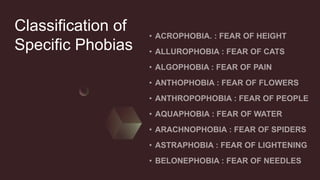
Classification of
Specific Phobias
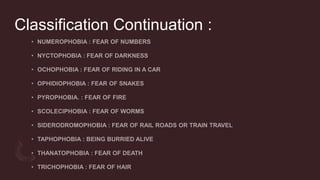
Classification Continuation :
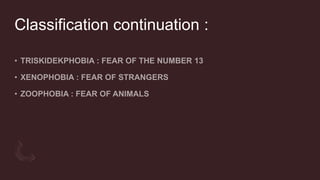
Classification continuation :
Phobia ppt

Phobia ppt

  • 2.
    Definition Fear cued bythe presence or anticipation of a specific object or situation exposure to which almost in variably provokes an immediate anxiety response or panic attack even though the subject recognise that the fear is excessive or unreasonable. The phobic stimulus is avoided or endured with naked distress.
  • 3.
    Etiology Psychoanalytic Theory :- Freud believed that phobia developed when a child experience normal incestual feeling towards the opposite gender parent and fear ,aggresion from same gender parents. Modern day psychoanalyst believe in the same concept of phobic development. eg: a female child who was sexually abused by an adult male family friend when he was taking her for a ride in his boat . Learning Theory :- A stressful stimulus produce an unconditioned response of fear . When the stressful stimulus is repeatedly paired with a harmless object. Phobia also maybe acquired by direct learning (modelling). eg: A mother who exhibit fear towards an object will provide a model for the child, who may also develop a phobia of the same object. Cognitive Theory :- Cognitive Theorist expose that an anxiety is the product of faulty cognition or anxiety inducing self instruction. Two type of faulty thinking have been investigated . NEGATIVE SELF STATEMENT AND IRRATIONAL BELIEVES and these produce anxiety reaction.
  • 4.
    Classification F40 :- PHOBICANXIETY D/S F40.0 :- AGORAPHOBIA F40.1:- SOCIAL PHOBIA F40.8:- OTHER PHOBIC ANXIETY D/S F40.9 :- PHOBIC ANXIETY D/S UNSPECIFIED.
  • 5.
    Clinical Manifestations Irritate Persistent fear of object Immediate anxietyon contact with fear Loss of control, fainting Avoid of activity involve fear stimulus Worried Sweating Blushing Confusion Urinary urgency Muscle tension Anticipatory anxiety Fear Panic attack
  • 11.
    Types AGORAPHOBIA : Inthis D/S there is a fear of being in places or situation from which escape might be difficult or in which help might not be available if a limited symptoms attack or panic like symptoms should occur. Onset of symptoms commonly occur in the 20s & 30s and persist for many years . It’s is diagnosed more commonly in women than in men . SOCIAL PHOBIA. : It is an excessive fear of situation in which a person might do something embarrassing or be evaluated negatively by others .The individual has extreme concern being exposed to possible scrutining by others and fear social or performance situation in which embarrassment may occur. It appear to be equally common among men and women. SPECIFIC PHOBIA. : Was formally called SIMPLE PHOBIA The essential feature of this D/S is a marked ,persistent and excessive or unreasonable fear when in the presence of or when anticipating an encounter with a specific object or situation. The DSM IV – TR identify subtype of the most common specific phobia they include the following : ANIMAL TYPE : This subtype would be identified as part of the diagnosis of the fear is of animals or insects . NATURAL ENVIRONMENT TYPE : Example of this subtype include object or situation that occur within the natural environment such as heights,storms and water. BLOOD – INJECTION INJURY TYPE : This diagnosis should be specified if the fear is of seeing blood or an injury or receiving an injection or other medical procedure. SITUATIONAL TYPE. : This subtype is designated if the fear is of a specific situation such as public transportation ,tunnel,bridges,elevators,flying,driving or places.
  • 13.
  • 14.
  • 15.
    Treatment Pharmacotherapy : Antidepressants , Benzodiazepines Psychotherapy: Behaviour therapy , Cognitive therapy, Group therapy, Family therapy .
  • 16.
  • 17.
  • 18.
  • 19.