Seminar On Fluid and
Electrolyte Imbalance
Aneez. K
Ist Year MSc. Nursing
EMCH CON
Terminologies
 Homeostatic
 Hydrostatic Pressure
 Osmolarity
 Osmolality
 Isotonic
 Hypotonic Solution
 Hypertonic Solution
 Anabolism
 Catabolism
 Total Body Water (TBW)
 Intracellular Fluid (ICF) Volume
 Extracellular Fluid (ECF) Volume
 Interstitial Fluid Volume
 Intravascular Fluid Volume
 Salt
 Electrolyte
 Solution
 Crystalloid
 Colloid
 Balanced Crystalloid
 Anion Gap
 Maintenance
 Replacement
 Resuscitation
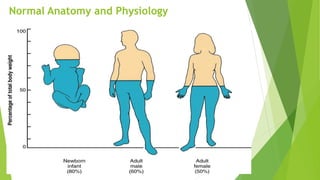
Normal Anatomy and Physiology
Why women have less water than men if
they are the same weight?
The water content of adipose (fat)
tissue is less than that of muscle,
while women have more adipose tissue
at the effect of feminine hormone.
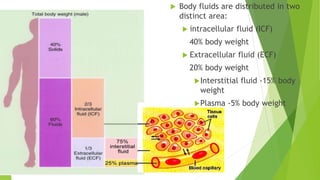
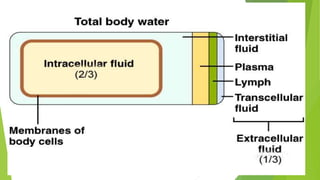
 Body fluids are distributed in two
distinct area:
 intracellular fluid (ICF)
40% body weight
 Extracellular fluid (ECF)
20% body weight
Interstitial fluid -15% body
weight
Plasma -5% body weight
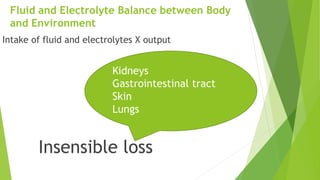
Fluid and Electrolyte Balance between Body
and Environment
Intake of fluid and electrolytes X output
Insensible loss
Kidneys
Gastrointestinal tract
Skin
Lungs
Intake
Output
 Lungs and Skin 0.5 – 1 l/day
 GI 100-150 ml/day
 Kidney
Regulation of Fluid and Electrolyte
 Passive transport mechanism
 Active transport mechanism
Passive transport mechanism
 Simple Diffusion through Lipid Layer
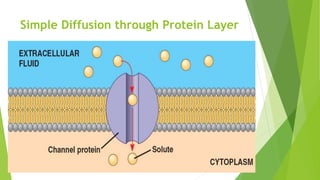
 Simple Diffusion through Protein Layer
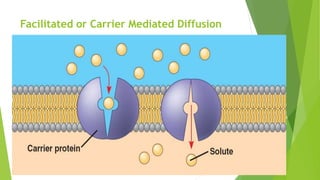
 Facilitated or Carrier Mediated Diffusion
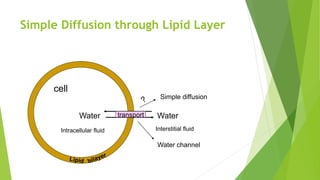
Simple Diffusion through Lipid Layer
Watertransport
Simple diffusion
Intracellular fluid Interstitial fluid
cell
Water
Water channel
Simple Diffusion through Protein Layer
Facilitated or Carrier Mediated Diffusion
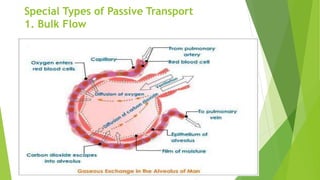
Special Types of Passive Transport
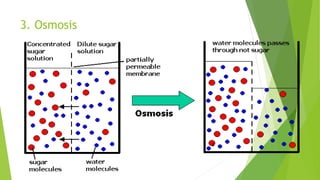
1. Bulk Flow
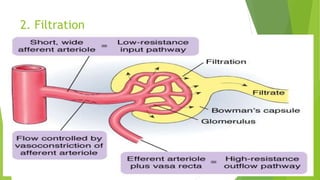
2. Filtration
3. Osmosis
Active Transport
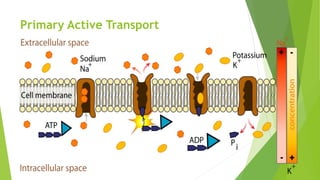
 Primary Active Transport
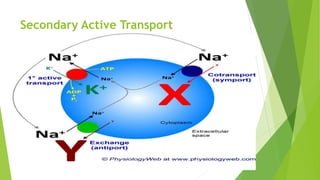
 Secondary Active Transport
Primary Active Transport
Secondary Active Transport
Hormonal Regulation of Fluid Balance
 Aldosterone
 Antidiuretic hormone
 Natriuretic peptide (NP)
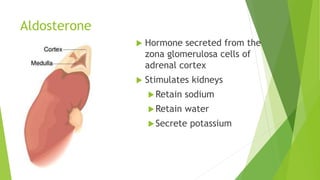
Aldosterone
 Hormone secreted from the
zona glomerulosa cells of
adrenal cortex
 Stimulates kidneys
Retain sodium
Retain water
Secrete potassium
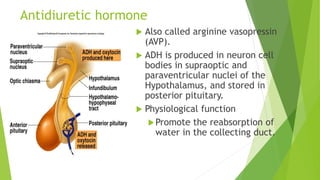
Antidiuretic hormone
 Also called arginine vasopressin
(AVP).
 ADH is produced in neuron cell
bodies in supraoptic and
paraventricular nuclei of the
Hypothalamus, and stored in
posterior pituitary.
 Physiological function
Promote the reabsorption of
water in the collecting duct.
The natriuretic peptide family
 Four peptides of this family have been identified, including:
Atrial natriuretic peptide (ANP)
Brain natriuretic peptide (BNP)
C-type natriuretic peptide (CNP)
Urodilatin
 Function:
Diuretic and natriuretic actions
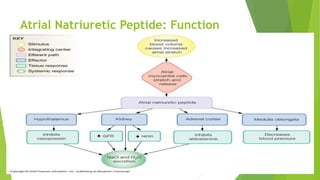
Atrial Natriuretic Peptide: Function
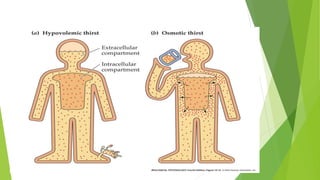
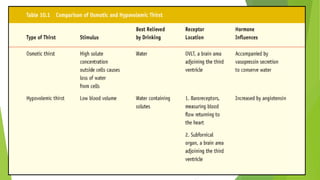
The sensation of thirst
 Conscious desire for water
 Major factor that determines fluid intake
 Initiated by the osmoreceptors in hypothalamus that are
stimulated by increase in osmotic pressure of body fluids
 Also stimulated by a decrease in the blood pressue through the
receptor of baroreceptor
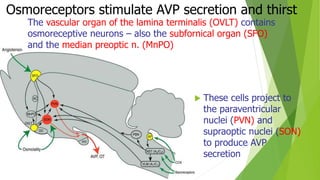
Osmoreceptors stimulate AVP secretion and thirst
 These cells project to
the paraventricular
nuclei (PVN) and
supraoptic nuclei (SON)
to produce AVP
secretion
The vascular organ of the lamina terminalis (OVLT) contains
osmoreceptive neurons – also the subfornical organ (SFO)
and the median preoptic n. (MnPO)
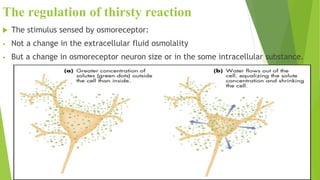
The regulation of thirsty reaction
 The stimulus sensed by osmoreceptor:
• Not a change in the extracellular fluid osmolality
• But a change in osmoreceptor neuron size or in the some intracellular substance.
Abnormalities in the Regulation of Body Fluid.
 Extra Cellular Fluid Volume Deficit (ECFVD)
 Extra Cellular Fluid Volume Excess
 Extra Cellular Fluid Volume Shift
Extra Cellular Fluid Volume Deficit (ECFVD)
 A decrease in intravascular and interstitial fluids.
 It is a common and serious fluid imbalance that
results in vascular fluid volume loss
(hypovolemia).
Risk Factors
 Diabetic ketoacidosis
 Hemorrhage
 Difficulty to swallowing
 Aged
 Severe mentally ill patient
Laboratory findings
 Increased Osmolality
 Increased or normal serum sodium level
 BUN (> 25 mg/d1)
 Hyperglycaemia (> 120 mg / dl)
 Increased specific gravity of urine
 Elevated hematocrit (>55%), Increased Specific
gravity
Management of Dehydration
 Pharmacologic Management
 Dietary management
 Nursing Management
 Nursing Diagnoses and Collaborative Problems
 Nursing Intervention
Falls Precautions:
 Assess for orthostatic hypotension
 Assess muscle strength in legs
 Orient the patient to the environment
 Remind the patient to call for help before getting
out of bed or a chair
 Help the patient get out of bed or a chair
 Provide, or remind the patient to use, a walker or
cane for ambulating
 Help the incontinent patient toilet every 1 to 2 hours
 Clean up spills immediately
 Provide adequate lighting at all times, especially at night
 Keep the call light within reach, and ensure that the patient
can use it
 Place the bed in the lowest position with the brakes locked
 Place objects that the patient needs within reach
 Ensure that adequate handrails are present in the patient's
room, bathroom, and hall
 Encourage family members or significant other to stay with
the patient
Extra Cellular Fluid Volume Excess
 ECFVE is increased fluid retention in the
intravascular & interstitial spaces
Extra Cellular Fluid Volume Shift
 Fluid volume shift is basically a change in the location of
extra cellular fluid between the intravascular and the
interstitial spaces.
Electrolyte Balance and Imbalance
 Sodium
 Hyponatremia
 Hypernatremia
Hyponatremia
• Definition:
– Commonly defined as a serum sodium
concentration <135 meq/L
– Hyponatremia represents a relative excess of
water in relation to sodium.
Hyponatremia is the most common electrolyte disorder
Acute hyponatremia (developing over 48 h or less) are
subject to more severe degrees of cerebral edema
sodium level is less than 105 mEq/L, the mortality is over
50%
Chronic hyponatremia (developing over more than 48 h)
experience milder degrees of cerebral edema
Types
Hypovolemic hyponatremia
Euvolemic hyponatremia
Hypervolemic hyponatremia
Redistributive hyponatremia
Pseudohyponatremia
Hypovolemic hyponatremia
 Develops as sodium and free water are lost
and/or replaced by inappropriately hypotonic
fluids
 Sodium can be lost through renal or non-renal
routes
 Nonrenal loss
GI losses
Vomiting, Diarrhea, fistulas, pancreatitis
Excessive sweating
Third spacing of fluids
ascites, peritonitis, pancreatitis, and burns
Cerebral salt-wasting syndrome
traumatic brain injury, aneurysmal
subarachnoid hemorrhage, and intracranial
surgery
Must distinguish from SIADH
 Renal Loss
Acute or chronic renal insufficiency
Diuretics
Euvolemic hyponatremia
 Normal sodium stores and a total body excess of free
water
Psychogenic polydipsia, often in psychiatric patients
Administration of hypotonic intravenous (5% DW) or
irrigation fluids ( sorbitol, glycerin) in the immediate
postoperative period
administration of hypotonic maintenance
intravenous fluids
Infants who may have been given inappropriate
amounts of free water
bowel preparation before colonoscopy or
colorectal surgery
Hypervolemic hyponatremia
 Total body sodium increases, and TBW increases to a greater
extent.
 Can be renal or non-renal
acute or chronic renal failure
dysfunctional kidneys are unable to excrete the ingested
sodium load
cirrhosis, congestive heart failure, or nephrotic syndrome
Hypervolemic hyponatremia
 Total body sodium increases, and TBW increases to a greater
extent.
 Can be renal or non-renal
acute or chronic renal failure
dysfunctional kidneys are unable to excrete the ingested
sodium load
cirrhosis, congestive heart failure, or nephrotic syndrome
Redistributive hyponatremia
Water shifts from the intracellular to the extracellular
compartment, with a resultant dilution of sodium. The TBW
and total body sodium are unchanged.
This condition occurs with hyperglycemia
Administration of mannitol
Hypernatremia
 Hypernatremia is usually due to water deficit
Excess water loss :eg- heat exposure
diabetes insipidus
Impaired thirst:eg-primary hypodypsia,
comatose
Excessive Na retension
Clinical feature
 Excessive thirst,polyuria,nausea
 Muscular weakness, neuromuscular irritability
 Altered mental status,focal neurological deficit
occasionally coma or seizures
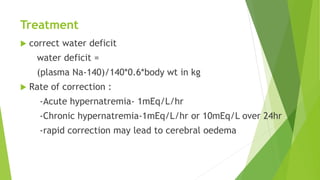
Treatment
 correct water deficit
water deficit =
(plasma Na-140)/140*0.6*body wt in kg
 Rate of correction :
-Acute hypernatremia- 1mEq/L/hr
-Chronic hypernatremia-1mEq/L/hr or 10mEq/L over 24hr
-rapid correction may lead to cerebral oedema
Potassium
 Hypokalemia
 Hyperkalemia
Calcium
 Hypocalcemia
 Hypercalcemia
Phosphorus
 Hypophosphatemia
 Hyperphosphatemia
Magnesium
 Hypomagnesemia
 Hypermagnesemia
Bibliography
 Priscilla Lemone, Karen Burke. “Medical surgical nursing, critical
thinking in client care”. 4th edition (2008). Page no. 185-198
 Ignatavicius Workman. “Medical surgical nursing, Patient centred
collaborative care”. 6th edition (2010). Elsevier publication. Page no.
1022-1024
 Brunner and Suddharth. “Text book of medical surgical nursing”.
Page no. 249-255
 Guyyton and Hall. “Text book of medical physiology”. 11th edition
(2006). Elsevier publications. Page no. 642-650
 Gerard.J.Tortora. “Principles of anatomy and physiology”. 11th
edition (2006). Wiley publication. Page no. 1122-1130
 K. Sembulingam, Prema Sembulingam. “Essentials of medical
physiology”. 5thedition (2010). Jaypee publications. Page no. 302-309
 Journal of Sports medicine Volume 31, Issue 10, August 2001 ISSN:
0112-1642 (Print) 1179-2035 (Online)
 Journal of Reproduction and Fertility. Supplement [1998, 53:1-14]
THANK YOU…………

Seminar on fluid and electrolyte imbalance

  • 1.
    Seminar On Fluidand Electrolyte Imbalance Aneez. K Ist Year MSc. Nursing EMCH CON
  • 2.
    Terminologies  Homeostatic  HydrostaticPressure  Osmolarity  Osmolality  Isotonic  Hypotonic Solution  Hypertonic Solution  Anabolism  Catabolism
  • 3.
     Total BodyWater (TBW)  Intracellular Fluid (ICF) Volume  Extracellular Fluid (ECF) Volume  Interstitial Fluid Volume  Intravascular Fluid Volume  Salt  Electrolyte  Solution  Crystalloid  Colloid  Balanced Crystalloid
  • 4.
     Anion Gap Maintenance  Replacement  Resuscitation
  • 5.
  • 6.
    Why women haveless water than men if they are the same weight? The water content of adipose (fat) tissue is less than that of muscle, while women have more adipose tissue at the effect of feminine hormone.
  • 7.
     Body fluidsare distributed in two distinct area:  intracellular fluid (ICF) 40% body weight  Extracellular fluid (ECF) 20% body weight Interstitial fluid -15% body weight Plasma -5% body weight
  • 9.
    Fluid and ElectrolyteBalance between Body and Environment Intake of fluid and electrolytes X output Insensible loss Kidneys Gastrointestinal tract Skin Lungs
  • 10.
  • 11.
    Output  Lungs andSkin 0.5 – 1 l/day  GI 100-150 ml/day  Kidney
  • 12.
    Regulation of Fluidand Electrolyte  Passive transport mechanism  Active transport mechanism
  • 13.
    Passive transport mechanism Simple Diffusion through Lipid Layer  Simple Diffusion through Protein Layer  Facilitated or Carrier Mediated Diffusion
  • 14.
    Simple Diffusion throughLipid Layer Watertransport Simple diffusion Intracellular fluid Interstitial fluid cell Water Water channel
  • 15.
  • 16.
    Facilitated or CarrierMediated Diffusion
  • 17.
    Special Types ofPassive Transport 1. Bulk Flow
  • 18.
  • 19.
  • 20.
    Active Transport  PrimaryActive Transport  Secondary Active Transport
  • 21.
  • 22.
  • 23.
    Hormonal Regulation ofFluid Balance  Aldosterone  Antidiuretic hormone  Natriuretic peptide (NP)
  • 24.
    Aldosterone  Hormone secretedfrom the zona glomerulosa cells of adrenal cortex  Stimulates kidneys Retain sodium Retain water Secrete potassium
  • 25.
    Antidiuretic hormone  Alsocalled arginine vasopressin (AVP).  ADH is produced in neuron cell bodies in supraoptic and paraventricular nuclei of the Hypothalamus, and stored in posterior pituitary.  Physiological function Promote the reabsorption of water in the collecting duct.
  • 26.
    The natriuretic peptidefamily  Four peptides of this family have been identified, including: Atrial natriuretic peptide (ANP) Brain natriuretic peptide (BNP) C-type natriuretic peptide (CNP) Urodilatin  Function: Diuretic and natriuretic actions
  • 27.
  • 28.
    The sensation ofthirst  Conscious desire for water  Major factor that determines fluid intake  Initiated by the osmoreceptors in hypothalamus that are stimulated by increase in osmotic pressure of body fluids  Also stimulated by a decrease in the blood pressue through the receptor of baroreceptor
  • 29.
    Osmoreceptors stimulate AVPsecretion and thirst  These cells project to the paraventricular nuclei (PVN) and supraoptic nuclei (SON) to produce AVP secretion The vascular organ of the lamina terminalis (OVLT) contains osmoreceptive neurons – also the subfornical organ (SFO) and the median preoptic n. (MnPO)
  • 30.
    The regulation ofthirsty reaction  The stimulus sensed by osmoreceptor: • Not a change in the extracellular fluid osmolality • But a change in osmoreceptor neuron size or in the some intracellular substance.
  • 33.
    Abnormalities in theRegulation of Body Fluid.  Extra Cellular Fluid Volume Deficit (ECFVD)  Extra Cellular Fluid Volume Excess  Extra Cellular Fluid Volume Shift
  • 34.
    Extra Cellular FluidVolume Deficit (ECFVD)  A decrease in intravascular and interstitial fluids.  It is a common and serious fluid imbalance that results in vascular fluid volume loss (hypovolemia).
  • 35.
    Risk Factors  Diabeticketoacidosis  Hemorrhage  Difficulty to swallowing  Aged  Severe mentally ill patient
  • 36.
    Laboratory findings  IncreasedOsmolality  Increased or normal serum sodium level  BUN (> 25 mg/d1)  Hyperglycaemia (> 120 mg / dl)  Increased specific gravity of urine  Elevated hematocrit (>55%), Increased Specific gravity
  • 37.
    Management of Dehydration Pharmacologic Management  Dietary management  Nursing Management  Nursing Diagnoses and Collaborative Problems  Nursing Intervention
  • 38.
    Falls Precautions:  Assessfor orthostatic hypotension  Assess muscle strength in legs  Orient the patient to the environment  Remind the patient to call for help before getting out of bed or a chair  Help the patient get out of bed or a chair  Provide, or remind the patient to use, a walker or cane for ambulating
  • 39.
     Help theincontinent patient toilet every 1 to 2 hours  Clean up spills immediately  Provide adequate lighting at all times, especially at night  Keep the call light within reach, and ensure that the patient can use it  Place the bed in the lowest position with the brakes locked  Place objects that the patient needs within reach  Ensure that adequate handrails are present in the patient's room, bathroom, and hall  Encourage family members or significant other to stay with the patient
  • 40.
    Extra Cellular FluidVolume Excess  ECFVE is increased fluid retention in the intravascular & interstitial spaces
  • 41.
    Extra Cellular FluidVolume Shift  Fluid volume shift is basically a change in the location of extra cellular fluid between the intravascular and the interstitial spaces.
  • 42.
    Electrolyte Balance andImbalance  Sodium  Hyponatremia  Hypernatremia
  • 43.
    Hyponatremia • Definition: – Commonlydefined as a serum sodium concentration <135 meq/L – Hyponatremia represents a relative excess of water in relation to sodium.
  • 44.
    Hyponatremia is themost common electrolyte disorder Acute hyponatremia (developing over 48 h or less) are subject to more severe degrees of cerebral edema sodium level is less than 105 mEq/L, the mortality is over 50% Chronic hyponatremia (developing over more than 48 h) experience milder degrees of cerebral edema
  • 45.
    Types Hypovolemic hyponatremia Euvolemic hyponatremia Hypervolemichyponatremia Redistributive hyponatremia Pseudohyponatremia
  • 46.
    Hypovolemic hyponatremia  Developsas sodium and free water are lost and/or replaced by inappropriately hypotonic fluids  Sodium can be lost through renal or non-renal routes
  • 47.
     Nonrenal loss GIlosses Vomiting, Diarrhea, fistulas, pancreatitis Excessive sweating Third spacing of fluids ascites, peritonitis, pancreatitis, and burns Cerebral salt-wasting syndrome traumatic brain injury, aneurysmal subarachnoid hemorrhage, and intracranial surgery Must distinguish from SIADH
  • 48.
     Renal Loss Acuteor chronic renal insufficiency Diuretics
  • 49.
    Euvolemic hyponatremia  Normalsodium stores and a total body excess of free water Psychogenic polydipsia, often in psychiatric patients Administration of hypotonic intravenous (5% DW) or irrigation fluids ( sorbitol, glycerin) in the immediate postoperative period
  • 50.
    administration of hypotonicmaintenance intravenous fluids Infants who may have been given inappropriate amounts of free water bowel preparation before colonoscopy or colorectal surgery
  • 51.
    Hypervolemic hyponatremia  Totalbody sodium increases, and TBW increases to a greater extent.  Can be renal or non-renal acute or chronic renal failure dysfunctional kidneys are unable to excrete the ingested sodium load cirrhosis, congestive heart failure, or nephrotic syndrome
  • 52.
    Hypervolemic hyponatremia  Totalbody sodium increases, and TBW increases to a greater extent.  Can be renal or non-renal acute or chronic renal failure dysfunctional kidneys are unable to excrete the ingested sodium load cirrhosis, congestive heart failure, or nephrotic syndrome
  • 53.
    Redistributive hyponatremia Water shiftsfrom the intracellular to the extracellular compartment, with a resultant dilution of sodium. The TBW and total body sodium are unchanged. This condition occurs with hyperglycemia Administration of mannitol
  • 54.
    Hypernatremia  Hypernatremia isusually due to water deficit Excess water loss :eg- heat exposure diabetes insipidus Impaired thirst:eg-primary hypodypsia, comatose Excessive Na retension
  • 55.
    Clinical feature  Excessivethirst,polyuria,nausea  Muscular weakness, neuromuscular irritability  Altered mental status,focal neurological deficit occasionally coma or seizures
  • 56.
    Treatment  correct waterdeficit water deficit = (plasma Na-140)/140*0.6*body wt in kg  Rate of correction : -Acute hypernatremia- 1mEq/L/hr -Chronic hypernatremia-1mEq/L/hr or 10mEq/L over 24hr -rapid correction may lead to cerebral oedema
  • 57.
  • 58.
  • 59.
  • 60.
  • 61.
    Bibliography  Priscilla Lemone,Karen Burke. “Medical surgical nursing, critical thinking in client care”. 4th edition (2008). Page no. 185-198  Ignatavicius Workman. “Medical surgical nursing, Patient centred collaborative care”. 6th edition (2010). Elsevier publication. Page no. 1022-1024  Brunner and Suddharth. “Text book of medical surgical nursing”. Page no. 249-255  Guyyton and Hall. “Text book of medical physiology”. 11th edition (2006). Elsevier publications. Page no. 642-650  Gerard.J.Tortora. “Principles of anatomy and physiology”. 11th edition (2006). Wiley publication. Page no. 1122-1130
  • 62.
     K. Sembulingam,Prema Sembulingam. “Essentials of medical physiology”. 5thedition (2010). Jaypee publications. Page no. 302-309  Journal of Sports medicine Volume 31, Issue 10, August 2001 ISSN: 0112-1642 (Print) 1179-2035 (Online)  Journal of Reproduction and Fertility. Supplement [1998, 53:1-14]
  • 63.