Presented by
Premnath R
Ist MSc. (N)
CNK
 The word phobia is derived from the Greek
phobos meaning extreme fear and flight.
 The ancient Greek god, Phobos, was believed
to be able to reduce the enemies of the
Greeks to a state of abject terror, making
victory in battle more likely.
Fear cued by the presence or anticipation of a specific
object or situation, exposure to which almost invariably
provokes an immediate anxiety response or panic attack
even though the subject recognizes that the fear is excessive
or unreasonable. The phobic stimulus is avoided or endured
with marked distress.
(Shahrokh & Hales, 2003)
According to the American Psychiatric
Association, a phobia is an irrational and excessive
fear of an object or situation.
Phobia is persistent avoidance behaviour
secondary to irrational fear of a specific object,
activity or situation.
(Ashok Singhal)
Marks has defined phobia on the following
four criteria:
1. The fear is out of proportion to the demands of the
situation.
2. It cannot be explained or reasoned away.
3. It is beyond voluntary control.
4. The fear leads to an avoidance of the feared
situation.
Epidemiology
 Phobias are the most common of all anxiety
disorders.
 Social phobia is the most common of all phobias
 Lifetime prevalence rates of agoraphobia have been
reported from a number of studies.
 Social phobia in males -11.1 and females -15.5 and a
total of 13.3.
 Specific phobia occurs in 2.4 to 9.2 percent of
children and adolescents, with usual onset
between 5 and 13 years of age.
 Women receive diagnoses of specific phobia more
often than men.
 Onset is often sudden and course usually chronic.
According to NIMH,
 1%-12.5% of Americans have phobias.
 Psychiatric disease commonest between the women
of all the ages and are the second common disease
between the men oldest of 25.
 Typical age of onset of phobias is usually childhood
and adolescence.
 The age of onset is earliest in animal phobias,
intermediate in social phobias and latest in
agoraphobia.
 Patients with agoraphobia consistently have the
highest rate of co-morbidity, and animal and
situational.
 Patients with social phobia have an increased rate
of suicidal ideation, financial dependancy and
having sought medical treatment.
 Pairing of a naturally frightening stimulus with a
second inherently neutral stimulus.
 As a result of the contiguity, especially when the
two stimuli are paired on several occasions, the
originally neutral stimulus takes on the capacity to
arouse anxiety by itself.
 The neutral stimulus, therefore, becomes a
conditioned stimulus for anxiety production.
 Anxiety is a drive that motivates the organism to do
what it can, to obviate the painful affect.
 In the course of its random behaviour, the organism
learns that certain actions enable it to avoid the
anxiety-provoking stimulus.
 Those avoidance patterns remain stable for long
periods of time; as a result of the reinforcement they
receive from their capacity to diminish activity.
 In social and specific phobia, the conflict is regarding
sexual arousal, leading to castration anxiety.
 When repression fails to be entirely successful, the
ego must call on auxiliary defences like
displacement, symbolization and avoidance.
 In agoraphobia, it is the separation anxiety playing a
central role.
 Interaction between genetic constitutional
diathesis and environmental stressors.
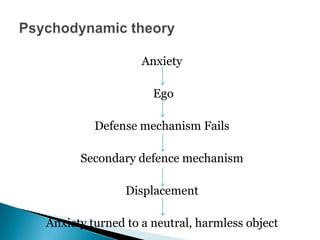
Anxiety
Ego
Defense mechanism Fails
Secondary defence mechanism
Displacement
Anxiety turned to a neutral, harmless object
 Phobias are generally caused by an event
recorded by the amygdala and hippocampus
and labelled as deadly or dangerous.
 Thus whenever a specific situation is
approached again the body reacts as if the
event were happening repeatedly afterward.
 Treatment comes in some way or another as a
replacing of the memory and reaction to the
previous event perceived as deadly with something
more realistic and based more rationally.
 Subconscious association causes far more fear
than is warranted based on the actual danger of
the stimulus.
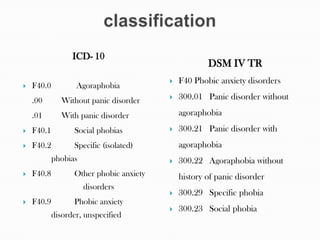
ICD- 10
 F40.0 Agoraphobia
.00 Without panic disorder
.01 With panic disorder
 F40.1 Social phobias
 F40.2 Specific (isolated)
phobias
 F40.8 Other phobic anxiety
disorders
 F40.9 Phobic anxiety
disorder, unspecified
DSM IV TR
 F40 Phobic anxiety disorders
 300.01 Panic disorder without
agoraphobia
 300.21 Panic disorder with
agoraphobia
 300.22 Agoraphobia without
history of panic disorder
 300.29 Specific phobia
 300.23 Social phobia
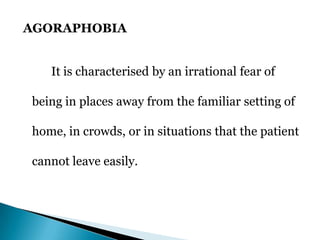
AGORAPHOBIA
It is characterised by an irrational fear of
being in places away from the familiar setting of
home, in crowds, or in situations that the patient
cannot leave easily.
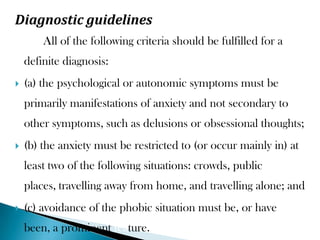
Diagnostic guidelines
All of the following criteria should be fulfilled for a
definite diagnosis:
 (a) the psychological or autonomic symptoms must be
primarily manifestations of anxiety and not secondary to
other symptoms, such as delusions or obsessional thoughts;
 (b) the anxiety must be restricted to (or occur mainly in) at
least two of the following situations: crowds, public
places, travelling away from home, and travelling alone; and
 (c) avoidance of the phobic situation must be, or have
been, a prominent feature.
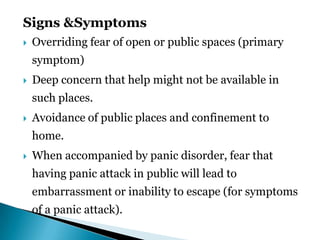
Signs &Symptoms
 Overriding fear of open or public spaces (primary
symptom)
 Deep concern that help might not be available in
such places.
 Avoidance of public places and confinement to
home.
 When accompanied by panic disorder, fear that
having panic attack in public will lead to
embarrassment or inability to escape (for symptoms
of a panic attack).
Social Phobia
It is an irrational fear of performing activities
in the presence of other people or interacting with
others. The patient is afraid of his own actions
being viewed by others critically, resulting in
embarrassment or humiliation.
Diagnostic guidelines
All of the following criteria should be fulfilled for a
definite diagnosis:
(a) The psychological, behavioural, or autonomic
symptoms must be primarily manifestations of anxiety
and not secondary to other symptoms such as
delusions or obsessional thoughts;
(b) The anxiety must be restricted to or predominate in
particular social situations; and
(c) The phobic situation is avoided whenever possible.
Signs &Symptoms
 Hyperventilation
 Sweating, cold, and clammy hands
 Blushing
 Palpitations
 Confusion
 Gastrointestinal symptoms
 Trembling hands and voice
 Urinary urgency
 Muscle tension
 Anticipatory anxiety
 Fear or embarrassment or ridicule
Specific Phobia
It is an irrational fear of a specific object or
stimulus. Simple phobias are common in
childhood .By early teenage most of these fears are
lost, but a few persist till adult life. Sometimes
they may reappear after a symptom-free period.
Exposure to the phobic object often results in
panic attack.
Diagnostic guidelines
All of the following should be fulfilled for a definite
diagnosis:
(a)The psychological or autonomic symptoms must be
primary manifestations of anxiety, and not secondary
to other symptoms such as delusion or obsessional
thought;
(b) the anxiety must be restricted to the presence of the
particular phobic object or situation
(c) the phobic situation is avoided whenever possible.
Signs &Symptoms
 Irrational and persistent fear of object or situation
 Immediate anxiety on contact with feared object or
situation
 Loss of control, fainting, or panic response.
 Avoidance of activities involving feared stimulus.
 Anxiety when thinking about stimulus.
 Worry with anticipatory anxiety.
 Possible impaired social or work functioning.
 PSYCHOTHERAPY
 COGNITIVE BEHAVIOUR THERAPY
 PHARMACOTHERAPY
 SUPPORTIVE THERAPY
INSIGHT-ORIENTED PSYCHOTHERAPY
It is superior to psychoanalytic
psychotherapy. Insight-oriented psychotherapy
enables the patient to understand the origin of
the phobia, phenomena of secondary gain and
the role of resistance, and enables the patient to
seek healthy ways of dealing with anxiety
provoking stimuli.
BEHAVIOUR THERAPY
 Desensitization
 Flooding
 Social skill training
Desensitization
Desensitization (also known as exposure
therapy), is a cognitive-behavioral therapy in
which people are gradually exposed to the
frightening object or event until they become used
to it and their physical symptoms decrease.
Flooding
Flooding is a more dramatic, cognitive-
behavioral approach in which person is
immediately exposed to the feared object or
situation. The person remains in the situation
until the anxiety lessens.
Social skill training
Social skill training includes
 Modeling
 Role-playing
The key aspects of successful behavior therapy are,
1. The patient’s commitment to treatment.
2. Clearly identified problems and objectives.
3. Available alternative strategies for coping with
the patient’s feelings.
Pharmacotherapy
 Antidepressant -
Phenelzine, tranylcypromine, imipramine, sertralin
e.
 Benzodiazepines-
clonazepam, alprazolam, lorazepam, diazepam.
 Beta-adrenergic antagonist –propranolol, atenolol.
Supportive therapy
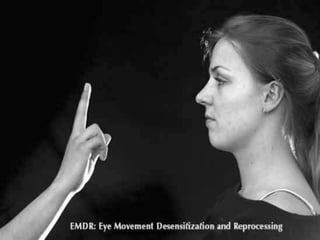
 Eye Movement Desensitization and Reprocessing
(EMDR) used to treat Post-traumatic stress
disorder, specific trauma.
 Hypnotherapy coupled with Neuro-linguistic
programming can also be used to help remove the
associations that trigger a phobic reaction.
NURSING MANAGEMENT
Assessment
 Anticipatory anxiety (when thinking about the phobic
object)
 Panic anxiety (when confronted with the phobic
object)
 Avoidance behaviors that interfere with relationships
or functioning
 Recognition of the phobia as irrational
 Embarrassment over the phobic fear
 Sufficient discomfort to seek treatment
Nursing diagnosis 1
 Fear related to a specific stimulus or causing
embarrassment to self in front of others, evidenced
by behaviour directed towards avoidance of the
feared object/situation.
Nursing Interventions
 Encourage the client to express
feelings, initially, without discussing the phobic
situation specifically.
 Teach the client and family or significant others about
phobic reactions.
 Reassure the client that he or she can learn to decrease
the anxiety and gain control over the anxiety attacks.
 Reassure the client that he or she will not be forced to
confront the phobic situation until prepared to do so.
 Assist the client to distinguish between the actual
phobic trigger and problems related to avoidance
behaviors.
 Encourage the client to practice relaxation until he or
she is successful.
 Explain systematic desensitization thoroughly to the
client.
 Reassure the client that you will allow him or her as
much time as needed at each step.
 Have the client develop a hierarchy of situations that
relate to the phobia by ranking from the least
anxiety-producing to the most anxiety-producing
situation.
 Beginning with the least anxiety-producing situation,
have the client use progressive relaxation until he or she
is able to decrease the anxiety. When the client is
comfortable with that situation, go to the next item on
the list, and repeat the procedure.
 It may be necessary to address specific avoidance
behavior(s) if any persist after the client has
completed the desensitizing process.
 Give positive feedback for the client's efforts at each
step. Convey the idea that he or she is succeeding at
each step.
 If the client becomes excessively anxious or begins to
feel out of control, return to the former step with
which the client was successful; then proceed slowly
to subsequent steps.
 As the client progresses in systematic
desensitization, ask the client if his or her avoidance
behaviors are decreasing.
Nursing diagnosis 2
 Social isolation related to fear of being in a place from
which one is unable to escape, evidenced by staying
alone, refusing to leave the room/home.
Interventions
 Convey an accepting attitude and unconditional
positive regard.
 Make brief, frequent contacts.
 Be honest and keep all promises.
 Attend group activities with the patient that may be
frightening for him.
 Administer anti-anxiety medications as ordered by
physician, monitor for effectiveness and adverse
effects.
 Discuss with the patient signs and symptoms of
increasing anxiety and techniques to interrupt the
response.
 Give recognition and positive reinforcement for
voluntary interactions with others.
Other nursing diagnoses are,
 Ineffective coping related to the fear attacks
associated with disease condition.
 Ineffective communication pattern related to the
fear associated with social gatherings.

Phobia

  • 1.
  • 3.
     The wordphobia is derived from the Greek phobos meaning extreme fear and flight.  The ancient Greek god, Phobos, was believed to be able to reduce the enemies of the Greeks to a state of abject terror, making victory in battle more likely.
  • 4.
    Fear cued bythe presence or anticipation of a specific object or situation, exposure to which almost invariably provokes an immediate anxiety response or panic attack even though the subject recognizes that the fear is excessive or unreasonable. The phobic stimulus is avoided or endured with marked distress. (Shahrokh & Hales, 2003)
  • 5.
    According to theAmerican Psychiatric Association, a phobia is an irrational and excessive fear of an object or situation. Phobia is persistent avoidance behaviour secondary to irrational fear of a specific object, activity or situation. (Ashok Singhal)
  • 6.
    Marks has definedphobia on the following four criteria: 1. The fear is out of proportion to the demands of the situation. 2. It cannot be explained or reasoned away. 3. It is beyond voluntary control. 4. The fear leads to an avoidance of the feared situation.
  • 7.
    Epidemiology  Phobias arethe most common of all anxiety disorders.  Social phobia is the most common of all phobias  Lifetime prevalence rates of agoraphobia have been reported from a number of studies.  Social phobia in males -11.1 and females -15.5 and a total of 13.3.
  • 8.
     Specific phobiaoccurs in 2.4 to 9.2 percent of children and adolescents, with usual onset between 5 and 13 years of age.  Women receive diagnoses of specific phobia more often than men.  Onset is often sudden and course usually chronic.
  • 9.
    According to NIMH, 1%-12.5% of Americans have phobias.  Psychiatric disease commonest between the women of all the ages and are the second common disease between the men oldest of 25.  Typical age of onset of phobias is usually childhood and adolescence.  The age of onset is earliest in animal phobias, intermediate in social phobias and latest in agoraphobia.
  • 10.
     Patients withagoraphobia consistently have the highest rate of co-morbidity, and animal and situational.  Patients with social phobia have an increased rate of suicidal ideation, financial dependancy and having sought medical treatment.
  • 11.
     Pairing ofa naturally frightening stimulus with a second inherently neutral stimulus.  As a result of the contiguity, especially when the two stimuli are paired on several occasions, the originally neutral stimulus takes on the capacity to arouse anxiety by itself.  The neutral stimulus, therefore, becomes a conditioned stimulus for anxiety production.
  • 12.
     Anxiety isa drive that motivates the organism to do what it can, to obviate the painful affect.  In the course of its random behaviour, the organism learns that certain actions enable it to avoid the anxiety-provoking stimulus.  Those avoidance patterns remain stable for long periods of time; as a result of the reinforcement they receive from their capacity to diminish activity.
  • 13.
     In socialand specific phobia, the conflict is regarding sexual arousal, leading to castration anxiety.  When repression fails to be entirely successful, the ego must call on auxiliary defences like displacement, symbolization and avoidance.  In agoraphobia, it is the separation anxiety playing a central role.
  • 14.
     Interaction betweengenetic constitutional diathesis and environmental stressors.
  • 15.
    Anxiety Ego Defense mechanism Fails Secondarydefence mechanism Displacement Anxiety turned to a neutral, harmless object
  • 16.
     Phobias aregenerally caused by an event recorded by the amygdala and hippocampus and labelled as deadly or dangerous.  Thus whenever a specific situation is approached again the body reacts as if the event were happening repeatedly afterward.
  • 17.
     Treatment comesin some way or another as a replacing of the memory and reaction to the previous event perceived as deadly with something more realistic and based more rationally.  Subconscious association causes far more fear than is warranted based on the actual danger of the stimulus.
  • 18.
    ICD- 10  F40.0Agoraphobia .00 Without panic disorder .01 With panic disorder  F40.1 Social phobias  F40.2 Specific (isolated) phobias  F40.8 Other phobic anxiety disorders  F40.9 Phobic anxiety disorder, unspecified DSM IV TR  F40 Phobic anxiety disorders  300.01 Panic disorder without agoraphobia  300.21 Panic disorder with agoraphobia  300.22 Agoraphobia without history of panic disorder  300.29 Specific phobia  300.23 Social phobia
  • 20.
    AGORAPHOBIA It is characterisedby an irrational fear of being in places away from the familiar setting of home, in crowds, or in situations that the patient cannot leave easily.
  • 21.
    Diagnostic guidelines All ofthe following criteria should be fulfilled for a definite diagnosis:  (a) the psychological or autonomic symptoms must be primarily manifestations of anxiety and not secondary to other symptoms, such as delusions or obsessional thoughts;  (b) the anxiety must be restricted to (or occur mainly in) at least two of the following situations: crowds, public places, travelling away from home, and travelling alone; and  (c) avoidance of the phobic situation must be, or have been, a prominent feature.
  • 22.
    Signs &Symptoms  Overridingfear of open or public spaces (primary symptom)  Deep concern that help might not be available in such places.  Avoidance of public places and confinement to home.  When accompanied by panic disorder, fear that having panic attack in public will lead to embarrassment or inability to escape (for symptoms of a panic attack).
  • 24.
    Social Phobia It isan irrational fear of performing activities in the presence of other people or interacting with others. The patient is afraid of his own actions being viewed by others critically, resulting in embarrassment or humiliation.
  • 25.
    Diagnostic guidelines All ofthe following criteria should be fulfilled for a definite diagnosis: (a) The psychological, behavioural, or autonomic symptoms must be primarily manifestations of anxiety and not secondary to other symptoms such as delusions or obsessional thoughts; (b) The anxiety must be restricted to or predominate in particular social situations; and (c) The phobic situation is avoided whenever possible.
  • 26.
    Signs &Symptoms  Hyperventilation Sweating, cold, and clammy hands  Blushing  Palpitations  Confusion  Gastrointestinal symptoms  Trembling hands and voice  Urinary urgency  Muscle tension  Anticipatory anxiety  Fear or embarrassment or ridicule
  • 28.
    Specific Phobia It isan irrational fear of a specific object or stimulus. Simple phobias are common in childhood .By early teenage most of these fears are lost, but a few persist till adult life. Sometimes they may reappear after a symptom-free period. Exposure to the phobic object often results in panic attack.
  • 29.
    Diagnostic guidelines All ofthe following should be fulfilled for a definite diagnosis: (a)The psychological or autonomic symptoms must be primary manifestations of anxiety, and not secondary to other symptoms such as delusion or obsessional thought; (b) the anxiety must be restricted to the presence of the particular phobic object or situation (c) the phobic situation is avoided whenever possible.
  • 30.
    Signs &Symptoms  Irrationaland persistent fear of object or situation  Immediate anxiety on contact with feared object or situation  Loss of control, fainting, or panic response.  Avoidance of activities involving feared stimulus.  Anxiety when thinking about stimulus.  Worry with anticipatory anxiety.  Possible impaired social or work functioning.
  • 31.
     PSYCHOTHERAPY  COGNITIVEBEHAVIOUR THERAPY  PHARMACOTHERAPY  SUPPORTIVE THERAPY
  • 32.
    INSIGHT-ORIENTED PSYCHOTHERAPY It issuperior to psychoanalytic psychotherapy. Insight-oriented psychotherapy enables the patient to understand the origin of the phobia, phenomena of secondary gain and the role of resistance, and enables the patient to seek healthy ways of dealing with anxiety provoking stimuli.
  • 33.
    BEHAVIOUR THERAPY  Desensitization Flooding  Social skill training
  • 34.
    Desensitization Desensitization (also knownas exposure therapy), is a cognitive-behavioral therapy in which people are gradually exposed to the frightening object or event until they become used to it and their physical symptoms decrease.
  • 35.
    Flooding Flooding is amore dramatic, cognitive- behavioral approach in which person is immediately exposed to the feared object or situation. The person remains in the situation until the anxiety lessens.
  • 36.
    Social skill training Socialskill training includes  Modeling  Role-playing
  • 37.
    The key aspectsof successful behavior therapy are, 1. The patient’s commitment to treatment. 2. Clearly identified problems and objectives. 3. Available alternative strategies for coping with the patient’s feelings.
  • 38.
    Pharmacotherapy  Antidepressant - Phenelzine,tranylcypromine, imipramine, sertralin e.  Benzodiazepines- clonazepam, alprazolam, lorazepam, diazepam.  Beta-adrenergic antagonist –propranolol, atenolol.
  • 39.
    Supportive therapy  EyeMovement Desensitization and Reprocessing (EMDR) used to treat Post-traumatic stress disorder, specific trauma.  Hypnotherapy coupled with Neuro-linguistic programming can also be used to help remove the associations that trigger a phobic reaction.
  • 40.
    NURSING MANAGEMENT Assessment  Anticipatoryanxiety (when thinking about the phobic object)  Panic anxiety (when confronted with the phobic object)  Avoidance behaviors that interfere with relationships or functioning  Recognition of the phobia as irrational  Embarrassment over the phobic fear  Sufficient discomfort to seek treatment
  • 41.
    Nursing diagnosis 1 Fear related to a specific stimulus or causing embarrassment to self in front of others, evidenced by behaviour directed towards avoidance of the feared object/situation. Nursing Interventions  Encourage the client to express feelings, initially, without discussing the phobic situation specifically.
  • 42.
     Teach theclient and family or significant others about phobic reactions.  Reassure the client that he or she can learn to decrease the anxiety and gain control over the anxiety attacks.  Reassure the client that he or she will not be forced to confront the phobic situation until prepared to do so.
  • 43.
     Assist theclient to distinguish between the actual phobic trigger and problems related to avoidance behaviors.  Encourage the client to practice relaxation until he or she is successful.  Explain systematic desensitization thoroughly to the client.  Reassure the client that you will allow him or her as much time as needed at each step.
  • 45.
     Have theclient develop a hierarchy of situations that relate to the phobia by ranking from the least anxiety-producing to the most anxiety-producing situation.  Beginning with the least anxiety-producing situation, have the client use progressive relaxation until he or she is able to decrease the anxiety. When the client is comfortable with that situation, go to the next item on the list, and repeat the procedure.
  • 46.
     It maybe necessary to address specific avoidance behavior(s) if any persist after the client has completed the desensitizing process.  Give positive feedback for the client's efforts at each step. Convey the idea that he or she is succeeding at each step.
  • 47.
     If theclient becomes excessively anxious or begins to feel out of control, return to the former step with which the client was successful; then proceed slowly to subsequent steps.  As the client progresses in systematic desensitization, ask the client if his or her avoidance behaviors are decreasing.
  • 48.
    Nursing diagnosis 2 Social isolation related to fear of being in a place from which one is unable to escape, evidenced by staying alone, refusing to leave the room/home. Interventions  Convey an accepting attitude and unconditional positive regard.  Make brief, frequent contacts.  Be honest and keep all promises.  Attend group activities with the patient that may be frightening for him.
  • 49.
     Administer anti-anxietymedications as ordered by physician, monitor for effectiveness and adverse effects.  Discuss with the patient signs and symptoms of increasing anxiety and techniques to interrupt the response.  Give recognition and positive reinforcement for voluntary interactions with others.
  • 50.
    Other nursing diagnosesare,  Ineffective coping related to the fear attacks associated with disease condition.  Ineffective communication pattern related to the fear associated with social gatherings.