Done by:
Saffia Al Zoubi (215510634)
Ghadeer Al-Kholaidi (214511257)
Maisa Salem (211410501)
Mahnoor Siddiqui (215510561)
Fatima Alhamed (215410395)
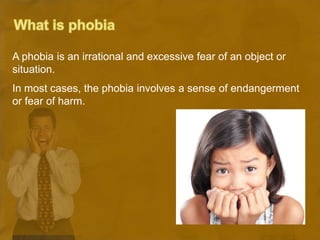
A phobia is an irrational and excessive fear of an object or
situation.
In most cases, the phobia involves a sense of endangerment
or fear of harm.
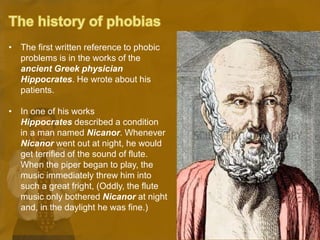
• The first written reference to phobic
problems is in the works of the
ancient Greek physician
Hippocrates. He wrote about his
patients.
• In one of his works
Hippocrates described a condition
in a man named Nicanor. Whenever
Nicanor went out at night, he would
get terrified of the sound of flute.
When the piper began to play, the
music immediately threw him into
such a great fright, (Oddly, the flute
music only bothered Nicanor at night
and, in the daylight he was fine.)
Phobia Fear
A phobia is similar to a fear with
one key difference: the anxiety they
experience is so strong that it
interferes with their quality of life
and/ or their ability to function
A fear is an emotional response to a
real or perceived threat. Fears are
common in the population and are
often normal -- or at least innocuous
-- reactions to objects or events
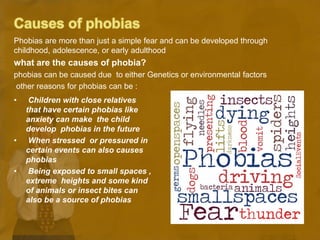
Phobias are more than just a simple fear and can be developed through
childhood, adolescence, or early adulthood
what are the causes of phobia?
phobias can be caused due to either Genetics or environmental factors
other reasons for phobias can be :
• Children with close relatives
that have certain phobias like
anxiety can make the child
develop phobias in the future
• When stressed or pressured in
certain events can also causes
phobias
• Being exposed to small spaces ,
extreme heights and some kind
of animals or insect bites can
also be a source of phobias
The symptoms of phobias are generally the same symptoms for every kind of
phobia but may differ in one or two things. These symptoms can be either physical
or psychological.
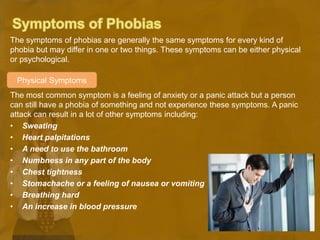
The most common symptom is a feeling of anxiety or a panic attack but a person
can still have a phobia of something and not experience these symptoms. A panic
attack can result in a lot of other symptoms including:
• Sweating
• Heart palpitations
• A need to use the bathroom
• Numbness in any part of the body
• Chest tightness
• Stomachache or a feeling of nausea or vomiting
• Breathing hard
• An increase in blood pressure
Physical Symptoms
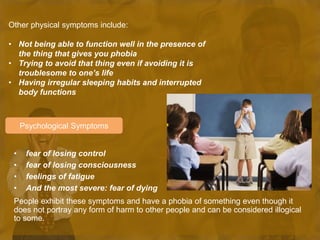
Psychological Symptoms
• fear of losing control
• fear of losing consciousness
• feelings of fatigue
• And the most severe: fear of dying
People exhibit these symptoms and have a phobia of something even though it
does not portray any form of harm to other people and can be considered illogical
to some.
Other physical symptoms include:
• Not being able to function well in the presence of
the thing that gives you phobia
• Trying to avoid that thing even if avoiding it is
troublesome to one’s life
• Having irregular sleeping habits and interrupted
body functions
• FEAR OF “OPEN SPACES”, panic disorder
• Extreme fear of places or situations where escape is
difficult or where help is unavailable.
• Effects:, avoid going out, stress, panic attacks, fear of
being alone, depression
• EXAMPLE: CROWDED PLACES, AIRPLANES
(TRANSPORTATION), home
Agoraphobia
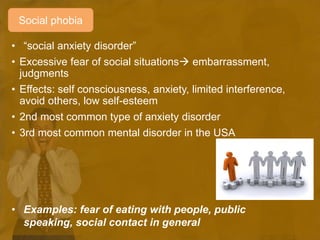
• “social anxiety disorder”
• Excessive fear of social situations embarrassment,
judgments
• Effects: self consciousness, anxiety, limited interference,
avoid others, low self-esteem
• 2nd most common type of anxiety disorder
• 3rd most common mental disorder in the USA
• Examples: fear of eating with people, public
speaking, social contact in general
Social phobia
• Unreasonable, excessive fear of certain objects or
situations in daily life
• Effects: intense anxiety, person’s ability to function
Specific phobia
Specific
Phobias
Animal Phobias
Aracnophobia
Ophidophobia
Cynophobia
Situational Phobias
Aviophobia
Acrophobia
Glossophobia
Medical/Injury
Phobias
Hemophobia
Dental Phobia
Natural environment
Phobias
Astraphobia
Heliophobia
OtherPphobias
Nyctophobia
Phobophobia
Coulrophobia
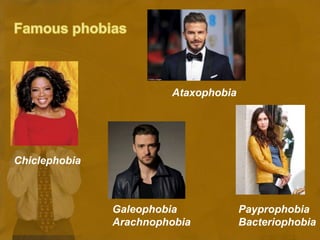
Chiclephobia
Ataxophobia
Galeophobia
Arachnophobia
Payprophobia
Bacteriophobia
• When a person is diagnosed with a certain
phobia its either :
which is developed early in childhood between the
ages of 4-8 . it can be developed because of a
certain experience that grows the fear within them,
and times passes till it turns into a fear (Phobia) . it
is not necessarily a genetic cause sometimes an
unpleasant event happened which left a mark on
the child
from the name this type of phobia is a complicated type, because it is a
combination of genetics , brain chemistry and certain life experiences.
another cause of complex phobia can be found in the field of neuroscience. the
brain sees certain images as scary or frighting, by that it sends a message to the
brain which it starts to develop some kind of fear (Phobia).
Simple phobia:
Complex phobia
How well phobia treatment will work depends partly on the severity of the
phobia. Though some phobias are never completely cured, therapy can help
many people learn to function effectively.
Types of therapy include:
Counter-Conditioning
Psychotherapy
Medication
Some overcame their fears by attending phobia clinics and support groups
Counter-conditioning
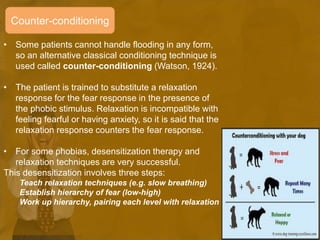
• Some patients cannot handle flooding in any form,
so an alternative classical conditioning technique is
used called counter-conditioning (Watson, 1924).
• The patient is trained to substitute a relaxation
response for the fear response in the presence of
the phobic stimulus. Relaxation is incompatible with
feeling fearful or having anxiety, so it is said that the
relaxation response counters the fear response.
• For some phobias, desensitization therapy and
relaxation techniques are very successful.
This desensitization involves three steps:
Teach relaxation techniques (e.g. slow breathing)
Establish hierarchy of fear (low-high)
Work up hierarchy, pairing each level with relaxation
Psychotherapy
• Treating social phobia usually involves gradual exposure
to social situations, along with role-playing and rehearsal.
Individuals are taught methods to reduce the anxiety they
feel. They are also encouraged to be less critical of
themselves.
• The best treatment for agoraphobia is to gradually move
the phobic person into the places and situations that trigger
anxiety. By taking small steps each day – with the company
of a trusted person - a sufferer eventually learns to cope
with situations that once caused intense fear.
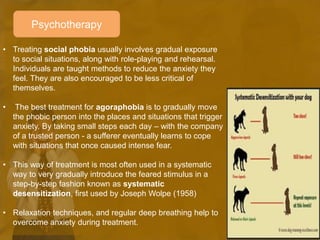
• This way of treatment is most often used in a systematic
way to very gradually introduce the feared stimulus in a
step-by-step fashion known as systematic
desensitization, first used by Joseph Wolpe (1958)
• Relaxation techniques, and regular deep breathing help to
overcome anxiety during treatment.
Medication
• The therapist may sometimes decide that
medications will help. In the treatment of
phobias, medications are used in conjunction
with therapy and may not necessarily be a part
of initial treatment.
• Antidepressants reuptake inhibitors like paroxetine or antianxiety, can be
especially helpful in the treatment of social phobia and preventing panic attacks
that take part in phobias such as agoraphobia. This way, the patients can deal
with the problem itself without having to deal with the panic attacks that come
from it
• Short-term treatment may also include sedative-hypnotic drugs can relieve
anxiety but may be habit-forming and cause drowsiness. Therefore, they may
not be the best choice when long-term symptom control is needed, or when one
has to be fully alert and perform certain tasks such as driving or operating
machines.
• Beta-blockers are also sometimes given lessen the fear response.
• Finally, some anticonvulsant medicines such as Neurontin and Lyrica have been
shown in early research studies to have value for several forms of social phobia
including anxiety disorder
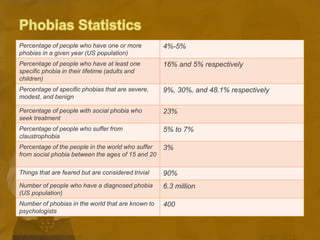
Percentage of people who have one or more
phobias in a given year (US population)
4%-5%
Percentage of people who have at least one
specific phobia in their lifetime (adults and
children)
16% and 5% respectively
Percentage of specific phobias that are severe,
modest, and benign
9%, 30%, and 48.1% respectively
Percentage of people with social phobia who
seek treatment
23%
Percentage of people who suffer from
claustrophobia
5% to 7%
Percentage of the people in the world who suffer
from social phobia between the ages of 15 and 20
3%
Things that are feared but are considered trivial 90%
Number of people who have a diagnosed phobia
(US population)
6.3 million
Number of phobias in the world that are known to
psychologists
400
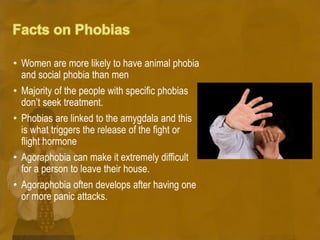
• Women are more likely to have animal phobia
and social phobia than men
• Majority of the people with specific phobias
don’t seek treatment.
• Phobias are linked to the amygdala and this
is what triggers the release of the fight or
flight hormone
• Agoraphobia can make it extremely difficult
for a person to leave their house.
• Agoraphobia often develops after having one
or more panic attacks.
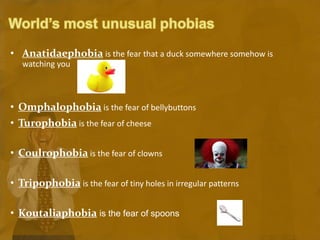
• Anatidaephobia is the fear that a duck somewhere somehow is
watching you
• Omphalophobia is the fear of bellybuttons
• Turophobia is the fear of cheese
• Coulrophobia is the fear of clowns
• Tripophobia is the fear of tiny holes in irregular patterns
• Koutaliaphobia is the fear of spoons
Thank you
• Saffia Al Zoubi (ID: 215510634): The symptoms of
phobia, statistics and facts, world’s most unusual phobias,
and compiling the information into one presentation
• Ghadeer Al-kholaidi (ID: 214511257): The
treatment of phobia
• Maisa Salem (ID: 211410501): Causes and
diagnosis of phobia
• Mahnoor Siddiqui (ID: 215510561): Types of
phobias, famous phobias, and short clip of phobia
• Fatima Alhamed (ID: 215410395): What is phobia,
history of phobia, and difference between phobia and fear
• K. C. (2016, May 9). What Are the Different Types of Phobias? Retrieved from
https://www.verywell.com/what-is-a-phobia-2795454
• Adapted from The Complete Idiot’s Guide to Phobias, copyright 2009, by Greg Korgeski, Ph.D.
• R. C., Ph.D. (2012, June 16). The Difference Between Phobia and Fear. Retrieved from
http://www.huffingtonpost.ca/roger-covin/phobia-and-fear_b_1596640.html
• http://www.phobics-society.org.uk/causes-of-phobias/
• http://www.nhs.uk/Conditions/Phobias/Pages/Symptoms.aspx
• http://chealth.canoe.com/Condition/GetCondition/Phobias
• http://psychcentral.com/lib/facts-about-phobias/ (By national institute of mental health
• http://www.dailymail.co.uk/health/article-37000/Trapped-web-phobias.html (By Michael Hanlon)
• http://factsd.com/phobia-facts/ (By Kristoff Bella)
• http://www.healthline.com/health/phobia-simple-specific#Overview1
• http://www.webmd.com/anxiety-panic/specific-phobias
• http://www.webmd.com/anxiety-panic/guide/mental-health-social-anxiety-disorder?page=2#1
• http://www.webmd.com/anxiety-panic/guide/mental-health-social-anxiety-disorder
• http://www.nickiswift.com/3628/celebrities-weird-phobias/
• http://phobialist.com/treat.html
• http://www.helpguide.org/articles/anxiety/therapy-for-anxiety-disorders.htm
• http://www.webmd.com/anxiety-panic/understanding-phobias-treatment

Phobia

  • 1.
    Done by: Saffia AlZoubi (215510634) Ghadeer Al-Kholaidi (214511257) Maisa Salem (211410501) Mahnoor Siddiqui (215510561) Fatima Alhamed (215410395)
  • 2.
    A phobia isan irrational and excessive fear of an object or situation. In most cases, the phobia involves a sense of endangerment or fear of harm.
  • 3.
    • The firstwritten reference to phobic problems is in the works of the ancient Greek physician Hippocrates. He wrote about his patients. • In one of his works Hippocrates described a condition in a man named Nicanor. Whenever Nicanor went out at night, he would get terrified of the sound of flute. When the piper began to play, the music immediately threw him into such a great fright, (Oddly, the flute music only bothered Nicanor at night and, in the daylight he was fine.)
  • 4.
    Phobia Fear A phobiais similar to a fear with one key difference: the anxiety they experience is so strong that it interferes with their quality of life and/ or their ability to function A fear is an emotional response to a real or perceived threat. Fears are common in the population and are often normal -- or at least innocuous -- reactions to objects or events
  • 5.
    Phobias are morethan just a simple fear and can be developed through childhood, adolescence, or early adulthood what are the causes of phobia? phobias can be caused due to either Genetics or environmental factors other reasons for phobias can be : • Children with close relatives that have certain phobias like anxiety can make the child develop phobias in the future • When stressed or pressured in certain events can also causes phobias • Being exposed to small spaces , extreme heights and some kind of animals or insect bites can also be a source of phobias
  • 6.
    The symptoms ofphobias are generally the same symptoms for every kind of phobia but may differ in one or two things. These symptoms can be either physical or psychological. The most common symptom is a feeling of anxiety or a panic attack but a person can still have a phobia of something and not experience these symptoms. A panic attack can result in a lot of other symptoms including: • Sweating • Heart palpitations • A need to use the bathroom • Numbness in any part of the body • Chest tightness • Stomachache or a feeling of nausea or vomiting • Breathing hard • An increase in blood pressure Physical Symptoms
  • 7.
    Psychological Symptoms • fearof losing control • fear of losing consciousness • feelings of fatigue • And the most severe: fear of dying People exhibit these symptoms and have a phobia of something even though it does not portray any form of harm to other people and can be considered illogical to some. Other physical symptoms include: • Not being able to function well in the presence of the thing that gives you phobia • Trying to avoid that thing even if avoiding it is troublesome to one’s life • Having irregular sleeping habits and interrupted body functions
  • 8.
    • FEAR OF“OPEN SPACES”, panic disorder • Extreme fear of places or situations where escape is difficult or where help is unavailable. • Effects:, avoid going out, stress, panic attacks, fear of being alone, depression • EXAMPLE: CROWDED PLACES, AIRPLANES (TRANSPORTATION), home Agoraphobia
  • 9.
    • “social anxietydisorder” • Excessive fear of social situations embarrassment, judgments • Effects: self consciousness, anxiety, limited interference, avoid others, low self-esteem • 2nd most common type of anxiety disorder • 3rd most common mental disorder in the USA • Examples: fear of eating with people, public speaking, social contact in general Social phobia
  • 10.
    • Unreasonable, excessivefear of certain objects or situations in daily life • Effects: intense anxiety, person’s ability to function Specific phobia
  • 11.
    Specific Phobias Animal Phobias Aracnophobia Ophidophobia Cynophobia Situational Phobias Aviophobia Acrophobia Glossophobia Medical/Injury Phobias Hemophobia DentalPhobia Natural environment Phobias Astraphobia Heliophobia OtherPphobias Nyctophobia Phobophobia Coulrophobia
  • 12.
  • 13.
    • When aperson is diagnosed with a certain phobia its either : which is developed early in childhood between the ages of 4-8 . it can be developed because of a certain experience that grows the fear within them, and times passes till it turns into a fear (Phobia) . it is not necessarily a genetic cause sometimes an unpleasant event happened which left a mark on the child from the name this type of phobia is a complicated type, because it is a combination of genetics , brain chemistry and certain life experiences. another cause of complex phobia can be found in the field of neuroscience. the brain sees certain images as scary or frighting, by that it sends a message to the brain which it starts to develop some kind of fear (Phobia). Simple phobia: Complex phobia
  • 14.
    How well phobiatreatment will work depends partly on the severity of the phobia. Though some phobias are never completely cured, therapy can help many people learn to function effectively. Types of therapy include: Counter-Conditioning Psychotherapy Medication Some overcame their fears by attending phobia clinics and support groups
  • 15.
    Counter-conditioning • Some patientscannot handle flooding in any form, so an alternative classical conditioning technique is used called counter-conditioning (Watson, 1924). • The patient is trained to substitute a relaxation response for the fear response in the presence of the phobic stimulus. Relaxation is incompatible with feeling fearful or having anxiety, so it is said that the relaxation response counters the fear response. • For some phobias, desensitization therapy and relaxation techniques are very successful. This desensitization involves three steps: Teach relaxation techniques (e.g. slow breathing) Establish hierarchy of fear (low-high) Work up hierarchy, pairing each level with relaxation
  • 16.
    Psychotherapy • Treating socialphobia usually involves gradual exposure to social situations, along with role-playing and rehearsal. Individuals are taught methods to reduce the anxiety they feel. They are also encouraged to be less critical of themselves. • The best treatment for agoraphobia is to gradually move the phobic person into the places and situations that trigger anxiety. By taking small steps each day – with the company of a trusted person - a sufferer eventually learns to cope with situations that once caused intense fear. • This way of treatment is most often used in a systematic way to very gradually introduce the feared stimulus in a step-by-step fashion known as systematic desensitization, first used by Joseph Wolpe (1958) • Relaxation techniques, and regular deep breathing help to overcome anxiety during treatment.
  • 17.
    Medication • The therapistmay sometimes decide that medications will help. In the treatment of phobias, medications are used in conjunction with therapy and may not necessarily be a part of initial treatment. • Antidepressants reuptake inhibitors like paroxetine or antianxiety, can be especially helpful in the treatment of social phobia and preventing panic attacks that take part in phobias such as agoraphobia. This way, the patients can deal with the problem itself without having to deal with the panic attacks that come from it • Short-term treatment may also include sedative-hypnotic drugs can relieve anxiety but may be habit-forming and cause drowsiness. Therefore, they may not be the best choice when long-term symptom control is needed, or when one has to be fully alert and perform certain tasks such as driving or operating machines. • Beta-blockers are also sometimes given lessen the fear response. • Finally, some anticonvulsant medicines such as Neurontin and Lyrica have been shown in early research studies to have value for several forms of social phobia including anxiety disorder
  • 18.
    Percentage of peoplewho have one or more phobias in a given year (US population) 4%-5% Percentage of people who have at least one specific phobia in their lifetime (adults and children) 16% and 5% respectively Percentage of specific phobias that are severe, modest, and benign 9%, 30%, and 48.1% respectively Percentage of people with social phobia who seek treatment 23% Percentage of people who suffer from claustrophobia 5% to 7% Percentage of the people in the world who suffer from social phobia between the ages of 15 and 20 3% Things that are feared but are considered trivial 90% Number of people who have a diagnosed phobia (US population) 6.3 million Number of phobias in the world that are known to psychologists 400
  • 19.
    • Women aremore likely to have animal phobia and social phobia than men • Majority of the people with specific phobias don’t seek treatment. • Phobias are linked to the amygdala and this is what triggers the release of the fight or flight hormone • Agoraphobia can make it extremely difficult for a person to leave their house. • Agoraphobia often develops after having one or more panic attacks.
  • 20.
    • Anatidaephobia isthe fear that a duck somewhere somehow is watching you • Omphalophobia is the fear of bellybuttons • Turophobia is the fear of cheese • Coulrophobia is the fear of clowns • Tripophobia is the fear of tiny holes in irregular patterns • Koutaliaphobia is the fear of spoons
  • 21.
  • 22.
    • Saffia AlZoubi (ID: 215510634): The symptoms of phobia, statistics and facts, world’s most unusual phobias, and compiling the information into one presentation • Ghadeer Al-kholaidi (ID: 214511257): The treatment of phobia • Maisa Salem (ID: 211410501): Causes and diagnosis of phobia • Mahnoor Siddiqui (ID: 215510561): Types of phobias, famous phobias, and short clip of phobia • Fatima Alhamed (ID: 215410395): What is phobia, history of phobia, and difference between phobia and fear
  • 23.
    • K. C.(2016, May 9). What Are the Different Types of Phobias? Retrieved from https://www.verywell.com/what-is-a-phobia-2795454 • Adapted from The Complete Idiot’s Guide to Phobias, copyright 2009, by Greg Korgeski, Ph.D. • R. C., Ph.D. (2012, June 16). The Difference Between Phobia and Fear. Retrieved from http://www.huffingtonpost.ca/roger-covin/phobia-and-fear_b_1596640.html • http://www.phobics-society.org.uk/causes-of-phobias/ • http://www.nhs.uk/Conditions/Phobias/Pages/Symptoms.aspx • http://chealth.canoe.com/Condition/GetCondition/Phobias • http://psychcentral.com/lib/facts-about-phobias/ (By national institute of mental health • http://www.dailymail.co.uk/health/article-37000/Trapped-web-phobias.html (By Michael Hanlon) • http://factsd.com/phobia-facts/ (By Kristoff Bella) • http://www.healthline.com/health/phobia-simple-specific#Overview1 • http://www.webmd.com/anxiety-panic/specific-phobias • http://www.webmd.com/anxiety-panic/guide/mental-health-social-anxiety-disorder?page=2#1 • http://www.webmd.com/anxiety-panic/guide/mental-health-social-anxiety-disorder • http://www.nickiswift.com/3628/celebrities-weird-phobias/ • http://phobialist.com/treat.html • http://www.helpguide.org/articles/anxiety/therapy-for-anxiety-disorders.htm • http://www.webmd.com/anxiety-panic/understanding-phobias-treatment