NILE UNIVERSITY OF
NIGERIA
Departments of Civil
Engineering and Petroleum Gas
Engineering
Group B10
PISHIKENI SHILOBA JOHN
(151202025)
FATIMA FARUK ABUBAKAR
(151202027)
NURUDDEEN BAGARE
(151202002)
BADRIYYAH SALIHU
(161205022)
1
Perovskites
Objectives
1. To explain what a perovskite is.
2. To establish structure-property correlation
3. To explore techniques for its processing
4. To investigate its applications
2
Introduction
Perovskite is Calcium Titanium Oxide or Calcium Titanate,
with the chemical formula CaTiO3 .The mineral was
discovered by Gustav Rose in 1839 and is named after
Russian mineralogist Count Lev Alelseevich Perovski (1792-
1856).
All materials with the same crystal structure as CaTiO3,
namely ABX3, are termed perovskites.
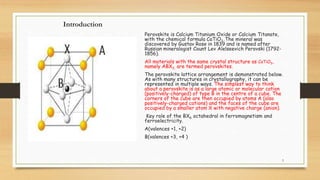
The perovskite lattice arrangement is demonstrated below.
As with many structures in crystallography, it can be
represented in multiple ways. The simplest way to think
about a perovskite is as a large atomic or molecular cation
(positively-charged) of type B in the centre of a cube. The
corners of the cube are then occupied by atoms A (also
positively-charged cations) and the faces of the cube are
occupied by a smaller atom X with negative charge (anion).
Key role of the BX6 octahedral in ferromagnetism and
ferroelectricity.
A(valences +1, +2)
B(valences +3, +4 )
3
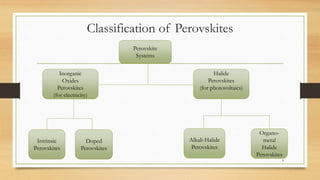
Classification of Perovskites
Perovskite
Systems
Inorganic
Oxides
Perovskites
(for electricity)
Organo-
metal
Halide
Perovskites
Intrinsic
Perovskites
Halide
Perovskites
(for photovoltaics)
Alkali-Halide
Perovskites
Doped
Perovskites
4
STRUCTURE-PROPERTY
CORRELATION
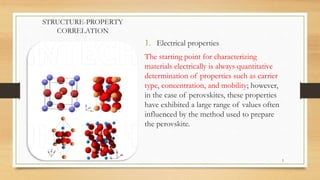
1. Electrical properties
The starting point for characterizing
materials electrically is always quantitative
determination of properties such as carrier
type, concentration, and mobility; however,
in the case of perovskites, these properties
have exhibited a large range of values often
influenced by the method used to prepare
the perovskite.
5
Worthy of note:
Yttrium barium copper oxide can be insulating or conducting depending on oxygen content.
The oxygen nonstoichiometric is one of the most significant reasons for the high value of Tc. It crystallizes into orthorhombic
structure, which is superconductive, it showed a tetragonal structure that does not show any superconductivity.
a. Dielectric property
There are some properties inherent to dielectric
materials like ferroelectricity, piezoelectricity,
electrostriction, and pyroelectricity. One of the
important characteristic of perovskites is ferroelectric
behaviour, which is obvious in BaTiO3, PdZrO3 and
their doped compounds.
The ferroelectric behaviour of BaTiO3 was strongly
related to its crystal structure. BaTiO3 was subjected
to three phase transitions; as the temperature
increases, it was converted from monoclinic to
tetragonal then to cubic. At temperature higher than
300K, BaTiO3 does not show any ferroelectric
behaviour as it crystallizes into cubic structure.
Rather, it showed high dielectric constant.
Electrical conductivity
Cu-based perovskites act as high-temperature
superconductors. The presence of Cu in A-
site is essential for the superconductivity and
various superconducting oxides can be
manufactured with different B-site ions.
The electronic conductivity of the
perovskites can be enhanced by doping the
A-site with another cation, which resulted in
increasing the quantity of the mobile charge
carriers created by the reparations of charge.
6
Catalytic properties
Perovskites showed excellent catalytic activity and high chemical stability.
Perovskites can be described as a model of active sites and as an oxidation or
oxygen-activated catalyst. The stability of the perovskite structure allowed the
compounds preparation from elements with unusual valence states or a high
extent of oxygen deficiency. Perovskites exhibited high catalytic activity, which
is partially associated with the high surface activity to oxygen reduction ratio or
oxygen activation that resulted from the large number of oxygen vacancies.
7
Optical properties
Although there are a lot of challenges in determining with certainty the optical
properties of perovskites (still under research). Progress in this area has been
hindered by the difficulty of producing continuous films of sufficient
smoothness and neglect of some morphological contributions(band structure)
which affect optical transition and further complicate accurate determination
of the absorption coefficient and other optical parameters of perovskite films.
However, hybrid perovskites (especially lead-halide perovskite) have recently
received a lot of attention due to high photoluminescence and quantum yields.
It has high optical absorption coefficient, excellent
charge carrier transport (crystallinity).
8
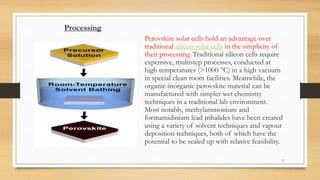
Processing
Perovskite solar cells hold an advantage over
traditional silicon solar cells in the simplicity of
their processing. Traditional silicon cells require
expensive, multistep processes, conducted at
high temperatures (>1000 °C) in a high vacuum
in special clean room facilities. Meanwhile, the
organic-inorganic perovskite material can be
manufactured with simpler wet chemistry
techniques in a traditional lab environment.
Most notably, methylammonium and
formamidinium lead trihalides have been created
using a variety of solvent techniques and vapour
deposition techniques, both of which have the
potential to be scaled up with relative feasibility.
9
Processing techniques
Solution processing
In one-step solution processing, a lead halide
and methylammonium halide can be dissolved
in a solvent and spin coated onto a substrate.
Subsequent evaporation and convective self-
assembly during spinning results in dense layers
of well crystallized perovskite material, due to
the strong ionic interactions within the material
(the organic component also contributes to a
lower crystallization temperature). Simple
solution processing results in the presence of
voids, platelets, and other defects in the layer,
which would hinder the efficiency of a solar
cell. To check some of these defects, highly
concentrated methylammonium halide is used.
Vapour deposition
In vapour assisted techniques, spin coated lead
halide is annealed in the presence of
methylammonium iodide vapour at a temperature
of around 150 °C. This technique holds an
advantage over solution processing, as it opens up
the possibility for multi-stacked thin films over
larger areas. This could be applicable for the
production of multi-junction cells. Additionally,
vapour deposited techniques result in less
thickness variation than simple solution processed
layers. However, both techniques can result in
planar thin film layers or for use in mesoscopic
designs, such as coatings on a metal oxide scaffold.
Such a design is common for current perovskite or
dye-sensitized solar cells.
10
Applications
(1-3: optical properties, 4: electrical properties)
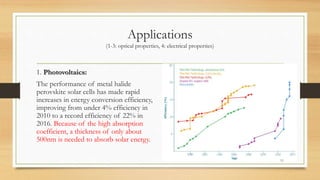
1. Photovoltaics:
The performance of metal halide
perovskite solar cells has made rapid
increases in energy conversion efficiency,
improving from under 4% efficiency in
2010 to a record efficiency of 22% in
2016. Because of the high absorption
coefficient, a thickness of only about
500nm is needed to absorb solar energy.
11
Applications
(1-3: optical properties, 4: electrical properties)
2. Light Emitting Diodes
Due to their high photoluminescence quantum efficiencies, perovskites may be good
candidates for use in Light-Emitting Diodes (LEDs). However, the propensity for
radiative recombination has mostly been observed at liquid nitrogen temperatures
3. Lasers
In 2008 researchers demonstrated that perovskite can generate laser light. LaAlO3
(Lantanum Aluminate) doped with neodymium gave laser emission at 1080nm. In 2014
it was shown that mixed methylammonium lead halide (CH3NH3PbI2Cl) cells
fashioned into optically pumped Vertical-Cavity Surface-Emitting Lasers (VCSELS)
convert visible pump light to near-IR laser light with a 70% efficiency.
4. Electromechanical devices, transducers, capacitors, actuators etc. due to
dielectric property(energy storage).
12
Current challenges
1. Toxicity: this is due to the lead deposits.
2. Short duration: Study shows that it can maintain only about 80% of it’s
initial efficiency after 500 hours. Researchers from ICL have showed that
superoxides are responsible for this. When light hits perovskites, electrons
are released and react with oxygen to form superoxides. So glass is used to
prevent material from oxidation although more recently, coating with iodide
to fill up vacancies(defect) reduces the chance for oxidation.
3. Scaling problem: Production is still on a small scale.
13
References
http://www.sigmaaldrich.com/technical-documents/articles/material-
matters/synthesis-properties.html
https://www.ncbi.nlm.nih.gov/pmc/articles/PMC4563667/
Drawbacks of perovskites:
http://www.sciencedirect.com/science/article/pii/S0038092X15005277
https://en.wikipedia.org/wiki/Perovskite_(structure)
Callister’s Materials Science and Engineering (adapted by R. Balasubramaniam) pages
80, 670, 710.
14
Acknowledgement
We appreciate our lead guide, Dr Vitalis C. Anye, for his immense contribution
to simplifying the concept of the topic. We also will not overlook the
contributions of those with who we had constructive arguments on the subject.
THANK YOU!!!
15

New Material:Perovskites presentation

  • 1.
    NILE UNIVERSITY OF NIGERIA Departmentsof Civil Engineering and Petroleum Gas Engineering Group B10 PISHIKENI SHILOBA JOHN (151202025) FATIMA FARUK ABUBAKAR (151202027) NURUDDEEN BAGARE (151202002) BADRIYYAH SALIHU (161205022) 1
  • 2.
    Perovskites Objectives 1. To explainwhat a perovskite is. 2. To establish structure-property correlation 3. To explore techniques for its processing 4. To investigate its applications 2
  • 3.
    Introduction Perovskite is CalciumTitanium Oxide or Calcium Titanate, with the chemical formula CaTiO3 .The mineral was discovered by Gustav Rose in 1839 and is named after Russian mineralogist Count Lev Alelseevich Perovski (1792- 1856). All materials with the same crystal structure as CaTiO3, namely ABX3, are termed perovskites. The perovskite lattice arrangement is demonstrated below. As with many structures in crystallography, it can be represented in multiple ways. The simplest way to think about a perovskite is as a large atomic or molecular cation (positively-charged) of type B in the centre of a cube. The corners of the cube are then occupied by atoms A (also positively-charged cations) and the faces of the cube are occupied by a smaller atom X with negative charge (anion). Key role of the BX6 octahedral in ferromagnetism and ferroelectricity. A(valences +1, +2) B(valences +3, +4 ) 3
  • 4.
    Classification of Perovskites Perovskite Systems Inorganic Oxides Perovskites (forelectricity) Organo- metal Halide Perovskites Intrinsic Perovskites Halide Perovskites (for photovoltaics) Alkali-Halide Perovskites Doped Perovskites 4
  • 5.
    STRUCTURE-PROPERTY CORRELATION 1. Electrical properties Thestarting point for characterizing materials electrically is always quantitative determination of properties such as carrier type, concentration, and mobility; however, in the case of perovskites, these properties have exhibited a large range of values often influenced by the method used to prepare the perovskite. 5
  • 6.
    Worthy of note: Yttriumbarium copper oxide can be insulating or conducting depending on oxygen content. The oxygen nonstoichiometric is one of the most significant reasons for the high value of Tc. It crystallizes into orthorhombic structure, which is superconductive, it showed a tetragonal structure that does not show any superconductivity. a. Dielectric property There are some properties inherent to dielectric materials like ferroelectricity, piezoelectricity, electrostriction, and pyroelectricity. One of the important characteristic of perovskites is ferroelectric behaviour, which is obvious in BaTiO3, PdZrO3 and their doped compounds. The ferroelectric behaviour of BaTiO3 was strongly related to its crystal structure. BaTiO3 was subjected to three phase transitions; as the temperature increases, it was converted from monoclinic to tetragonal then to cubic. At temperature higher than 300K, BaTiO3 does not show any ferroelectric behaviour as it crystallizes into cubic structure. Rather, it showed high dielectric constant. Electrical conductivity Cu-based perovskites act as high-temperature superconductors. The presence of Cu in A- site is essential for the superconductivity and various superconducting oxides can be manufactured with different B-site ions. The electronic conductivity of the perovskites can be enhanced by doping the A-site with another cation, which resulted in increasing the quantity of the mobile charge carriers created by the reparations of charge. 6
  • 7.
    Catalytic properties Perovskites showedexcellent catalytic activity and high chemical stability. Perovskites can be described as a model of active sites and as an oxidation or oxygen-activated catalyst. The stability of the perovskite structure allowed the compounds preparation from elements with unusual valence states or a high extent of oxygen deficiency. Perovskites exhibited high catalytic activity, which is partially associated with the high surface activity to oxygen reduction ratio or oxygen activation that resulted from the large number of oxygen vacancies. 7
  • 8.
    Optical properties Although thereare a lot of challenges in determining with certainty the optical properties of perovskites (still under research). Progress in this area has been hindered by the difficulty of producing continuous films of sufficient smoothness and neglect of some morphological contributions(band structure) which affect optical transition and further complicate accurate determination of the absorption coefficient and other optical parameters of perovskite films. However, hybrid perovskites (especially lead-halide perovskite) have recently received a lot of attention due to high photoluminescence and quantum yields. It has high optical absorption coefficient, excellent charge carrier transport (crystallinity). 8
  • 9.
    Processing Perovskite solar cellshold an advantage over traditional silicon solar cells in the simplicity of their processing. Traditional silicon cells require expensive, multistep processes, conducted at high temperatures (>1000 °C) in a high vacuum in special clean room facilities. Meanwhile, the organic-inorganic perovskite material can be manufactured with simpler wet chemistry techniques in a traditional lab environment. Most notably, methylammonium and formamidinium lead trihalides have been created using a variety of solvent techniques and vapour deposition techniques, both of which have the potential to be scaled up with relative feasibility. 9
  • 10.
    Processing techniques Solution processing Inone-step solution processing, a lead halide and methylammonium halide can be dissolved in a solvent and spin coated onto a substrate. Subsequent evaporation and convective self- assembly during spinning results in dense layers of well crystallized perovskite material, due to the strong ionic interactions within the material (the organic component also contributes to a lower crystallization temperature). Simple solution processing results in the presence of voids, platelets, and other defects in the layer, which would hinder the efficiency of a solar cell. To check some of these defects, highly concentrated methylammonium halide is used. Vapour deposition In vapour assisted techniques, spin coated lead halide is annealed in the presence of methylammonium iodide vapour at a temperature of around 150 °C. This technique holds an advantage over solution processing, as it opens up the possibility for multi-stacked thin films over larger areas. This could be applicable for the production of multi-junction cells. Additionally, vapour deposited techniques result in less thickness variation than simple solution processed layers. However, both techniques can result in planar thin film layers or for use in mesoscopic designs, such as coatings on a metal oxide scaffold. Such a design is common for current perovskite or dye-sensitized solar cells. 10
  • 11.
    Applications (1-3: optical properties,4: electrical properties) 1. Photovoltaics: The performance of metal halide perovskite solar cells has made rapid increases in energy conversion efficiency, improving from under 4% efficiency in 2010 to a record efficiency of 22% in 2016. Because of the high absorption coefficient, a thickness of only about 500nm is needed to absorb solar energy. 11
  • 12.
    Applications (1-3: optical properties,4: electrical properties) 2. Light Emitting Diodes Due to their high photoluminescence quantum efficiencies, perovskites may be good candidates for use in Light-Emitting Diodes (LEDs). However, the propensity for radiative recombination has mostly been observed at liquid nitrogen temperatures 3. Lasers In 2008 researchers demonstrated that perovskite can generate laser light. LaAlO3 (Lantanum Aluminate) doped with neodymium gave laser emission at 1080nm. In 2014 it was shown that mixed methylammonium lead halide (CH3NH3PbI2Cl) cells fashioned into optically pumped Vertical-Cavity Surface-Emitting Lasers (VCSELS) convert visible pump light to near-IR laser light with a 70% efficiency. 4. Electromechanical devices, transducers, capacitors, actuators etc. due to dielectric property(energy storage). 12
  • 13.
    Current challenges 1. Toxicity:this is due to the lead deposits. 2. Short duration: Study shows that it can maintain only about 80% of it’s initial efficiency after 500 hours. Researchers from ICL have showed that superoxides are responsible for this. When light hits perovskites, electrons are released and react with oxygen to form superoxides. So glass is used to prevent material from oxidation although more recently, coating with iodide to fill up vacancies(defect) reduces the chance for oxidation. 3. Scaling problem: Production is still on a small scale. 13
  • 14.
  • 15.
    Acknowledgement We appreciate ourlead guide, Dr Vitalis C. Anye, for his immense contribution to simplifying the concept of the topic. We also will not overlook the contributions of those with who we had constructive arguments on the subject. THANK YOU!!! 15