PHOTOCATALYST
Nguyen Thi Dieu Thuy, Chonbuk National University
October , 2015
1
1) Photocatalys
2) Nanoparticles necessary for
photocatalyst with high activity
2
CONTEXT
3
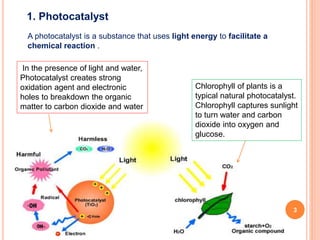
Chlorophyll of plants is a
typical natural photocatalyst.
Chlorophyll captures sunlight
to turn water and carbon
dioxide into oxygen and
glucose.
In the presence of light and water,
Photocatalyst creates strong
oxidation agent and electronic
holes to breakdown the organic
matter to carbon dioxide and water
1. Photocatalyst
A photocatalyst is a substance that uses light energy to facilitate a
chemical reaction .
4
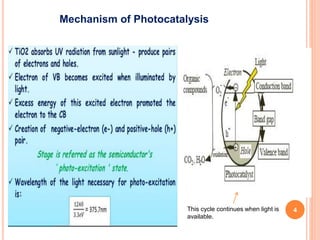
Mechanism of Photocatalysis
This cycle continues when light is
available.
5
Basic Functions of Photocatalyst
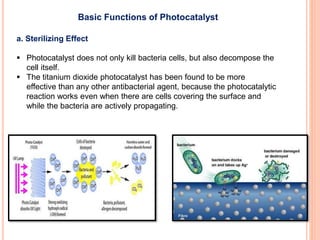
a. Sterilizing Effect
 Photocatalyst does not only kill bacteria cells, but also decompose the
cell itself.
 The titanium dioxide photocatalyst has been found to be more
effective than any other antibacterial agent, because the photocatalytic
reaction works even when there are cells covering the surface and
while the bacteria are actively propagating.
6
b. Deodorizing effect
 The hydroxyl radicals accelerate the breakdown of
any Volatile Organic Compounds by destroying the
molecular bonds.
 This will help combine the organic gases to form a
single molecule that is not harmful to humans thus
enhance the air cleaning efficiency.
Basic Functions of Photocatalyst
7
Applications of photocatalyst air purification
c. Air Purifying Effect
8
d. Anti fogging, Self-Cleaning
 When the original building materials are coated with a photocatalyst, a
protective film of titanium provides the self-cleaning building by becoming
antistatic, super oxidative, and hydrophilic.
9
e. Water Purification
 Photocatalyst coupled with UV lights can oxidize organic
pollutants into nontoxic materials, such as CO2 and water and
can disinfect certain bacteria.
 This technology is very effective at removing further hazardous
organic compounds (TOCs) and at killing a variety of bacteria and
some viruses in the secondary wastewater treatment.
10
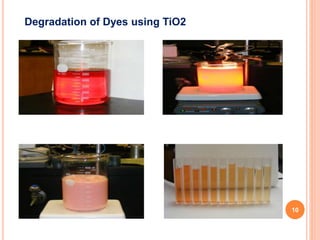
Degradation of Dyes using TiO2
11
TiO2 Degrading Methylene Blue
1
1.1
1.2
1.3
1.4
1.5
1.6
0 20 40 60 80
Absorbance
Time (mins)
Absorbance s. Time
12
2. Nanoparticles necessary for photocatalyst with high activity
 Quantum size effects on the nanoparticles properties. Thus by varying the
size of the semiconductor particles, it is possible to enhance the redox
potential of the valence-band holes and the conduction band electrons.
 Small size
 The big surface area
 Shape and size of
interactive surface
 Adsorption potential
A good
photocatalyst
with high
activity
13
THANK YOU
FOR
YOUR ATTENTION

Photocatalytic

  • 1.
    PHOTOCATALYST Nguyen Thi DieuThuy, Chonbuk National University October , 2015 1
  • 2.
    1) Photocatalys 2) Nanoparticlesnecessary for photocatalyst with high activity 2 CONTEXT
  • 3.
    3 Chlorophyll of plantsis a typical natural photocatalyst. Chlorophyll captures sunlight to turn water and carbon dioxide into oxygen and glucose. In the presence of light and water, Photocatalyst creates strong oxidation agent and electronic holes to breakdown the organic matter to carbon dioxide and water 1. Photocatalyst A photocatalyst is a substance that uses light energy to facilitate a chemical reaction .
  • 4.
    4 Mechanism of Photocatalysis Thiscycle continues when light is available.
  • 5.
    5 Basic Functions ofPhotocatalyst a. Sterilizing Effect  Photocatalyst does not only kill bacteria cells, but also decompose the cell itself.  The titanium dioxide photocatalyst has been found to be more effective than any other antibacterial agent, because the photocatalytic reaction works even when there are cells covering the surface and while the bacteria are actively propagating.
  • 6.
    6 b. Deodorizing effect The hydroxyl radicals accelerate the breakdown of any Volatile Organic Compounds by destroying the molecular bonds.  This will help combine the organic gases to form a single molecule that is not harmful to humans thus enhance the air cleaning efficiency. Basic Functions of Photocatalyst
  • 7.
    7 Applications of photocatalystair purification c. Air Purifying Effect
  • 8.
    8 d. Anti fogging,Self-Cleaning  When the original building materials are coated with a photocatalyst, a protective film of titanium provides the self-cleaning building by becoming antistatic, super oxidative, and hydrophilic.
  • 9.
    9 e. Water Purification Photocatalyst coupled with UV lights can oxidize organic pollutants into nontoxic materials, such as CO2 and water and can disinfect certain bacteria.  This technology is very effective at removing further hazardous organic compounds (TOCs) and at killing a variety of bacteria and some viruses in the secondary wastewater treatment.
  • 10.
  • 11.
    11 TiO2 Degrading MethyleneBlue 1 1.1 1.2 1.3 1.4 1.5 1.6 0 20 40 60 80 Absorbance Time (mins) Absorbance s. Time
  • 12.
    12 2. Nanoparticles necessaryfor photocatalyst with high activity  Quantum size effects on the nanoparticles properties. Thus by varying the size of the semiconductor particles, it is possible to enhance the redox potential of the valence-band holes and the conduction band electrons.  Small size  The big surface area  Shape and size of interactive surface  Adsorption potential A good photocatalyst with high activity
  • 13.