Terms to Know
 Percent composition – relative amounts of

each element in a compound
 Empirical formula – lowest whole- number
ratio of the atoms of an element in a
compound
An 8.20 g piece of magnesium
combines completely with 5.40
g of oxygen to form a
compound. What is the percent
composition of this compound?
1. Calculate the total mass
2. Divide each given by the total mass
and then multiply by 100%
3. Check your answer: The
percentages should total 100%
Answer
 The total mass is 8.20 g + 5.40 g = 13.60

g
 Divide 8.2 g by 13.6 g and then multiply by
100% = 60.29412 = 60.3%
 Divide 5.4 g by 13.6 g and then multiply by
100% = 39.70588 = 39.7%
 Check your answer: 60.3% + 39.7% =
100%
Calculate the percent composition
of propane (C3H8)
 1.

List the elements
 2. Count the atoms
 3. Multiply the number of atoms of
the element by the atomic mass of
the element (atomic mass is on the
periodic table)
 4. Express each element as a
percentage of the total molar mass
 5. Check your answer
Answer
 Total molar mass = 44.0 g/mol
 36.0 g C = 81.8%
 8.0 g H = 18.2%
Calculate the mass of carbon in
52.0 g of propane (C3H8)
Calculate the percent composition using
the formula (See previous problem)
2. Determine 81.8% of 82.0 g
Move decimal two places to the
left (.818 x 82 g)
3. Answer = 67.1 g
1.
Calculating Empirical Formulas
 Microscopic – atoms
 Macroscopic – moles of atoms
 Lowest whole-number ratio may not be the

same as the compound formula
Example: The empirical formula of
hydrogen peroxide (H2O2) is HO
Empirical Formulas
The first step is to find the mole-to-mole
ratio of the elements in the compound
 If the numbers are both whole numbers,
these will be the subscripts of the elements
in the formula
 If the whole numbers are identical,
substitute the number 1
Example: C2H2 and C8H8 have an empirical
formula of CH
 If either or both numbers are not whole
numbers, numbers in the ratio must be
multiplied by the same number to yield
whole number subscripts

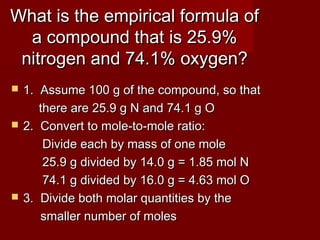
What is the empirical formula of
a compound that is 25.9%
nitrogen and 74.1% oxygen?






1. Assume 100 g of the compound, so that
there are 25.9 g N and 74.1 g O
2. Convert to mole-to-mole ratio:
Divide each by mass of one mole
25.9 g divided by 14.0 g = 1.85 mol N
74.1 g divided by 16.0 g = 4.63 mol O
3. Divide both molar quantities by the
smaller number of moles








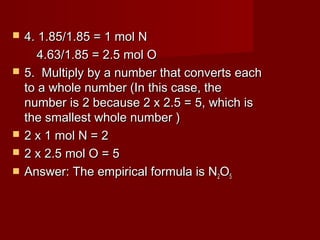
4. 1.85/1.85 = 1 mol N
4.63/1.85 = 2.5 mol O
5. Multiply by a number that converts each
to a whole number (In this case, the
number is 2 because 2 x 2.5 = 5, which is
the smallest whole number )
2 x 1 mol N = 2
2 x 2.5 mol O = 5
Answer: The empirical formula is N2O5
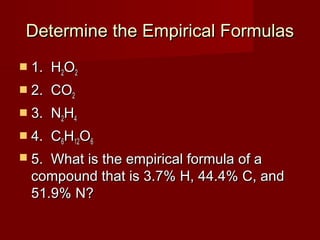
Determine the Empirical Formulas
 1.

H 2O 2

 2.

CO2

 3.

N2H4

 4.

C6H12O6

 5.

What is the empirical formula of a
compound that is 3.7% H, 44.4% C, and
51.9% N?
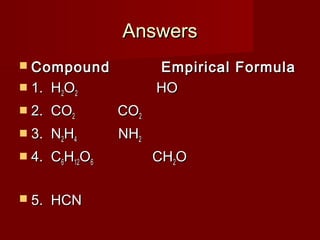
Answers
 Compound

Empirical Formula
HO

 1.

H 2O 2

 2.

CO2

CO2

 3.

N2H4

NH2

 4.

C6H12O6

 5.

HCN

CH2O
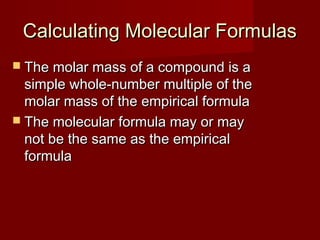
Calculating Molecular Formulas
 The molar mass of a compound is a

simple whole-number multiple of the
molar mass of the empirical formula
 The molecular formula may or may
not be the same as the empirical
formula
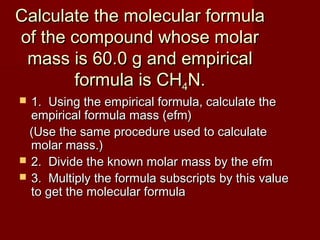
Calculate the molecular formula
of the compound whose molar
mass is 60.0 g and empirical
formula is CH4N.

1. Using the empirical formula, calculate the
empirical formula mass (efm)
(Use the same procedure used to calculate
molar mass.)
 2. Divide the known molar mass by the efm
 3. Multiply the formula subscripts by this value
to get the molecular formula

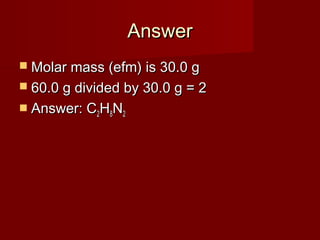
Answer
 Molar mass (efm) is 30.0 g
 60.0 g divided by 30.0 g = 2
 Answer: C2H8N2
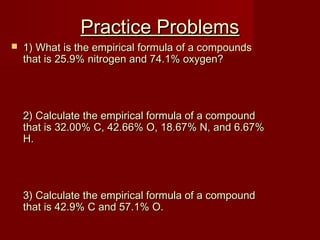
Practice Problems



1) What is the empirical formula of a compounds
that is 25.9% nitrogen and 74.1% oxygen?

2) Calculate the empirical formula of a compound
that is 32.00% C, 42.66% O, 18.67% N, and 6.67%
H.

3) Calculate the empirical formula of a compound
that is 42.9% C and 57.1% O.
Practice Problems


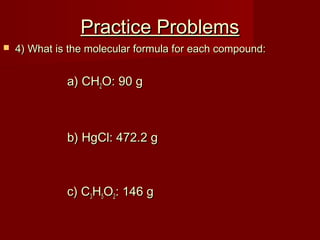
4) What is the molecular formula for each compound:

a) CH2O: 90 g

b) HgCl: 472.2 g

c) C3H5O2: 146 g

Percent comp_empirical formula_molecular formula

  • 1.
    Terms to Know Percent composition – relative amounts of each element in a compound  Empirical formula – lowest whole- number ratio of the atoms of an element in a compound
  • 2.
    An 8.20 gpiece of magnesium combines completely with 5.40 g of oxygen to form a compound. What is the percent composition of this compound? 1. Calculate the total mass 2. Divide each given by the total mass and then multiply by 100% 3. Check your answer: The percentages should total 100%
  • 3.
    Answer  The totalmass is 8.20 g + 5.40 g = 13.60 g  Divide 8.2 g by 13.6 g and then multiply by 100% = 60.29412 = 60.3%  Divide 5.4 g by 13.6 g and then multiply by 100% = 39.70588 = 39.7%  Check your answer: 60.3% + 39.7% = 100%
  • 4.
    Calculate the percentcomposition of propane (C3H8)  1. List the elements  2. Count the atoms  3. Multiply the number of atoms of the element by the atomic mass of the element (atomic mass is on the periodic table)  4. Express each element as a percentage of the total molar mass  5. Check your answer
  • 5.
    Answer  Total molarmass = 44.0 g/mol  36.0 g C = 81.8%  8.0 g H = 18.2%
  • 6.
    Calculate the massof carbon in 52.0 g of propane (C3H8) Calculate the percent composition using the formula (See previous problem) 2. Determine 81.8% of 82.0 g Move decimal two places to the left (.818 x 82 g) 3. Answer = 67.1 g 1.
  • 7.
    Calculating Empirical Formulas Microscopic – atoms  Macroscopic – moles of atoms  Lowest whole-number ratio may not be the same as the compound formula Example: The empirical formula of hydrogen peroxide (H2O2) is HO
  • 8.
    Empirical Formulas The firststep is to find the mole-to-mole ratio of the elements in the compound  If the numbers are both whole numbers, these will be the subscripts of the elements in the formula  If the whole numbers are identical, substitute the number 1 Example: C2H2 and C8H8 have an empirical formula of CH  If either or both numbers are not whole numbers, numbers in the ratio must be multiplied by the same number to yield whole number subscripts 
  • 9.
    What is theempirical formula of a compound that is 25.9% nitrogen and 74.1% oxygen?    1. Assume 100 g of the compound, so that there are 25.9 g N and 74.1 g O 2. Convert to mole-to-mole ratio: Divide each by mass of one mole 25.9 g divided by 14.0 g = 1.85 mol N 74.1 g divided by 16.0 g = 4.63 mol O 3. Divide both molar quantities by the smaller number of moles
  • 10.
         4. 1.85/1.85 =1 mol N 4.63/1.85 = 2.5 mol O 5. Multiply by a number that converts each to a whole number (In this case, the number is 2 because 2 x 2.5 = 5, which is the smallest whole number ) 2 x 1 mol N = 2 2 x 2.5 mol O = 5 Answer: The empirical formula is N2O5
  • 11.
    Determine the EmpiricalFormulas  1. H 2O 2  2. CO2  3. N2H4  4. C6H12O6  5. What is the empirical formula of a compound that is 3.7% H, 44.4% C, and 51.9% N?
  • 12.
    Answers  Compound Empirical Formula HO 1. H 2O 2  2. CO2 CO2  3. N2H4 NH2  4. C6H12O6  5. HCN CH2O
  • 13.
    Calculating Molecular Formulas The molar mass of a compound is a simple whole-number multiple of the molar mass of the empirical formula  The molecular formula may or may not be the same as the empirical formula
  • 14.
    Calculate the molecularformula of the compound whose molar mass is 60.0 g and empirical formula is CH4N. 1. Using the empirical formula, calculate the empirical formula mass (efm) (Use the same procedure used to calculate molar mass.)  2. Divide the known molar mass by the efm  3. Multiply the formula subscripts by this value to get the molecular formula 
  • 15.
    Answer  Molar mass(efm) is 30.0 g  60.0 g divided by 30.0 g = 2  Answer: C2H8N2
  • 16.
    Practice Problems  1) Whatis the empirical formula of a compounds that is 25.9% nitrogen and 74.1% oxygen? 2) Calculate the empirical formula of a compound that is 32.00% C, 42.66% O, 18.67% N, and 6.67% H. 3) Calculate the empirical formula of a compound that is 42.9% C and 57.1% O.
  • 17.
    Practice Problems  4) Whatis the molecular formula for each compound: a) CH2O: 90 g b) HgCl: 472.2 g c) C3H5O2: 146 g