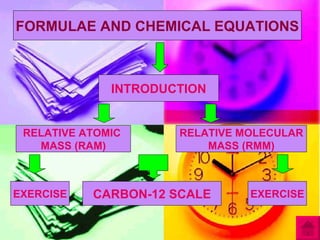
FORMULAE AND CHEMICAL EQUATIONS


              INTRODUCTION


 RELATIVE ATOMIC      RELATIVE MOLECULAR
   MASS (RAM)             MASS (RMM)


EXERCISE   CARBON-12 SCALE      EXERCISE
INTRODUCTION


   Mass of one atom is small. For
    example the mass of one atom
    cuprum 1.06 x10⁻²² gram.

   We can’t weigh one atom directly
    but we can compare the mass of
    one atom with another mass of
    one atom by using the relative
    mass scale.
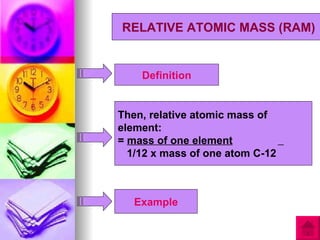
RELATIVE ATOMIC MASS (RAM)


    Definition


Then, relative atomic mass of
element:
= mass of one element
  1/12 x mass of one atom C-12


   Example
DEFINITION OF RELATIVE
        ATOMIC MASS (RAM)


   RELATIVE ATOMIC MASS (RAM)
    of elements is how much time one
    atom of element more heavy than
    1/12 mass of one atom C-12 with
    the mass of one atom C-12 is
    12.000.
EXAMPLE:

   The mass of one atom potassium is 39
    time more bigger than 1/12 x mass of
    one atom C-12.

    So, relative atomic mass for one atom
                 potassium is 39.


                  K = 39
RELATIVE MOLECULAR MASS (RMM)


       Definition


     Relative molecular mass of
     compound=
     Mass of one molecule of compound
     1/12 x mass of one atom C-12


        Example
DEFINITION OF RELATIVE
      MOLECULAR MASS (RMM)


   RELATIVE MOLECULAR MASS
    (RMM) is how much time the
    mass of one molecule is
    compound is more bigger than
    1/12 mass of one atom C-12 with
    the mass of one atom C-12 is
    12.000.
EXAMPLE:

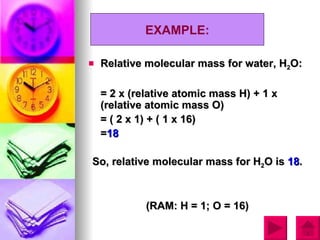
   Relative molecular mass for water, H2O:

    = 2 x (relative atomic mass H) + 1 x
    (relative atomic mass O)
    = ( 2 x 1) + ( 1 x 16)
    =18

So, relative molecular mass for H2O is 18.


             (RAM: H = 1; O = 16)
EXAMPLE:

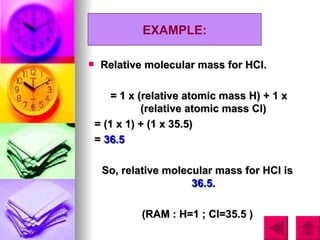
    Relative molecular mass for HCl.

        = 1 x (relative atomic mass H) + 1 x
               (relative atomic mass Cl)
    = (1 x 1) + (1 x 35.5)
    = 36.5

     So, relative molecular mass for HCl is
                       36.5.

             (RAM : H=1 ; Cl=35.5 )
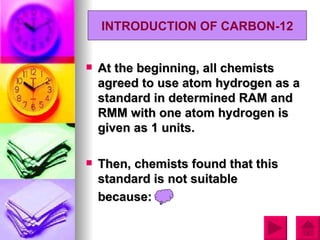
INTRODUCTION OF CARBON-12


   At the beginning, all chemists
    agreed to use atom hydrogen as a
    standard in determined RAM and
    RMM with one atom hydrogen is
    given as 1 units.

   Then, chemists found that this
    standard is not suitable
    because:
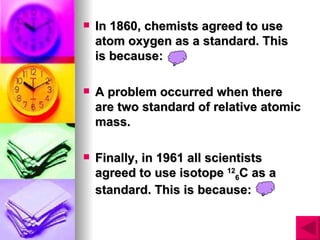
   In 1860, chemists agreed to use
    atom oxygen as a standard. This
    is because:

   A problem occurred when there
    are two standard of relative atomic
    mass.

   Finally, in 1961 all scientists
    agreed to use isotope 126C as a
    standard. This is because:
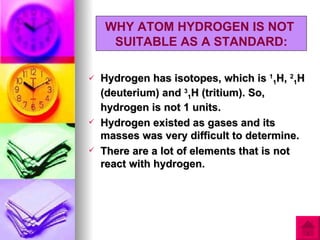
WHY ATOM HYDROGEN IS NOT
     SUITABLE AS A STANDARD:

   Hydrogen has isotopes, which is 11H, 21H
    (deuterium) and 31H (tritium). So,
    hydrogen is not 1 units.
   Hydrogen existed as gases and its
    masses was very difficult to determine.
   There are a lot of elements that is not
    react with hydrogen.
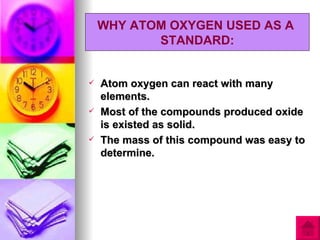
WHY ATOM OXYGEN USED AS A
           STANDARD:


   Atom oxygen can react with many
    elements.
   Most of the compounds produced oxide
    is existed as solid.
   The mass of this compound was easy to
    determine.
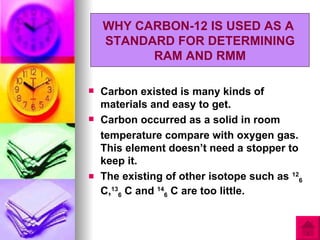
WHY CARBON-12 IS USED AS A
    STANDARD FOR DETERMINING
          RAM AND RMM

   Carbon existed is many kinds of
    materials and easy to get.
   Carbon occurred as a solid in room
    temperature compare with oxygen gas.
    This element doesn’t need a stopper to
    keep it.
   The existing of other isotope such as 126
    C,136 C and 146 C are too little.
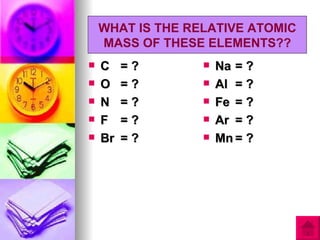
WHAT IS THE RELATIVE ATOMIC
    MASS OF THESE ELEMENTS??
   C    =?          Na = ?
   O    =?          Al = ?
   N    =?          Fe = ?
   F    =?          Ar = ?
   Br   =?          Mn = ?
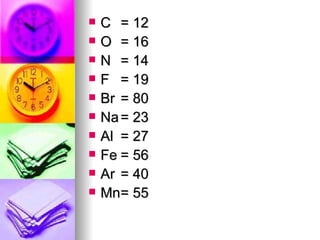
   C = 12
   O = 16
   N = 14
   F = 19
   Br = 80
   Na = 23
   Al = 27
   Fe = 56
   Ar = 40
   Mn= 55
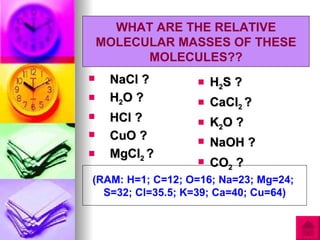
WHAT ARE THE RELATIVE
    MOLECULAR MASSES OF THESE
          MOLECULES??
    NaCl ?          H2S ?
    H2O ?           CaCl2 ?
    HCl ?           K2O ?
    CuO ?           NaOH ?
    MgCl2 ?
                     CO2 ?
(RAM: H=1; C=12; O=16; Na=23; Mg=24;
  S=32; Cl=35.5; K=39; Ca=40; Cu=64)
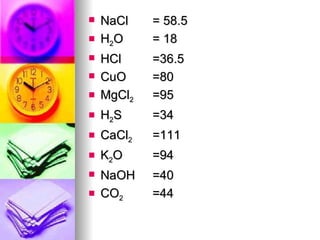
   NaCl    = 58.5
   H2O     = 18
   HCl     =36.5
   CuO     =80
   MgCl2   =95
   H2S     =34
   CaCl2   =111
   K2O     =94
   NaOH    =40
   CO2     =44

Carbon-12 scale

  • 1.
    FORMULAE AND CHEMICALEQUATIONS INTRODUCTION RELATIVE ATOMIC RELATIVE MOLECULAR MASS (RAM) MASS (RMM) EXERCISE CARBON-12 SCALE EXERCISE
  • 2.
    INTRODUCTION  Mass of one atom is small. For example the mass of one atom cuprum 1.06 x10⁻²² gram.  We can’t weigh one atom directly but we can compare the mass of one atom with another mass of one atom by using the relative mass scale.
  • 3.
    RELATIVE ATOMIC MASS(RAM) Definition Then, relative atomic mass of element: = mass of one element 1/12 x mass of one atom C-12 Example
  • 4.
    DEFINITION OF RELATIVE ATOMIC MASS (RAM)  RELATIVE ATOMIC MASS (RAM) of elements is how much time one atom of element more heavy than 1/12 mass of one atom C-12 with the mass of one atom C-12 is 12.000.
  • 5.
    EXAMPLE:  The mass of one atom potassium is 39 time more bigger than 1/12 x mass of one atom C-12. So, relative atomic mass for one atom potassium is 39. K = 39
  • 6.
    RELATIVE MOLECULAR MASS(RMM) Definition Relative molecular mass of compound= Mass of one molecule of compound 1/12 x mass of one atom C-12 Example
  • 7.
    DEFINITION OF RELATIVE MOLECULAR MASS (RMM)  RELATIVE MOLECULAR MASS (RMM) is how much time the mass of one molecule is compound is more bigger than 1/12 mass of one atom C-12 with the mass of one atom C-12 is 12.000.
  • 8.
    EXAMPLE:  Relative molecular mass for water, H2O: = 2 x (relative atomic mass H) + 1 x (relative atomic mass O) = ( 2 x 1) + ( 1 x 16) =18 So, relative molecular mass for H2O is 18. (RAM: H = 1; O = 16)
  • 9.
    EXAMPLE:  Relative molecular mass for HCl. = 1 x (relative atomic mass H) + 1 x (relative atomic mass Cl) = (1 x 1) + (1 x 35.5) = 36.5 So, relative molecular mass for HCl is 36.5. (RAM : H=1 ; Cl=35.5 )
  • 10.
    INTRODUCTION OF CARBON-12  At the beginning, all chemists agreed to use atom hydrogen as a standard in determined RAM and RMM with one atom hydrogen is given as 1 units.  Then, chemists found that this standard is not suitable because:
  • 11.
    In 1860, chemists agreed to use atom oxygen as a standard. This is because:  A problem occurred when there are two standard of relative atomic mass.  Finally, in 1961 all scientists agreed to use isotope 126C as a standard. This is because:
  • 12.
    WHY ATOM HYDROGENIS NOT SUITABLE AS A STANDARD:  Hydrogen has isotopes, which is 11H, 21H (deuterium) and 31H (tritium). So, hydrogen is not 1 units.  Hydrogen existed as gases and its masses was very difficult to determine.  There are a lot of elements that is not react with hydrogen.
  • 13.
    WHY ATOM OXYGENUSED AS A STANDARD:  Atom oxygen can react with many elements.  Most of the compounds produced oxide is existed as solid.  The mass of this compound was easy to determine.
  • 14.
    WHY CARBON-12 ISUSED AS A STANDARD FOR DETERMINING RAM AND RMM  Carbon existed is many kinds of materials and easy to get.  Carbon occurred as a solid in room temperature compare with oxygen gas. This element doesn’t need a stopper to keep it.  The existing of other isotope such as 126 C,136 C and 146 C are too little.
  • 15.
    WHAT IS THERELATIVE ATOMIC MASS OF THESE ELEMENTS??  C =?  Na = ?  O =?  Al = ?  N =?  Fe = ?  F =?  Ar = ?  Br =?  Mn = ?
  • 16.
    C = 12  O = 16  N = 14  F = 19  Br = 80  Na = 23  Al = 27  Fe = 56  Ar = 40  Mn= 55
  • 17.
    WHAT ARE THERELATIVE MOLECULAR MASSES OF THESE MOLECULES??  NaCl ?  H2S ?  H2O ?  CaCl2 ?  HCl ?  K2O ?  CuO ?  NaOH ?  MgCl2 ?  CO2 ? (RAM: H=1; C=12; O=16; Na=23; Mg=24; S=32; Cl=35.5; K=39; Ca=40; Cu=64)
  • 18.
    NaCl = 58.5  H2O = 18  HCl =36.5  CuO =80  MgCl2 =95  H2S =34  CaCl2 =111  K2O =94  NaOH =40  CO2 =44