Redox
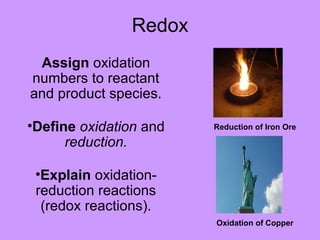
Assign oxidation
numbers to reactant
and product species.
•Define oxidation and
reduction.
•Explain oxidation-
reduction reactions
(redox reactions).
Oxidation of Copper
Reduction of Iron Ore
Oxidation and reduction reactions:
what the gosh darn heck are they?
Oxidation: the LOSS of electrons
Reduction: the GAIN of electrons
Redox
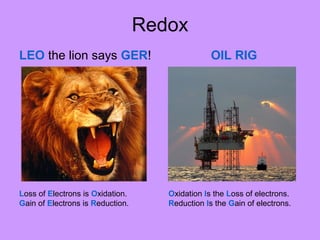
LEO the lion says GER! OIL RIG
Loss of Electrons is Oxidation.
Gain of Electrons is Reduction.
Oxidation Is the Loss of electrons.
Reduction Is the Gain of electrons.
Connection to Electrochemistry
• RED CAT • AN OX
REDuction occurs at the CAThode.
OXidation occurs at the ANode.
Half Reactions
• Show what happens to electrons in the two parts of
a redox reaction: the reduction and the oxidation
• Steel hulls in ships have zinc blocks attached
because they oxidize and release electrons. These
electrons get consumed by the steel and prevent
corrosion.
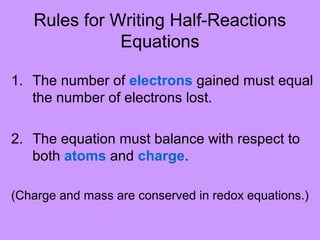
Rules for Writing Half-Reactions
Equations
1. The number of electrons gained must equal
the number of electrons lost.
2. The equation must balance with respect to
both atoms and charge.
(Charge and mass are conserved in redox equations.)
Assigning Oxidation Numbers
•An oxidation number is
not based on any real
charge on the atom.
•It is based on the
atom’s electronegativity
relative to the other
atoms to which it is
bonded in a given
molecule.
•Oxidation numbers are
always reported for one
individual atom or ion and
not for groups of atoms or
ions.
Write the half-reaction equations for the redox
reaction
Mg (s) + Br2 (l) → MgBr2 (s)
• Step 1: Use oxidation numbers to determine
what is oxidized and what is reduced
0 0 2+ 1-
Mg (s) + Br2 (l) → MgBr2 (s)
What happened to Mg?
Mg gained a positive charge so it lost electrons.
It is oxidized.
0 0 2+ 1-
Mg (s) + Br2 (l) → MgBr2 (s)
What happened to Br2?
Br2 got a negative charge so it gained electrons.
It is reduced.
• Step 2 : Write two separate equations: one
showing oxidation and another showing
reduction. Use coefficients to balance the
number of atoms.
Mg → Mg2+
Br2 → 2Br-
Step 3: Make the charge balance in each
equation by adding electrons.
Mg → Mg2+
+ 2e-
Br2 + 2e-
→ 2Br-
Check:
1. The number of electrons gained must
equal the number of electrons lost.
2. The equation must balance with respect
to both atoms and charge.
Practice Assigning Oxidation
Numbers
• http://www.occc.edu/kmbailey/chem1115tutori
Practice Identifying the Elements
Oxidized and Reduced
• http://www.occc.edu/kmbailey/chem1115tu
Redox Reactions and Covalent
Bonds
• Substances with covalent bonds also undergo redox
reactions. When hydrogen burns in chlorine, a covalent
bond forms from the sharing of two electrons.
• The pair of electrons is more strongly attracted to the
chlorine atom because of its higher electronegativity.
2 2
0 0 +1 1
H + Cl 2HCl→
–
• Neither atom has totally lost or totally gained any electrons.
• Hydrogen has donated a share of its bonding electron to the
chlorine but has not completely transferred that electron.
Objectives
• Balance redox equations by using the
half-reaction method.
• Identify oxidizing and reducing agents.
• Explain the concept of disproportionation.
Balancing Redox Equations
• Simple redox equations
can be balanced by
inspection (the method
you previously learned),
but most redox equations
cannot be balanced by
inspection.
• A more systematic
approach called the half-
reaction method, or ion-
electron method, is
required.
Seven Steps of the Half-Reaction
Method
1. Write the formula equation if it is not given in the
problem. Then write the ionic equation.
2. Assign oxidation numbers. Delete substances
containing only elements that do not change
oxidation state.
3.Write the half-reaction for oxidation.
Balance the atoms.
Balance the charge.
4.Write the half-reaction for reduction.
Balance the atoms.
Balance the charge.
• 5. Conserve charge by adjusting the
coefficients in front of the electrons so
that the number lost in oxidation equals
the number gained in reduction.
• 6. Combine the half-reactions, and
cancel out anything common to both
sides of the equation.
• 7. Combine ions to form the compounds
shown in the original formula equation.
Check to ensure that all other ions
balance.
Balancing Redox Equations
Problem
• A deep purple solution of
potassium permanganate is
titrated with a colorless
solution of iron(II) sulfate
and sulfuric acid. The
products are iron(III)
sulfate, manganese(II)
sulfate, potassium sulfate,
and water—all of which are
colorless.
• Do Step1
Write the formula equation if it is not given
in the problem. Then write the ionic
equation.
4 4 2 4
2 4 3 4 2 4 2
KMnO + FeSO + H SO
Fe (SO ) + MnSO + K SO + H O
→
+ 2+ 2 + 2
4 4 4
3+ 2 2+ 2 + 2
4 4 4 2
K + MnO +Fe + SO + 2H + SO
2Fe + 3SO + Mn + SO + 2K + SO + H O
→– – –
– – –
• Do Step 2
Assign oxidation numbers to each element
and ion. Delete substances containing an
element that does not change oxidation
state.
+1 +7 2 +2 +6 2 +1 +6 2
+3 +6
+ 2+ 2 + 2–
4 4 4
3+ 2– 2+ 2– + 2
4 4
2 +2 +6 2 +1 +6 2 +
4 2
1 2
K + MnO +Fe + SO + 2H + SO
2Fe + 3SO + Mn + SO + 2K + SO + H O
→
– – –
– –
–
– –
– –
Only ions or molecules whose oxidation numbers
change are retained.
+7 2 +2 +3 +2
2+ 3+ 2+
4MnO + Fe Fe + Mn→
–
–
• Do Step 3
Write the half-reaction for oxidation. The
iron shows the increase in oxidation
number. Therefore, it is oxidized.
+2 +
2 3+
3
+
Fe Fe→
Balance the mass.
The mass is already balanced.
Balance the charge.
2
+2
+ 3+
+3
Fe Fe + e→ –
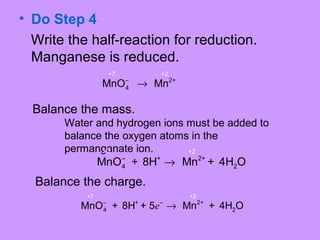
• Do Step 4
Write the half-reaction for reduction.
Manganese is reduced.
+7
4
+2
2+
MnO Mn→–
Balance the mass.
Water and hydrogen ions must be added to
balance the oxygen atoms in the
permanganate ion.
+
+7 +2
2+
4 2MnO + 8H Mn + 4H O→–
Balance the charge.
+7
+ 2
4 2
2
+
+
MnO + 8H + 5 Mn + 4H Oe →– –
• Do Step 5
Adjust the coefficients to conserve charge.
lost in oxidation 1
gained in reduction 5
e
e
=
–
–
2+ 3+
5(Fe Fe + )e→ –
+ 2+
4 21(MnO + 8H + 5 Mn + 4H O)e →– –
• Do Step 6
Combine the half-reactions and cancel.
2+ 3+
Fe Fe + e→ –
+ 2+
4 2MnO + 8H + 5 Mn + 4H Oe →– –
2+ + 2+ 3+
4 2MnO + 5Fe + 8H + 5 Mn + 5Fe + 4H O + 5e e→– – –
• Do Step 7
Combine ions to form compounds from the
original equation.
2+ + 3+ 2+
4 22(5Fe + MnO + 8H 5Fe + Mn + 4H O)→–
→2+ + 3+ 2+
4 210Fe + 2MnO + 16H 10Fe + 2Mn + 8H On
→4 4 2 4
2 4 3 4 2 4 2
10FeSO + 2KMnO + 8H SO
5Fe (SO ) + 2MnSO + K SO + 8H O
Oxidizing and Reducing Agents
• Label a small object (such
as an empty box)
“electrons.”
• Ask a classmate to take the
electrons from you.
• The other student was the
agent of your losing the
electrons and you were the
agent of the other student’s
gaining the electrons.
• By causing you to lose your electrons, the
other student is the oxidizing agent.
• You are the reducing agent because you
caused the student to gain electrons.
• The student is reduced by you, and you
are oxidized by the other student.
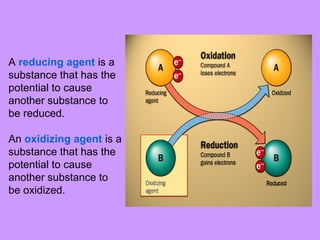
A reducing agent is a
substance that has the
potential to cause
another substance to
be reduced.
An oxidizing agent is a
substance that has the
potential to cause
another substance to
be oxidized.
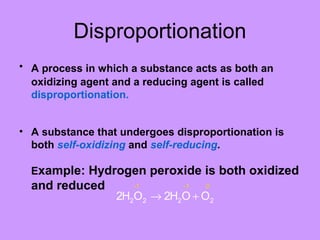
Disproportionation
• A process in which a substance acts as both an
oxidizing agent and a reducing agent is called
disproportionation.
• A substance that undergoes disproportionation is
both self-oxidizing and self-reducing.
Example: Hydrogen peroxide is both oxidized
and reduced -1 -1 0
2 2 2 22H O 2H O O→ +

Redox

  • 1.
    Redox Assign oxidation numbers toreactant and product species. •Define oxidation and reduction. •Explain oxidation- reduction reactions (redox reactions). Oxidation of Copper Reduction of Iron Ore
  • 2.
    Oxidation and reductionreactions: what the gosh darn heck are they? Oxidation: the LOSS of electrons Reduction: the GAIN of electrons
  • 3.
    Redox LEO the lionsays GER! OIL RIG Loss of Electrons is Oxidation. Gain of Electrons is Reduction. Oxidation Is the Loss of electrons. Reduction Is the Gain of electrons.
  • 5.
    Connection to Electrochemistry •RED CAT • AN OX REDuction occurs at the CAThode. OXidation occurs at the ANode.
  • 6.
    Half Reactions • Showwhat happens to electrons in the two parts of a redox reaction: the reduction and the oxidation • Steel hulls in ships have zinc blocks attached because they oxidize and release electrons. These electrons get consumed by the steel and prevent corrosion.
  • 7.
    Rules for WritingHalf-Reactions Equations 1. The number of electrons gained must equal the number of electrons lost. 2. The equation must balance with respect to both atoms and charge. (Charge and mass are conserved in redox equations.)
  • 8.
  • 9.
    •An oxidation numberis not based on any real charge on the atom. •It is based on the atom’s electronegativity relative to the other atoms to which it is bonded in a given molecule. •Oxidation numbers are always reported for one individual atom or ion and not for groups of atoms or ions.
  • 10.
    Write the half-reactionequations for the redox reaction Mg (s) + Br2 (l) → MgBr2 (s) • Step 1: Use oxidation numbers to determine what is oxidized and what is reduced 0 0 2+ 1- Mg (s) + Br2 (l) → MgBr2 (s) What happened to Mg? Mg gained a positive charge so it lost electrons. It is oxidized.
  • 11.
    0 0 2+1- Mg (s) + Br2 (l) → MgBr2 (s) What happened to Br2? Br2 got a negative charge so it gained electrons. It is reduced. • Step 2 : Write two separate equations: one showing oxidation and another showing reduction. Use coefficients to balance the number of atoms. Mg → Mg2+ Br2 → 2Br-
  • 12.
    Step 3: Makethe charge balance in each equation by adding electrons. Mg → Mg2+ + 2e- Br2 + 2e- → 2Br- Check: 1. The number of electrons gained must equal the number of electrons lost. 2. The equation must balance with respect to both atoms and charge.
  • 13.
    Practice Assigning Oxidation Numbers •http://www.occc.edu/kmbailey/chem1115tutori Practice Identifying the Elements Oxidized and Reduced • http://www.occc.edu/kmbailey/chem1115tu
  • 14.
    Redox Reactions andCovalent Bonds • Substances with covalent bonds also undergo redox reactions. When hydrogen burns in chlorine, a covalent bond forms from the sharing of two electrons. • The pair of electrons is more strongly attracted to the chlorine atom because of its higher electronegativity. 2 2 0 0 +1 1 H + Cl 2HCl→ – • Neither atom has totally lost or totally gained any electrons. • Hydrogen has donated a share of its bonding electron to the chlorine but has not completely transferred that electron.
  • 15.
    Objectives • Balance redoxequations by using the half-reaction method. • Identify oxidizing and reducing agents. • Explain the concept of disproportionation.
  • 16.
    Balancing Redox Equations •Simple redox equations can be balanced by inspection (the method you previously learned), but most redox equations cannot be balanced by inspection. • A more systematic approach called the half- reaction method, or ion- electron method, is required.
  • 17.
    Seven Steps ofthe Half-Reaction Method 1. Write the formula equation if it is not given in the problem. Then write the ionic equation. 2. Assign oxidation numbers. Delete substances containing only elements that do not change oxidation state. 3.Write the half-reaction for oxidation. Balance the atoms. Balance the charge. 4.Write the half-reaction for reduction. Balance the atoms. Balance the charge.
  • 18.
    • 5. Conservecharge by adjusting the coefficients in front of the electrons so that the number lost in oxidation equals the number gained in reduction. • 6. Combine the half-reactions, and cancel out anything common to both sides of the equation. • 7. Combine ions to form the compounds shown in the original formula equation. Check to ensure that all other ions balance.
  • 19.
  • 21.
    Problem • A deeppurple solution of potassium permanganate is titrated with a colorless solution of iron(II) sulfate and sulfuric acid. The products are iron(III) sulfate, manganese(II) sulfate, potassium sulfate, and water—all of which are colorless.
  • 22.
    • Do Step1 Writethe formula equation if it is not given in the problem. Then write the ionic equation. 4 4 2 4 2 4 3 4 2 4 2 KMnO + FeSO + H SO Fe (SO ) + MnSO + K SO + H O → + 2+ 2 + 2 4 4 4 3+ 2 2+ 2 + 2 4 4 4 2 K + MnO +Fe + SO + 2H + SO 2Fe + 3SO + Mn + SO + 2K + SO + H O →– – – – – –
  • 23.
    • Do Step2 Assign oxidation numbers to each element and ion. Delete substances containing an element that does not change oxidation state. +1 +7 2 +2 +6 2 +1 +6 2 +3 +6 + 2+ 2 + 2– 4 4 4 3+ 2– 2+ 2– + 2 4 4 2 +2 +6 2 +1 +6 2 + 4 2 1 2 K + MnO +Fe + SO + 2H + SO 2Fe + 3SO + Mn + SO + 2K + SO + H O → – – – – – – – – – – Only ions or molecules whose oxidation numbers change are retained. +7 2 +2 +3 +2 2+ 3+ 2+ 4MnO + Fe Fe + Mn→ – –
  • 24.
    • Do Step3 Write the half-reaction for oxidation. The iron shows the increase in oxidation number. Therefore, it is oxidized. +2 + 2 3+ 3 + Fe Fe→ Balance the mass. The mass is already balanced. Balance the charge. 2 +2 + 3+ +3 Fe Fe + e→ –
  • 25.
    • Do Step4 Write the half-reaction for reduction. Manganese is reduced. +7 4 +2 2+ MnO Mn→– Balance the mass. Water and hydrogen ions must be added to balance the oxygen atoms in the permanganate ion. + +7 +2 2+ 4 2MnO + 8H Mn + 4H O→– Balance the charge. +7 + 2 4 2 2 + + MnO + 8H + 5 Mn + 4H Oe →– –
  • 26.
    • Do Step5 Adjust the coefficients to conserve charge. lost in oxidation 1 gained in reduction 5 e e = – – 2+ 3+ 5(Fe Fe + )e→ – + 2+ 4 21(MnO + 8H + 5 Mn + 4H O)e →– –
  • 27.
    • Do Step6 Combine the half-reactions and cancel. 2+ 3+ Fe Fe + e→ – + 2+ 4 2MnO + 8H + 5 Mn + 4H Oe →– – 2+ + 2+ 3+ 4 2MnO + 5Fe + 8H + 5 Mn + 5Fe + 4H O + 5e e→– – –
  • 28.
    • Do Step7 Combine ions to form compounds from the original equation. 2+ + 3+ 2+ 4 22(5Fe + MnO + 8H 5Fe + Mn + 4H O)→– →2+ + 3+ 2+ 4 210Fe + 2MnO + 16H 10Fe + 2Mn + 8H On →4 4 2 4 2 4 3 4 2 4 2 10FeSO + 2KMnO + 8H SO 5Fe (SO ) + 2MnSO + K SO + 8H O
  • 29.
    Oxidizing and ReducingAgents • Label a small object (such as an empty box) “electrons.” • Ask a classmate to take the electrons from you. • The other student was the agent of your losing the electrons and you were the agent of the other student’s gaining the electrons.
  • 30.
    • By causingyou to lose your electrons, the other student is the oxidizing agent. • You are the reducing agent because you caused the student to gain electrons. • The student is reduced by you, and you are oxidized by the other student.
  • 31.
    A reducing agentis a substance that has the potential to cause another substance to be reduced. An oxidizing agent is a substance that has the potential to cause another substance to be oxidized.
  • 32.
    Disproportionation • A processin which a substance acts as both an oxidizing agent and a reducing agent is called disproportionation. • A substance that undergoes disproportionation is both self-oxidizing and self-reducing. Example: Hydrogen peroxide is both oxidized and reduced -1 -1 0 2 2 2 22H O 2H O O→ +