Chemistry notes & exercises Dhiffushi School
Empirical and molecular formula Page 1
Empirical and molecular formula
Name: Index:
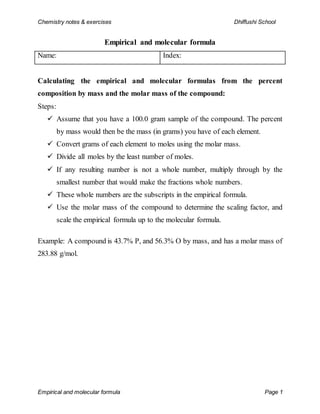
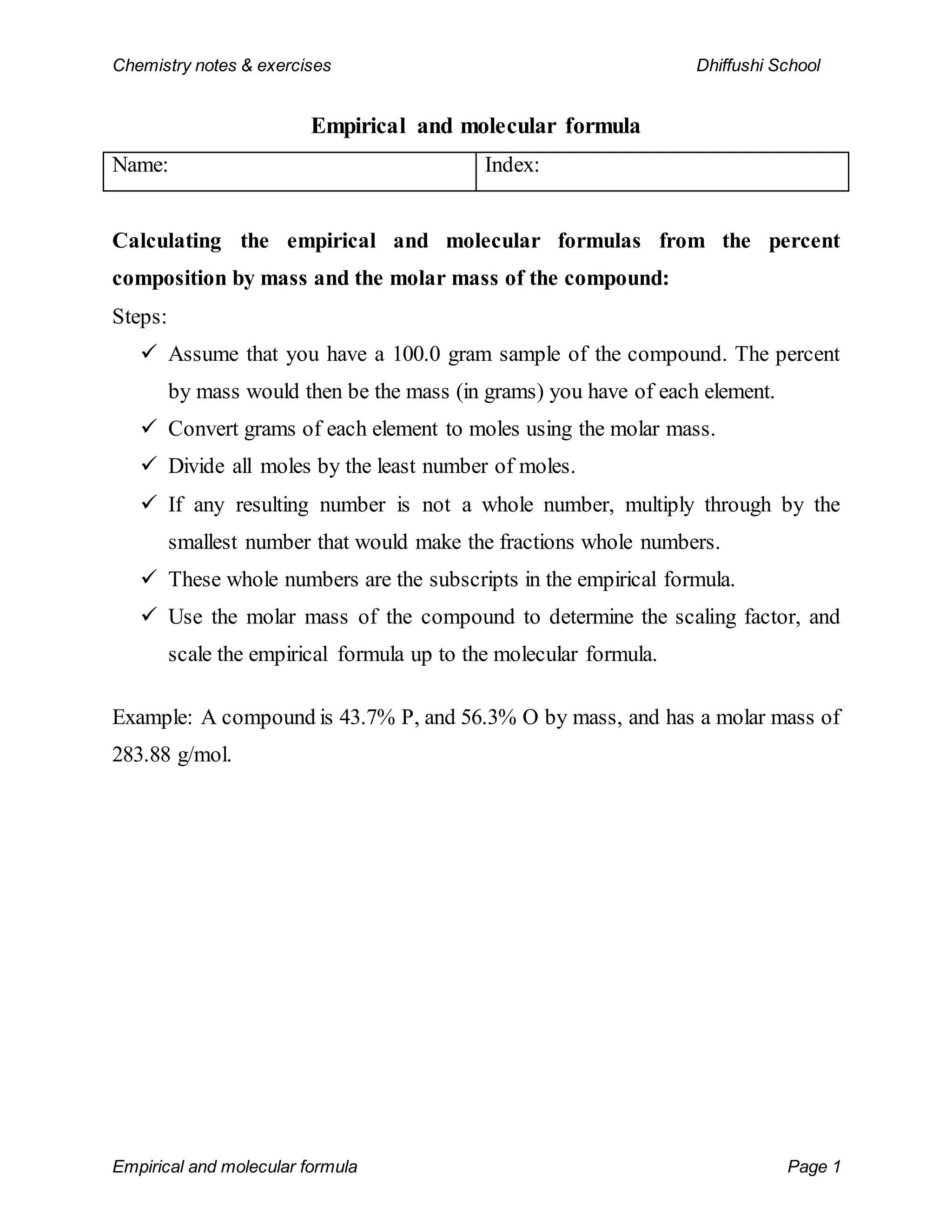
Calculating the empirical and molecular formulas from the percent
composition by mass and the molar mass of the compound:
Steps:
 Assume that you have a 100.0 gram sample of the compound. The percent
by mass would then be the mass (in grams) you have of each element.
 Convert grams of each element to moles using the molar mass.
 Divide all moles by the least number of moles.
 If any resulting number is not a whole number, multiply through by the
smallest number that would make the fractions whole numbers.
 These whole numbers are the subscripts in the empirical formula.
 Use the molar mass of the compound to determine the scaling factor, and
scale the empirical formula up to the molecular formula.
Example: A compound is 43.7% P, and 56.3% O by mass, and has a molar mass of
283.88 g/mol.
Chemistry notes & exercises Dhiffushi School
Empirical and molecular formula Page 2
a) What is the empirical formula of the compound?
Assume a 100.0 g sample of the compound:
Detail of the procedure
Elements
Phosphorous oxygen
Convert grams to moles
43.7𝑔
31
56.3𝑔
16
Divide each by the smallest
number of moles
1.42
1.42
3.52
1.42
Convert to whole numbers
1 2.5
1×2 = 2 2.5×2 = 5
Empirical formula P2O5
b) What is the molecular formula of the compound?
𝑆𝑐𝑎𝑙𝑖𝑛𝑔 𝑓𝑎𝑐𝑡𝑜𝑟 =
𝑚𝑎𝑠𝑠 𝑜𝑓 𝑐𝑜𝑚𝑝𝑜𝑢𝑛𝑑
𝑚𝑎𝑠𝑠 𝑜𝑓 𝑃2𝑂5
283.88
142
283.88
142
= 1.99 or 2
2[P2O5]
= P4O10
Molecular formula P4O10 (tetraphosphorus decoxide)
Chemistry notes & exercises Dhiffushi School
Empirical and molecular formula Page 3
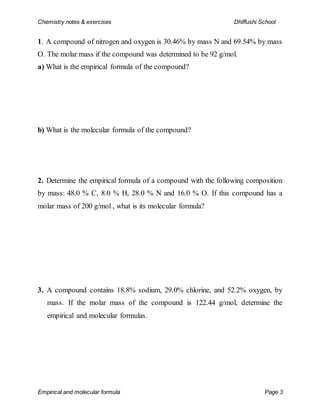
1. A compound of nitrogen and oxygen is 30.46% by mass N and 69.54% by mass
O. The molar mass if the compound was determined to be 92 g/mol.
a) What is the empirical formula of the compound?
b) What is the molecular formula of the compound?
2. Determine the empirical formula of a compound with the following composition
by mass: 48.0 % C, 8.0 % H, 28.0 % N and 16.0 % O. If this compound has a
molar mass of 200 g/mol , what is its molecular formula?
3. A compound contains 18.8% sodium, 29.0% chlorine, and 52.2% oxygen, by
mass. If the molar mass of the compound is 122.44 g/mol, determine the
empirical and molecular formulas.
Chemistry notes & exercises Dhiffushi School
Empirical and molecular formula Page 4
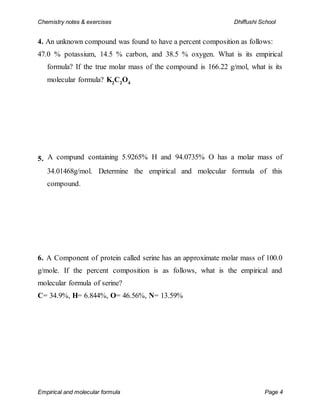
4. An unknown compound was found to have a percent composition as follows:
47.0 % potassium, 14.5 % carbon, and 38.5 % oxygen. What is its empirical
formula? If the true molar mass of the compound is 166.22 g/mol, what is its
molecular formula? K2
C2
O4
5. A compund containing 5.9265% H and 94.0735% O has a molar mass of
34.01468g/mol. Determine the empirical and molecular formula of this
compound.
6. A Component of protein called serine has an approximate molar mass of 100.0
g/mole. If the percent composition is as follows, what is the empirical and
molecular formula of serine?
C= 34.9%, H= 6.844%, O= 46.56%, N= 13.59%

Empirical and molecula formula

  • 1.
    Chemistry notes &exercises Dhiffushi School Empirical and molecular formula Page 1 Empirical and molecular formula Name: Index: Calculating the empirical and molecular formulas from the percent composition by mass and the molar mass of the compound: Steps:  Assume that you have a 100.0 gram sample of the compound. The percent by mass would then be the mass (in grams) you have of each element.  Convert grams of each element to moles using the molar mass.  Divide all moles by the least number of moles.  If any resulting number is not a whole number, multiply through by the smallest number that would make the fractions whole numbers.  These whole numbers are the subscripts in the empirical formula.  Use the molar mass of the compound to determine the scaling factor, and scale the empirical formula up to the molecular formula. Example: A compound is 43.7% P, and 56.3% O by mass, and has a molar mass of 283.88 g/mol.
  • 2.
    Chemistry notes &exercises Dhiffushi School Empirical and molecular formula Page 2 a) What is the empirical formula of the compound? Assume a 100.0 g sample of the compound: Detail of the procedure Elements Phosphorous oxygen Convert grams to moles 43.7𝑔 31 56.3𝑔 16 Divide each by the smallest number of moles 1.42 1.42 3.52 1.42 Convert to whole numbers 1 2.5 1×2 = 2 2.5×2 = 5 Empirical formula P2O5 b) What is the molecular formula of the compound? 𝑆𝑐𝑎𝑙𝑖𝑛𝑔 𝑓𝑎𝑐𝑡𝑜𝑟 = 𝑚𝑎𝑠𝑠 𝑜𝑓 𝑐𝑜𝑚𝑝𝑜𝑢𝑛𝑑 𝑚𝑎𝑠𝑠 𝑜𝑓 𝑃2𝑂5 283.88 142 283.88 142 = 1.99 or 2 2[P2O5] = P4O10 Molecular formula P4O10 (tetraphosphorus decoxide)
  • 3.
    Chemistry notes &exercises Dhiffushi School Empirical and molecular formula Page 3 1. A compound of nitrogen and oxygen is 30.46% by mass N and 69.54% by mass O. The molar mass if the compound was determined to be 92 g/mol. a) What is the empirical formula of the compound? b) What is the molecular formula of the compound? 2. Determine the empirical formula of a compound with the following composition by mass: 48.0 % C, 8.0 % H, 28.0 % N and 16.0 % O. If this compound has a molar mass of 200 g/mol , what is its molecular formula? 3. A compound contains 18.8% sodium, 29.0% chlorine, and 52.2% oxygen, by mass. If the molar mass of the compound is 122.44 g/mol, determine the empirical and molecular formulas.
  • 4.
    Chemistry notes &exercises Dhiffushi School Empirical and molecular formula Page 4 4. An unknown compound was found to have a percent composition as follows: 47.0 % potassium, 14.5 % carbon, and 38.5 % oxygen. What is its empirical formula? If the true molar mass of the compound is 166.22 g/mol, what is its molecular formula? K2 C2 O4 5. A compund containing 5.9265% H and 94.0735% O has a molar mass of 34.01468g/mol. Determine the empirical and molecular formula of this compound. 6. A Component of protein called serine has an approximate molar mass of 100.0 g/mole. If the percent composition is as follows, what is the empirical and molecular formula of serine? C= 34.9%, H= 6.844%, O= 46.56%, N= 13.59%