Chapter 9: Stoichiometry
• Homework: SR on p. 311 (attempt
ALL on LL)
• Anyone who I asked to do a
presentation for the symposium
see me ASAP!!!
• Boards are due by homeroom in
Commons on Friday!
• Like following a recipe
• Key is a balanced equation and
reading the equation in terms of…
• Coefficients
• Let’s examine a few word
problems, starting on p. 305 and
ending on p. 311 after we attempt
one together
Yeaaaaa…
boooyyyy!
Let’s try this
Na + Cl  ______
1. Type of reaction?
2. Skeleton equation
3. Balanced equation
4. How is read in terms of
moles?
5. “RECIPE” for moles to
moles, moles to mass,
mass to moles and
mass to mass – what is
the key term here?
6. Examples…
Do Now
• Have homework out to
review every single
question!!!
• Boards and binders in
this room! Presentations!
• Write down 1-2 questions
you still have regarding
stoichiometry
• Homework: p. 320, #5-10
on LL
• Collect binders/posters –
presentations in lab!
The pain!
The pain!
Do Now
• Quiz – 5 minutes
• Homework: p. 321, #21-27
• Have homework from p. 320 to be collected
• Have questions from homework ready
• Together:
1. What are the ways a balanced equation can be
interpreted?
2. What is a mole ratio?
3. Do you think experiments always work out the way you
planned? Explain…
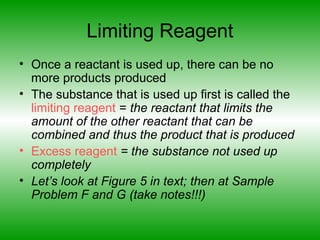
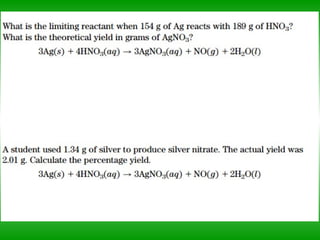
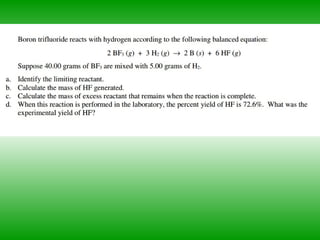
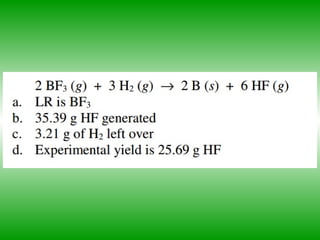
Limiting Reagent
• Once a reactant is used up, there can be no
more products produced
• The substance that is used up first is called the
limiting reagent = the reactant that limits the
amount of the other reactant that can be
combined and thus the product that is produced
• Excess reagent = the substance not used up
completely
• Let’s look at Figure 5 in text; then at Sample
Problem F and G (take notes!!!)
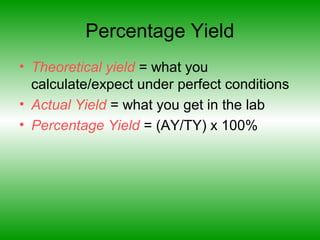
Percentage Yield
• Theoretical yield = what you
calculate/expect under perfect conditions
• Actual Yield = what you get in the lab
• Percentage Yield = (AY/TY) x 100%
Stoich ppt
Stoich ppt
Stoich ppt
Stoich ppt

Stoich ppt

  • 1.
    Chapter 9: Stoichiometry •Homework: SR on p. 311 (attempt ALL on LL) • Anyone who I asked to do a presentation for the symposium see me ASAP!!! • Boards are due by homeroom in Commons on Friday! • Like following a recipe • Key is a balanced equation and reading the equation in terms of… • Coefficients • Let’s examine a few word problems, starting on p. 305 and ending on p. 311 after we attempt one together Yeaaaaa… boooyyyy!
  • 2.
    Let’s try this Na+ Cl  ______ 1. Type of reaction? 2. Skeleton equation 3. Balanced equation 4. How is read in terms of moles? 5. “RECIPE” for moles to moles, moles to mass, mass to moles and mass to mass – what is the key term here? 6. Examples…
  • 3.
    Do Now • Havehomework out to review every single question!!! • Boards and binders in this room! Presentations! • Write down 1-2 questions you still have regarding stoichiometry • Homework: p. 320, #5-10 on LL • Collect binders/posters – presentations in lab! The pain! The pain!
  • 4.
    Do Now • Quiz– 5 minutes • Homework: p. 321, #21-27 • Have homework from p. 320 to be collected • Have questions from homework ready • Together: 1. What are the ways a balanced equation can be interpreted? 2. What is a mole ratio? 3. Do you think experiments always work out the way you planned? Explain…
  • 5.
    Limiting Reagent • Oncea reactant is used up, there can be no more products produced • The substance that is used up first is called the limiting reagent = the reactant that limits the amount of the other reactant that can be combined and thus the product that is produced • Excess reagent = the substance not used up completely • Let’s look at Figure 5 in text; then at Sample Problem F and G (take notes!!!)
  • 6.
    Percentage Yield • Theoreticalyield = what you calculate/expect under perfect conditions • Actual Yield = what you get in the lab • Percentage Yield = (AY/TY) x 100%