Classification of Matter Elements, Compounds, Mixtures
Lesson Objective Physical and Chemical Changes. Elements Compounds Mixtures
Physical and Chemical Changes All reaction in Chemistry can be divided into two types of changes:   Physical   or   Chemical . Physical Change : NO new  substance is formed. These changes are  easily reversible  or temporary. An example is dissolving salt in water. Other examples of physical change include:   melting, boiling, mixing 2 solids or liquids .
Chemical Change : A  NEW  substance is formed. These changes are  irreversible  or  permanent . The new substance formed will have  different properties  compared to its original elements. (E.g. different melting and different chemical reactions from the original substance.) Physical and Chemical Changes
One can recognize a chemical change from  2 observations : The new substance has a  different appearance , such as different color or different physical state. An example is the electrolysis of water. Reason: Electrolysis of water produces two new substances, Hydrogen gas and oxygen gas. Hydrogen and oxygen are both gases but water is a liquid. A lot of heat is given out  in a chemical changes. Chemical changes are called chemical reactions. Physical and Chemical Changes
Illustration of chemical changes
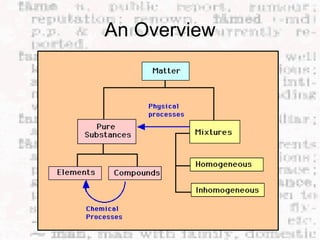
An Overview
Elements, Compounds and Mixtures “  single, attached, play play…”
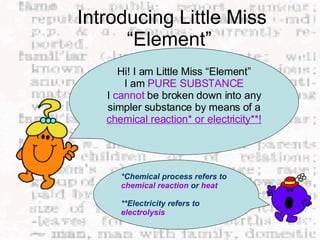
Introducing Little Miss “Element”  Hi! I am Little Miss “Element” I am  PURE SUBSTANCE I  cannot  be broken down into any simpler substance by means of a  chemical reaction* or electricity**! *Chemical process refers to  chemical reaction  or  heat **Electricity refers to  electrolysis
Elements Definition of an element: An element is a  pure substance  which  cannot  be split up into two or more simpler substances by chemical means.  Sugar is not an element as it can be broken down into carbon and water.
Note that an element:  Consists of only one kind of atom,  Cannot be broken down into a simpler type of matter by either physical or chemical means Can exist as either atoms (e.g. argon) or molecules (e.g., nitrogen).  Elements
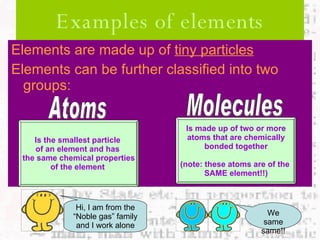
Examples of elements Elements are made up of  tiny particles Elements can be further classified into two groups: Atoms Molecules Is the smallest particle  of an element and has  the same chemical properties of the element  Is made up of two or more atoms that are chemically bonded together (note: these atoms are of the  SAME element!!) Hi, I am from the “Noble gas” family and I work alone We same same!!
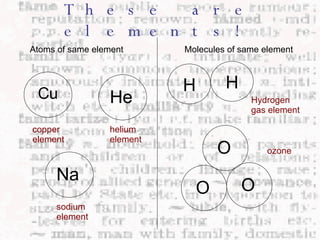
These are elements! Atoms of same element copper element sodium element helium element Molecules of same element Hydrogen gas element ozone Cu Na He H O H O O
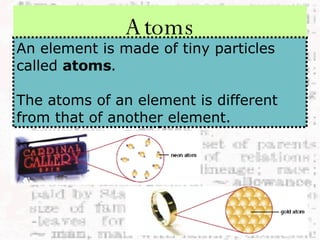
Atoms An element is made of tiny particles called  atoms . The atoms of an element is different from that of another element.
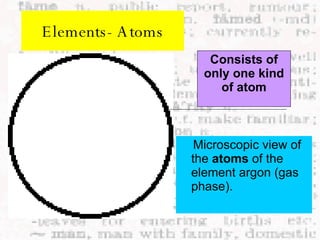
Elements- Atoms Microscopic view of the  atoms  of the element argon (gas phase).  Consists of only one kind of atom
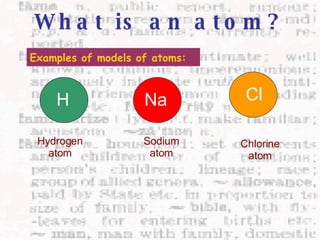
What is an atom? Examples of models of atoms: Hydrogen atom Sodium atom Chlorine atom H Na Cl
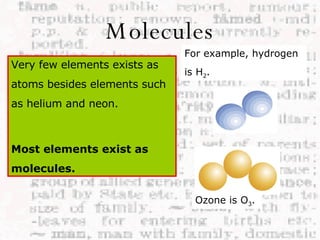
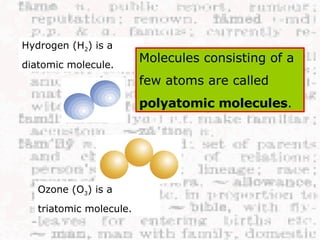
Molecules Very few elements exists as atoms besides elements such as helium and neon. Most elements exist as molecules. For example, hydrogen is H 2 . Ozone is O 3 .
Molecules consisting of a few atoms are called  polyatomic molecules . Hydrogen (H 2 ) is a diatomic molecule. Ozone (O 3 ) is a triatomic molecule.
Elements-Molecules Microscopic view of the  molecules  of the element nitrogen (gas phase). Consists of only one kind of atom
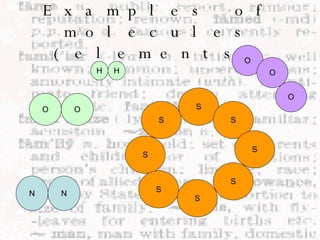
Examples of molecules (elements) N N S S S S S S S S H H O O O O O
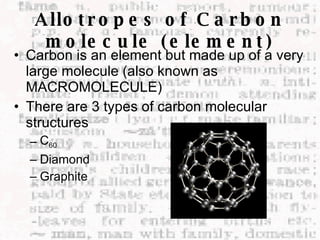
Allotropes of Carbon molecule (element) Carbon is an element but made up of a very large molecule (also known as MACROMOLECULE) There are 3 types of carbon molecular structures C 60 Diamond Graphite
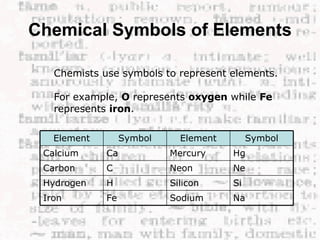
Chemical Symbols of Elements Chemists use symbols to represent elements.  For example,  O  represents  oxygen  while  Fe  represents  iron . Element Symbol Element Symbol Calcium Ca Mercury Hg Carbon C Neon Ne Hydrogen H Silicon Si Iron Fe Sodium Na
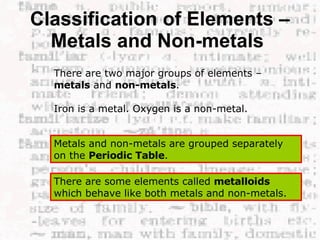
Classification of Elements – Metals and Non-metals  There are two major groups of elements –  metals  and  non-metals .  Iron is a metal. Oxygen is a non-metal. There are some elements called  metalloids  which behave like both metals and non-metals. Metals and non-metals are grouped separately on the  Periodic Table .
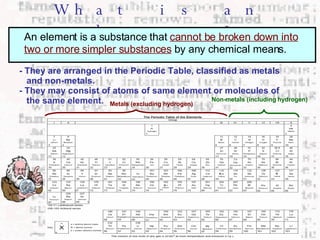
What is an element? An element is a substance that  cannot be broken down into two or more simpler substances  by any chemical means. - They are arranged in the Periodic Table, classified as metals    and non-metals. - They may consist of atoms of same element or molecules of    the same element. Metals (excluding hydrogen) Non-metals (including hydrogen)
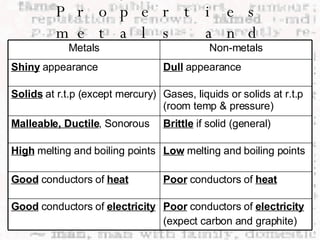
Physical Properties metals and non-metals  Metals Non-metals Shiny  appearance Dull  appearance Solids  at r.t.p (except mercury) Gases, liquids or solids at r.t.p (room temp & pressure) Malleable, Ductile , Sonorous Brittle  if solid (general) High  melting and boiling points Low  melting and boiling points Good  conductors of  heat Poor  conductors of  heat Good  conductors of  electricity Poor  conductors of  electricity (expect carbon and graphite)
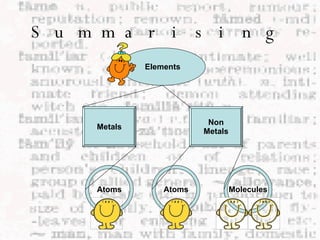
Summarising Elements Metals Non Metals Atoms Atoms Molecules
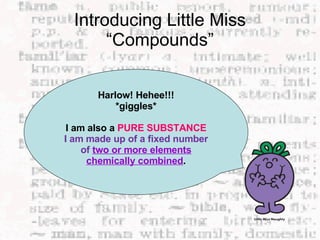
Introducing Little Miss “Compounds” Harlow! Hehee!!! *giggles* I am also a  PURE SUBSTANCE I am made up of  a fixed number of  two or more elements chemically combined .
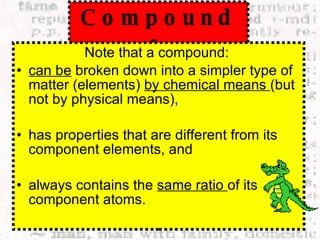
Compounds Note that a compound:  can be  broken down into a simpler type of matter (elements)  by chemical means  (but not by physical means),  has properties that are different from its component elements, and  always contains the  same ratio  of its component atoms.
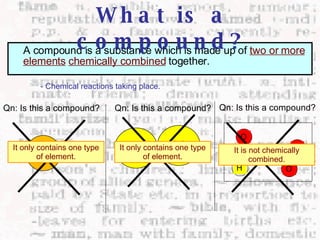
A compound is a substance which is made up of  two or more elements   chemically combined  together. What is a compound? Chemical reactions taking place. Qn: Is this a compound? It only contains one type of element. Qn: Is this a compound? It only contains one type of element. H O H O O Qn: Is this a compound? It is not chemically combined.
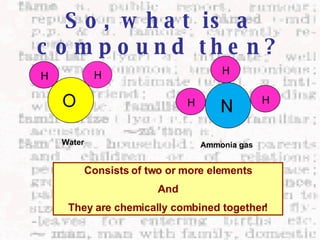
So, what is a compound then? Water  Ammonia gas  Consists of two or more elements And They are chemically combined together! H
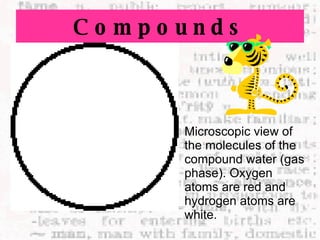
Compounds Microscopic view of the molecules of the compound water (gas phase). Oxygen atoms are red and hydrogen atoms are white.
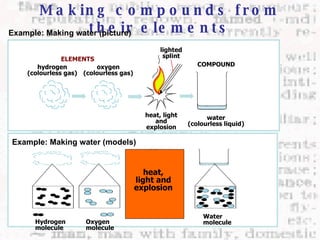
Making compounds from their elements ELEMENTS COMPOUND hydrogen (colourless gas) oxygen (colourless gas) lighted splint heat, light and explosion water (colourless liquid) Example: Making water (picture) Water molecule Oxygen molecule Hydrogen molecule mixture of hydrogen and oxygen water Example: Making water (models) heat, light and explosion
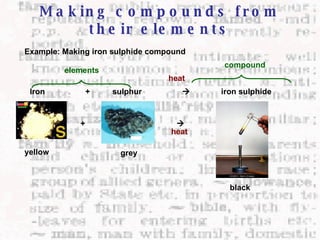
Making compounds from their elements Example: Making iron sulphide compound Iron  +  sulphur     iron sulphide elements compound + yellow grey  heat heat black
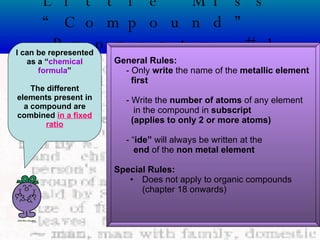
Little Miss “Compound”  Property #1 I can be represented as a “ chemical formula ” The different elements present in a compound are combined  in a fixed ratio General Rules: - Only  write  the name of the  metallic element    first - Write the  number of atoms  of any element    in the compound in  subscript     (applies to only 2 or more atoms) - “ ide”  will always be written at the    end  of the  non metal element Special Rules: Does not apply to organic compounds (chapter 18 onwards)
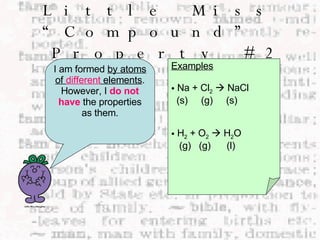
Little Miss “Compound”  Property #2 I am formed  by atoms of  different  elements . However, I  do not have  the properties as them. Examples Na + Cl 2     NaCl (s)  (g)  (s) H 2  + O 2     H 2 O (g)  (g)  (l)
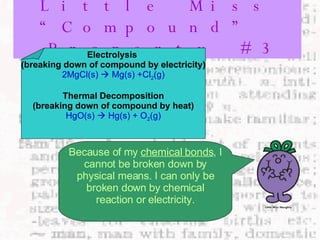
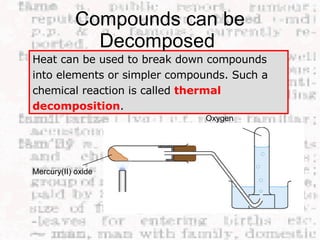
Little Miss “Compound”  Property #3 Because of my  chemical bonds , I cannot be broken down by physical means. I can only be broken down by chemical reaction or electricity. Electrolysis  (breaking down of compound by electricity) 2MgCl(s)    Mg(s) +Cl 2 (g) Thermal Decomposition (breaking down of compound by heat) HgO(s)    Hg(s) + O 2 (g)
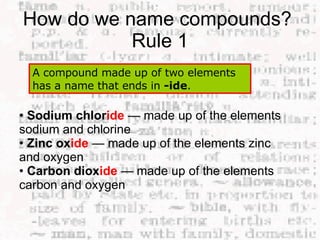
How do we name compounds?  Rule 1 A compound made up of two elements has a name that ends in  -ide .  •  Sodium chlor ide   — made up of the elements sodium and chlorine  •  Zinc ox ide   — made up of the elements zinc and oxygen  •  Carbon diox ide   — made up of the elements carbon and oxygen
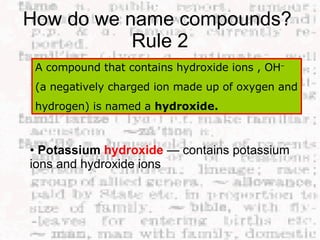
How do we name compounds?  Rule 2 A compound that contains hydroxide ions , OH –  (a negatively charged ion made up of oxygen and hydrogen) is named a  hydroxide.   •  Potassium  hydroxide   — contains potassium ions and hydroxide ions
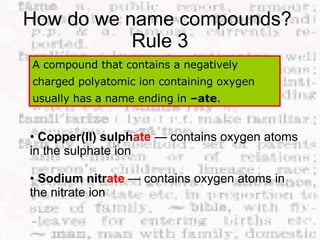
How do we name compounds?  Rule 3 A compound that contains a negatively charged polyatomic ion containing oxygen usually has a name ending in  –ate .  •  Copper(II) sulph ate   — contains oxygen atoms in the sulphate ion  •  Sodium nitr ate   — contains oxygen atoms in the nitrate ion
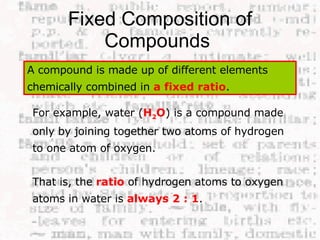
Fixed Composition of Compounds  For example, water ( H 2 O ) is a compound made only by joining together two atoms of hydrogen to one atom of oxygen.  That is, the  ratio  of hydrogen atoms to oxygen atoms in water is  always 2 : 1 .  A compound is made up of different elements chemically combined in  a fixed ratio .
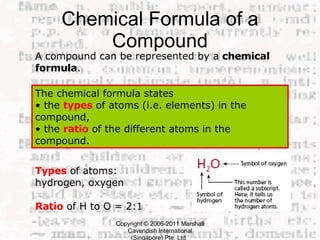
Chemical Formula of a Compound Copyright © 2006-2011 Marshall Cavendish International (Singapore) Pte. Ltd.  A compound can be represented by a  chemical formula .  The chemical formula states  • the  types  of atoms (i.e. elements) in the compound,  • the  ratio  of the different atoms in the compound.  Types  of atoms: hydrogen, oxygen Ratio  of H to O = 2:1
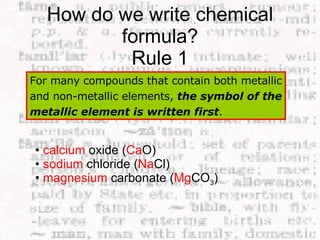
How do we write chemical formula? Rule 1 For many compounds that contain both metallic and non-metallic elements,  the symbol of the metallic element is written first .  •  calcium  oxide ( Ca O)  •  sodium  chloride ( Na Cl)  •  magnesium  carbonate ( Mg CO 3 )
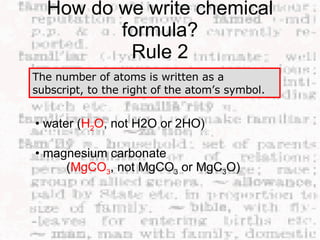
How do we write chemical formula? Rule 2 The number of atoms is written as a subscript, to the right of the atom’s symbol.  •  water ( H 2 O , not H2O or 2HO)  •  magnesium carbonate    ( MgCO 3 , not MgCO 3  or MgC 3 O)
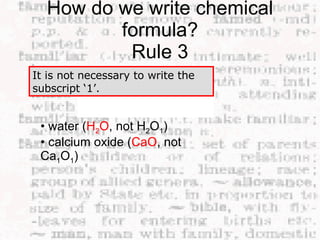
How do we write chemical formula? Rule 3 It is not necessary to write the subscript ‘1’.  •  water ( H 2 O , not H 2 O 1 )  • calcium oxide ( CaO , not Ca 1 O 1 )
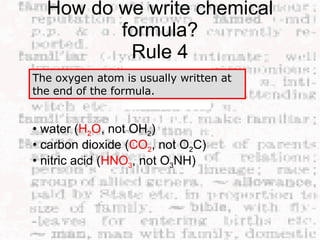
How do we write chemical formula? Rule 4 The oxygen atom is usually written at the end of the formula.  •  water ( H 2 O , not OH 2 )  • carbon dioxide ( CO 2 , not O 2 C)  • nitric acid ( HNO 3 , not O 3 NH)
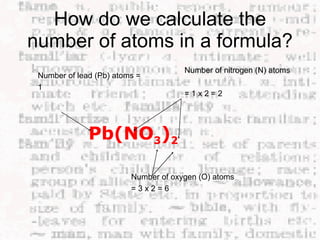
How do we calculate the number of atoms in a formula? Pb(NO 3 ) 2 Number of nitrogen (N) atoms  = 1 x 2 = 2 Number of lead (Pb) atoms = 1 Number of oxygen (O) atoms  = 3 x 2 = 6
Compounds can be Decomposed  Heat can be used to break down compounds into elements or simpler compounds. Such a chemical reaction is called  thermal decomposition .  Mercury(II) oxide  Oxygen
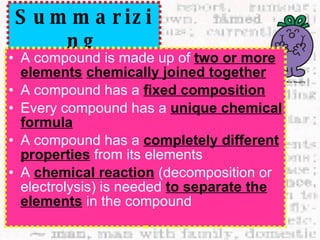
Summarizing A compound is made up of  two or more elements   chemically joined together A compound has a  fixed composition Every compound has a  unique chemical formula A compound has a  completely different properties  from its elements A  chemical reaction  (decomposition or electrolysis) is needed  to separate the elements  in the compound
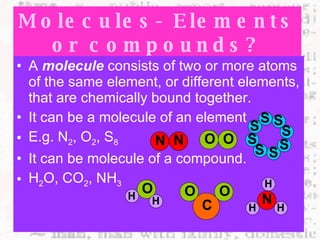
Molecules- Elements or compounds? A  molecule  consists of two or more atoms of the same element, or different elements, that are chemically bound together.  It can be a molecule of an element  E.g. N 2 , O 2 , S 8 It can be molecule of a compound. H 2 O, CO 2 , NH 3 N N O O S S S S S S S S O H H O O C N H H H
Think about this… ROJAK!!
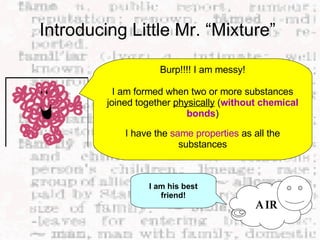
Introducing Little Mr. “Mixture”  Burp!!!! I am messy! I am formed when two or more substances joined together  physically  ( without chemical bonds ) I have the  same properties  as all the substances I am his best friend! AIR
Mixtures Definition of a mixture: A mixture is not a pure substance as it contains a mixture of atoms of molecules which are not chemically combined together.
Mixtures Note that a mixture:  consists of  two or more different elements  and/or compounds  NOT chemically combined . Can be homogeneous or non-homogeneous  can be separated into its components by  physical means , and  often  retains  many of the  properties of its components .
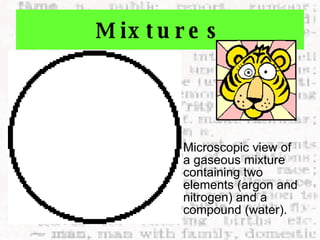
Microscopic view of a gaseous mixture containing two elements (argon and nitrogen) and a compound (water). Mixtures
Mixtures Examples of mixtures include muddy water and air.  Air is made up of gases such as nitrogen and oxygen mixed together.
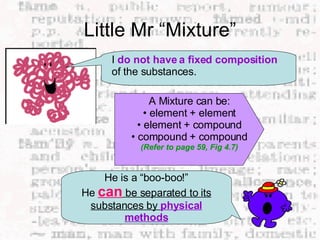
Little Mr “Mixture” I  do not have a fixed composition  of the substances. A Mixture can be: element + element element + compound compound + compound (Refer to page 59, Fig 4.7) He is a “boo-boo!” He  can  be separated to its substances by  physical methods
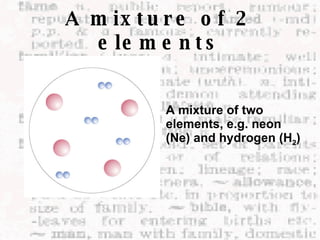
A mixture of 2 elements A mixture of two elements, e.g. neon (Ne) and hydrogen (H 2 )
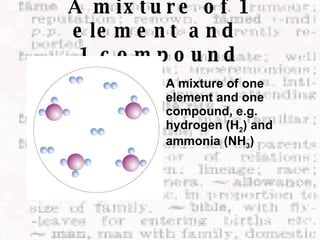
A mixture of 1 element and  1 compound A mixture of one element and one compound, e.g. hydrogen (H 2 ) and ammonia (NH 3 )
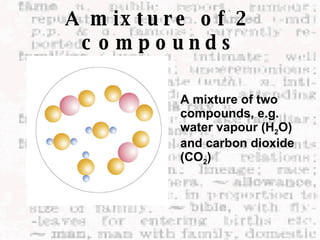
A mixture of 2 compounds A mixture of two compounds, e.g. water vapour (H 2 O) and carbon dioxide (CO 2 )
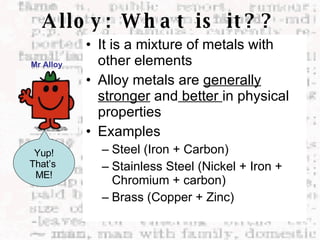
Alloy: What is it?? It is a mixture of metals with other elements Alloy metals are  generally stronger  and  better  in physical properties Examples Steel (Iron + Carbon) Stainless Steel (Nickel + Iron + Chromium + carbon) Brass (Copper + Zinc) Yup! That’s  ME! Mr Alloy
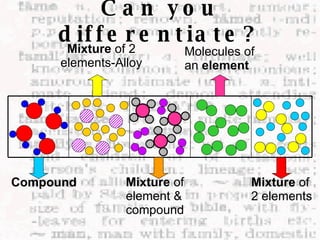
Can you differentiate? Compound Mixture  of element & compound Mixture  of 2 elements-Alloy Molecules of an  element Mixture  of 2 elements
Conclusion An element is a pure substance which cannot be split up into two or more simpler substances by chemical means.  A compound consist of a fixed number of different kinds of atoms chemically combined together. A mixture is not a pure substance as it contains a mixture of atoms of molecules which are not chemically combined together.
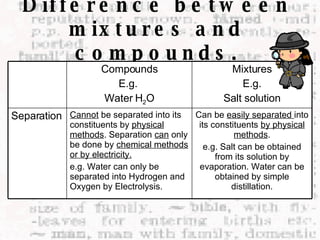
Difference between mixtures and compounds. Compounds E.g.  Water H 2 O Mixtures E.g. Salt solution Separation Cannot  be separated into its constituents by  physical methods . Separation  can  only be done by  chemical methods or by electricity. e.g. Water can only be separated into Hydrogen and Oxygen by Electrolysis. Can be  easily separated  into its constituents  by physical methods . e.g. Salt can be obtained from its solution by evaporation. Water can be obtained by simple distillation.
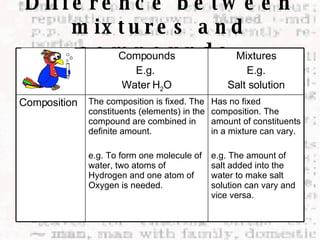
Difference between mixtures and compounds. Compounds E.g.  Water H 2 O Mixtures E.g. Salt solution Composition The composition is fixed. The constituents (elements) in the compound are combined in definite amount. e.g. To form one molecule of water, two atoms of Hydrogen and one atom of Oxygen is needed. Has no fixed composition. The amount of constituents in a mixture can vary. e.g. The amount of salt added into the water to make salt solution can vary and vice versa.
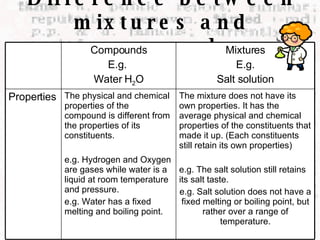
Difference between mixtures and compounds. Compounds E.g.  Water H 2 O Mixtures E.g. Salt solution Properties The physical and chemical properties of the compound is different from the properties of its constituents. e.g. Hydrogen and Oxygen are gases while water is a liquid at room temperature and pressure. e.g. Water has a fixed melting and boiling point. The mixture does not have its own properties. It has the average physical and chemical properties of the constituents that made it up. (Each constituents still retain its own properties) e.g. The salt solution still retains its salt taste. e.g. Salt solution does not have a fixed melting or boiling point, but rather over a range of temperature.
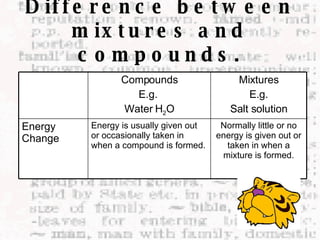
Difference between mixtures and compounds. Compounds E.g.  Water H 2 O Mixtures E.g. Salt solution Energy Change Energy is usually given out or occasionally taken in when a compound is formed. Normally little or no energy is given out or taken in when a mixture is formed.
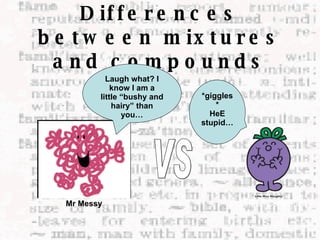
Differences between mixtures and compounds *giggles* HeE stupid… Laugh what? I know I am a little “bushy and hairy” than you… Little Miss Compound Mr Messy VS
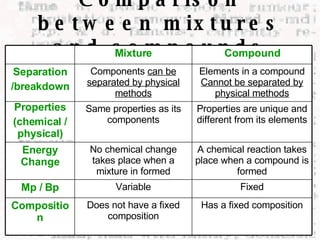
Comparison between mixtures and compounds Fixed Variable Mp / Bp Has a fixed composition Does not have a fixed composition Composition A chemical reaction takes place when a compound is formed No chemical change takes place when a mixture in formed Energy Change Properties are unique and different from its elements Same properties as its components Properties (chemical / physical) Elements in a compound  Cannot be separated by physical methods Components  can be separated by physical methods Separation /breakdown Compound Mixture
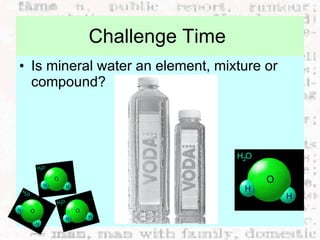
Challenge Time  Is mineral water an element, mixture or compound?
Challenge Time Are YOU an element, mixture or compound?
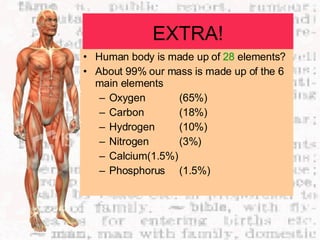
EXTRA! Human body is made up of  28  elements? About 99% our mass is made up of the 6 main elements Oxygen (65%) Carbon (18%) Hydrogen  (10%) Nitrogen (3%) Calcium (1.5%) Phosphorus  (1.5%)
The End……