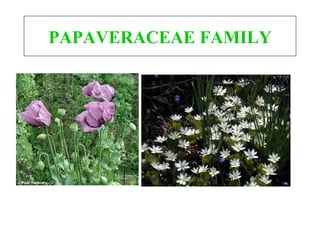
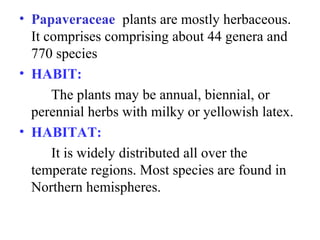

PAPAVERACEAE FAMILY
• The Papaveraceae, or the poppy family
• Many plants in the Papaveraceae are
economically important plants, widely grown
for their attractive flowers .
• Papaveraceae plants are mostly herbaceous.
It comprises comprising about 44 genera and
770 species
• HABIT:
The plants may be annual, biennial, or
perennial herbs with milky or yellowish latex.
• HABITAT:
It is widely distributed all over the
temperate regions. Most species are found in
Northern hemispheres.
• STEM:
Herbaceous, erect, cylindrical, and
branched.
• LEAVES:
Radical rather large, alternate or the upper
one sometimes opposite, simple lobed or
deeply divided or compound.
• INFLORESCENCE:
The terminal flowers solitary in most species. In
others the terminal inflorescence is cymose or
racemose
• FLOWER:
Hermaphrodite, actinomorphic or zygomorphic,
Hypogynous, di or trimerous. Ebracteate and
pedicellate, large and showy
• CALYAX:
Sepals 2-3, free, caducous, inferior
• COROLLA:
Petals 4 or more, free in two whorls.
• ANDROCEIUM:
Stamens numerous occasionally 4 or 2, free,
alternating, whorls.
• GYNAECIUM:
Polycarpillary, syncarpous, uni locular
ovules usually numerous, placentation
parietal.
• FRUIT:
Capsule dehiscing by pores or valves.
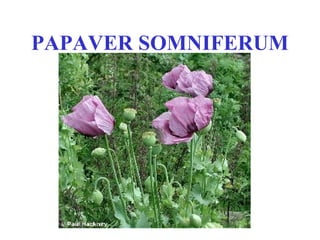
PAPAVER SOMNIFERUM
•
• BOTANICAL ORIGION: Papaver
somniferum
• Common Name: Crude Opium, Gum opium,
post, Afim.
• Part used: Dried milky latex obtained by
incision from unripe capsules.
• Habit: Annual herb
• Habitat: Found in Turkey, India, Pakistan,
Iran, Thailand.
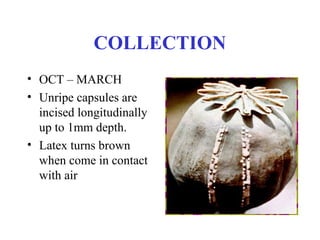
COLLECTION
• OCT – MARCH
• Unripe capsules are
incised longitudinally
up to 1mm depth.
• Latex turns brown
when come in contact
with air
• Constituents:
It contains more than 30
alkaloids and 6 main ones are6 main ones are
• MorphineMorphine
• CodeineCodeine
• ThebaineThebaine
• NoscapineNoscapine
• NarceineNarceine
• papaverinepapaverine
• Morphine Type:
of benzyl isoquinoline system.
Morphine
Pseudo or oxymorphine
Codeine
Thebaine
belongs to phenantherene ring system
Codeine is an ether of morphine and is used
medicinally
• Phthalide Isoquinoline Type:
Noscapine
Oxynarcotine
Narceine
Narcotoline
• Benzyl Isoquinoline Type:
Papaverine
Codamine
Laudanidine
• Cryptopine Type:
Protopine
Cryptopine
It also contains
Meconic acid(free and in combination with
morphine)
Sugars
Salts
Albumins
Colouring matter
• MEDICINAL USES:
Opium & Morphine:
Relieve pain
Hypnotics (affect the sensory nerve cells of the
cerebrum).
Opium (closely resembles morphine) – exerts
action more slowly – preferable to morphine
(e.g in diarrhoea).
Opium: also a diaphoretic
Codeine
Milder sedative
Relieve cough
Habitual use may cause constipation
Both Morphine & Codeine decrease
metabolism
Codeine – was used to treat diabetes (before
the introduction of insulin
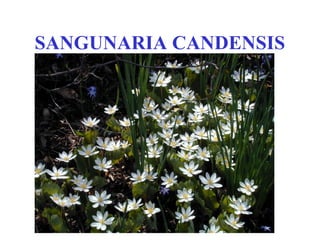
SANGUNARIA CANDENSIS
• BOTANICAL ORIGION: Sangunaria
canadensis
• Common Name: Blood root, Red root
• Part used: Dried rhizomes and roots
• Habit: Perennial herb
• Habitat: United states of America and Canada
• Constituents:
Mainly contain
Isoquinoline alkaloids
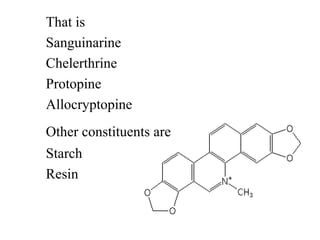
That is
Sanguinarine
Chelerthrine
Protopine
Allocryptopine
Other constituents are
Starch
Resin
• MEDICINAL USES:
Emetic
Expectorant
Extract is used as tooth paste in gingivi and
periodical diseases.
It is toxic if taken in large doses(more than
125mg)
Papaveraceae

Papaveraceae

  • 1.
  • 2.
    • The Papaveraceae,or the poppy family • Many plants in the Papaveraceae are economically important plants, widely grown for their attractive flowers .
  • 3.
    • Papaveraceae plantsare mostly herbaceous. It comprises comprising about 44 genera and 770 species • HABIT: The plants may be annual, biennial, or perennial herbs with milky or yellowish latex. • HABITAT: It is widely distributed all over the temperate regions. Most species are found in Northern hemispheres.
  • 4.
    • STEM: Herbaceous, erect,cylindrical, and branched. • LEAVES: Radical rather large, alternate or the upper one sometimes opposite, simple lobed or deeply divided or compound.
  • 5.
    • INFLORESCENCE: The terminalflowers solitary in most species. In others the terminal inflorescence is cymose or racemose • FLOWER: Hermaphrodite, actinomorphic or zygomorphic, Hypogynous, di or trimerous. Ebracteate and pedicellate, large and showy • CALYAX: Sepals 2-3, free, caducous, inferior
  • 6.
    • COROLLA: Petals 4or more, free in two whorls. • ANDROCEIUM: Stamens numerous occasionally 4 or 2, free, alternating, whorls.
  • 7.
    • GYNAECIUM: Polycarpillary, syncarpous,uni locular ovules usually numerous, placentation parietal. • FRUIT: Capsule dehiscing by pores or valves.
  • 8.
  • 9.
    • • BOTANICAL ORIGION:Papaver somniferum • Common Name: Crude Opium, Gum opium, post, Afim. • Part used: Dried milky latex obtained by incision from unripe capsules. • Habit: Annual herb • Habitat: Found in Turkey, India, Pakistan, Iran, Thailand.
  • 10.
    COLLECTION • OCT –MARCH • Unripe capsules are incised longitudinally up to 1mm depth. • Latex turns brown when come in contact with air
  • 11.
    • Constituents: It containsmore than 30 alkaloids and 6 main ones are6 main ones are • MorphineMorphine • CodeineCodeine • ThebaineThebaine • NoscapineNoscapine • NarceineNarceine • papaverinepapaverine
  • 12.
    • Morphine Type: ofbenzyl isoquinoline system. Morphine Pseudo or oxymorphine Codeine Thebaine belongs to phenantherene ring system Codeine is an ether of morphine and is used medicinally
  • 13.
    • Phthalide IsoquinolineType: Noscapine Oxynarcotine Narceine Narcotoline • Benzyl Isoquinoline Type: Papaverine Codamine Laudanidine
  • 14.
    • Cryptopine Type: Protopine Cryptopine Italso contains Meconic acid(free and in combination with morphine) Sugars Salts Albumins Colouring matter
  • 15.
    • MEDICINAL USES: Opium& Morphine: Relieve pain Hypnotics (affect the sensory nerve cells of the cerebrum). Opium (closely resembles morphine) – exerts action more slowly – preferable to morphine (e.g in diarrhoea). Opium: also a diaphoretic
  • 16.
    Codeine Milder sedative Relieve cough Habitualuse may cause constipation Both Morphine & Codeine decrease metabolism Codeine – was used to treat diabetes (before the introduction of insulin
  • 17.
  • 18.
    • BOTANICAL ORIGION:Sangunaria canadensis • Common Name: Blood root, Red root • Part used: Dried rhizomes and roots • Habit: Perennial herb • Habitat: United states of America and Canada • Constituents: Mainly contain Isoquinoline alkaloids
  • 19.
  • 20.
    • MEDICINAL USES: Emetic Expectorant Extractis used as tooth paste in gingivi and periodical diseases. It is toxic if taken in large doses(more than 125mg)