DanishT47@gmail.com
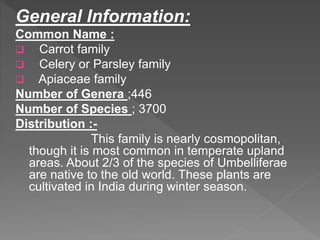
General Information:
Common Name :
 Carrot family
 Celery or Parsley family
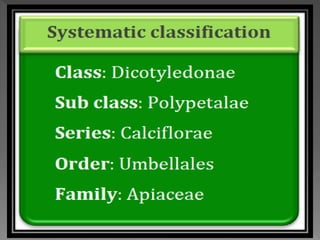
 Apiaceae family
Number of Genera ;446
Number of Species ; 3700
Distribution :-
This family is nearly cosmopolitan,
though it is most common in temperate upland
areas. About 2/3 of the species of Umbelliferae
are native to the old world. These plants are
cultivated in India during winter season.
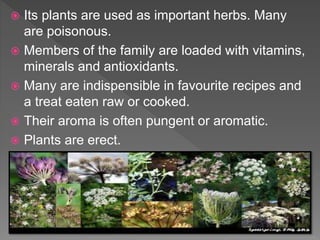
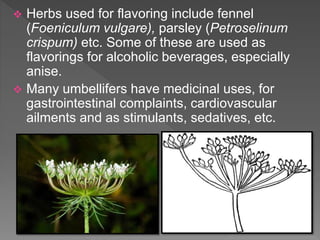
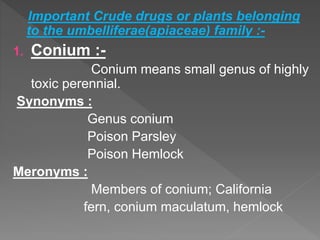
 The Umbelliferae family is named after the
shape of its flowers, which are called umbels.
 The umbels are unique in their floral uniformity.
 These distinctive umbrella shaped blooms are
attractive in arrangements and lovedd by
numerous beneficial insects.
 They pollinate freely which allow it to increase
its natural distribution.
 Seed dispersal occurs through wind.
 It is an Angiospermic plant.
 Its plants are used as important herbs. Many
are poisonous.
 Members of the family are loaded with vitamins,
minerals and antioxidants.
 Many are indispensible in favourite recipes and
a treat eaten raw or cooked.
 Their aroma is often pungent or aromatic.
 Plants are erect.
Vegetative Charcteristics :-
Habitat :-
Members of this family are adapted to
conditions that encourage heavy concentrations of
essential oils.
Habit :-
Most of this family are herbaceous annual,
biennial (having a 2 year cycle), or perennial
plants.
Root system :-
These plants have either tap root,
fusiform or branched system.. The roots are large
enough to store the useful food materials . For
example carrot and parsnip.
Stems:-
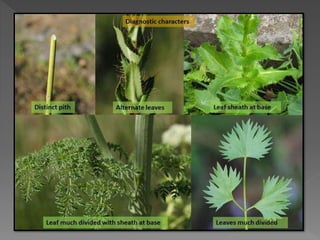
Stems are hollow at the points where the
leaves are attached. Usually stems are soft, green,
aerial. Either prostrate or erect. Sometimes stems
penetrate underground and store food materials.
The nodes of the stem are swollen. They possess
alternate, undivided or dividedd leaves, base of
stalks often dilated & sheathing the stem.
Leaves :-
Leaves are alternate, exstipulate, pinnately
compound or palmately lobed with reticulate
venation stem or base of leaf.
Umbels:-
Umbels are compound or simple, with or
without bracts & bracteoles at the base of primary &
secondary rays, repectively.
Floral Charcteristics :-
Inflorescence :-
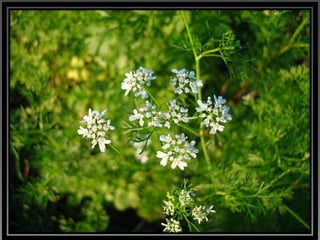
It is the characteristic feature of
this family. The flowering head is usually a
simple or compound umbel, but it can be
reduced to a single flower in some species.
This flat-topped umbel resembles a flattened
umbrella structure and thus the alternate name
for this family is Umbelliferae (apiaceae). The
primary umbel is surrounded by an involucre of
bracts and secondary umbel is subtended by an
involucre of bractlets.
Flower :-
Flowers are small, bracteate/ebracteate,
pediciliate or sessile, complete, regular,
pentamerous, actinomorphic or zygomorphic,
epigynous, cyclic usually bisexual and rarely
unisexual. Flowers are arranged in umbels or
double umbels. Flowers are many, small, white
or yellow in color.
Calyx :-
The calyx consists of 5 sepals which
remain adnate to the ovary wall. Sometimes
sepals may be absent. The aestivation is
valvate. The calyx is usually represented by five
inconspicuous teeth.
Corolla :-
The corolla consists of 5 free petals
alternating with sepals. Petals are usually
apically inflexed in bud and they fall off soon.
The aestivation is imbricate or valvate. The
petals are two lobes. The peripheral flowers of
coriandrum have unequal petals.
Androecium:-
It consists of 5 free stamens,
alternating with the petals. They arise from an
epigynous disc. The filaments are equal in
length, inflexed in bug and the anthers are
basifixed or dorsifixed, dithecous, introse and
dehisce longitudinally.
Gynoecium :-
It is bicarpellary and syncarpous with
an inferior bilocular ovary. Each carpel has a single
pendulous and anatropus ovule. The placentation is
axile. An epigynous disc called as stylopodium, is
present on the top of the ovary. Stylopodium
surrounds the two styles. Stigmas are capitates and
distinct. The carpels are ribbed and have parallel
resinous canals called vittae.
Pollination :-
Flowers are pollinated by a wide variety
of insects-mostly flies, mosquitoes or gnats, bees,
butterflies or moths.
Fruit :-
The fruit can be divided into 2 parts
 The fruit is schizocarpic cremocarp. A cremocarp
is made up of two one-seeded carples called as
mericarps.
 Mericarps remain attached to the central axis
known as carpophore. Mericarps are
longitudinally ridged and in between the ridges
or wings resinous or oil ducts called vittae are
present.
Seeds :-
Seeds are endospermic with a small
embryo. The endosperm may be flat, cresent or
concave on the ventral side.
Economic Importance
The family Apiaceae/Umbelliferae contributes
several important food, essentail oils and
aromatic herbs to human race. Hence this
family is considered as economically important.
 One remarkable feature of umbelliferae family
is the wide range of uses of different species,
ranging from food and fodder to spices, poisons
and perfumery.
 The carrot (Daucus carota) is a major vegetable
crop, with a world production of 23.3 megatons.
 Herbs used for flavoring include fennel
(Foeniculum vulgare), parsley (Petroselinum
crispum) etc. Some of these are used as
flavorings for alcoholic beverages, especially
anise.
 Many umbellifers have medicinal uses, for
gastrointestinal complaints, cardiovascular
ailments and as stimulants, sedatives, etc.
Important Crude drugs or plants belonging
to the umbelliferae(apiaceae) family :-
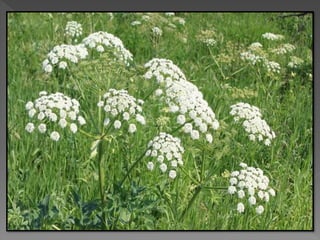
1. Conium :-
Conium means small genus of highly
toxic perennial.
Synonyms :
Genus conium
Poison Parsley
Poison Hemlock
Meronyms :
Members of conium; California
fern, conium maculatum, hemlock
Biological Source :-
Conium is a genus of two species of highly
poisonous perennial herbaceous flowering plant
known as conium maculatum.
Geographical Source :-
 It is found in disturbed or waste areas such
as roadsides and edges of cultivated fields.
 Poison hemlock was introduced into North
America from Europe and can be found in all
areas of U.S. except for desert areas. It can be
found growing in the samekind of habitats as
the water hemlock.
 Conium maculatum, a Eurasian weed naturalized in
North America, contains high concentrations of
piperidine alkaloids that act as chemical defense
against herbivores. Conium maculatum is a highly
toxic weed found in waste places throughout much
of the world.
Cultivation and collection :-
 Hemlock was occasionally deliberately grown as a
medicinal herb in the past, even though it is highly
poisonous.
 It is generally considered a weed of gardens those
days.
 The poisonous hemlock does not require any
maintenance to grow and should be eradicated
upon sight.
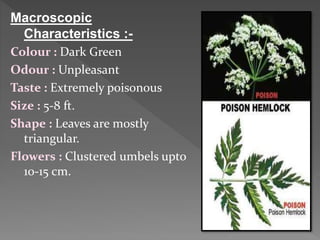
Macroscopic
Characteristics :-
Colour : Dark Green
Odour : Unpleasant
Taste : Extremely poisonous
Size : 5-8 ft.
Shape : Leaves are mostly
triangular.
Flowers : Clustered umbels upto
10-15 cm.
Medicinal Action and Uses :-
 As a medicine conium is sedative and
antipasmodic and in sufficient doses act as a
paralyser to the motion centres. In its action it is
therefore, directly antagonistic to that of
Strychnine and hence it has been
recommended as an antidote to Strychnine
poisoning.
 Hemlock juice (Succus conii) is prescibed as a
remedy in cases of undue nervous motor
excitability, such as teething in children,
epilepsy from detention cramp, in the early
stages of paralysis agitans, in spasms of the
larynx and gullet in acute mania.
 The drug has to be administered with care, as
narcotic poisoning may result from internal use,
and overdoses produce paralysis.
 Hemlock was formerly believed to exercise an
alterative effect in scrofulous disorders.
 Both the Greek and Arabian physicians were in the
practice of using it for the cure of indolent tumors,
swellings and pains of the joints.
 In the case of poisoning by hemlock, antidotes are
tannic acid, stimulants and coffee, emetics of zinc
or mustard and castor oil, and if necessary,
artificial respiration.
 It is essential to keep up the temp. of the body.
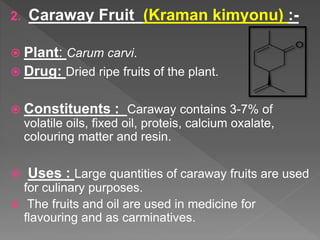
2. Caraway Fruit (Kraman kimyonu) :-
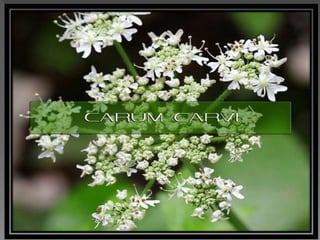
 Plant: Carum carvi.
 Drug: Dried ripe fruits of the plant.
 Constituents : Caraway contains 3-7% of
volatile oils, fixed oil, proteis, calcium oxalate,
colouring matter and resin.
 Uses : Large quantities of caraway fruits are used
for culinary purposes.
 The fruits and oil are used in medicine for
flavouring and as carminatives.
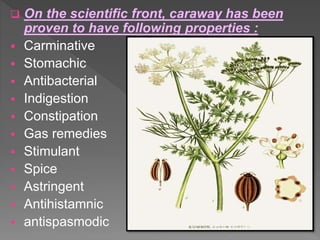
 On the scientific front, caraway has been
proven to have following properties :
 Carminative
 Stomachic
 Antibacterial
 Indigestion
 Constipation
 Gas remedies
 Stimulant
 Spice
 Astringent
 Antihistamnic
 antispasmodic
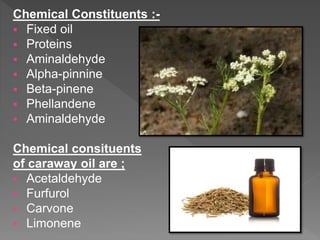
Chemical Constituents :-
 Fixed oil
 Proteins
 Aminaldehyde
 Alpha-pinnine
 Beta-pinene
 Phellandene
 Aminaldehyde
Chemical consituents
of caraway oil are ;
 Acetaldehyde
 Furfurol
 Carvone
 Limonene
Organuleptic Evaluation :-
Texture : Rough
Fracture : Weak
External Markings : Longitudinal markings, noch
is present at one side.
Internal Markings : Fibrous
Apex and Base : Pointed
Shape : Elongated and tapering on both sides.
Size : 4-6mm in length and 2mm thick.
Odour and Taste : Characteristic and aromatic.
External colors : Brown, ridges are light in color.
Internal colors : Brown
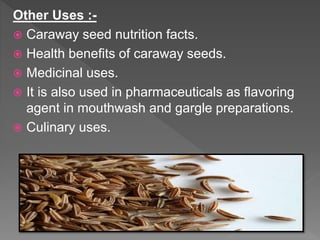
Other Uses :-
 Caraway seed nutrition facts.
 Health benefits of caraway seeds.
 Medicinal uses.
 It is also used in pharmaceuticals as flavoring
agent in mouthwash and gargle preparations.
 Culinary uses.
3. CORIANDER and CORIANDER OIL –
(Kişniş) :-
 Plant: Coriandrum sativum. It is indigenous to Italy, but is widely
cultivated in many parts of Europe, Mediterranean, India and
China.
 Drug: Dried, nearly ripe fruit of the plant.
 Constituents : Coriander fruits contain up to 1.8% volatile oil. The
distilled oil contains 65-70% linalool(coriandrol) and a smaller
amounts of α-pinene, γ-terpinene and limonene.
 Uses : Very large quantities of the spice are produced in many
countries for domestic purposes, such as for use in curries.
Pharmaceutically coriander and its oils are used as a flavouring
agent and carminative.
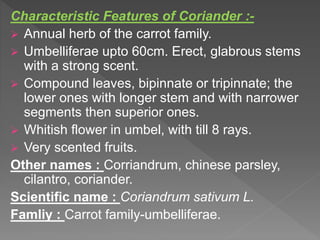
Characteristic Features of Coriander :-
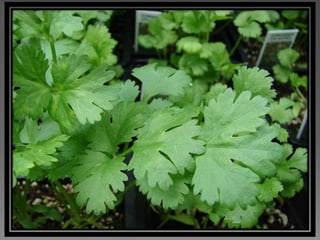
 Annual herb of the carrot family.
 Umbelliferae upto 60cm. Erect, glabrous stems
with a strong scent.
 Compound leaves, bipinnate or tripinnate; the
lower ones with longer stem and with narrower
segments then superior ones.
 Whitish flower in umbel, with till 8 rays.
 Very scented fruits.
Other names : Corriandrum, chinese parsley,
cilantro, coriander.
Scientific name : Coriandrum sativum L.
Famliy : Carrot family-umbelliferae.
Habitat :-
Native from Asia and Africa, it can be found
as a cultivated plant because its fruits as a species
or medicinal plant.
Parts Used :-
The dried ripe fruits are used (the
seeds) and an essential oil is distilled from it.
Properties :-
 Both the seeds and leaves are rich in oils and act
on the digestive system, stimulating the appetite
and relieving irritation.
 It contains coumarins, phenylpropanoids and
triterpenes, while the essential oil contains linalool
as well as furanocoumarins (coriandrine and
dihydrocoriandrine).
 The unripe fruits also contain decanal and tricen-
2-al, which gives them a very particular smell.
Therapeutic Uses :-
Internal Use :
 The herb has a great success in treating loss of
appetite and other dyspeptic complaints. When
used in laxatives, it eases griping.
 The roots, leaves and leafstalks can be used to
flavor soups, salads, beans and curries.
 Dried stems are used for smoking foods.
 The seeds (dried ripe fruits) are used as an
ingredient of curry powders, pickels, pickling
spice, baked foods, sausages and sauces.
 Chewing the seeds after eating garlic is used to
freshen the breath.
External Use :-
 Coriander is included in lotions and ointments to
treat piles (hemorrhoids), rheumatism,
menstrual disorders and painful joints.
 Historically, the fruits have been used to treat
wounds and burns and the herb has
antimicrobial properties.
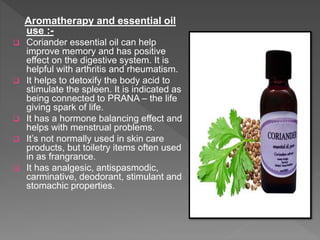
Aromatherapy and essential oil
use :-
 Coriander essential oil can help
improve memory and has positive
effect on the digestive system. It is
helpful with arthritis and rheumatism.
 It helps to detoxify the body acid to
stimulate the spleen. It is indicated as
being connected to PRANA – the life
giving spark of life.
 It has a hormone balancing effect and
helps with menstrual problems.
 It’s not normally used in skin care
products, but toiletry items often used
in as frangrance.
 It has analgesic, antispasmodic,
carminative, deodorant, stimulant and
stomachic properties.
Safety Precautions and Warnings :-
 The essential oil may have sensitizing to the
skin and some people may have an allergic
reaction to it.
 Very large doses may have a stupefying effect
on the mind.
Picking-up and Storing :-
The fruit will be picked up in the month of July
and August. The leaves should be taken fresh.
The fruit will dry off in the dark place and they
should be preserved in a little bag.
4. BITTER FENNEL and SWEET
FENNEL - Rezene
 Plant: Foeniculum vulgare subsp. vulgare var.
vulgare. The plant is widely cultivated in many parts
of the world.
 Drug: Bitter fennel consists of the dried ripe fruits of
the plant.
 Constituents : The fruits contain 1-4% of volatile
oil. The principal constituents of bitter fennel oil are
fenchone (12-25%), trans-anethole (55-75%)
together with anisaldehyde and estragole.
 Uses : Fennel and its volatile oil are used as an
aromatic and carminative.
Characteristic Features :-
 A pale green vegetable with seeds and leaves that
are used for flavoring food.
 Local name : SAUNF
 Scientific name : Foeniculum vulgare
 Family : Umbelliferae
 English name : FENNEL
 Appearance :
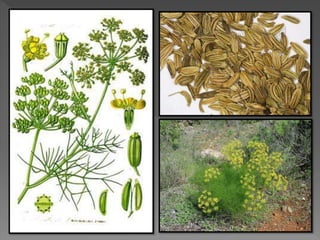
 Fennel is a perennial herb. It is erect, glaucous
green and grows to heights of upto 2.5m, with
hollow stems.
 The leaves grow upto 40cm long; they are finely
disected, with the ultimate segments filiform
(thread-like), about 0.5mm wide.
 The flowers are produced in terminal compound
umbels 5-15cm wide, each umbel section
having 20-50 tiny yellow flowers on short
pedicals.
 The fruit is a dry seed from 4-10mm long, half
as wide or less.
Essential oil :-
 CHEST RUB- The essential oil extracted from
the fennel finds use as a topical herbal remedy
and can be utilized as a massage or oil rub.
 To treat chest problems, a combination herbal
oil is typically used containing about
25 drops of the thyme herbal oil, the same
amount of the oil of eucalyptus and the fennel
oils. These three are mixed in about 25ml of the
sunflower or almond oil.
Collection and Harvesting :-
 Harvesting of the fresh leaves for the immediate
use can be carried out throughout the summer
right up to the time when the first frost appears
– pluck leaves from plants and use when
needed. Morning is the ideal time to collect the
leaves and this must be done when the Sun is
already shinning and evaporated the dew.
Preparation :-
Seeds can be used whole or
ground in a spice mill or mortar and pestle.
Uses :-
 For culinary purpose :
The bulb, foliage and
seeds of the fennel plant are widely used in
many of the culinary purpose.
 For different diseases :
Fennel is used for
various digestive problems including heartburn,
intestinal gas, loss of appetite, and colic in
infants. It is also used for upper respiratory tract
infections, coughs,
bronchitis, cholera, backache, bedwetting and
visual problems.
 Foods and Beverages :
It is used as a flavoring
agent in foods and beverages.
 Anti-platelet :
Fennel has antiplatelet activity and
ability to inhibit clot reaction.
 Roots :
Roots of fennel are used in medicine.
 Source of Vitamin C :
In addition to its unusual
phytonutrients, fennel bulb is an excellent source of
vitamin c.
 Source of Fibers :
As a very good source of
fiber, fennel bulb may help to reduce elevated
cholesterol levels, and since fiber also removes
potentially carcinogenic toxins from the colon
cancer. In addition to its fiber, fennel is a very
source of folate.
 Cosmetic Preparation ( Essential Oil) :
Many cosmetic preparations in the market also
use extracts of the fennel fruit and especially the
volatile fennel oil as the fragrance components
in the products.
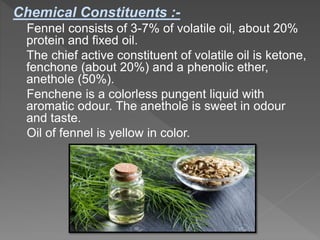
Chemical Constituents :-
Fennel consists of 3-7% of volatile oil, about 20%
protein and fixed oil.
The chief active constituent of volatile oil is ketone,
fenchone (about 20%) and a phenolic ether,
anethole (50%).
Fenchene is a colorless pungent liquid with
aromatic odour. The anethole is sweet in odour
and taste.
Oil of fennel is yellow in color.
Storage of Fennel :-
 Dried fennel seeds should be stored in an
airtight container in a cool and dry location
where they will keep for about six months.
 Storing fennel seeds in the refrigerator will help
to keep them fresher longer.
Food Allergy – Fennel :-
 A fennel allergy is an adverse reaction by the
body’s immune system to fennel or food
containing fennel. This type of allergy is rare
and serious reactions are very rare. e.g. skin,
respiratory and behavioral symptoms.
Symptoms of Food allergy – fennel :
 Runny nose
 Watery eyes
 Sore eyes
 Itchy eyes
 Red eyes
Treatments for food allergy – fennel :
Avoid contact with the allergen, adrenaline
injection if anaphylactic reaction occurs
antihisatmines, bronchodilators for asthmatic
symptoms.
Treatment of different diseases by fennel :-
 The well known aromatic culinary herb called the
fennel was extensively used as a herbal remedy to
aid digestion.
 Some other uses of the fennel in the treatment of
disorders in women include its use as an aid in the
regulation of the menstrual cycle and as herbal aid
in relieving pains during menstruation.
 It also is a very effective remedy for the treatment
of urinary tract infections in patients.
 It’s a very effective remedy for disorders such as
arthritis and gout.
 Local application of the oil on the body or the
bruised seed exudates is used in alleviating the
pain of a toothache and earache in patients.
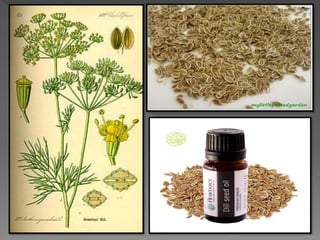
5. Dill and Dill oil ( Dereotu ):-
 Plant : Anethum graveolens L.
 Drug : Dried ripe fruits of the plant.
 Constituents : The volatile oil resembles oil of
caraway in containing carvone and limonene. The
European fruits yield about 3-4% of volatile oil,
which shoul contain 43 to 63% carvone.
 Uses : Like caraway, dill is used as a carminative
and flavor; it is much used in infant’s gripe water
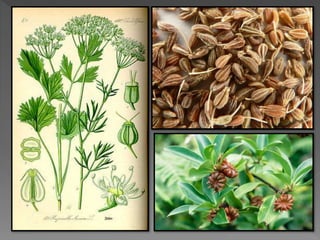
6. ANISEED and ANISEED OIL - Anason
 Plant : Pimpinella anisum. The plant is widely
cultivated in many parts of the world.
 Drug: Dried ripe fruits of the plant.
 Constituents : Anise fruits yield 2-3% of
volatile oil. The essential oil contains mainly
trans-anethol, and estragole and smaller
amount of anisaldehyde.
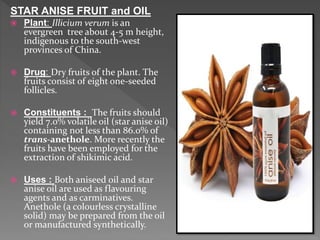
STAR ANISE FRUIT and OIL
 Plant: Illicium verum is an
evergreen tree about 4-5 m height,
indigenous to the south-west
provinces of China.
 Drug: Dry fruits of the plant. The
fruits consist of eight one-seeded
follicles.
 Constituents : The fruits should
yield 7.0% volatile oil (star anise oil)
containing not less than 86.0% of
trans-anethole. More recently the
fruits have been employed for the
extraction of shikimic acid.
 Uses : Both aniseed oil and star
anise oil are used as flavouring
agents and as carminatives.
Anethole (a colourless crystalline
solid) may be prepared from the oil
or manufactured synthetically.
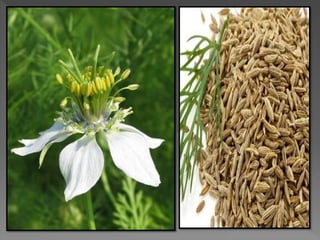
7. CUMIN - Kimyon (Zeera)
 Plant : Cuminum cyminum. A small plant
indigenous to Egypt. It is widely cultivated in
many parts of the world.
 Drug : Dried ripe fruits of the plant. The fruits
are about 6 mm long and resemble caraway and
are densely covered with short bristly hairs.
 Constituents : Cumin yields 2.5-4% of volatile
oil. This contains 25-35% of aldehydes (cuminic
aldehyde), pinene and α-terpineol.
 Uses : As a spice.
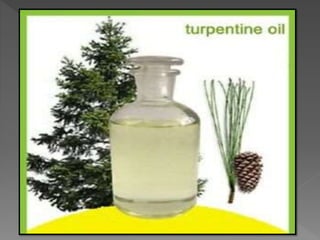
8. TURPENTINE OIL
 Pharmaceutical turpentine oil is obtained by distillation and
rectification from the oleoresin produced by various species of
Pinus. The unrectified oil is the turpentine of commerce. The
resin remaining in the still is the source of colophony.
 Rectification of the commercial oil consists of treatment with
aqueous alkali to remove traces of phenols,cresols, resin acids
and possible redistillation.
 Constituents : Oil of turpentine consists chiefly of terpenes
(+)-and (-)-α-pinene,(-)-β-pinene and camphene. Other
components of the oil which find industrial uses are β-
phellandrene, δ-3-carene, limonene, p-cymene, longifoline and
estragol.
 Uses : Oil of turpentine is now rarely given internally.
Externally it is used as a counterirritant and rubefacient. For
inhalation, terebene is usually preferred.
9. JUNIPER BERRIES and OIL - Ardıç
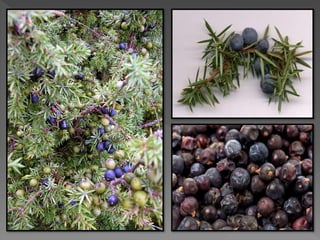
 Plant: Juniperus communis is an evergreen schrub or
small tree.
 Drug: Dried ripe fruits of the plant. They are collected in
former Yugoslavia, Italy, Hungary, Poland, Sweden and
other countries.
 Constituents : The main constituents are volatile oil
(about 0.5-1.5%), invert sugar (33%) and resin. The
BP/EP specifies a minimum essential oil content of 1.0%
with reference to the anhydrous drug.
 Uses : Juniper berries are used for the preparation of oil
of juniper and in making certain varieties of gin. The oil
has diuretic and antiseptic properties.
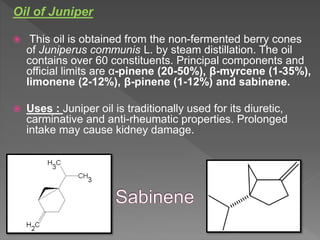
Oil of Juniper
 This oil is obtained from the non-fermented berry cones
of Juniperus communis L. by steam distillation. The oil
contains over 60 constituents. Principal components and
official limits are α-pinene (20-50%), β-myrcene (1-35%),
limonene (2-12%), β-pinene (1-12%) and sabinene.
 Uses : Juniper oil is traditionally used for its diuretic,
carminative and anti-rheumatic properties. Prolonged
intake may cause kidney damage.
Other Economically Important crude drugs
of Apiaceae/Umbelliferae family :-
The family Apiaceae contributes several important
food, essential oils and aromatic herbs to human race.
Hence this family is considered as economically
important.
 Apium graveolens: It is cultivated in Himalayas,
Uttaranchal, Himachal Pradesh and South India. It is
used as a vegetable. Its roots and seeds are used
medicinally. The fruits are used for extracting valuable
oil and the seeds are used as spices.
 Coriandrum sativum: It is chiefly grown in Madhya
Pradesh, Maharashtra, Karnataka, Bihar and Uttar
Pradesh. The fruits and leaves are used as condiment
and spice. The fruit of this aromatic herb is used as
stimulant, carminative, stomachic and tonic.
 Cuminum cyminum: It is grown in the Punjab and
Uttar Pradesh. This plant gives aromatic fruits which
are used as flavoring agents.
 Carum carvi: It is cultivated in Bihar, Orissa, the
Punjab, Bengal and Andhra Pradesh. The fruits are
used as condiment. Its fruits are also used as
stomachic and carminative.
 Bunium persicum: It is found in Kashmir. The
starchy tubers are eaten as vegetable. Its seeds are
used as spice.
 Trachyspermum ammi: It is cultivated throughout
India. Its fruits are used as spices. They are
medicinally used as carminative, stimulant and tonic
for indigestion.
 Daucus carota: It is grown chiefly in the Punjab,
Uttar Pradesh and Madhya Pradesh. The roots of this
plant are edible.
 Centella asiatica: It has a wide range of medical
applications. It is used to cure cholera, madness and
as medicine of few forms of leprosy.
 Anethum species: The fruits of Anethum
graveolens are used as spice and condiment. They are
also used as carminative
 Ferula species:
Ferula asafoetida is grown in the
Punjab and Kashmir. The gum-resin obtained
from its roots is used in perfume industry. It is
also used in flavoring food products. It also has
medical application in treatment of asthma,
cough and indigestion. Ferula galbaniflua gives
an oleo gum resin. This resin from the stem is
used in perfumery. It is also used in the
treatment of chronic bronchitis and asthma. The
roots and seeds of Ferula jaeschkena are used in
the production of essential oil. Oleo-gum resin
obtained from Ferula narthex is used for
flavoring food products.
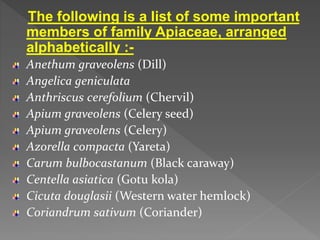
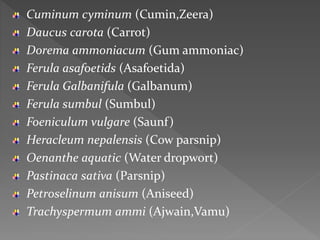
The following is a list of some important
members of family Apiaceae, arranged
alphabetically :-
Anethum graveolens (Dill)
Angelica geniculata
Anthriscus cerefolium (Chervil)
Apium graveolens (Celery seed)
Apium graveolens (Celery)
Azorella compacta (Yareta)
Carum bulbocastanum (Black caraway)
Centella asiatica (Gotu kola)
Cicuta douglasii (Western water hemlock)
Coriandrum sativum (Coriander)
Cuminum cyminum (Cumin,Zeera)
Daucus carota (Carrot)
Dorema ammoniacum (Gum ammoniac)
Ferula asafoetids (Asafoetida)
Ferula Galbanifula (Galbanum)
Ferula sumbul (Sumbul)
Foeniculum vulgare (Saunf)
Heracleum nepalensis (Cow parsnip)
Oenanthe aquatic (Water dropwort)
Pastinaca sativa (Parsnip)
Petroselinum anisum (Aniseed)
Trachyspermum ammi (Ajwain,Vamu)
References :-
1. https://www.slideshare.net/drasra1/family-
umbelliferae
2. https://www.researchgate.net/publication/
324554162_Medicinal_Plants_of_the_Apia
ceae_and_Rutaceae_from_the_Chimgan_
mountains_Uzbekistan_Ethnopharmacolo
gy_Chemical_composition_and_Biologica
l_Activities
3. https://www.researchgate.net/publication/
338390914_Hawraz_-
_Plants_belonging_to_Umbelliferae_Apiac
eae_family
Umbelliferae