1
DNA
Replication
copyright cmassengale
2
DNA Structure
• Rosalind Franklin took
diffraction x-ray
photographs of DNA
crystals
• In the 1950’s, Watson &
Crick built the first model
of DNA using Franklin’s
x-rays
copyright cmassengale
3
Discovery of DNA
Structure
• Erwin Chargaff showed the
amounts of the four bases on
DNA ( A,T,C,G)
• In a body or somatic cell:
A = 30.3%
T = 30.3%
G = 19.5%
C = 19.9%
copyright cmassengale
4
Chargaff’s Rule
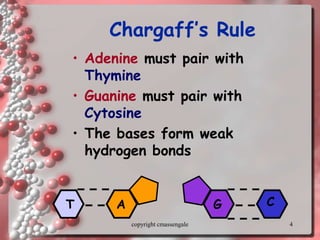
• Adenine must pair with
Thymine
• Guanine must pair with
Cytosine
• The bases form weak
hydrogen bonds
G C
T A
copyright cmassengale
5
DNA
Structure
copyright cmassengale
6
DNA
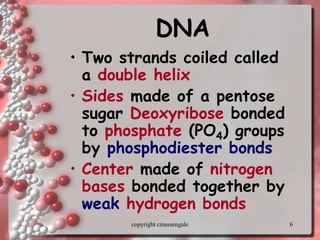
• Two strands coiled called
a double helix
• Sides made of a pentose
sugar Deoxyribose bonded
to phosphate (PO4) groups
by phosphodiester bonds
• Center made of nitrogen
bases bonded together by
weak hydrogen bonds
copyright cmassengale
7
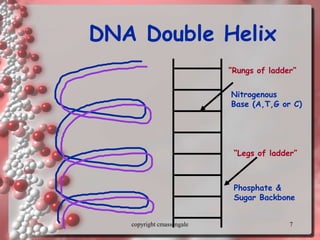
DNA Double Helix
Nitrogenous
Base (A,T,G or C)
“Rungs of ladder”
“Legs of ladder”
Phosphate &
Sugar Backbone
copyright cmassengale
8
Helix
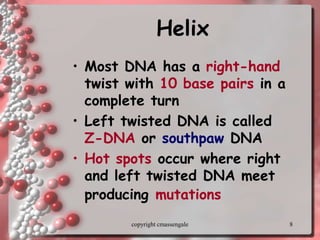
• Most DNA has a right-hand
twist with 10 base pairs in a
complete turn
• Left twisted DNA is called
Z-DNA or southpaw DNA
• Hot spots occur where right
and left twisted DNA meet
producing mutations
copyright cmassengale
9
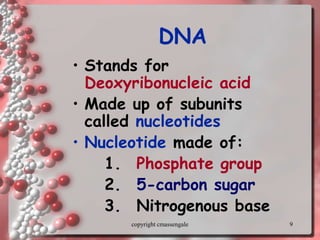
DNA
• Stands for
Deoxyribonucleic acid
• Made up of subunits
called nucleotides
• Nucleotide made of:
1. Phosphate group
2. 5-carbon sugar
3. Nitrogenous base
copyright cmassengale
10
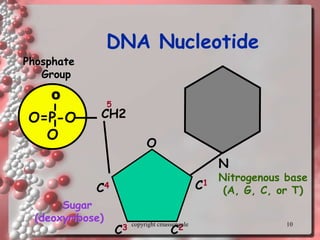
DNA Nucleotide
O=P-O
O
Phosphate
Group
N
Nitrogenous base
(A, G, C, or T)
CH2
O
C1
C4
C3 C2
5
Sugar
(deoxyribose)
O
copyright cmassengale
11
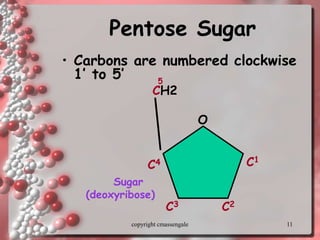
Pentose Sugar
• Carbons are numbered clockwise
1’ to 5’
CH2
O
C1
C4
C3 C2
5
Sugar
(deoxyribose)
copyright cmassengale
12
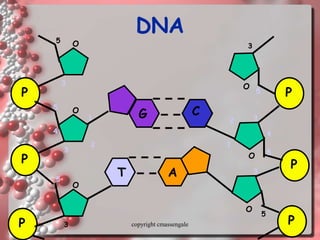
DNA
P
P
P
O
O
O
1
2
3
4
5
5
3
3
5
P
P
P
O
O
O
1
2 3
4
5
5
3
5
3
G C
T A
copyright cmassengale
13
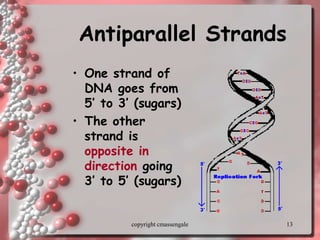
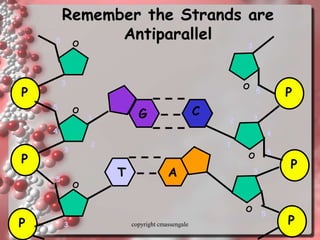
Antiparallel Strands
• One strand of
DNA goes from
5’ to 3’ (sugars)
• The other
strand is
opposite in
direction going
3’ to 5’ (sugars)
copyright cmassengale
14
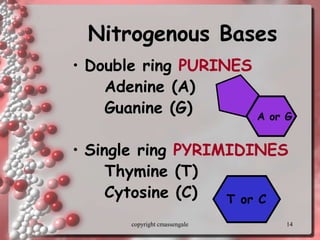
Nitrogenous Bases
• Double ring PURINES
Adenine (A)
Guanine (G)
• Single ring PYRIMIDINES
Thymine (T)
Cytosine (C) T or C
A or G
copyright cmassengale
15
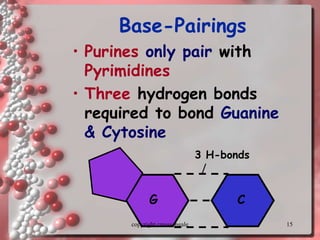
Base-Pairings
• Purines only pair with
Pyrimidines
• Three hydrogen bonds
required to bond Guanine
& Cytosine
C
G
3 H-bonds
copyright cmassengale
16
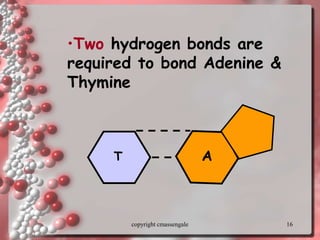
T A
•Two hydrogen bonds are
required to bond Adenine &
Thymine
copyright cmassengale
17
Question:
• If there is 30%
Adenine, how much
Cytosine is present?
copyright cmassengale
18
Answer:
• There would be 20%
Cytosine
• Adenine (30%) = Thymine
(30%)
• Guanine (20%) = Cytosine
(20%)
• Therefore, 60% A-T and
40% C-G
copyright cmassengale
19
DNA
Replication
copyright cmassengale
20
Replication Facts
• DNA has to be copied
before a cell divides
• DNA is copied during the S
or synthesis phase
• New cells will need identical
DNA strands
copyright cmassengale
21
DNA Replication
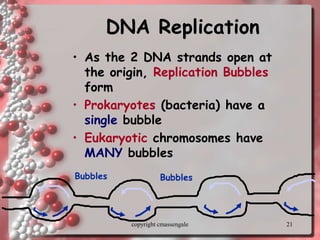
• As the 2 DNA strands open at
the origin, Replication Bubbles
form
• Prokaryotes (bacteria) have a
single bubble
• Eukaryotic chromosomes have
MANY bubbles
Bubbles Bubbles
copyright cmassengale
22
DNA Replication
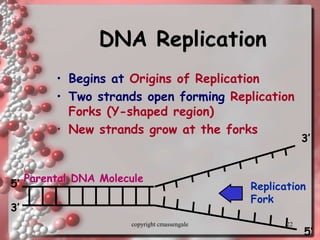
• Begins at Origins of Replication
• Two strands open forming Replication
Forks (Y-shaped region)
• New strands grow at the forks
Replication
Fork
Parental DNA Molecule
3’
5’
3’
5’
copyright cmassengale
23
DNA Replication
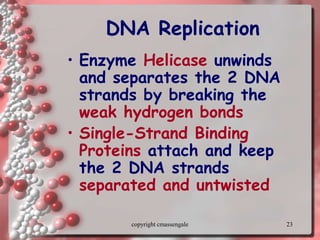
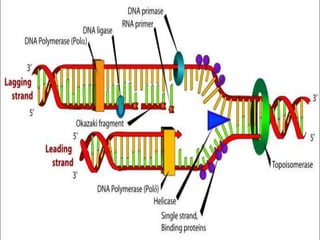
• Enzyme Helicase unwinds
and separates the 2 DNA
strands by breaking the
weak hydrogen bonds
• Single-Strand Binding
Proteins attach and keep
the 2 DNA strands
separated and untwisted
copyright cmassengale
24
DNA Replication
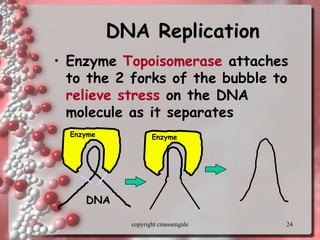
• Enzyme Topoisomerase attaches
to the 2 forks of the bubble to
relieve stress on the DNA
molecule as it separates
Enzyme
DNA
Enzyme
copyright cmassengale
25
DNA Replication
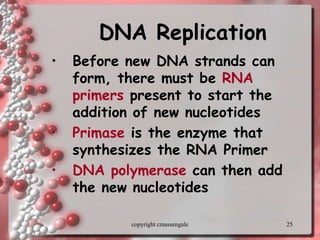
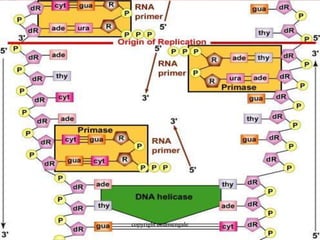
• Before new DNA strands can
form, there must be RNA
primers present to start the
addition of new nucleotides
• Primase is the enzyme that
synthesizes the RNA Primer
• DNA polymerase can then add
the new nucleotides
copyright cmassengale
26
copyright cmassengale
27
DNA Replication
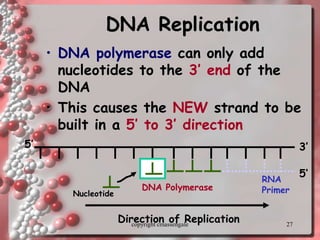
• DNA polymerase can only add
nucleotides to the 3’ end of the
DNA
• This causes the NEW strand to be
built in a 5’ to 3’ direction
RNA
Primer
DNA Polymerase
Nucleotide
5’
5’ 3’
Direction of Replication
copyright cmassengale
28
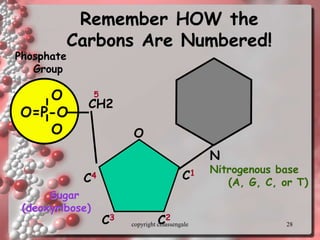
Remember HOW the
Carbons Are Numbered!
O
O=P-O
O
Phosphate
Group
N
Nitrogenous base
(A, G, C, or T)
CH2
O
C1
C4
C3 C2
5
Sugar
(deoxyribose)
copyright cmassengale
29
Remember the Strands are
Antiparallel
P
P
P
O
O
O
1
2
3
4
5
5
3
3
5
P
P
P
O
O
O
1
2 3
4
5
5
3
5
3
G C
T A
copyright cmassengale
30
Synthesis of the New DNA
Strands
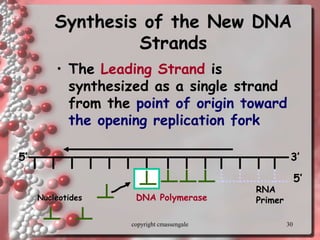
• The Leading Strand is
synthesized as a single strand
from the point of origin toward
the opening replication fork
RNA
Primer
DNA Polymerase
Nucleotides
3’
5’
5’
copyright cmassengale
31
Synthesis of the New DNA
Strands
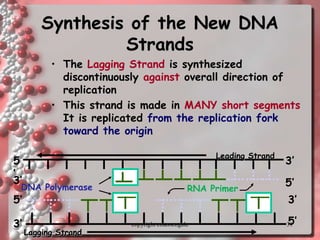
• The Lagging Strand is synthesized
discontinuously against overall direction of
replication
• This strand is made in MANY short segments
It is replicated from the replication fork
toward the origin
RNA Primer
Leading Strand
DNA Polymerase
5
’
5’
3’
3’
Lagging Strand
5’
5’
3’
3’ copyright cmassengale
32
Lagging Strand Segments
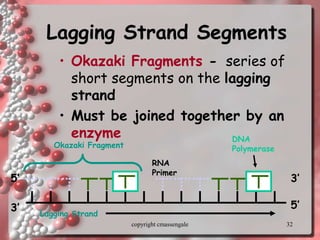
• Okazaki Fragments - series of
short segments on the lagging
strand
• Must be joined together by an
enzyme
Lagging Strand
RNA
Primer
DNA
Polymerase
3’
3’
5’
5’
Okazaki Fragment
copyright cmassengale
33
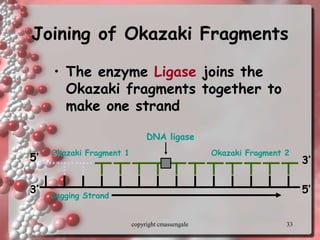
Joining of Okazaki Fragments
• The enzyme Ligase joins the
Okazaki fragments together to
make one strand
Lagging Strand
Okazaki Fragment 2
DNA ligase
Okazaki Fragment 1
5’
5’
3’
3’
copyright cmassengale
34
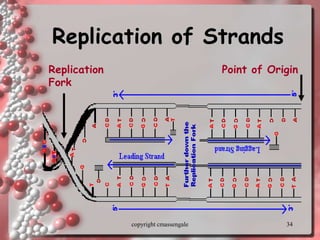
Replication of Strands
Replication
Fork
Point of Origin
copyright cmassengale
35
Proofreading New DNA
• DNA polymerase initially makes
about 1 in 10,000 base pairing
errors
• Enzymes proofread and correct
these mistakes
• The new error rate for DNA that
has been proofread is 1 in 1 billion
base pairing errors
copyright cmassengale
36
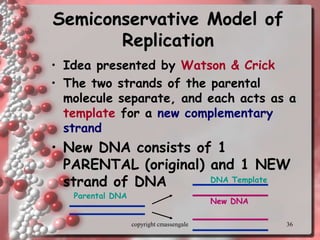
Semiconservative Model of
Replication
• Idea presented by Watson & Crick
• The two strands of the parental
molecule separate, and each acts as a
template for a new complementary
strand
• New DNA consists of 1
PARENTAL (original) and 1 NEW
strand of DNA
Parental DNA
DNA Template
New DNA
copyright cmassengale
37
DNA Damage & Repair
• Chemicals & ultraviolet radiation
damage the DNA in our body cells
• Cells must continuously repair
DAMAGED DNA
• Excision repair occurs when any of
over 50 repair enzymes remove
damaged parts of DNA
• DNA polymerase and DNA ligase
replace and bond the new nucleotides
together
copyright cmassengale
38
copyright cmassengale

DNA replication1.ppt

  • 1.
  • 2.
    2 DNA Structure • RosalindFranklin took diffraction x-ray photographs of DNA crystals • In the 1950’s, Watson & Crick built the first model of DNA using Franklin’s x-rays copyright cmassengale
  • 3.
    3 Discovery of DNA Structure •Erwin Chargaff showed the amounts of the four bases on DNA ( A,T,C,G) • In a body or somatic cell: A = 30.3% T = 30.3% G = 19.5% C = 19.9% copyright cmassengale
  • 4.
    4 Chargaff’s Rule • Adeninemust pair with Thymine • Guanine must pair with Cytosine • The bases form weak hydrogen bonds G C T A copyright cmassengale
  • 5.
  • 6.
    6 DNA • Two strandscoiled called a double helix • Sides made of a pentose sugar Deoxyribose bonded to phosphate (PO4) groups by phosphodiester bonds • Center made of nitrogen bases bonded together by weak hydrogen bonds copyright cmassengale
  • 7.
    7 DNA Double Helix Nitrogenous Base(A,T,G or C) “Rungs of ladder” “Legs of ladder” Phosphate & Sugar Backbone copyright cmassengale
  • 8.
    8 Helix • Most DNAhas a right-hand twist with 10 base pairs in a complete turn • Left twisted DNA is called Z-DNA or southpaw DNA • Hot spots occur where right and left twisted DNA meet producing mutations copyright cmassengale
  • 9.
    9 DNA • Stands for Deoxyribonucleicacid • Made up of subunits called nucleotides • Nucleotide made of: 1. Phosphate group 2. 5-carbon sugar 3. Nitrogenous base copyright cmassengale
  • 10.
    10 DNA Nucleotide O=P-O O Phosphate Group N Nitrogenous base (A,G, C, or T) CH2 O C1 C4 C3 C2 5 Sugar (deoxyribose) O copyright cmassengale
  • 11.
    11 Pentose Sugar • Carbonsare numbered clockwise 1’ to 5’ CH2 O C1 C4 C3 C2 5 Sugar (deoxyribose) copyright cmassengale
  • 12.
  • 13.
    13 Antiparallel Strands • Onestrand of DNA goes from 5’ to 3’ (sugars) • The other strand is opposite in direction going 3’ to 5’ (sugars) copyright cmassengale
  • 14.
    14 Nitrogenous Bases • Doublering PURINES Adenine (A) Guanine (G) • Single ring PYRIMIDINES Thymine (T) Cytosine (C) T or C A or G copyright cmassengale
  • 15.
    15 Base-Pairings • Purines onlypair with Pyrimidines • Three hydrogen bonds required to bond Guanine & Cytosine C G 3 H-bonds copyright cmassengale
  • 16.
    16 T A •Two hydrogenbonds are required to bond Adenine & Thymine copyright cmassengale
  • 17.
    17 Question: • If thereis 30% Adenine, how much Cytosine is present? copyright cmassengale
  • 18.
    18 Answer: • There wouldbe 20% Cytosine • Adenine (30%) = Thymine (30%) • Guanine (20%) = Cytosine (20%) • Therefore, 60% A-T and 40% C-G copyright cmassengale
  • 19.
  • 20.
    20 Replication Facts • DNAhas to be copied before a cell divides • DNA is copied during the S or synthesis phase • New cells will need identical DNA strands copyright cmassengale
  • 21.
    21 DNA Replication • Asthe 2 DNA strands open at the origin, Replication Bubbles form • Prokaryotes (bacteria) have a single bubble • Eukaryotic chromosomes have MANY bubbles Bubbles Bubbles copyright cmassengale
  • 22.
    22 DNA Replication • Beginsat Origins of Replication • Two strands open forming Replication Forks (Y-shaped region) • New strands grow at the forks Replication Fork Parental DNA Molecule 3’ 5’ 3’ 5’ copyright cmassengale
  • 23.
    23 DNA Replication • EnzymeHelicase unwinds and separates the 2 DNA strands by breaking the weak hydrogen bonds • Single-Strand Binding Proteins attach and keep the 2 DNA strands separated and untwisted copyright cmassengale
  • 24.
    24 DNA Replication • EnzymeTopoisomerase attaches to the 2 forks of the bubble to relieve stress on the DNA molecule as it separates Enzyme DNA Enzyme copyright cmassengale
  • 25.
    25 DNA Replication • Beforenew DNA strands can form, there must be RNA primers present to start the addition of new nucleotides • Primase is the enzyme that synthesizes the RNA Primer • DNA polymerase can then add the new nucleotides copyright cmassengale
  • 26.
  • 27.
    27 DNA Replication • DNApolymerase can only add nucleotides to the 3’ end of the DNA • This causes the NEW strand to be built in a 5’ to 3’ direction RNA Primer DNA Polymerase Nucleotide 5’ 5’ 3’ Direction of Replication copyright cmassengale
  • 28.
    28 Remember HOW the CarbonsAre Numbered! O O=P-O O Phosphate Group N Nitrogenous base (A, G, C, or T) CH2 O C1 C4 C3 C2 5 Sugar (deoxyribose) copyright cmassengale
  • 29.
    29 Remember the Strandsare Antiparallel P P P O O O 1 2 3 4 5 5 3 3 5 P P P O O O 1 2 3 4 5 5 3 5 3 G C T A copyright cmassengale
  • 30.
    30 Synthesis of theNew DNA Strands • The Leading Strand is synthesized as a single strand from the point of origin toward the opening replication fork RNA Primer DNA Polymerase Nucleotides 3’ 5’ 5’ copyright cmassengale
  • 31.
    31 Synthesis of theNew DNA Strands • The Lagging Strand is synthesized discontinuously against overall direction of replication • This strand is made in MANY short segments It is replicated from the replication fork toward the origin RNA Primer Leading Strand DNA Polymerase 5 ’ 5’ 3’ 3’ Lagging Strand 5’ 5’ 3’ 3’ copyright cmassengale
  • 32.
    32 Lagging Strand Segments •Okazaki Fragments - series of short segments on the lagging strand • Must be joined together by an enzyme Lagging Strand RNA Primer DNA Polymerase 3’ 3’ 5’ 5’ Okazaki Fragment copyright cmassengale
  • 33.
    33 Joining of OkazakiFragments • The enzyme Ligase joins the Okazaki fragments together to make one strand Lagging Strand Okazaki Fragment 2 DNA ligase Okazaki Fragment 1 5’ 5’ 3’ 3’ copyright cmassengale
  • 34.
    34 Replication of Strands Replication Fork Pointof Origin copyright cmassengale
  • 35.
    35 Proofreading New DNA •DNA polymerase initially makes about 1 in 10,000 base pairing errors • Enzymes proofread and correct these mistakes • The new error rate for DNA that has been proofread is 1 in 1 billion base pairing errors copyright cmassengale
  • 36.
    36 Semiconservative Model of Replication •Idea presented by Watson & Crick • The two strands of the parental molecule separate, and each acts as a template for a new complementary strand • New DNA consists of 1 PARENTAL (original) and 1 NEW strand of DNA Parental DNA DNA Template New DNA copyright cmassengale
  • 37.
    37 DNA Damage &Repair • Chemicals & ultraviolet radiation damage the DNA in our body cells • Cells must continuously repair DAMAGED DNA • Excision repair occurs when any of over 50 repair enzymes remove damaged parts of DNA • DNA polymerase and DNA ligase replace and bond the new nucleotides together copyright cmassengale
  • 38.