UMBELLIFERAE
• The Apiaceae (or Umbelliferae),
commonly known as
• carrot or parsley family,
• is a group of mostly aromatic plants with
hollow stems.
• The family is large, with more than 3,700
species spread across 434 genera
• It is the sixteenth largest family of flowering
plants.
• HABIT:
Plants are annual, biennial and perennials
herbs with
• HABITAT:
It is widely distributed in through out the
world.
• STEM:
Furrowed fistular stem having swollen
nodes .
.
• LEAVES:
usually alternate and compound.
• INFLORESCENCE:
simple or compound umbel
• FLOWER:
Pentamerous , Epigynous, Hermaphrodite,
Zygomorphic, pedicellate
• COROLLA:
5 petals, free, adnate to the ovary and sometimes
unequal.
• CALYX:
5 sepals free,adnate to ovary often
considerably reduced in size.
• ANDROCEIUM:
5 stamens, alternate with petals,
polyandrous
• GYNAECIUM:
Bicarpillary, syncarpous, with axile
placentation, ovary inferior, two celled
• FRUIT:
Cremocarp consisting of two indehiscent
carpels laterally or dorsally compressed,
breaking up into two parts called mericarp.
Each mericarp contain one seed.
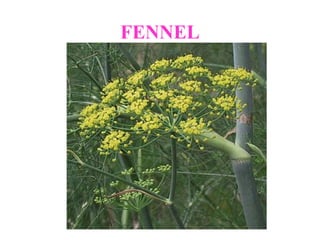
FENNEL
• BOTANICAL ORIGION: Foeniculum
vulgare
• Common Name: Saunf
• Part used: Dried ripened fruit
• Habit: A perennial sub shrub
• Habitat: Indigenous to Mediterranean
countries and Asia
Cultivated in France, India and Russia
Constituents:
Mainly contain volatile oil
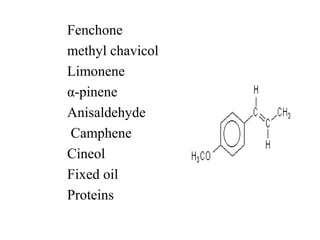
The major volatile oil is
Anethole (40-50%)
Fenchone
methyl chavicol
Limonene
α-pinene
Anisaldehyde
Camphene
Cineol
Fixed oil
Proteins
• Fennel oil has β-pinene, anisic acid,
phellandrine and anisic aldehyde
• MEDICINAL USES
Antiseptic,
antispasmodic,
Anti inflammatory
carminative
Expectorant
Fennel can increase production of bile, used in
the treatment of infant colic, increases
lactation and promote mensturation.
• Commercially the oil is used in soap
washes, perfumes.
CARAWAY
• BOTANICAL ORIGION: Carum carvi
Common Name: carum, caraway fruits.
• Part used: Dried ripened fruit
• Habit: A biennial sub shrub
• Habitat: Native to Europe and Western Asia
Cultivated in Germany, India and
North Africa, Canada
Constituents:
Mainly contain volatile oil
The major volatile oil is
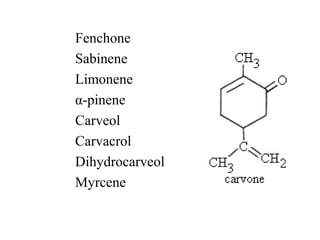
Carvone (65%)
Fenchone
Sabinene
Limonene
α-pinene
Carveol
Carvacrol
Dihydrocarveol
Myrcene
• MEDICINAL USES
Aromatic,
Stimulant,
Carminative
Flavoring agent
Caraway oil has strong fungicidal action
Oil is also expectorant
Drug is recommended in dyspepsia as a tonic, as
stomachic, for flatulent indigestion
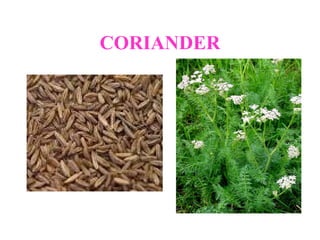
CORIANDER
• BOTANICAL ORIGION: Coriandrum
sativum
• Common Name: Fructus coriandri, coriander
fruits.
• Part used: Dried ripened fruit
• Habit: Annual herb
• Habitat: Cultivated in central and Eastern
Europe particularly in Russia, Africa, and
India.
Constituents:
Mainly contain volatile oil
The major volatile oil is
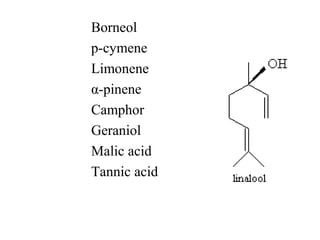
Linalool (coriandrol)
Borneol
p-cymene
Limonene
α-pinene
Camphor
Geraniol
Malic acid
Tannic acid
• MEDICINAL USES
Aromatic,
Stimulant,
Carminative
Flavoring agent
Diaphoretic
Oil is also expectorant
Appetizer
Externally applied for the treatment of
rheumatism
In infusion for children’s diarrhoea, digestive
upsets, anorexia and flatulence.
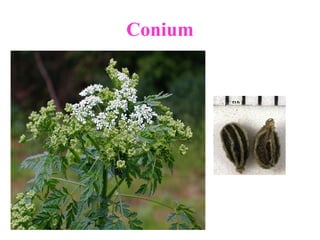
Conium
• BOTANICAL ORIGION: Conium
maculatum
• Common Name: Poison hemlock
• Part used: Dried fully grown unripened fruit
• Habit: A diennial herb
• Habitat: Indeginous to Europe and cultivated
in North and south America and in varous
parts of Asia
• Constituents:
Mainly contain Alkaloid
Coniine
N-methyl coniine
γ- coniceine
Cohydrine
Pseudocohydrine
• MEDICINAL USES
In homeopathy,used to treat glandular enlargements, for
instance, cancerous tumors, particularly in the breast.
To cure nervous disorders accompanied by slowly
progressing paralysis in the muscles that starts in the
feet and moves upwards.
Sedative and
Antispasmodic
in sufficient doses acts as a paralyser to the centres of
motion. In its action it is, therefore, directly
antagonistic to that of Strychnine, and hence it has
been recommended as an antidote to Strychnine
poisoning, and in other poisons of the same class, and
in tetanus, hydrophobia
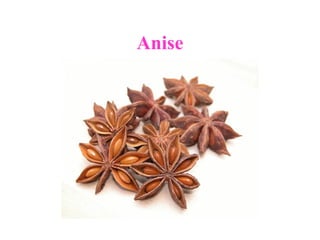
Anise
• BOTANICAL ORIGION: Pimpinella
anisum
• Common Name: Anise, Aniseed, sweet
cumin, star anise
• Part used: Dried ripened fruit
• Habit: Annual herb
• Habitat: Native to Egypt, Greece, Asia Minor
and cultivated in Spain, Italy, Russia,
Germany.
Constituents:
Mainly contain volatile oil
The major volatile oil is
Anethole
Anisaldehyde
Anisic acid
Linaool
Dianthone
Lipids
Fatty acids
Sterols
Proteins
Carbohydrates
• MEDICINAL USES
Expectorant,
Carminative
Aromatic
Flavoring agent in cough mixtures and lozenges
Antispasmodic
Appetizer
Externally applied for the treatment of scabies
It can enhance memory, used in bronchitis,
asthma and in whooping cough
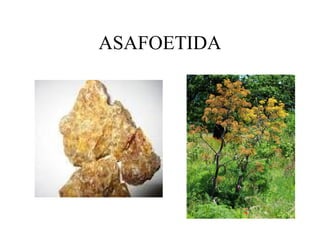
ASAFOETIDA
• BOTANICAL ORIGION: Ferula foetida, Ferula
asafoetida
• Common Name: Gum asafetida, Devil’s dung,Hing
• Part used: Oleogum resin obtained by incising the living
rhizomes and roots
• Habit: Perennial branching herb
• Habitat: Indegenous to Iran and Afghanistan.
Constituents:
Mainly contain volatile oil 4-20%
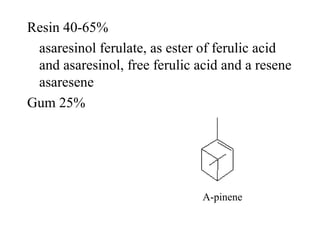
Pinene
Organic disulphides including isobutyl propanyl
disulphide responsible for alliaceous odour
Resin 40-65%
asaresinol ferulate, as ester of ferulic acid
and asaresinol, free ferulic acid and a resene
asaresene
Gum 25%
Α-pinene
• MEDICINAL USES
Expectorant,
Carminative
Antispasmodic
Laxative