RANUNCULACEAE
Dr. Asha
 Distribution pattern
 It is a large family. It has 43 genera and over 2000
species. Plants are cosmopolitan in distribution but
flourish well in temperate climates. Rare in tropics.
 Important Species
 Ranunculus muricatus. Butter cup
 Delphinium ajacis, Larkspur
 Ranunculus muricatus (a weed)
 Aconitum uncinatum (a wild herb)
MORPHOLOGICAL DESCRIPTION OF FAMILY
 Habits: Annual or perennial herbs, vines (Clematis),
hydrophyte (Ranunculus aquatilis), tree (Paeonia).
 Roots: Tuberous root.
 Stem: Herbaceous stem, develops rhizome, erect or climbing,
branched, glabrous or hairy.
 Leaves: Petiolate.rarely sessile as in Delphinium, Alternate
rarely opposite. simple or compound,rarely pinnately
compound leaves as in Xanthorrhiza , heterophily exhibited
by Ranunculus aquatilis,exstipulate, reticulate venation,
unicostate or multicostate.
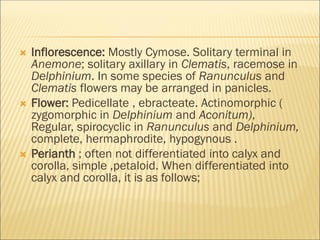
 Inflorescence: Mostly Cymose. Solitary terminal in
Anemone; solitary axillary in Clematis, racemose in
Delphinium. In some species of Ranunculus and
Clematis flowers may be arranged in panicles.
 Flower: Pedicellate , ebracteate. Actinomorphic (
zygomorphic in Delphinium and Aconitum),
Regular, spirocyclic in Ranunculus and Delphinium,
complete, hermaphrodite, hypogynous .
 Perianth ; often not differentiated into calyx and
corolla, simple ,petaloid. When differentiated into
calyx and corolla, it is as follows;
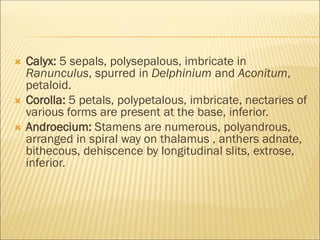
 Calyx: 5 sepals, polysepalous, imbricate in
Ranunculus, spurred in Delphinium and Aconitum,
petaloid.
 Corolla: 5 petals, polypetalous, imbricate, nectaries of
various forms are present at the base, inferior.
 Androecium: Stamens are numerous, polyandrous,
arranged in spiral way on thalamus , anthers adnate,
bithecous, dehiscence by longitudinal slits, extrose,
inferior.
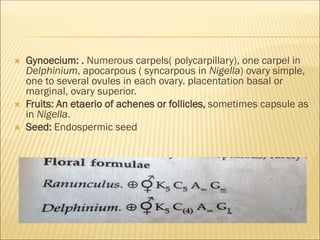
 Gynoecium: . Numerous carpels( polycarpillary), one carpel in
Delphinium, apocarpous ( syncarpous in Nigella) ovary simple,
one to several ovules in each ovary. placentation basal or
marginal, ovary superior.
 Fruits: An etaerio of achenes or follicles, sometimes capsule as
in Nigella.
 Seed: Endospermic seed
ECONOMIC IMPORTANCE
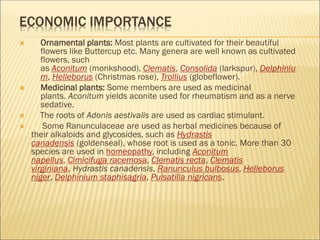
 Ornamental plants: Most plants are cultivated for their beautiful
flowers like Buttercup etc. Many genera are well known as cultivated
flowers, such
as Aconitum (monkshood), Clematis, Consolida (larkspur), Delphiniu
m, Helleborus (Christmas rose), Trollius (globeflower).
 Medicinal plants: Some members are used as medicinal
plants. Aconitum yields aconite used for rheumatism and as a nerve
sedative.
 The roots of Adonis aestivalis are used as cardiac stimulant.
 Some Ranunculaceae are used as herbal medicines because of
their alkaloids and glycosides, such as Hydrastis
canadensis (goldenseal), whose root is used as a tonic. More than 30
species are used in homeopathy, including Aconitum
napellus, Cimicifuga racemosa, Clematis recta, Clematis
virginiana, Hydrastis canadensis, Ranunculus bulbosus, Helleborus
niger, Delphinium staphisagria, Pulsatilla nigricans.
ECONOMIC IMPORTANCE
 Condiments: Some members are used as condiments.
For example, seeds of Nigella It is also used as drugs. The
seeds of Nigella sativa are used as a spice in Indian and
Middle Eastern cuisine
 Weeds: Some members are weeds like R. antriccaus.
 Importance of honey: Most members of this family have
nectaries. nectaries have great importance for honey bees.
 Poisonous species: Some members of this family produce
acrid juice. It is highly poisonous.e.g. Helleborus viridis.
Thanks

Ranunculaceae

  • 1.
  • 2.
     Distribution pattern It is a large family. It has 43 genera and over 2000 species. Plants are cosmopolitan in distribution but flourish well in temperate climates. Rare in tropics.  Important Species  Ranunculus muricatus. Butter cup  Delphinium ajacis, Larkspur  Ranunculus muricatus (a weed)  Aconitum uncinatum (a wild herb)
  • 3.
    MORPHOLOGICAL DESCRIPTION OFFAMILY  Habits: Annual or perennial herbs, vines (Clematis), hydrophyte (Ranunculus aquatilis), tree (Paeonia).  Roots: Tuberous root.  Stem: Herbaceous stem, develops rhizome, erect or climbing, branched, glabrous or hairy.  Leaves: Petiolate.rarely sessile as in Delphinium, Alternate rarely opposite. simple or compound,rarely pinnately compound leaves as in Xanthorrhiza , heterophily exhibited by Ranunculus aquatilis,exstipulate, reticulate venation, unicostate or multicostate.
  • 4.
     Inflorescence: MostlyCymose. Solitary terminal in Anemone; solitary axillary in Clematis, racemose in Delphinium. In some species of Ranunculus and Clematis flowers may be arranged in panicles.  Flower: Pedicellate , ebracteate. Actinomorphic ( zygomorphic in Delphinium and Aconitum), Regular, spirocyclic in Ranunculus and Delphinium, complete, hermaphrodite, hypogynous .  Perianth ; often not differentiated into calyx and corolla, simple ,petaloid. When differentiated into calyx and corolla, it is as follows;
  • 5.
     Calyx: 5sepals, polysepalous, imbricate in Ranunculus, spurred in Delphinium and Aconitum, petaloid.  Corolla: 5 petals, polypetalous, imbricate, nectaries of various forms are present at the base, inferior.  Androecium: Stamens are numerous, polyandrous, arranged in spiral way on thalamus , anthers adnate, bithecous, dehiscence by longitudinal slits, extrose, inferior.
  • 6.
     Gynoecium: .Numerous carpels( polycarpillary), one carpel in Delphinium, apocarpous ( syncarpous in Nigella) ovary simple, one to several ovules in each ovary. placentation basal or marginal, ovary superior.  Fruits: An etaerio of achenes or follicles, sometimes capsule as in Nigella.  Seed: Endospermic seed
  • 7.
    ECONOMIC IMPORTANCE  Ornamentalplants: Most plants are cultivated for their beautiful flowers like Buttercup etc. Many genera are well known as cultivated flowers, such as Aconitum (monkshood), Clematis, Consolida (larkspur), Delphiniu m, Helleborus (Christmas rose), Trollius (globeflower).  Medicinal plants: Some members are used as medicinal plants. Aconitum yields aconite used for rheumatism and as a nerve sedative.  The roots of Adonis aestivalis are used as cardiac stimulant.  Some Ranunculaceae are used as herbal medicines because of their alkaloids and glycosides, such as Hydrastis canadensis (goldenseal), whose root is used as a tonic. More than 30 species are used in homeopathy, including Aconitum napellus, Cimicifuga racemosa, Clematis recta, Clematis virginiana, Hydrastis canadensis, Ranunculus bulbosus, Helleborus niger, Delphinium staphisagria, Pulsatilla nigricans.
  • 8.
    ECONOMIC IMPORTANCE  Condiments:Some members are used as condiments. For example, seeds of Nigella It is also used as drugs. The seeds of Nigella sativa are used as a spice in Indian and Middle Eastern cuisine  Weeds: Some members are weeds like R. antriccaus.  Importance of honey: Most members of this family have nectaries. nectaries have great importance for honey bees.  Poisonous species: Some members of this family produce acrid juice. It is highly poisonous.e.g. Helleborus viridis.
  • 9.