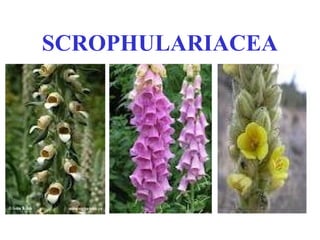
SCROPHULARIACEA
• Scrophulariaceae, the figwort family, are a
family of flowering plants.
• The family name is based on the name of the
included genus Scrophularia L.
• Including about 275 genera and over 5,000
species
• HABIT:
The plants are annual or perennial herbs or
under-shrubs.
HABITAT:
Members of the Scrophulariaceae have a
cosmopolitan distribution, with the majority
found in temperate areas, including tropical
mountains.
• STEM:
• LEAVES:
Leaves are simple, alternate, opposite or
whorled exstipulate and some times exhibit
heterophylly.
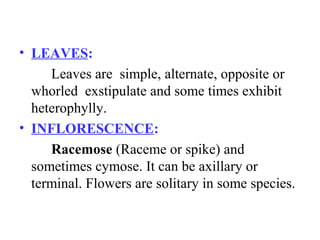
• INFLORESCENCE:
Racemose (Raceme or spike) and
sometimes cymose. It can be axillary or
terminal. Flowers are solitary in some species.
• FLOWER:
Zygomorphic, two-lipped and some
times personate( two lips in the form of a
face ). Bisexual and Hypogynous. Bracts
and bracteoles are generally present.
• COROLLA:
5 petals, gamopetalous, often two lipped
and sometimes spurred or saccate (A bony
outgrowth or sac like). Zygomorphic and
rarely regular.
• CALYX:
5 sepals, gamosepalous five lobbed and
often imbricate (to overlap in a regular pattern)
• ANDROCEIUM:
4 stamens, didynamous, sometimes 2,
arching over in pairs.
• GYNAECIUM:
Bicarpillary, syncarpous, ovary superior,
bilocular. Placentation is axile.
• FRUIT:
Mostly capsule and sometimes berry.
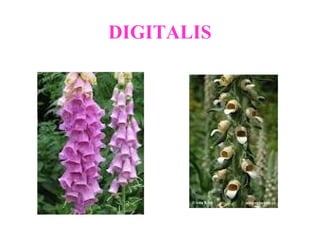
DIGITALIS
• BOTANICAL ORIGION: Digitalis lanata,
Digitalis purpurea
• Common Name: Grecian foxglove, Purple
foxglove, Digitalis
• Digitalis is from Latin word-----Digitus---
Finger (Finger shaped corolla)
• Purpurea is a latin word-------purple colour
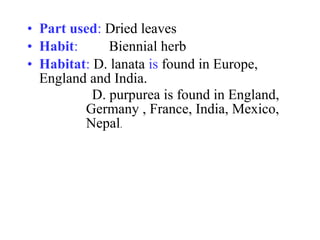
• Part used: Dried leaves
• Habit: Biennial herb
• Habitat: D. lanata is found in Europe,
England and India.
D. purpurea is found in England,
Germany , France, India, Mexico,
Nepal.
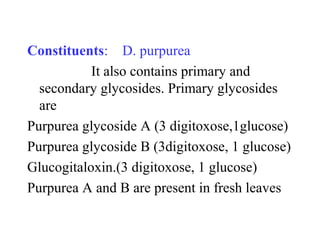
Constituents: D. purpurea
It also contains primary and
secondary glycosides. Primary glycosides
are
Purpurea glycoside A (3 digitoxose,1glucose)
Purpurea glycoside B (3digitoxose, 1 glucose)
Glucogitaloxin.(3 digitoxose, 1 glucose)
Purpurea A and B are present in fresh leaves
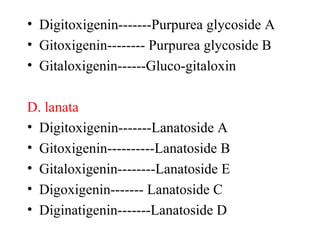
• Digitoxigenin-------Purpurea glycoside A
• Gitoxigenin-------- Purpurea glycoside B
• Gitaloxigenin------Gluco-gitaloxin
D. lanata
• Digitoxigenin-------Lanatoside A
• Gitoxigenin----------Lanatoside B
• Gitaloxigenin--------Lanatoside E
• Digoxigenin------- Lanatoside C
• Diginatigenin-------Lanatoside D
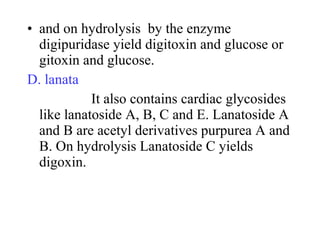
• and on hydrolysis by the enzyme
digipuridase yield digitoxin and glucose or
gitoxin and glucose.
D. lanata
It also contains cardiac glycosides
like lanatoside A, B, C and E. Lanatoside A
and B are acetyl derivatives purpurea A and
B. On hydrolysis Lanatoside C yields
digoxin.
Constituents:
MEDICINAL USES
D.Purpurea
Used in chronic heart failure
Also used in the treatment of internal
hemorrhages, in inflammatory diseases , in
epilepsy and other diseases.
D lanata
has cardiac effect 3to 4 times greater than
purpurea.
Commercial source of digoxin
Used in the treatment of CHF
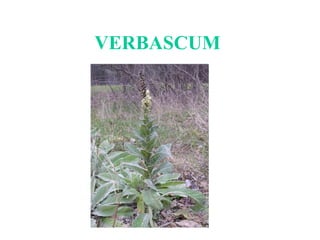
VERBASCUM
• BOTANICAL ORIGION: Verbascum thapus
• Common Name: Mullein leaves
• Part used: Dried leaves
• Habit: Biennial herb
• Habitat: Found in Europe, Africa and Asia
Constituents
• Polysaccharides
• Iridoid glycosides
• Flavonoids
• Saponins
• Volatile oil
• MEDICINAL USES
• Demulcent, Emollient- the polysaccharide
mucilage and gums soothe irritated tissues
• Expectorant- saponins stimulate fluid
production
• Anti-inflammatory- iridoid glycosides and
flavonoids decrease inflammation
• Mild Diuretic
• Anti-viral

Scrophulariaceae

  • 1.
  • 2.
    • Scrophulariaceae, thefigwort family, are a family of flowering plants. • The family name is based on the name of the included genus Scrophularia L. • Including about 275 genera and over 5,000 species • HABIT: The plants are annual or perennial herbs or under-shrubs.
  • 3.
    HABITAT: Members of theScrophulariaceae have a cosmopolitan distribution, with the majority found in temperate areas, including tropical mountains. • STEM:
  • 4.
    • LEAVES: Leaves aresimple, alternate, opposite or whorled exstipulate and some times exhibit heterophylly. • INFLORESCENCE: Racemose (Raceme or spike) and sometimes cymose. It can be axillary or terminal. Flowers are solitary in some species.
  • 5.
    • FLOWER: Zygomorphic, two-lippedand some times personate( two lips in the form of a face ). Bisexual and Hypogynous. Bracts and bracteoles are generally present. • COROLLA: 5 petals, gamopetalous, often two lipped and sometimes spurred or saccate (A bony outgrowth or sac like). Zygomorphic and rarely regular.
  • 6.
    • CALYX: 5 sepals,gamosepalous five lobbed and often imbricate (to overlap in a regular pattern) • ANDROCEIUM: 4 stamens, didynamous, sometimes 2, arching over in pairs. • GYNAECIUM: Bicarpillary, syncarpous, ovary superior, bilocular. Placentation is axile.
  • 7.
    • FRUIT: Mostly capsuleand sometimes berry.
  • 8.
  • 9.
    • BOTANICAL ORIGION:Digitalis lanata, Digitalis purpurea • Common Name: Grecian foxglove, Purple foxglove, Digitalis • Digitalis is from Latin word-----Digitus--- Finger (Finger shaped corolla) • Purpurea is a latin word-------purple colour
  • 10.
    • Part used:Dried leaves • Habit: Biennial herb • Habitat: D. lanata is found in Europe, England and India. D. purpurea is found in England, Germany , France, India, Mexico, Nepal.
  • 11.
    Constituents: D. purpurea Italso contains primary and secondary glycosides. Primary glycosides are Purpurea glycoside A (3 digitoxose,1glucose) Purpurea glycoside B (3digitoxose, 1 glucose) Glucogitaloxin.(3 digitoxose, 1 glucose) Purpurea A and B are present in fresh leaves
  • 12.
    • Digitoxigenin-------Purpurea glycosideA • Gitoxigenin-------- Purpurea glycoside B • Gitaloxigenin------Gluco-gitaloxin D. lanata • Digitoxigenin-------Lanatoside A • Gitoxigenin----------Lanatoside B • Gitaloxigenin--------Lanatoside E • Digoxigenin------- Lanatoside C • Diginatigenin-------Lanatoside D
  • 14.
    • and onhydrolysis by the enzyme digipuridase yield digitoxin and glucose or gitoxin and glucose. D. lanata It also contains cardiac glycosides like lanatoside A, B, C and E. Lanatoside A and B are acetyl derivatives purpurea A and B. On hydrolysis Lanatoside C yields digoxin.
  • 15.
  • 16.
    MEDICINAL USES D.Purpurea Used inchronic heart failure Also used in the treatment of internal hemorrhages, in inflammatory diseases , in epilepsy and other diseases. D lanata has cardiac effect 3to 4 times greater than purpurea. Commercial source of digoxin Used in the treatment of CHF
  • 17.
  • 18.
    • BOTANICAL ORIGION:Verbascum thapus • Common Name: Mullein leaves • Part used: Dried leaves • Habit: Biennial herb • Habitat: Found in Europe, Africa and Asia
  • 19.
    Constituents • Polysaccharides • Iridoidglycosides • Flavonoids • Saponins • Volatile oil
  • 20.
    • MEDICINAL USES •Demulcent, Emollient- the polysaccharide mucilage and gums soothe irritated tissues • Expectorant- saponins stimulate fluid production • Anti-inflammatory- iridoid glycosides and flavonoids decrease inflammation • Mild Diuretic • Anti-viral