Angiosperms
Classification and description in semi-
technical language of at least one plant from
each family.
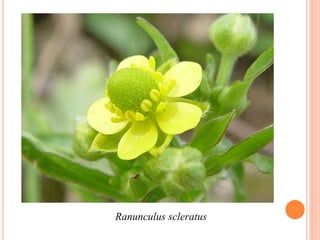
1. Ranunculus
(Ranunculus scleratus)
2. Delphinium
(Delphinium ajacis)
1.
Ranunculus
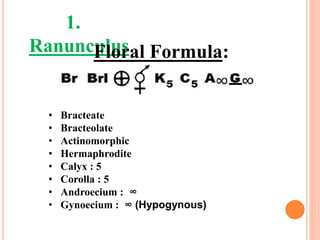
• Bracteate
• Bracteolate
• Actinomorphic
• Hermaphrodite
• Calyx : 5
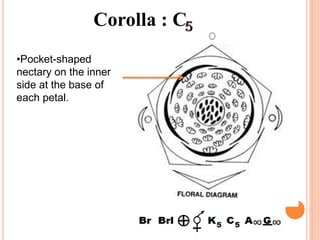
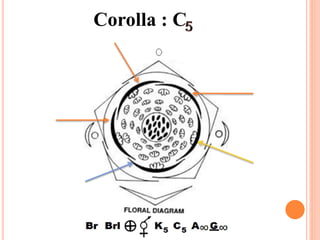
• Corolla : 5
• Androecium : ∞
• Gynoecium : ∞ (Hypogynous)
Floral Formula:
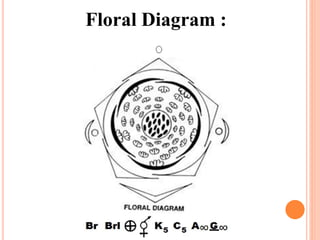
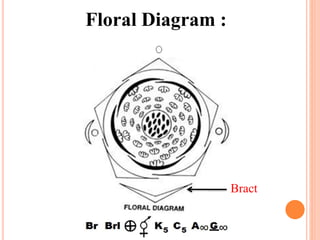
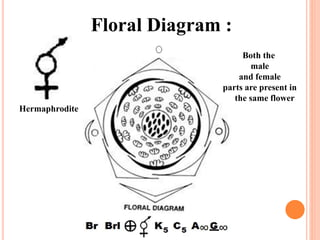
Floral Diagram :
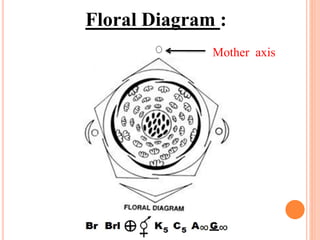
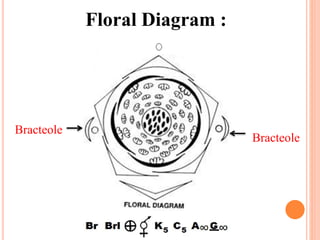
Floral Diagram :
Mother axis
Floral Diagram :
Bract
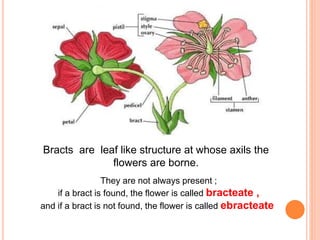
Bracts are leaf like structure at whose axils the
flowers are borne.
They are not always present ;
if a bract is found, the flower is called bracteate ,
and if a bract is not found, the flower is called ebracteate
Floral Diagram :
Bracteole
Bracteole
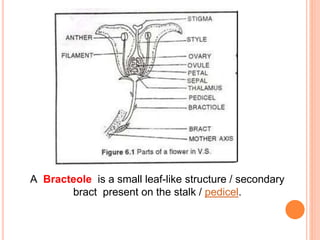
A Bracteole is a small leaf-like structure / secondary
bract present on the stalk / pedicel.
Actinomorphic
Symmetry
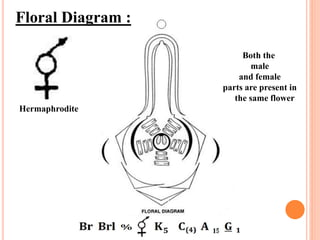
Hermaphrodite
Floral Diagram :
Both the
male
and female
parts are present in
the same flower
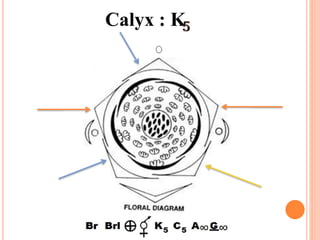
Calyx : K •Sepals 5,
• Polysepalous,
• Petaloid,
• Aestivation :
Quincuncial.
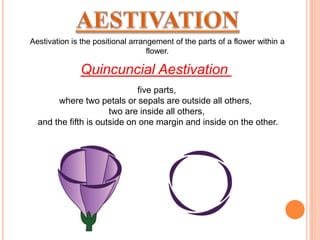
Aestivation is the positional arrangement of the parts of a flower within a
flower.
five parts,
where two petals or sepals are outside all others,
two are inside all others,
and the fifth is outside on one margin and inside on the other.
Quincuncial Aestivation
Calyx : K
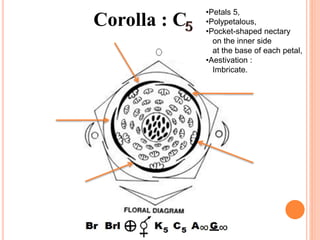
Corolla : C
•Petals 5,
•Polypetalous,
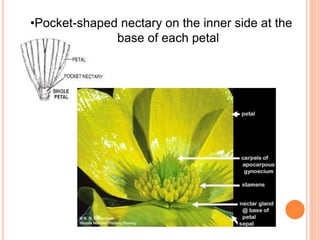
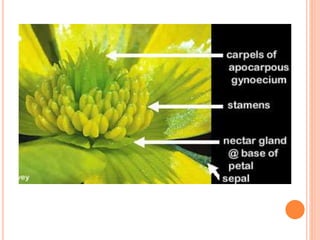
•Pocket-shaped nectary
on the inner side
at the base of each petal,
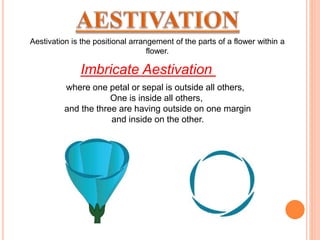
•Aestivation :
Imbricate.
Corolla : C
•Pocket-shaped
nectary on the inner
side at the base of
each petal.
•Pocket-shaped nectary on the inner side at the
base of each petal
Aestivation is the positional arrangement of the parts of a flower within a
flower.
where one petal or sepal is outside all others,
One is inside all others,
and the three are having outside on one margin
and inside on the other.
Imbricate Aestivation
Corolla : C
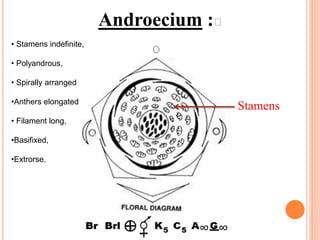
Androecium :Ꝏ
• Stamens indefinite,
• Polyandrous,
• Spirally arranged
•Anthers elongated
• Filament long,
•Basifixed,
•Extrorse.
Stamens
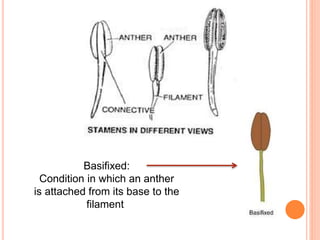
Basifixed:
Condition in which an anther
is attached from its base to the
filament
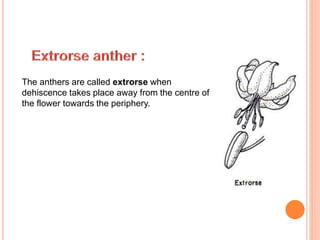
The anthers are called extrorse when
dehiscence takes place away from the centre of
the flower towards the periphery.
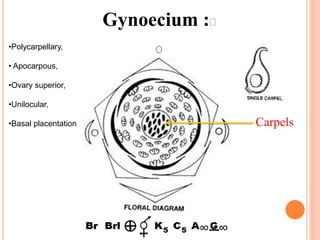
Gynoecium :Ꝏ
•Polycarpellary,
• Apocarpous,
•Ovary superior,
•Unilocular,
•Basal placentation Carpels
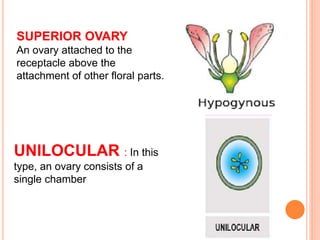
SUPERIOR OVARY
An ovary attached to the
receptacle above the
attachment of other floral parts.
UNILOCULAR : In this
type, an ovary consists of a
single chamber
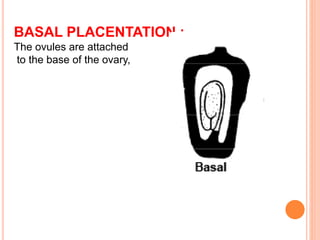
BASAL PLACENTATION :
The ovules are attached
to the base of the ovary,
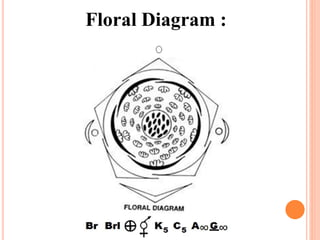
Floral Diagram :
Ranunculus scleratus
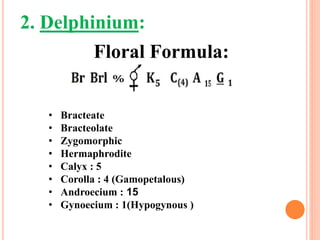
2. Delphinium:
• Bracteate
• Bracteolate
• Zygomorphic
• Hermaphrodite
• Calyx : 5
• Corolla : 4 (Gamopetalous)
• Androecium : 15
• Gynoecium : 1(Hypogynous )
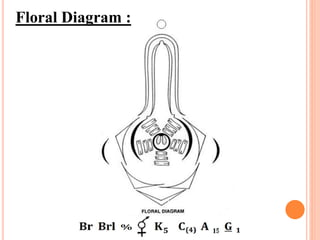
Floral Formula:
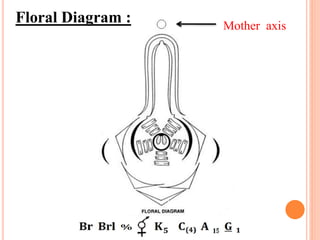
Floral Diagram : Mother axis
Floral Diagram :
Bracts
Floral Diagram :
BracteoleBracteole
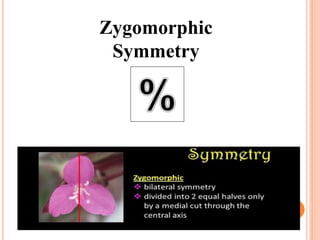
Zygomorphic
Symmetry
Floral Diagram :
Hermaphrodite
Both the
male
and female
parts are present in
the same flower
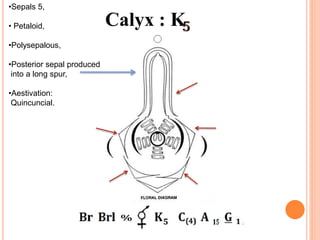
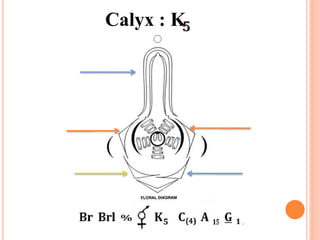
Calyx : K
•Sepals 5,
• Petaloid,
•Polysepalous,
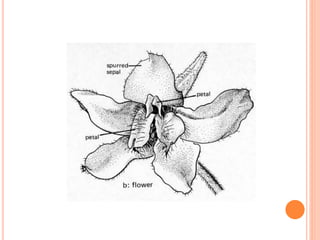
•Posterior sepal produced
into a long spur,
•Aestivation:
Quincuncial.
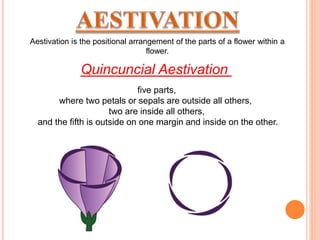
Aestivation is the positional arrangement of the parts of a flower within a
flower.
five parts,
where two petals or sepals are outside all others,
two are inside all others,
and the fifth is outside on one margin and inside on the other.
Quincuncial Aestivation
Calyx : K
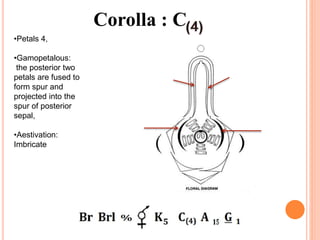
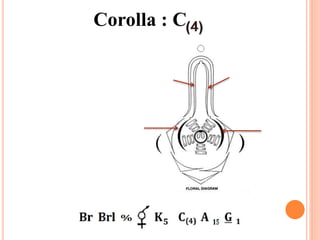
Corolla : C
•Petals 4,
•Gamopetalous:
the posterior two
petals are fused to
form spur and
projected into the
spur of posterior
sepal,
•Aestivation:
Imbricate
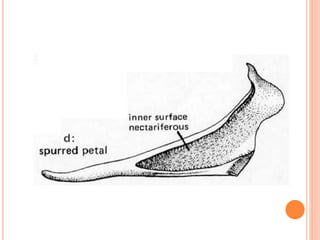
The posterior two petals are fused to form
spur and projected into the spur of
posterior sepal;
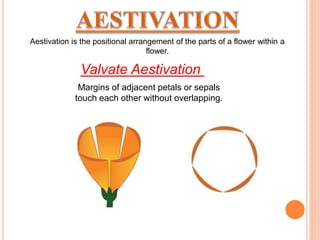
Aestivation is the positional arrangement of the parts of a flower within a
flower.
Margins of adjacent petals or sepals
touch each other without overlapping.
Valvate Aestivation
Corolla : C
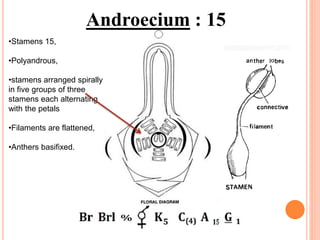
Androecium : 15
•Stamens 15,
•Polyandrous,
•stamens arranged spirally
in five groups of three
stamens each alternating
with the petals
•Filaments are flattened,
•Anthers basifixed.
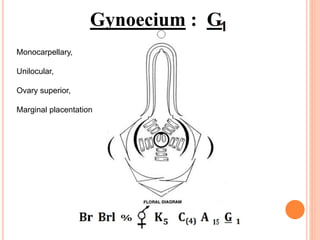
Gynoecium : G
Monocarpellary,
Unilocular,
Ovary superior,
Marginal placentation
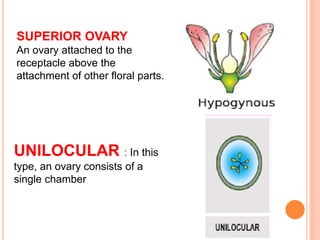
SUPERIOR OVARY
An ovary attached to the
receptacle above the
attachment of other floral parts.
UNILOCULAR : In this
type, an ovary consists of a
single chamber
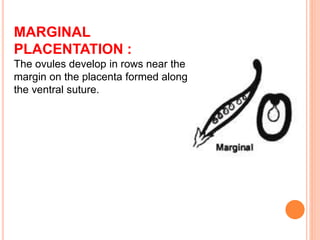
MARGINAL
PLACENTATION :
The ovules develop in rows near the
margin on the placenta formed along
the ventral suture.
Floral Diagram :
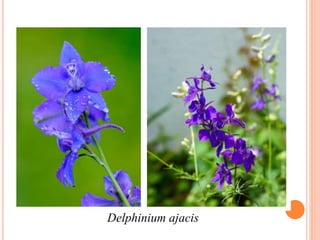
Delphinium ajacis
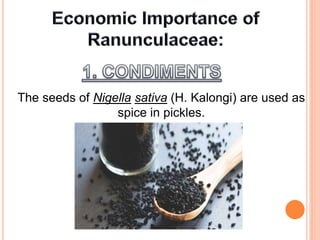
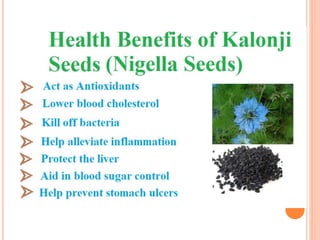
The seeds of Nigella sativa (H. Kalongi) are used as
spice in pickles.
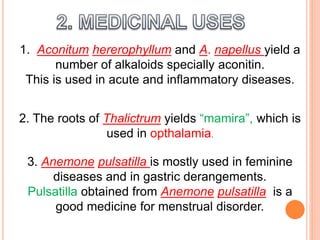
1. Aconitum hererophyllum and A. napellus yield a
number of alkaloids specially aconitin.
This is used in acute and inflammatory diseases.
2. The roots of Thalictrum yields “mamira”, which is
used in opthalamia.
3. Anemone pulsatilla is mostly used in feminine
diseases and in gastric derangements.
Pulsatilla obtained from Anemone pulsatilla is a
good medicine for menstrual disorder.
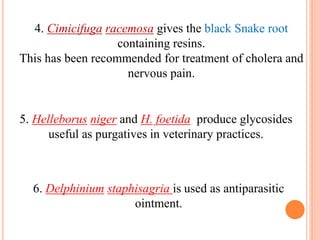
4. Cimicifuga racemosa gives the black Snake root
containing resins.
This has been recommended for treatment of cholera and
nervous pain.
5. Helleborus niger and H. foetida produce glycosides
useful as purgatives in veterinary practices.
6. Delphinium staphisagria is used as antiparasitic
ointment.
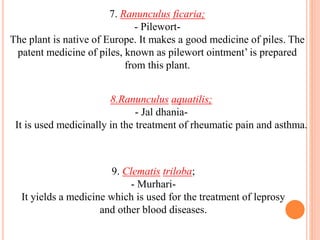
7. Ranunculus ficaria;
- Pilewort-
The plant is native of Europe. It makes a good medicine of piles. The
patent medicine of piles, known as pilewort ointment’ is prepared
from this plant.
8.Ranunculus aquatilis;
- Jal dhania-
It is used medicinally in the treatment of rheumatic pain and asthma.
9. Clematis triloba;
- Murhari-
It yields a medicine which is used for the treatment of leprosy
and other blood diseases.
10. Aconitum napellus
yields an alkaloid aconite used for rheumatism and as
nerve sedative.
11. Some species of Clematis are used as a remedy for
leprosy and blood diseases.
12. Juice of some species of Ranunculus used for
intermittent(Irregular) fever.
13. Roots of Hydrastis canadensis are used as antidote
of snake bite.
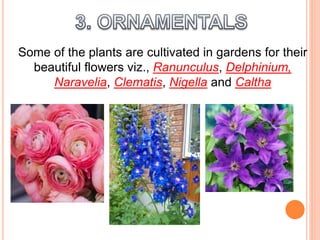
Some of the plants are cultivated in gardens for their
beautiful flowers viz., Ranunculus, Delphinium,
Naravelia, Clematis, Nigella and Caltha
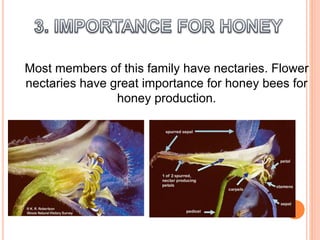
Most members of this family have nectaries. Flower
nectaries have great importance for honey bees for
honey production.
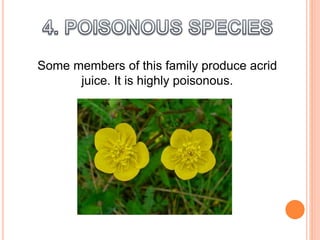
Some members of this family produce acrid
juice. It is highly poisonous.
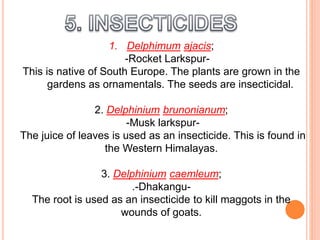
1. Delphimum ajacis;
-Rocket Larkspur-
This is native of South Europe. The plants are grown in the
gardens as ornamentals. The seeds are insecticidal.
2. Delphinium brunonianum;
-Musk larkspur-
The juice of leaves is used as an insecticide. This is found in
the Western Himalayas.
3. Delphinium caemleum;
.-Dhakangu-
The root is used as an insecticide to kill maggots in the
wounds of goats.
Family: Ranunculaceae (Ranunculus,Delphinium)