LILIACEAE / LILY FAMILY
• The Liliaceae, or the lily family, is a family of
monocotyledons
• Many plants in the Liliaceae are important
ornamental plants, widely grown for their
attractive flowers .
• Liliaceae are mostly perennial herbs with
rhizomes, bulbs or fibrous roots. It comprises
comprising about 280 genera and 4,000
species
• HABIT:
Plants are perennials herbs.
• HABITAT:
It is widely distributed all over the world
that especially abundant in sub-tropical and
temperate regions
• STEM:
Herbaceous, rhizomes, bulbs, tubers or
corms with adventitious roots.
• LEAVES:
Radical or cauline usually exstipulate,
simple, sheathing at the base with parallel
venations.
• INFLORESCENCE:
raceme or sometimes cymose
• FLOWER:
Regular, hermaphrodite, actinomorphic,
Hypogynous, trimerous. Bracteate and bracts are
usually small and scarious (thin, dry and
membranous)
• PERIANTH:
Perianths are petaloid. These are usually six in
two whorls. They may be 3+ 3 and free
(Ployphylous), or (3+3) and united ( Gamophyllous)
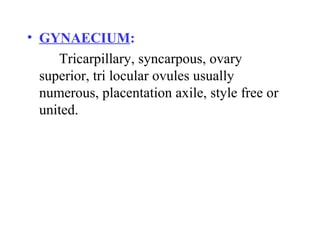
• ANDROCEIUM:
6 stamens in two
whorls 3 each, rarely
3, polyandrous
sometimes epiphyllous
• GYNAECIUM:
Tricarpillary, syncarpous, ovary
superior, tri locular ovules usually
numerous, placentation axile, style free or
united.
FRUIT:
Berry or capsule
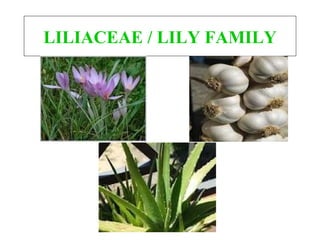
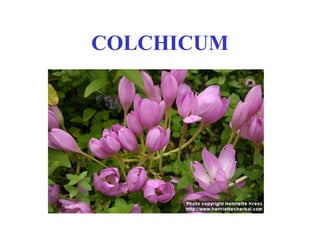
COLCHICUM
• BOTANICAL ORIGION: Colchicum
autumnale, Colchicum luteum
• Common Name: Cormus colchici, Autumn
crocus corm.
• Part used: Dried seeds and corms
• Habit: Annual herb
• Habitat: England, Poland, USA, Holland
In india luteum is used as a
substituent for C. autumnale
• Constituents:
Mainly contain alkaloids
The major alkaloid is
Colchicine(0.3-0.8%)
Colchicoresin
Colchicein
Steroidal saponins
Cardiac glycosides
Anthracene
glycosides
Fixed oils
Starch
Glucose
• Corms also contains
Resin
Starch
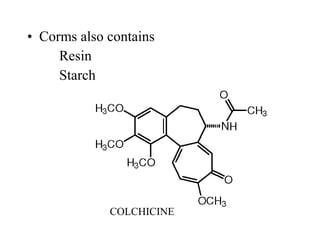
COLCHICINE
• MEDICINAL USES:
Colchicine is used to relieve the pain and
inflammation of gout and rheumatism.
It is a mitotic inhibitor and is used in
malignant tumors but is toxic.
demecolcine is less toxic and is
recommended in Myeloid leukaemia.
In higher doses colchicine is toxic and
causes vomiting, diarrhoea and death due to
respiratory failure.
It is used for causing polypoidy.
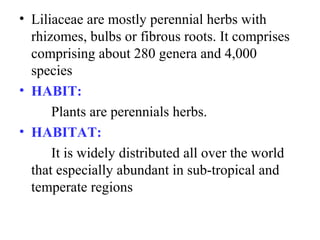
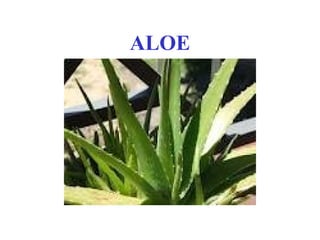
ALOE
• BOTANICAL ORIGION: Aloe vera (Aloe
barbadensis), Aloe ferox, Aloe perryi
• Common Name: Aloe
• Part used: Dried juice collected by incision
from the bases of the leaves
• Habit: Xerophyte/ may be shrub, tree,
herb
• Habitat: South and North Africa, West indies,
India.
• Constituents:
Mainly contain
anthraquinone glycosides
That is
Barbaloin
Isobarbaloin
β-barbaloin
Chrysophanic acid
Resinous matter
Volatile oil
• MEDICINAL USES:
Aloe is a drastic cathartic and should not
be used alone.
It is abortifacient in higher doses.
Ointment of aloe gel is used in sun
burns, thermal burns, radiation burns
abrasions and skin irritations.
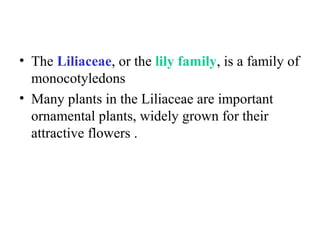
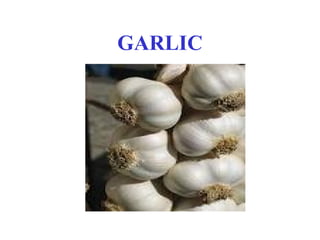
GARLIC
• BOTANICAL ORIGION: Allium sativum
• Common Name: Garlic,Lasan
• Part used: Ripe bulb
• Habit: Herb
• Habitat: Cultivated in India, South Russia,
Europe, Italy and USA.
• Constituents:
Main constituent is volatile oil
containing allyl disulphide,
Allin
Allicin
Allyl propyl disulphide
Diallyl disulphide
It also contains
Thio glycosides
Aminoacids
Fatty acids
Vitamins
Mucilage
Albumin
• MEDICINAL USES:
Anthelmintic
Antiasthmatic
Anticholesterolemic
Antiseptic
Antispasmodic
Expectorant
Diuretic
Diaphoretic

Liliaceae