A presentation on precipitation
titration & its implication
Submitted by-
NIHAR RANJAN DASH
COLLEGE OF AGRICULTURE OUAT,BBSR
Precipitation Titration
• Precipitation titration is a titration involving the formation of salt
deposits that are not easily soluble between titrant and analyte and
the titration continues till the very last amount of analyte is
consumed.
• Example : AgNO3 + NaCl AgCl + NaNO3
History of precipitation titration
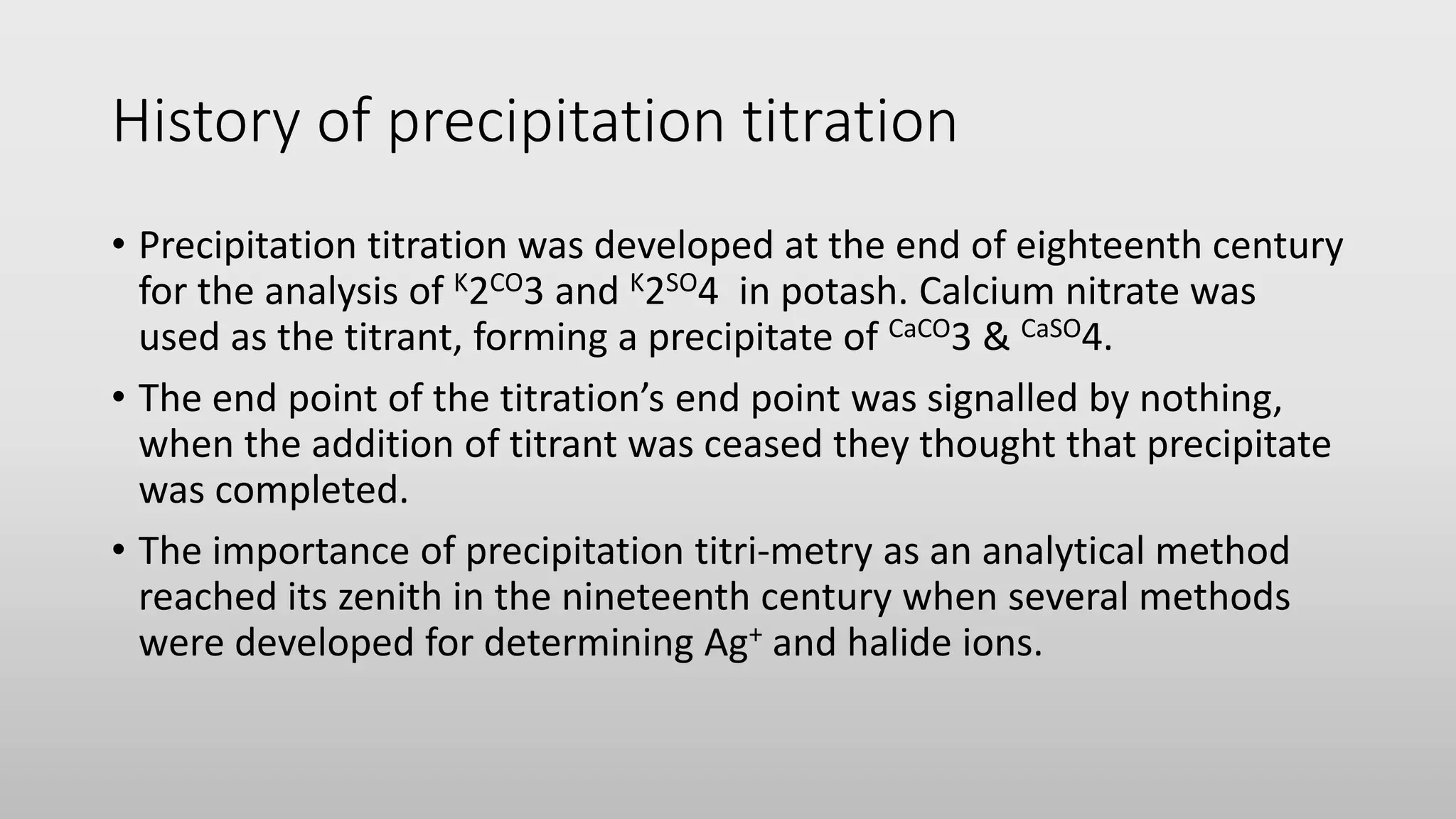
• Precipitation titration was developed at the end of eighteenth century
for the analysis of K2CO3 and K2SO4 in potash. Calcium nitrate was
used as the titrant, forming a precipitate of CaCO3 & CaSO4.
• The end point of the titration’s end point was signalled by nothing,
when the addition of titrant was ceased they thought that precipitate
was completed.
• The importance of precipitation titri-metry as an analytical method
reached its zenith in the nineteenth century when several methods
were developed for determining Ag+ and halide ions.
Characteristics of Precipitation Titration
• They are fast and the stoichiometry is known and reproducibile
• They are complete or can be quantified depending on the amount of
solubility product (in general a precipitation titration is considered
complete when Kps< 10-8)
• An indicator can be used to find the equivalence point or titration
end point which, for this type of titration, corresponds to when
precipitation of the analyte under analysis is complete.
Principle of Precipitation Titration
• The main principle of principle of the precipitation titration is that
the quantity of added precipitating reagent or precipitant is
equivalent to the the substance being precipitated.
Lack of popularity of precipitation titration
- The main reason for lack of popularity of these methods is the lack of
suitable methods indicators to detect the end point in precipitation
reactions. Secondly, the composition of the precipitate is not always
known.
Argento-metric Titrations
• Argento metry is derived from a latin word Argentum which means
silver .
• The most widely applicable precipitation titrations involve the use of
silver nitrate with chlorides, bromides, iodides, and thiocyanate .
• Since silver is always there so precipitation titrations are referred to as
Argentometric titrations.
• This implies that this type of titration is relatively limited.
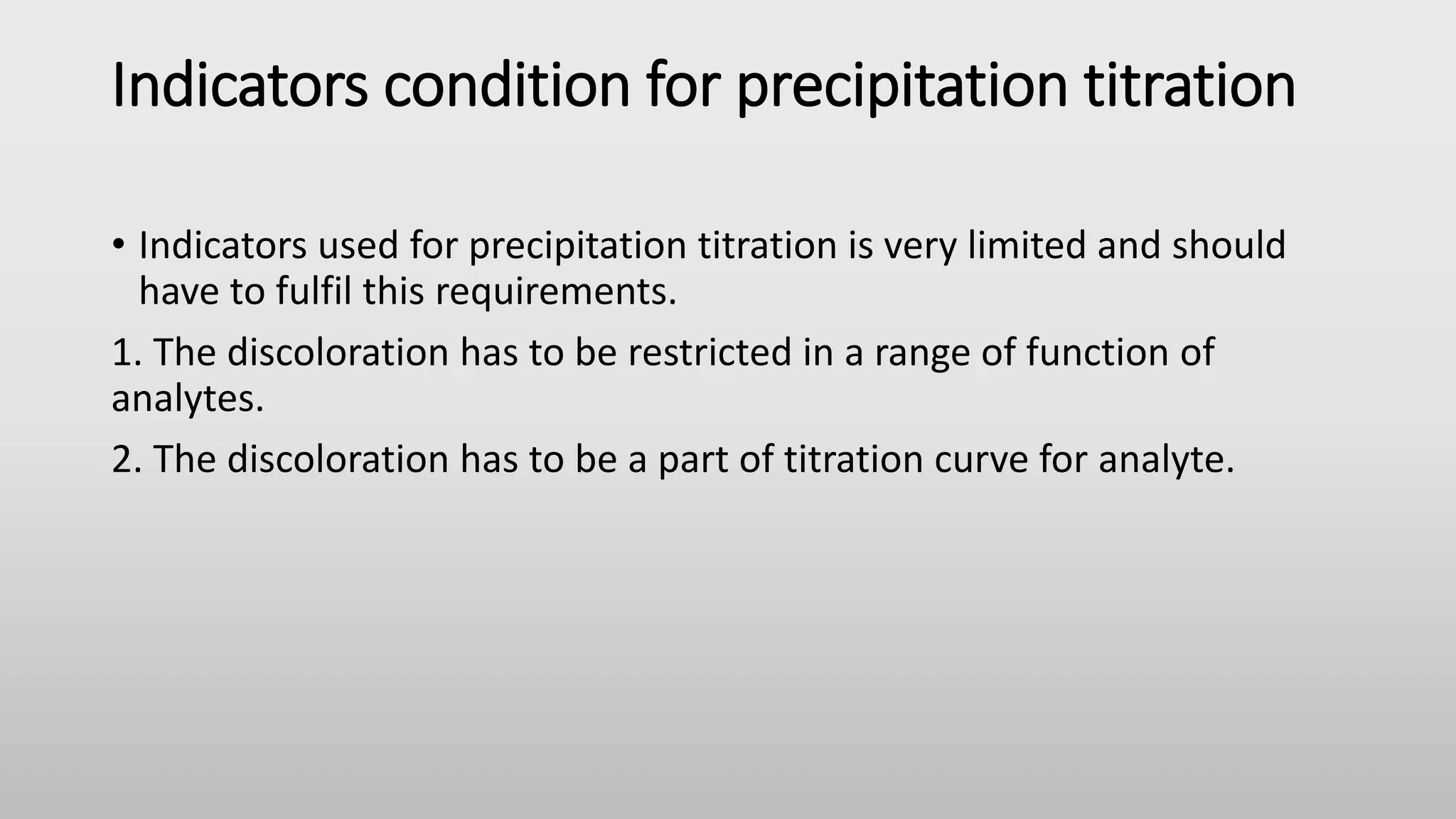
Indicators condition for precipitation titration
• Indicators used for precipitation titration is very limited and should
have to fulfil this requirements.
1. The discoloration has to be restricted in a range of function of
analytes.
2. The discoloration has to be a part of titration curve for analyte.
Methods of precipitation titration
• According to the indicator and technique used for end point
detection, three main procedures are widely used.
These are –
1. Mohr Method
2. Volhard Method
3. Fajan’s Method
Mohr Method
• This method was given by Karl Friedrich Mohr (1806-1879).
• Mohr method is a titration which use standard solution to determine
the concentration of Cl- of a solution or to standardize AgNO3 by
using a certain primary solution.
• This method use K2CrO4 as an indicator.
• The end-point of titration is reached when the colour of Ag2CrO4
changed to brick-red.
2Ag+ + CrO42- Ag2CrO4
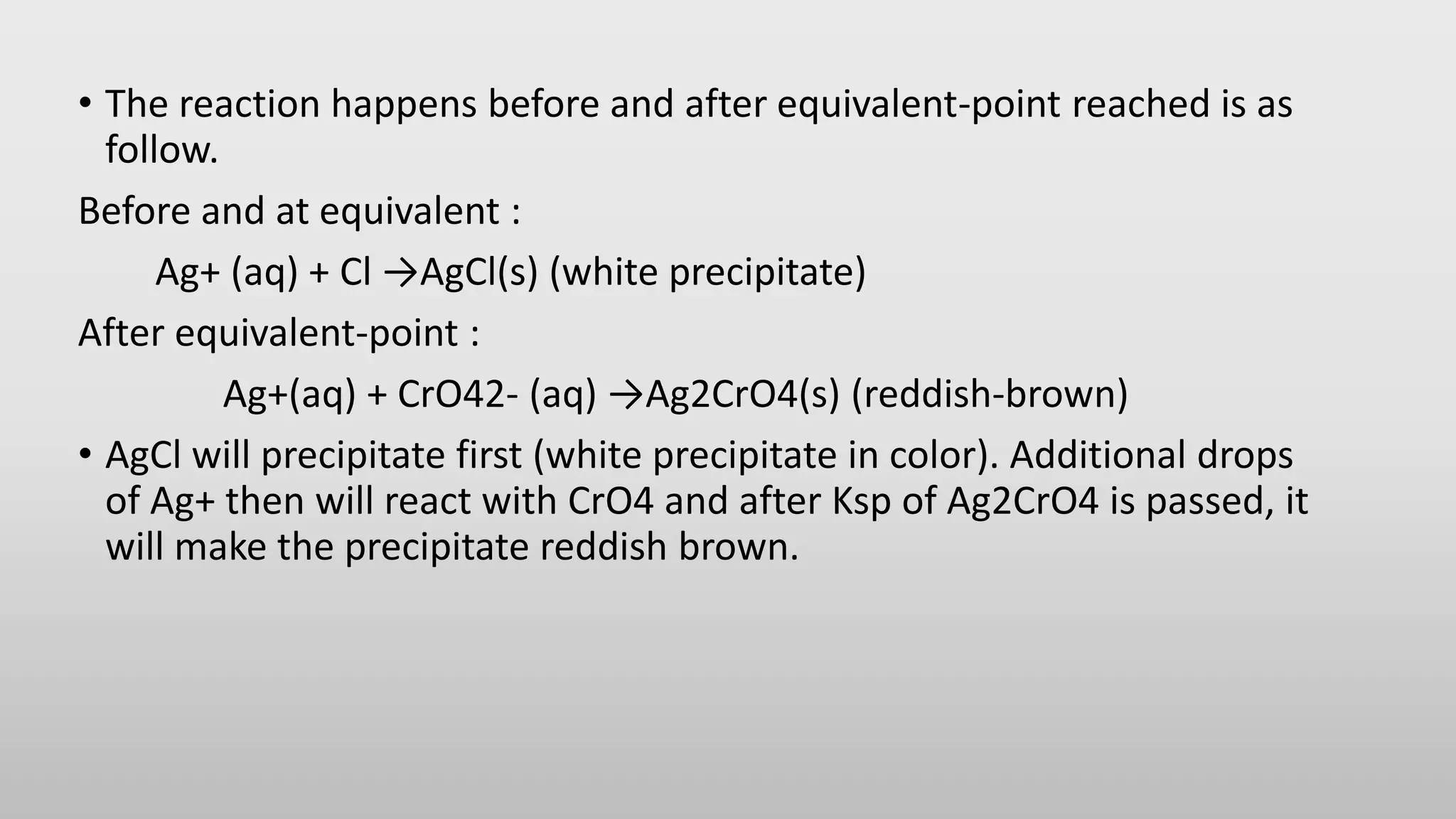
• The reaction happens before and after equivalent-point reached is as
follow.
Before and at equivalent :
Ag+ (aq) + Cl →AgCl(s) (white precipitate)
After equivalent-point :
Ag+(aq) + CrO42- (aq) →Ag2CrO4(s) (reddish-brown)
• AgCl will precipitate first (white precipitate in color). Additional drops
of Ag+ then will react with CrO4 and after Ksp of Ag2CrO4 is passed, it
will make the precipitate reddish brown.
• In this method, neutral medium should be used since, in alkaline
solutions, silver will react with the hydroxide ions forming AgOH.
• In acidic solutions, chromate will be converted to dichromate & the
end point is delayed. Therefore, the pH of solution should be kept at
about 7.
• There is always some error in this method because a dilute chromate
solution is used due to the intense color of the indicator. This will
require additional amount of Ag+ for the Ag2 CrO4 to form . This leads
to a late equivalent point . To correct for this error we can determine
a blank .
Volhard’s Method
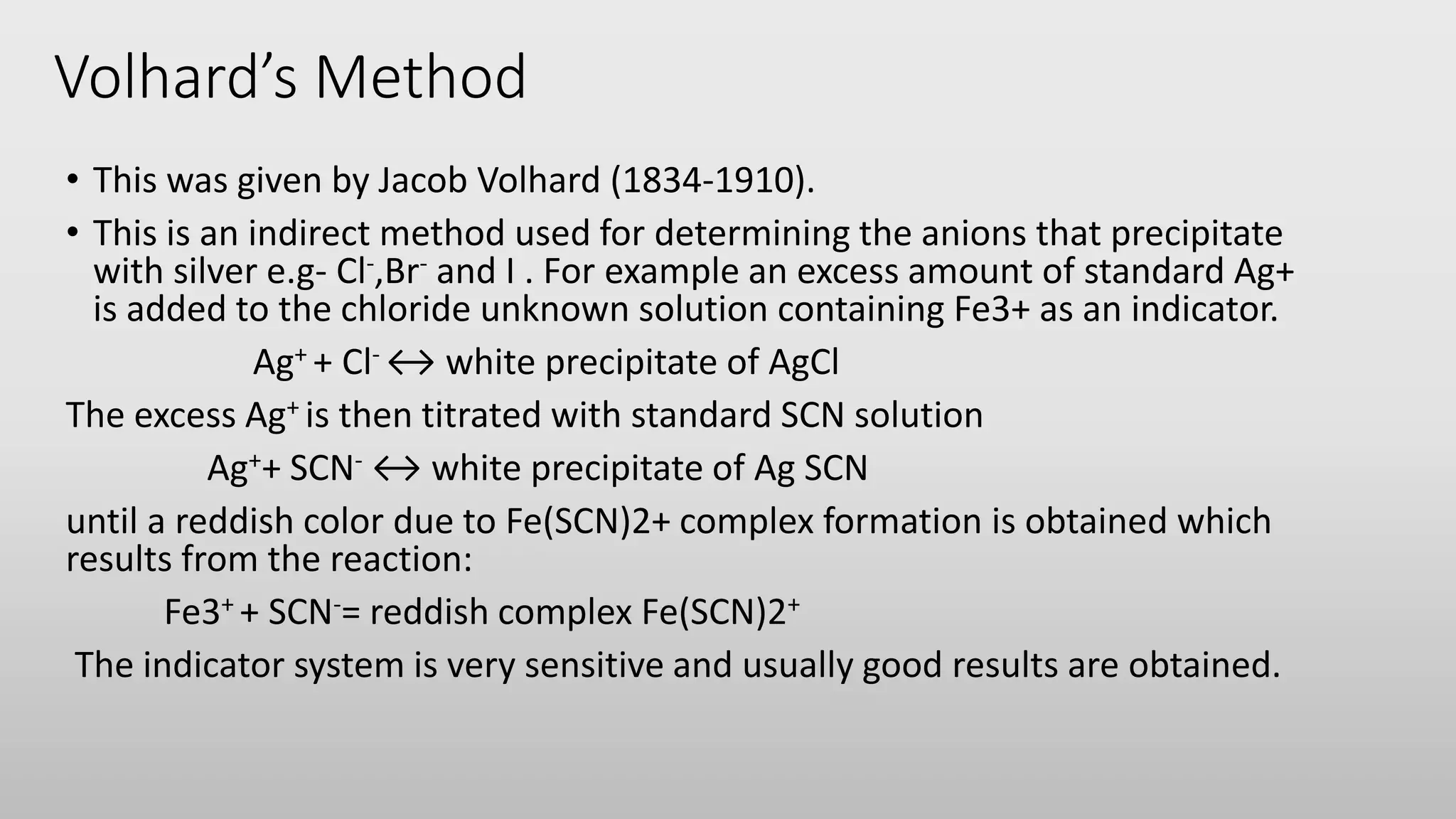
• This was given by Jacob Volhard (1834-1910).
• This is an indirect method used for determining the anions that precipitate
with silver e.g- Cl-,Br- and I . For example an excess amount of standard Ag+
is added to the chloride unknown solution containing Fe3+ as an indicator.
Ag+ + Cl- ↔ white precipitate of AgCl
The excess Ag+ is then titrated with standard SCN solution
Ag++ SCN- ↔ white precipitate of Ag SCN
until a reddish color due to Fe(SCN)2+ complex formation is obtained which
results from the reaction:
Fe3+ + SCN-= reddish complex Fe(SCN)2+
The indicator system is very sensitive and usually good results are obtained.
• The amount of thiocyanate which will give visible color is very small,
thus the end point error is very small but the solution should be
shaken vigorously at the end point as silver ions are absorbed on the
precipitate.
• If AgX is less soluble than AgSCN as in the case of I- and Br-, the
excess Ag+ can be titrated in the presence of AgX precipitate .
Advantages of Volhard’s method
1.The acidic environment give advantage for halide analysis because
anions such as carbonate , oxalate and arsenate that do not form
precipitate with silver in acidic medium ( but they do in basic medium )
will not interfere with halides .
2.Give accurate results due to back titration
Limitations of Volhard’s method
1- Can not be used in neutral or basic medium .
2- Time consuming .
•Fajan’s Method :
• Fluorescein and its derivatives are adsorbed to the surface of colloidal
AgCl. After all chloride is used, the first drop of Ag+ will react with
fluorescein (FI-) forming a reddish color.
Ag++ Fl- = AgF
• Since fluorescein and its derivatives are weak acids, the pH of the
solution should be slightly alkaline to keep the indicator in the anion
form but, at the same time, is not alkaline enough to convert Ag+ into
AgOH .
• Fluorescein derivatives that are stronger acids than fluorescien (like
eosin) can be used at acidic pH without problems. This method is
simple and results obtained are reproducible.
Limitations of Precipitation Titration
• It is very difficult to detect the end point.
• Co-precipitation may be occurred.
• A few number of ions such as halide ions (Cl-, Br-, l-) can be titrated by
precipitation method.
Quantitative Applications
• Table provides list of typical precipitation titrations
Titrand Titrant End point detection method
AsO43- AgNO3, KSCN Volhard’s method
Br- AgNO3, KSCN Mohr’s or Volhard’s
Cl- AgNO3
AgNO3,KSCN
Mohr’s or Fajan’s
Volhard’s
CO32- AgNO3,KSCN Volhard’s
I- AgNO3
AgNO3,KSCN
Fajan’s
Volhard’s
S2-
AgNO3,KSCN Volhard’s
SCN-
AgNO3,KSCN Volhard’s
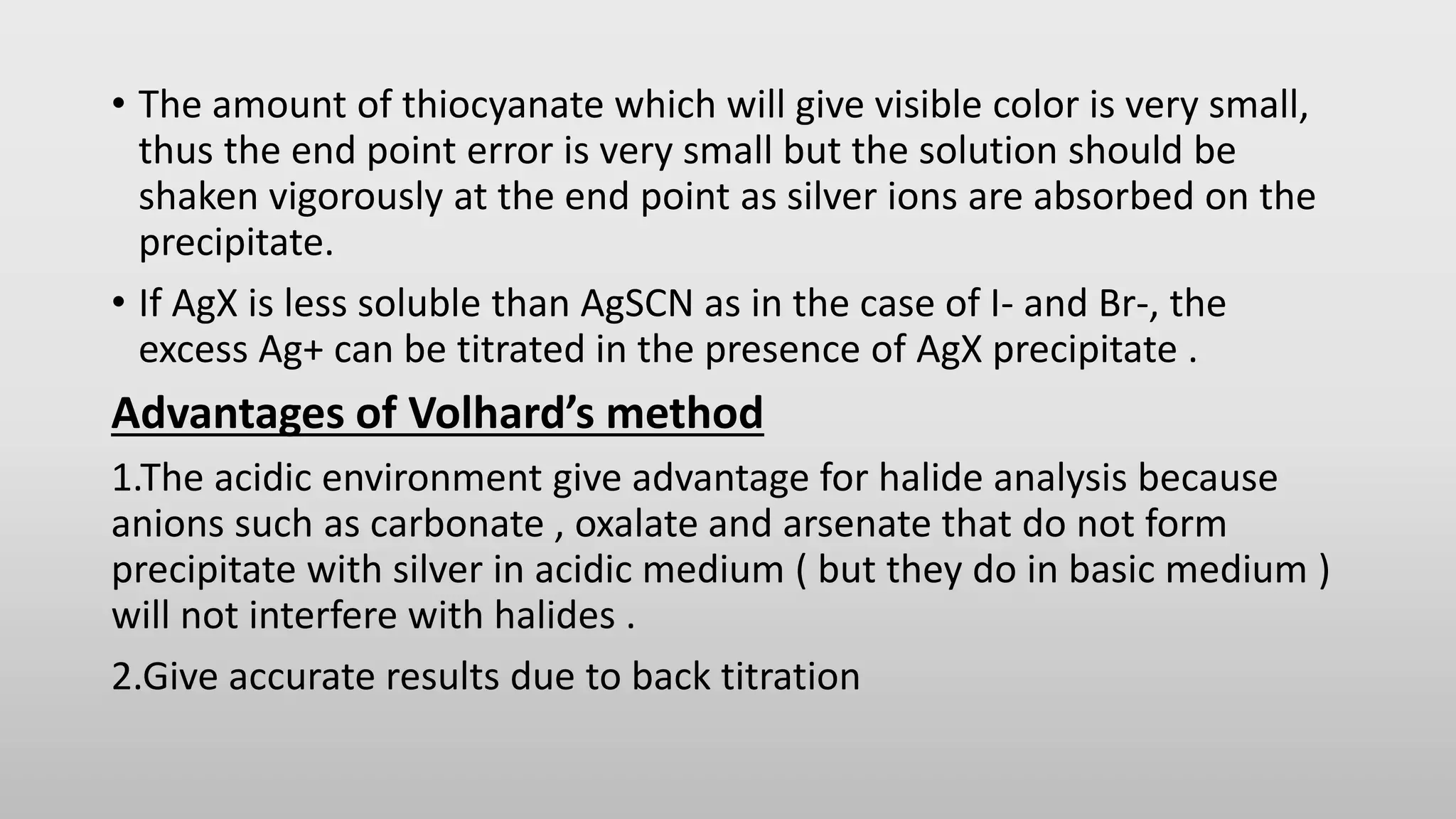
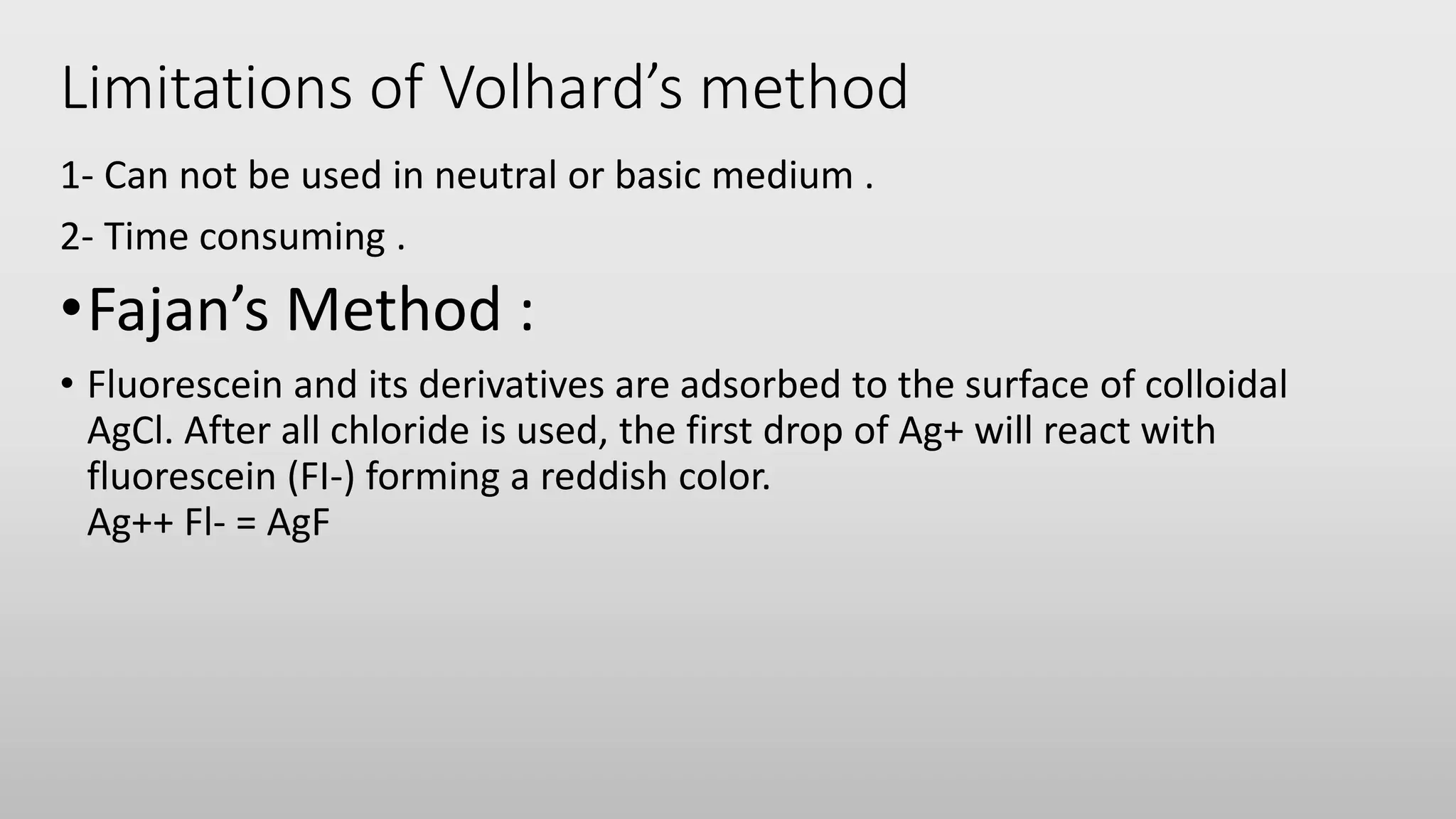
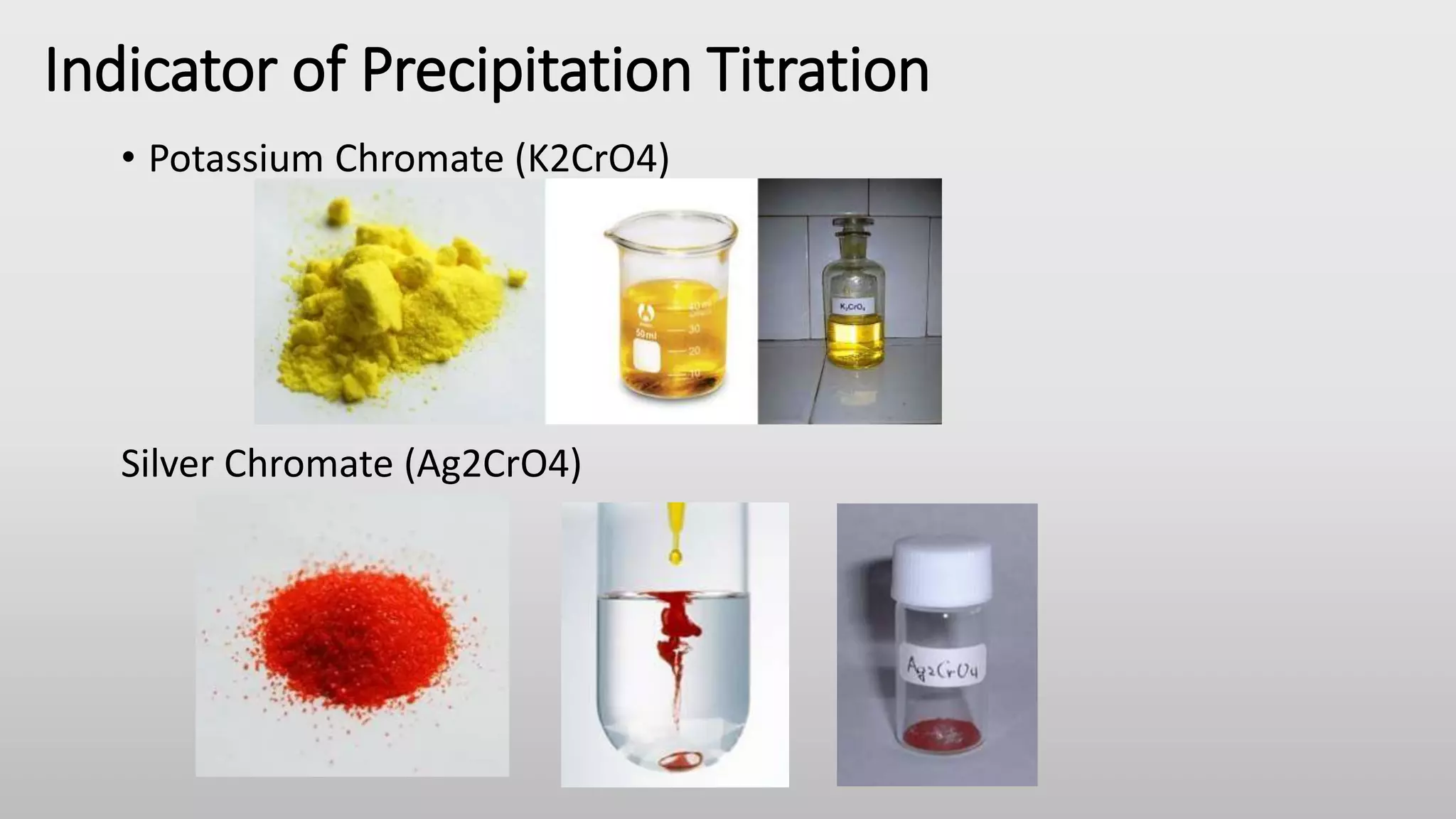
Indicator of Precipitation Titration
• Potassium Chromate (K2CrO4)
Silver Chromate (Ag2CrO4)
• Reference
Vogel’s A TextBook of Quantitative Inorganic Analysis, Fifth Edition.
 New age Basic Concepts of Analytical Chemistry , Third Edition.
A Systematic Handbook Of Volumetric Analysis by Sutton & Fransis.
www.jgateplus.com
www. http://krishikosh.egranth.ac.in/handle.
Thank You

A presentation on precipitation titration & its implication On titration

  • 1.
    A presentation onprecipitation titration & its implication Submitted by- NIHAR RANJAN DASH COLLEGE OF AGRICULTURE OUAT,BBSR
  • 2.
    Precipitation Titration • Precipitationtitration is a titration involving the formation of salt deposits that are not easily soluble between titrant and analyte and the titration continues till the very last amount of analyte is consumed. • Example : AgNO3 + NaCl AgCl + NaNO3
  • 3.
    History of precipitationtitration • Precipitation titration was developed at the end of eighteenth century for the analysis of K2CO3 and K2SO4 in potash. Calcium nitrate was used as the titrant, forming a precipitate of CaCO3 & CaSO4. • The end point of the titration’s end point was signalled by nothing, when the addition of titrant was ceased they thought that precipitate was completed. • The importance of precipitation titri-metry as an analytical method reached its zenith in the nineteenth century when several methods were developed for determining Ag+ and halide ions.
  • 4.
    Characteristics of PrecipitationTitration • They are fast and the stoichiometry is known and reproducibile • They are complete or can be quantified depending on the amount of solubility product (in general a precipitation titration is considered complete when Kps< 10-8) • An indicator can be used to find the equivalence point or titration end point which, for this type of titration, corresponds to when precipitation of the analyte under analysis is complete.
  • 5.
    Principle of PrecipitationTitration • The main principle of principle of the precipitation titration is that the quantity of added precipitating reagent or precipitant is equivalent to the the substance being precipitated. Lack of popularity of precipitation titration - The main reason for lack of popularity of these methods is the lack of suitable methods indicators to detect the end point in precipitation reactions. Secondly, the composition of the precipitate is not always known.
  • 6.
    Argento-metric Titrations • Argentometry is derived from a latin word Argentum which means silver . • The most widely applicable precipitation titrations involve the use of silver nitrate with chlorides, bromides, iodides, and thiocyanate . • Since silver is always there so precipitation titrations are referred to as Argentometric titrations. • This implies that this type of titration is relatively limited.
  • 7.
    Indicators condition forprecipitation titration • Indicators used for precipitation titration is very limited and should have to fulfil this requirements. 1. The discoloration has to be restricted in a range of function of analytes. 2. The discoloration has to be a part of titration curve for analyte.
  • 8.
    Methods of precipitationtitration • According to the indicator and technique used for end point detection, three main procedures are widely used. These are – 1. Mohr Method 2. Volhard Method 3. Fajan’s Method
  • 9.
    Mohr Method • Thismethod was given by Karl Friedrich Mohr (1806-1879). • Mohr method is a titration which use standard solution to determine the concentration of Cl- of a solution or to standardize AgNO3 by using a certain primary solution. • This method use K2CrO4 as an indicator. • The end-point of titration is reached when the colour of Ag2CrO4 changed to brick-red. 2Ag+ + CrO42- Ag2CrO4
  • 10.
    • The reactionhappens before and after equivalent-point reached is as follow. Before and at equivalent : Ag+ (aq) + Cl →AgCl(s) (white precipitate) After equivalent-point : Ag+(aq) + CrO42- (aq) →Ag2CrO4(s) (reddish-brown) • AgCl will precipitate first (white precipitate in color). Additional drops of Ag+ then will react with CrO4 and after Ksp of Ag2CrO4 is passed, it will make the precipitate reddish brown.
  • 11.
    • In thismethod, neutral medium should be used since, in alkaline solutions, silver will react with the hydroxide ions forming AgOH. • In acidic solutions, chromate will be converted to dichromate & the end point is delayed. Therefore, the pH of solution should be kept at about 7. • There is always some error in this method because a dilute chromate solution is used due to the intense color of the indicator. This will require additional amount of Ag+ for the Ag2 CrO4 to form . This leads to a late equivalent point . To correct for this error we can determine a blank .
  • 12.
    Volhard’s Method • Thiswas given by Jacob Volhard (1834-1910). • This is an indirect method used for determining the anions that precipitate with silver e.g- Cl-,Br- and I . For example an excess amount of standard Ag+ is added to the chloride unknown solution containing Fe3+ as an indicator. Ag+ + Cl- ↔ white precipitate of AgCl The excess Ag+ is then titrated with standard SCN solution Ag++ SCN- ↔ white precipitate of Ag SCN until a reddish color due to Fe(SCN)2+ complex formation is obtained which results from the reaction: Fe3+ + SCN-= reddish complex Fe(SCN)2+ The indicator system is very sensitive and usually good results are obtained.
  • 13.
    • The amountof thiocyanate which will give visible color is very small, thus the end point error is very small but the solution should be shaken vigorously at the end point as silver ions are absorbed on the precipitate. • If AgX is less soluble than AgSCN as in the case of I- and Br-, the excess Ag+ can be titrated in the presence of AgX precipitate . Advantages of Volhard’s method 1.The acidic environment give advantage for halide analysis because anions such as carbonate , oxalate and arsenate that do not form precipitate with silver in acidic medium ( but they do in basic medium ) will not interfere with halides . 2.Give accurate results due to back titration
  • 14.
    Limitations of Volhard’smethod 1- Can not be used in neutral or basic medium . 2- Time consuming . •Fajan’s Method : • Fluorescein and its derivatives are adsorbed to the surface of colloidal AgCl. After all chloride is used, the first drop of Ag+ will react with fluorescein (FI-) forming a reddish color. Ag++ Fl- = AgF
  • 15.
    • Since fluoresceinand its derivatives are weak acids, the pH of the solution should be slightly alkaline to keep the indicator in the anion form but, at the same time, is not alkaline enough to convert Ag+ into AgOH . • Fluorescein derivatives that are stronger acids than fluorescien (like eosin) can be used at acidic pH without problems. This method is simple and results obtained are reproducible.
  • 16.
    Limitations of PrecipitationTitration • It is very difficult to detect the end point. • Co-precipitation may be occurred. • A few number of ions such as halide ions (Cl-, Br-, l-) can be titrated by precipitation method.
  • 17.
    Quantitative Applications • Tableprovides list of typical precipitation titrations Titrand Titrant End point detection method AsO43- AgNO3, KSCN Volhard’s method Br- AgNO3, KSCN Mohr’s or Volhard’s Cl- AgNO3 AgNO3,KSCN Mohr’s or Fajan’s Volhard’s CO32- AgNO3,KSCN Volhard’s I- AgNO3 AgNO3,KSCN Fajan’s Volhard’s S2- AgNO3,KSCN Volhard’s SCN- AgNO3,KSCN Volhard’s
  • 18.
    Indicator of PrecipitationTitration • Potassium Chromate (K2CrO4) Silver Chromate (Ag2CrO4)
  • 19.
    • Reference Vogel’s ATextBook of Quantitative Inorganic Analysis, Fifth Edition.  New age Basic Concepts of Analytical Chemistry , Third Edition. A Systematic Handbook Of Volumetric Analysis by Sutton & Fransis. www.jgateplus.com www. http://krishikosh.egranth.ac.in/handle.
  • 20.