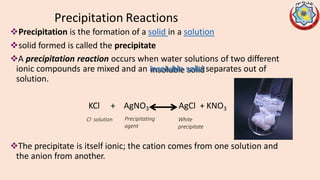
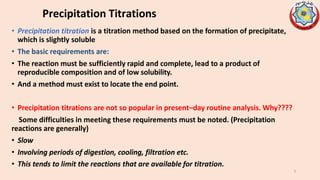
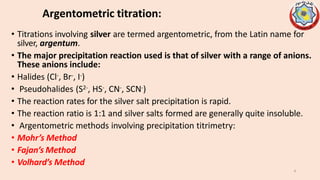
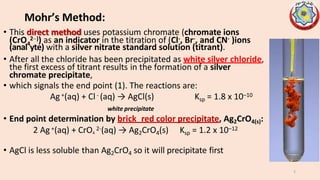
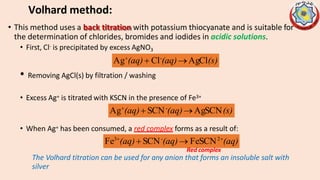
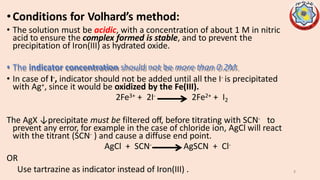
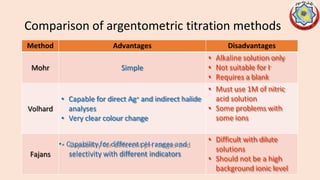
Precipitation titrations involve the titration of an analyte ion against a standard solution that causes the analyte to precipitate out of solution. Argentometric titrations, which use silver ions, are common precipitation titrations. Mohr's method uses potassium chromate as an indicator for chloride, bromide, and cyanide ions. Volhard's method involves a back titration of excess silver with thiocyanate. Fajan's method uses adsorption indicators that change color when adsorbed onto the precipitate. The different argentometric methods each have advantages and disadvantages regarding factors like speed, applicable ions, and endpoint detection.
![Conditions for Mohr’s method:
• The titrations are performed only in neutral or slightly basic medium to
prevent silver hydroxide formation (at pH > 10).
2Ag+ + 2OH- 2AgOH(s) Ag2O(s) + H2O
black precipitate
• Or the formation of chromic acid at pH < 7.
2 7 2
CrO42- + H3O+ HCrO4- + H2O
2 CrO42- + 2 H3O+ Cr O 2- + H O
bright-orange
• Reducing [CrO42-] will delay the formation of the precipitate although more
Ag+ to be added to reach end point, which cause error.
6](https://image.slidesharecdn.com/precipitationtitration1-230312134114-1e4015e9/85/precipitation-titration-1-pptx-6-320.jpg)
![Titration Curves for Argentometric Methods
The points on the curve can be calculated, given the analyte concentration, AgNO3
concentration and the appropriate Ksp.
Plots of titration curves are normally sigmoidal curves consisting of pAg (or pAnalyte)
versus volume of AgNO3 solution added.
Example: Titration of chloride with silver.
A useful relationship can be derived by taking
the negative logarithm of both sides of a
solubility-product expression. Thus, for silver
chloride,
𝑠𝑝
𝐾 = 𝐴𝑔
+
[𝐶𝑙
−
]
𝑙𝑜𝑔𝐾𝑠𝑝 = −log( 𝐴𝑔
+ −
𝐶𝑙 )
𝑠𝑝
𝑙𝑜𝑔𝐾 = − log 𝐴𝑔
+
− 𝑙𝑜𝑔 𝐶𝑙
−
+
𝑝𝐾𝑠𝑝 = 𝑝𝐴𝑔 +𝑝𝐶𝑙
−](https://image.slidesharecdn.com/precipitationtitration1-230312134114-1e4015e9/85/precipitation-titration-1-pptx-14-320.jpg)
![• Consider titration of Cl- with a standard solution of AgNO3.
• Titration curve prepared by plotting pCl (-log[Cl-]) against the volume of AgNO3
in a manner similar to acid-base titration.
• Before titration started – only have Cl-.
pCl = - log[Cl-]
• Titration proceed – part of Cl- is removed from solution by precipitation as AgCl.
pCl = -log [remaining Cl-]
• At equivalence point - we have solution a saturated solution of AgCl.
[Cl-]= √Ksp
• Excess AgNO3 added – excess Ag+. [Cl-] is determine from the concentration of
Ag+ and Ksp.
[Cl-] = Ksp/[Ag+]
Plotting precipitation titration curves](https://image.slidesharecdn.com/precipitationtitration1-230312134114-1e4015e9/85/precipitation-titration-1-pptx-15-320.jpg)
![Example
Calculate pCl for the titration of 100.0 ml 0.100 M NaCl with 0.100 M
AgNO3 for the addition of 0.0, 20.0, 99.0, 99.5, 100.0 and 110.0 ml AgNO3.
Ksp AgCl is 1.0 x10⁻¹⁰
Solution
a) Addition of 0.0 ml Ag+
[Cl-] = 0.100 M
pCl = -log [Cl-]
= -log 0.100
= 1
b) Addition of 20.0 ml Ag+
Initial mmol Cl- = 100.0 ml x 0.100 M = 10.0 mmol
mmol added Ag+ = 20.0 ml x 0.100 M = 2.0 mmol
mmol Cl- left = 8.0 mmol
[Cl-] left = 8.0 = 0.0667 M
(100+20) ml
pCl = -log [Cl-]
= -log 0.0667
= 1.18](https://image.slidesharecdn.com/precipitationtitration1-230312134114-1e4015e9/85/precipitation-titration-1-pptx-16-320.jpg)
![c) Addition of 99.0 ml Ag d) Addition of 100.0 ml
Initial mmol Cl- = 100.0 ml x 0.100 M = 10.0 mmol
mmol added Ag+ = 100.0 ml x 0.100 M= 10.0 mmol
Equivalence point is reached. The solution contain
saturated AgCl solution
Ksp = [Ag+][Cl-] = 1.0 x10⁻¹⁰
[Cl-] = √Ksp = √1.0 x10-10
= 1.0 x 10⁻⁵
pCl = -log 1.0 x10-5
= 5](https://image.slidesharecdn.com/precipitationtitration1-230312134114-1e4015e9/85/precipitation-titration-1-pptx-17-320.jpg)
![e) Addition of 100.5 ml Ag+
Initial mmol Cl = 100.0 ml x 0.100 M = 10.0 mmol
mmol added Ag+= 100.5 ml x 0.100 M =10.05 mmol
mmol Ag+ excess = = 0.05 mmol
[Ag+] excess = 0.05/200.5 ml = 2.5 x 10⁻⁴ M
Ksp = [Ag+][Cl-] = 1.0 x10⁻¹⁰
Ksp
[Cl-] = = 1.0 x10-10 = 4.0 x 10⁻⁷
[Ag+] 2.5 x 10⁻⁴ M
pCl = - log 4.0 x 10-7
= 6.4](https://image.slidesharecdn.com/precipitationtitration1-230312134114-1e4015e9/85/precipitation-titration-1-pptx-18-320.jpg)


